Sunday November 15, 2026
Revisiting Wat Arun in Bangkok
But First Breakfast
The hotel in which I am staying used to be the Novotel Phloen Chit (the Novotel Hotel in the Phloen Chit district of Bangkok). I had come to like this hotel because it is very affordable for a 4 or 5-star hotel, and it is right by a stop on the BTS Skytrain, making transportation simple. Three years ago, I had reserved my two days at the Novotel Phloen Chit website, and when I arrived, the sign had changed to Four Points by Sheraton. Nothing inside seems to have changed, everything seemed much the same as before, including the very extensive and nicely presented breakfast buffet.
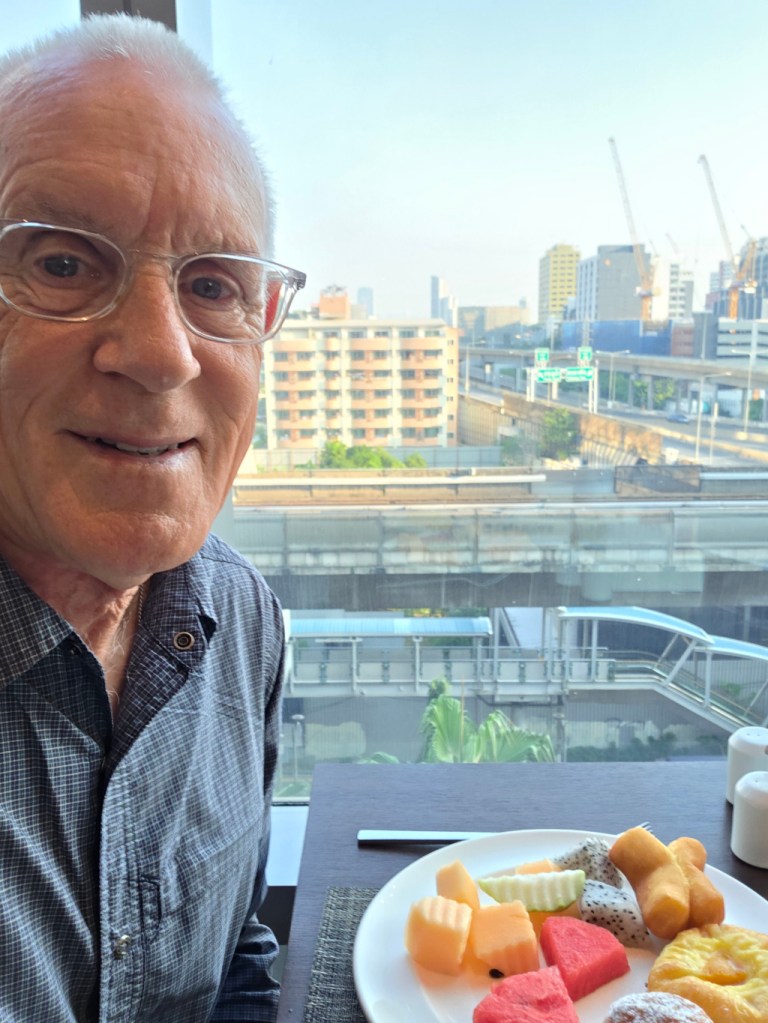
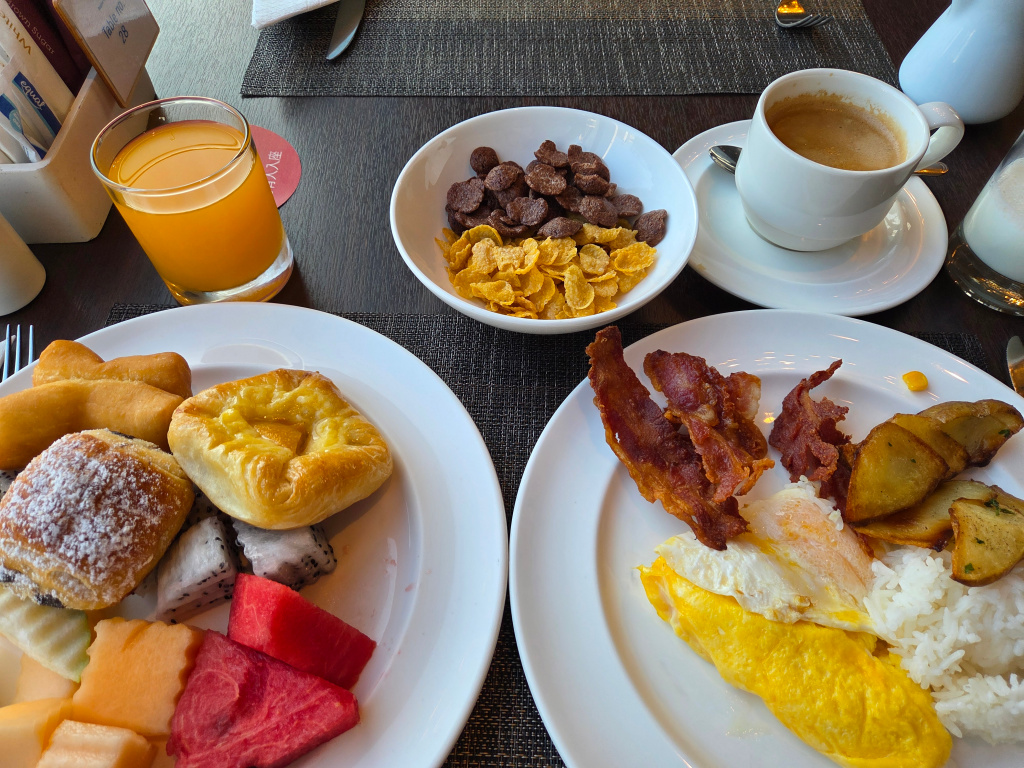
And after the long, long day of travel yesterday and a fairly small dinner, I am very hungry this morning. Here I am at my favorite table looking over Bangkok and the BTS Skytrain below. I seem to be looking a bit too serious as I fumble with using my watch to take a photo on my phone. And my breakfast…yes, I was hungry. Coffee, orange juice, cereal, fruit, two small pastries, eggs, bacon, potatoes, and rice (and I finished it all).
Planning
My plans for today will be very similar to my one full day in Bangkok each of the last three or four years, so this post might seem almost repetitive. I like to see Wat Arun and Wat Pho, then visit an important temple I have not seen. Each time I see these favorite sights, I see them differently, so it is not repetitive to me.
Bangkok is a large city, about the size of Los Angeles with twice as many people. It has a frenetic pace. The traffic is almost always congested, the mass transit systems are crowded, and there is an almost infectous energy to the city. Bangkok is a great city, rich with history and culture. But the high energy tires me out, so I stay in Bangkok just enough time to see a few favorite sights, namely Wat Arun and Wat Pho. If I have the energy and there is time, I would also like to visit Wat Bowaniwet Wihan Ratchaworawihan, because it is where two former kings of the Chakri Dynasty served as monks: King Rama IX (Bumiphol Adulyadej) and King Rama VI (Vajiravudh) and is the final resting place for both.
Wat Arun
Withoug question, Wat Arun is my favorite temple of all the Buddhist temples I have visited over the years. I found this stock photo of Wat Arun from across the Chao Praya River that conveys better just how large the towers are. I did not take this photo, and include it only to show a perspective I cannot get.

Wat Arun is significant in Thai history and one of Bangkok’s best-known landmarks. It is classified as a Royal Temple of the First Class, a category consisting of approximately 15 Thai Buddhist temples (there are over 30,000 active Buddhist temples in Thailand). In the 1700s, Wat Arun was known as Wat Makok, after the village of Bang Makok in which it was located. It is likely that the current nickname Bangkok evolved from the village name Bang Makok.
As an aside, the actual name of the city we call Bangkok is the longest city name in the world:
Phonetically:
“Krung Thep Mahanakhon Amon Rattanakosin Mahinthara Ayuthaya Mahadilok Phop Noppharat Ratchathani Burirom Udomratchaniwet Mahasathan Amon Piman Awatan Sathit Sakkathattiya Witsanukam Prasit.”
In the Thai language:
กรุงเทพมหานคร อมรรัตนโกสินทร์ มหินทรายุธยามหาดิลก ภพนพรัตน์ ราชธานีบุรีรมย์ อุดมราชนิเวศน์ มหาสถาน อมรพิมาน อวตารสถิตสักกะทัตติยะ วิษณุกรรมประสิทธิ์
It translates to:
“The city of angels, the great city, the residence of the Emerald Buddha, the impregnable city (unlike Ayutthaya) of God Indra, the grand capital of the world endowed with nine precious gems, the happy city, abounding in an enormous Royal Palace that resembles the heavenly abode where reigns the reincarnated god, a city given by Indra and built by Vishnukarn.”
The Thai people refer to the city as Krung Thep and only use the nickname “Bangkok” when speaking to foreigners.
When the former capital Ayutthaya was overthrown in 1774, King Taksin and what was left of his army moved south along the Chao Phraya River, and it is believed that when Taksin saw Wat Makok at dawn, he decided to make this the new seat of his kingdom. He rebuilt the temple and renamed it for Aruna, the Hindu Goddess of the dawn. Almost all Thai Buddhist temples have a formal or official name, a short name, and sometimes a nickname. Wat Arun’s formal name is Wat Arun Ratchawararam Ratchawaramahawihan.
Yaks and Main Viharn
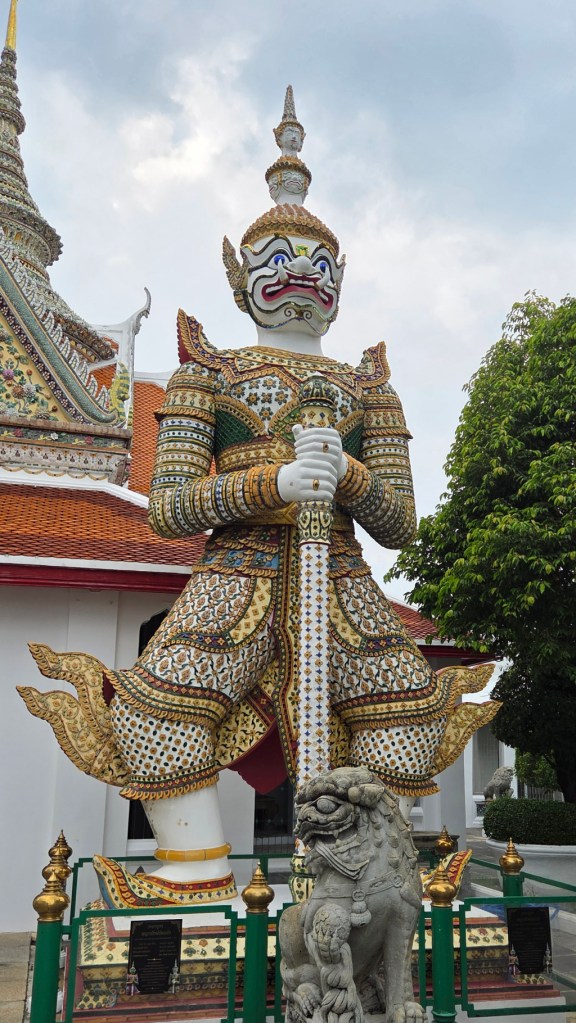
Wat Arun, like many Thai temples, is something of a small campus, with several buildings and structures. The entrance to the main viharn (worship hall) at Wat Arun is guarded by two large yak or yaksha figures. From Wikipedia, “yaksha are a broad class of nature-spirits, usually benevolent, but sometimes mischievous or capricious, connected with water, fertility, trees, the forest, treasure, and wilderness.” Here are the yaks standing guard at the entrance with many other tourists:
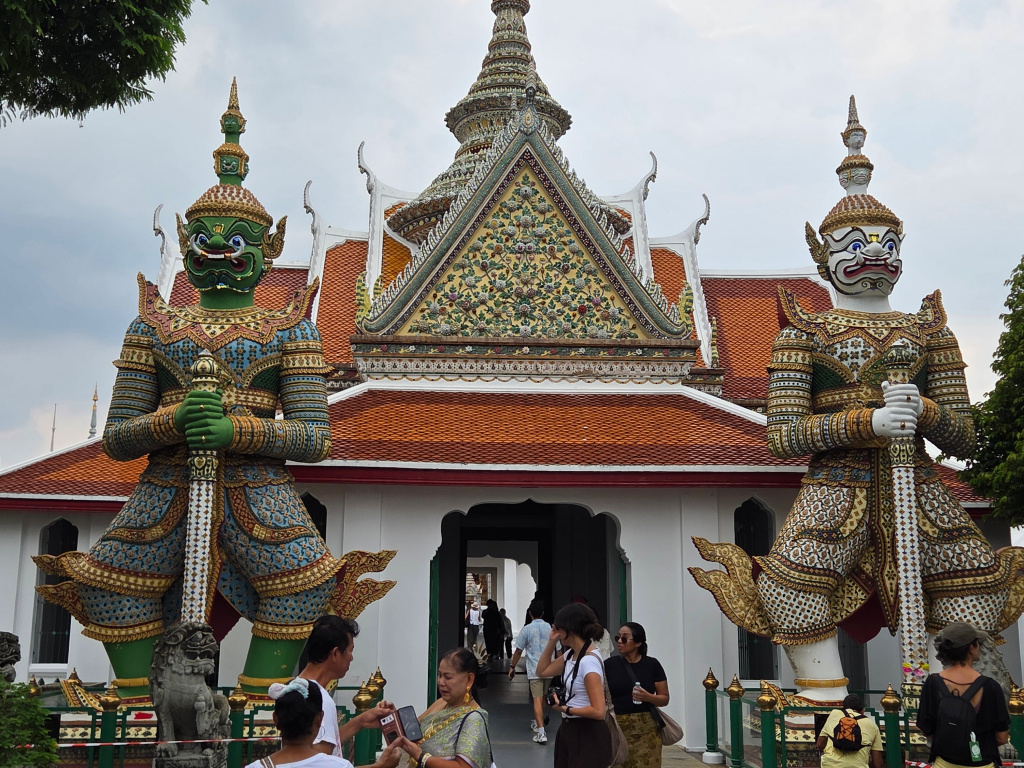
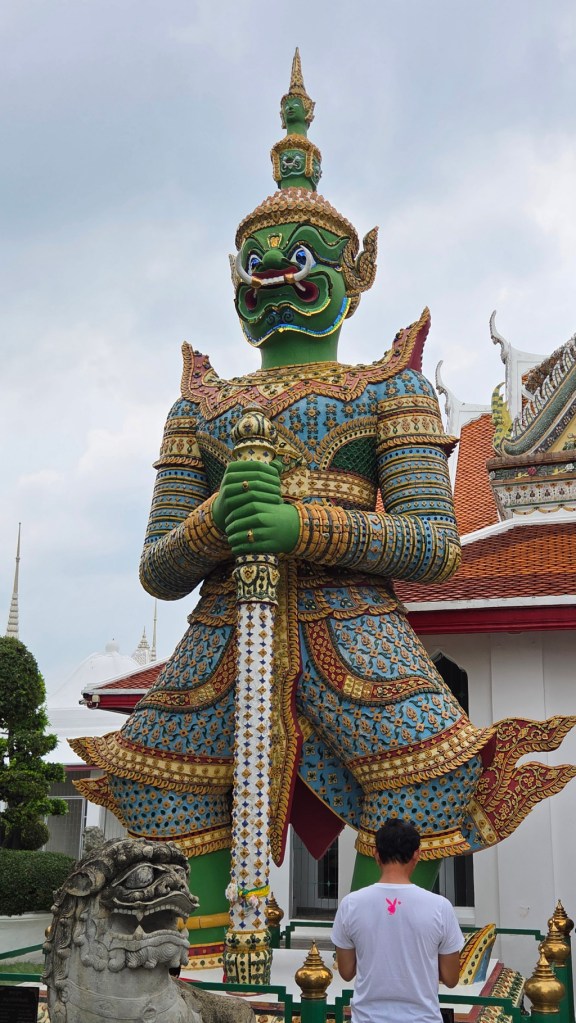
I tried to get closer views of the yaks without many people in the photo, a challenge as Wat Arun had more tourists than I have ever seen. The green yak is Yak Thotsakan and the white yak is Yak Sahassa Deja
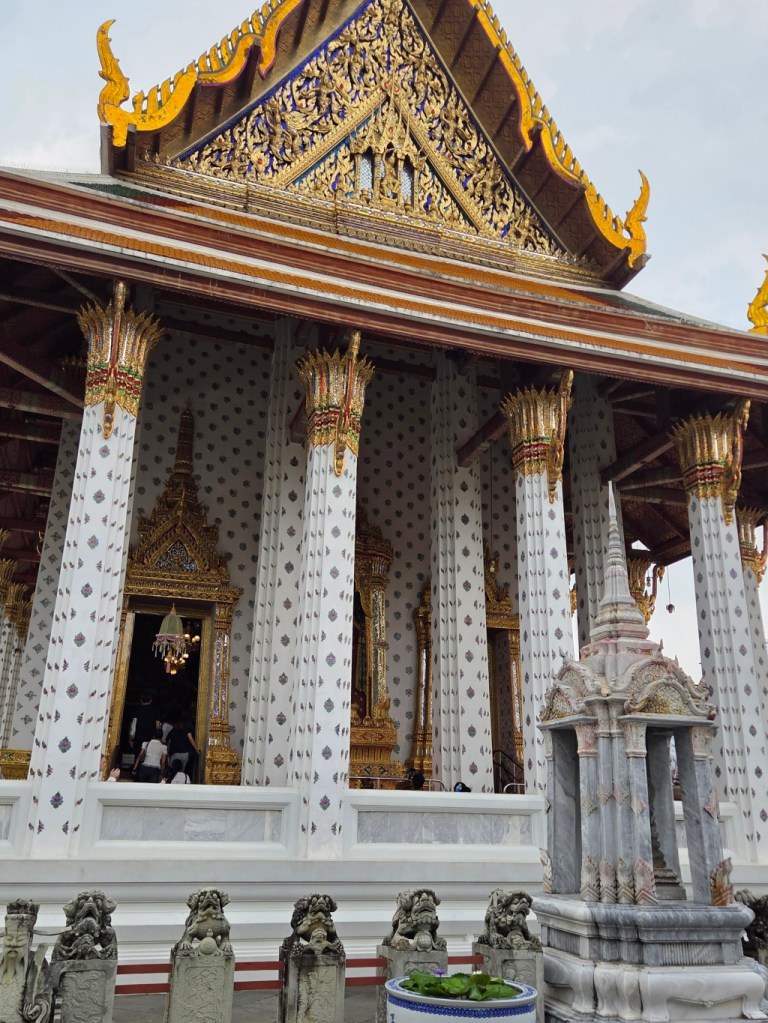
Walking through the entrance to the main viharn (worship hall), I was pretty sure I had never actually gone inside the main viharn. Here is the front, diffucult to get a good view because of the closeness of the other structures nearby.
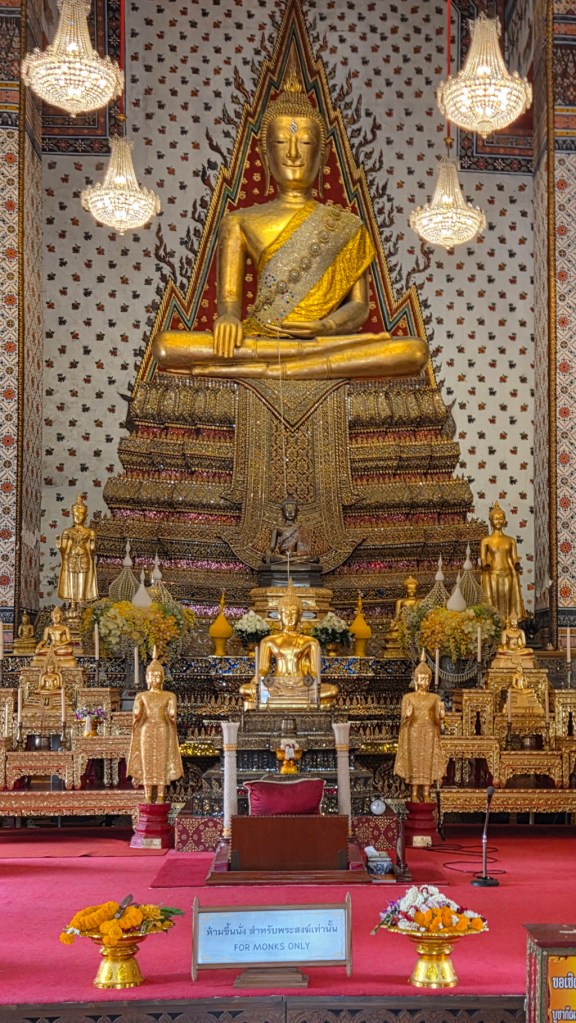
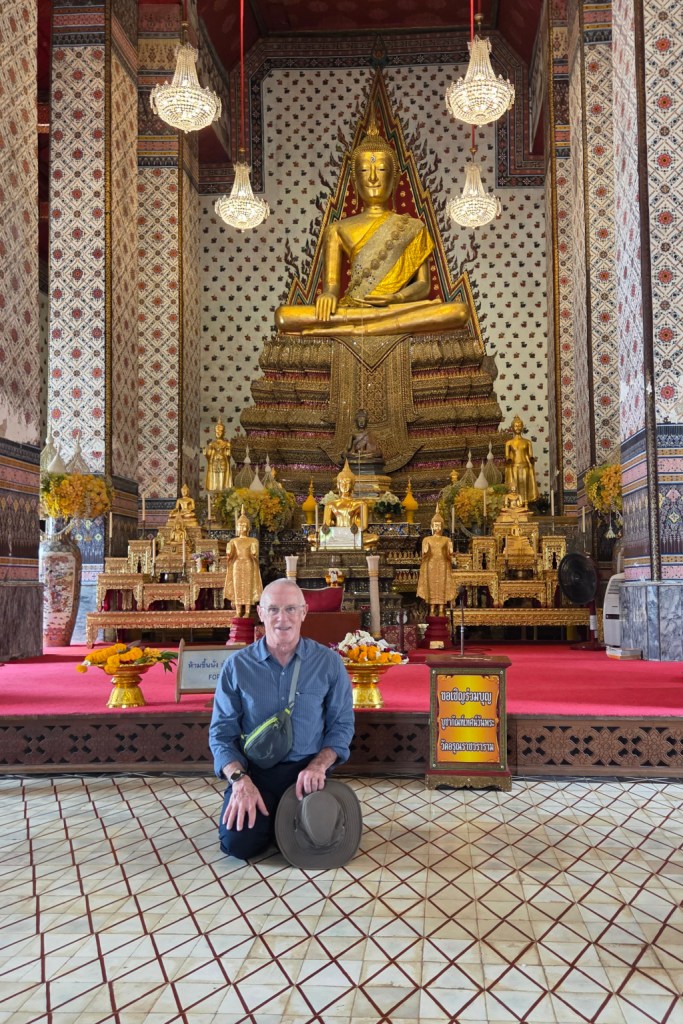
I went inside and took a photo of the Buddha image, then another tourist took my photo.
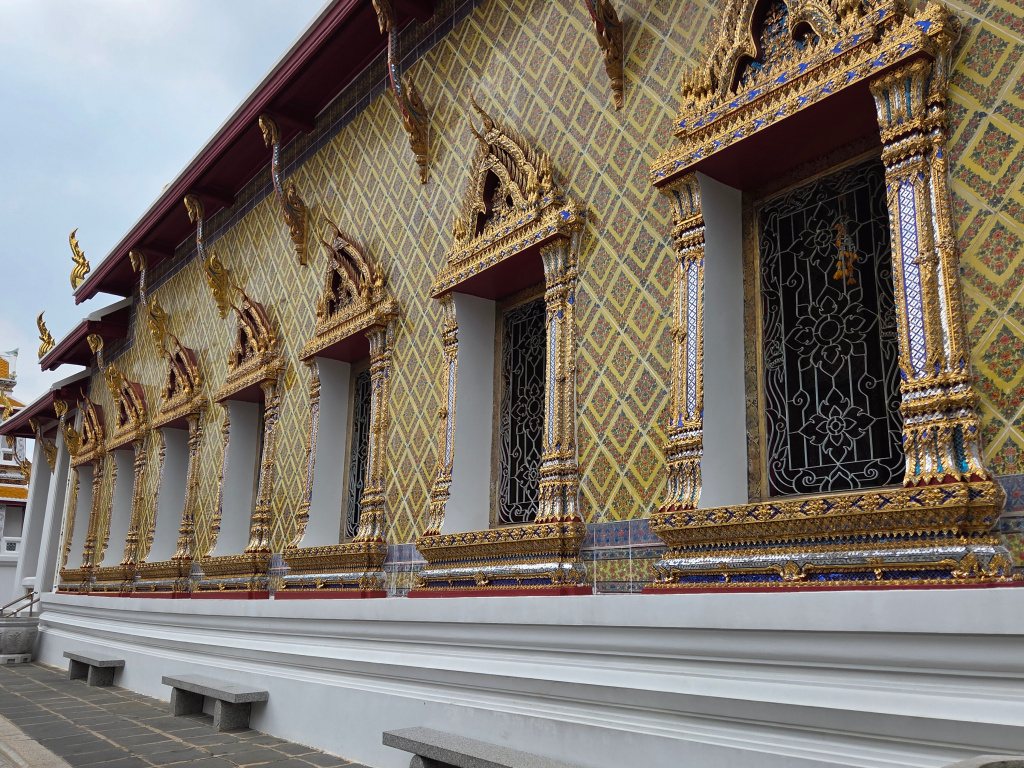
The outside of this viharn is very striking, simple, but elegant.
The Prangs at Wat Arun
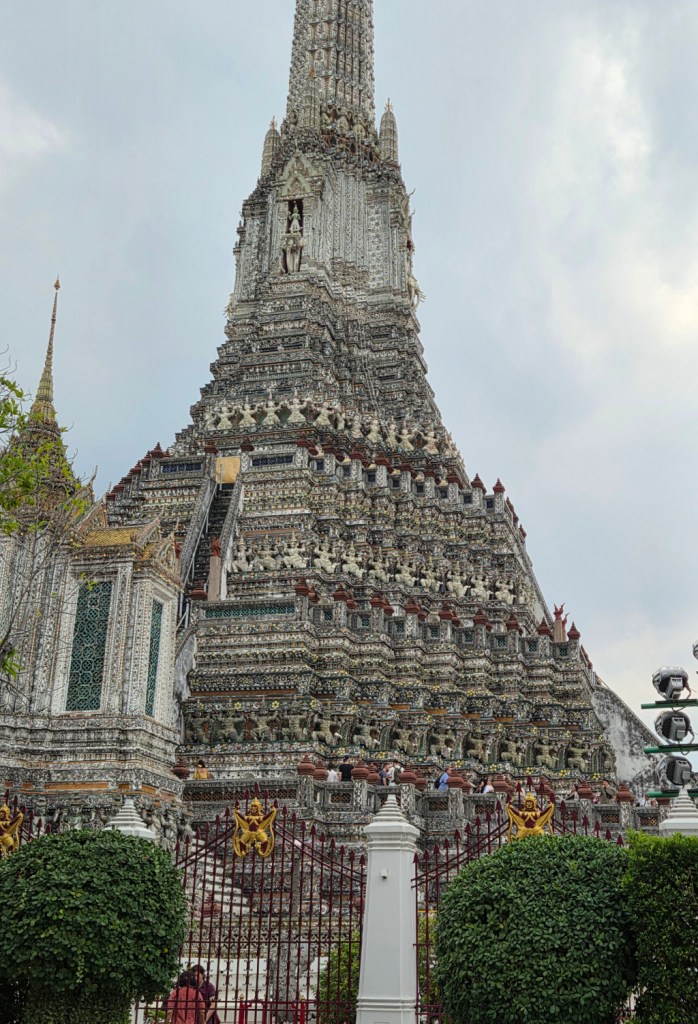
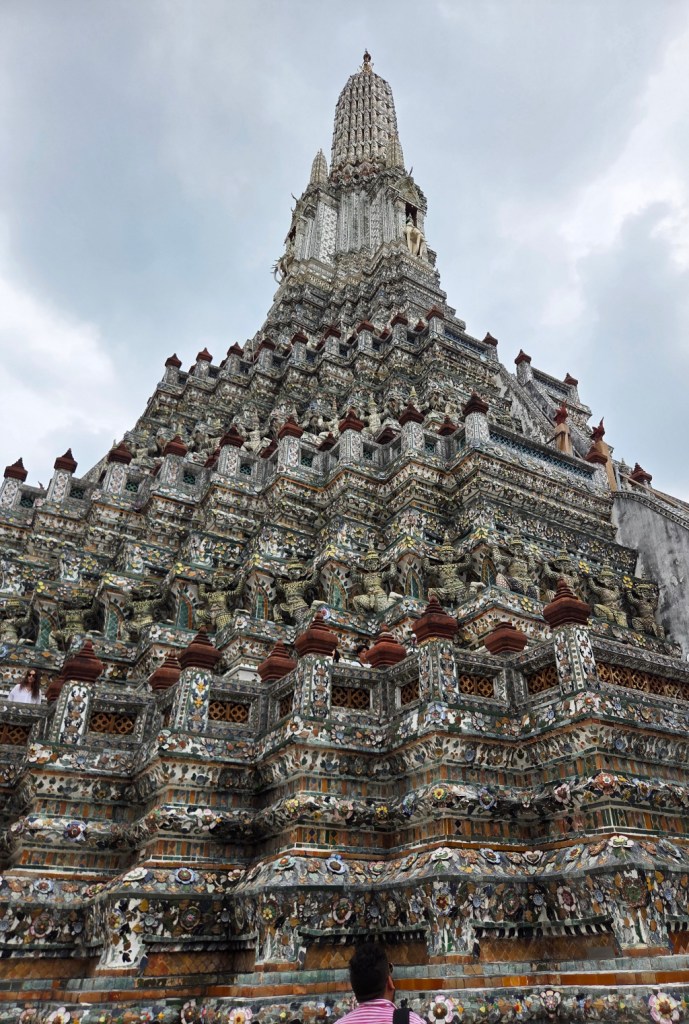
The famous visual of Wat Arun are the “prangs.” Four Khmer-style “prangs” and a fifth, larger one in the middle. This layout is a representation of the five sacred mountains which were home to the gods according to Khmer, Hindu, and Buddhist cosmology. The central prang represents Mount Meru, the center of the universe. When the height of the central prang was extended by King Rama III in the 1800s, he ordered that colorful ceramics and porcelain should be used to form elaborate motifs and designs. This unusual design feature makes the prangs shimmer and shine in the sunlight and gives the temple a unique appeal that has to be seen close up to be fully appreciated. A staircase, which is very steep with narrow steps (and no handrails), allows visitors to climb part way up the central prang to a platform from which to view the four smaller prangs.
It is difficult to get a good view of the towers (perhaps if I had a drone and was allowed to use it – drone use is strictly regulated in Thailand). There are hoards of tourists everywhere, and it is very hot and humid and my energy is waning.
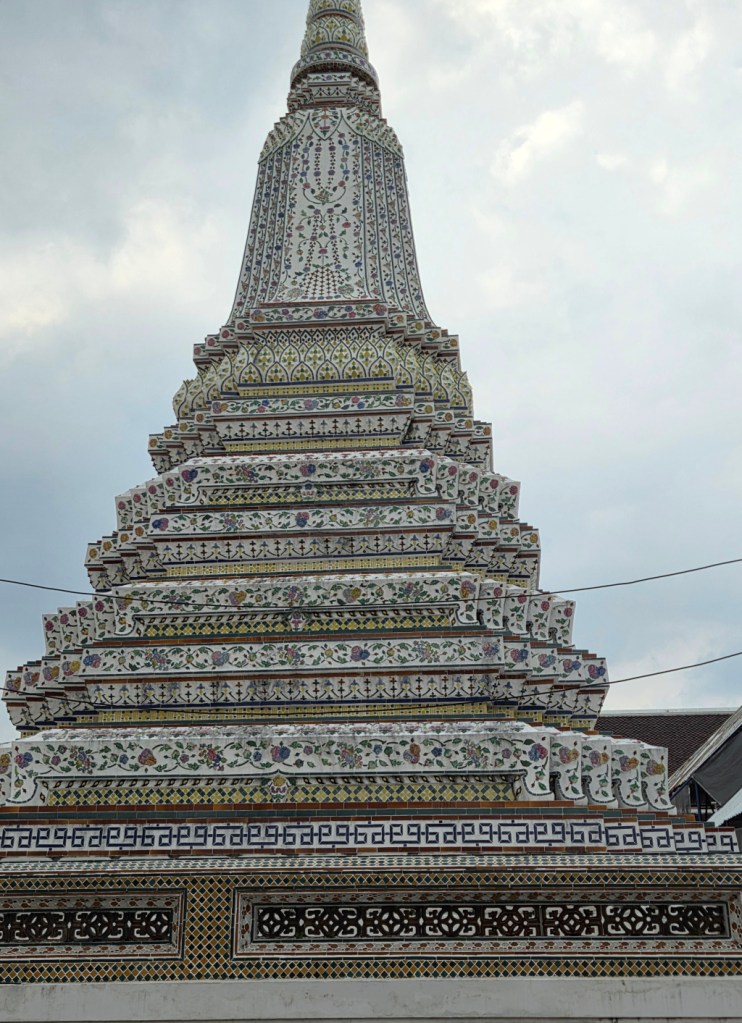
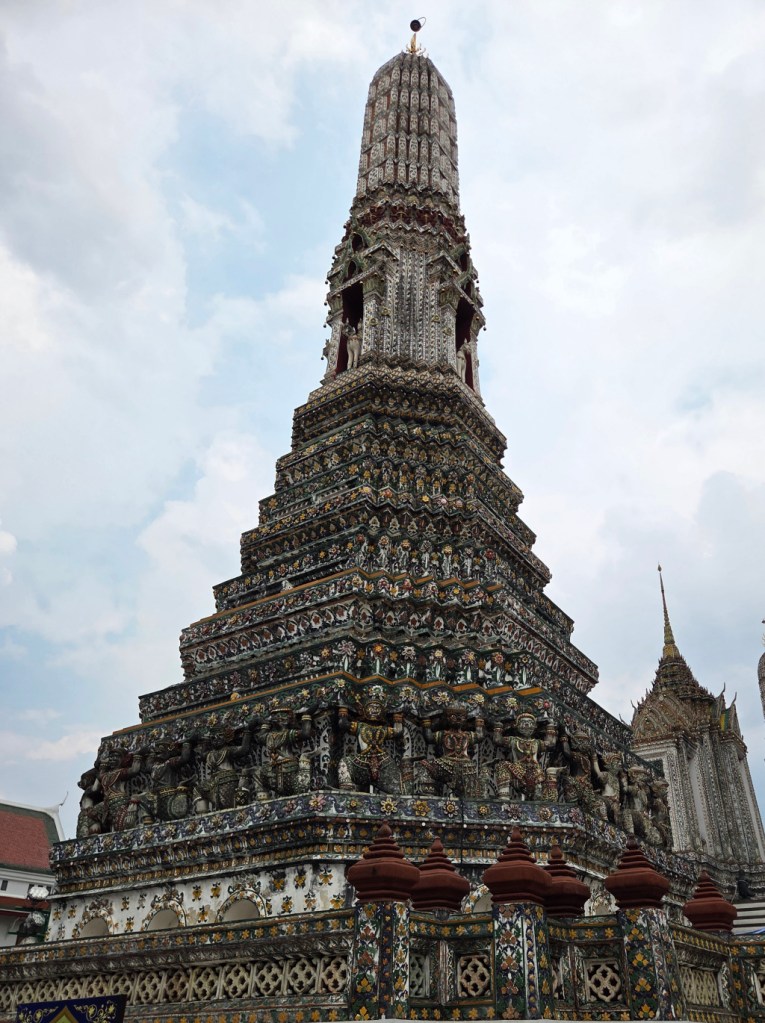
First, two of the smaller prangs:
I did get a resonable view of the central prang from a distance:
Here is some detail of one of the smaller prangs:
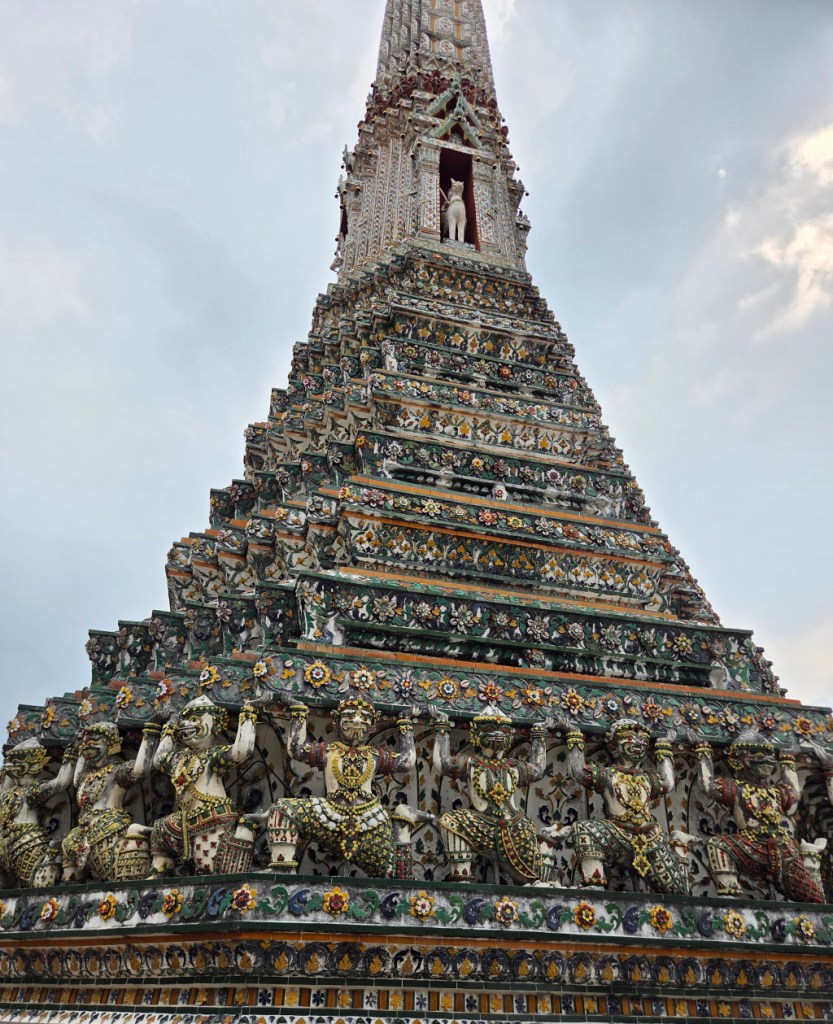
And a little closer detail of the larger, central prang:
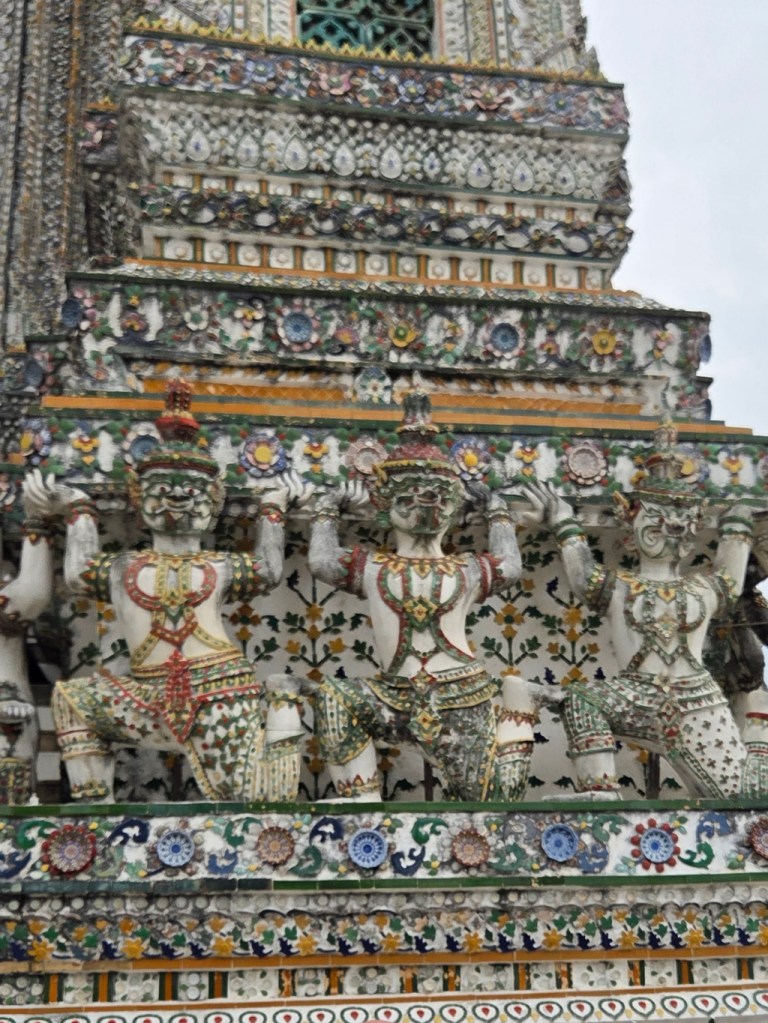
Finally, a view of the large prang from close to the base looking up:
Wat Arun is crowded, it is very hot and humid (as it always is in Bangkok), and I think I will skip climbing up the steep stairs for a view from the second level. Instead, I’ll get on the ferry for the 12 Baht ride over to Wat Pho.
Next: Full Day in Bangkok 2 – Wat Pho


