Monday, December 28, 2015
First Full Day – Revisiting Familiar Favorites – Part 1
This will be a long post — my first full day in Bangkok was a long one, and there is a lot to share.
Before the day really started, I learned that I am not yet adjusted to the 15-hour time difference (no surprise), when I awoke at 3:30 AM and was fully awake. Am I going to end up sleepwalking through the day? I rested a while more, then got up, checked email and touched base with work and the systems I manage. All seemed well. At 7:00 I went to the restaurant in which the large impressive breakfast buffet is held. I was quite hungry after eating little on the planes, and having only a small dinner (at the La Monita TacoTruck). I rallied to the cause and had a large very Western-style breakfast.
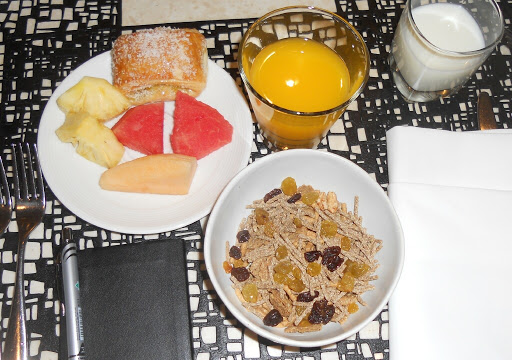
First, orange juice, cereal, fruit and a danish. The orange juice is very good in Thailand; the oranges are a little different than those we have in the U.S., smaller and with just a tang to the taste. Notice the raisins in the cereal, I am certain that those are available only because the hotel is catering to western palates; I do not think grapes are grown in large quantities in Thailand.
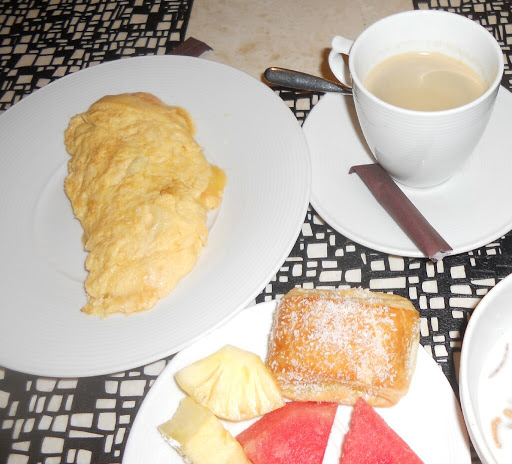
When the omelette came, my coffee arrived. This was a relatively simple Western-style breakfast, and everything about it was good, especially the coffee. Most hotels and even coffee shops use Thai coffee, and it is good. I notice that I like the flavor so much that I use less milk and sugar when I drink coffee in Thailand. Unfortunately, the coffee is so popular in Thailand that there is not much left over for export, so it is difficult or impossible to get Thai coffee beans in the U.S.
Visiting a Couple Favorite Temples
After breakfast, it was time to visit a few favorites. and get some walking in. It will be a hot day, so I am taking plenty of water and a couple of snacks with me, plus my camera, and my notebook.
Return to Wat Arun
The first item on the list is to return to Wat Arun. My impression last year was not highly favorable, that Wat Arun reminded my of a temple that had been built to look old. Inspite of my first impression, Wat Arun is considered important in the Thai culture, and is one of the Royal Temples of the First Class. I am going to return and re-evaluate my first impression; the journey is a multi-part journey: first, I took the the skytrain to Sapphan-Taksin stop (35 THB); second, walked to river and boarded the boat (40 THB) and got off at the Tat Thien pier for Wat Pho (the 7th pier), and third, boarded a ferry to get across the river (9THB).
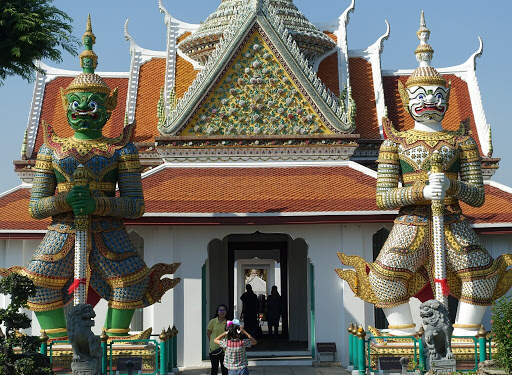
The entrance is guarded by these two magnificent sentries, more than 10 meters high.
There had been a temple at this spot since at least the mid-1600s. The original name of the temple was Wat Makok, likely named for a fruit called the makok that once grew along the rivers and creeks in the area. When the capital was reestablished in Thonburi (the predecessor city to present-day Bangkok), after the Burmese took over the capital at Ayutthaya, the story is that the king vowed to restore the temple after passing it at dawn and seeing the sun reflecting off the large chedi.The name Wat Arun or more formally, Wat Arun Ratchawararam Ratchawaramahawihan, comes from the Hindu god Aruna, often personified as the radiations of the rising sun. For a time, the re-established palace was adjacent to Wat Arun, but was moved across the river by King Rama II in 1785.
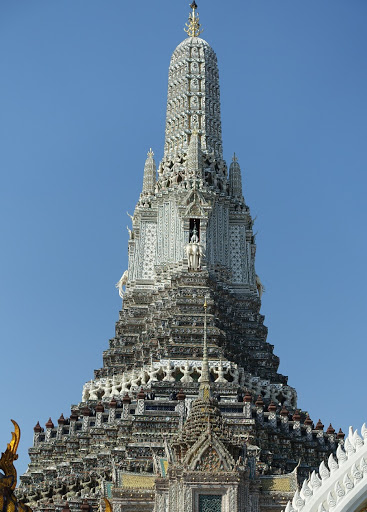
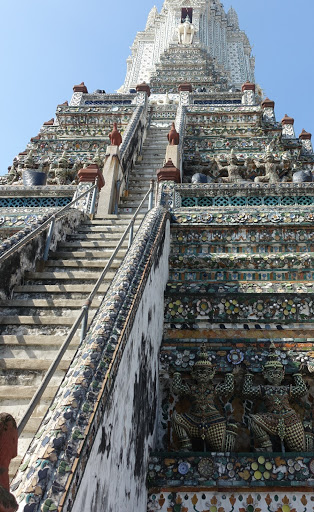
First view of the large tower, called a prang (a Khmer-style tower), surrounded by four, smaller, but equally impressive prangs. (It is not entirely clear if these are chedi or simply towers. My understanding is that a chedi holds the remains of someone of significance, and there is no indication that these towers hold remains, therefore that may be why they are not called chedi.) This is a very large structure, possibly up to 86 meters (282 feet) tall in some documentation; other documentation lists its height at 67 meters (220 feet). It is tall, and the detail in the decoration is clearly not meant to look old. The stairs are steep, and the public is not allowed up those stairs. Some detail of the tower in the next picture.
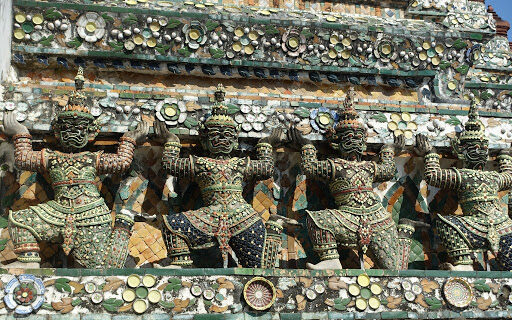
Off to Wat Pho and the Reclining Buddha
Back across the river on the ferry for 9 THB (25 cents), and following the crowds to Wat Pho to see the Reclining Buddha. Wat Pho, or more formally, Wat Phra Chetuphon Vimolmangklararm Rajwaramahaviharn, is the first in the list of six temples in Thailand classed as the highest grade of the first class Royal temples. the shorter name, Wat Pho is a contraction of its former name, Wat Photaram. Wat Pho is always busy, and in spite of the crowds, I love seeing the Reclining Buddha. And every time I have seen it, I am surprised at how large it is. I wrote in my notes that I would be surprised if it were less than 35 meters, and later I learned that it is 46 meters long. Because of the structure and the many people, it is difficult to get a good picture.
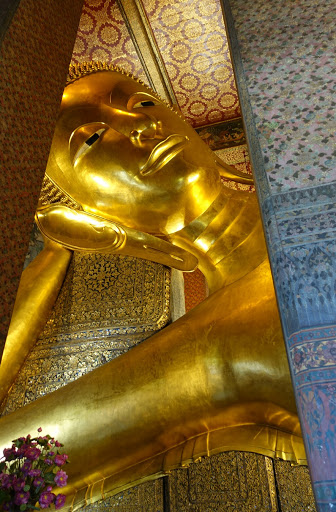
A picture of the head as best as I can get the angle, because blocking a good view are pillars holding up the structure. The head alone is 5 meters high (about 16 feet).
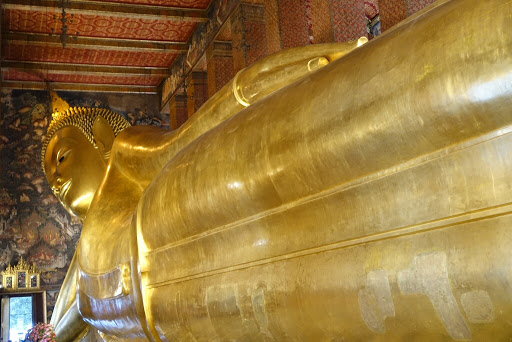
A view of most of the length of the Reclining Buddha body, most of the 46 meters.
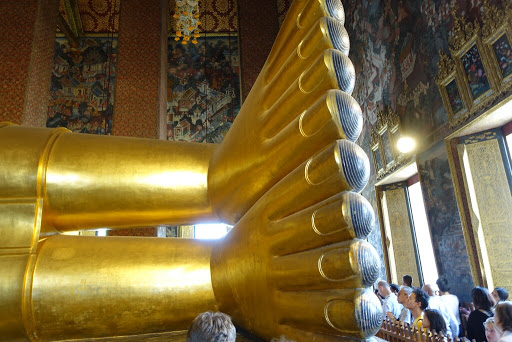
A view of the Reclining Buddha feet, 3 meters high.
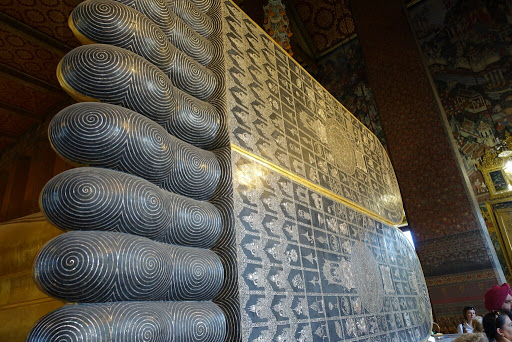
The bottoms of the Reclinig Buddha’s feet with the Buddha special symbols, 4.5 meters long.
Wat Pho is a large campus, with many viharn (worship halls), most of which are not open to the public. I do enjoy walking around and peeking into the various buildings to see what can be seen, but mostly the doors are closed. Wat Pho is also considered the first public university in Thailand, and in 1955, a school for traditional medicine and for massage was established. Wat Pho is now considered the center for Thai Massage.


