Monday 2 February 2026
Another visit to the so-called Silver Temple
Much of my time in Chiang Mai is very solitary. I do talk to friends at the guest house where I stay, I talk to friends at Wild Rose Yoga, I talk to my trainer Ning at the gym, and occasionally share time at dinner with other friends. When I visit temples, hike up the Monks Trail, and walk around the city, I am typically alone, and that is fine-I do not mind and am comfortable being alone. A friend from the U.S., Esther, came to Chiang Mai to visit for a week. We connected, and for a few days, I got to show her around part of the city, tell her what I know about Chiang Mai and what I have learned about the history. It was fun for me to have someone with whom I could share my love of Thailand and especially Chiang Mai.
Wat Sri Suphan
On Monday, I had the morning free to show Esther some important temples in the area. On Esther’s list of temples of interest was Wat Sri Suphan, also known as Wat Srisuphan. This is an old, historic, and very important temple to the Thai people. The temple is situated in Haiya district, immediately south of the old city, the traditional silversmith area of the city where there are still many silver workshops operating.
Wat Sri Suphan was originally built in about 1500 during the reign of King Mueang Kaeo, the eleventh ruler of the Mengrai Dynasty. The Mengrai dynasty was started by King Mengrai, who founded Chiang Saen, Chiang Rai, and then Chiang Mai, and lasted over 250 years until 1558. By 1510 the viharn (assembly hall), the ubosot (ordination hall), and the chedi (pagoda) were completed.
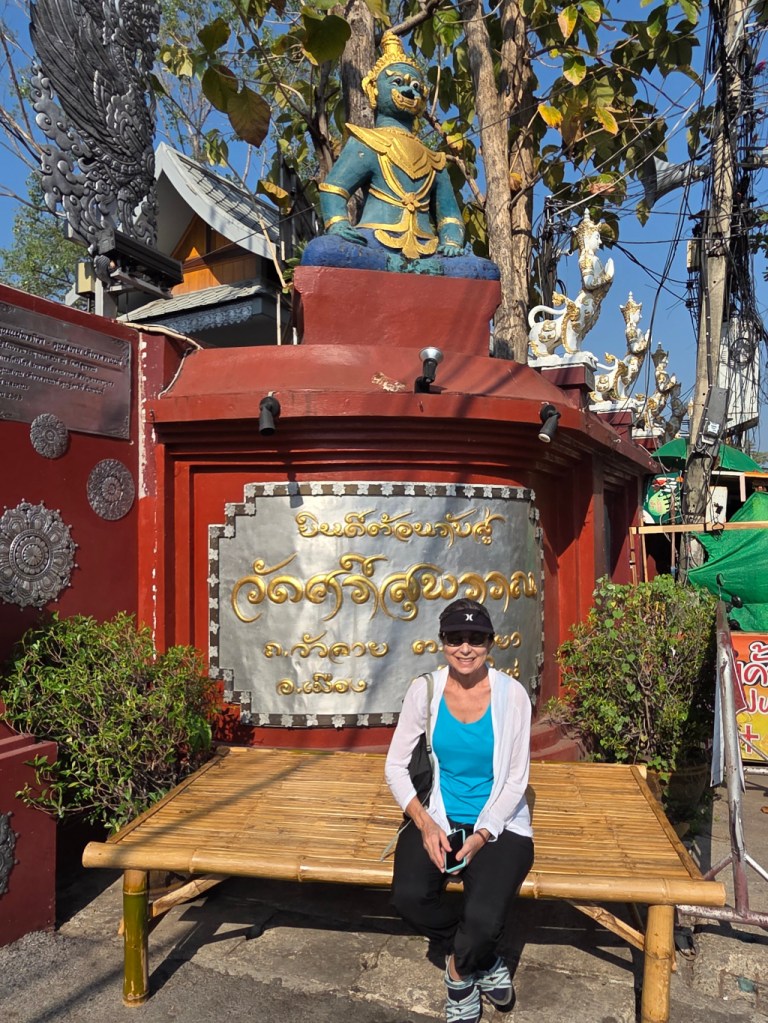
Esther and I walked south through Chiang Mai Gate and down Wualai Road to Wat Sri Suphan. Here is a photo of Esther at the entrance to the temple.
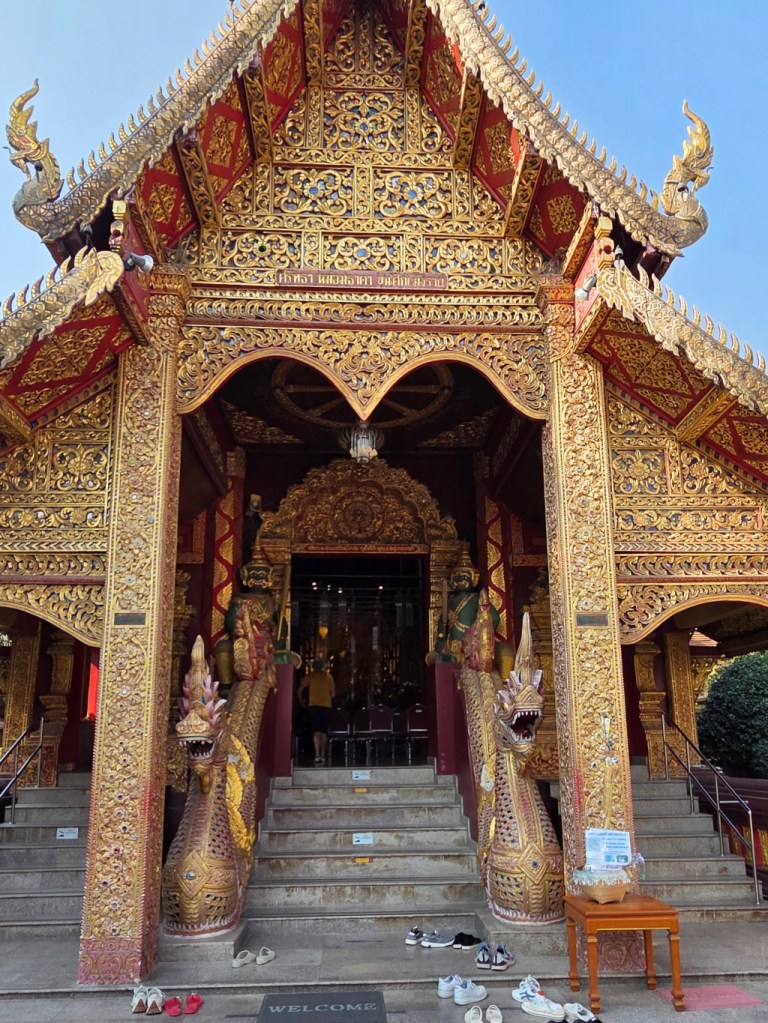
Because the Wat Sri Suphan has been renovated and redesigned a number of times, little remains of those original buildings except some teak pillars and supports which can be seen in the new viharn. First we visited the viharn and its intricately detailed front facade.
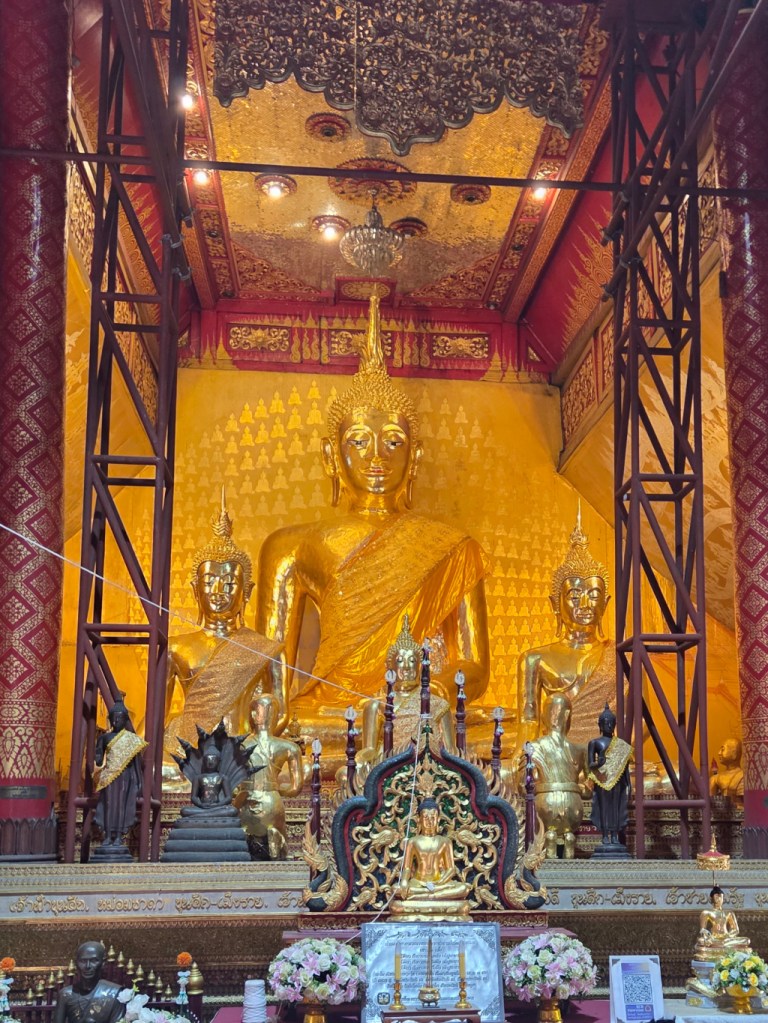
Inside, there was preparation for something taking place with some scaffolding and hanging decorations, so it was difficult to get a clear photo of the main Buddha image at the altar. The large Buddha with the gold background is impressive and contrasts with the silver we will see very soon.
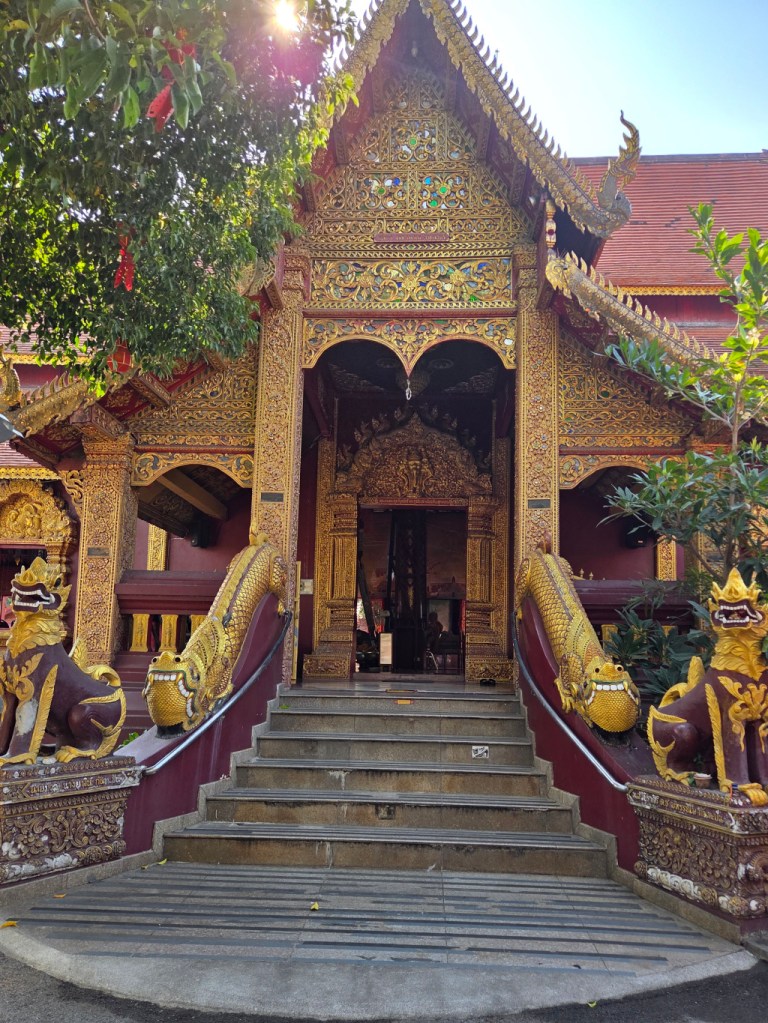
There is a side entrance to the viharn, not particularly unusual. What is interesting to me is that the side entrance is protected by two “mom” serpent creatures. I typically see those serpents protecting the entrance to a ho trai, a library of Buddhist and temple documents. I do not recall seeing these at a viharn entrance. They do look fierce.
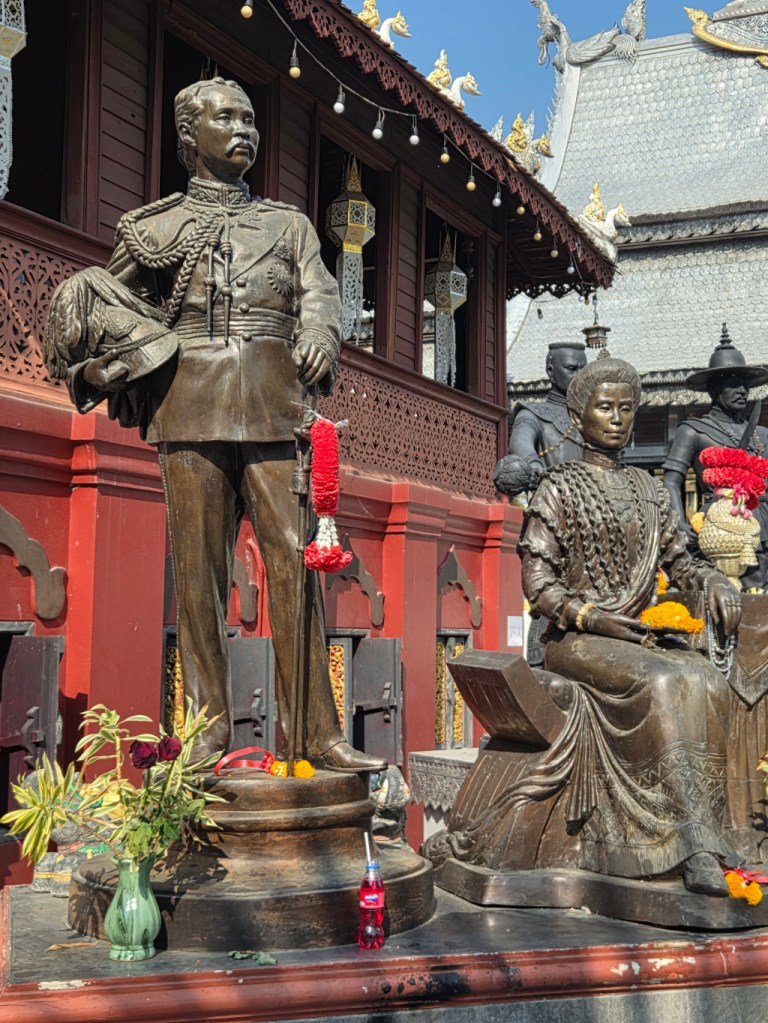
After seeing the viharn, we walked over to see the silver ubosot (ordination hall). On the way, I often stop to take a photo of the statue of King Kaeo and his wife, the Queen.
The Silver Ubosot
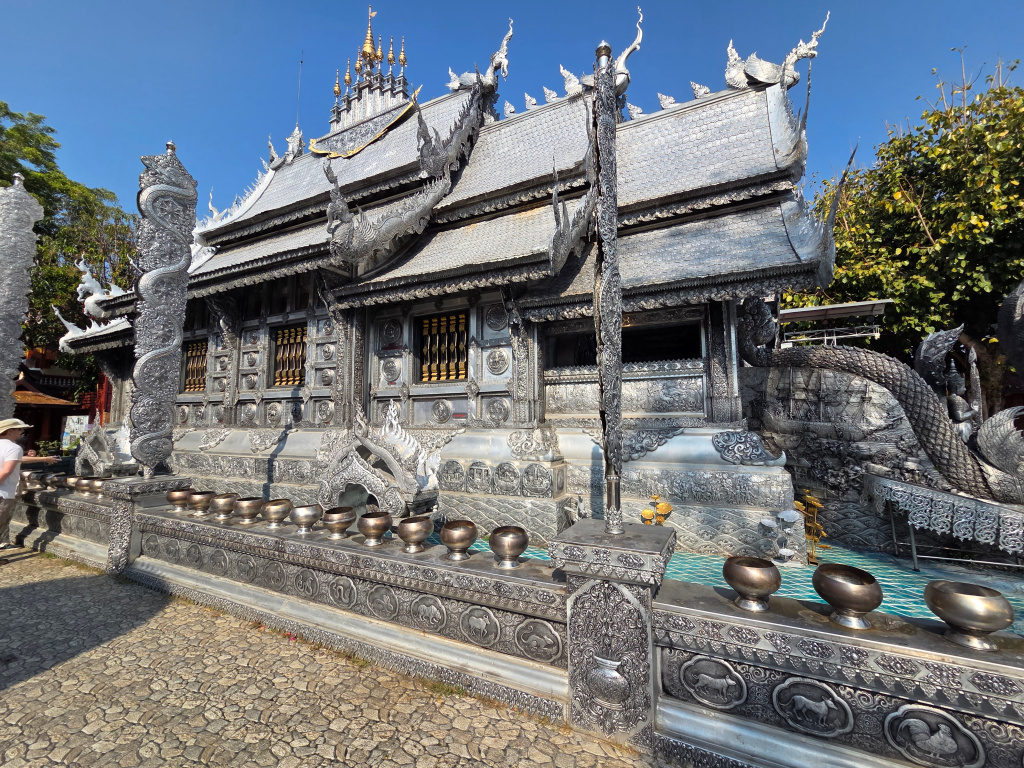
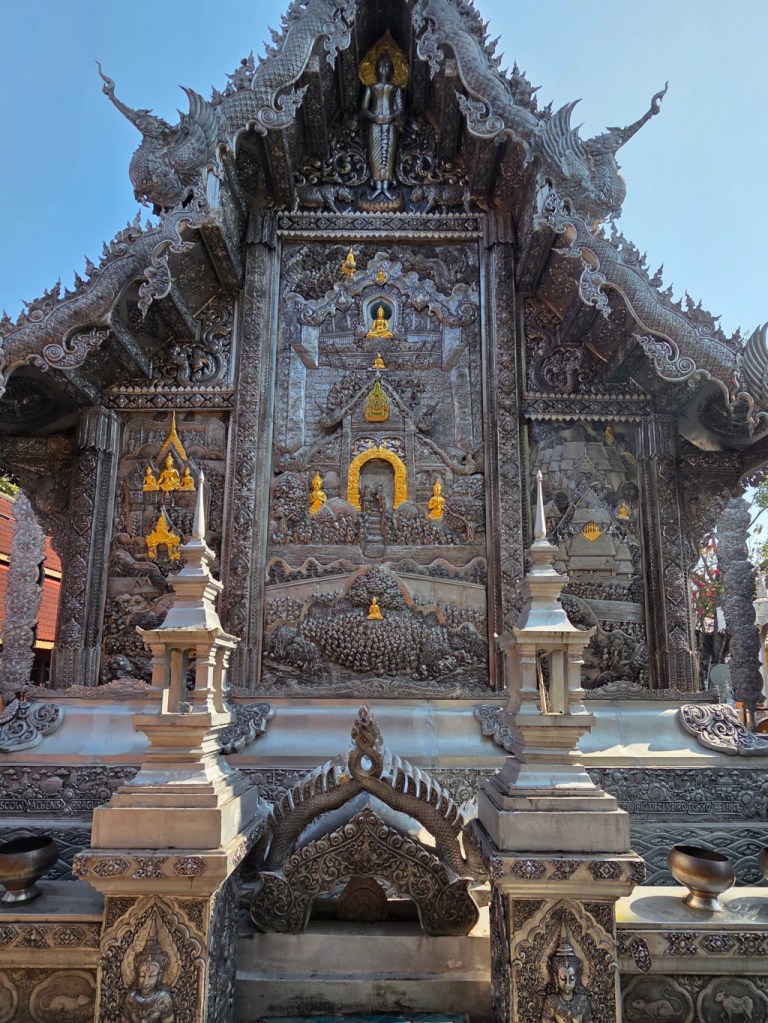
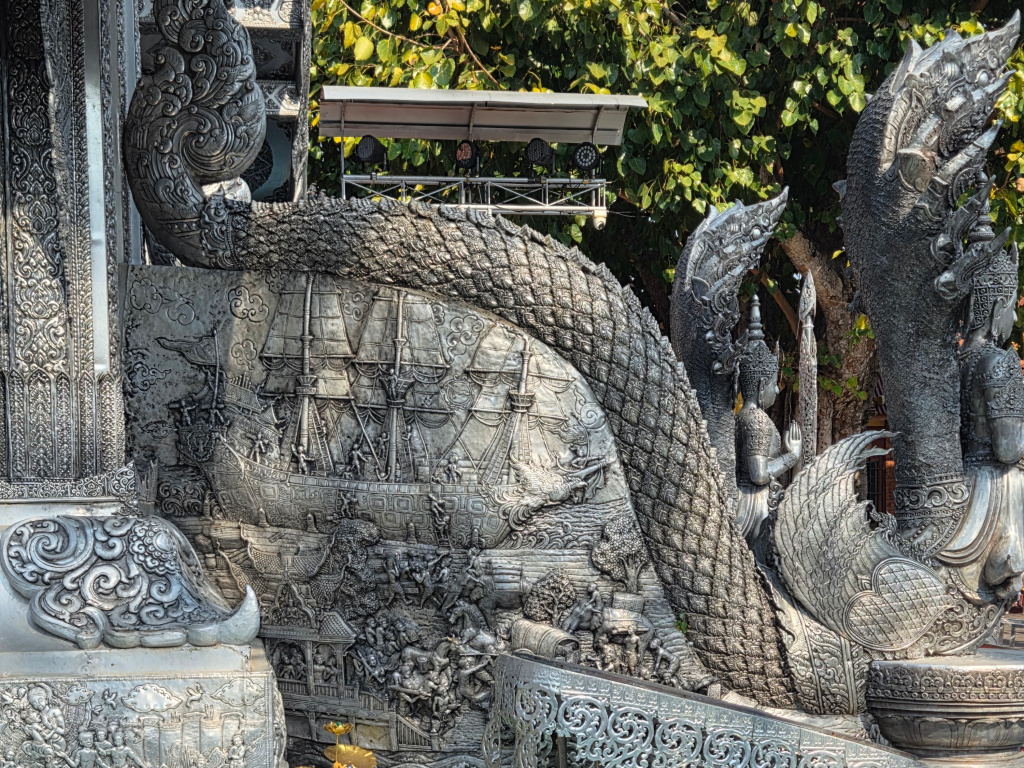
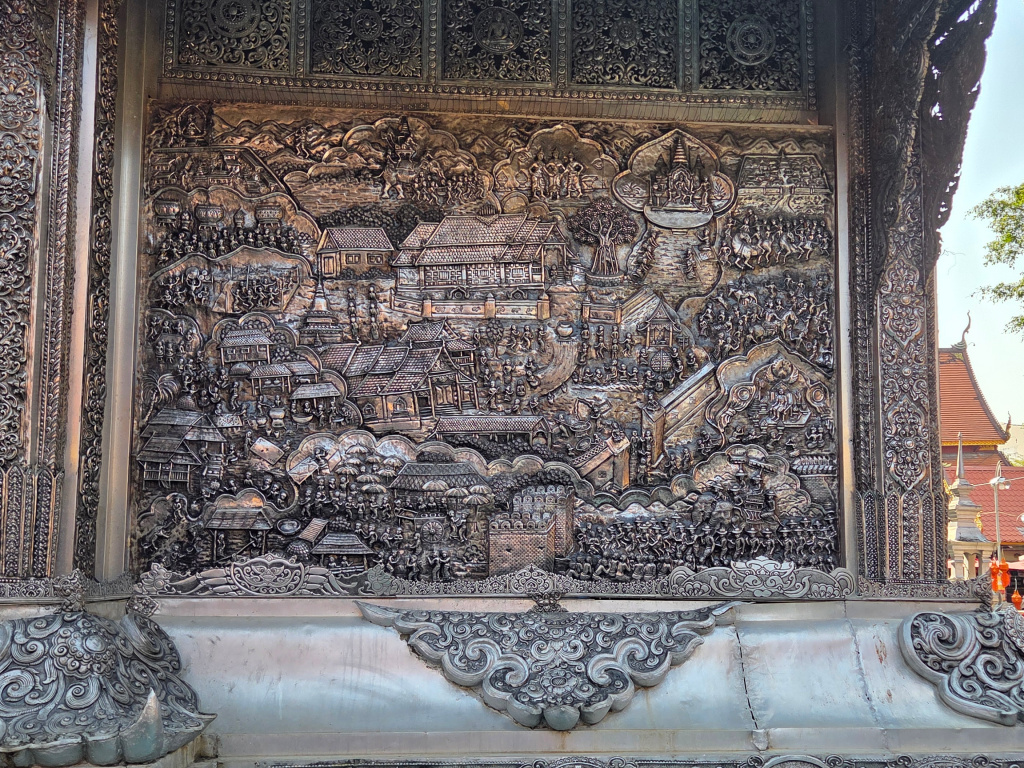
The most recent reincarnation of the temple began in 2004 under the direction of the abbot (head monk of the temple), Phra Kru Phithatsuthikhun. Rather than using standard temple renovation techniques, he chose to make use of the skill and knowledge of local silversmiths. This is most evident in the design of the main ubosot (ordination hall). Using silver, nickel, and aluminium panelling and extensive, decorative metalwork sculping and repoussé work, the result is a silver-colored building which shimmers in the sunlight and is full of intricate details.
“Repoussé” working literally means “pushed from behind” and refers to the working of the malleable metal sheets from behind with hammers creating reliefs. “Chasing” is the opposite and refers to the working of the metal from the front to create the finished design. Both methods are used for the decoration of the Silver Ubosot at Wat Sri Suphan.
I have posted many, many photos of the silver ubosot at Wat Sri Suphan over the years, so I’ll only post a few here. First, our first view as we walked towards the silver ubosot.
And a photo of the intricate detail on the back of the ubosot.
A couple of photos showing some of the detail on the sides.
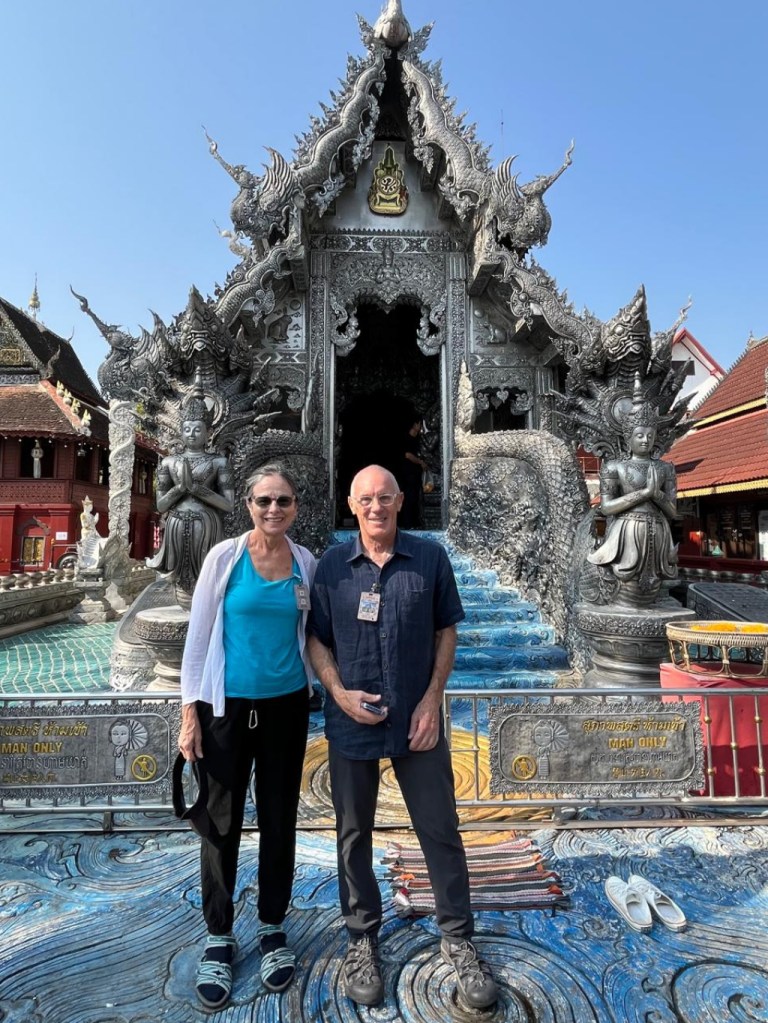
And finally, a photo of Esther and me at the front of the silver ubosot.
There are more than 44,000 active Buddhist temples in Thailand. Chiang Mai has no shortage of temples, in fact, it is often said that within the old walled city, about one square mile, are 55 temples. And there are many more outside the old city.
After visiting Wat Sri Suphan, Esther and I walked to the two most important and popular temples in Chiang Mai, Wat Phra Singh and then to Wat Chedi Luang. I have made blog posts about both of those temples this year.
Next: Doi Inthanon, the highest mountain in Thailand

 James the Intrepid Pilgrim