Sunday 4 January 2026
Returning to the Railway Station Walk
It is Sunday and I have no yoga, no strength training, and no hikes on my schedule. I decided to take a long walk to the railway station, revisiting the same walk I made the last two winters. I’ll break this into three or four posts, in an attempt to follow my New Year’s resolution to make more frequent and shorter posts. [And I am aware that I have already broken that resolution…it has been more than a week since I made the walk.] Furthermore, since I have already covered the details and some history of the temples I see along the way on this walk, I’ll just present a few photos of what I see.
Remembering what I did when I was on my last two Camino de Santiago pilgrimage walks in Spain, I started the walk in Samsung Health on my phone so both my Samsung phone and Samsung watch collaborate in tracking my walk. And here is the result, the general stats of the walk and a map. (I tried tracking walks on the Camino de Santiago with both Samsung Health and Google Fit, and liked the Samsung maps a little better. Perhaps I’ll try Google fit another time to see how they compare a year later.)

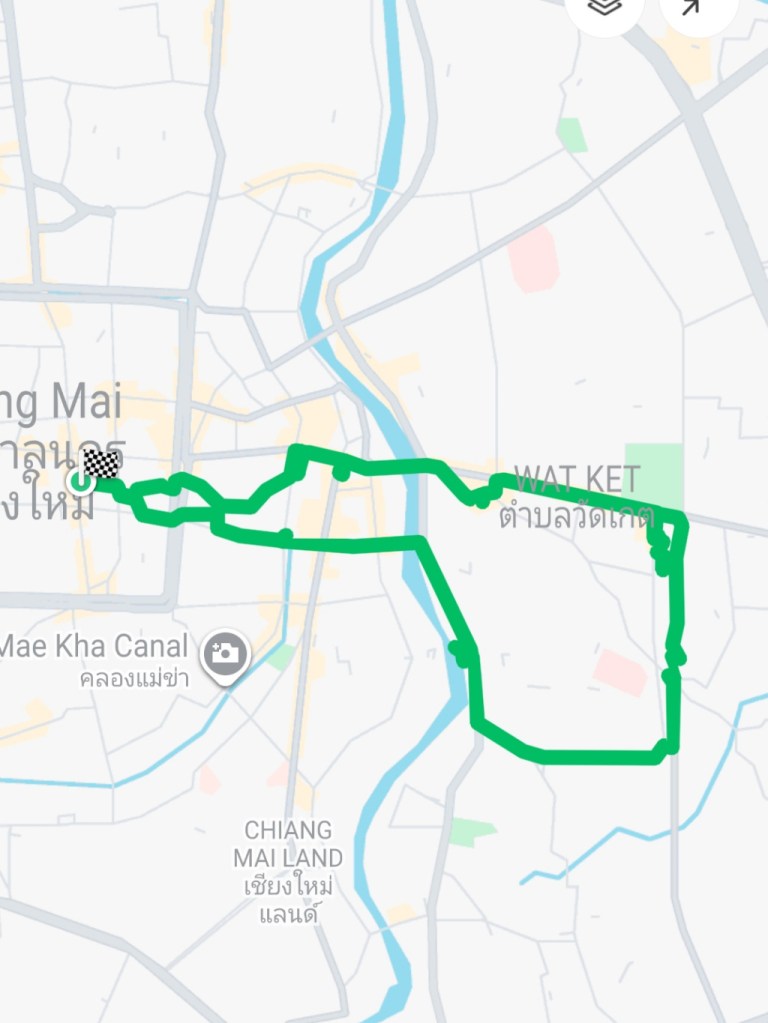
I am a little suprised that my average speed was almost 5 km/hour, because I stopped often to look at things and take photographs. Overall a good walk. So what did I see…here we go.
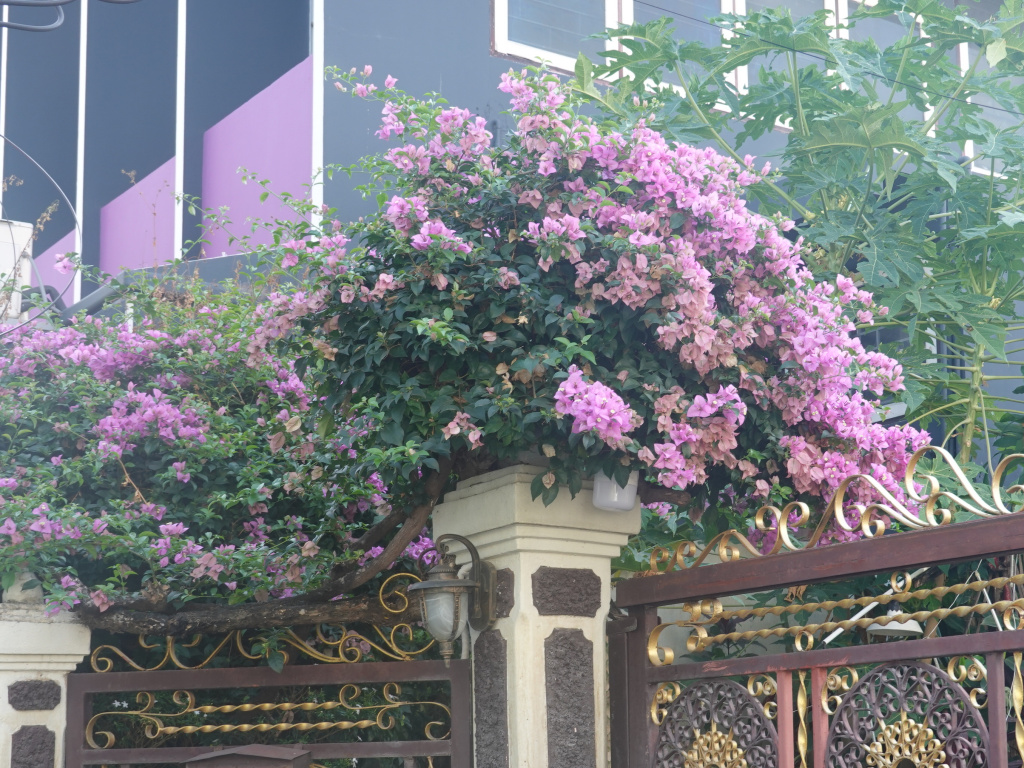
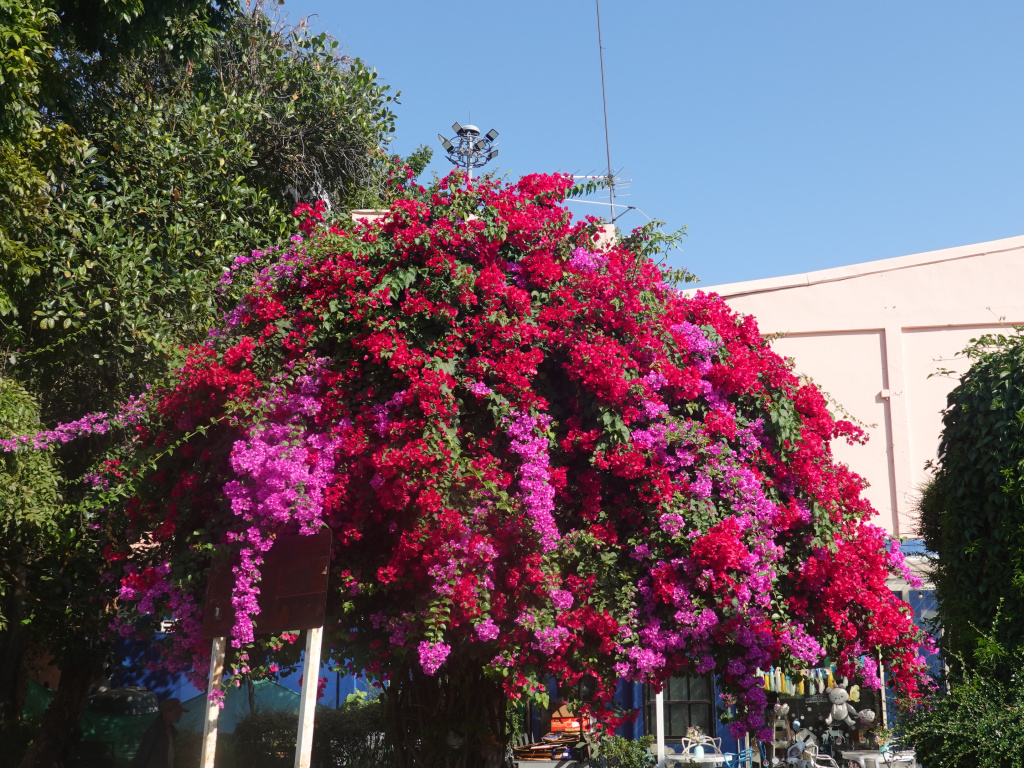
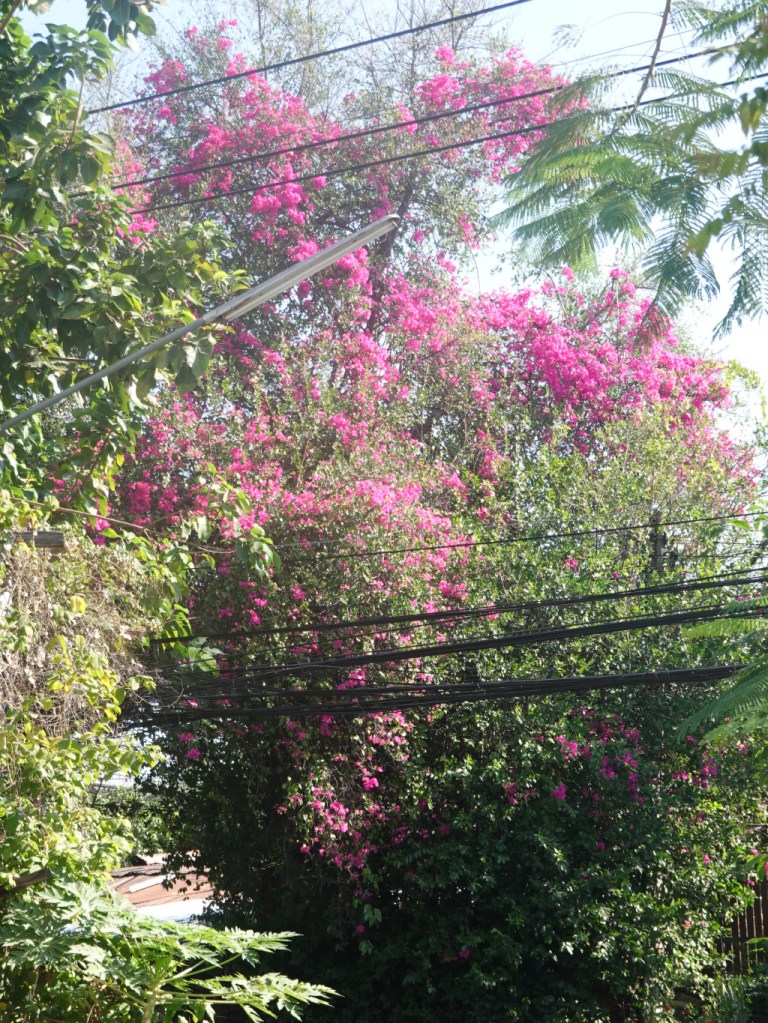
Bougainvillas
While bougainvilla plants are native to Mexico, Bolivia, Paraguay, Peru, Brazil, and Argentina (how did the plants skip Central America?), they are here in northern Thailand and seem to thrive in this climate. As I walked through the sois toward Tha Phae Gate and Tha Phae Road, I saw several bougainvilla plants, some small, some larger, and all beautiful.

Klong Mae Kha
I made a blog post recently about the improved walkway along the Klong Mae Kha north of Tha Phae Road to Wichayanon Road, near the French boulangerie Chouquette: https://james-intrepid-pilgrim.blog/2025/12/28/klong-mae-kha-north/. As I passed over the Klong Mae Kha on Tha Phae Road, I saw that the barricades were gone from the newly improved walkway on the Klong Mae Kha going south from Tha Phae Road. I was hoping that the improvements would extend all the way to Loi Kroh Road, but there is still a good way to go. The improvements go to a bridge which is also a lock gate on the klong. The lock has three gates, two of which are open – I did not even know that there were lock gates on the klong. So I walked on the newly improved Klong Mae Kha walkway to the locks, crossed over and walked back on the other side. Here is a photo of the locks and looking back down the klong when I got close to Tha Phae Road again.
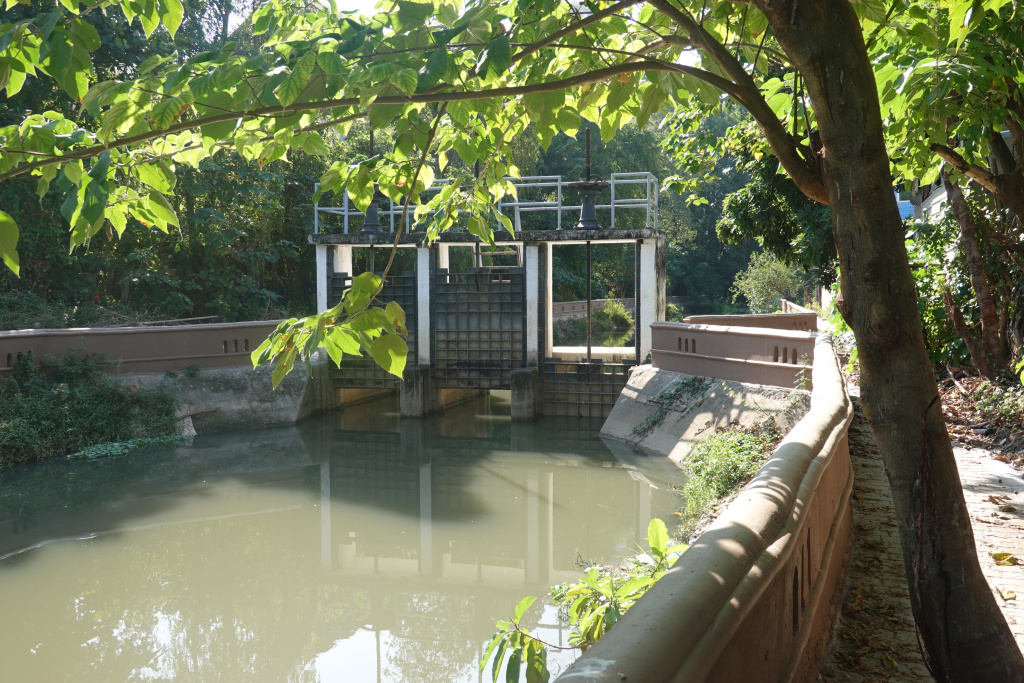
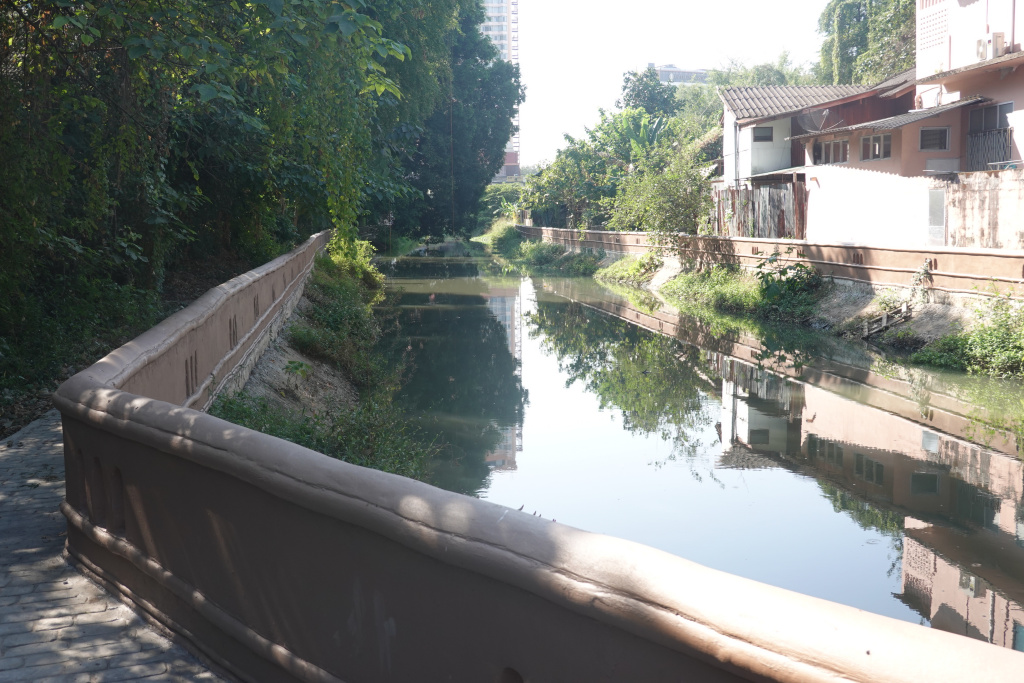
I’m hoping the project to continue clearing the walkways along the Klong Mae Kha continues. I am seeing more people starting to use these walkways.
Wat Upkhut
Continuing eastward along Tha Phae Road, just before reaching the Nawarat Bridge over the Mae Ping River, I passed Wat Upakhut (occasionally spelled as Wat Upakut). This temple is commonly referred to as the “temple with 1,000 Buddhas” because it has a small hall with a thousand Buddha images. During my infrequent visits the hall has always been closed, so I have not yet had the opportunity to view the 1,000 Buddhas.
Wat Upakut is always busy, and is said to be the site of many festivals since it is on the main road near the old commercial center of the town. Wat Upakhut was once larger, but part of its grounds and several structures were lost when the adjacent Puttasatharn Buddhist complex was constructed (no reference to a date has been found). Despite these reductions, the remaining buildings and surrounding grounds are well‑maintained. Over the many years I have visited, the temple has never appeared to require major cleaning or renovation.
Photographing the entrance presents a challenge because the temple fronts a busy thoroughfare that can be described as four or five lanes (the definition of “lane” is somewhat ambiguous in Thailand, as are the sidewalks). I did get this photo of part of the Naga‑guarded entrance. And because I was practically looking into the sun, the glare was almost inevitable.

Probably because the temple grounds were reduced, everything seems a bit crowded inside the temple.
Phrea Mae Thorani
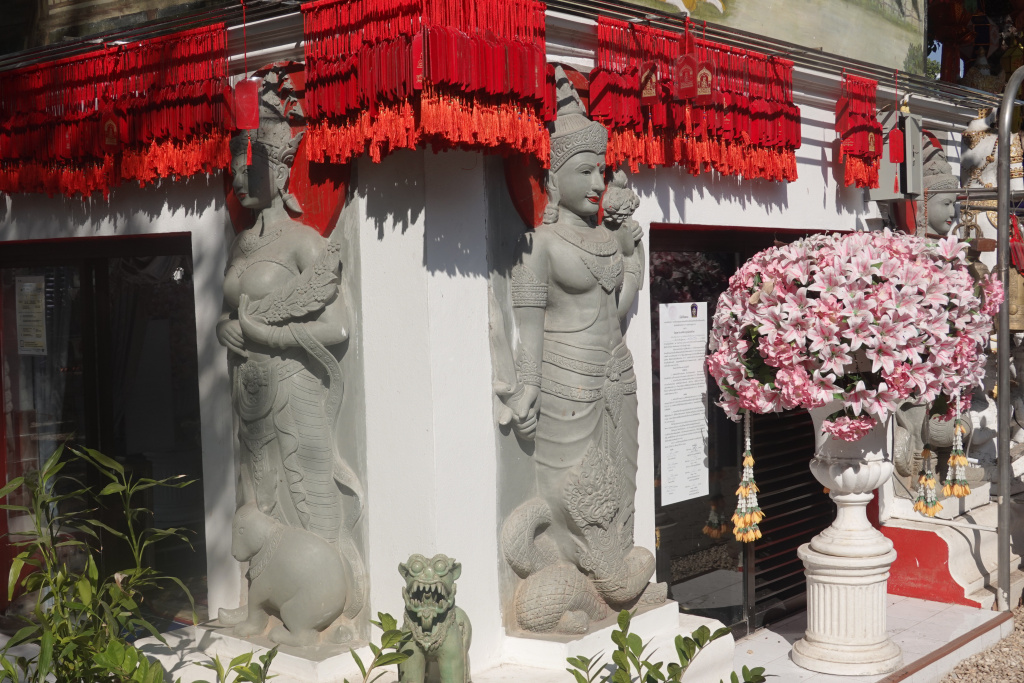
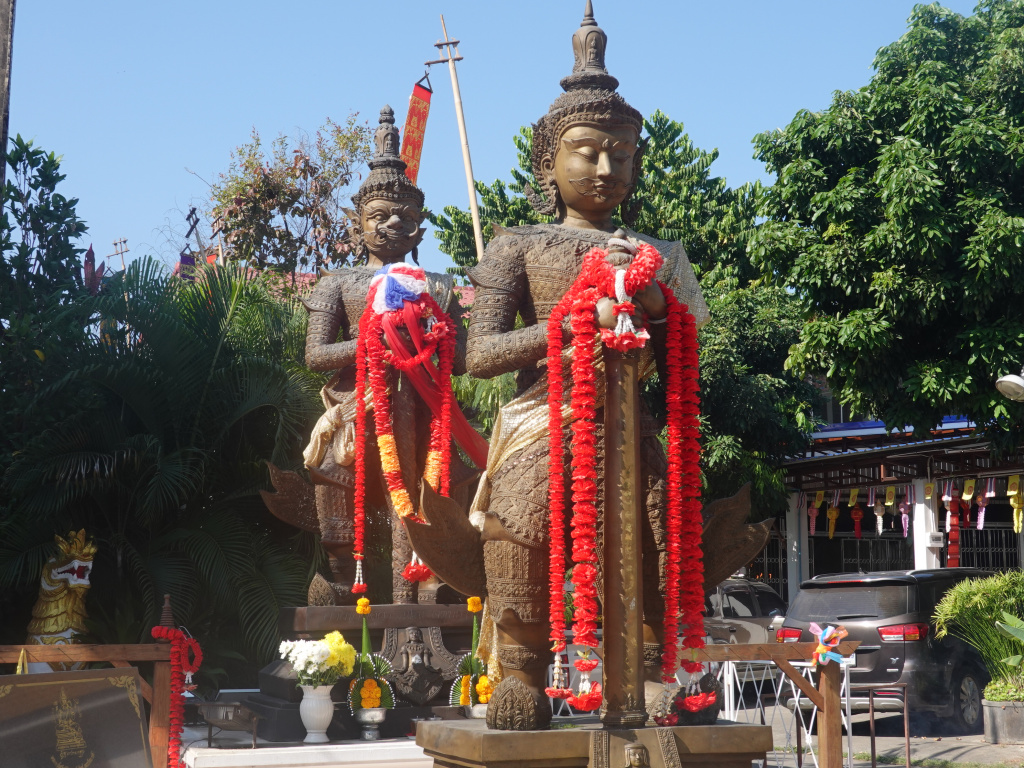
Inside the temple grounds is one of my favorite statues of Phrae Mae Thorani, or the Mother Earth Godess. A quote from Wikipedia:
Images of Preah Thorani are common in shrines and Buddhist temples of Burma, Cambodia, Thailand, and Laos. According to Buddhist myths, Phra Mae Thorani is personified as a young woman wringing the cool waters of detachment out of her hair to drown Mara, the demon sent to tempt Gautama Buddha as he meditated under the Bodhi Tree.

The gray images at Wat Upakhut are unusual at Buddhist temples, and they appeal to me, maybe because they are less common. Here is a photo of the gray thewada (angelic beings who live in the heavenly realms) on the side of the viharn (assembly or worship hall). A note: I have read and been told that thewada have no gender and can appear male or female depending on the artist and the context. I always like the appearance of these carved thewada at Wat Upakhut.
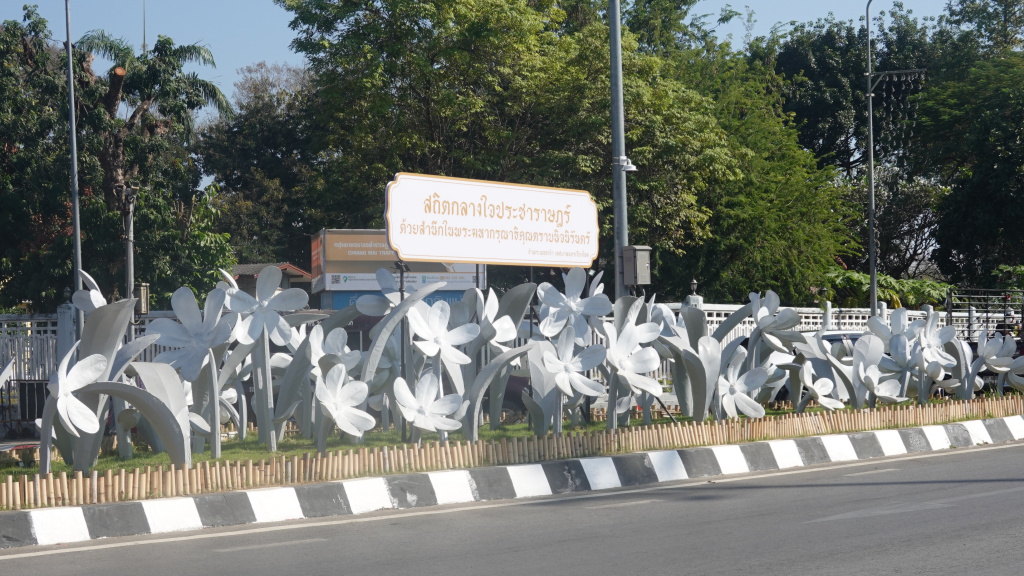
Leaving Wat Upakhut, I noticed a flower sculpture in the middle of the road close to the Nawarat Bridge. I don’t remember this from before, and I also do not think it is new. (Maybe I need to keep my eyes open and look around more.) I do like its look.
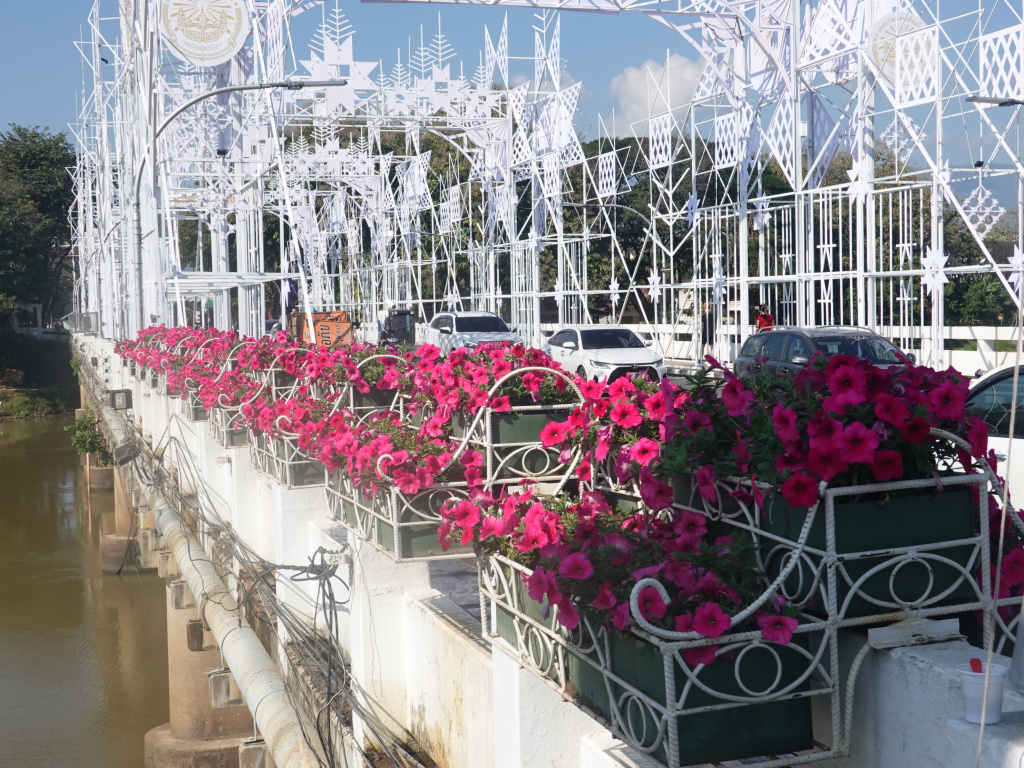
Continuing over the Nawarat Bridge, called Sapphan Nawarat in Thai, I always love how it is kept decorated with flowers. So I took a photo. There is a little more about the history of the Nawarat Bridge in this blog post of mine: https://james-intrepid-pilgrim.blog/2025/01/02/railway-station-walk-2-nawarat-bridge/
Wat San Pa Khoi
After crossing the bridge, I turned off the main road to visit a temple I like. Wat San Pa Khoi is a relatively local temple, that is, used by the locals and not on tourist maps. Like last year, there are many cars in the parking lot, but I saw no people the entire time I was there.
By the viharn (worship hall) are these two rustic-looking statues. I can find nothing indicating who they are or what they are. The look like or are similar to yaksha, but different. Regardless, I like them, so a photo was in order.
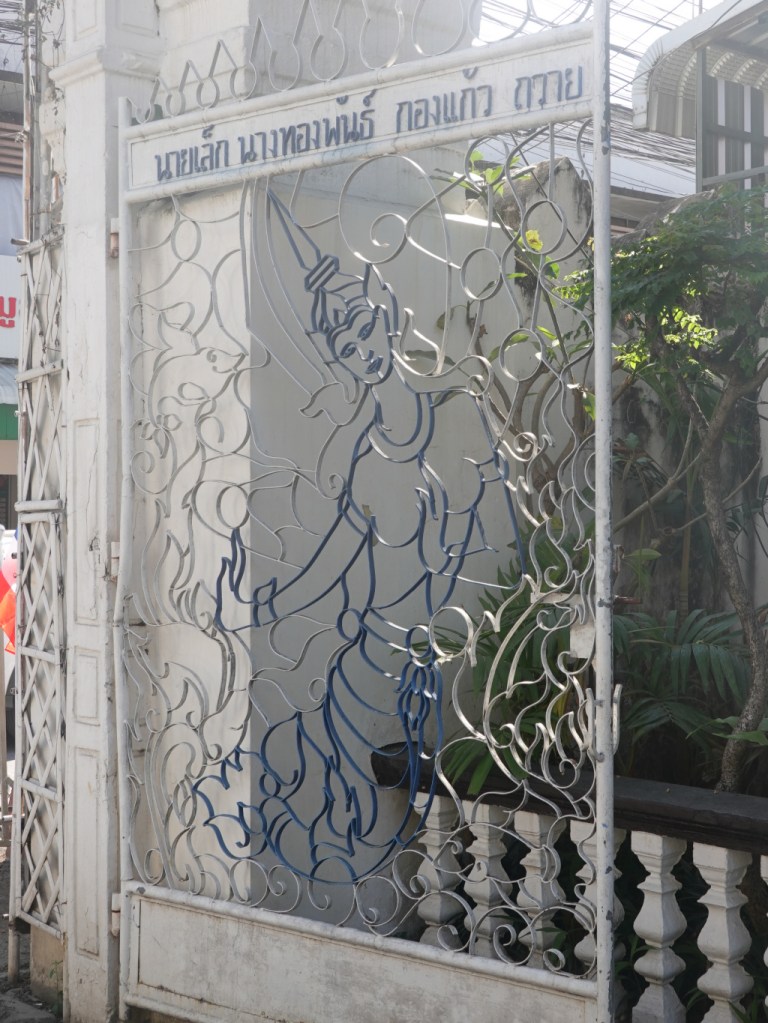
A color I seldom see at temples here is blue. There is a lot of red, a lot of gold, some green, some yellow, and less purple. The ubosot at Wat san Pa Khoi had a subtle but clear blue theme to it, with the blue thewada (angels), the blue of the gate, the fence, and blue in the artwork over the entrance. I noticed this blue because I so seldom see blue at temples here.

Continuing that subtle or not-so-subtle blue theme is the artwork and writing on the front gates. It is a little hard to see the thewada silhouette in the metalwork of the gate. The writing is more obvious.
Next: Back to the main road and the Chiang Mai Railway Station

 James the Intrepid Pilgrim