Monday 15 December 2025
Returning to an important historic temple
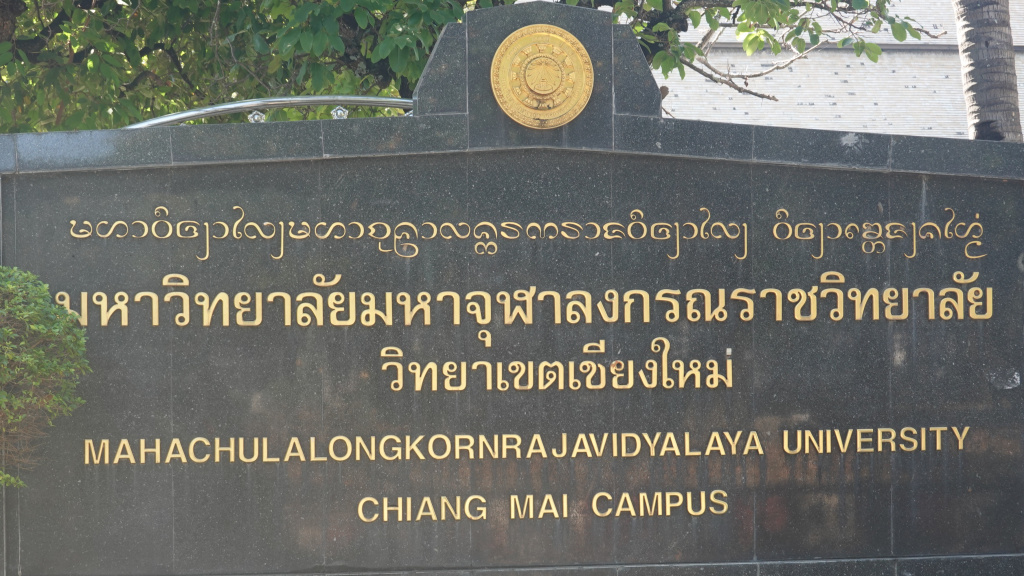
Continuing my walk west on Suthep Road, eventually I came to the historic Wat Suan Dok. The temple campus is also the home of a university. Several of the more significant and large temples also have a four-year, accredited university on their campus. So, while frequently very quiet and peaceful, at times, the temple area is quite busy. The English translation of the name is long. It can be broken down “Maha” means “grand” or “great.” “Chulalongkorn” is the name of King Rama V, a highly-regarded King of Siam in the last half of the 19th Century. “Rajavidalaya” essentially translates to “Royal University.” Maha Chulalongkorn Rajavidalaya University is a well, known and highly regarded royal university in Thailand specializing in Buddhist studies and religious education.
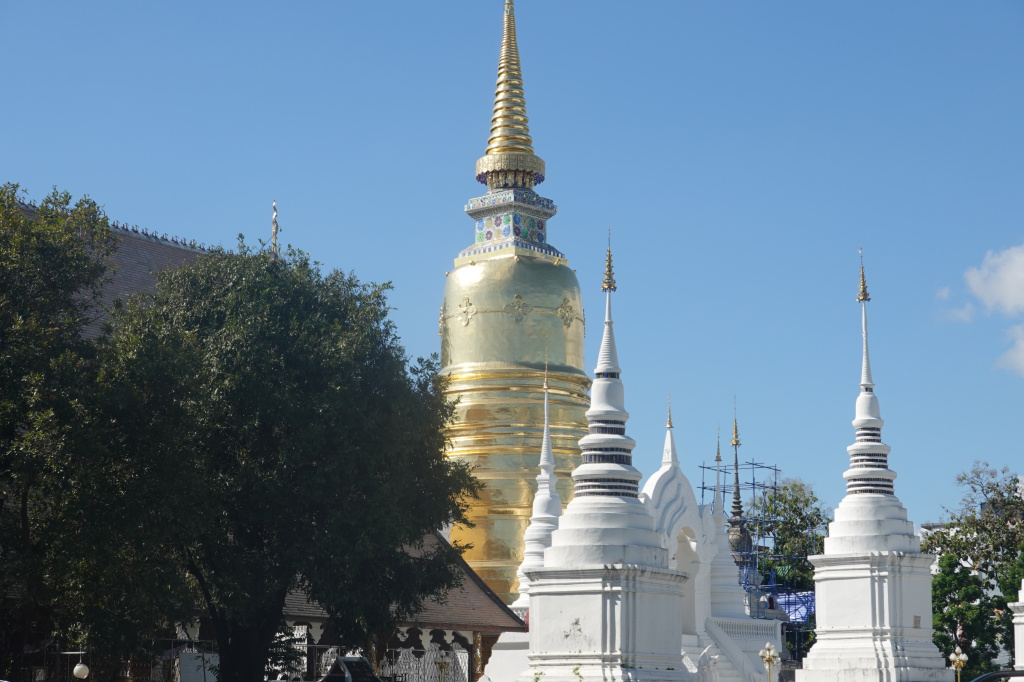
The first view of Wat Suan Dok from the road entrance is of the large viharn (assembly hall) behind the trees and the historic large gold chedi.
Wat Suan Dok Legend
A legendary story links Wat Suan Dok to the Wat Phra That Doi Suthep, temple near the top of the nearby mountain.
In the mid‑1300s, a monk from the Sukhothai kingdom named Sumanathera dreamed that he should travel to Pang Cha to seek a relic. There he discovered a bone that many believed to be a shoulder bone of Gautama Buddha. According to the legend, the relic possessed magical powers: it glowed, vanished and reappeared, moved on its own, and could even replicate itself.
Sumanathera brought the relic to King Dhammaraja, the ruler of Sukhothai. In the presence of the king, the relic displayed none of its miraculous abilities. Skeptical of its authenticity, King Dhammaraja told Sumanathera to keep the relic and dismissed him.
In 1368, King Nu Naone of Lanna heard of the relic and invited Sumanathera to Chiang Mai, requesting the relic in the hope of using the relic as a mechanism to spread Theravada Buddhism. And a plaque at Wat Suan Dok states that the temple was “the first temple in the Lanna Kingdom to be built according to the belief of Theravada Buddhism.”
When the relic was shown to King Nu Naone, it exhibited its magical powers. So King Nu Naone ordered a chedi to be constructed at Wat Suan Dok to house the relic. As the chedi neared completion, the relic split into two pieces. The smaller fragment was placed inside the new chedi at Wat Suan Dok, the large gold chedi seen today.
The larger fragment was affixed to the back of a royal elephant, which was then released into the jungle. The elephant, followed by the king and his cavalry, climbed the mountain now known as Doi Suthep. Near the summit it halted, trumpeted three times, and died. King Nu Naone subsequently commissioned a temple and a chedi to enshrine the relic at that spot. This temple became the very famous Wat Phra That Doi Suthep.
Today, thousands of tourists—both foreign visitors and Thais—travel daily to Wat Phra That Doi Suthep. While the site is a sacred Royal Temple of the Second Class, relatively few tourists also visit Wat Suan Dok, despite its pivotal role in the legend.
Wat Suan Dok Today
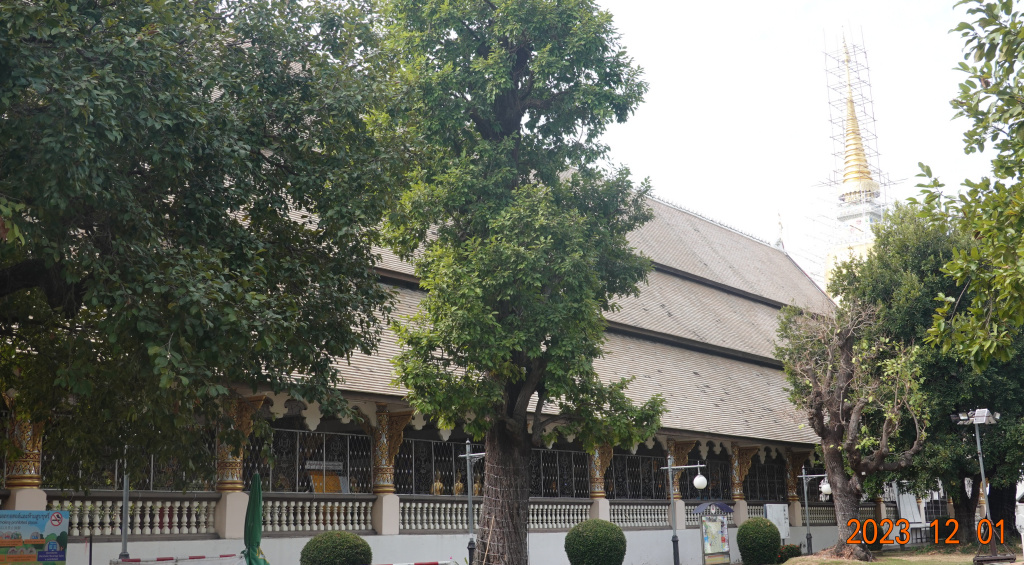
Getting closer to the Wat Suan Dok viharn, I did not get a good photo of the building. Here is a photo I took a few years ago giving an idea of the size of the large viharn through the trees. It can also be seen that the top of the chedi in the background is still surrounded by scaffolding from the most recent restoration.
As is common with almost all temples, Wat Suan Dok has undergone many restorations in its history. Here is a photo from the 1930s by Edward Walter Hutchinson. The chedi is not yet gold (although difficult to tell in a black & white photo), and the large size of the viharn is evident. The gilding of the chedi turning it from white to gold took place during a renovation approximately 10 years ago.

I have posted many, many photos in the past of Wat Suan Dok, and I always love coming to this temple. I will post just a few I took today and try to keep it brief. While Wat Suan Dok is seldom busy, inside the feel is quiet and reverent.
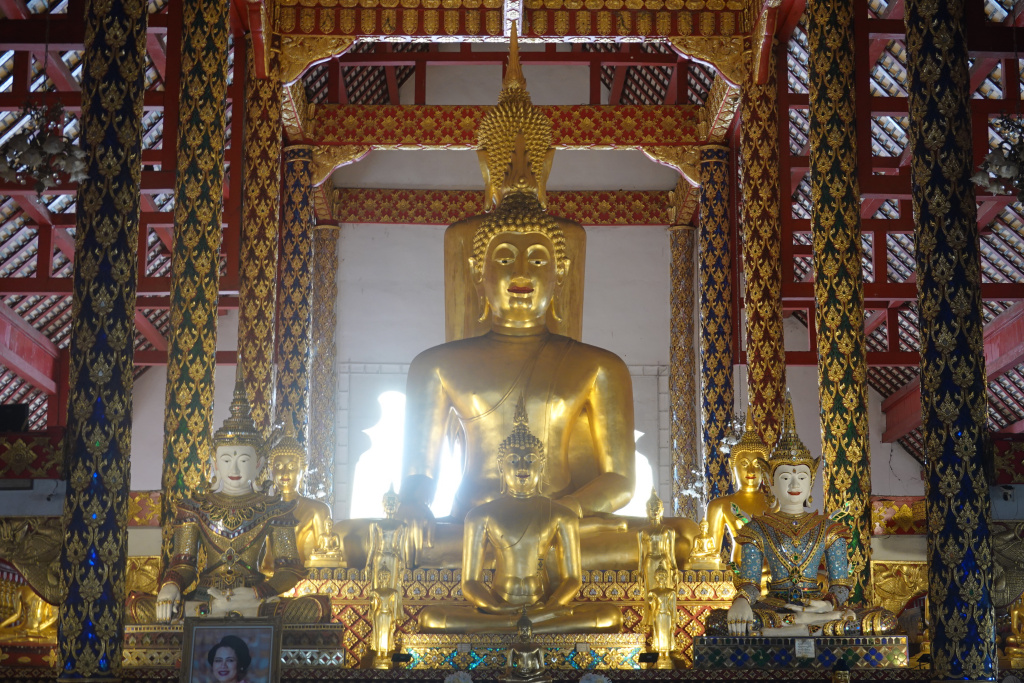
First, inside the viharn. This is a large structure. It could easily hold several hundred people. And, I have seen it quite full at least twice while an event was taking place.
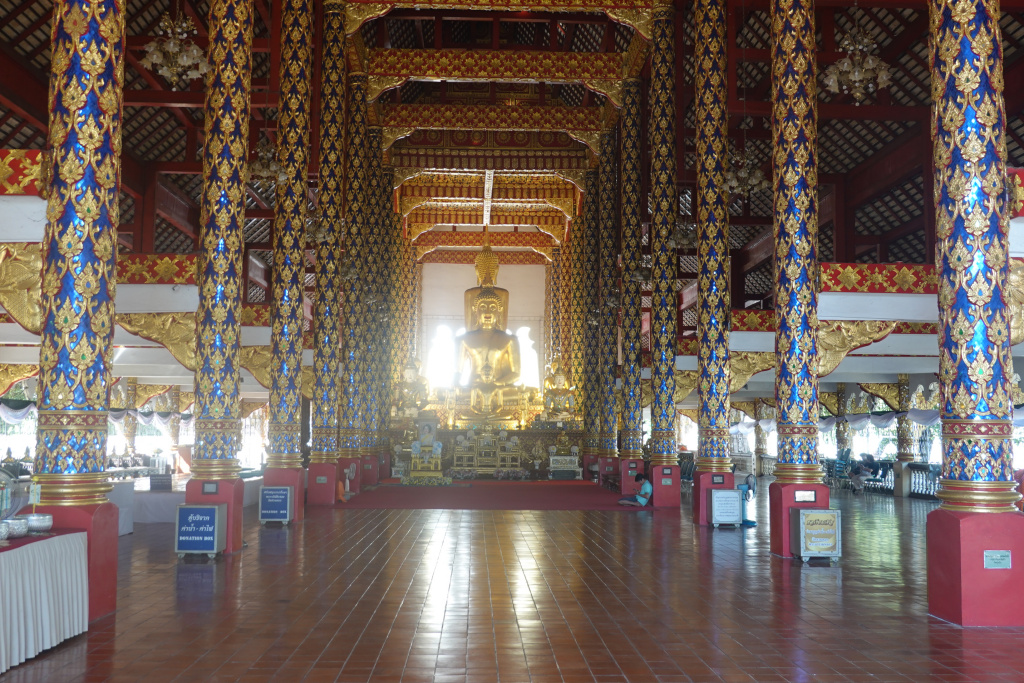
A closer, direct view of the Buddha images on the altar, and a slightly angled view of the same.
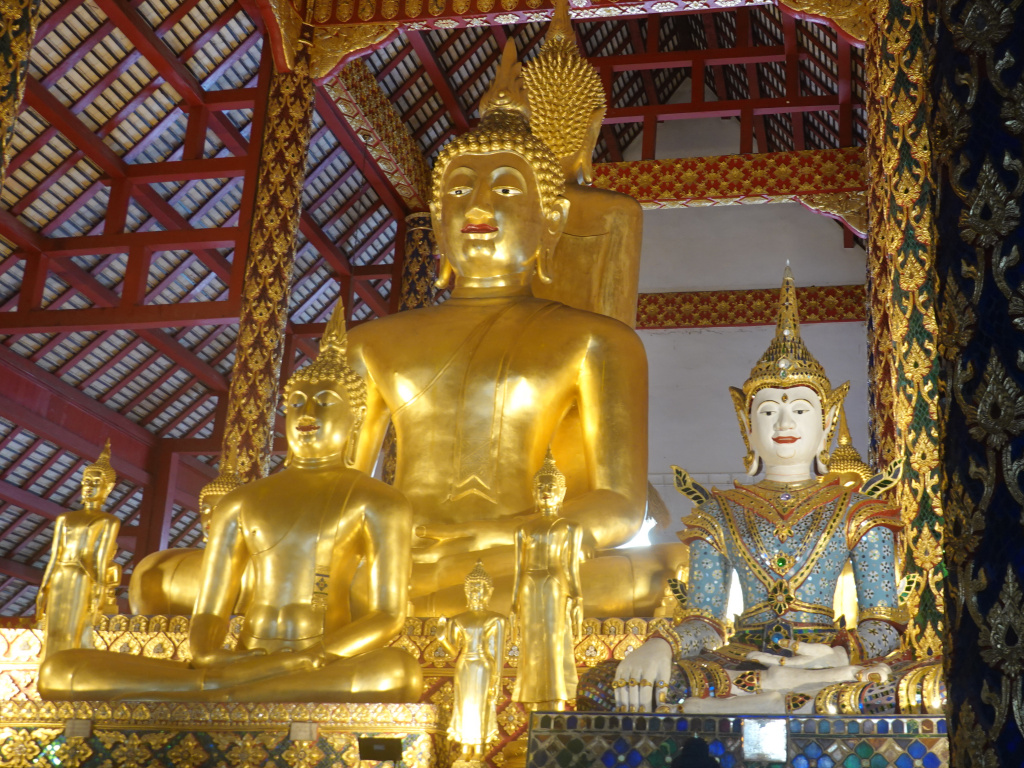
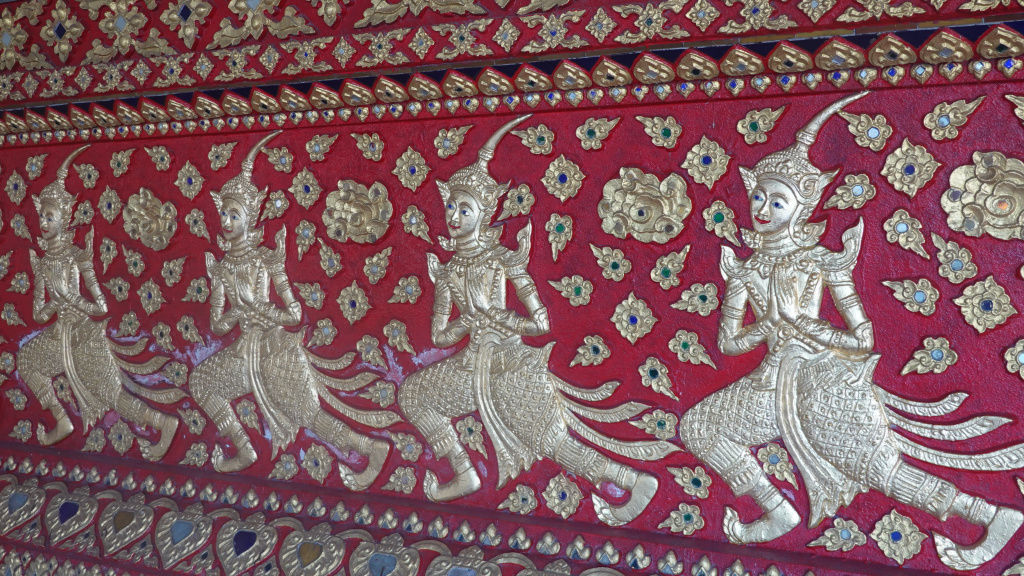
Walking to the back, I always smile when I see the dancing thewada (a thewada is an angelic being who lives in the heavenly realms) along the altar structure.
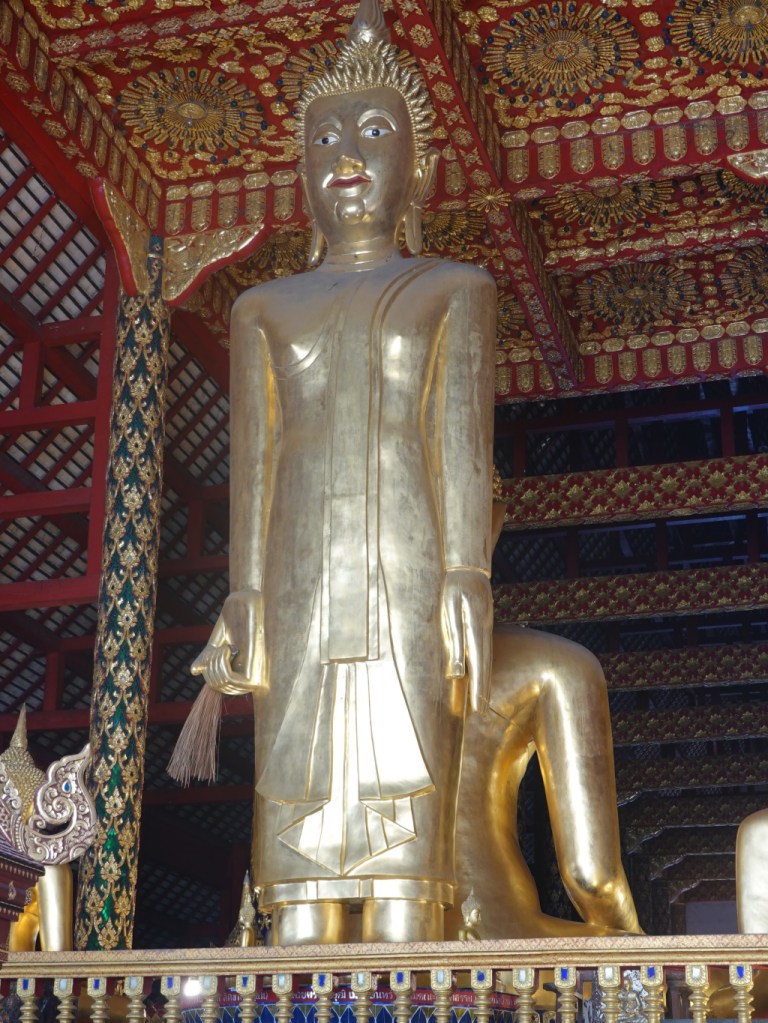
An unusual characteristic of the viharn at Wat Suan Dok is that the top half of the back is open to a view of the large gold chedi. And behind those seated Buddha images on the altar is this dramatic standing Buddha gazing out to the chedi.
Wat Phra Chao Kao Tue
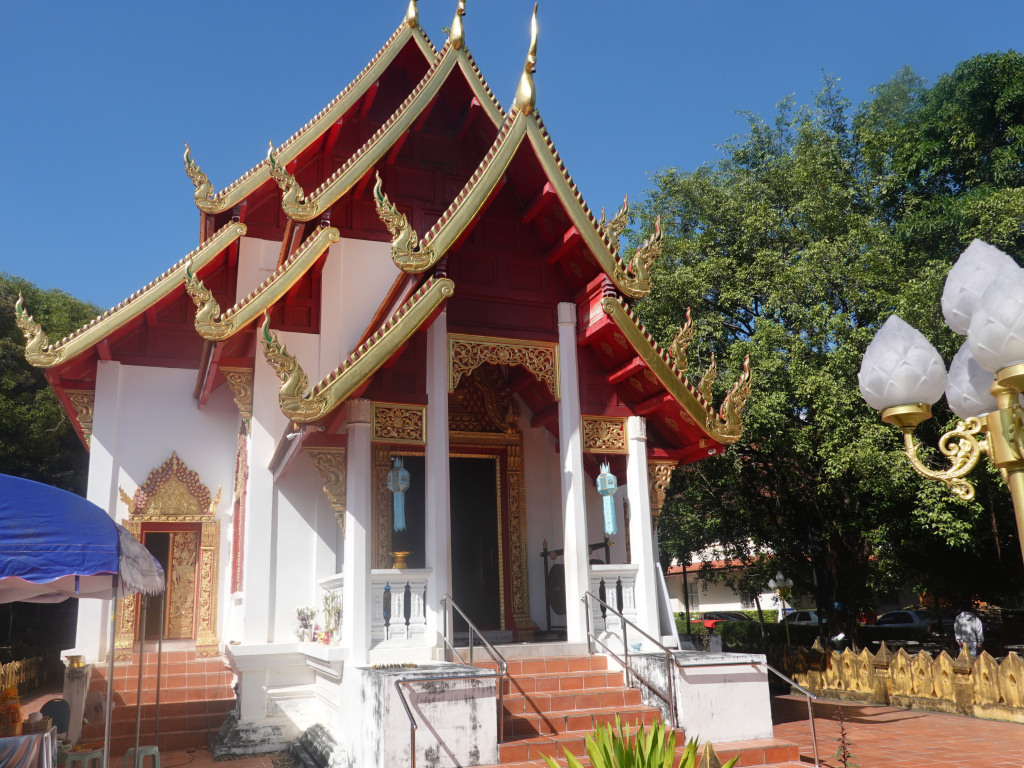
Just a short walk south of the main Wat Suan Dok complex lies a modest temple known as Wat Phra Chao Kao Tue, or simply Wat Kao Tue. It is unclear whether it was a separate temple from Wat Suan Dok, or always part of the larger Wat Suan Dok temple. Wat Kao Tue has a single, relatively small viharn that was completely renovated three to four years ago (at least since my first visit). Inside, the focal point is the Prajoe Kao Tue Buddha statue, which carries an intriguing piece of history.
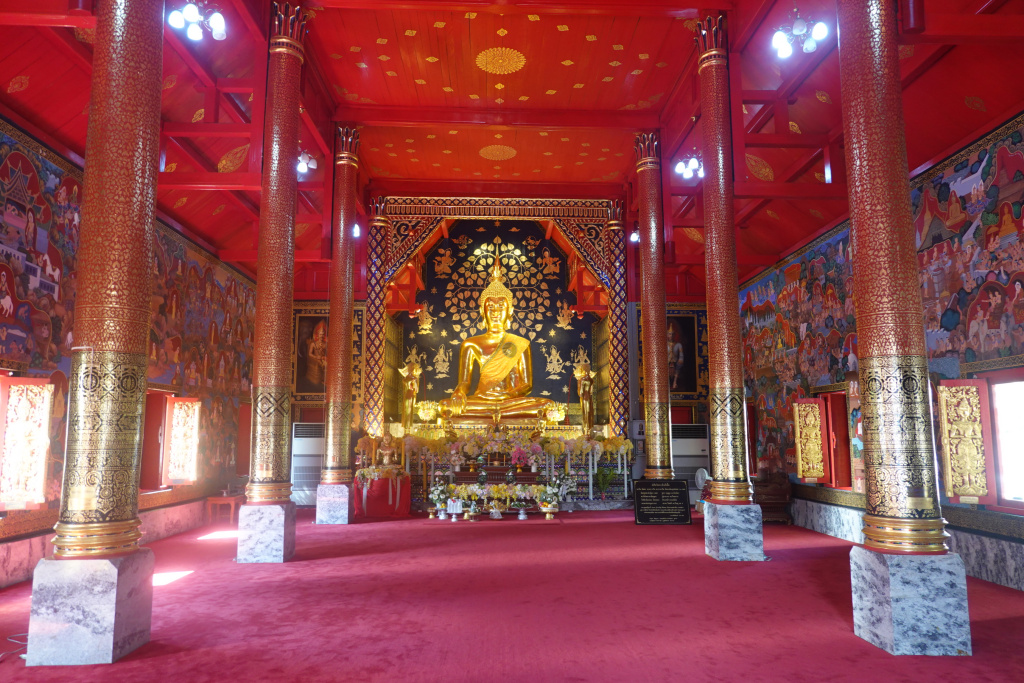
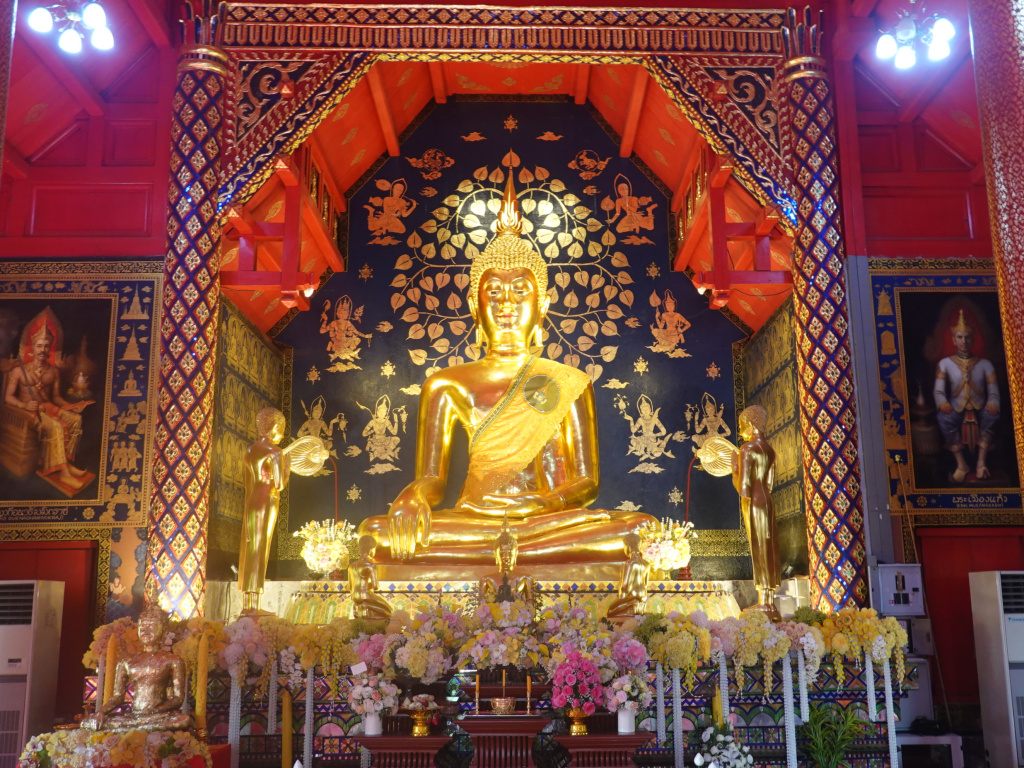
According to information displayed at the temple, King Muang Kaew (ruled Chiang Mai 1495‑1525) commissioned a craftsman from Chiang Saen to create this statue 1n 1504. The king originally planned to relocate it to Wat Phra Singh, but the statue proved too massive to move safely. Consequently, he chose to construct an ubosot on the spot to house the Buddha permanently. The Prajoe Kao Tue Buddha is a large, 4.7-meter-tall (15.4 feet) bronze Buddha statue. It is a masterpiece blending Sukhothai and Ayutthaya artistic styles, with elongated finger phalanges characteristic of Sukhothai and clothing features reflecting Ayutthaya influence. The statue is made up of nine pieces and is revered as a significant cultural and religious artifact.
When I first discovered Wat Kao Tue, a Thai lady with whom I spoke told me that this Buddha was considered to be the most beautiful in all of Lanna (northern Thailand). She was very proud, and pleased that a foreigner had found and appreciated the temple.
The viharn at Wat Kao Tue, clean and bright after the recent remodel:
Inside the viharn and a closer view of the Prajoe Kao Tue Buddha:
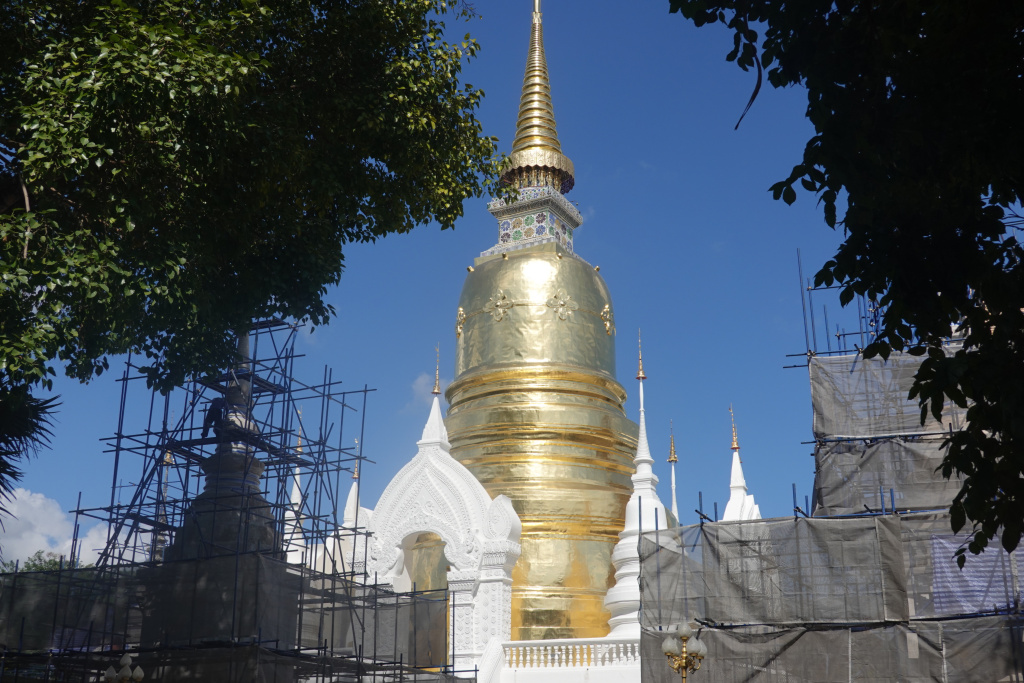
Walking back to the main part of Wat Suan Dok and the main road, I took another photo of the large gold chedi. The smaller chedi structures surrounding it are under renovation, and I saw many men climbing up the scaffolding.
I also learned that Wat Suan Dok was a small city at one time, 570 meters square (0.35 miles) with a wall surrounding it. I am very curious about whether any of that wall remains-this warrants further investigation. Nevertheless, I walked out of the campus through what might have been one of the original gates in that wall. And there is a bit of a wall on both sides of the gate. More to come on this concept.
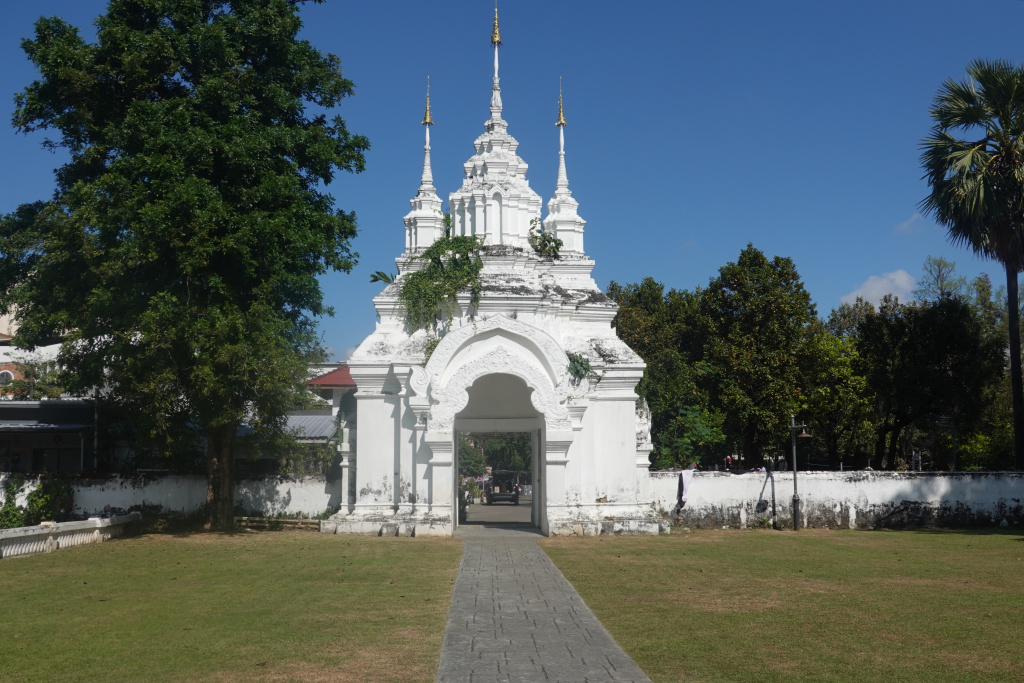
Visiting Wat Suan Dok is always interesting and as many times as I have been there, I always see it a little differently or learn something new.
Next:
– Short visit to Wat Phra Singh
– Klong Mae Kha north of Tha Phae Road
– A Day in the Life…

 James the Intrepid Pilgrim