Monday, 1 December 2025
Almost abandoned temple near Suan Prung Gate
It seemed to be time for a haircut, so after a strength-training session with Ning at Pump Fitness, I walked to Suan Prung Gate. The Samlaan Barber I see is a very short distance inside the gate.
Wat Phuak Hong, The Temple of Swans, is what I call a small, local temple, seldom visited by tourists and primarily for the people living nearby. I first found the temple years ago when I visited the Samlaan Barber, whose shop was on the soi leading to the temple (now moved across the main street). From the first time I saw Wat Phuak Hong, it looked practically abandoned – the grounds are generally unkempt, the viharn (assembly or worship hall) doors are always closed and chained shut, and the chedi has grasses and weeds growing at many places.
In my research, I found no date when this temple when this temple was founded or constructed. One reference indicated that it was at least 600 years old, and another that it was likely built in the 16th or 17th centuries.
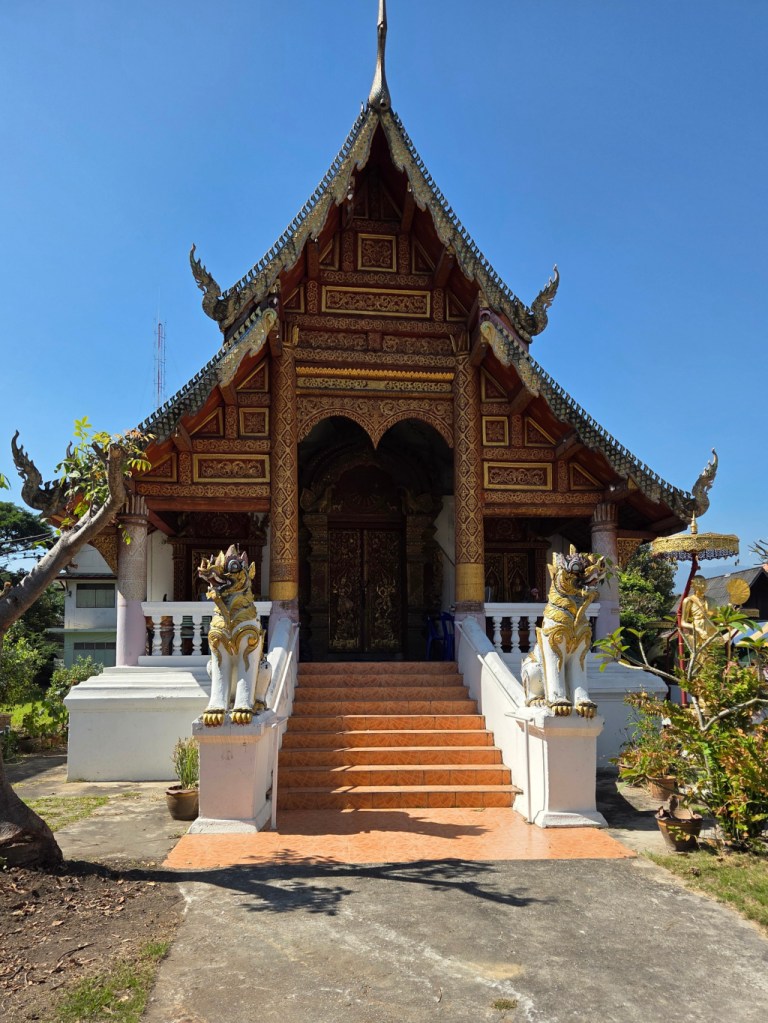
The entrance to the temple is guarded by a pair of Chinthe mythological lions, which is frequently an indicator of Burmese style temples. Although the roof looks very much Lanna-style to me.
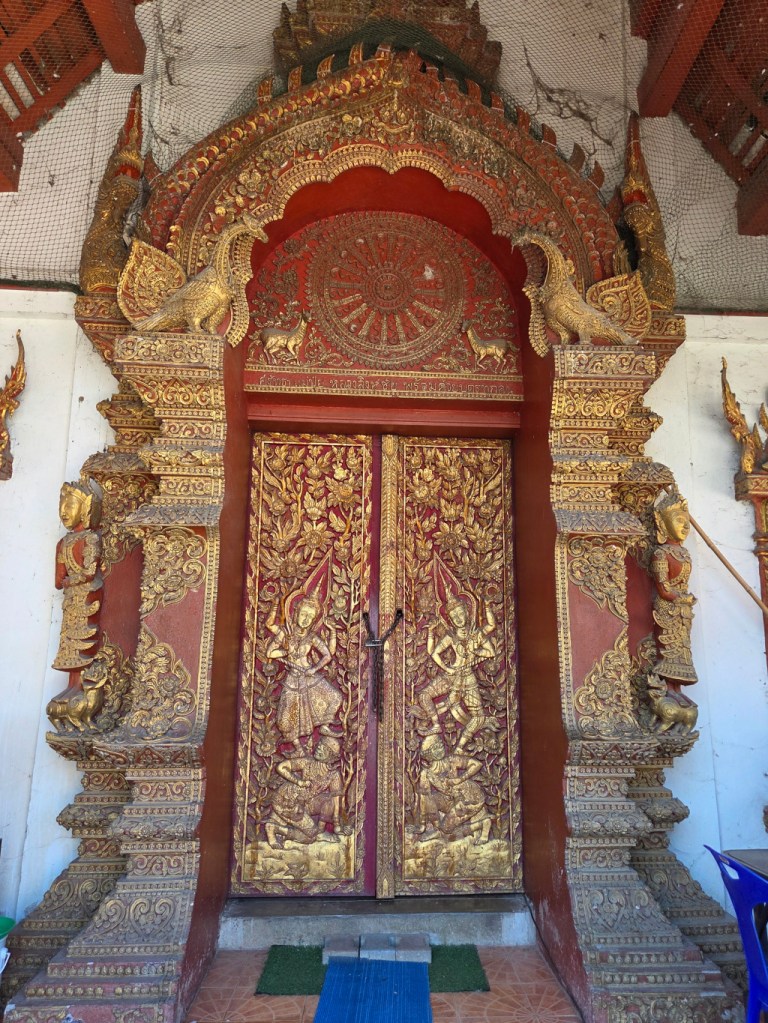
The thewada (angelic beings that live in the heavenly realms) dancing on the yak on the viharn doors reminds me of the similarly devorated doors at one of the viharn at Wat Phra That Doi Suthep.
Chedi Si Phuak Hong
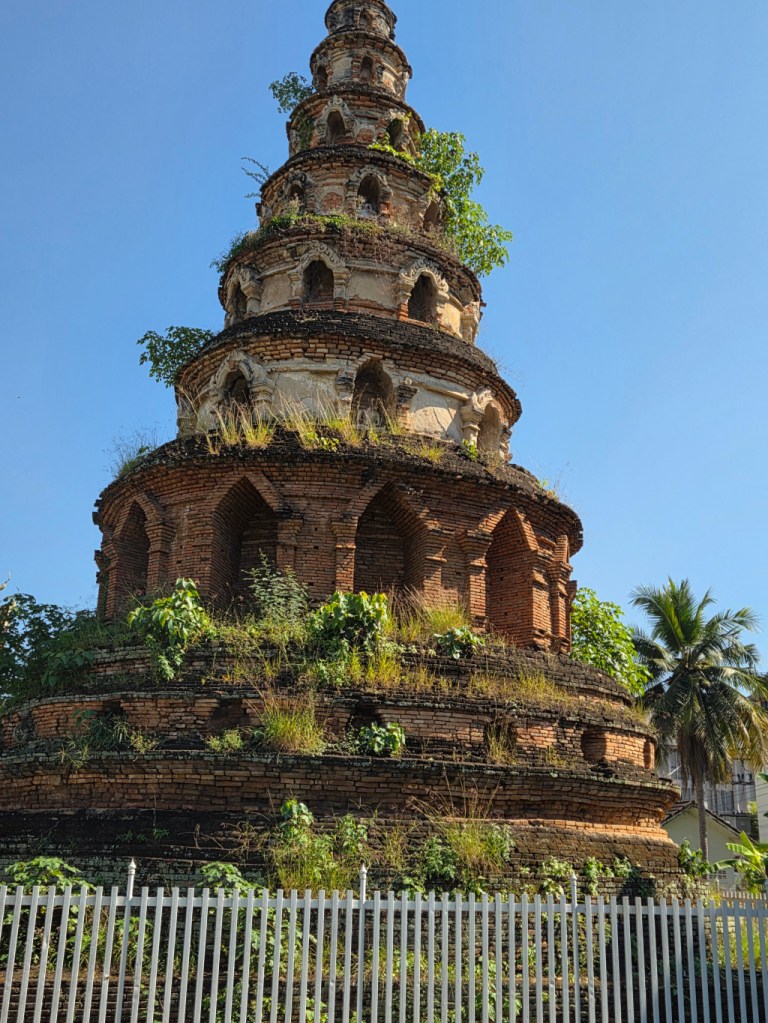
At the back of the viharn, as is customary, is the chedi named Chedi Si Puak Hong. It is said to have been built in the 16th or 17th century. Its style differs from other chedi in North Thailand. It is circular with eight circular levels rising in diminishing size, and each level has niches for Buddha statues. Its appearance reminds one of a wedding cake.
A few similarly styled chedi do exist in Chiang Mai. The chedi at Wat Santitam north of the old city, and the chedi at Wat Chedi Liam in Wiang Kum Kam are two examples. They are square-shaped compared to the round shape of the Chedi Si Phuak Hong. I found the following quote (but lost the reference), “It was either influenced by Yunnanese architecture (southwestern China) or it is a circular version of the stepped Mon chedi of the Wat Ku Kut in Lamphun.”
The near-crumbling Chedi Si Phuak Hong has continually deteriorated (as has the whole temple) over the years I have visited. On a close look, it appears to have been repaired and/or renovated more than once, with a mixture of old and new bricks. Weeds, shrubs, and plants sprout from the brickwork. Its condition saddens me.
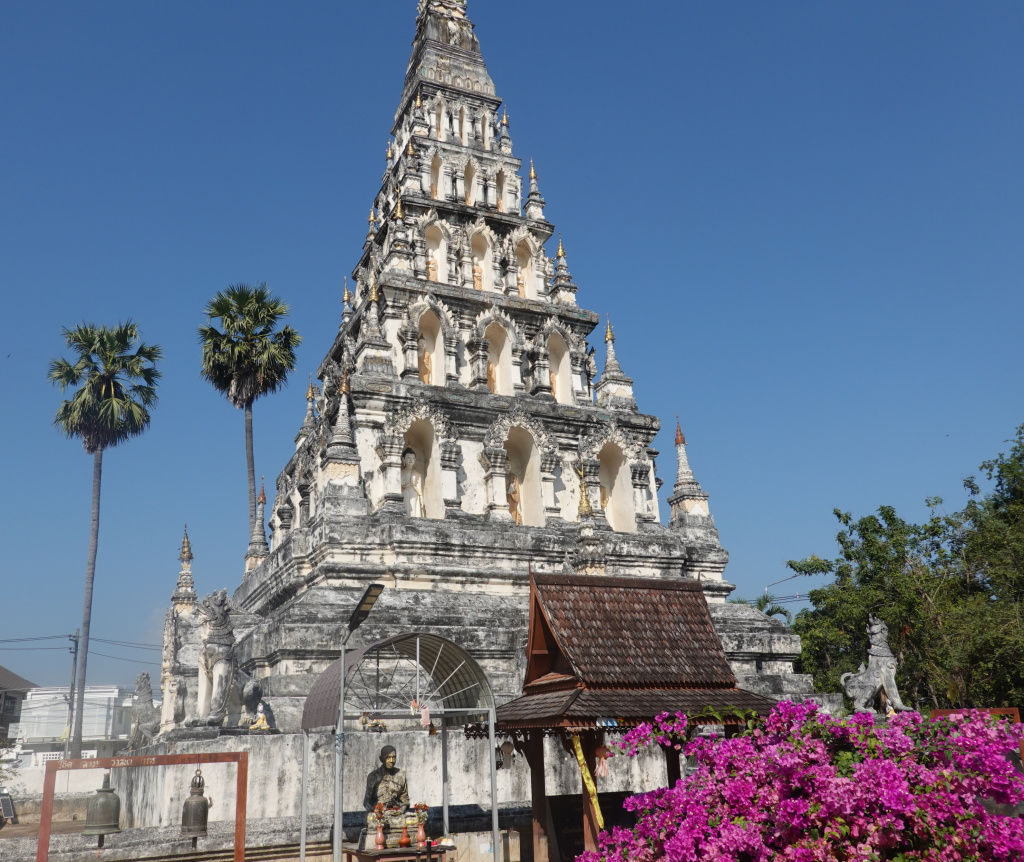
The two similar chedi in the Chiang Mai area are the chedi at Wat Chedi Liam in Wiang Kum Kam, and the chedi at Wat Santitham just north of the walled city of Chiang Mai. At first look, they are quite different: the chedi at Wat Phuak Hong is round, while the other two are square. But the layers with niches are very similar. Construction of the chedi at Wat Santitham started in 2014 and was completed in late 2022 or early 2023. The chedi at Wat Santitham was deliberately styled after the chedi at Wat Chedi Liam, and the similarity in the photos reflects that.
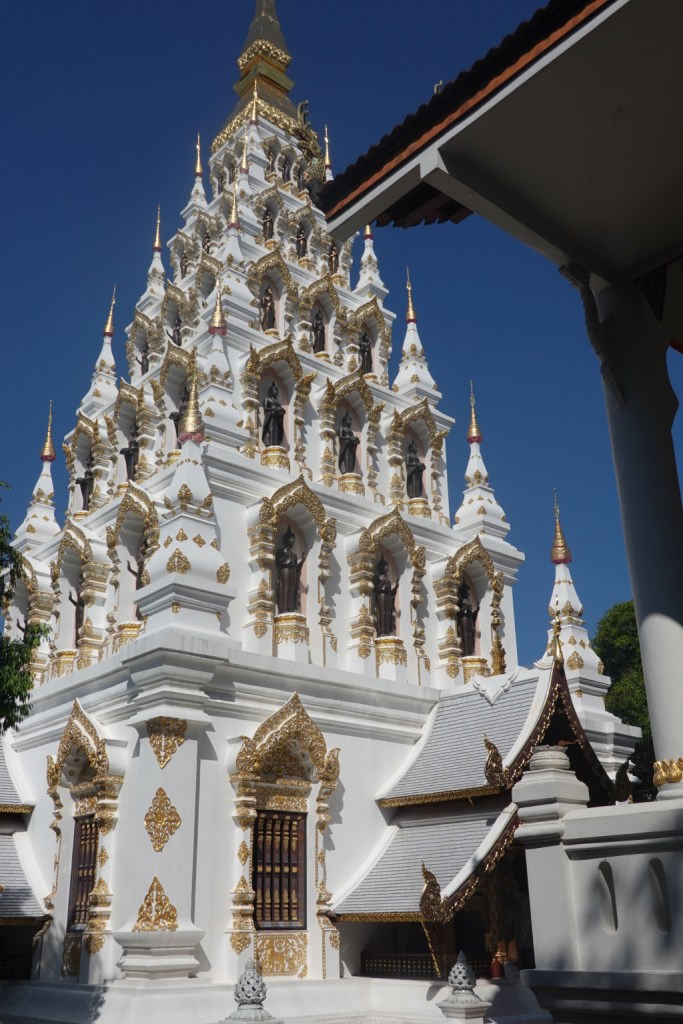
I keep hoping for a renovation project at Wat Phuak Hong. This is a unique temple and deserves better than the gradual deterioration I have seen over the years.
Next: Hike up the Monks Trail to Wat Phalad

 James the Intrepid Pilgrim