Friday, 28 November 2025
Return to Wat Pan Tao across the street
Wat Pan Tao
Directly beside the famous Wat Chedi Luang on on Prapokkloa Road is Wat Pan Tao (sometimes spelled Wat Phan Tao), a very old temple in Chiang Mai. It was originally founded in the 14th century as a living quarters for the monks of Wat Chedi Luang. The name Wat Pan Tao is said to translate to “temple of 1000 kilns” referring to the ovens that were once here for casting Buddha images long ago.
Later, from about 1846 to 1854, the temple was used as a royal palace (ho kham) by Chao Mahawong of the Chao Chet Ton Dynasty. Following the expulsion of the Burmese from Siam in 1876, the Siamese Chakri Dynasty of Bangkok annexed the former Lanna Kingdom (northern Thailand). Chao Mahawong became the ruler of Chiang Mai and the former Lanna Kingdom, now part of Siam. In 1876, the royal residence was demolished, and new temple buildings were constructed in its place. The teak from the old palace building was used to construct the current viharn.
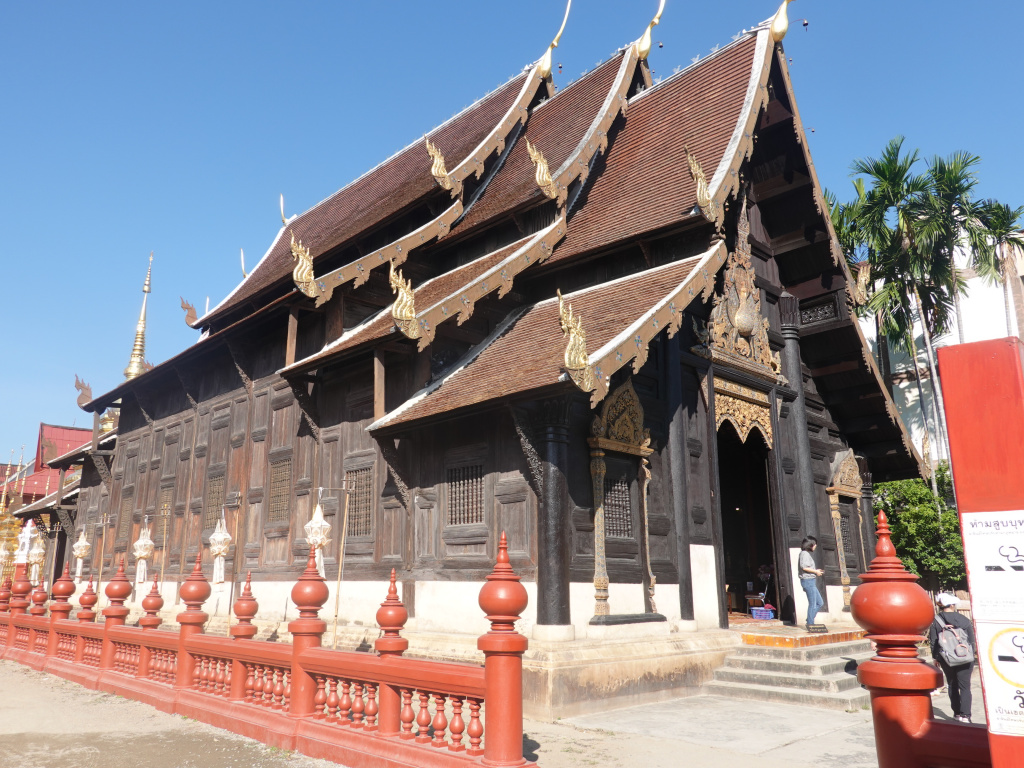
A plaque near the entrance of Wat Pan Tao states that the viharn (prayer or worship hall) is “the most beautiful teak viharn in Chiang Mai”. It is unclear whether this applies to the very plain, unfinished exterior, or to the finished and ornamented black laquered interior. I like both, the rustic appearance of the exterior gives the viharn a mature character. The dark, rich tones of the interior give it a respectful, reverent look.
There is a narrow pedestrian entrance on Prapokkloa Road and much of the front wall is red, the same color as the top of the chedi before the chedi was clad in all gold in about 2019. Here is a photo of the unfinished exterior of the viharn.
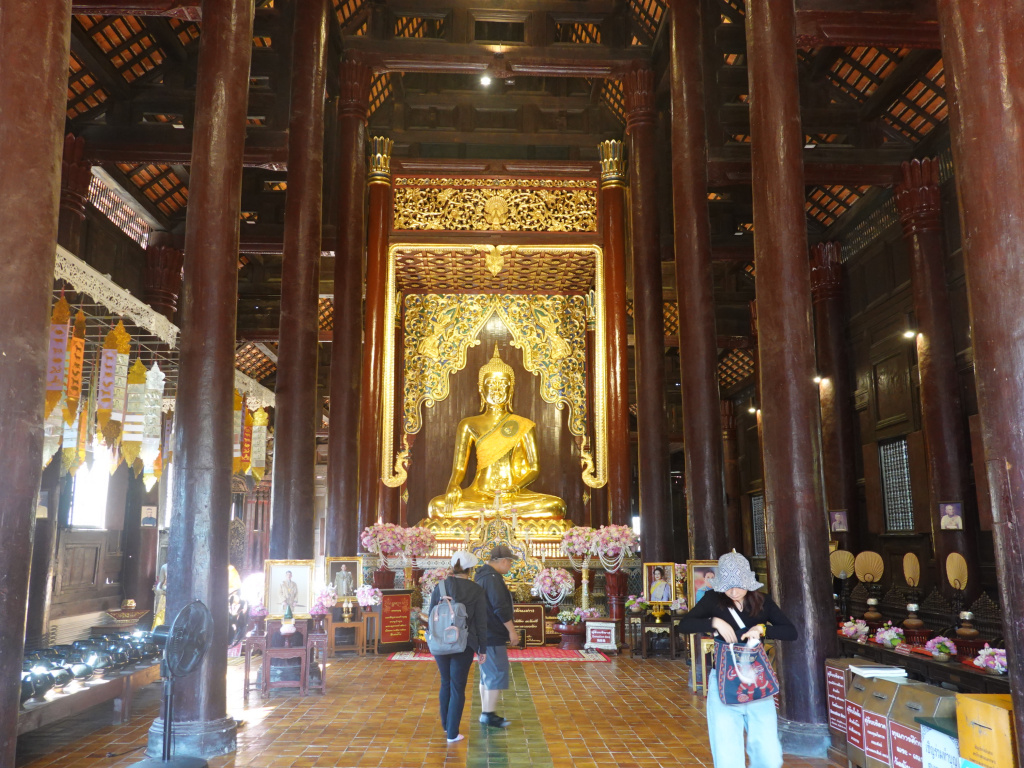
Inside the viharn, Darkness encourages pious worship and reverence, and inside it’s dark enough, being a teak building. One leading guidebook describes the viharn as “without doubt the most atmospheric wat in the old city”. Unfortunately, the floor tiles were replaced between my very first visit in 2003 and my return in 2012. The old floor tiles were a rich, rustic blue and red, so beautiful that I took a photo of the floor. (Unfortunately, I do not have that photo with me; perhaps I’ll add it back when I return home.) Now, in what is more a traditional yellowish-brown and green, the floor tiles seem to be wrong for the building. The thick teak columns have a pleasing, natural appearance, having been left without adornment in keeping with the rest of the building.
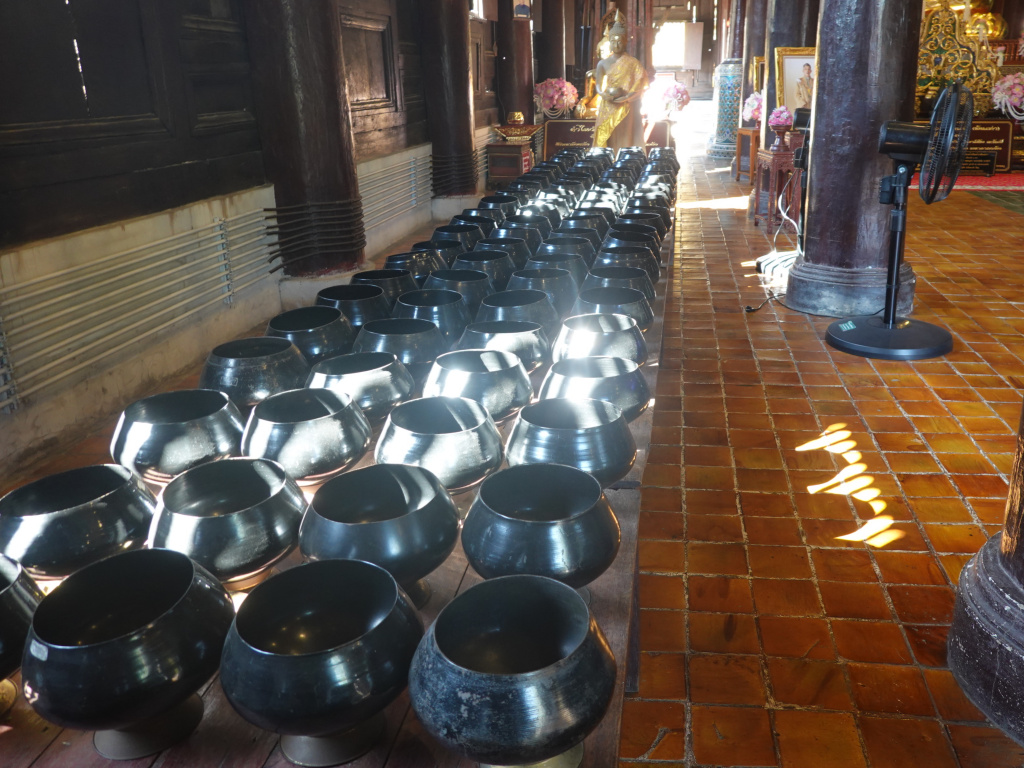
In keeping with the ever-present idea of donation (making merit), off on the left of the viharn are many donation bowls.
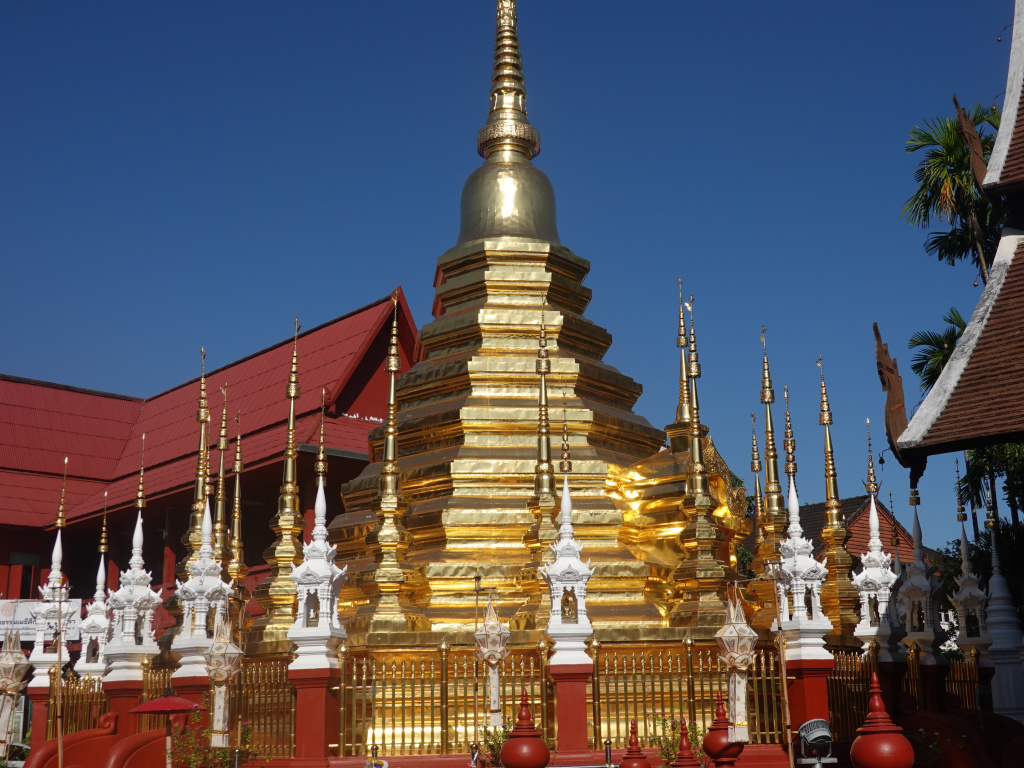
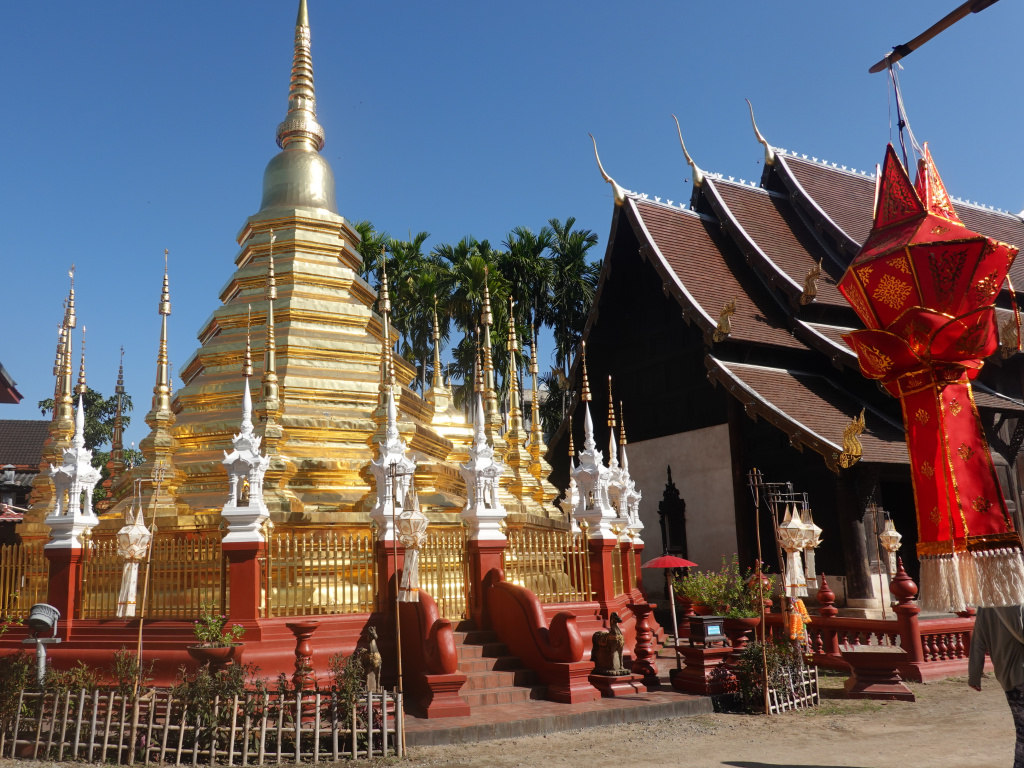
The chedi has undergone a complete transformation since 2018 with the elegant pewter color with the red bell at the top now completely covered in shiny gold cladding. I much preferred the old chedi. The structure’s shape is the same, octagonal layers rising like a pyramid to a bell topped with a finial.
I found a photo of the chedi at Wat Pan Tao before the cladding in gold in 2018.
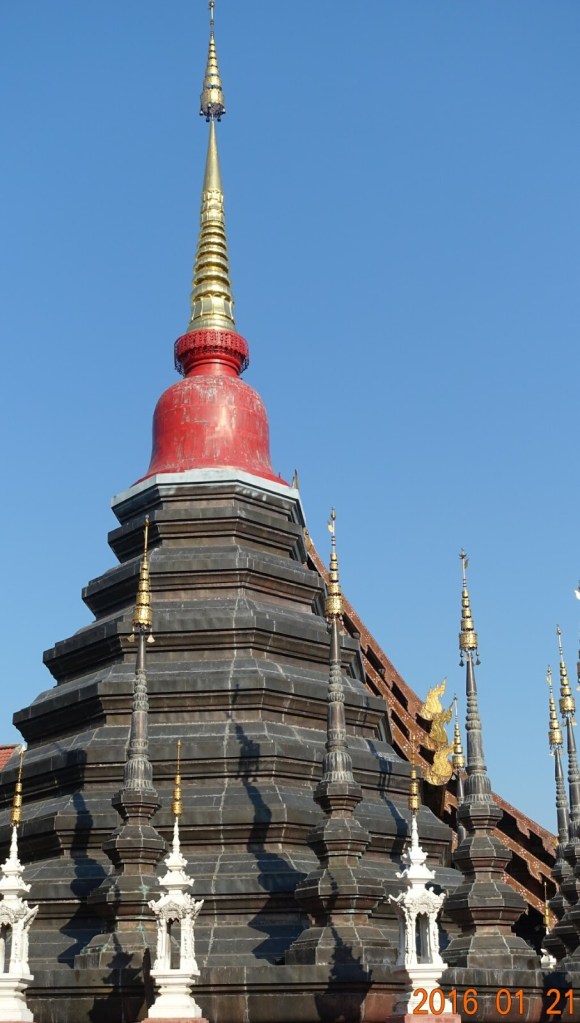
I much prefer this more rustic look. The shiny gold looks tasteless or even gaudy to me.
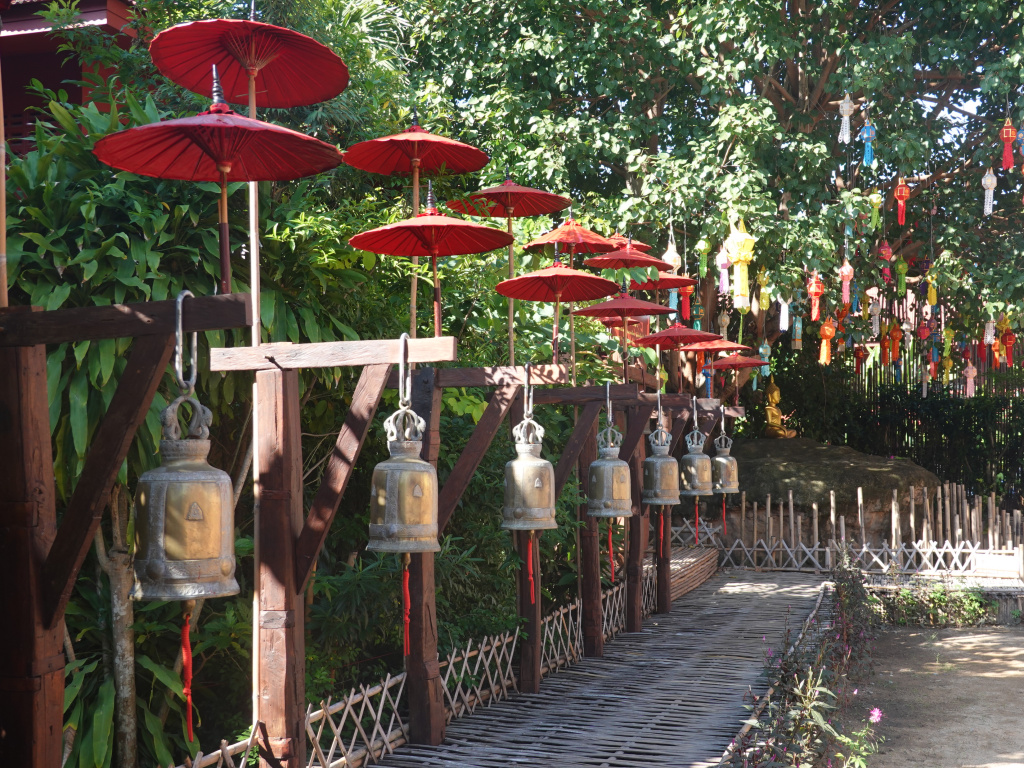
Across from the chedi, I walked along the bamboo walkway and rang all the bells.
Before I return to The 3-Sis, one more look at the chedi I don’t like so much in contrast with the viharn I very much like.
Next: Hike up the Monks Trail to Wat Phalad

 James the Intrepid Pilgrim