Friday 28 November 2025
Return to Wat Chedi Luang across the street
There are about 30,000 Buddhist temples in Thailand. Of those, 34 are listed as “Royal Temples,” divided into classes: 1 in Special Class, 19 First Class, 6 Second Class, and 9 Third Class. The special Class temple is Wat Phra Kaew in the Grand Palace in Bangkok. Of those 34 temples, only 3 are in Chiang Mai: Wat Phra Singh (first class), Wat Phra That Doi Suthep (second class), and Wat Suan Dok (third class). In all the research and reading I have done, and observations I have made, Wat Chedi Luang is as important as those three, if not moreso, so it is odd to me that Wat Chedi Luang is not considered a “Royal Temple.” And the few Thai people I have discussed this with were also surprised.
Wat Chedi Luang
I have written many times about Wat Chedi Luang. It is easily in my top 3 or 4 favorite temples, so I’ll summarize the history again. The 3-Sis guesthouse where I stay is directly across the street from Wat Chedi Luang, so I see bus loads of tourists, many Thai, arriving every day while I am eating breakfast.
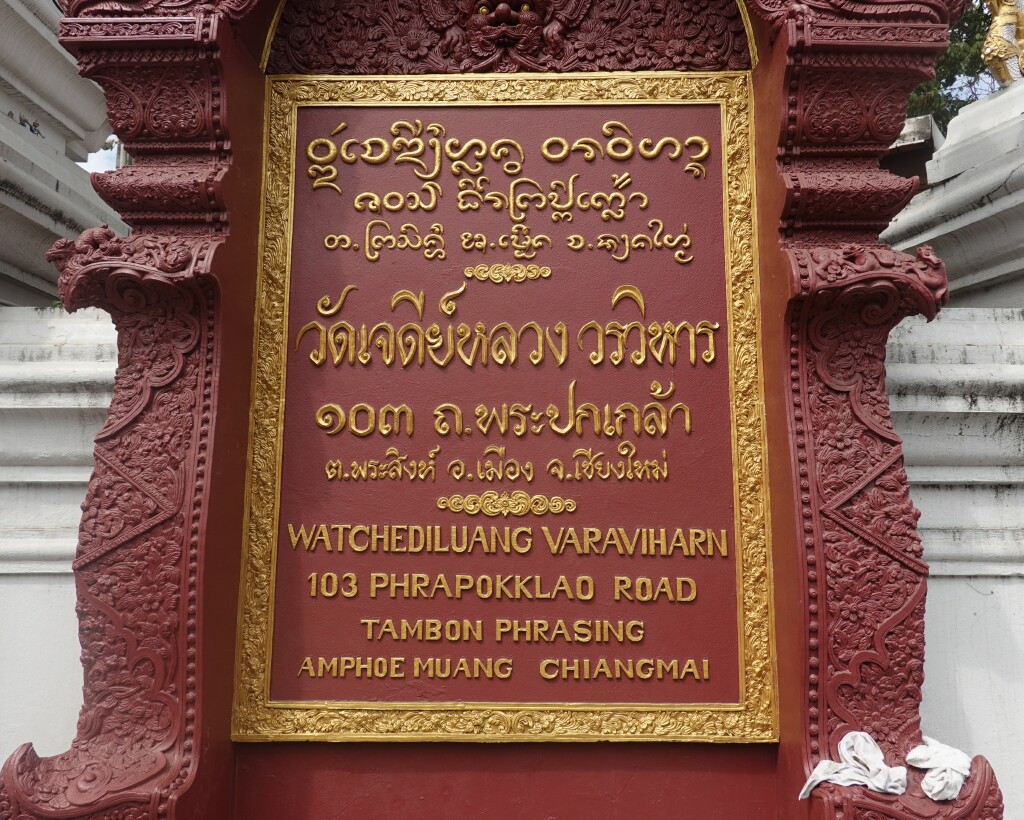
In years past, I would sit for my morning meditation at the base of the large chedi before breakfast. When they started charging 50 baht for non-Thais to enter, I decreased the frequency of going there. Wat Chedi Luang remains one of my favorite places for a morning meditation.
The Name Wat Chedi Luang
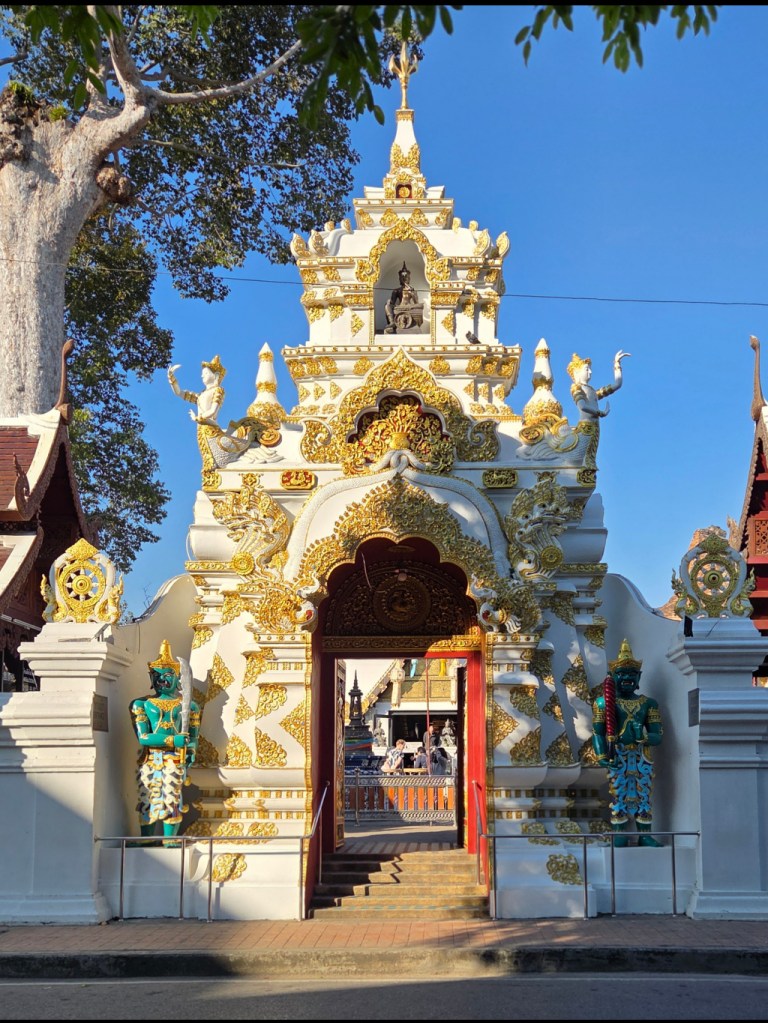
Wat means temple or temple grounds. Chedi is a pagoda. Luang translates to either royal or “really big.” Both apply to Wat Chedi Luang, it is a Royal temple with the really big chedi. Before we see the chedi, we have to enter the temple grounds. Here is the entrance for foreigners, built about 7 or 8 years ago and where they now charge 50 baht per person (about $1.60). It is nice, and in an historic style. It does, however, represent the growing commercialization of almost everything related to tourism.
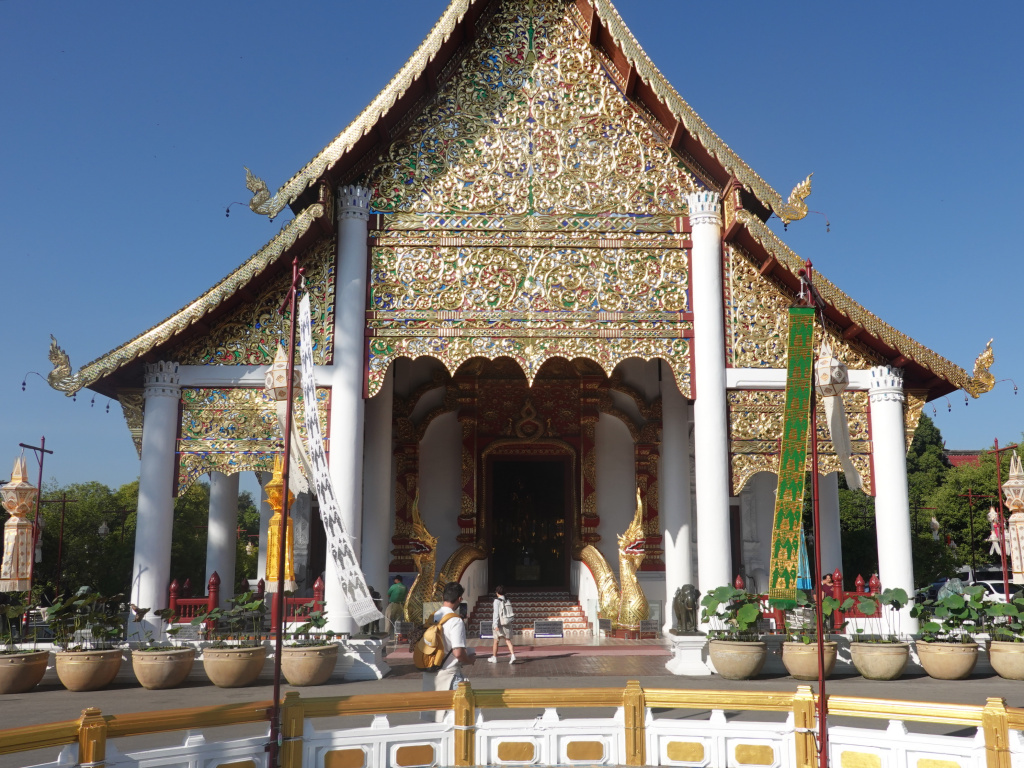
Phra Viharn Luang
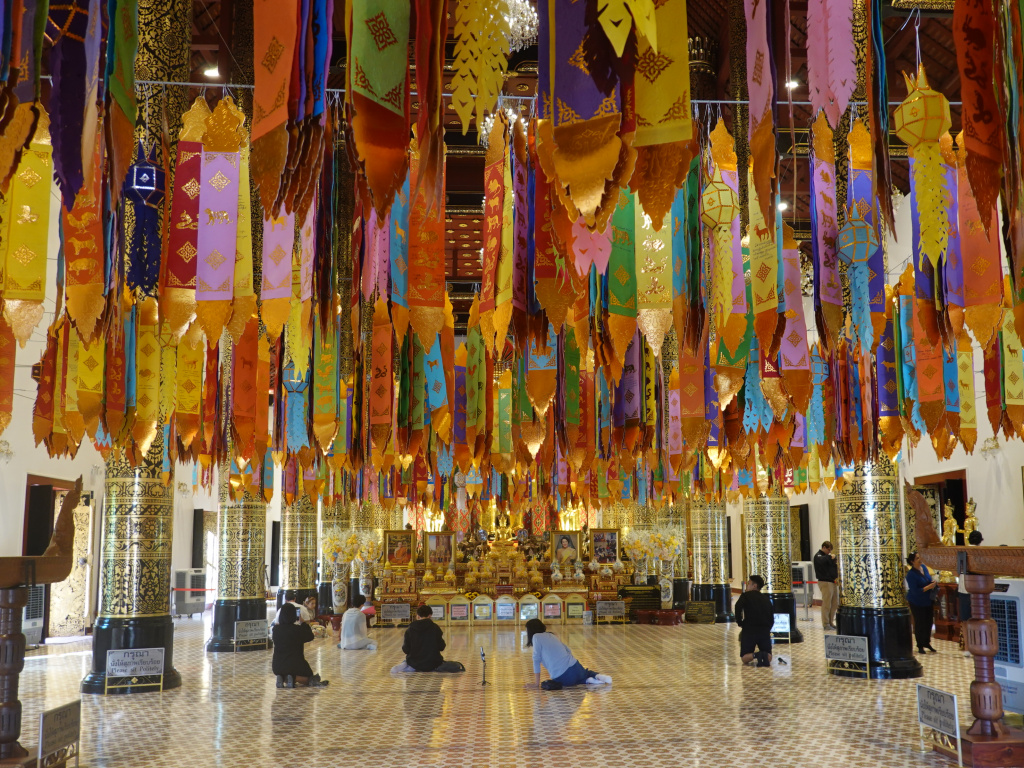
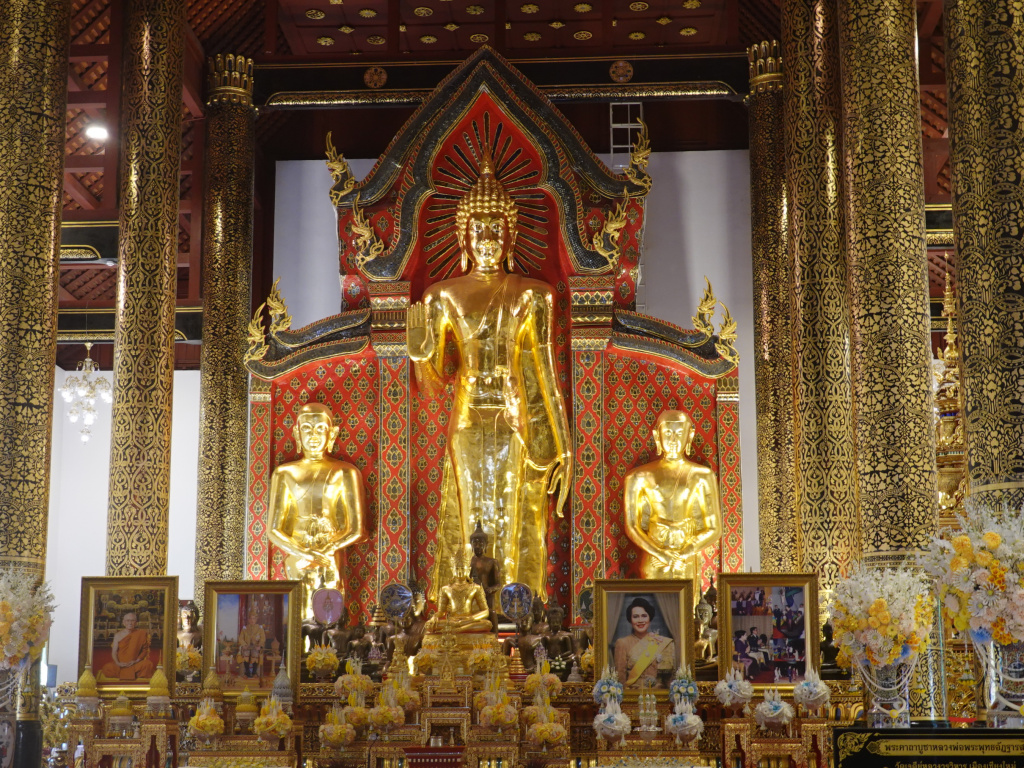
After entering, the most significant structure is the large viharn (assembly or worship hall), the Phra Viharn Luang. This viharn has been rebuilt several times, and houses the much-revered Phra Chat Attorat standing Buddha. The current viharn structure dates to 1929, and sits on the original viharn site dating to 1411, built by the Queen Mother of King Sam Fang Kaen, who also had cast the standing Buddha image.
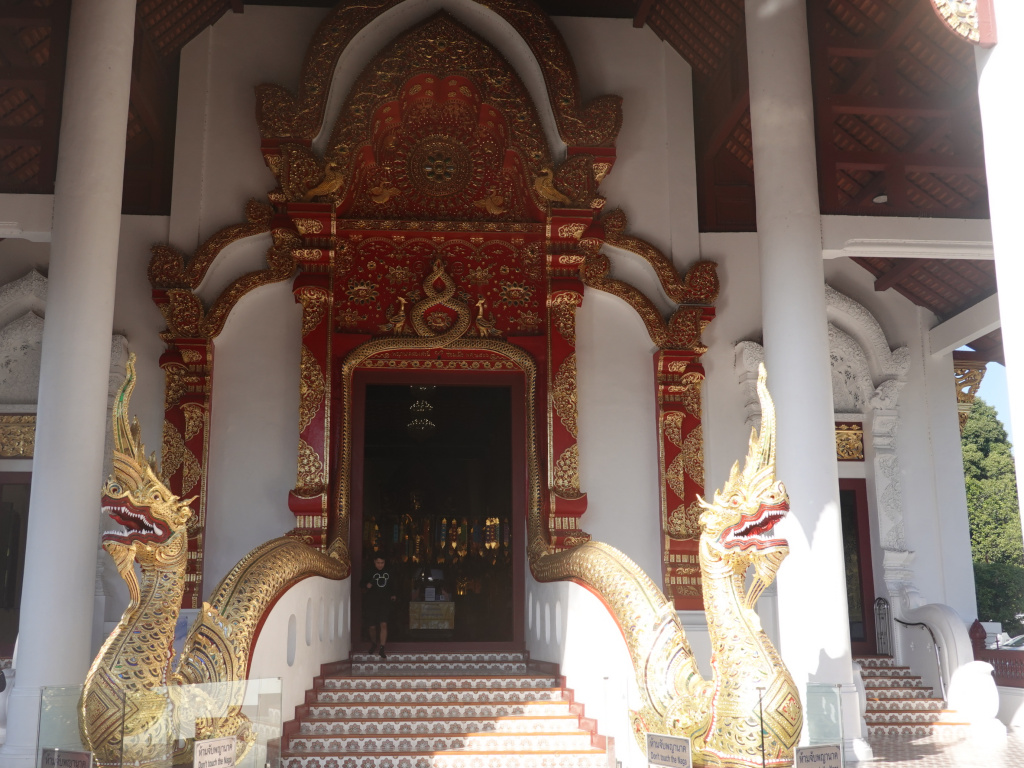
And a closer view of the entrance and the Naga serpents guarding the entrance.
Inside, there is much decoration as the year-end celebrations ramp up. When first walking in, the large standing Buddha could not be seen.
Finally, I could see the large Phra Chat Attorat Buddha, standing tall and reverent, flanked by two of the Buddha’s eminent disciples, Moggallana and Sariputta. This statue is often considered to be the most beautiful Buddha image in the Lanna Kingdom.
A Brief History
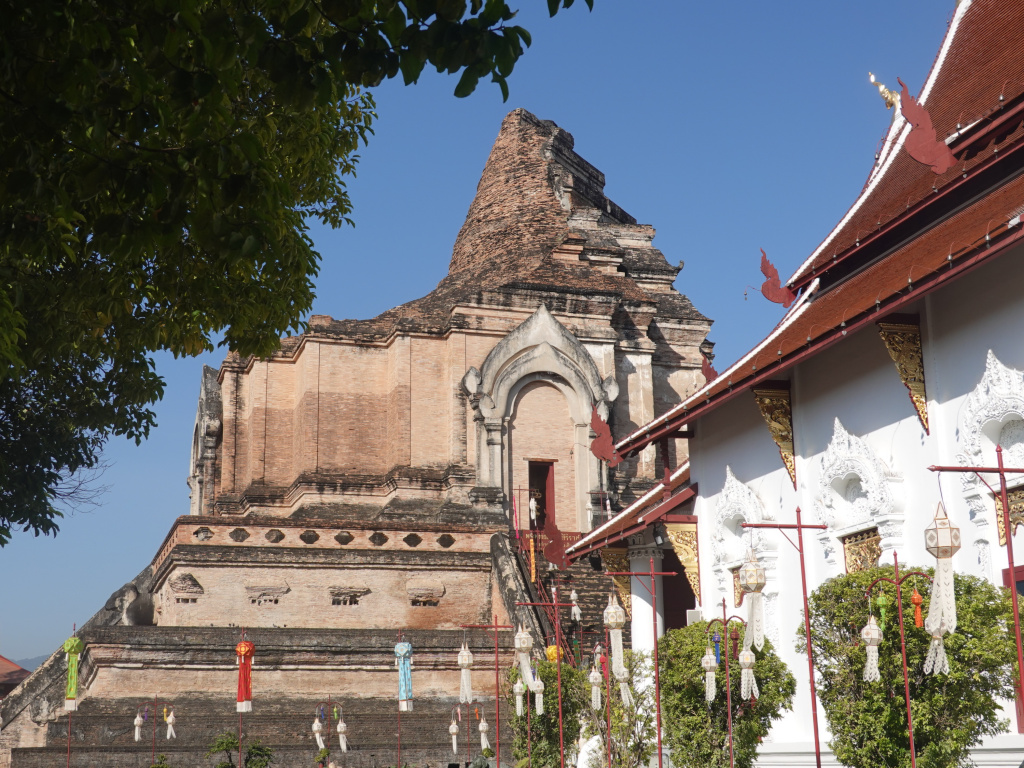
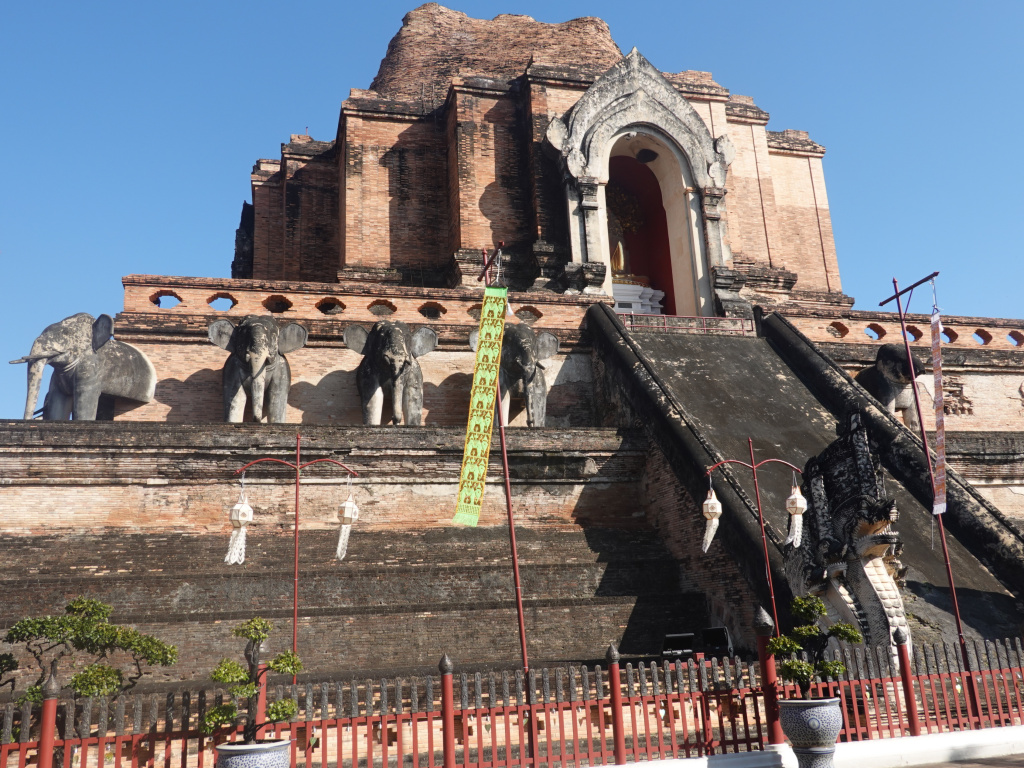
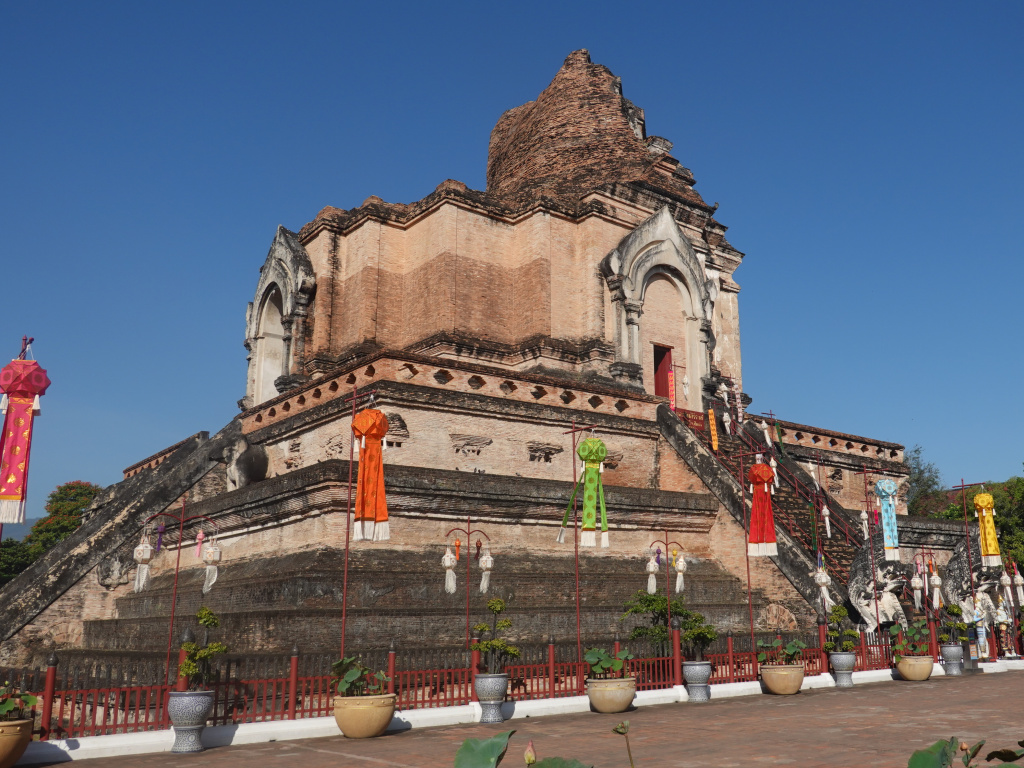
Construction of Wat Chedi Luang started in the 14th century when King Saeng Muang Ma planned to build a chedi to inter the ashes of his late father. After 10 years of construction, it was left unfinished, only to be completed after the king’s death by his widow. It was not finished until the mid-15th century. King Tilokarat of the Mengrai Dynasty, who ruled Lanna (much of northern Thailand and Laos) from 1441 to 1487 managed managed enlarging and the completion of the chedi at Wat Chedi Luang in Chiang Mai. When finished, the chedi was 82 meters high (270 feet) with a base diameter of 54 meters (178 feet), and by far the largest structure in all of Lanna. The famous Emerald Buddha was installed in the eastern niche in 1468. In 1545, an earthquake caused the collapse of the top 30 meters of the chedi. The top portion has never been restored because there is no documentation of how it appeared, and to restore it improperly would cause it great dishonor. So it is left as is.
Emerald Buddha Modern History
Shortly after the earthquake, in 1551, the Emerald Buddha was moved to Luang Prabang in what is now Laos. And in 1564 it was moved to Vientiane. In 1779, the Siamese General Chao Phraya Chakri (after whom the Chao Phraya River is named) invaded Laos, looted Vientiane, and took the Emerald Buddha to Siam. It was installed in a shrine close to Wat Arun in Thonburi, the new capital of Siam (currently a suburb of Bangkok). Chao Phraya Chakri then seized the throne for himself and founded the Chakri Dynasty of the Rattanakosin Kingdom, where he would later be titled King Rama I.
He shifted his capital across Chao Phraya River to its present location in Bangkok, and constructed the new Grand Palace including Wat Phra Kaew within its compound. The Emerald Buddha was moved to its current home in the ubosot of the Wat Phra Kaew temple in 1785.
[Note, the Emerald Buddha is called “emerald” for its green color, not its composition. The statue is carved of jasper.]
Back to Wat Chedi Luang
For the 600th anniversary of the chedi in 1995, a copy of the Emerald Buddha made from black jade was placed in the reconstructed eastern niche.
Walking by the viharn, I got this first view of the large chedi.
Under that large arch is the eastern niche, where the black replica of the Emerald Buddha sits. Two closer views of the chedi show only four of what were 32 full-size elephant statues on the sides. The first view is from the bench where I used to sit for my daily meditation.
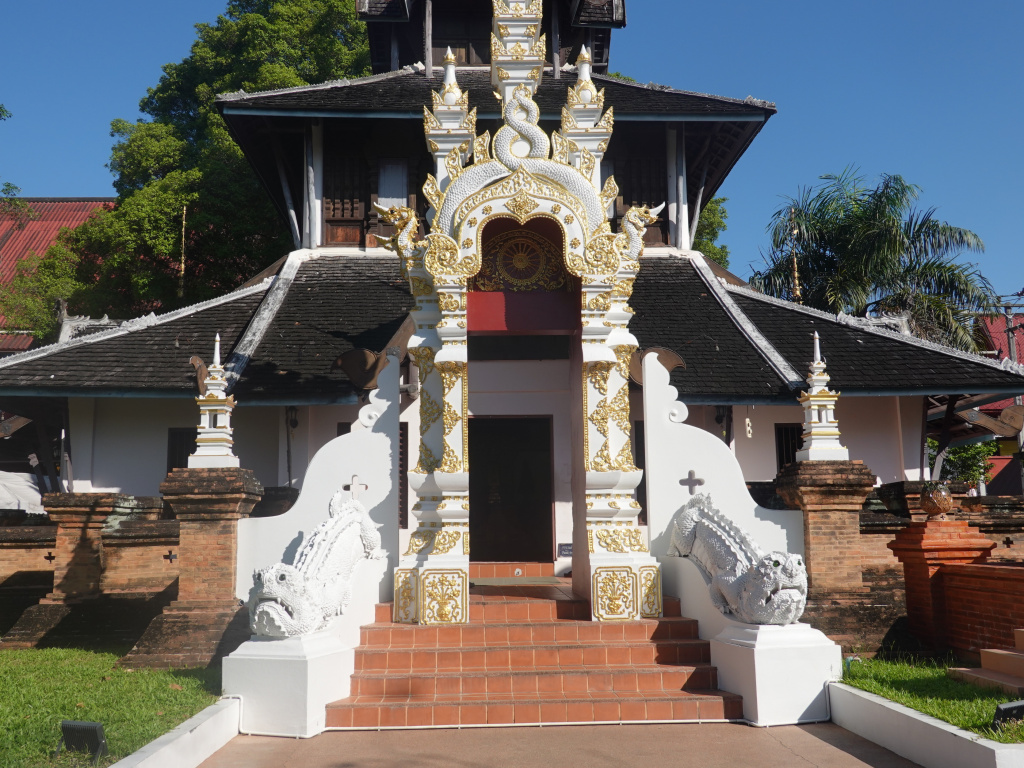
Continuing aroung the chedi, enjoying its elegance and powerful size, I saw the Ho Trai. A Ho Trai is a Buddhist library, where sacred documents of the temple are stored. The Ho Trai here has undergone a facelift of sorts and is now very clean and white. The two creatures commonly found protecting the entrance of Ho Trai are called “mom,” pronounced almost like “moam.” Their fierce look is to ward off evil spirits from entering the library.
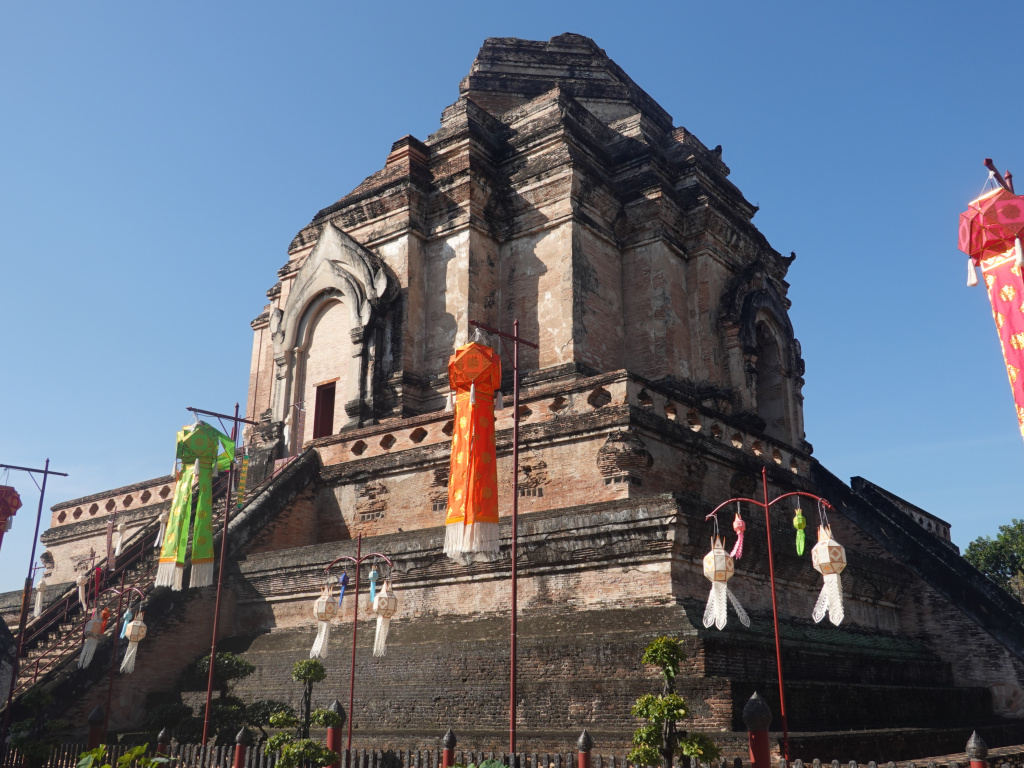
Leaving the temple grounds, one last look at the great chedi.
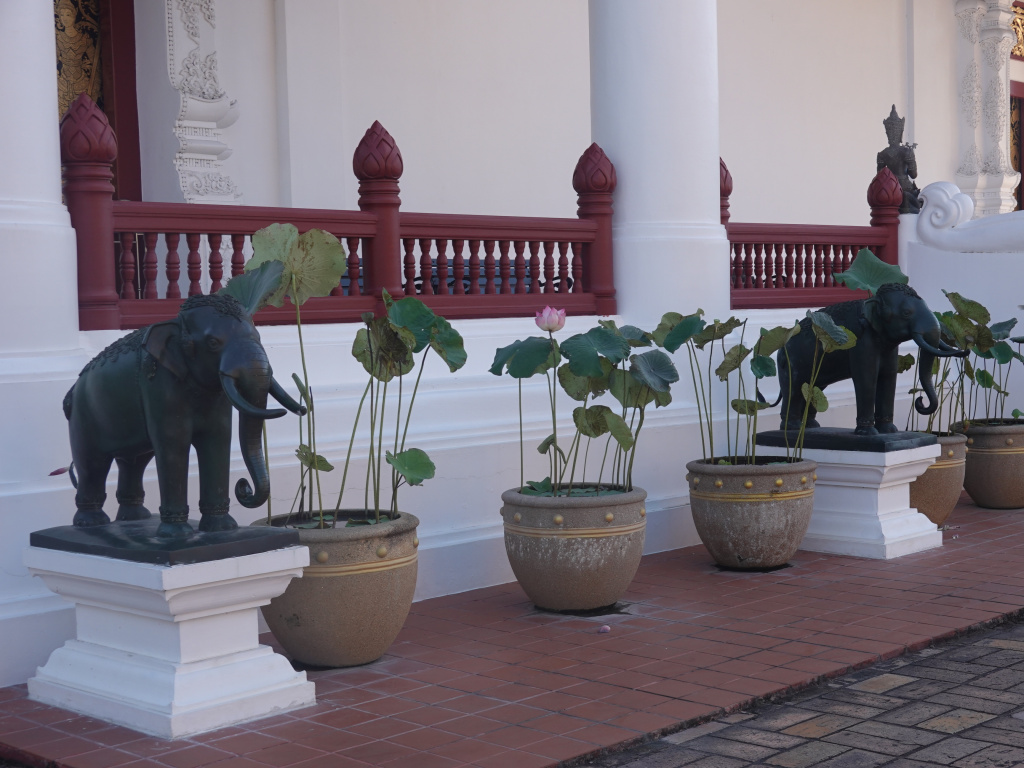
Passing the north side of the viharn the north portico is very new-looking after the major renovation that completed last year before the King’s visit to Wat Phra Singh and Wat Chedi Luang in January.
Next: Wat Pan Tao, also across the street from The 3-Sis

 James the Intrepid Pilgrim