Saturday, 22 November 2025
Grandiose, elaborate temple in rural Chiang Mai Province
Note: This is a long post with many photos of this elaborate, ornate temple.
Wat Sri Don Moon History
Wat Sri Don Moon is in the rural Saraphi district of southern Chiang Mai Province. The temple has something of an interesting history. Not more dramatic than many temples in northern Thailand, but a history with some ups and downs. There is no evidence of when the original Wat Sri Don Moon was built. It was formerly called Wat Kan Khuen because of a herd of elephants that wreaked havoc on the temple structures while searching for food. The name Wat Kan Khuen in the Lanna language somehow reflects this story, so I’ll have to find someone who can explain this name better.
The original temple is thought to have been built during the reign of King Tilokarat of the Mengrai Dynasty, who ruled Lanna (much of northern Thailand and Laos) from 1441 to 1487. King Tilikorat oversaw many large infrastructure projects in Lanna and specifically Chiang Mai, including building Wat Chet Yod in Chiang Mai in 1455, and enlarging the chedi at Wat Chedi Luang in Chiang Mai to be the largest structure in the Lanna Kingdom at 82 meters high (an earthquake in 1545 caused the collapse of the upper 30-40 meters).
The Burmese invaded the Lanna Thai Kingdom in 1558, ending the widespread rule of the Mengrai Dynasty and causing great damage to cities. People across what is now Chiang Mai Province suffered and fled in disarray. Wat Kan Khuen became deserted.
In the late 1700s, Prince Kawila emerged as a pivotal figure in the revival of the Lanna Kingdom in northern Thailand. He led successful campaigns against Burmese domination, liberating Chiang Saen and later becoming governor of Lampang under the Rattanakosin Kingdom. With support from Bangkok, he liberated Lamphun and Chiang Mai from Burmese control in 1775. He mobilised populations from surrounding villages and towns to resettle in Chiang Mai, restoring important temples and buildings from the Mangrai Dynasty era. King Kuwila also revived Lanna’s cultural heritage, including traditional Buddhist rituals, music, dances, and craftsmanship. People who had been forced out of Chiang Saen settled in the Ban Yang Noeng area (currently the Saraphi district of Chiang Mai). They cleared the land, built houses, and found and renovated two abandoned temples, one of which was named Wat Sri Don Moon.
Wat Sri Don Moon Current Look
Wat Sri Don Moon is off the main highway about halfway between Chiang Mai and Lamphun. A couple of roads to the temple are barely wide enough for one lane. We got there and were directed to a parking area. After a long drive, we went to use the restroom, and were surprised to see one of the nicest and cleanest restroom facilities I have ever seen. Really. Then we made our way to the main temple grounds and structures through a small forest with water features for photo-ops.


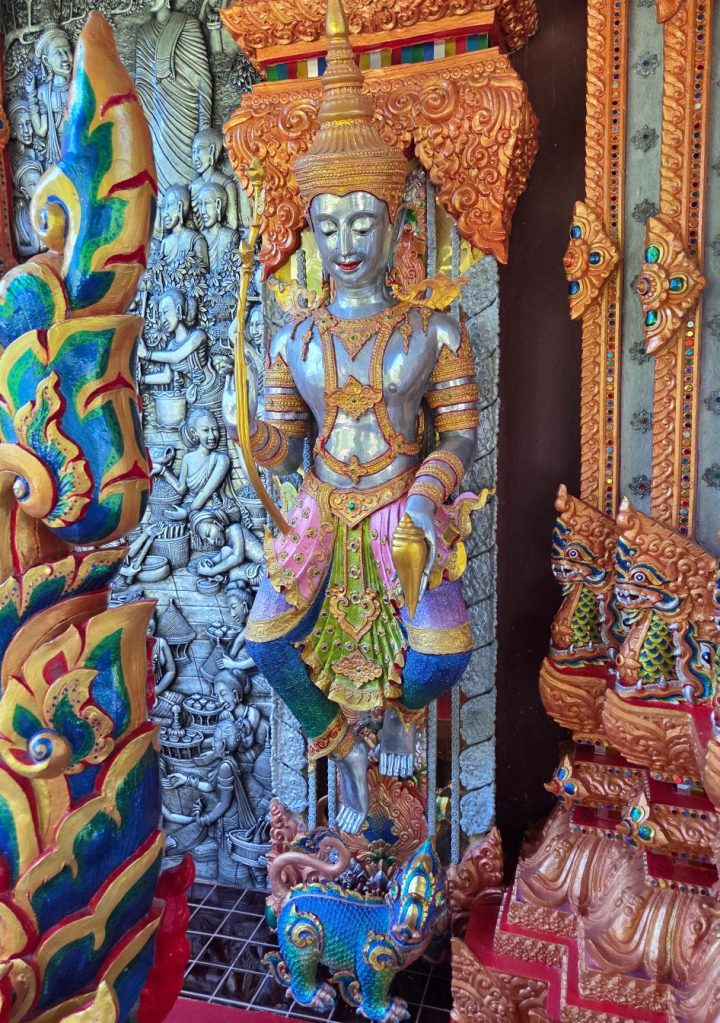
A short distance away was the large, elaborate, ornate viharn. We came to the side, and I took a photo of the thewada (angelic being that lives in the heavenly realms) at the side entrance.
I turned to the main entrance and took this photo of the entrance from inside:
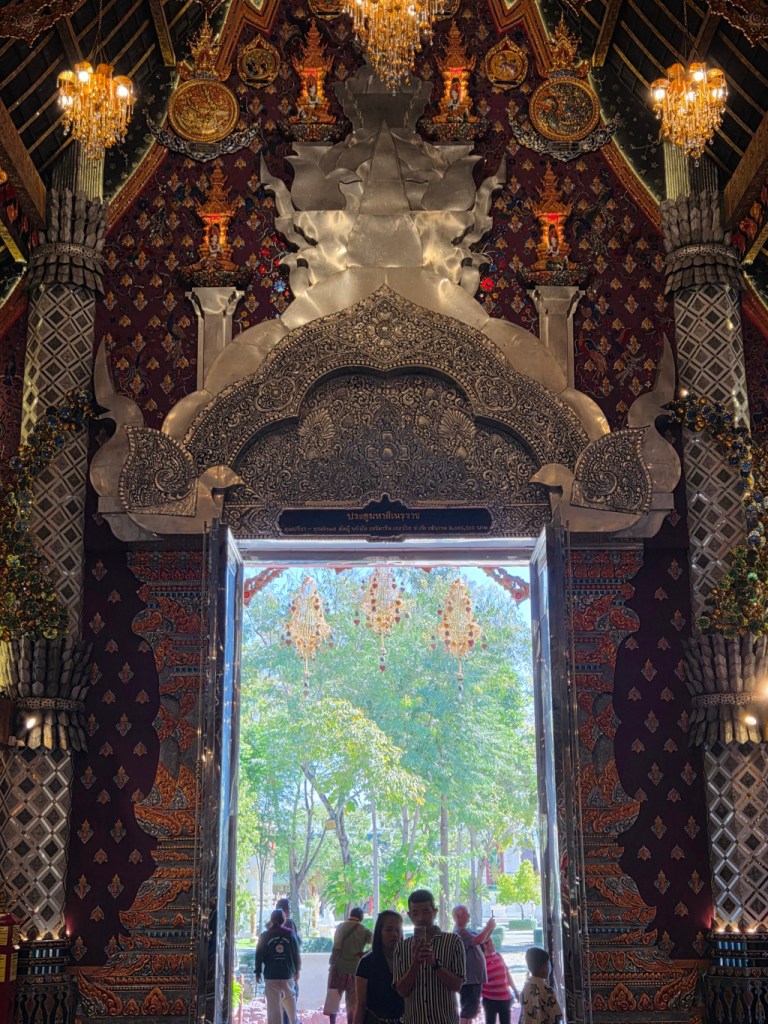
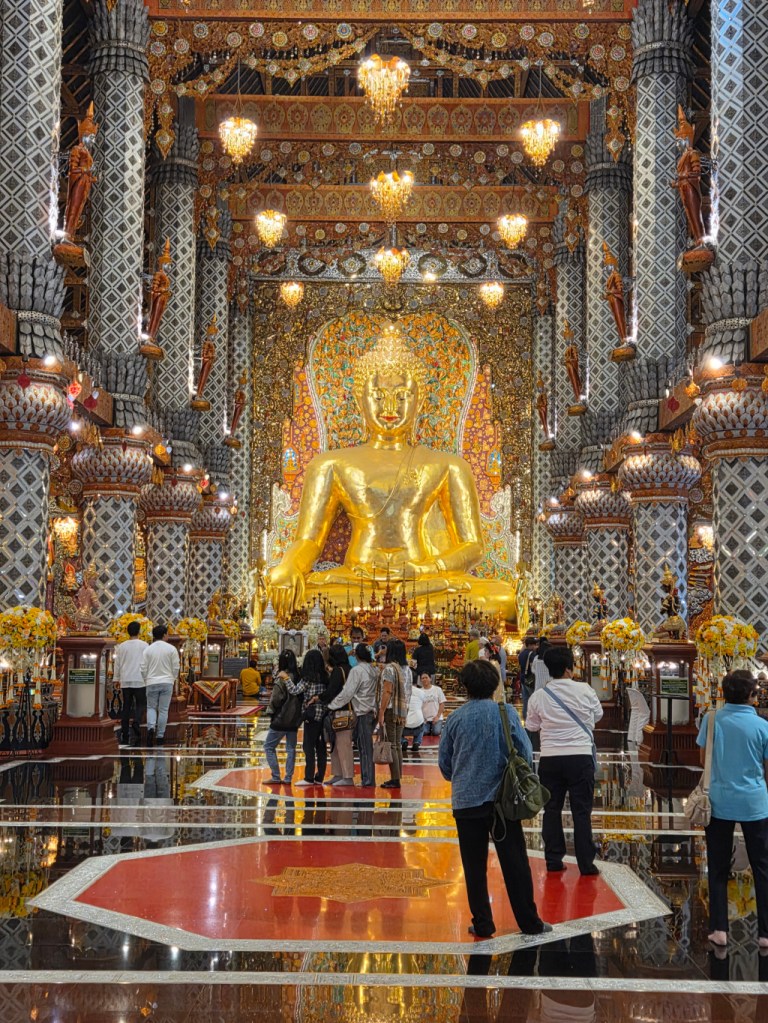
Everything I see is ornate and very detailed. I turned and saw the entire viharn, large and detailed.
I could not help but notice these elaborate (there’s that word again) window coverings.
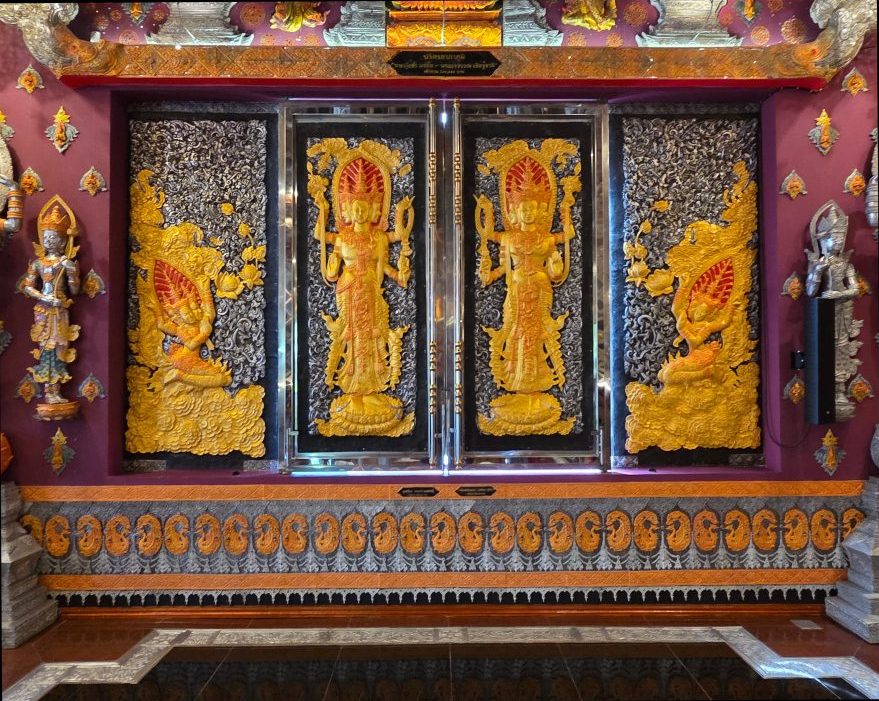
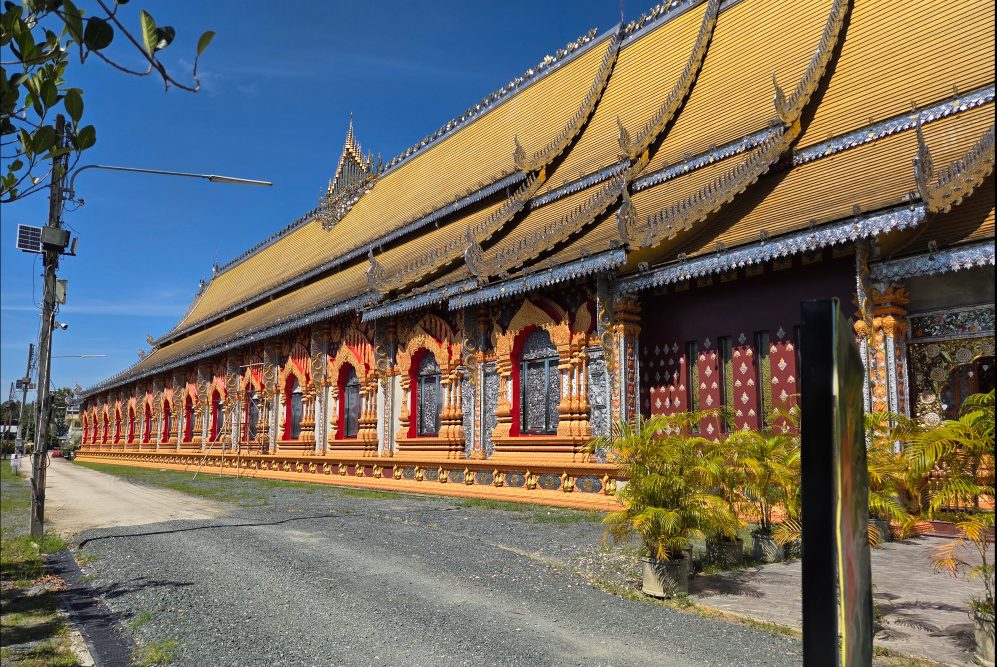
From right in front of the windows, a view down the side of the viharn gives an idea of how large this structure is.

Back to the middle (with many, many tourists) and closer to the altar, here is the large, gold Buddha image:

At the front of the altar is a very nice depiction of Phra Mae Thorani (Mother Earth) always seen wringing her hair to drown the evil spirits who were interrupting the Buddha in his meditation.
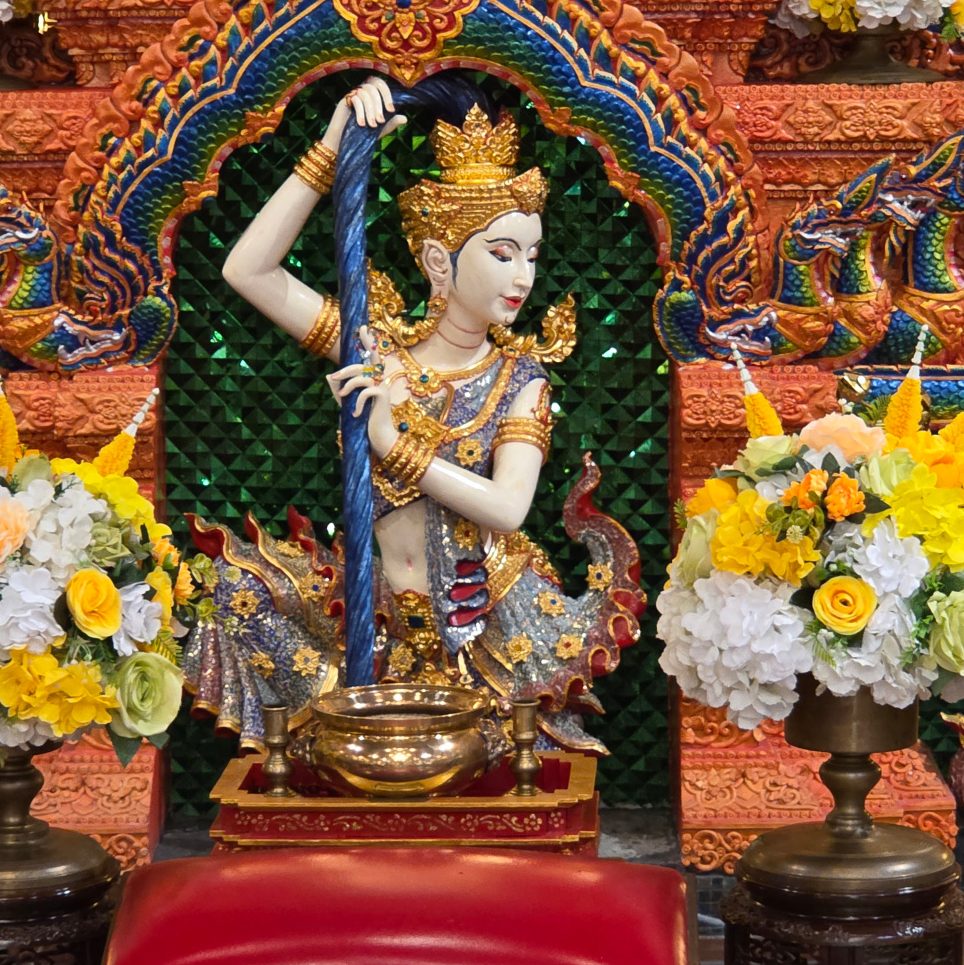
Here is Mukda about to make an offering.

Also right in front is an homage to Queen Mother Sirikit, who recently passed away.

In Thai culture, the days have associated colors. Mukda was born on a Monday (yellow), and I on a Wednesday (green), so here we are under the decorations of the relevant color:


Just before we left the viharn, we got a photo of the two of us in that large viharn.

Outside the main entrance, I was struck by the large thewada, one on each side, guarding the entrance, and each with a musical instrument of some kind. One has something similar to a lute, and the other a single-string bass instrument.


Mukda and I walked to the left to the side road we may not have been supposed to go to. From there I got a photo showing better the scope of the length of the viharn in which we had just been – a substantial structure.
At the back of the viharn, is the city in the mist, which simulates the Buddha’s descent to save the world. It is this idea that shapes the design and decoration of the temple’s exterior landscape, focusing on the shady and beautiful, like a simulation of heaven on the ground.
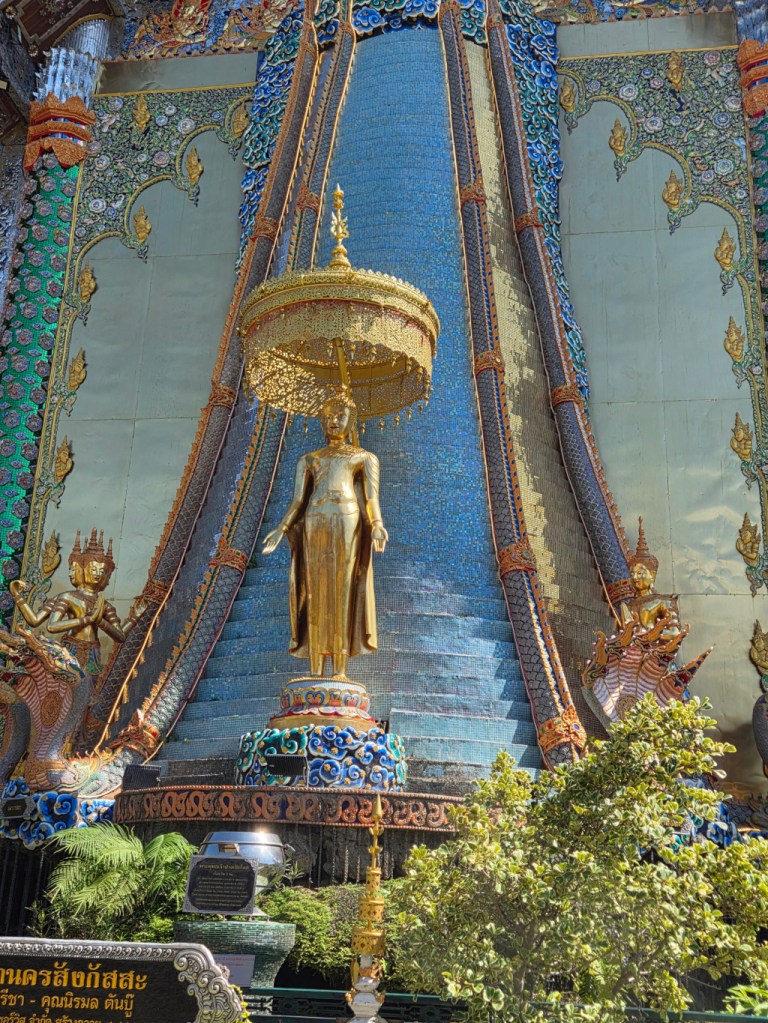
Near the back was another structure with a green thewada that compelled a photograph.

And, near the back of the viharn was an area for making offerings, lighting candles, or pouring oil into an appropriately colored perpetual lamp. I did pour oil into the green perpetual lamp (but no photo). Mukda and I both lit candles and placed them around the statue.


There are many structures on the temple grounds, all elaborately decorated. I was photographing Mukda in front of the ubosot and was photographed. Then Lao and I posed for a photo. So many photos.


Walking back through the forested area, the city in the mist, we had another photo-op, me driving a samlor with Mukda riding.

This was an interesting temple visit. Being away from the main tourist areas, almost everyone we saw was Thai. We made our way back to the parking area, one more stop at the very nice restroom, and were on our way to a Japanese-themed restaurant fairly close by. After a good group lunch, we headed back to Chiang Mai city. A very good day visiting a remote and elaborate temple.
Next: Photos by the river near Doi Saket

 James the Intrepid Pilgrim