Tuesday 3 December 2024
A walk to Wat Chai Mongkhon
I am in a good routine here in Chiang Mai. I practice yoga at Wild Rose Yoga about three times per week, go to the gym twice weekly for strength training with Ning my personal trainer (her Instagram is pt.ning, she posts several times per day, including a few videos of me). Mornings when I do not have a yoga class or training session, I head out with my camera to explore parts of Chiang Mai, including returning to familiar places to see how they might seem different to me now, what changed, or what I see differently.
Today, after my strength training session with Ning, I’m going to Wat Chai Mongkhon, on the bank of the Mae Ping River, to see how the temple has fared after the recent floods. Since I’ll be walking down Sridonchai Road and over the Klong Mae Kha, I’ll make a diversion to see whether I can see the new construction along the klong from the north. I already saw evidence of what appears to be a large project from the south at Ragang Road.
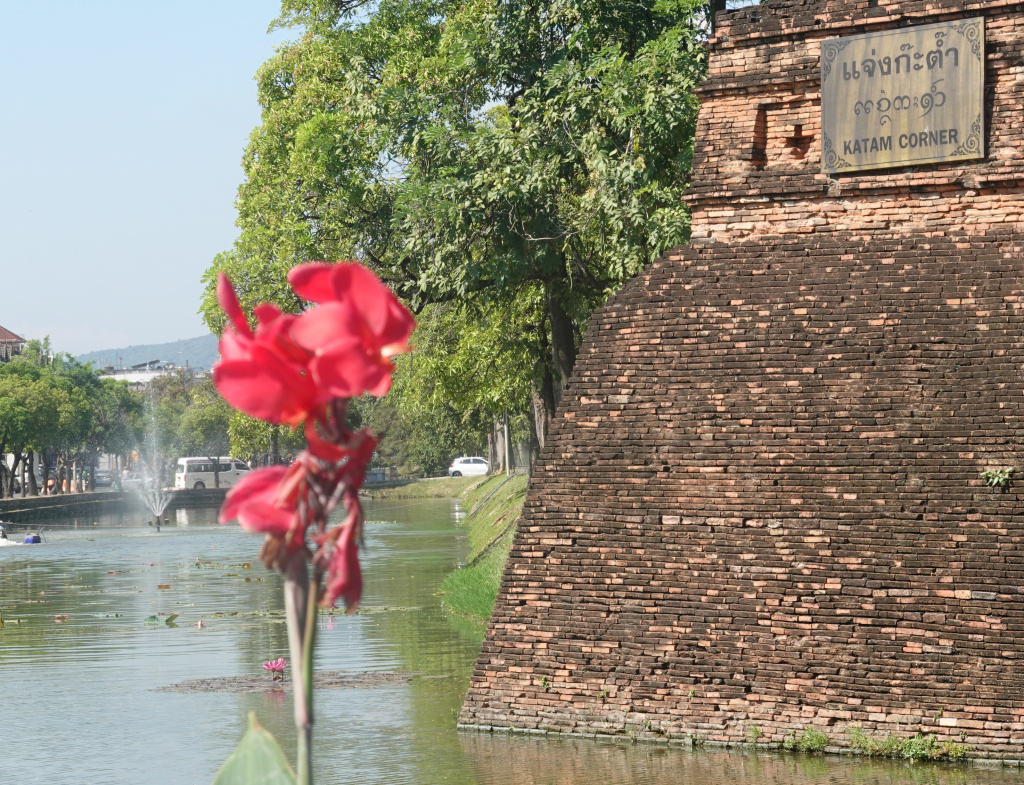
Katam Corner
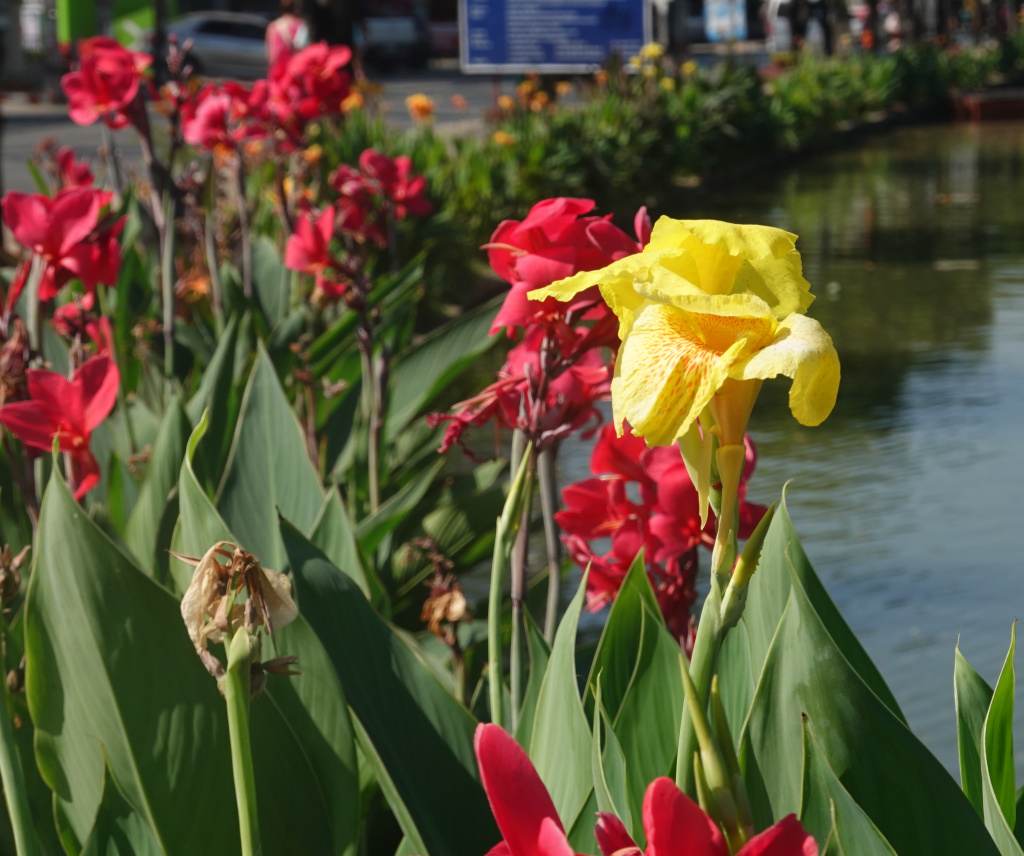
Someday, I’m going to spend the whole morning just photographing flowers. I see many pretty flowers every day here, some in unexpected places. Walking past Katam Corner, the southwest corner of the wall/moat, I saw these flowers along the side of the moat:

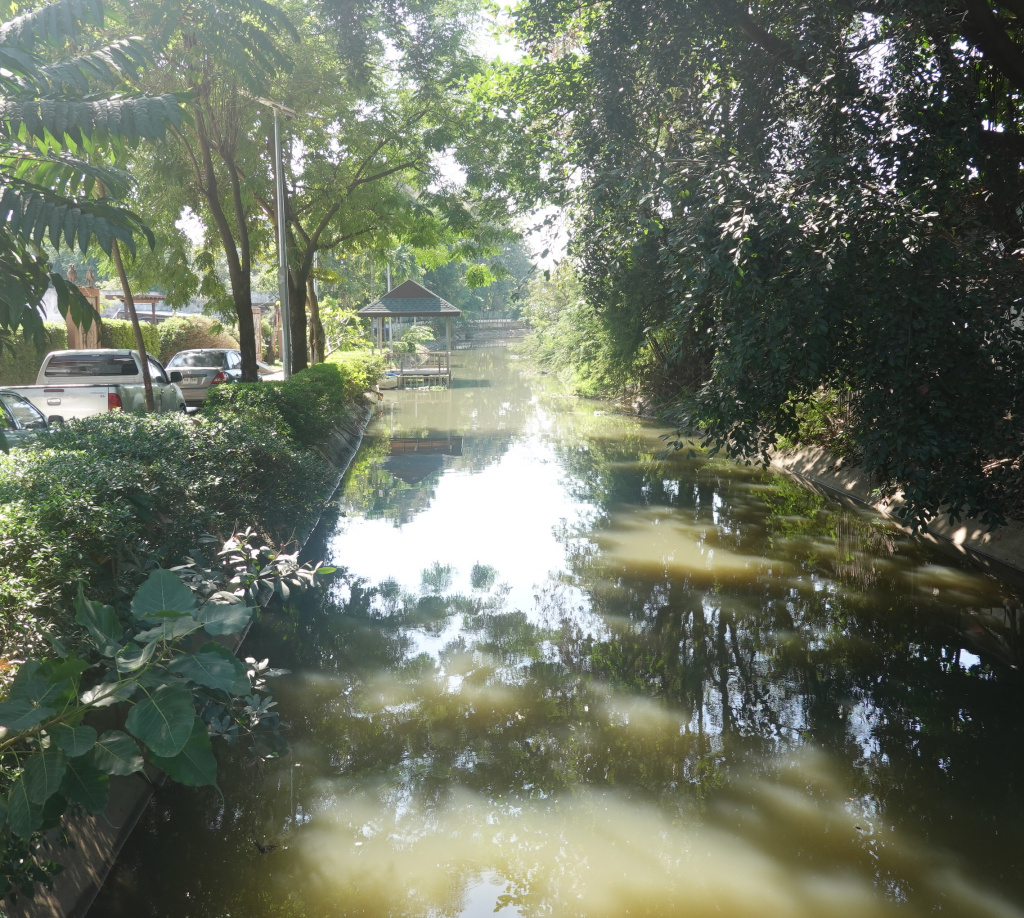
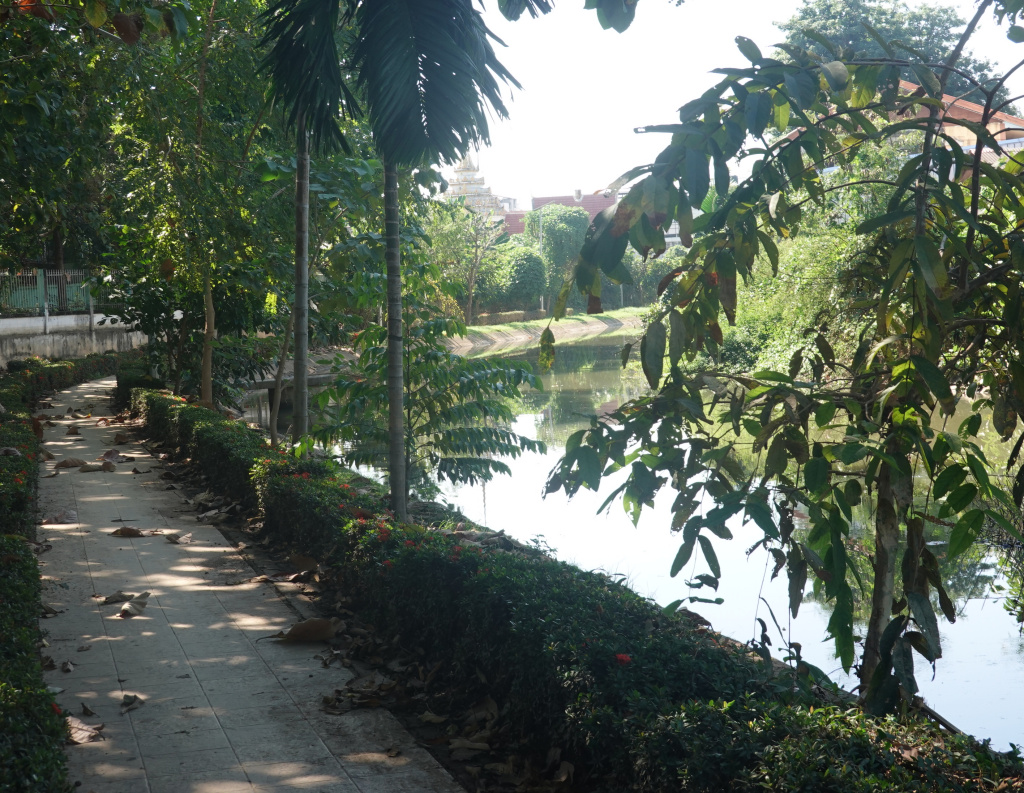
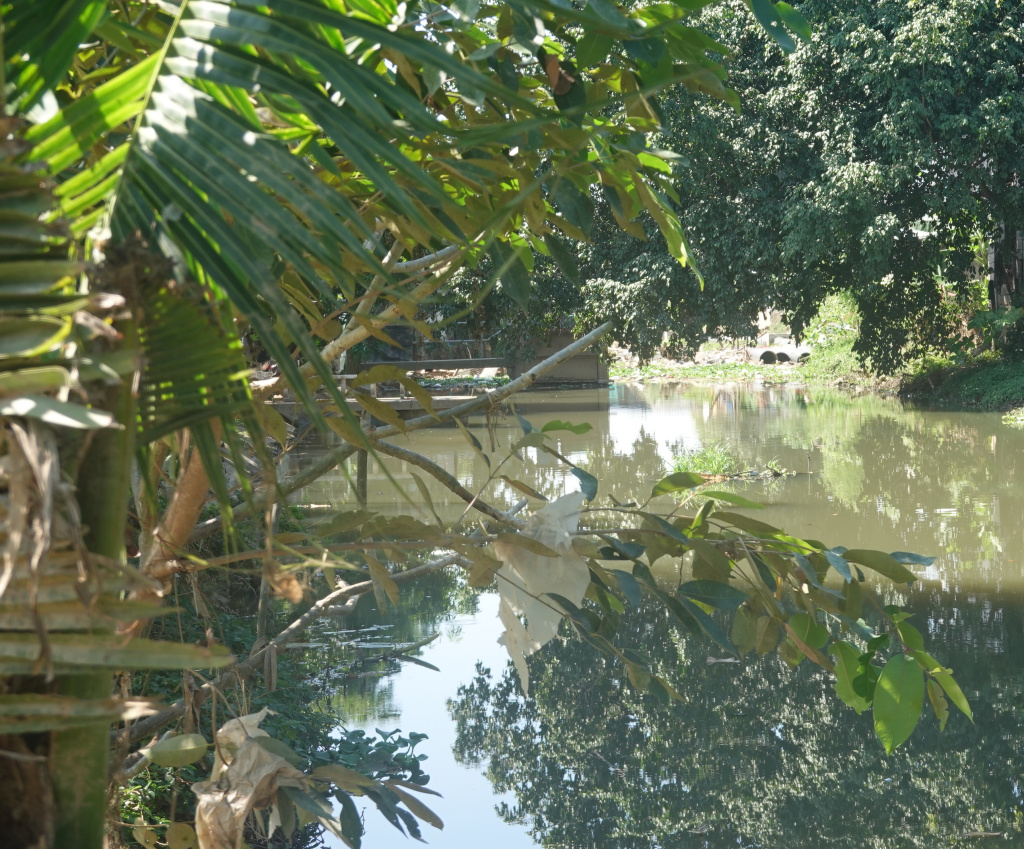
I turned left from Katam Corner to proceed east along Sridonchai Road, past several hardware stores and other shops, finally getting to the bridge over the Klong Mae Kha. From that bridge, I took a photo of the klong, then proceeded to walk south on the walking path along the klong, towards where I hoped to see the construction. Here is a photo of the klong from the bridge, and another as I was walking along the path by the klong.
When I got close, I could see some homes ahead and on the left, and a large, territorial dog came out and was more than a little threatening. As far as I can tell, there are no leash laws in Chiang Mai, and some dogs are loud and a little scary, especially in a group of three or four.
This dog was not going to let me closer, so I backed off. When I got far enough away that the dog stopped barking, I was able to zoom in and get a photo of what I am certain is a distant view of the construction. The circular things on the right in the middle seem to be the ends of some large pipes.
Wat Chai Mongkhon
Continued east on Sridonchai to Charoen Prathet Road, a main road close to and on the west side of the Mae Ping River, or as they would say in Thai, Mae Nam Ping. “Mae Nam” means river. “Mae” is “mother,” “Nam” is “water” so I think of the term for river as being water from mother nature. In English it is translated to be “Mae Ping River” or just “Ping River.” The temple is close and in just a few minutes I was across from the entrance to Wat Chai Mongkhon. This entrance is one-way inbound; the exit for vehicles is to the left (not seen in the photo and not a cool-looking gate like this).
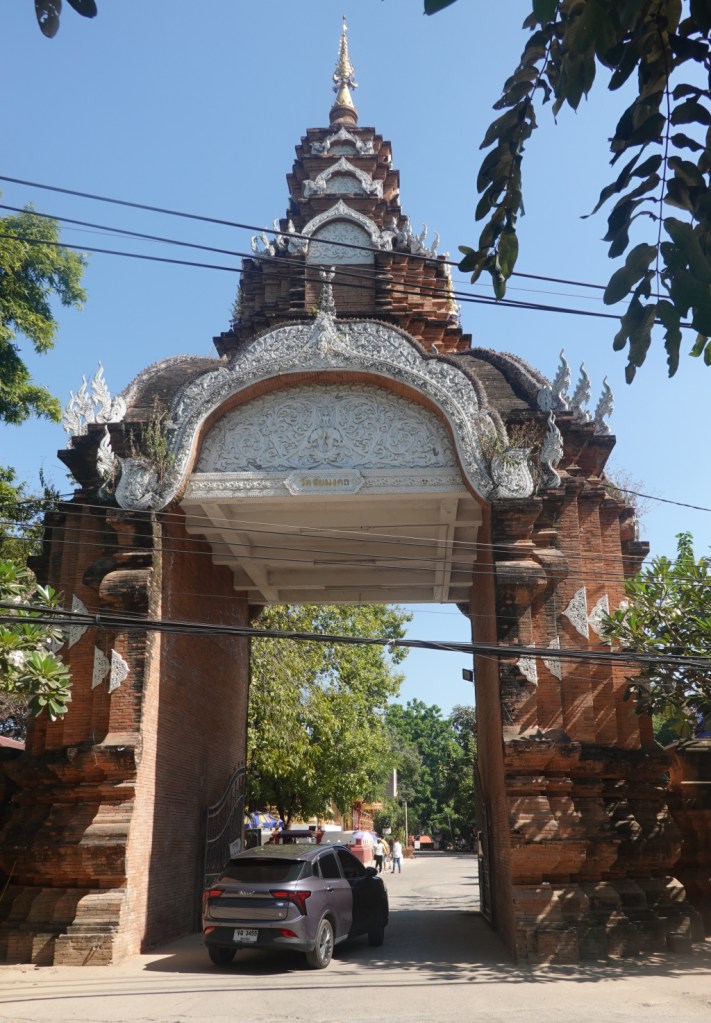
The origins of the Wat Chai Mongkhon go back to the 16th century. The temple was later abandoned during the Burmese occupation before being rebuilt by King Kawila after the Burmese expulsion. King Kawila ruled the Chiang Mai kingdom from 1782 until 1816. When during that period the temple was rebuilt I could not determine.
Wat Chai Mongkhon is one of the busiest temples in Chiang Mai with worshipers coming and going continually passing into the viharn to meet the monks. While I was there, a constant stream of cars was coming in and leaving.
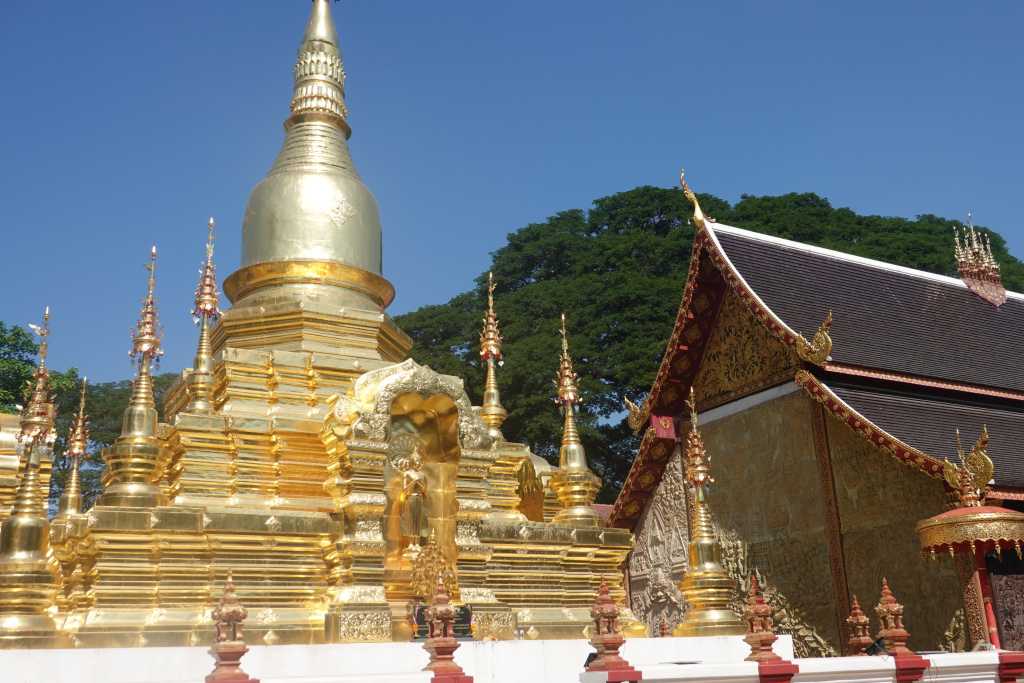
The entrance is on the west end of the temple grounds. Therefore, the first structure noticed after the entrance gate is the large gold chedi. This chedi was under reconstruction until about 2022 and was changed from being a very natural-looking stucco and brick to being clad in a shiny gold material. I have seen the same change in other chedis, most notably at Wat Phra Singh and Wat Pan Tao. I am not a fan of the shiny gold chedi look. To me, it is unnatural and gaudy. But, it is apparently what the monks or people in charge like.
The next structure is the viharn (assembly or worship hall). Negotiating my way between the continual stream of cars, the side entrance steps to the viharn are guarded by these rather fierce mom creatures (pronounced “moam”).
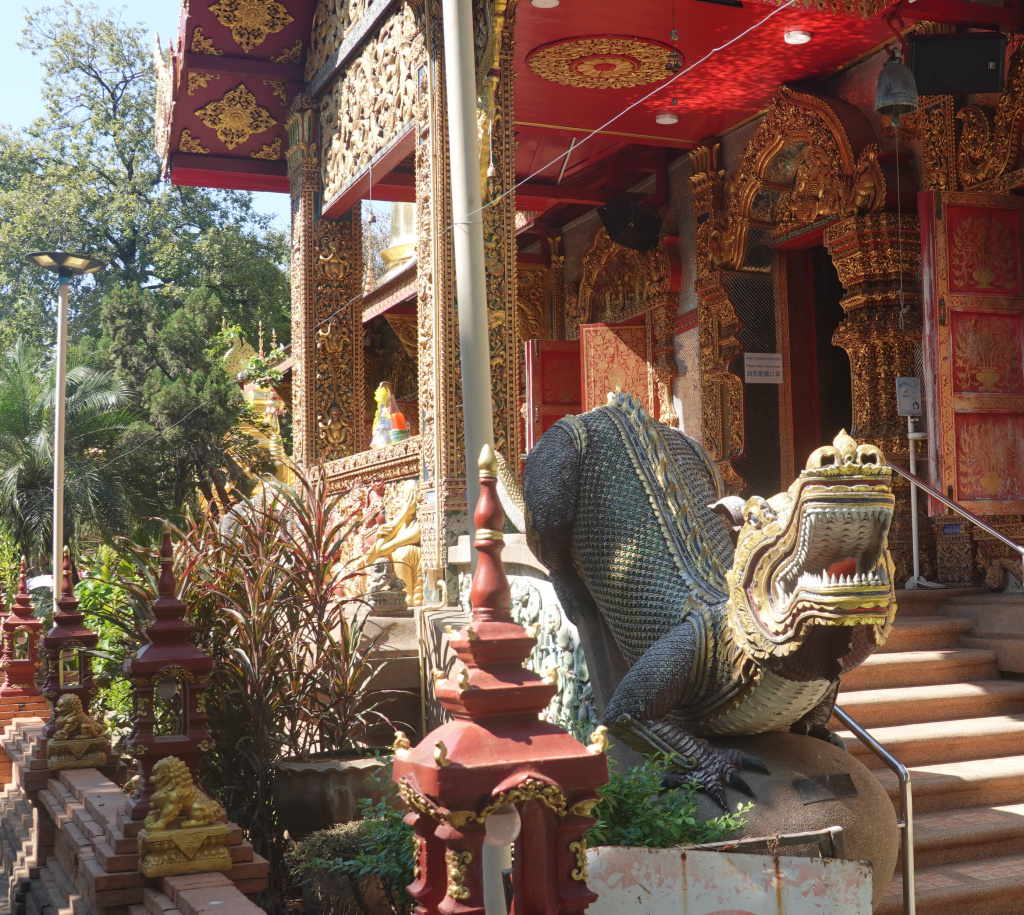
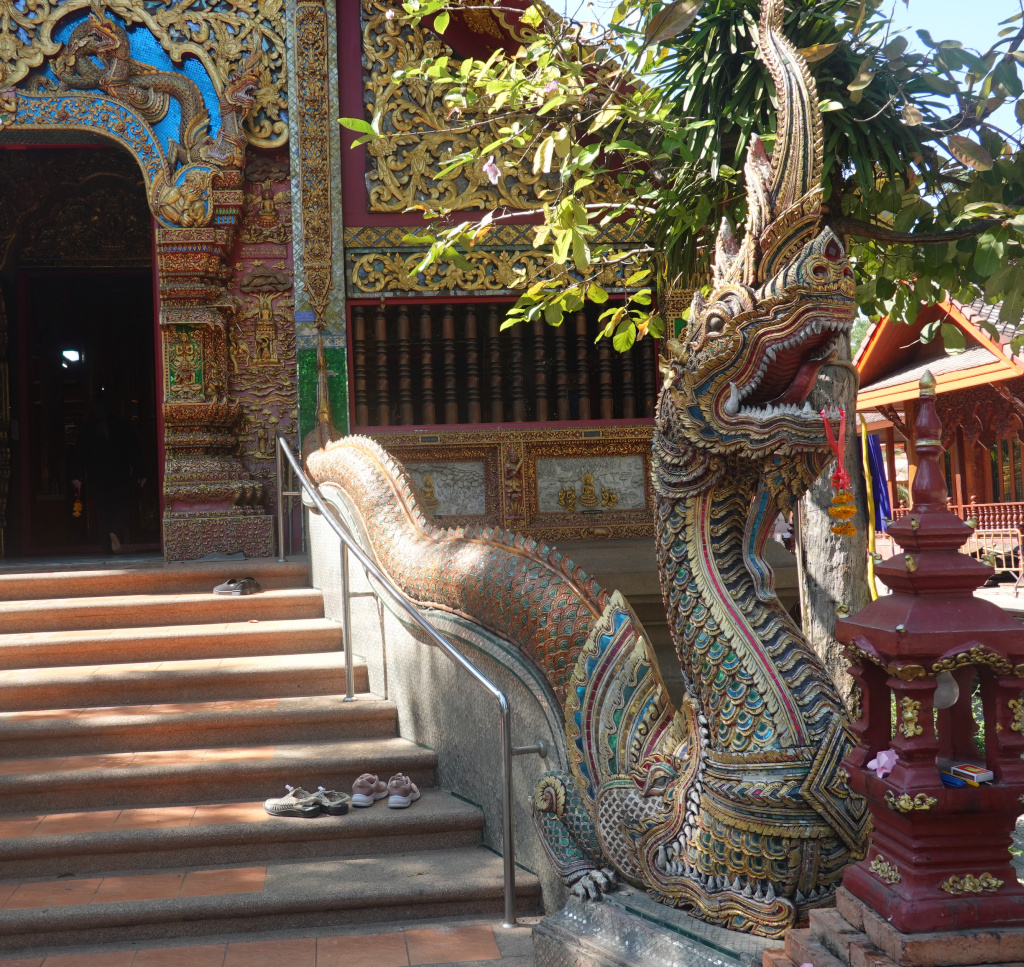
The viharn itself is typical Lanna styled with the tiered roofline and roof sweeping low on the sides. The entrance is guarded by the naga dragon-like creatures, also typical of Lanna styling.
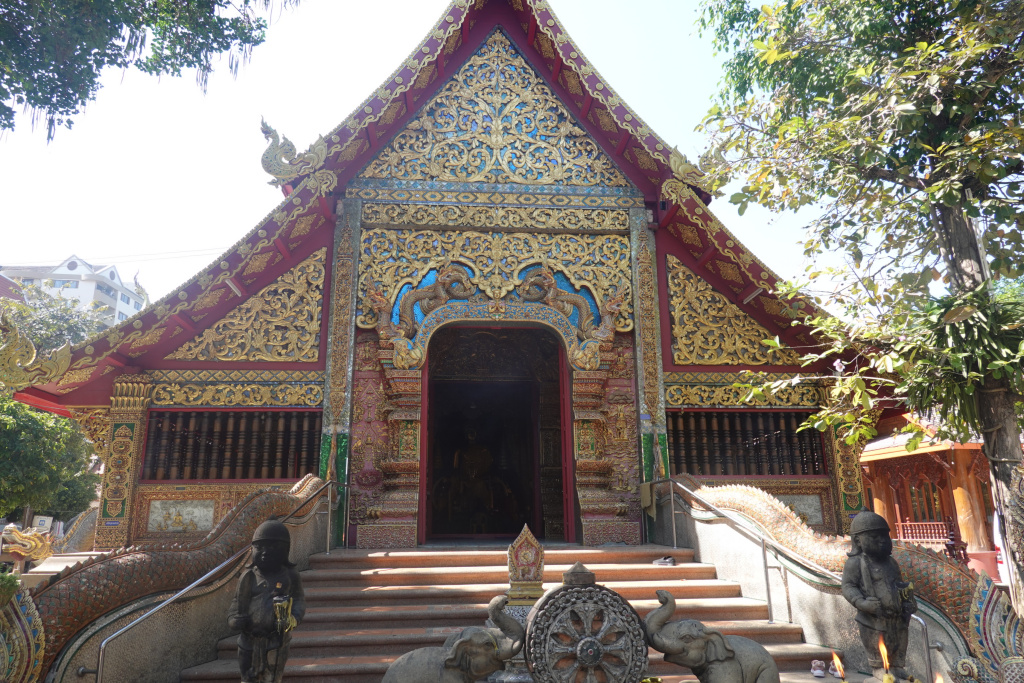
I did not quite get the whole front of the viharn and the naga in the photo, so here is a photo of one of the naga along the stair banister
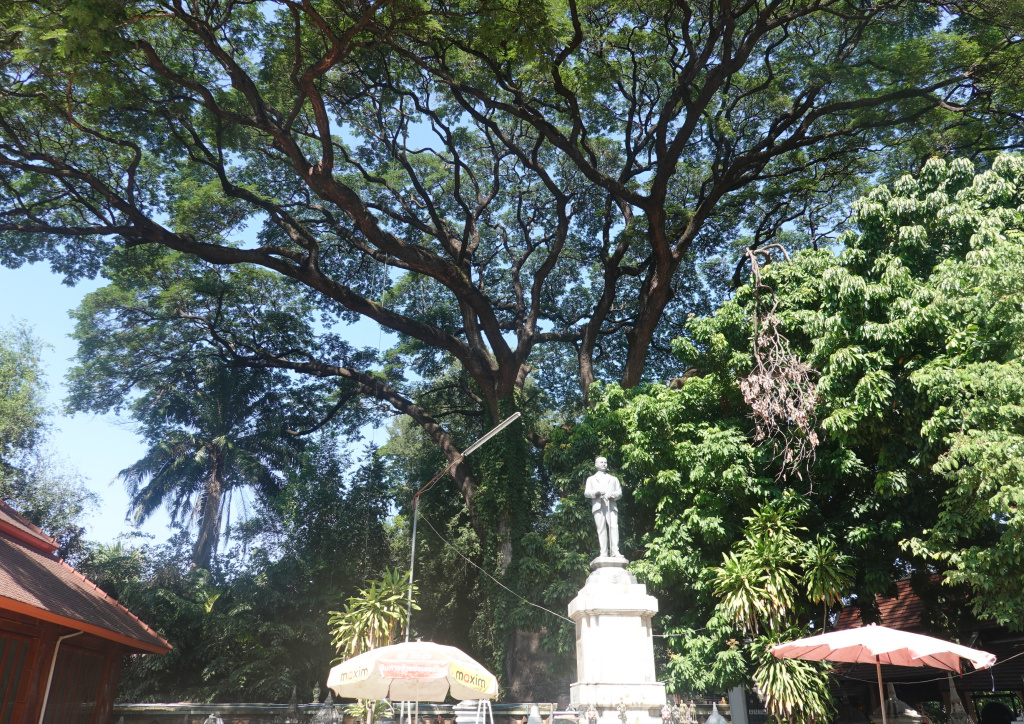
To the right of the viharn is a statue of King Chulalongkorn under a large and striking tree. Chulalongkorn, also known as King Rama V, the fifth king of Siam from the Chakri dynasty, ruled Siam and then Thailand from 1878 to 1910. During the latter part of Chulalongkorn’s reign, Lanna (what was northern Thailand and Laos) was annexed by Siam to become what is currently Thailand.
For whoever is counting, the current king of Thailand is King Maha Vajiralongkorn, also known as King Rama X, who took the throne in 2016 after his father, King Bhumibol Adulyadej or King Rama IX, passed away after being on the throne for 70 years.
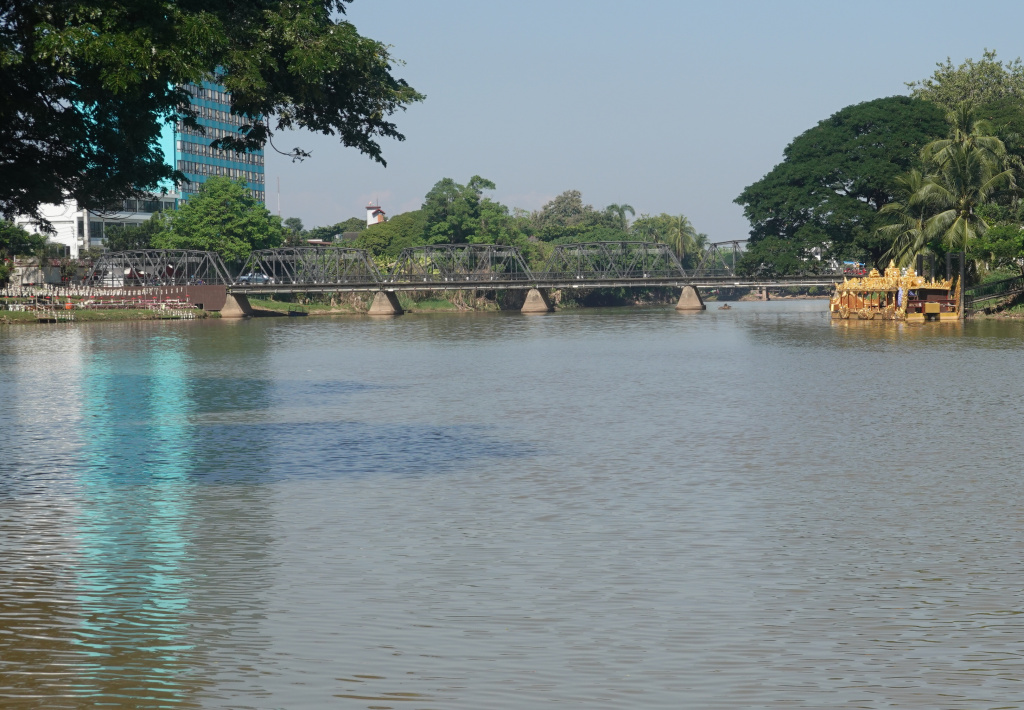
If Wat Chai Mongkhon had been flooded, the cleanup has been thorough. I saw no evidence of the October and early November floods. I walked to the boat landing to see the Mae Ping River. You have to go up about 10-12 steps and then down to the landing. This may have protected the temple from flooding. From the landing looking north to the Iron Bridge, the river appears peaceful. I could see that it is actually moving fairly fast.
Made my way back to The 3-Sis after what had been a 9-kilometer walk. Strength training and a long walk. Time for a rest, and some quiet time at Story 106 to keep updating my blog.
Next: Three temples in the north of the old city

 James the Intrepid Pilgrim