Friday 22 November 2024
Walking the entire circumference of old Chiang Mai
For my first full day in Chiang Mai, I thought I would walk the entire circumference of the Chiang Mai old city wall & moat, about 8 kilometers (5 miles). Given my recent experience in Bangkok, I am wearing a hat and carrying water with me.
Brief History of the Chiang Mai Wall
Chiang Mai was built by King Mengrai in 1296 as a walled city. The term “chiang” in a city name historically meant a fortified or walled city. King Mengrai first built and resided in Chiang Rai (walled city of King Mengrai) but it was close to Burma and the Burmese and his people battled many times. He decided to build a new city, farther from Burma, with a more substantial wall and also surrounded by a moat. The word “mai” in Thai means “new” so Chiang Mai is the “new walled city.”
The wall is almost square, about 1600 meters on a side. In 1893, a British explorer and surveyor mapped Chiang Mai and found that although the southeast corner is off by less than 30 meters, the old city wall is remarkably close to a square considering the lack of technology available in 1296.
Most of the old wall is gone. When the Japanese occupied Thailand during World War II, they took down the Chiang Mai city wall to use the bricks to pave the road to Pai on which to move military equipment. Over time after the war, the road inside the moat expanded, filling the space where the wall had been. The corners and the gates were reconstructed from 1966 through 1969, and Tha Phae Gate was completely reconstructed in 1986. The few remains of the walls were renovated in 1996 and 1997 utilizing a combination of old and new bricks. In the winter of 2018/2019, the latest large-scale renovation project was done using new brickwork, making the restored portions of the walls and bastions clearly visible.
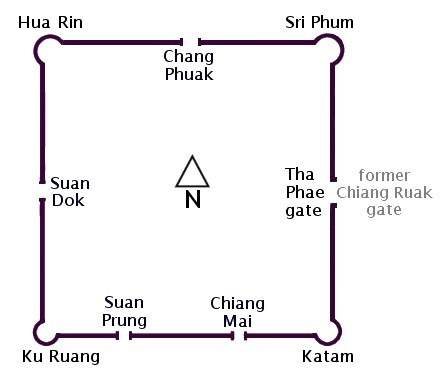
The bastions located at the four corners and the moat are the most original parts of the original fortifications that have survived. All of the bastions have undergone restoration multiple times over the centuries. A very simple diagram of the wall with the corners and gates indicated:
Breakfast before the walk
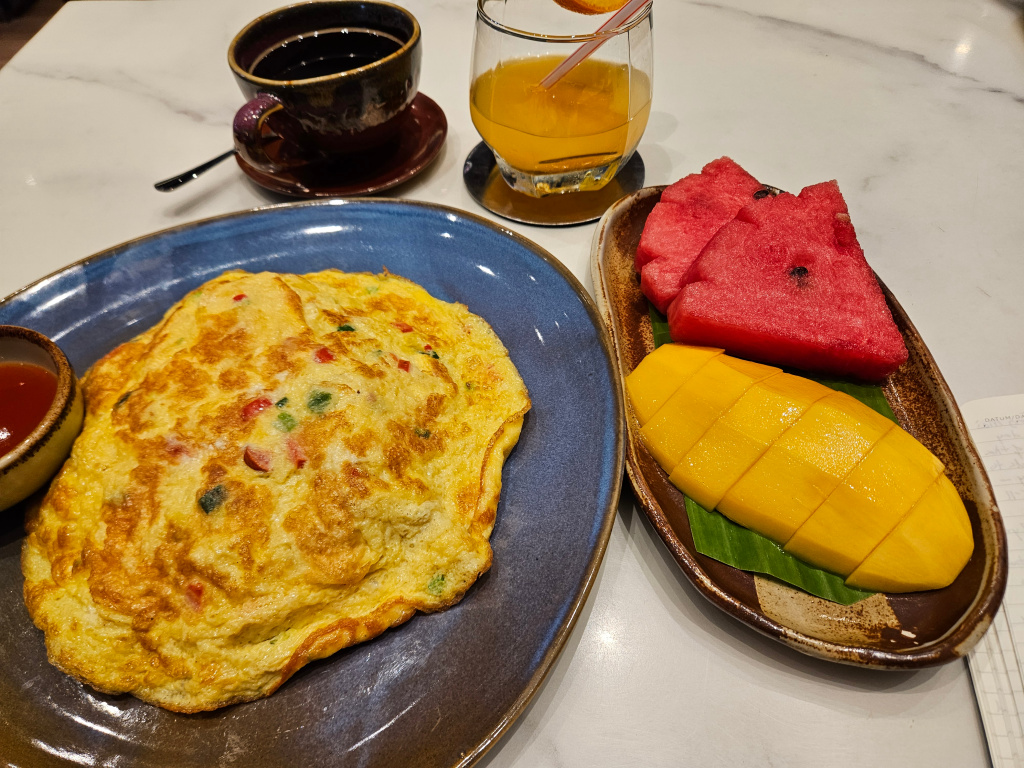
Before I started the walk around the circumference, I had breakfast at The 3-Sis, as I do every day. Today was a Thai omelet over a mound of rice, fruit (today mango and watermelon), coffee, and orange juice.
Walking the Circumference
The 3-Sis guesthouse is right in the middle of the old city, just south of the N” in the map above. I made my way to a place the road crosses the moat just south of Tha Phae Gate and walked south, on my way to Katam Corner.
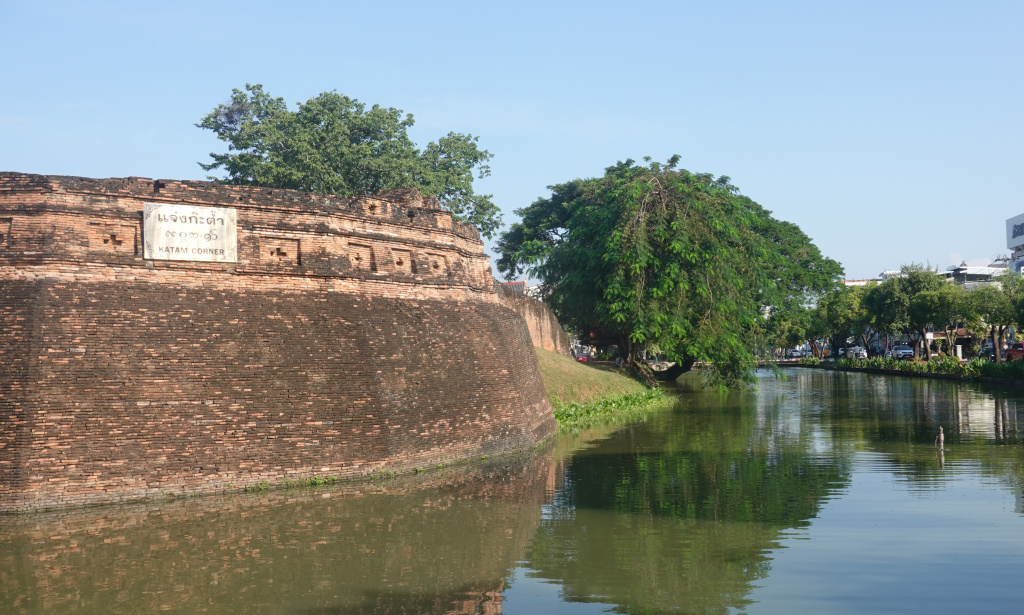
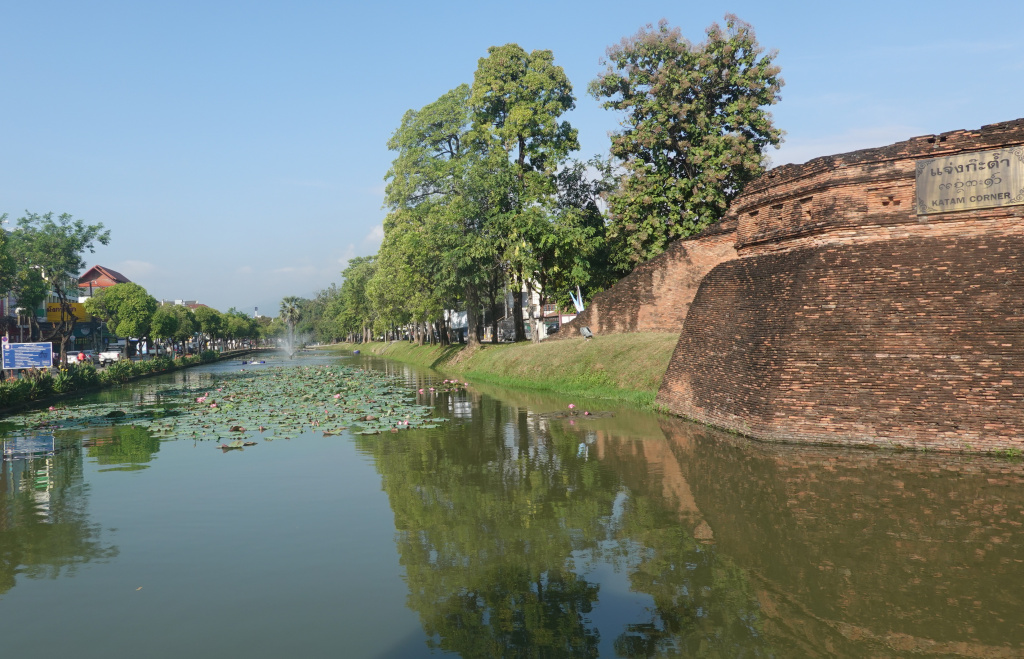
Water enters the moat from a creek at the northwest corner. Today, this is under the intersection at the corner and is no longer visible. Water flows from the northwest corner to the southeast corner where it empties into another creek, also under the intersection today. A “katam” is a bamboo trap used to catch fish, and fishermen would use their katams to catch fish as the water flowed out of the moat into the creek. Thus the name Katam Corner. Here is a photo of Katam Corner and the moat looking west from Katam Corner.
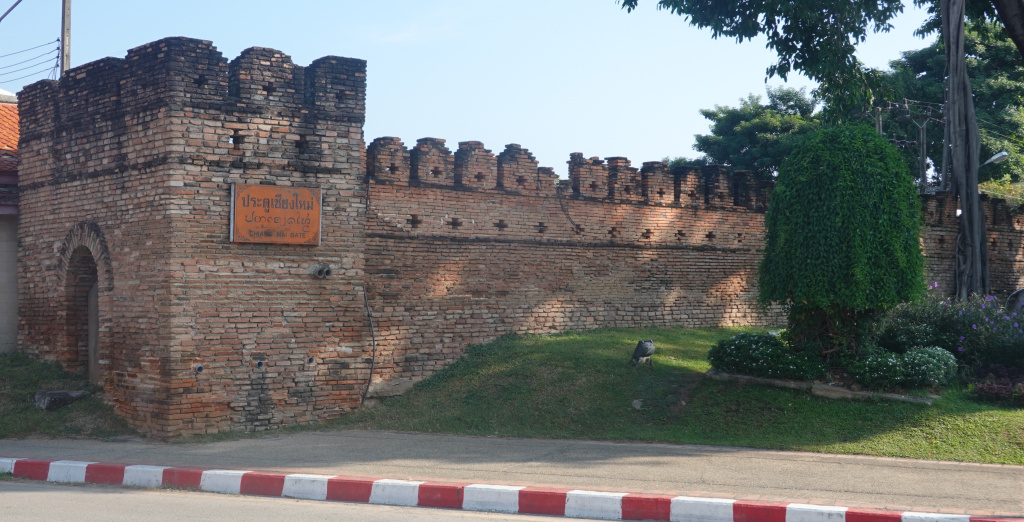
Continuing west, I passed Chiang Mai gate, one of two gates on the south side of the wall. To facilitate modern traffic, when the gates were reconstructed in the 1960s, the entrances were widened to allow traffic through. What remains of the gates are simple, rectangular structures serving as ornamental markers built on the sites of the original gates. They are no longer functional gates, only decorative structures. Here is one side of Chiang Mai Gate today:
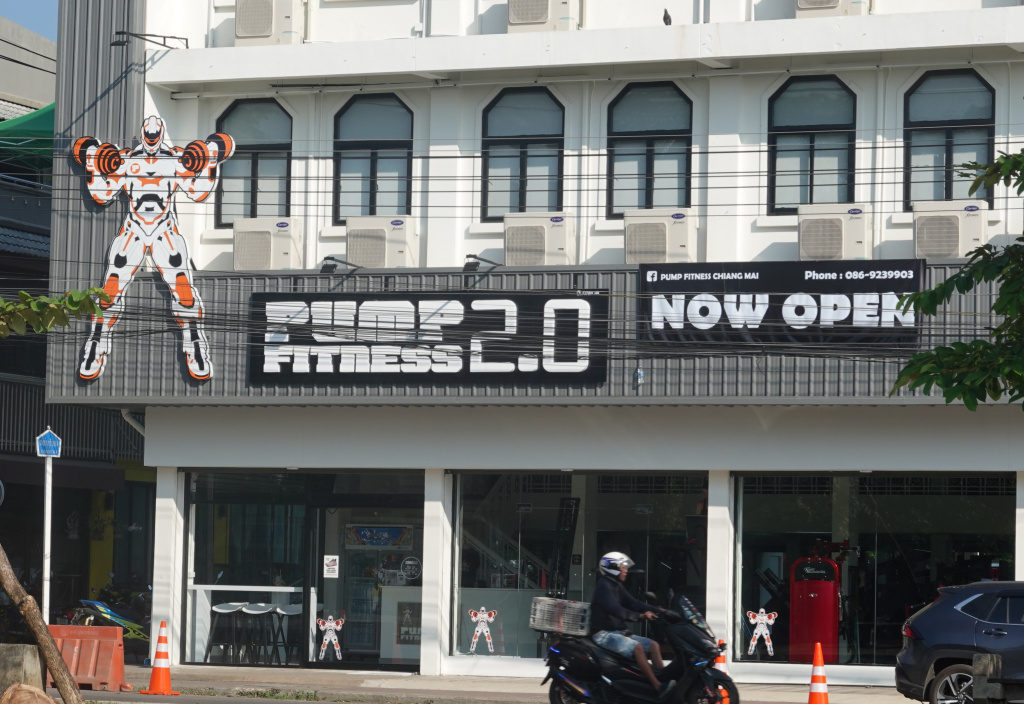
Another 80-100 meters to the west, I can see the new Pump Fitness 2.0 that was built since I left Chiang Mai last February. I’ll be doing strength training with my personal trainer Ning here twice per week. This newer version of Pump Fitness is much larger and also closer to The 3-Sis and Wild Rose Yoga.
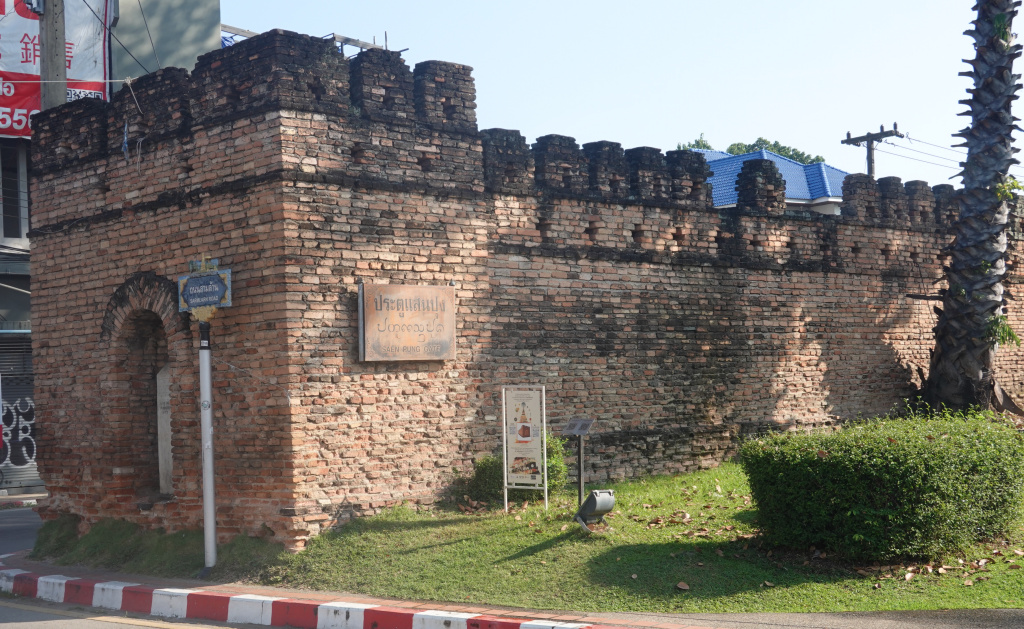
Very soon I came to Suan Pung Gate, the second gate on the south side of the wall/moat. No surprise, the structure looks almost exactly like Chiang Mai Gate.
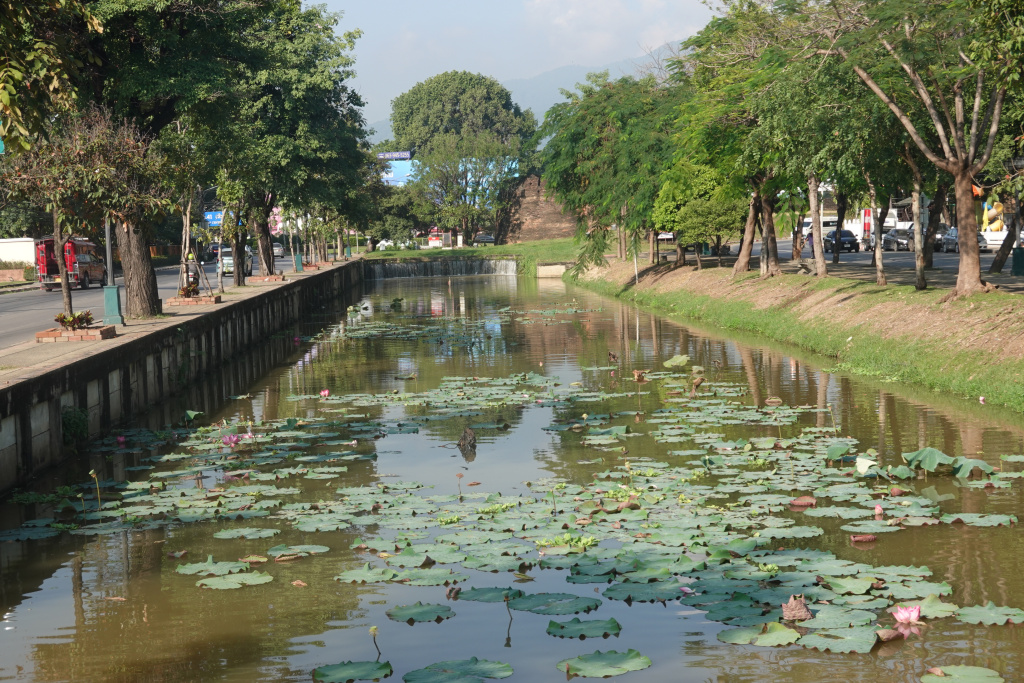
Then a view of the moat as I approached Ku Ruang Corner.
Soon I was at Ku Ruang Corner, somewhat more massive than Karam Corner, and a view of the moat looking north from Ku Ruang Corner.
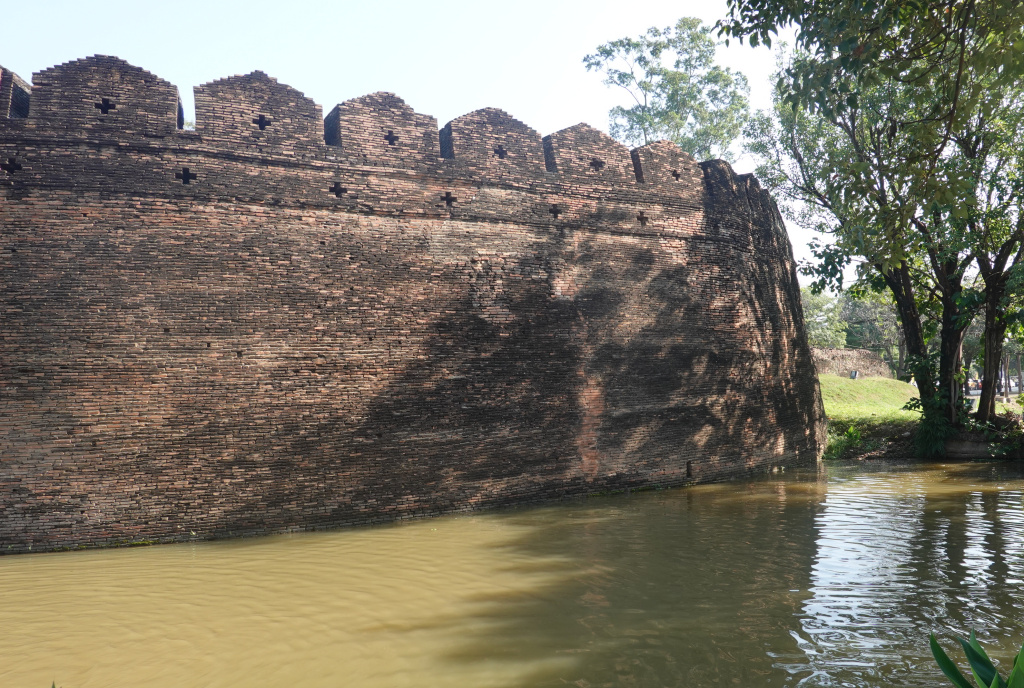
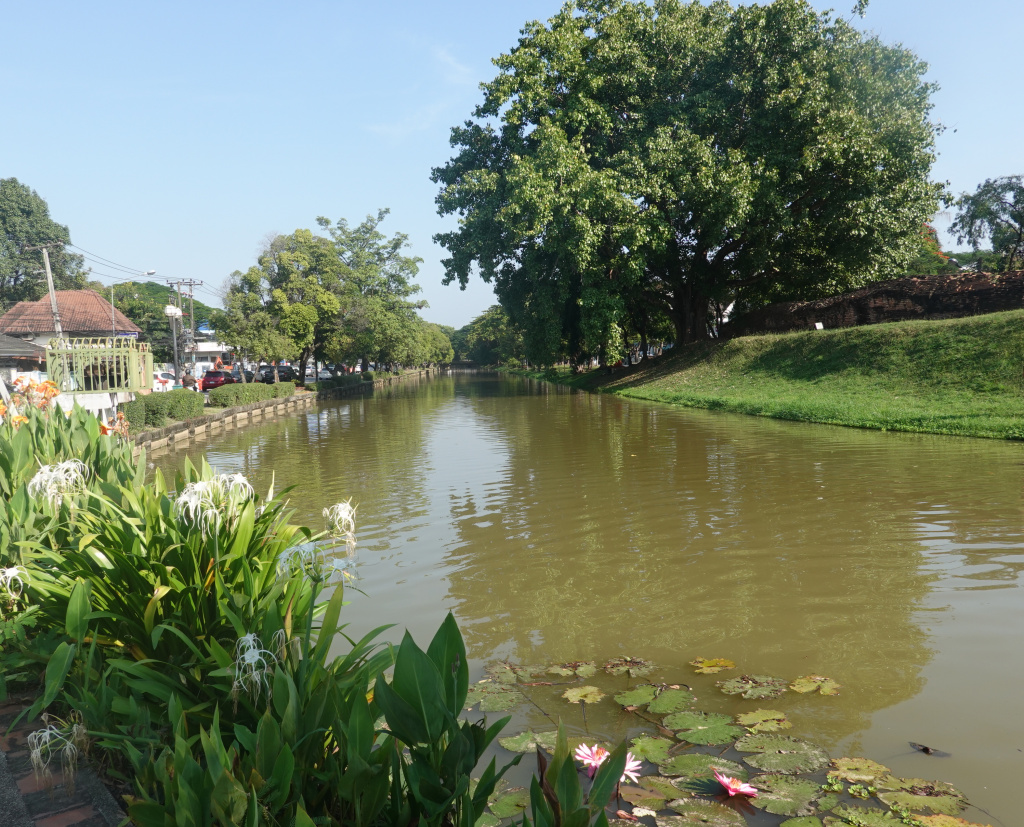
On the upper right of the rightmost photo, a 100-meter or slightly longer portion of the wall is still intact, although much shorter than it had been.
Continuing north along the west side of the moat, I came to Suan Dok Gate. The area directly west of the old city was the king’s flower gardens and Suan Dok Gate opened to those flower gardens. The flower gardens are only a note in history, now long gone. The road going west from Suan Dok Gate today passes three large hospitals and then Chiang Mai University. I photographed both sides of Suan Dok Gate, and again, the modern version of the gate looks like Chiang Mai Gate and Suan Pung Gate since the reconstruction of all were the same project.
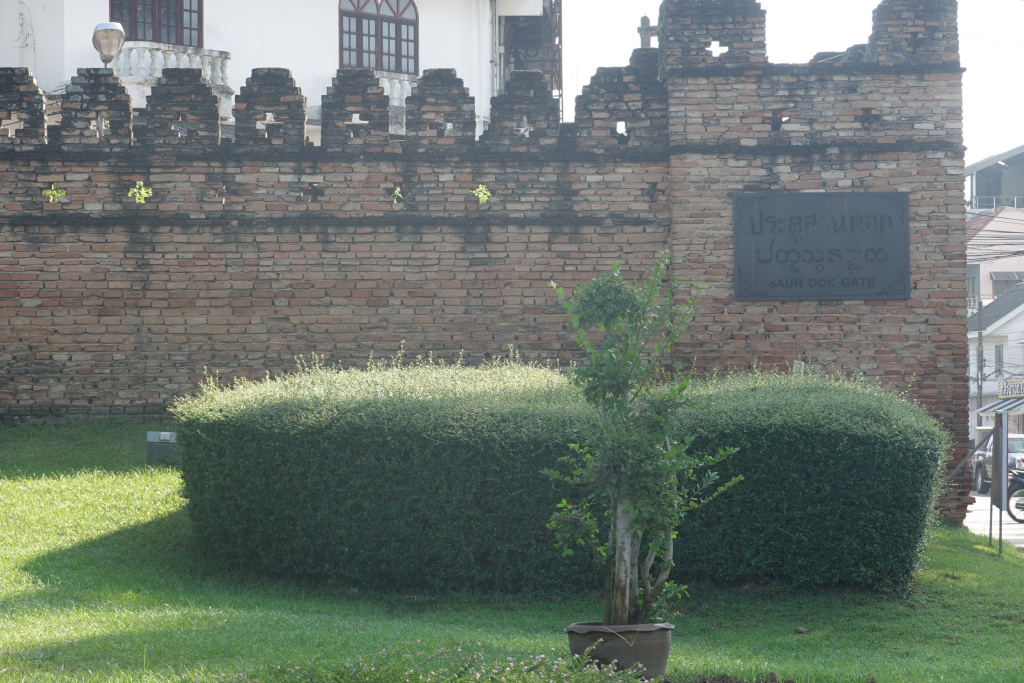
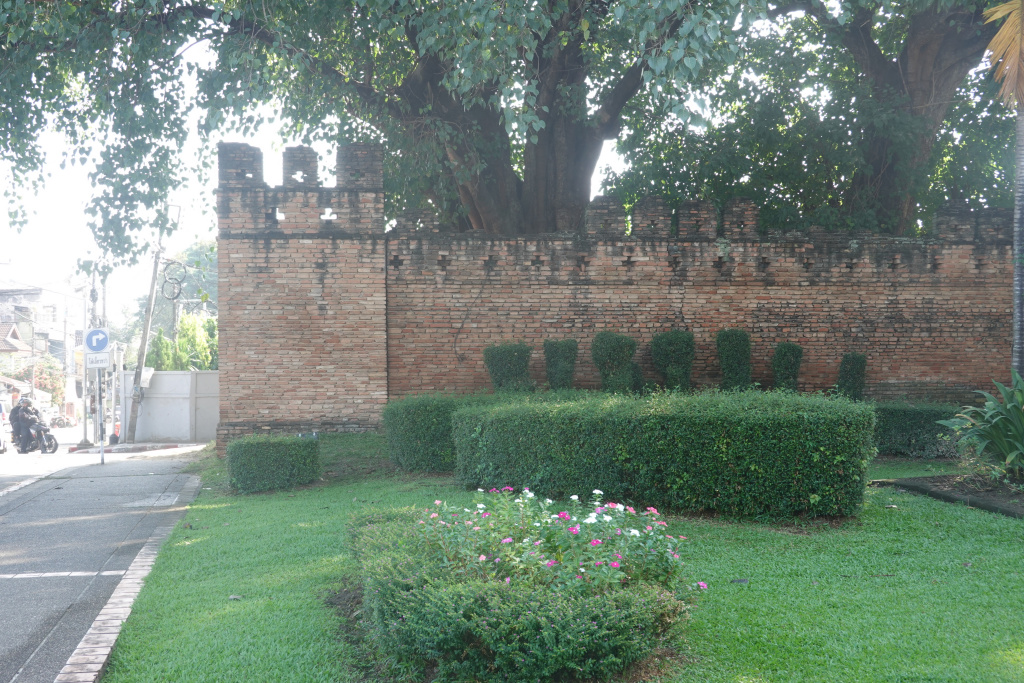
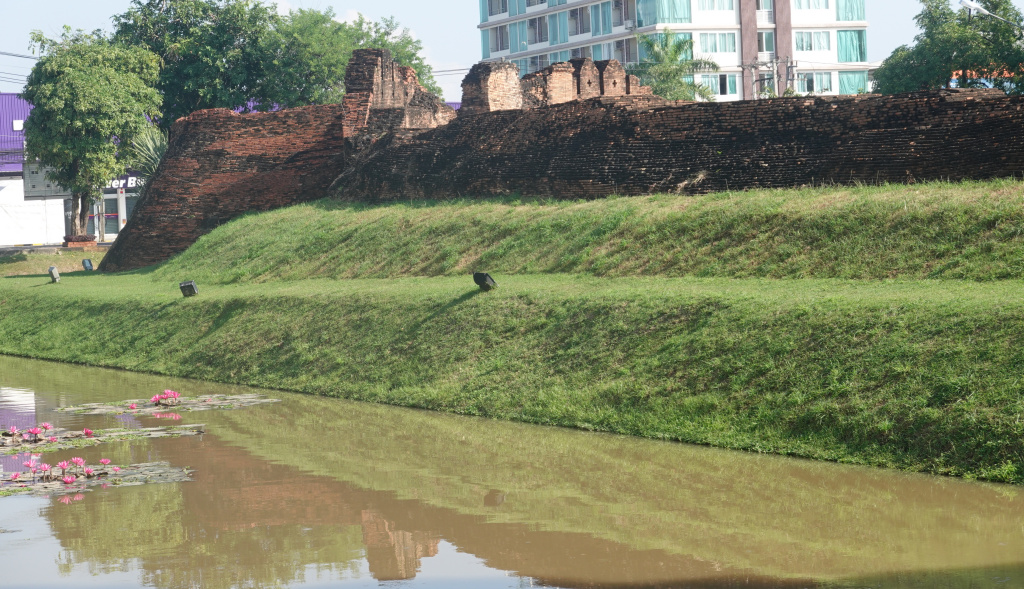
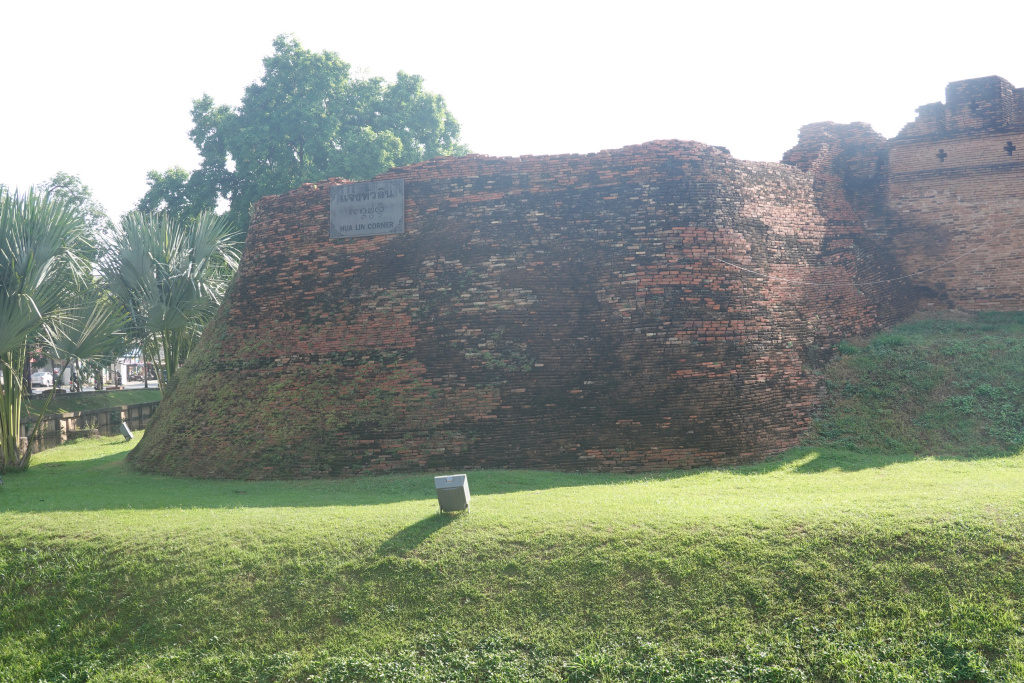
Continuing north, I came to Hua Lin Corner, also sometimes spelled Hua Rin. The sound at the start of “Lin” or “Rin” is sort of in between the L and an R sounds in English. The Thai language with 44 consonants and at least 22 vowel forms has many sounds that are difficult to approximate in English. This is where water enters the moat from a now underground creek. Here is a photo of an intact part of the wall just before Hua Lin Corner and a photo of Hua Lin Corner itself.
In the middle of the north side of the wall/moat is Chang Phuak Gate. About two years ago after extended heavy rains, part of Chang Phuak Gate collapsed. In the process of starting to rebuild the structure, other archeologically significant structures were found. It is unclear what the plans are for this gate. The road has been closed to traffic and a bridge for pedestrians added for people to cross.
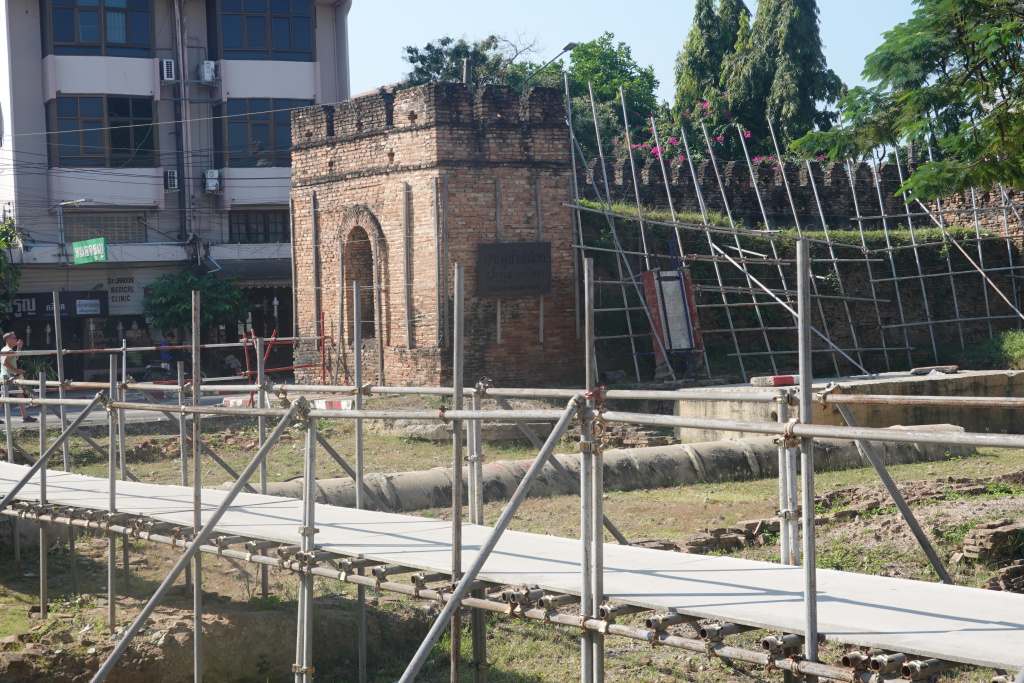
Chang Phuak is another term that is a reminder that translations must consider culture and context. “Chang” in Thai (pronounced chong) translates to “elephant.” The word “phuak” (pronounced pwuk) by itself translates to “ivory” or “off-white.” However, in the context of a large animal, a water buffalo or an elephant, it does not mean ivory or off-white, rather it means “not the normal color.” Historically, the royal elephants were a different breed, a reddish-brownish gray rather than the plain gray of most elephants. [I learned about this in the Elephant Museum in Bangkok.] Chang Phuak Gate is where royalty would enter Chiang Mai on their royal elephants. This makes sense because less than 100 meters inside Chang Phuak Gate and slightly to the east is Wat Chiang Man, the temple King Mengrai constructed as a place to live and worship as he supervised the construction of the city. Another 50 meters south of Wat Chiang Man is Wat Lam Chang, the temple of the tethered elephant, where the royal elephants were housed and fed.
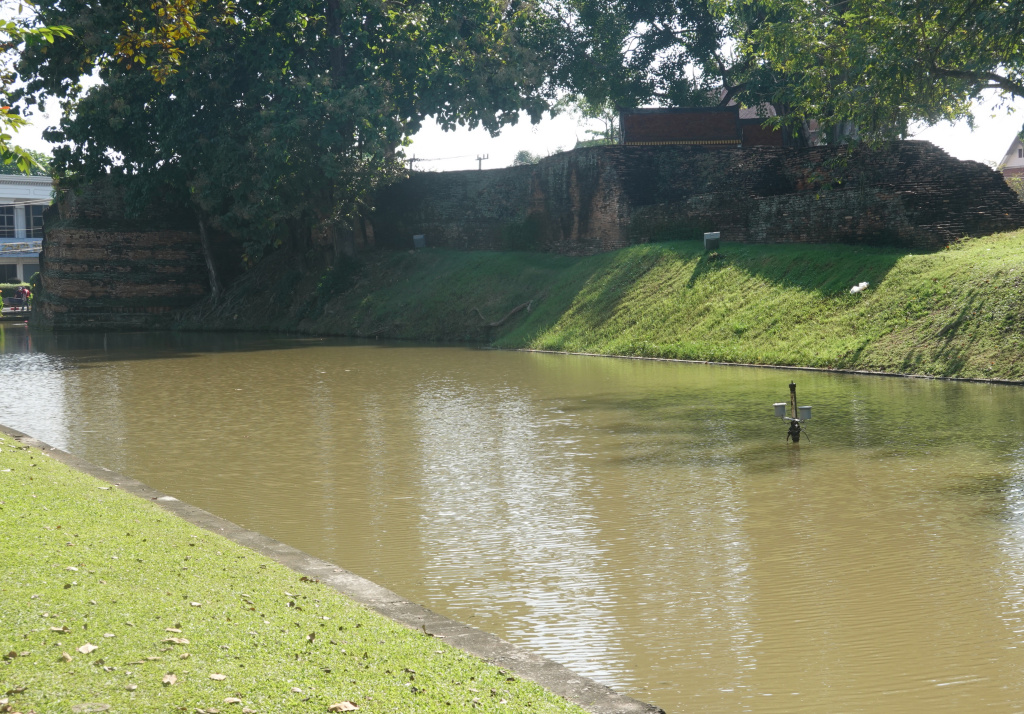
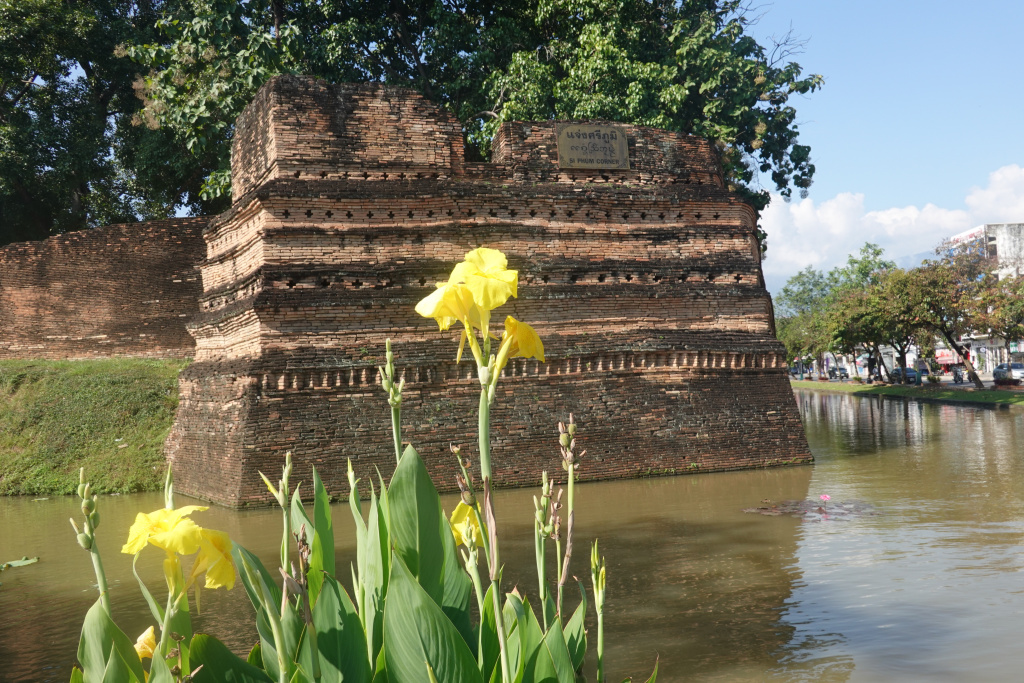
From Chang Phuak Gate, going eastward, I approached Sri Phum Corner. From both sides of the corner are portions of the wall still intact. The photo on the left part of the wall as I approached Sri Phum Corner, almost hidden in the shadows. The photo on the right is of the corner itself.
From Sri Phum Corner, I made a little diversion outside the wall/moat to pass by Ohm Sala, the place where Khun Ohm teaches and practices Chi Nei Tsang and Gua Sha. She was inside teaching, saw me as I approached, and came to the door to say hello. I’ll see Ohm soon for a Chi Nei Tsang session – always a good feeling.
The Walk
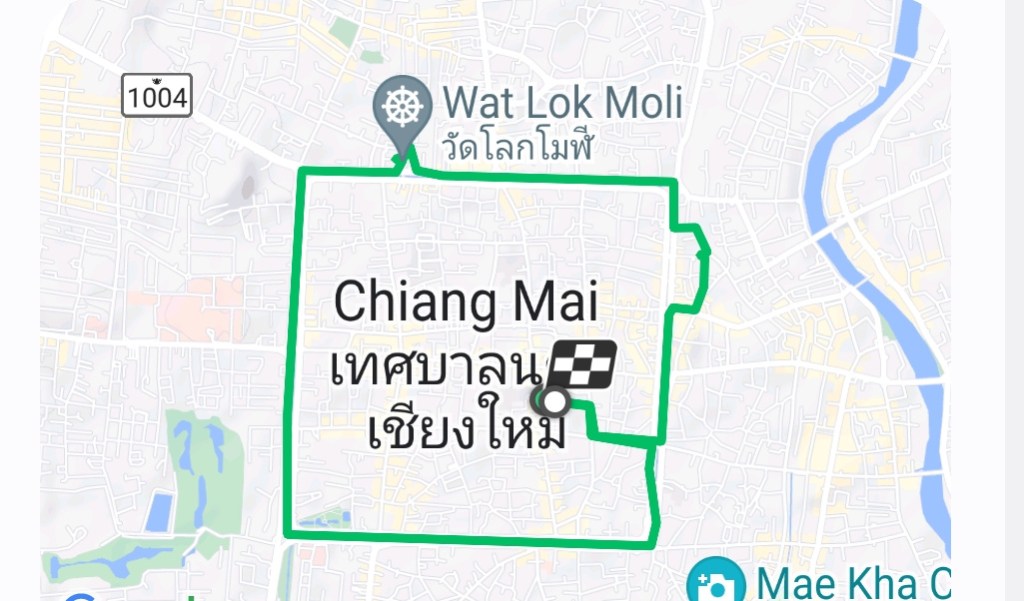
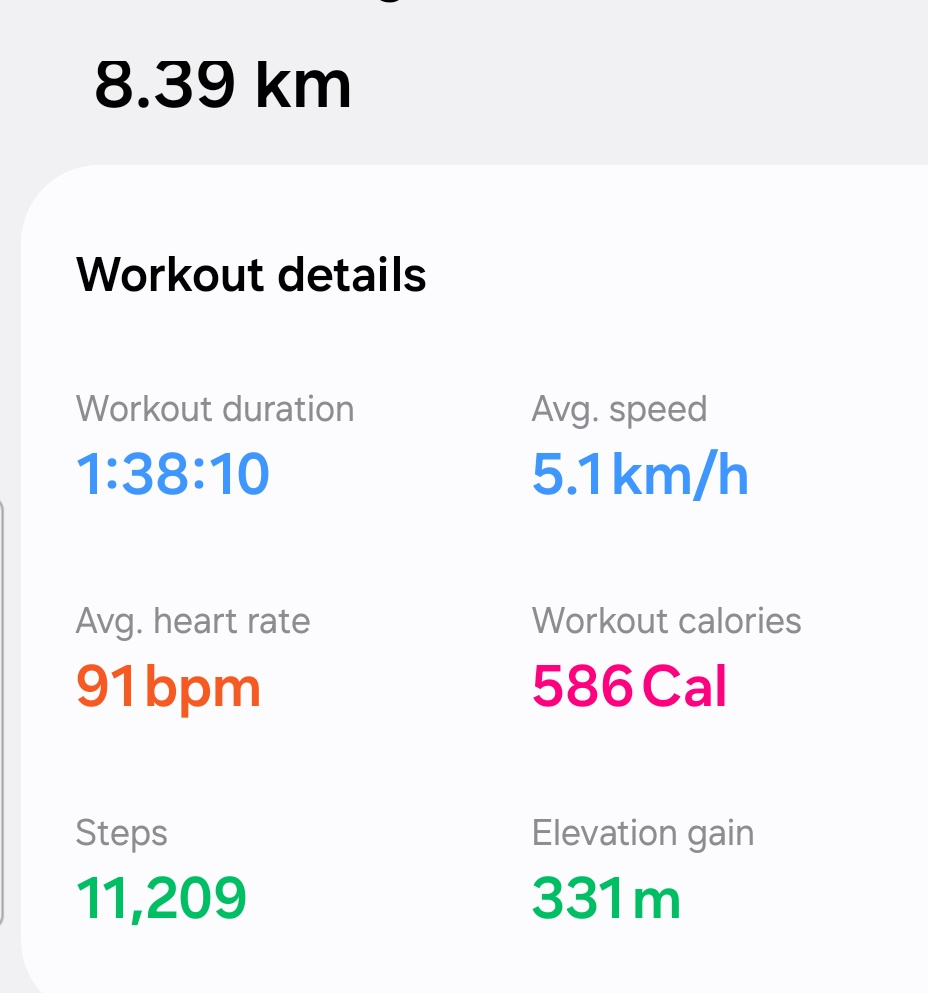
The walk was 8.4 kilometers or 5.22 miles. I made good time, averaging 5.1 km/hour, and that includes a stop at Wat Lok Moli to use the restroom. As can be seen from the map on the right, aside from my diversion, it was almost a square route.
Today, my first full day in Chiang Mai was a very good start to my 12th winter in Chiang Mai.
Next: Wat Chedi Luang, a favorite temple

 James the Intrepid Pilgrim