Tuesday 19 November 2024
One Full Day in Bangkok Part 1 – Wat Arun
My plans for today will be very similar to my one full day in Bangkok last year, so this post will be quite similar to that from last year and years past when I was only in Bangkok for one full day. Bangkok is a large city, about the size of Los Angeles with twice as many people. It has a frenetic pace. The traffic is almost always congested, the mass transit systems are crowded, and there is an almost infectious energy to Bangkok. It is a great city, rich with history and culture. But the high energy tires me out, so I stay in Bangkok just enough time to see a few favorite sights.
I arrived in Bangkok Monday afternoon, very tired after the long journey from my home just north of San Diego. And after having dinner at Sunrise Tacos, I returned to my hotel, planning to visit the Crimson Room (a jazz venue), but fell asleep. Wednesday (tomorrow) I leave for Chiang Mai shortly after lunchtime, so there is no time for sightseeing tomorrow. Today, Tuesday, is my one day in Bangkok to see my favorite sights, namely Wat Arun and Wat Pho, and depending on my energy level, I thought I’d see Wat Suthat which I have never seen, and then return to Wat Saket (the Golden Mount Temple) which I visited once about 10 or 11 years ago.
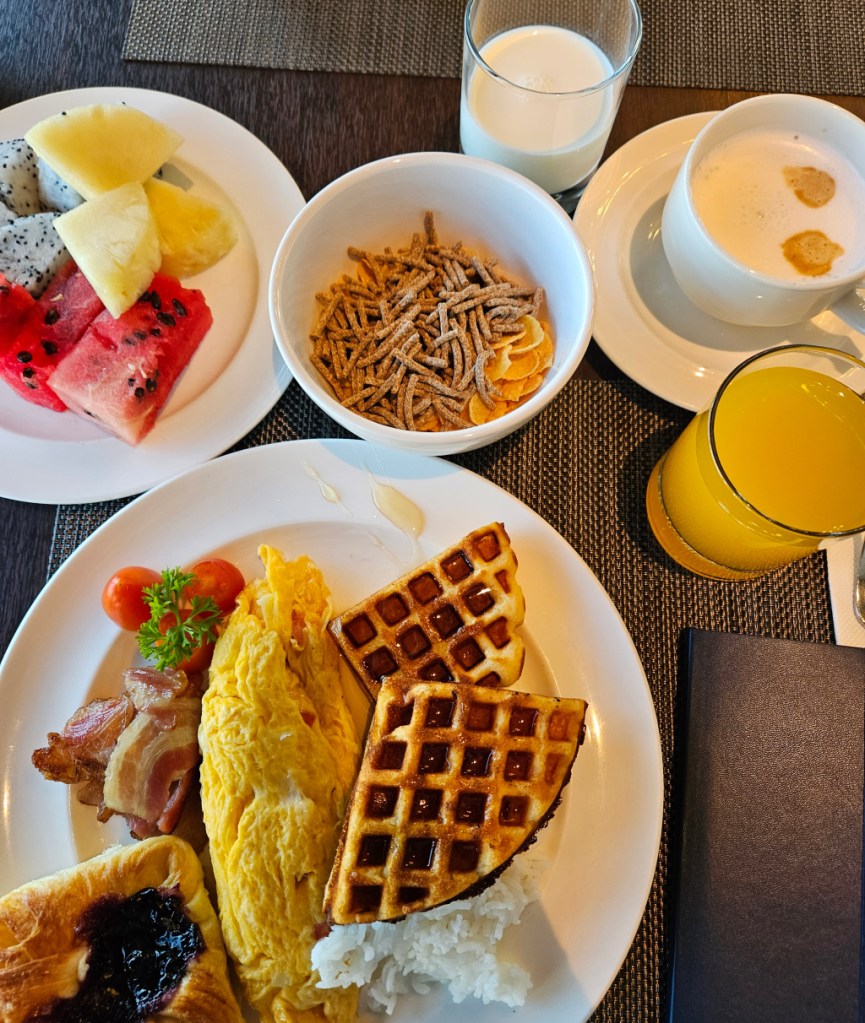
The hotel offers a rather extensive and delicious breakfast buffet. So, being on vacation, I splurge a little. My very Western-style breakfast and a selfie of me trying to get a good photo are seen below:

After breakfast, I headed out to see the sights. As in the past, I took the BTS Skytrain up to the Siam Square interchange, changed trains from the Sukhumvit Line to the Silom Line, took the second train to the Saphan Taksin stop, and walked to the Sathorn Pier to catch a boat up the Chao Phraya River to Wat Arun, my favorite temple in Bangkok.
Wat Arun
I found this stock photo of Wat Arun from across the Chao Praya River that conveys better just how large the towers are. I did not take this photo, and include it only to show a perspective I cannot get.

Wat Arun is significant in Thai history, one of Bangkok’s best-known landmarks. It is classified as a Royal Temple of the First Class, a category consisting of only six Thai Buddhist temples (there are over 30,000 active Buddhist temples in Thailand). In the 1700s, Wat Arun was known as Wat Makok, after the village of Bang Makok in which it was located. It is likely that the current city name Bangkok evolved from the village name Bang Makok.
When the former capital Ayutthaya was overthrown in 1774, King Taksin and what was left of his army moved south along the Chao Phraya River, and it is believed that when Taksin saw this temple at dawn, he decided to make this the new seat of his kingdom. He rebuilt the temple and renamed it for Aruna, the Hindu Goddess of the dawn. Almost all Thai Buddhist temples have a formal or official name, a short name, and sometimes a nickname. Wat Arun’s formal name is Wat Arun Ratchawararam Ratchawaramahawihan. The most recent cleaning and renovation of Wat Arun took place from 2013 – 2017 during which time the towers were covered with scaffolding as workers carefully restored the surfaces.
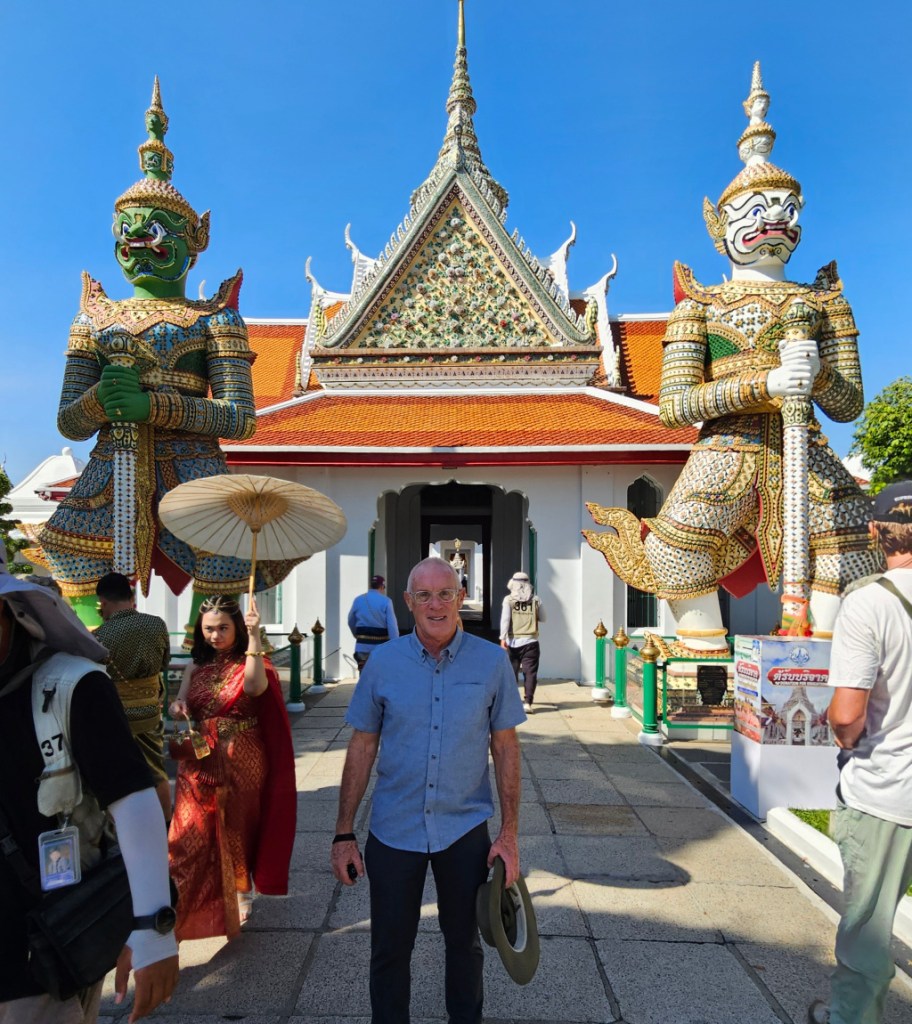
Wat Arun, like many Thai temples, is something of a small campus, with several buildings and structures. The entrance to the main viharn (worship hall) at Wat Arun is guarded by two large yak or yaksha figures. From Wikipedia, “yaksha are a broad class of nature-spirits, usually benevolent, but sometimes mischievous or capricious, connected with water, fertility, trees, the forest, treasure, and wilderness.” Here are the yaks standing guard at the entrance with me and other tourists:
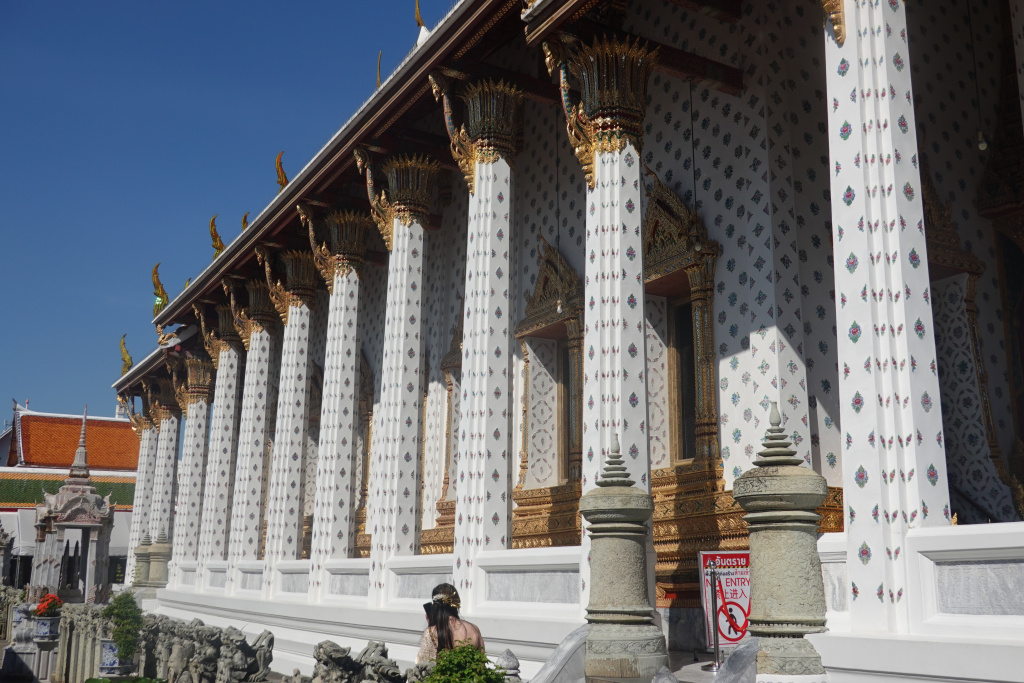
Walking past the main viharn I was attracted to the tall, parallel, white columns supporting the roof:
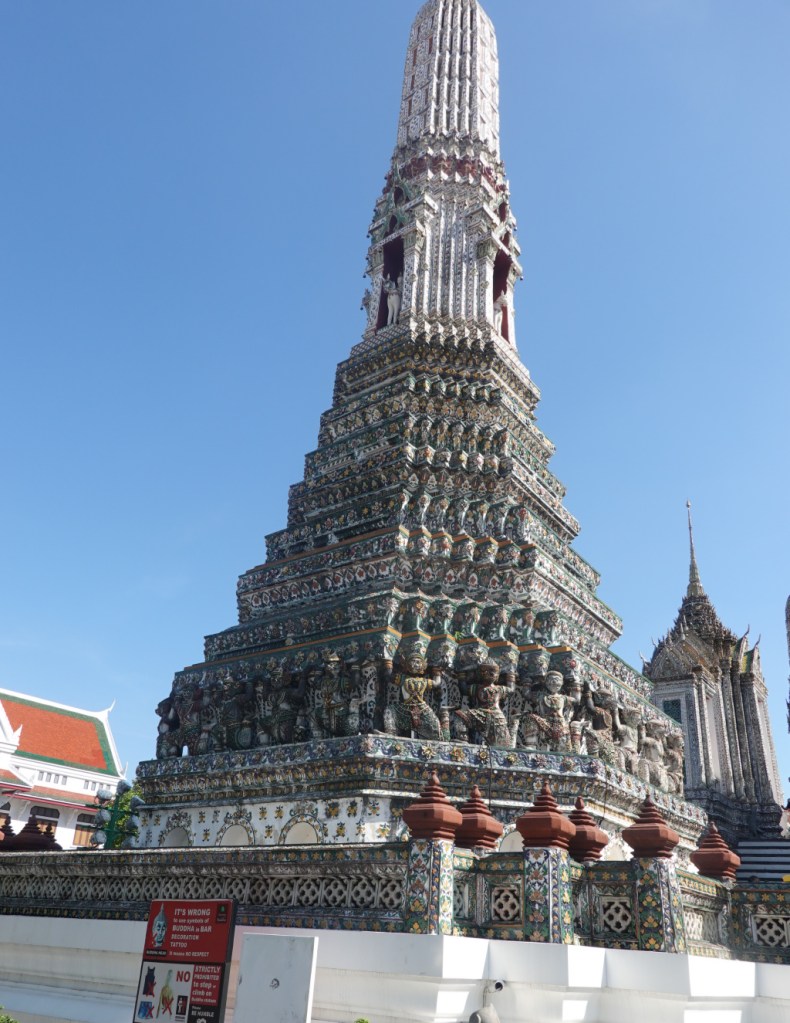
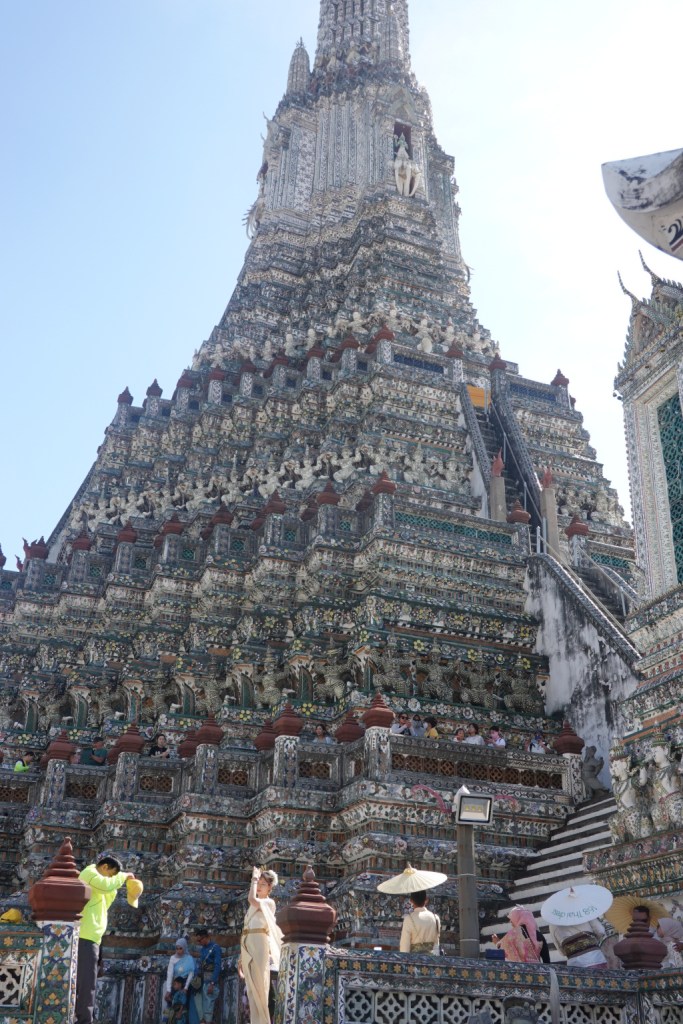
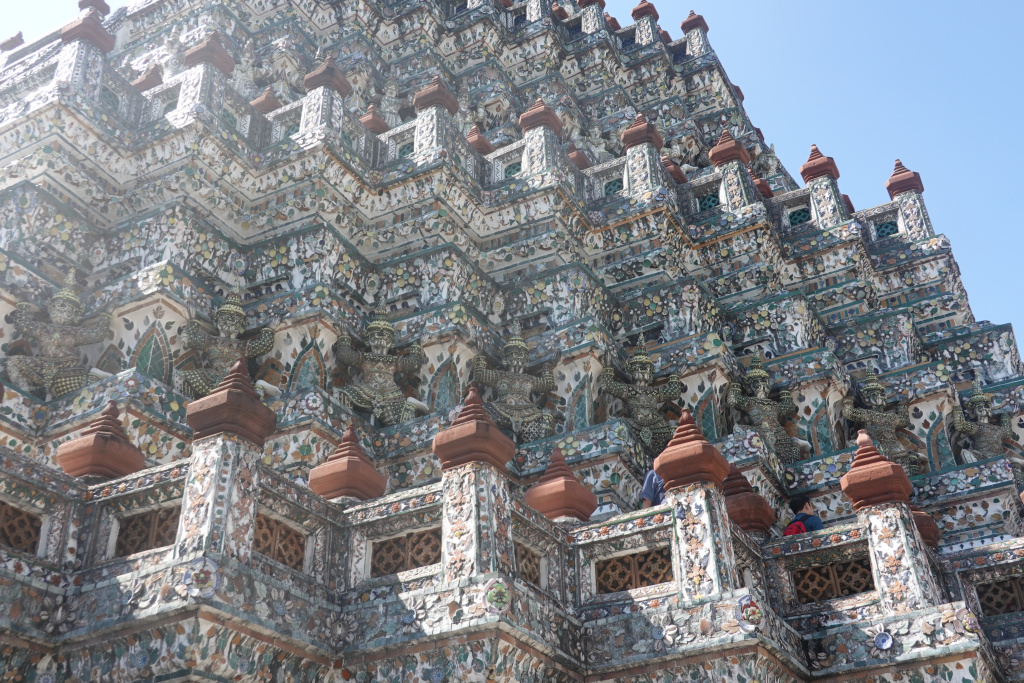
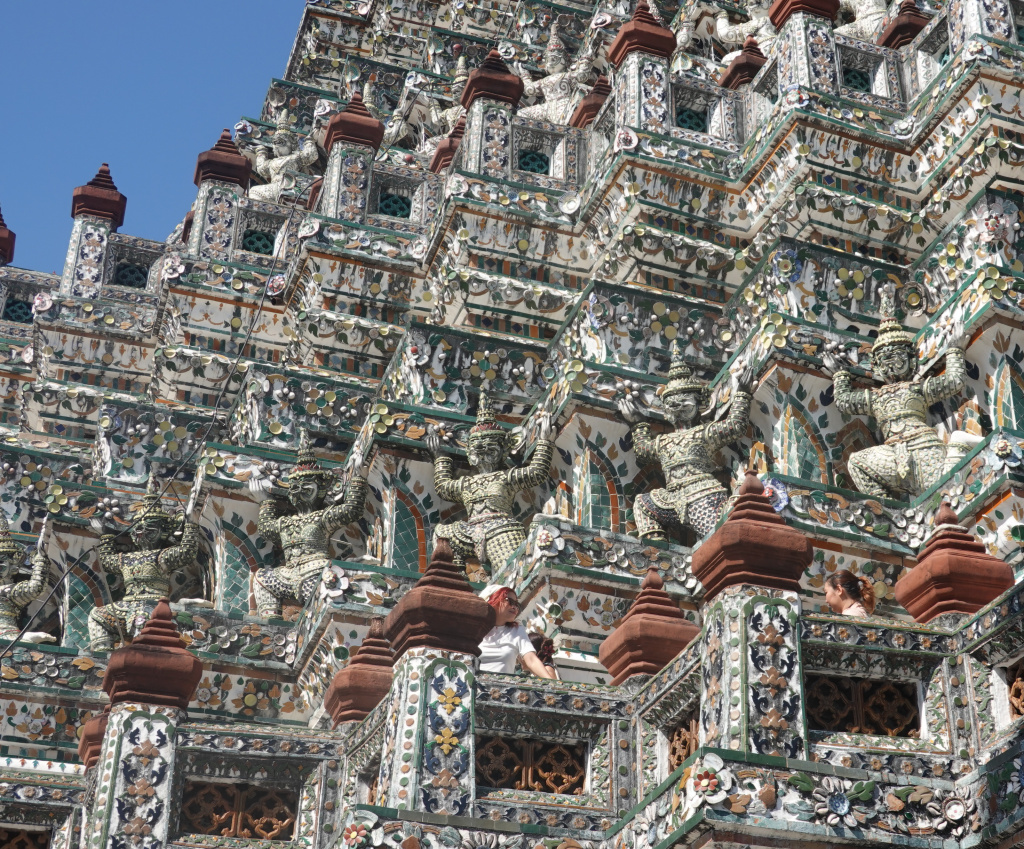
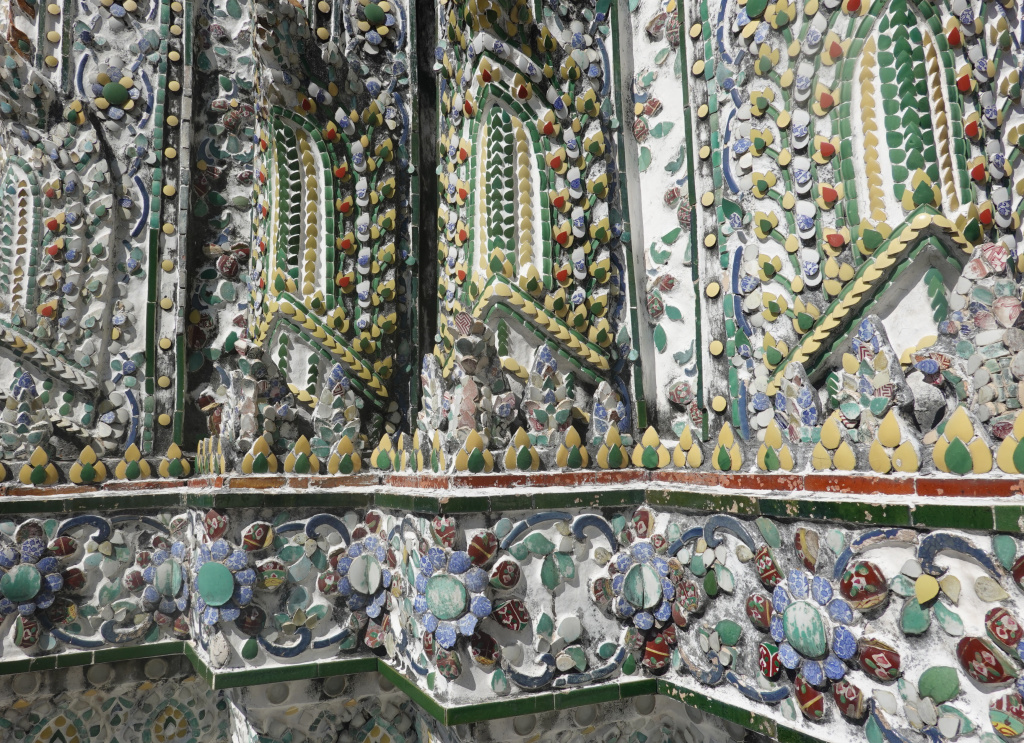
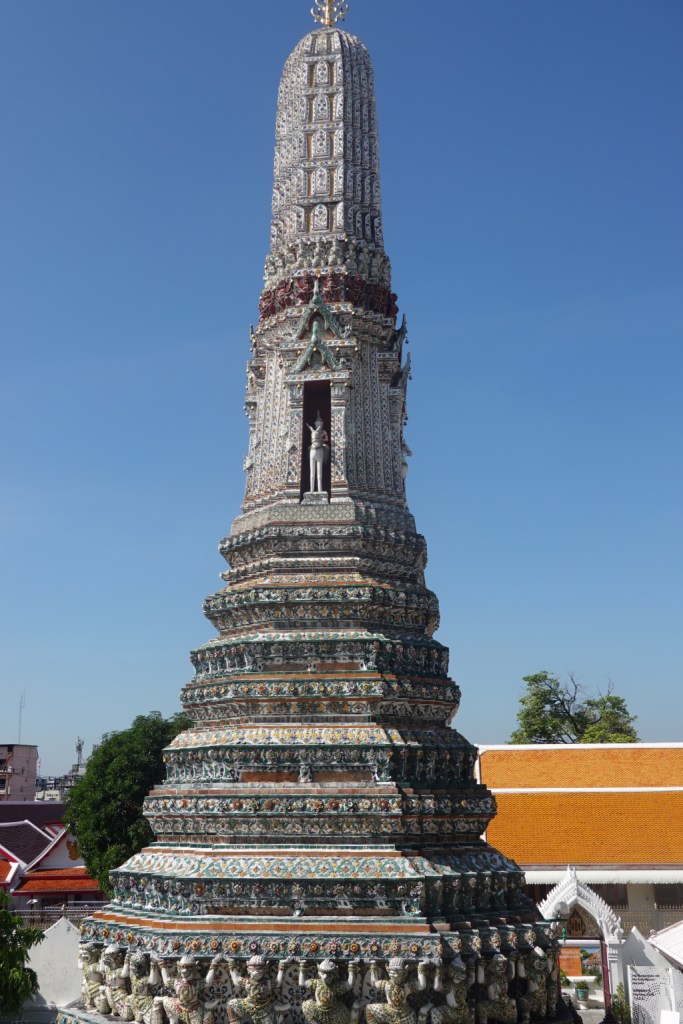
The main part of Wat Arun consists of four Khmer-style “prangs” and a fifth, larger one in the middle. This layout is a representation of the five sacred mountains which were home to the gods according to Khmer, Hindu, and Buddhist cosmology. The central prang represents Mount Meru, the center of the universe. When the height of the central prang was extended by King Rama III in the 1800s, he ordered that colorful ceramics and porcelain should be used to form elaborate motifs and designs. This unusual design feature makes the prangs shimmer and shine in the sunlight and gives the temple a unique appeal that has to be seen close up to be fully appreciated. A staircase, which is very steep with narrow steps (and no handrails), allows visitors to climb part way up the central prang to a platform from which to view the four smaller prangs.
It is difficult to get a good view of the towers (perhaps if I had a drone and was allowed to use it). Here are three views of the central prang towering high:

I climbed up to the platform to get a closer look at the detail. Not only are there no guardrails, the steps are almost double the height of standard steps, so it is a precarious climb. Here are some closer views showing some of the detail:
From the platform, I got a photo of one of the corner towers:
And another tourist from Spain took this photo of me after I took one of her and her friend:

It seems that the thing to do is to dress in traditional clothing and have photos taken at historic sights. I have noticed an upsurge of this in recent years. I took a few photos of a lady and her boyfriend, both in “traditional” clothing. [Traditional clothing and modern sneakers.] Then he took a photo of me with his girlfriend.
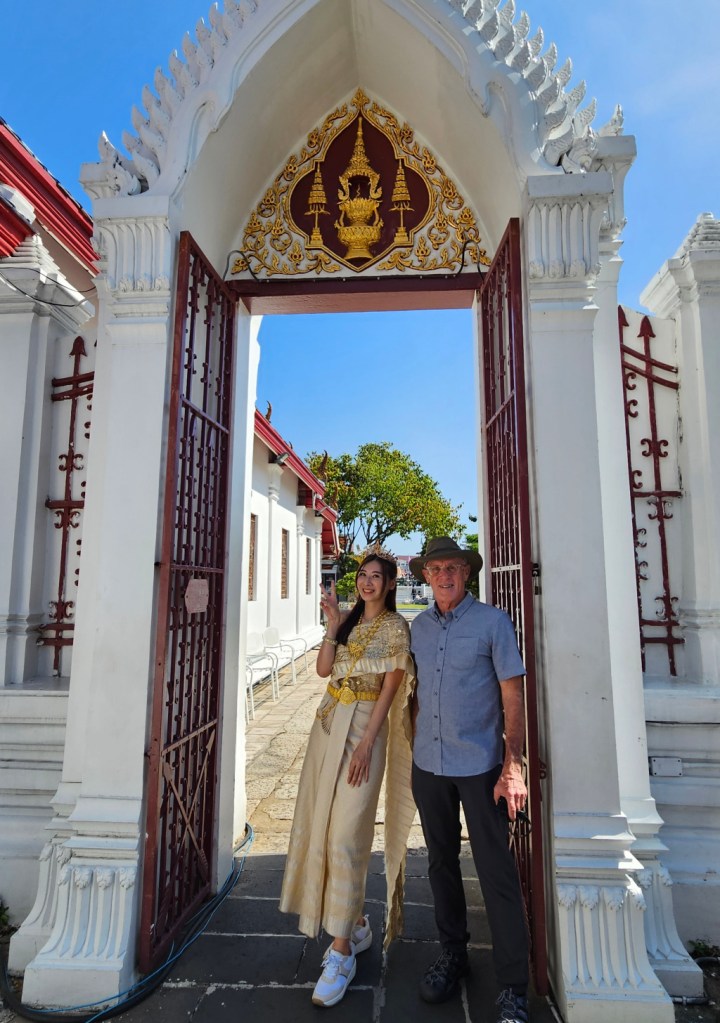
After the photo, I took the ferry across the river to walk over to see Wat Pho.
Next: Full Day in Bangkok Part 2 – Wat Pho

 James the Intrepid Pilgrim