Tuesday 20 January 2024
Wat Chang Taem
Wat Chang Taem is next door to See You Soon, where I am staying for the last two weeks of this visit to Chiang Mai. I was at The 3-Sis for the first two months, so named because it is owned by 3 sisters (Poppy, Ice, Uhey) and their parents. The family also owns other properties in Chiang Mai. Poppy, one of the sisters, runs The 3-Sis and the adjoining Poppy’s Cafe. Ice and her husband Ball run See You Soon, a very busy restaurant, and clothing shop, and there are 6 rooms upstairs. So I stay at See You Soon part of my time in Chiang Mai every year – I know and like the staff at both places.
Wat Chang Team
Wat Chang Taem is a small temple, compared to most Buddhist temples in Chiang Mai.

Wat Chang Taem’s name means “10,000 drops of rain,” where exactly it got that name I have not discovered. The temple plays an important role in the annual Inthakhin Festival when the Chiang Mai city pillar, now at Wat Chedi Luang, is venerated. A side building holds the Fon Saen Ha Buddha which is over 1000 years old. This Buddha statue dates from the tenth century and was originally in a temple in Lamphun. King Tilokorat of the Mengrai Dynasty (1441 to 1487) overthrew Lamphun and destroyed most buildings except the temple housing the Fon Saen Ha Buddha. This statue along with the Buddha image called “Pra Kaew Khao” were taken to Chiang Mai. The Pra Kaew Khao Buddha was moved to Wat Chiang Man and the Fon Saen Ha Buddha moved to Wat Chang Taem. The Fon Saen Ha Buddha is moved from Wat Chang Saen to Wat Chedi Luang for the annual week-long Inthakin festival in late May or early June according to the lunar calendar.
Opposite the main entrance and across a parking area is the entrance to the building in which the Fon Saen Ha Buddha is kept in a room upstairs. The stairs are guarded by white naga dragon-like creatures.

Upstairs, when the doors are open, the Fon Saen Ha Buddha can be seen in an alcove behind heavy steel gates, but not well because the room is dark and there are no lights behind the gates.

There is a pedestrian entrance also on Prapokkloa Road that leads directly into the viharn (worship or prayer hall). And the entrance to the viharn is, like the building housing the Fon Saen Ha Buddha, protected by sweeping white naga dragon-like creatures. (It was almost impossible to get a direct photo including the whole of the Naga because the stairway broadens and there was not enough space.)


The viharn itself is built in the Lanna style with a multi-tiered sweeping roof and tall columns inside supporting the roof. Instead of one large Buddha image at the altar, there are several moderate-sized statues and in the foreground in the center, the multiple-entwined snake statue. I have seen this elsewhere and know little about its meaning.

Walking to the back to the main entrance guarded by the Singha lion creatures to see an overview, the Lanna-style roof of the viharn is more apparent, and the slim white chedi with the gold top rises up.
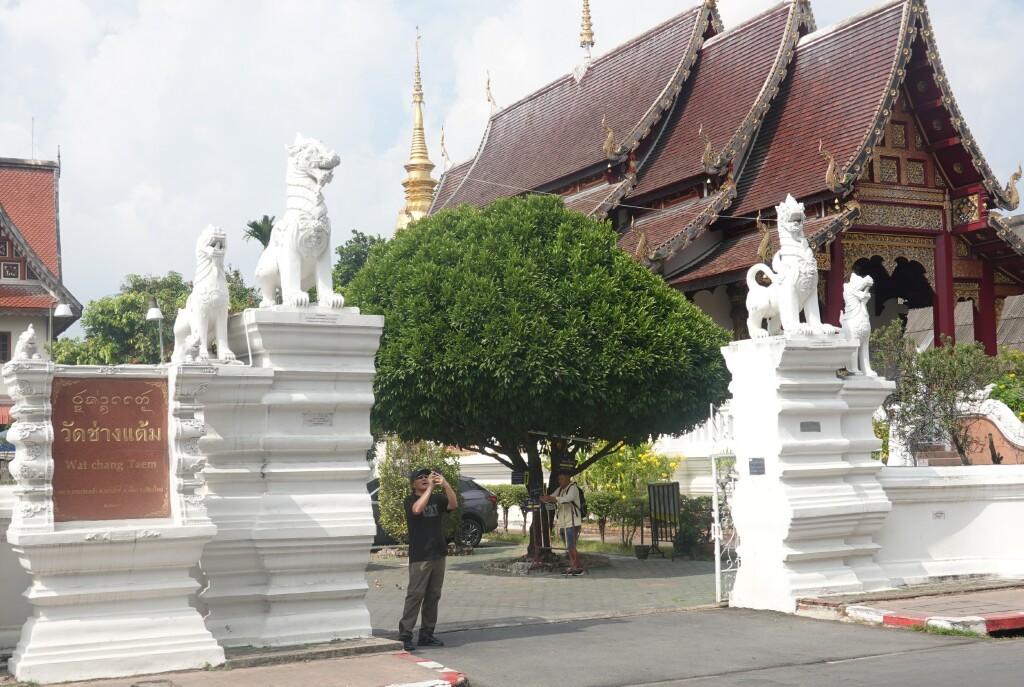
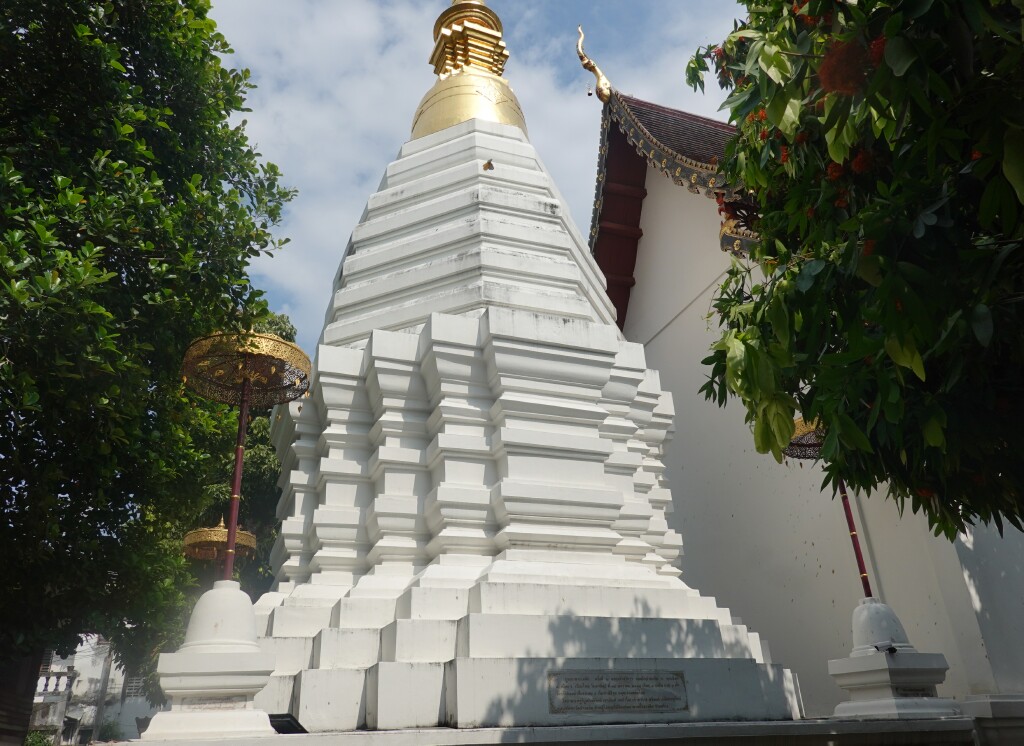
The chedi at Wat Chang Taem is tall, white stucco, and slim, octagonal with many layers and a gold, bell-like top section.
Wat Chang Taem is a very nice almost low-key local temple that houses a very important 1000-year-old Buddha image. While not extremely busy, being situated on busy Prapokkloa Road gives it a constant stream of tourists while at the same time feeling very peaceful.
Next: Prapokkloa Road Temples 5 – Wat Pan Tao

 James the Intrepid Pilgrim