Tuesday, January 30, 2024
Wat Muen Tum
Across Prapokkloa Road and only 50 meters or so north of Wat Jed Lin is Wat Muen Tum, sometimes spelled Wat Muen Toom. Almost all Buddhist temples have the main entrance on the east side. The viharn (worship or prayer hall) doors open to the east to greet the rising sun honoring the beginning of the day. On the west, or setting sun side of the viharn is the chedi (pagoda) in which the remains of someone are interred. The setting sun represents the end or death, so it is appropriate that the chedi is placed at the west end. Five of the six temples along Prapokkloa Road have their entrance on the west side of the street, so on the street entrance to the temple grounds is the east end, the entrance of the viharn. The exception is Wat Muen Tum. It is on the east side of the street, so the “entrance” is on the west side of the chedi. There is also an entrance at the side of the temple grounds down Prapokkloa Soi 6, but that is not a major road, so is seldom used.
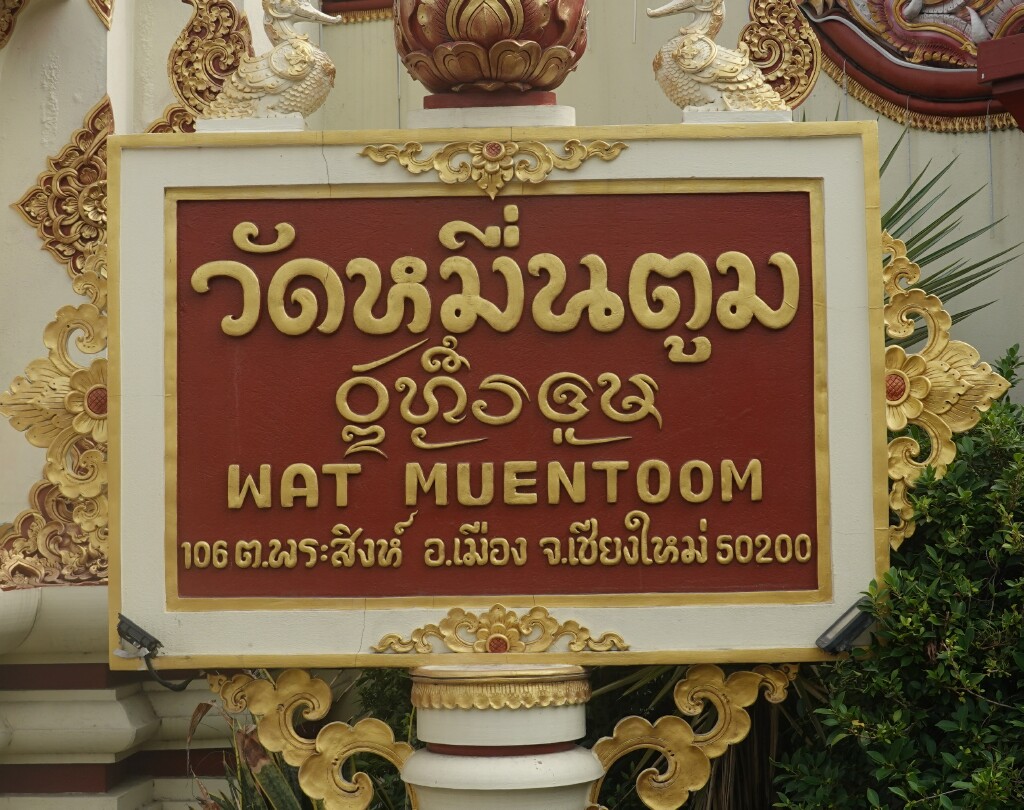
There is little historical information available about Wat Muen Tum. It was built around the year 1478 during the reign of King Mueang Kaeo, so this is a very old temple. The temple name Muen Tum was originally a nobleman soldier. He brought his relatives, family, and other people together to help build this temple to offer to the Buddha. Therefore, it was called Wat Muen Tum after the name of the nobleman. According to history, whenever a new king of the Mengrai dynasty took the throne, he would first pass a three-step water bathing ceremony. This ceremony will be held at three important temples in order. First, the new king would dress in all white at the white cloth temple (for which I have not learned its actual name). Second, there was a ceremony at Wat Muen Tum to leave behind bad luck. And third, there was a bathing ceremony at Wat Jed Lin.
Even learning of that history, I am still mystified about why the entrance to the temple is from what would be considered the “back” of the temple grounds. On the oldest map of Chiang Mai I have found from 1893, Prapokkloa Road is the most dominant north-south road in Chiang Mai’s old city, running almost directly from Chiang Mai Gate on the south side to Chang Phuak Gate on the north side. Here is that map made for King Inthawichayanon in 1893. It was hand-written and is very difficult to read. Royal temples are in red (Wat Phra Singh, Wat Chedi Luang, Wat Pan Tao, and Wat Chiang Man), other temples are in orange and vanished temples are in yellow. Royal residences are in green.

From Chiang Mai gate on the south, the rightmost of the two gates in the south, going north on the main road, Prapokkloa Road, Wat Fon Soi can be seen first, then Wat Jed Lin with the pond at the back, and across the street and a little north is Wat Muen Tum.
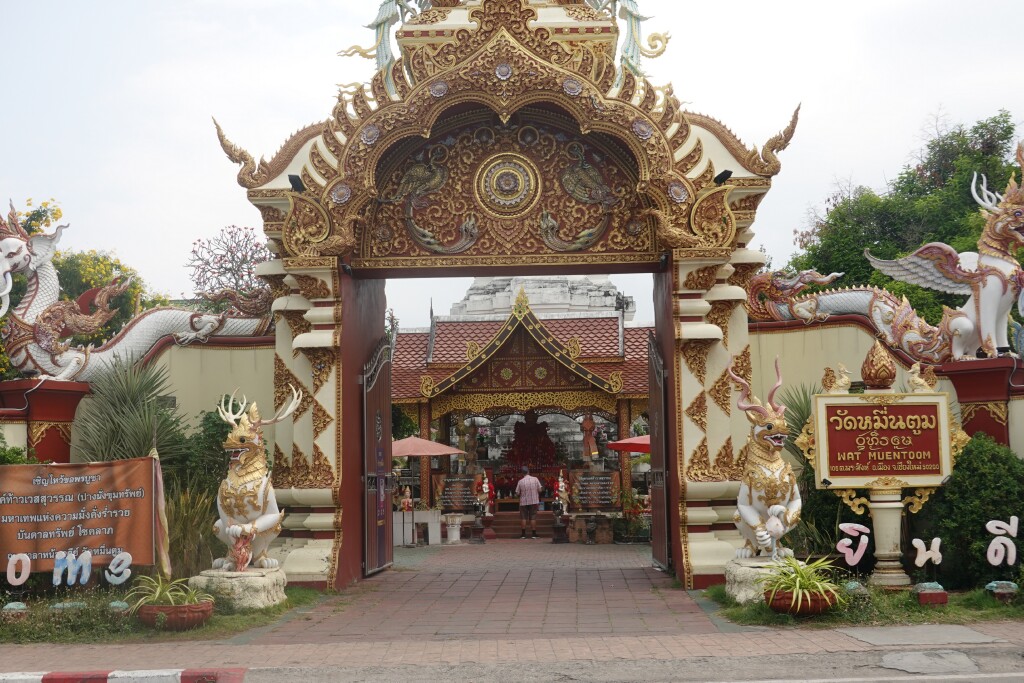
Starting in 2018, the entrance to Wat Muen Tum on Prapokkloa Road was reconstructed in a rather large-scale construction project. A grand archway was built, and ornately decorated. What is interesting and different from most temples is that the two sides of the entrance are not the same, mirror images, or even symmetrical – they are completely different. Here are views of the entrance structure. The left side has a Singha in front of what appears to be a naga (dragon), but unlike most naga, behind that is an elephant-naga creature. On the right side, there is a female water nymph or mermaid in front of a large Singha.


And a centered direct view of the elaborate new entrance archway:
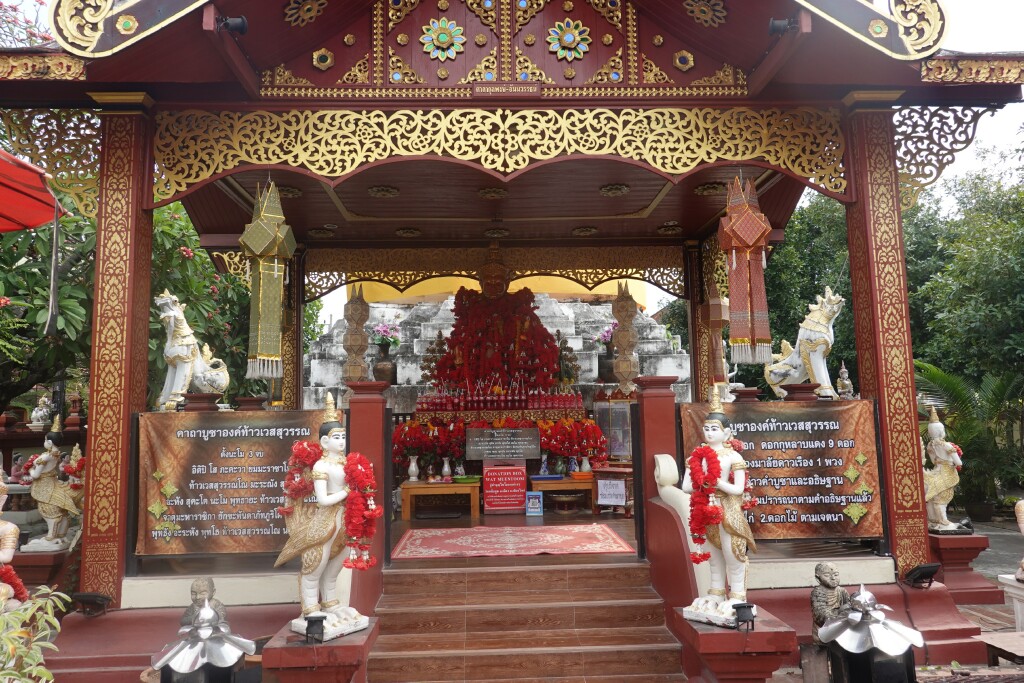
Once inside the new entrance, there is a new pavilion over a Buddha statue. The area from the entrance to the pavilion is decorated brightly, and the chedi towers over the pavilion in the background. Inside, the Buddha statue is almost completely covered in red flowers.

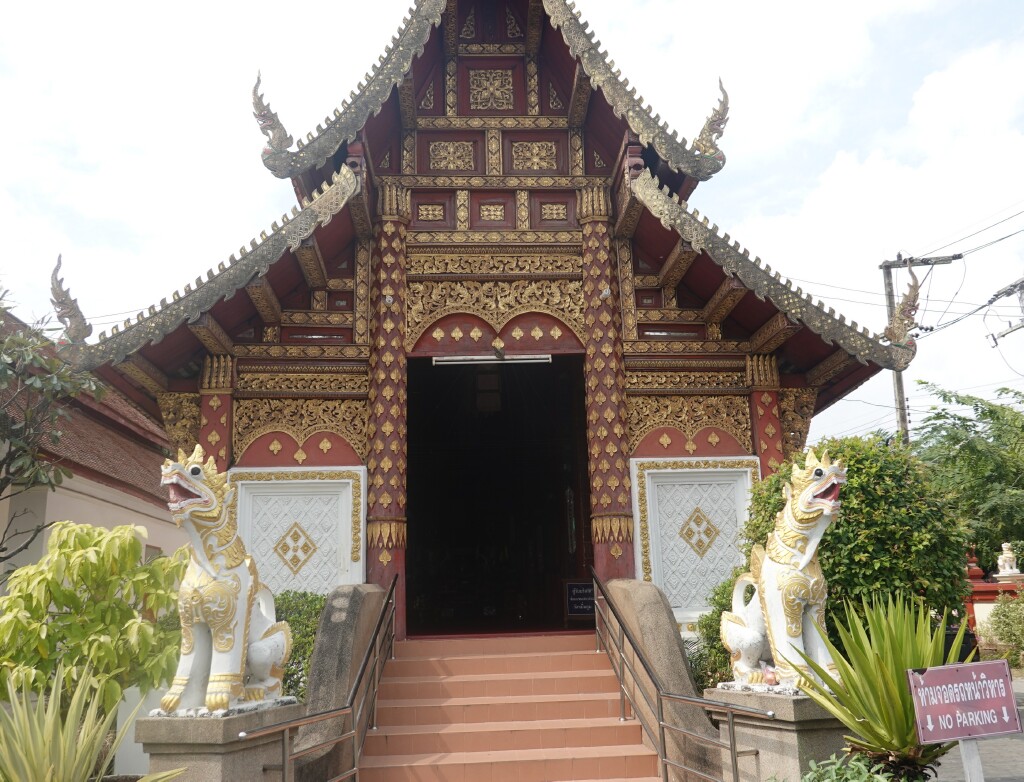
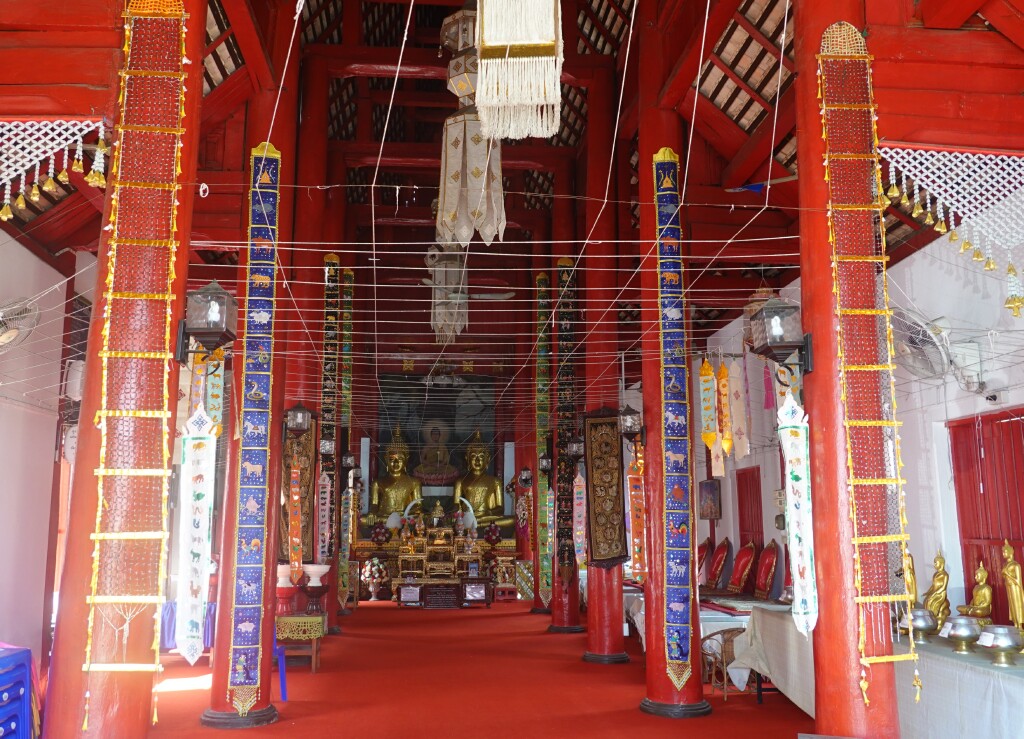
Walking to the front of the viharn, it is a Lanna-styled structure, with its split, multi-tiered, steeply pitched roof. The entrance is protected by two Burmese-style Singha, lion-like mythical creatures. Inside, as is typical of Lanna-styled prayer halls, large columns support the roof.
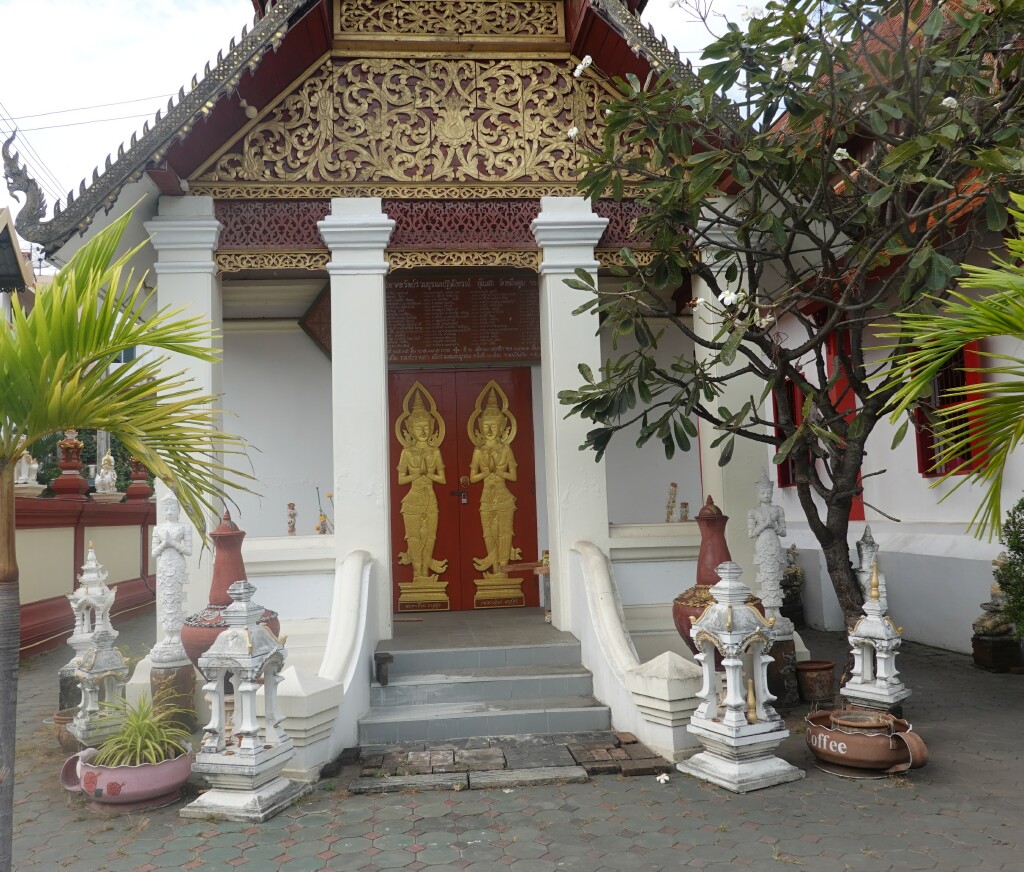
The ubosot (ordination hall) is right next to the viharn, and is a plain white structure with minimal decoration other than the praying thewada on the doors.
Behind the viharn, the chedi is tall and thin with many layers deeply indented in whitewashed stucco that needs cleaning. At the side is a pewter-colored Buddha statue.

Wat Muen Tum, being along a major road, Prapokkloa Road, and having the new, elaborate entrance arch, gets many visitors to the Buddha pavilion just inside the entrance. Few of those visitors explore the temple beyond that pavilion.
Next: Prapokkloa Temples 4 – Wat Chang Taem

 James the Intrepid Pilgrim