Sunday 21 January 2024
Three temples on Tha Phae Road
Wat Chetawan
About 200 meters east of Tha Phae Gate on the north side of Tha Phae Road is Wat Chetawan, directly across Tha Phae Road from Wat Mahawan. Wat Chetawan seems to be in a constant state of renovation and/or reconstruction for as many times I have noticed this temple in my many visits to Chiang Mai. The sign over the main entrance appears temporary and is all in Thai. And just behind the sign on the right is construction scaffolding.
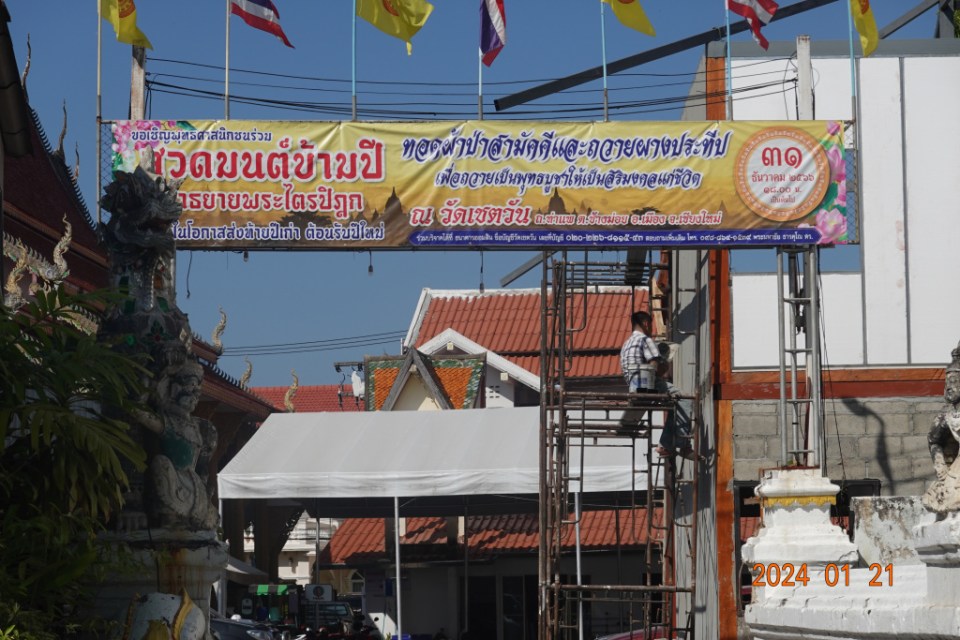
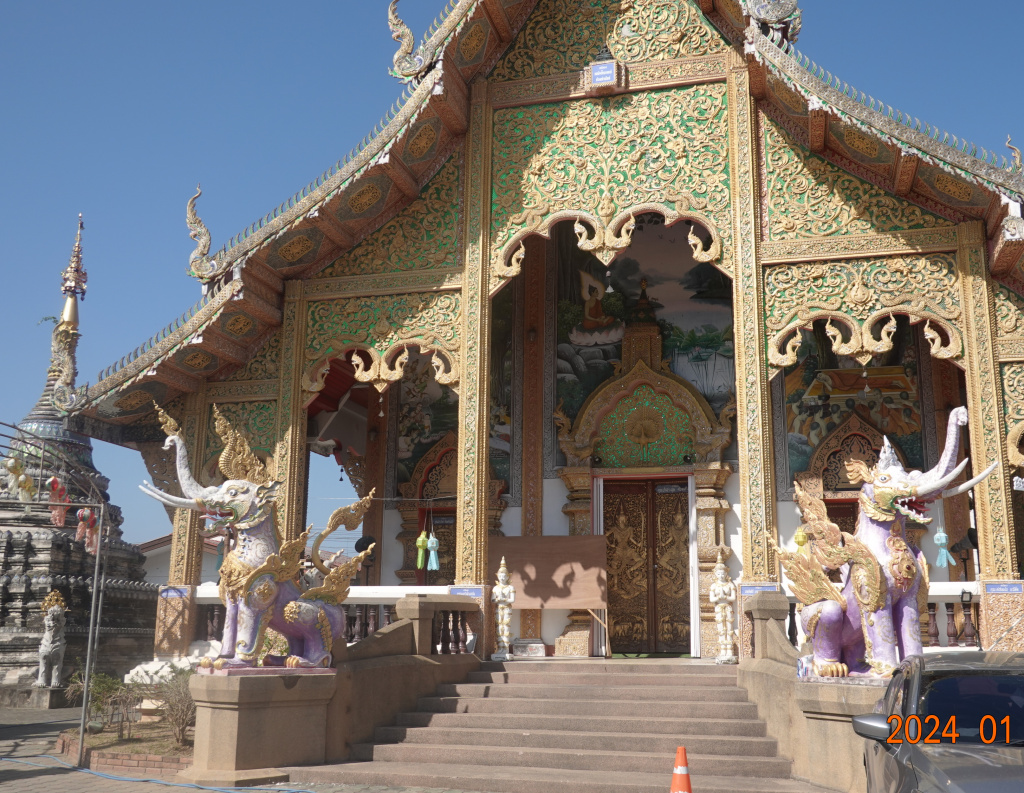
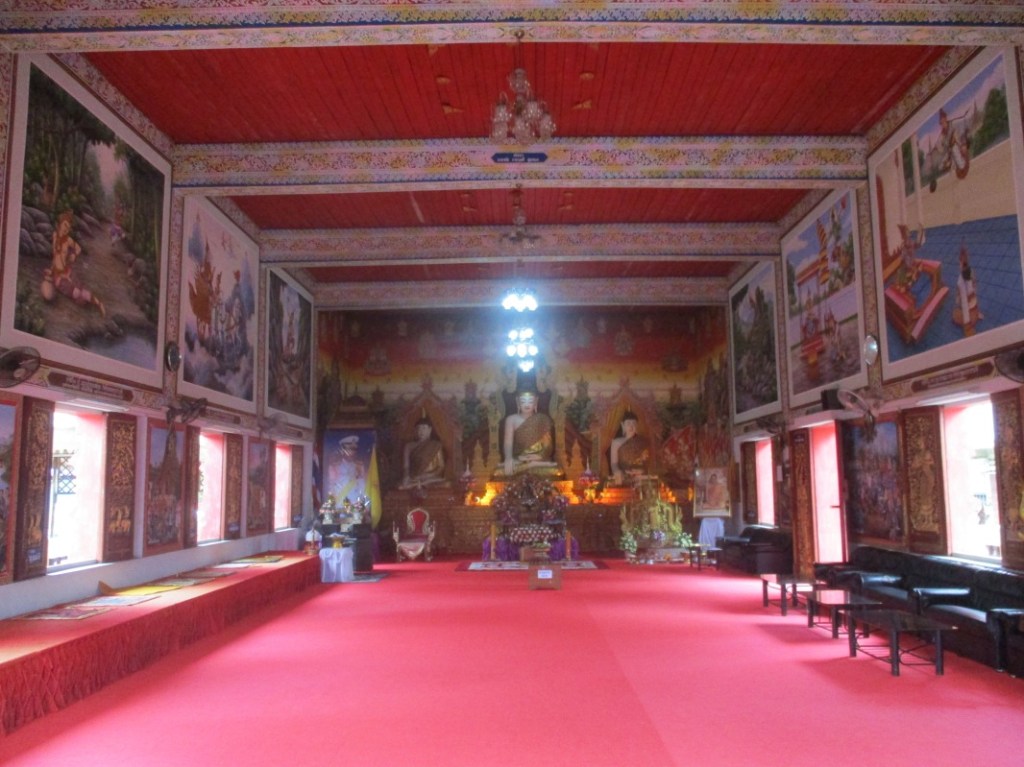
Inside the temple grounds, there is much evidence of construction, piles of materials, and construction trash (which I chose not to photograph). I was able to get a pretty good view of the front of the main viharn (worship hall) with its winged elephant guardians at the stairway. Its doors were closed, so I was not able to photograph the inside. I did, however, find a photograph from at least 8 years ago on the internet. I would have liked to see its distinct interior: very spacious without columns supporting the roof and the very red theme.
What prompts some appeal is that Wat Chetawan has the distinction of having three large chedis. All three are old and in dire need of maintenance or restoration. In some places, the stone and plaster are cracking and vegetation is growing on them. The style of the three are very similar. It might be that they were all constructed in the same time period, or under the same temple management or royal reign. It was difficult to get a good angle for the photographs because I was up against the temple wall on one side, and looking directly into the sun on the other.
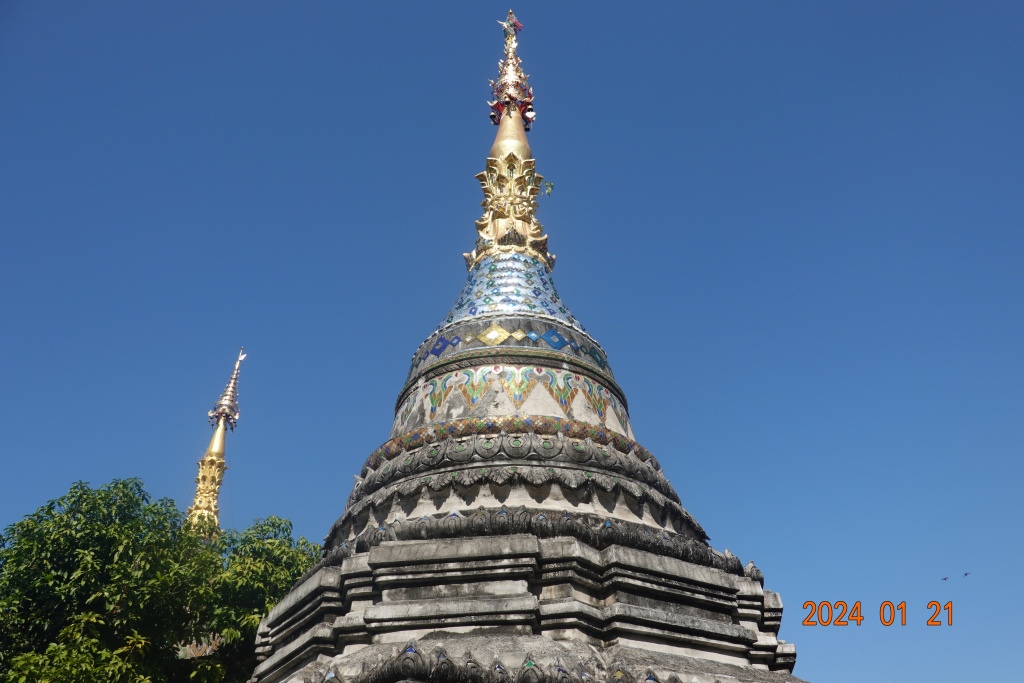
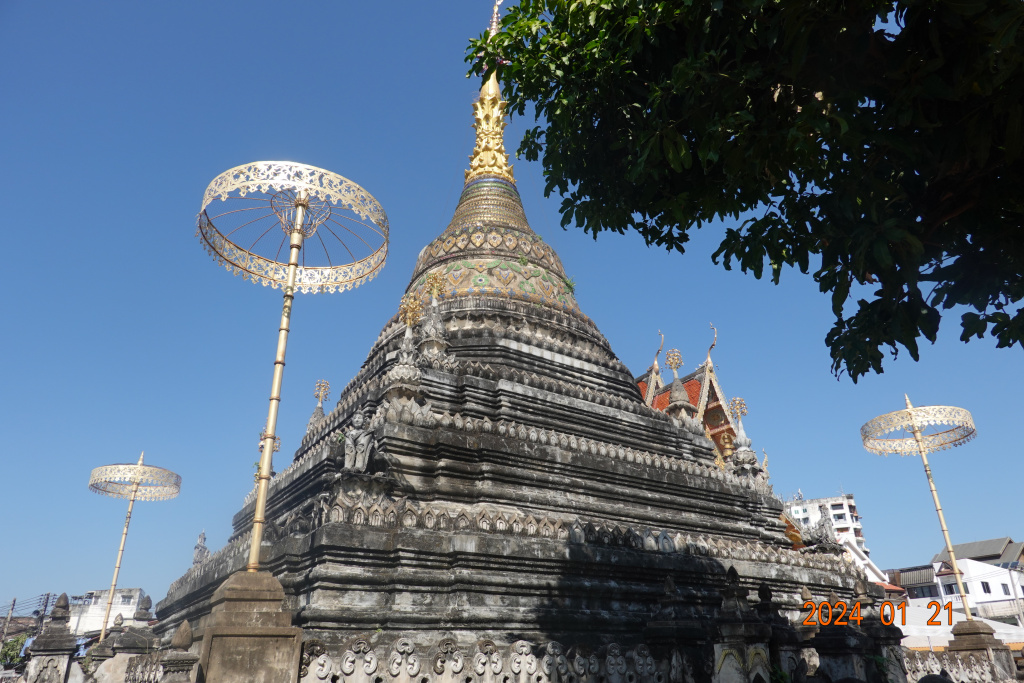

At first glance, the first two are almost twin chedis, but the first has a blue motif and the second green. All three are in the Burmese style, each has a square base with decreasing layers and a round mid-section supporting the top bell structure. Almost impossible to tell from the photos, the chedis are in decreasing size with the first being the largest, the second slightly smaller, and the third only about 2/3 the size of the first.
The other distinction is that the chedis are not behind the viharn. The viharn at Wat Chetawan is not oriented east-west as are almost all Buddhist temple viharn. [I have been told that the viharn doors face east to greet the rising sun because the rising sun represents birth or the beginning. The chedi is at the west end of the viharn, the setting sun end, because the setting sun represents the end or death, and in the chedi the ashes of someone are interred.] The viharn at Wat Chetawan is oriented approximately south-north with the viharn doors facing south towards Tha Phae Road. The chedis are on the west side of the viharn.
Why the orientation of the viharn at Wat Chetawan is different than the norm is unknown. It could be that because Tha Phae Road was such a major thoroughfare between the walled city and the Mae Ping River, having the viharn doors open to that major road was important. As I am writing this I realize that the three viharn’s doors at Wat Buppharam open to the north, facing Tha Phae Road. Perhaps the same logic in the orientation could be applied to both temples.
Walking out, the construction at the entrance for what appears to be the monk’s quarters was very active. I did not get a close-up photo, but it is clear OSHA is not in Thailand – almost all of the construction workers were wearing flip-flops with no hard hats, and nothing supporting them as they climb and work on the scaffolding or beams of the structure.
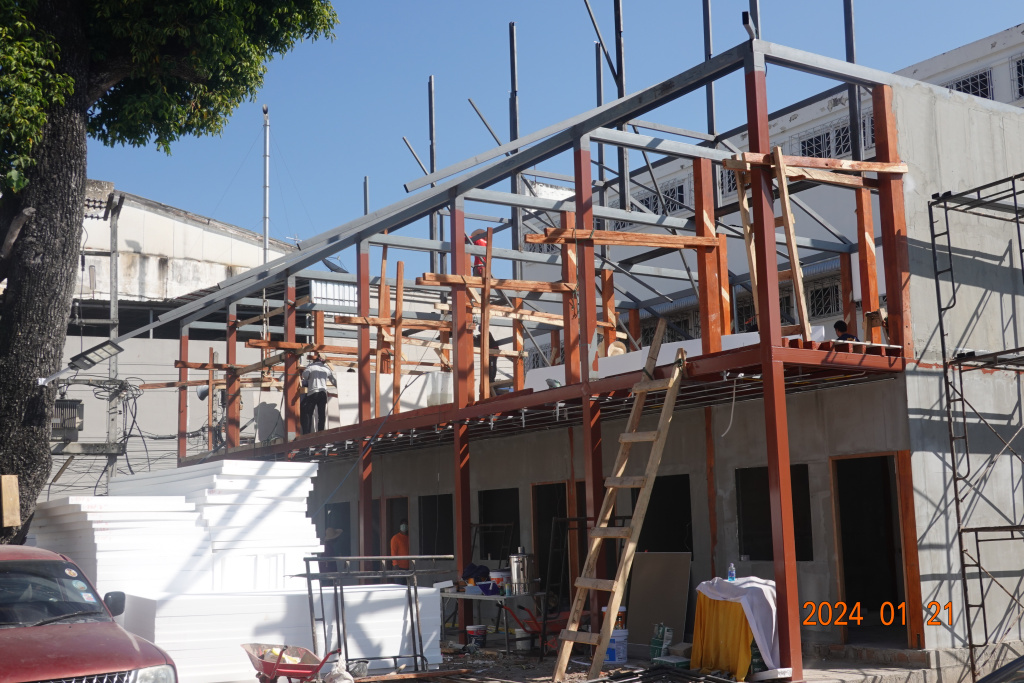
Wat Chetawan holds little appeal to me other than the three somewhat decaying chedis and my interest in seeing inside the viharn with its lack of supporting columns and rich red motif.
Next: Wat Jed Yod in the waning afternoon light

 James the Intrepid Pilgrim