Tuesday, January 9, 2024
In the City of Lamphun
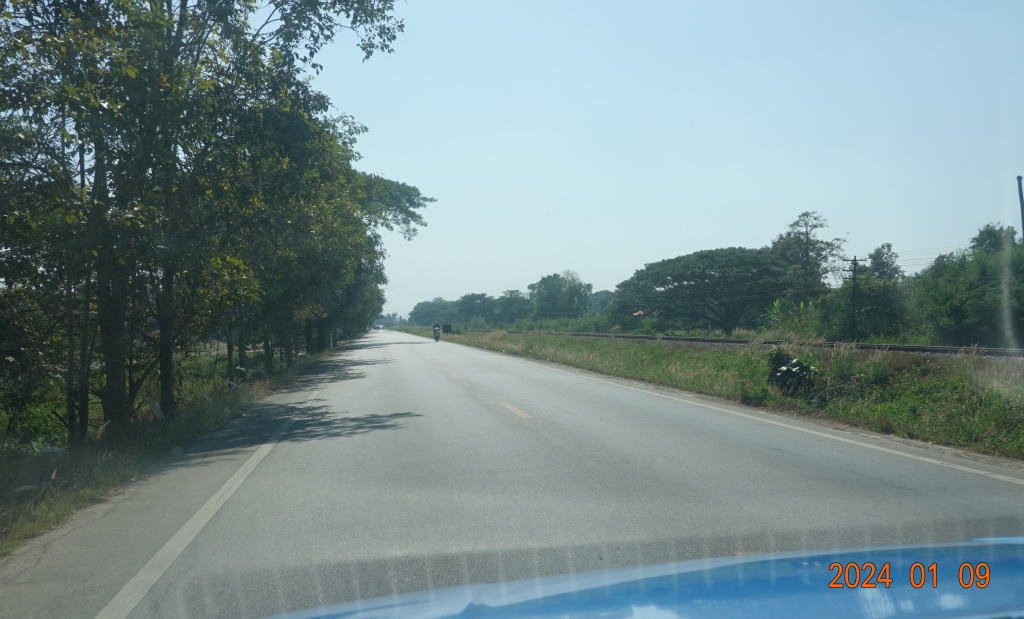
On the way to Lamphun, the songtaew driver allowed me to sit in the cab with him since I was the only passenger and there would be no pickups along the way. The fastest way to get to Lamphun is a road running parallel to the train tracks, the same road I walked down almost three weeks ago (although while I was walking, I did not go all the way to Lamphun). I took a photo of the view showing the train tracks on the right.
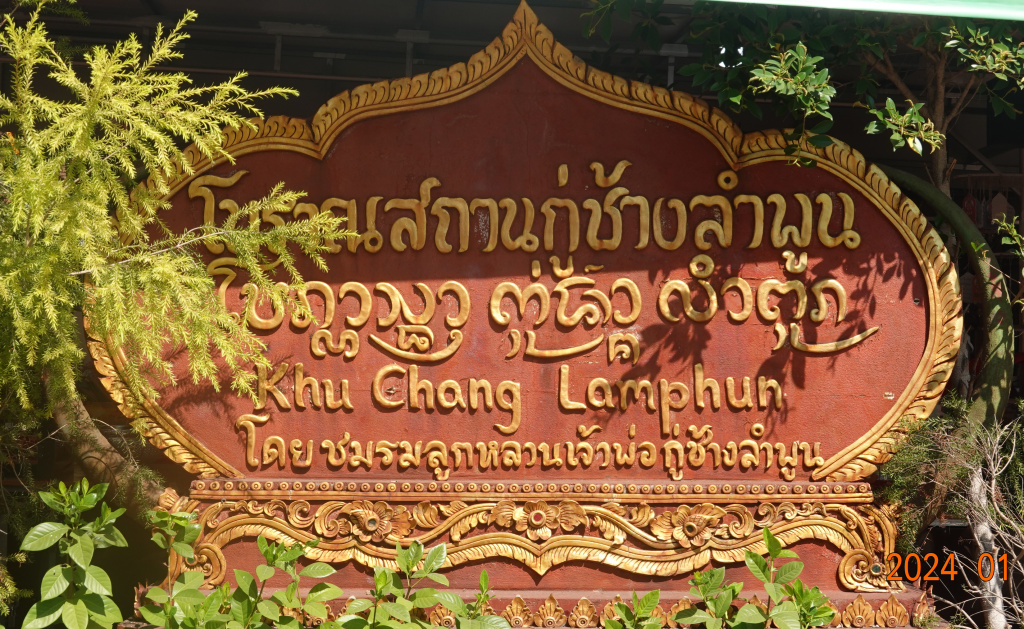
Khu Chang Elephant Memorial
I had asked the driver to take me to Wat Phra That Haripunchai. As we entered town, he told me I ought to photograph the Khu Chang Elephant Memorial. He seemed to think it was important, and it is on the list of things to see in Lamphun. He said he would wait for me as I took photographs and then take me to Wat Phra That Haripunchai, no additional charge.
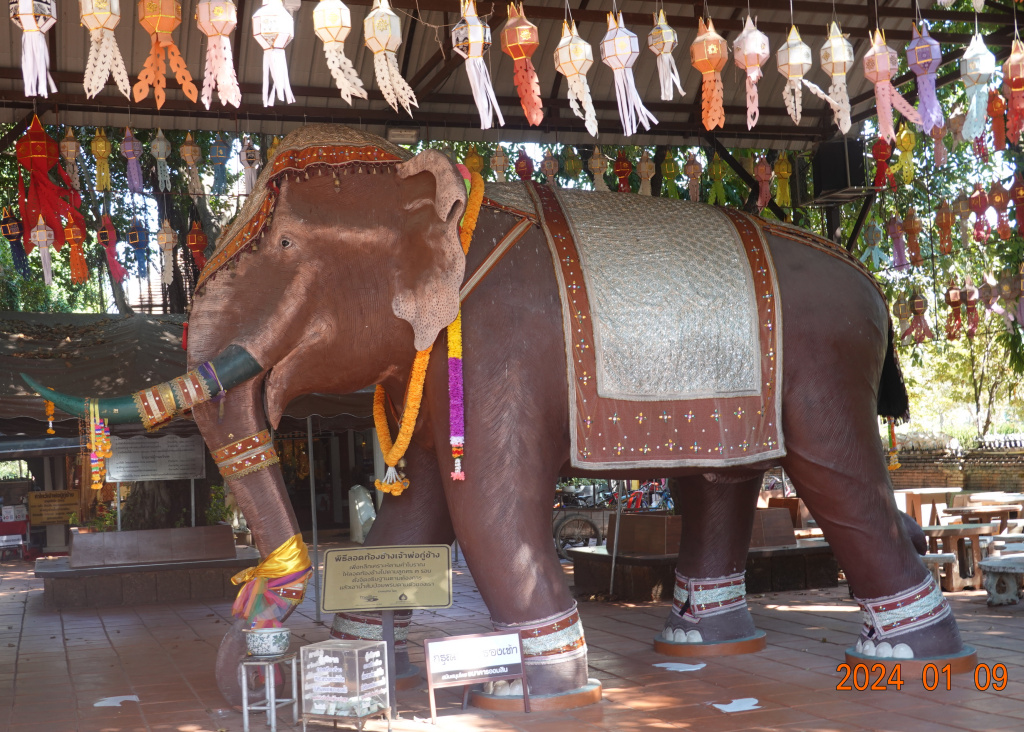
I read that Khu Chang was the majestic elephant of Queen Cham Thewi, the first Queen Regent of the Kingdom of Haripunchai (after which the temple Wat Phra That Haripunchai is named). The elephant was called Bpu Kum Ngaa Keo, and according to the legend, it was a very strong elephant. Whenever Bpu Kum Ngaa Keo fought in a war and it turned its tusks toward the enemy, it caused the enemy’s resolve to weaken. The elephant was characterized by a dark body color and green ivories (?!?). At this memorial site is a replica of the Bpu Kum Ngaa Keo elephant (green tusks and all).
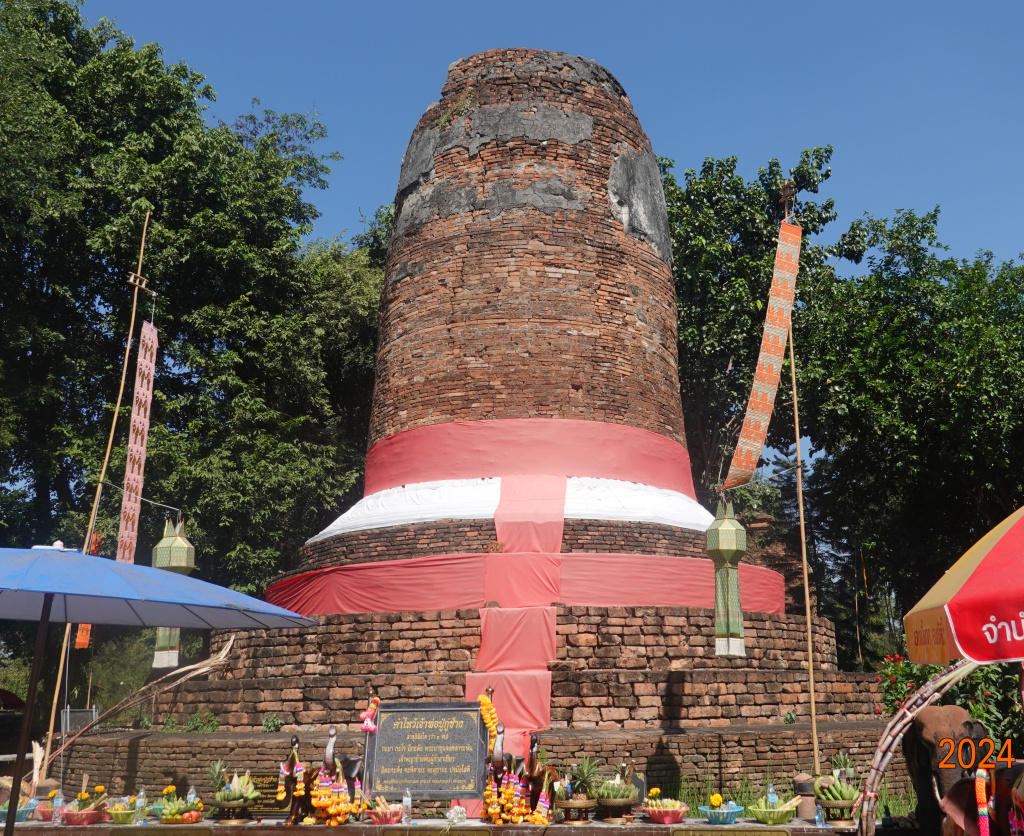
Later, when the elephant died, Queen Cham Thewi ordered a high chedi built in which to inter the remains. The chedi is built of brick, cone-shaped, and not pointed as is typical of many chedis.
Wat Phra That Haripunchai
Wat Phra That Haripunchai is classified as a Royal Temple of the First Class. Of the 33,000 or more active Buddhist temples in Thailand, only 19 are classified as Royal Temples of the First Class. Only one of those 19 is in Chiang Mai, Wat Phra Singh. And there are only six classified as Royal Temples of the Second Class, of which one is in Chiang Mai, Wat Phra That Doi Suthep. I could find no indication about what group designates the classification, how they determine the classification, when, or how often that classification is reviewed. Nevertheless, Wat Phra That Haripunchai in Lamphun is considered a very important temple in all of Thailand.
A note about the name: In a temple name, “Phra” indicates the temple has an honorific Buddha image, and “That” means the temple has a sacred relic. Combining the two tells that there is a relic of Buddha in the sanctity of the temple.
According to history, King Athitayarat and his royal consort, Queen Patumwadi had built Wat Phra That Hariphunchai around 1064 AD, over two hundred years before King Mengrai founded Chiang Mai. This is a very old temple, although almost all of the structures have been rebuilt over time.
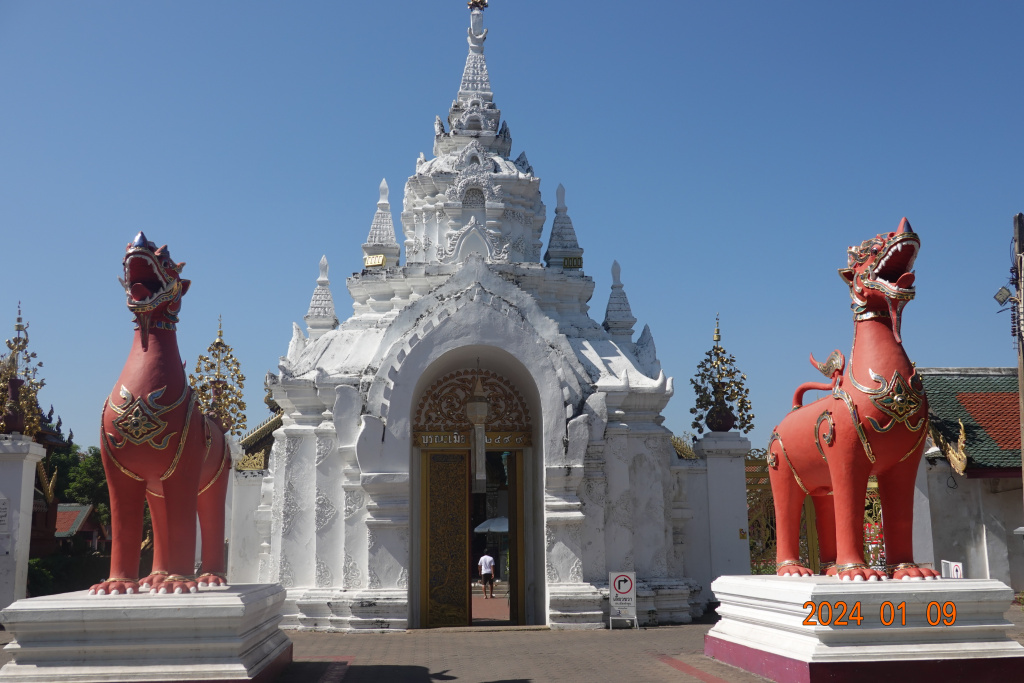
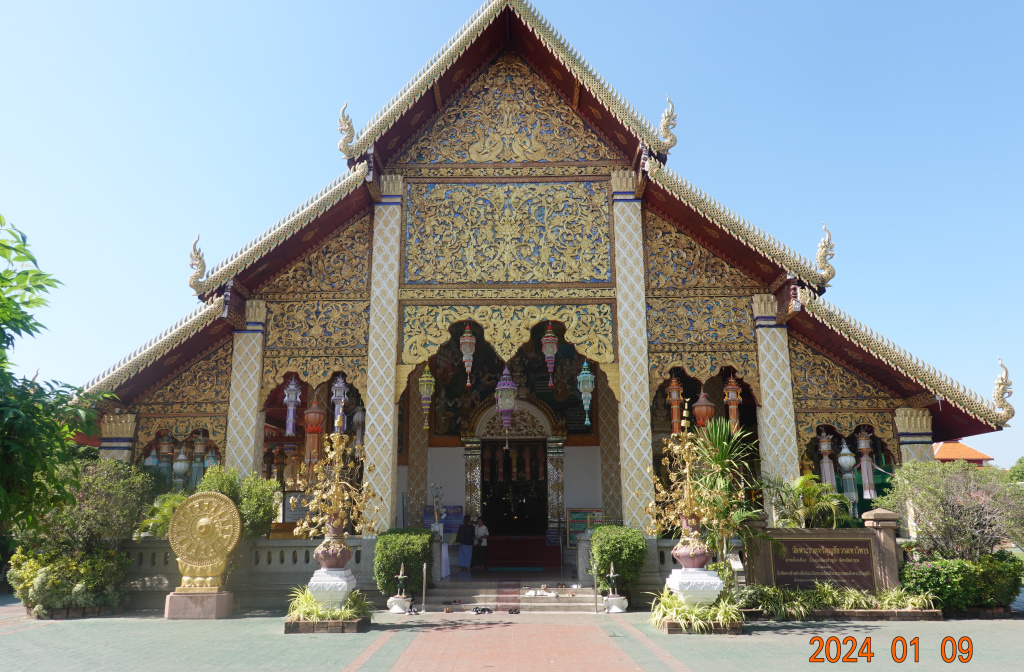
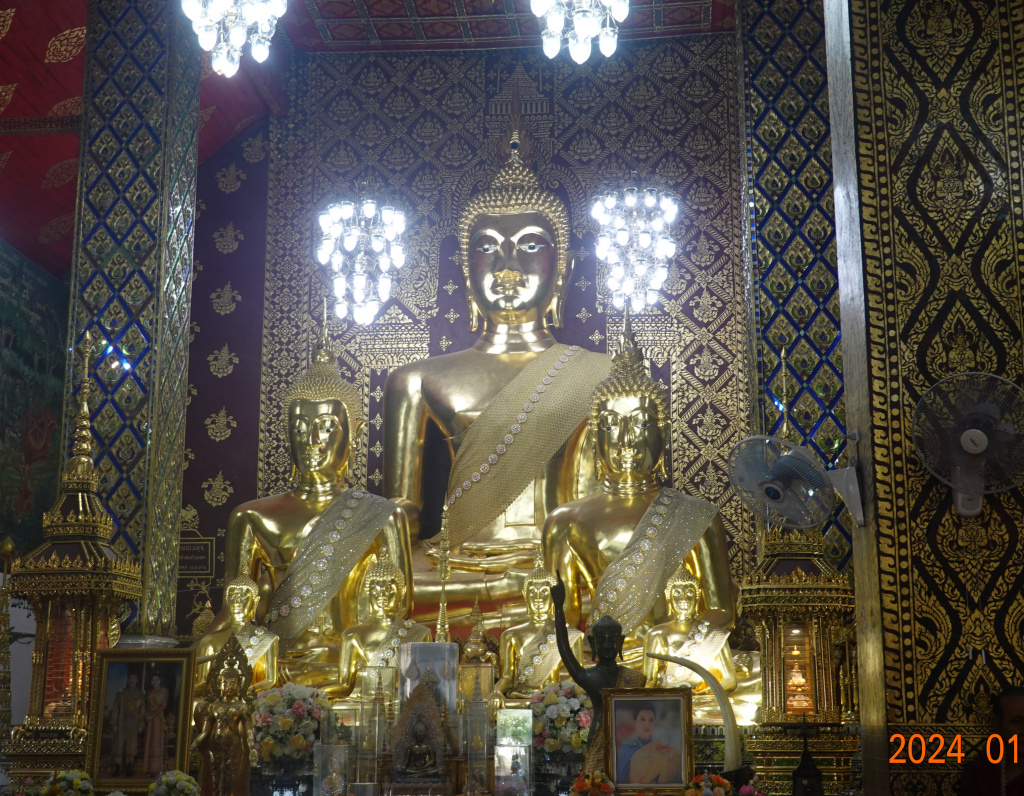
As soon as I arrived, I remembered this temple fairly clearly from my visit ten years ago. And it left me with the feeling I was in a tourist place, and not a sacred Buddhist temple. Wat Phra That Haripunchai does not resonate with me. [Much the same as Wat Phra Singh in Chiang Mai.] As important as it is said to be, I got a very touristy sensation being here. But I continued on. Here is the front of and inside the main worship hall (viharn) at Wat Phra That Haripunchai.
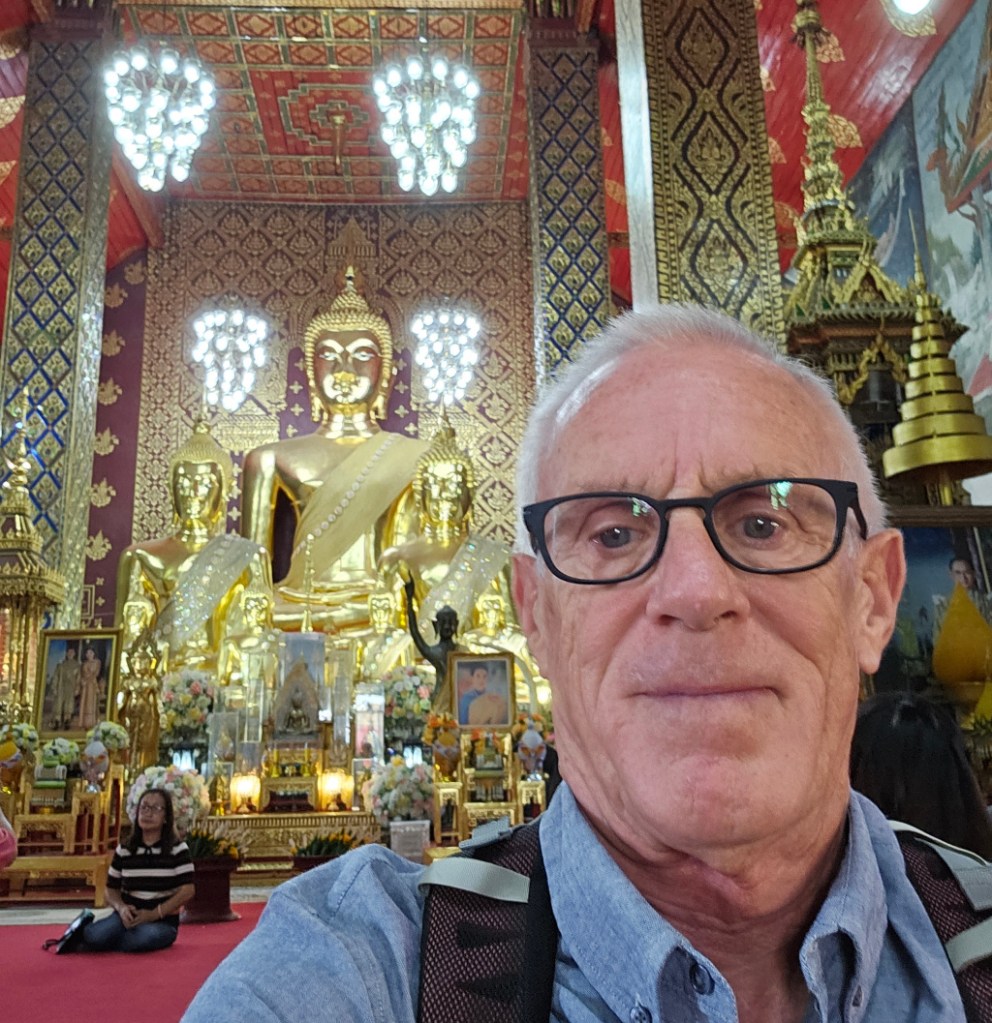
And I really was there, if there was doubt (and I look far too serious trying to get a good selfie):
The side of the viharn was nicely constructed and decorated, and walking that way gave a view of the large gold chedi.
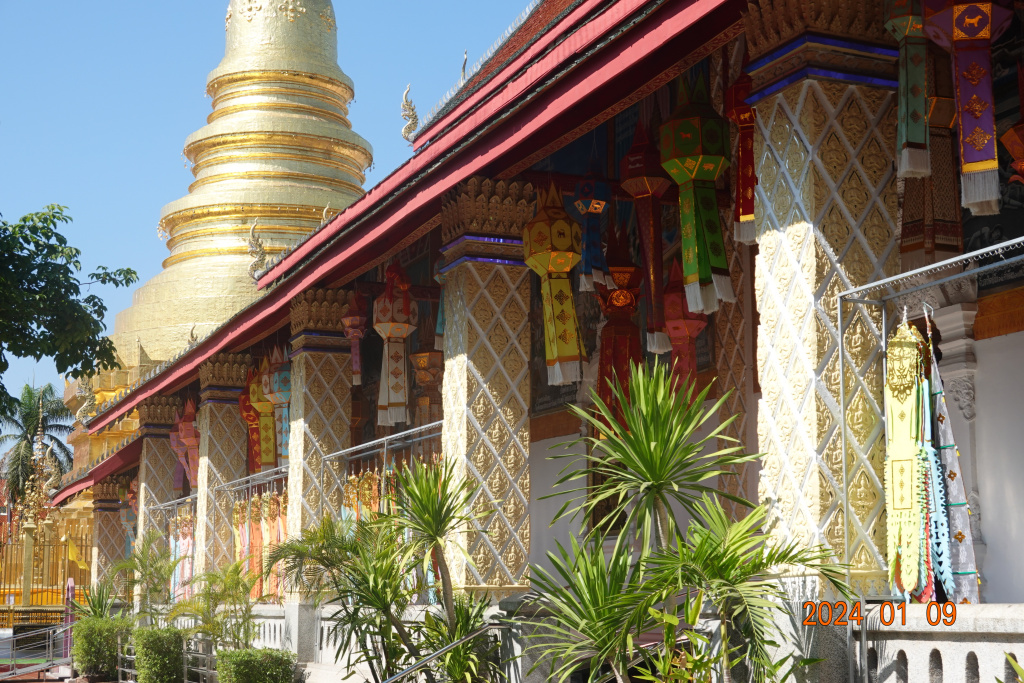
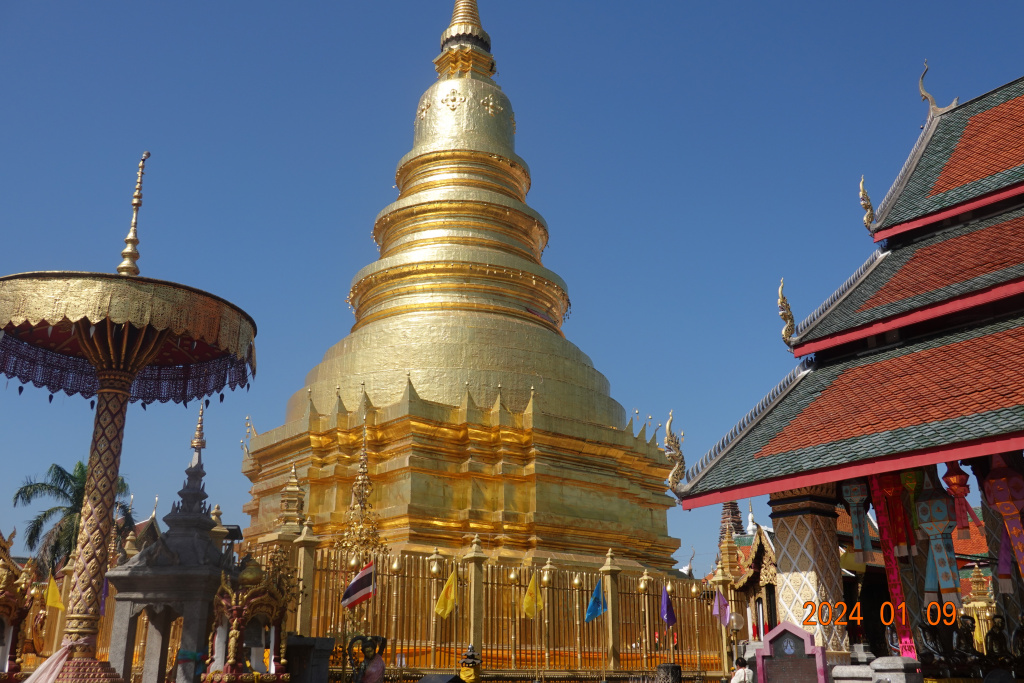
As I have said before, the shiny gold chedi looks superficial, gaudy, and almost as if had been made solely to appeal to tourists. I prefer the more rustic look of the exposed brick chedis, like that at the elephant memorial.
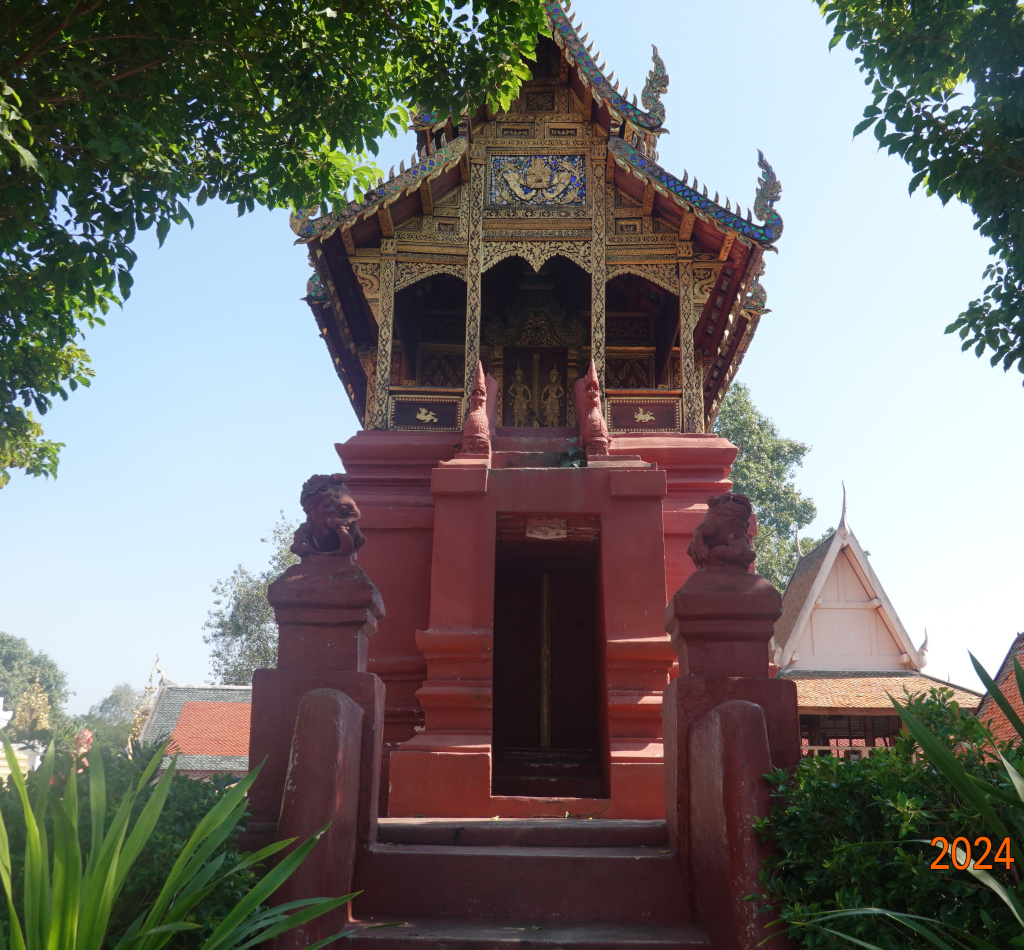
Close by is this ho trai, a library of Buddhist documents and documents of the temple. At several temples I have seen, the ho trai is a two-story building similar to this. The curiosity is that there appear to be steps leading to the second-story front doors, but no way to get to those steps. Because of the similarity in design, there must be a reason. Another curiosity to investigate.
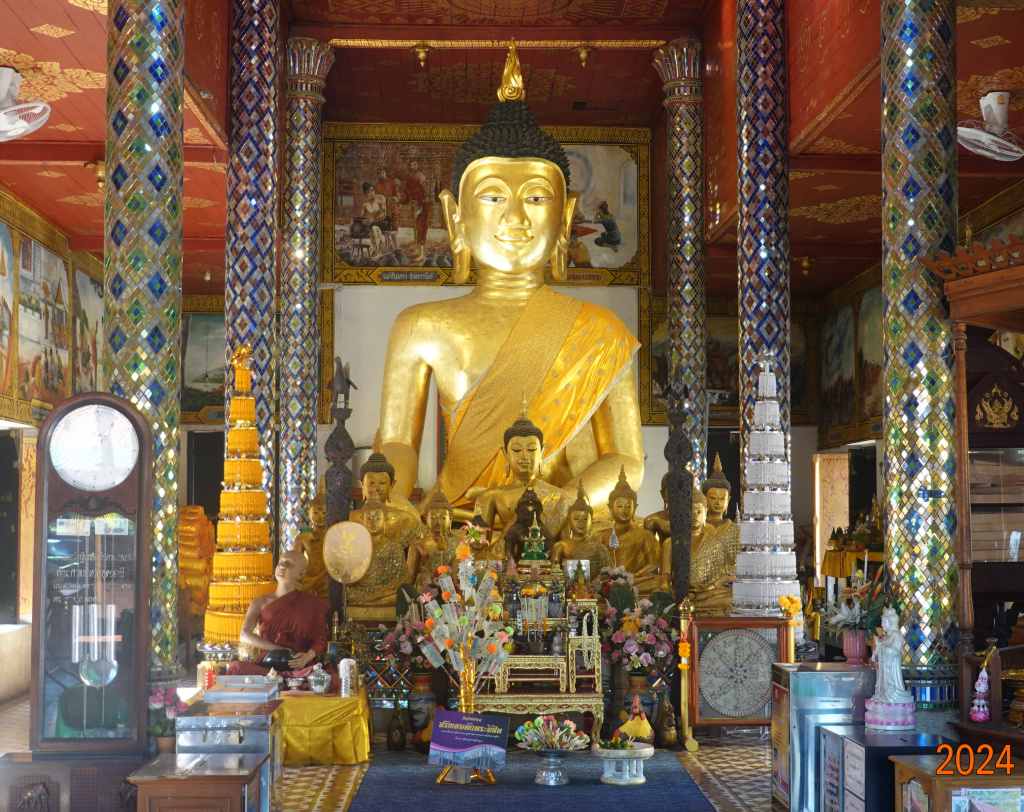
Near the Ho Trai was a sala (open-air structure) with long rows of Buddha statues. Most were plain shiny gold, and a few were different (which appealed to me more than the shiny gold statues). In particular, I loved the Buddha statue made of a dark grey, almost black stone. The emerald green Buddha statue also was very nice.
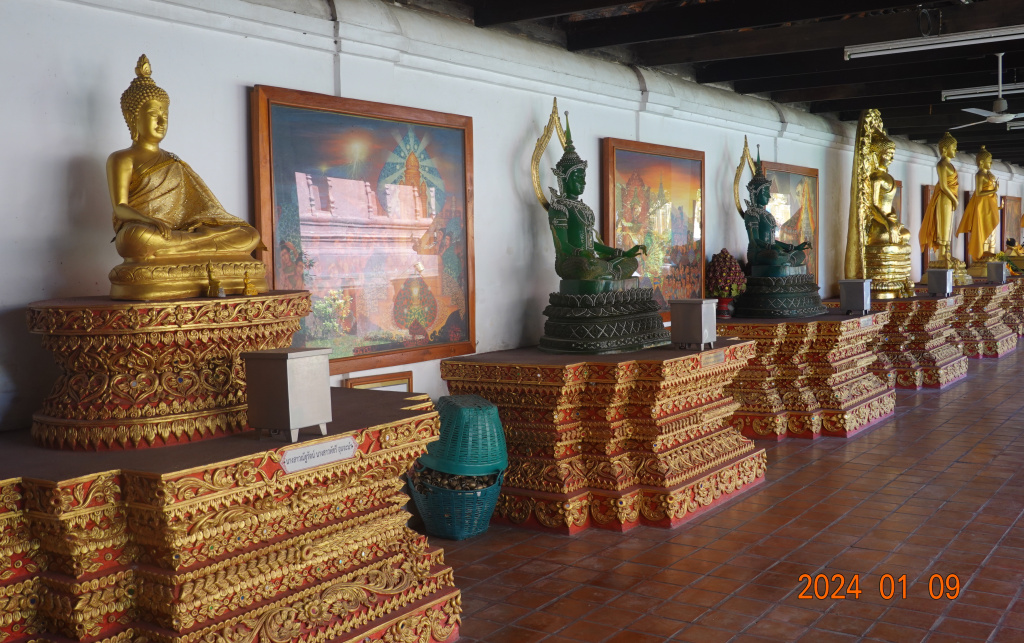
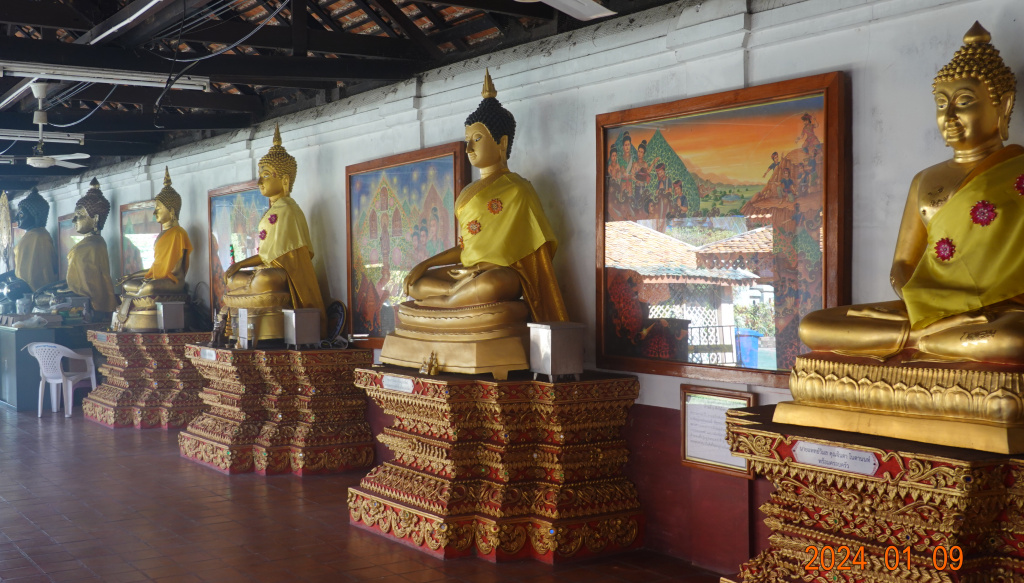
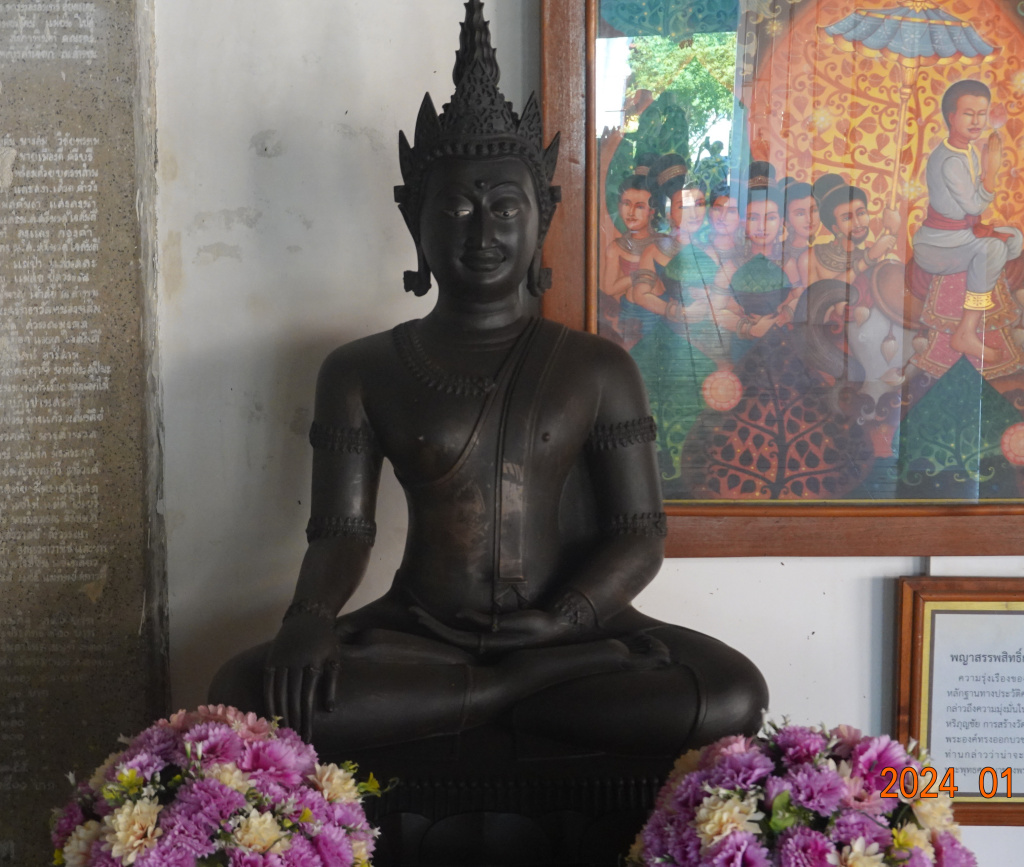
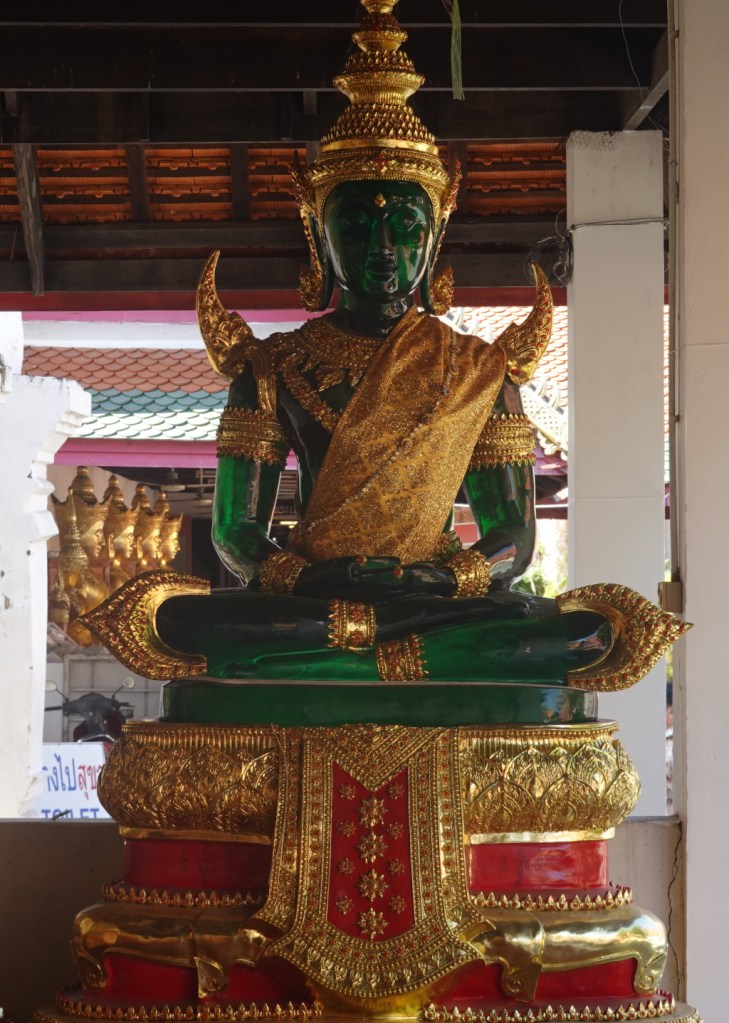
Another curiosity: Having visited many, many Buddhist temples, I have seen many gold Buddha statues, some in an ivory-colored stone, a few in dark grey stone (like here), a few in a reddish stone, and a few in this bright green color, but never any shade of blue.
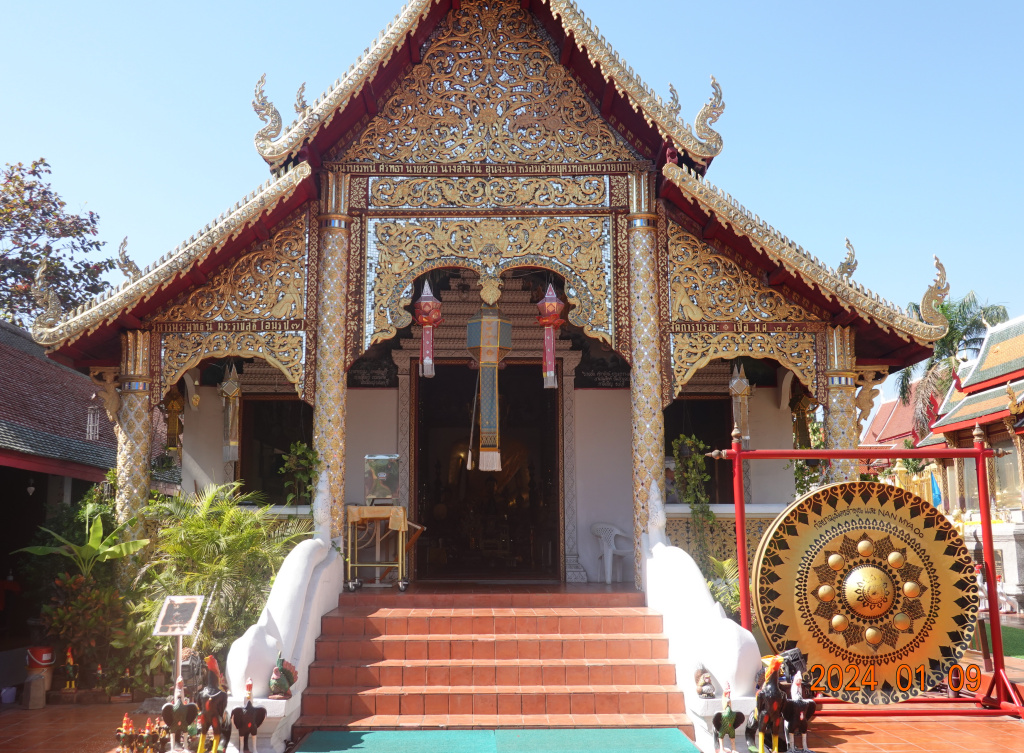
There was a smaller viharn close by, a little less gaudy and more appealing, and with a large painted gong by the steps. That is quite different – these large gongs are almost always black.
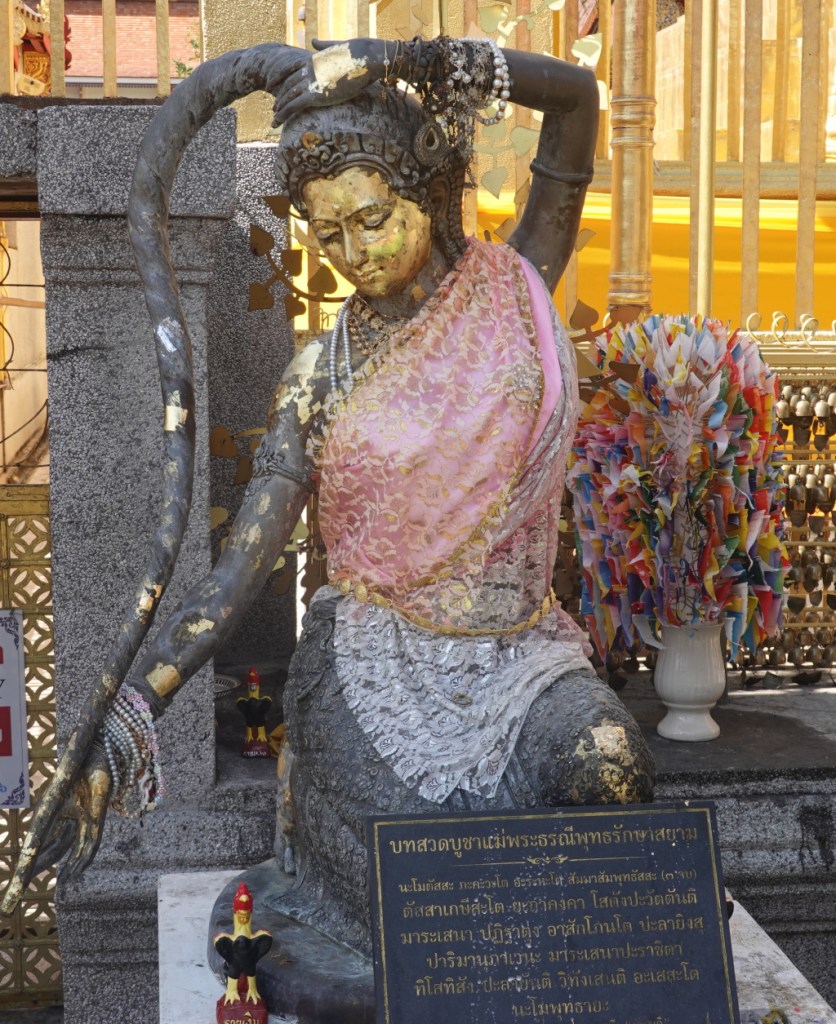
At many temples, they honor the goddess of the earth or mother nature, and Wat Phra That Haripunchai does so with this statue of Phra Mae Thorani. The gold is where people have applied gold leaf to the statue. Eventually, it may be all gold.
Off in a more remote corner of the temple grounds was my favorite thing here, a large, old exposed-brick chedi, called the Suwanna Chedi. The chedi is also referred to as the Pathumwadi Chedi, named after the queen. This is more to my liking, looking very rustic and authentic.
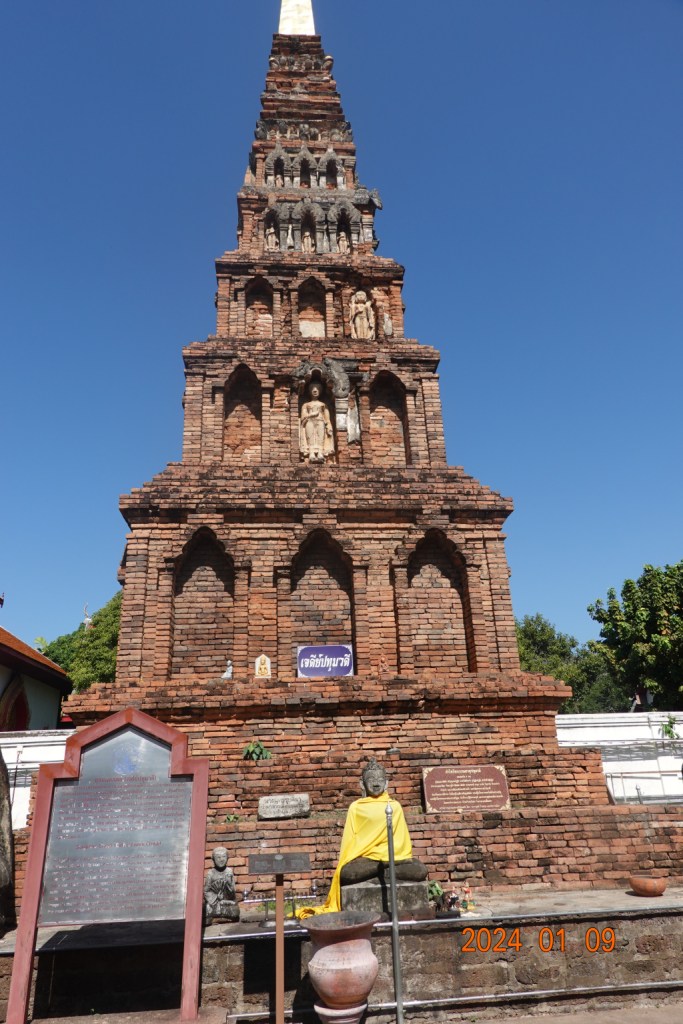
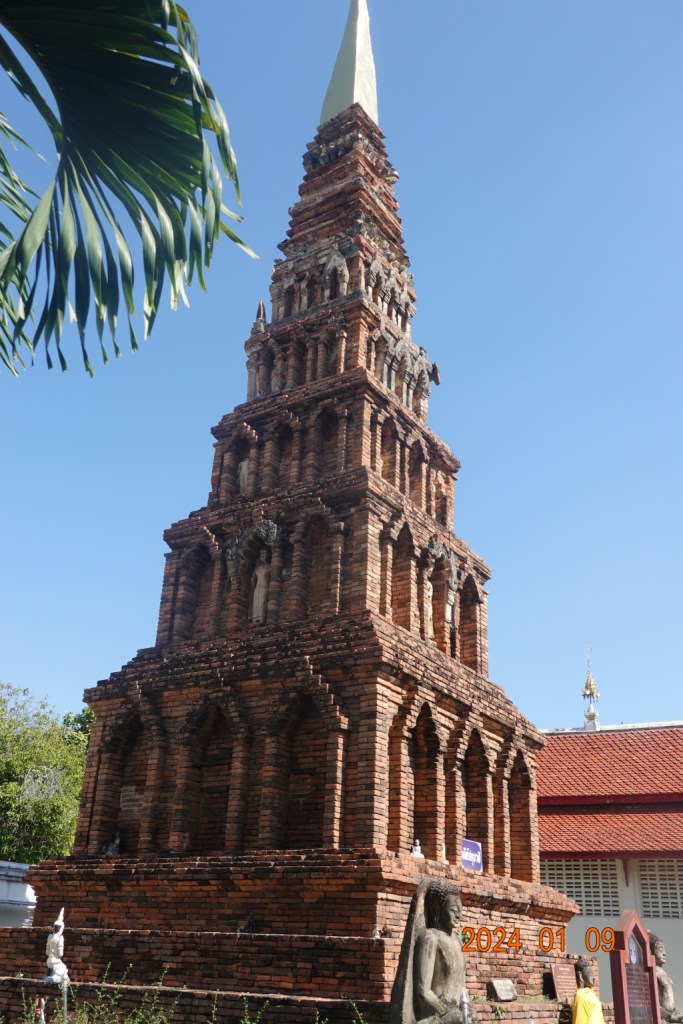
The Suwanna Chedi is very similar in style to the chedi at Wat Phuak Hong in the southeast part of old city Chiang Mai, the chedi at Wat Chedi Liam in the Wiang Kum Kam area southeast of Chiang Mai, and the chedi at Wat Santitam (a modern replica of the chedi at Wat Chedi Liam).
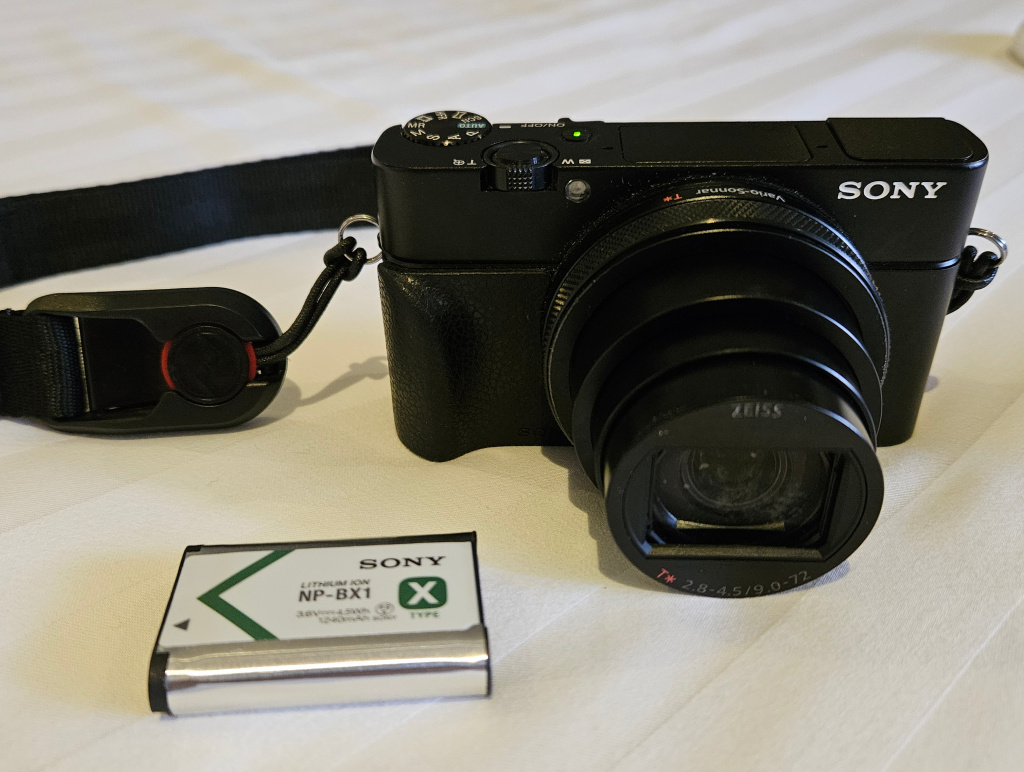
My Sony RX100-VII Camera Battery
Leaving Wat Phra That Haripunchai, my Sony RX100 camera told me the battery was exhausted (I was a little exhausted, too). I have three batteries with me on this trip. The battery easily lasts for over 300 photos and on most excursions with my camera, I take between 50 and 75 photos. The biggest power draw is probably the movement of the camera zoom lens every time I power the camera on or off. After a day of using my camera, I almost always rotate to a fresh battery. I put the battery from the camera into the charger, then insert one of my fully-charged batteries into the camera, set the time zone, time & date, and I’m ready for more photos. And when I go somewhere with my camera, I almost always take a spare battery. Suddenly I realized that I had not recently rotated batteries and had not picked up one of the spare batteries this morning. Aarrgghh!
This disappointing development, the heat of the afternoon, and being completely underwhelmed at Wat Phra That Haripunchai left me less inspired to continue exploring Lamphun. While Lamphun has a population of only 20,000, it is quite spread out, and getting to a couple more temples I was considering would mean long walks in the heat of the afternoon. Lamphun is not a common tourist destination like Chiang Mai, Chiang Rai, Sukhothai, or Lampang, so no tuk-tuks or songthaews drive around looking for passengers. I went to a coffee shop/restaurant and got an iced latte as I mulled over what I wanted to do. I could continue on and use my phone camera to photograph things. Having lost my inspiration and enthusiasm, being close to the end of the afternoon, and not eager for more walking in the heat, I decided I’m done with Lamphun. I’m going back to Chiang Mai.
I approached three ladies talking at the register and asked them using Google Translate (not being a tourist area, very little English is spoken here) what a good way would be to get to Chiang Mai, maybe the train, bus, songtaew? They looked at each other and me, and spoke quickly in Thai. Then one of the ladies told me she was driving to Chiang Mai to pick up some things for her shop and would be happy to take me if I could wait about 15 minutes. She also said, “Maybe I can practice a little English.” All three ladies were nodding and seemed to want me to accept, so I agreed.
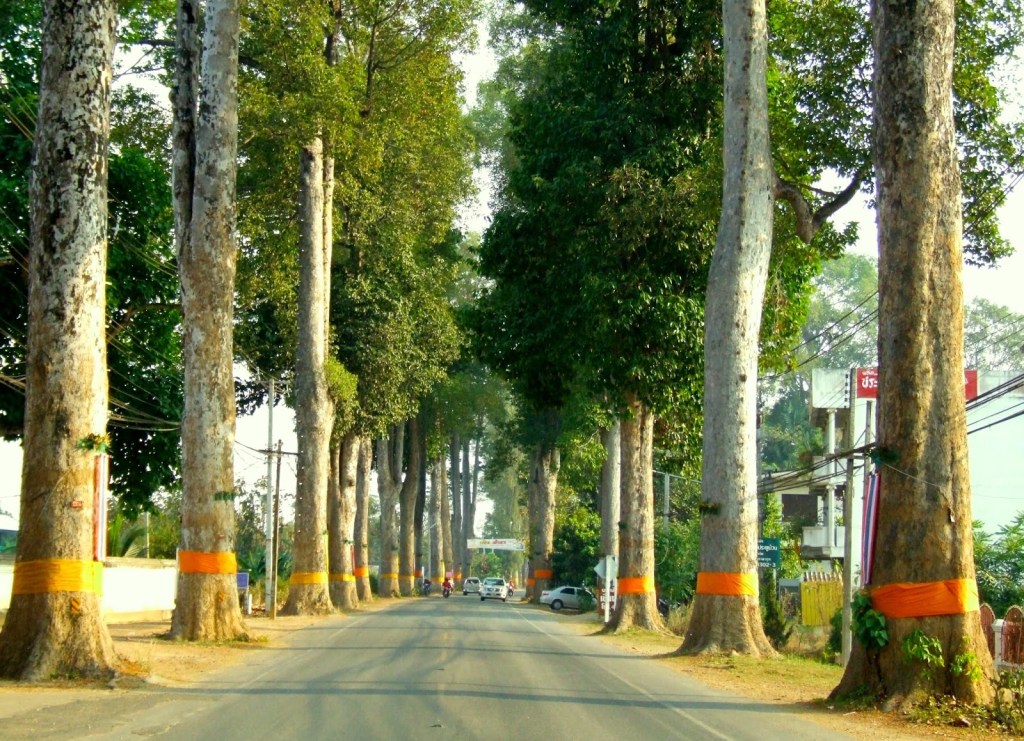
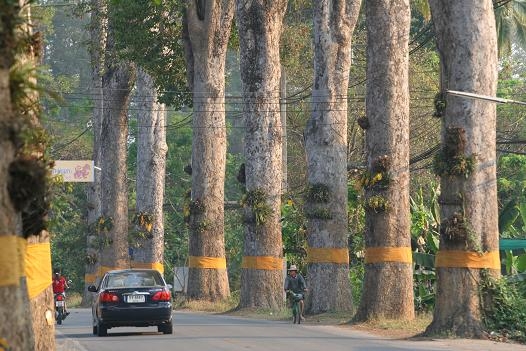
We got into her pickup truck and headed to Chiang Mai, chatting in halting English and my broken Thai (which she tried to correct). We took a different road back than the road on which I had come, called by many, “the road with the big trees.” That is the Chiang Mai-Lamphun Road and it is lined with very large trees. I thought it rude to take photos while in her truck, so I have no photos of the large trees – they are very large. I found photos and information on the internet.
In 1911, Luang Chao Phraya Surasihavisitsak, the first governor of Payab Region, gave Chiang Mai over 2000 rubber trees to plant along the Chiang Mai-Lamphun Road from the Nawarat Bridge to the end of Chiang Mai. The tremendous size of these rubber trees cannot be found even in the northern Thai forests. The two thousand trees are planted along the road between 10 and 20 meters apart on both sides. These trees are now more than 100 years old.
There is much slow traffic on this road, so the drive was slow and we continued talking. Her intended destination was only a little outside the old city near Warorot Market, an area I know well. When we arrived, I tried to offer her money for fuel, and she refused profusely. I wanted to insist, but also did not want to offend her, so I thanked her and we said goodbye. I walked back to The 3-Sis leaving Lamphun in my memory. I will not forget the kindness of that lady. The best part of the day was that nice lady and the drive with her back to Chiang Mai. A very nice ending to an otherwise uninspired and forgettable day.
Next: Wat Phra That Doi Kham

 James the Intrepid Pilgrim
Where do they get the gold for the statues? How do they keep them clean?
LikeLike
I don’t know where the gold comes from. In the past, I have seen people applying gold leaf to a statue. Regarding keeping things clean – mostly these statues are outside exposed to the weather, the hot sun, rain, etc. Nothing but the rain keeps things clean.
LikeLike
Amazing. I’ve hear they purchase the gold leafing and when they apply to other statues they instill their prayers into them so didn’t know if these were the same kind of situation. Thanks for the response.
LikeLike
That is an uplifting story.
LikeLike