Tuesday, January 9, 2024
An afternoon in Lamphun
I have many, many excellent days in Chiang Mai, Thailand. And even the not-so-good days are pretty good. Tuesday afternoon was one of those not-so-good afternoons. I had decided to make an afternoon trip to Lamphun, a small city about 25 kilometers (15 miles) south of Chiang Mai.
Lamphun
Lamphun is fairly significant in the region’s history. It is the capital of the Lamphun Province with an official population of less than 20,000. When the Burmese overtook Chiang Mai in the 1500s, the seat of the Chiang Mai kingdom was moved to Lamphun. When the 1545 earthquake caused part of the very large chedi at Wat Chedi Luang to topple, the Emerald Buddha (named for its green color, not its composition) which had been in the eastern niche of the chedi was moved to Lamphun (some stories say Lampang, a different city). In 1564, the Emerald Buddha was moved to Vientiane (now the capital of Laos), and when the Siamese General Chao Phraya Chakri invaded the Lao kingdom in 1779, he moved the Emerald Buddha to Siam. It was placed in a shrine close to Wat Arun in Thonburi, the new capital of Siam. Chao Phra Chakri then seized the throne for himself and founded the Chakri Dynasty of the Rattanakosin Kingdom, where he would later be titled King Rama I (the current King of Thailand is King Rama X). The capital was moved across the Chao Phraya River in 1785 to its present location at Wat Phra Kaew in the compound of the Grand Palace in Bangkok. I did see the Emerald Buddha when I visited Wat Phra Kaew in Bangkok in late November, but no pictures are allowed, so I did not get a photo.
Back to Lamphun. I had been to Lamphun about 10 years ago during my second yoga-focused visit to Chiang Mai. But I was only there for a very short time (about an hour). I had listed four temples south of Chiang Mai that I wanted to visit, hired a driver for the day, and set out first to Lamphun to see one temple, Wat Phra That Haripunchai (the most important temple in Lamphun). After seeing that temple, we left Lamphun, drove west, and visited three more temples I had listed on a fairly circuitous drive back to Chiang Mai. Similar to my interest in making the daytime train trip to Bangkok, I was curious to see Lamphun again after 10 or 11 years, figure out a way to get there, maybe see a couple more temples, and figure out a way to return to Chiang Mai the same day since I have a yoga class scheduled for 8:00 AM Wednesday.
Songthaew
There are many options for getting to Lamphun. Train, bus, songthaew, or even a Bolt or Grab. A “songthaew” is a small pickup truck with two benches in the covered back. “Song” translates to two, and “thaew” to line or bank, for the two lines or “banks” of seats in the back. These are shared-ride services and hold up to 10 people. Most commonly seen throughout Chiang Mai are the red trucks, or red songthaews (I read recently that there are 2700 red songthaews in Chiang Mai). You can flag down a songthaew, ask if they are going close to where you want to go, and if they are, you get in. They will stop to pick up or drop off other riders along the way. Within the city of Chiang Mai, when you get out, you pay 30 baht (about $1).
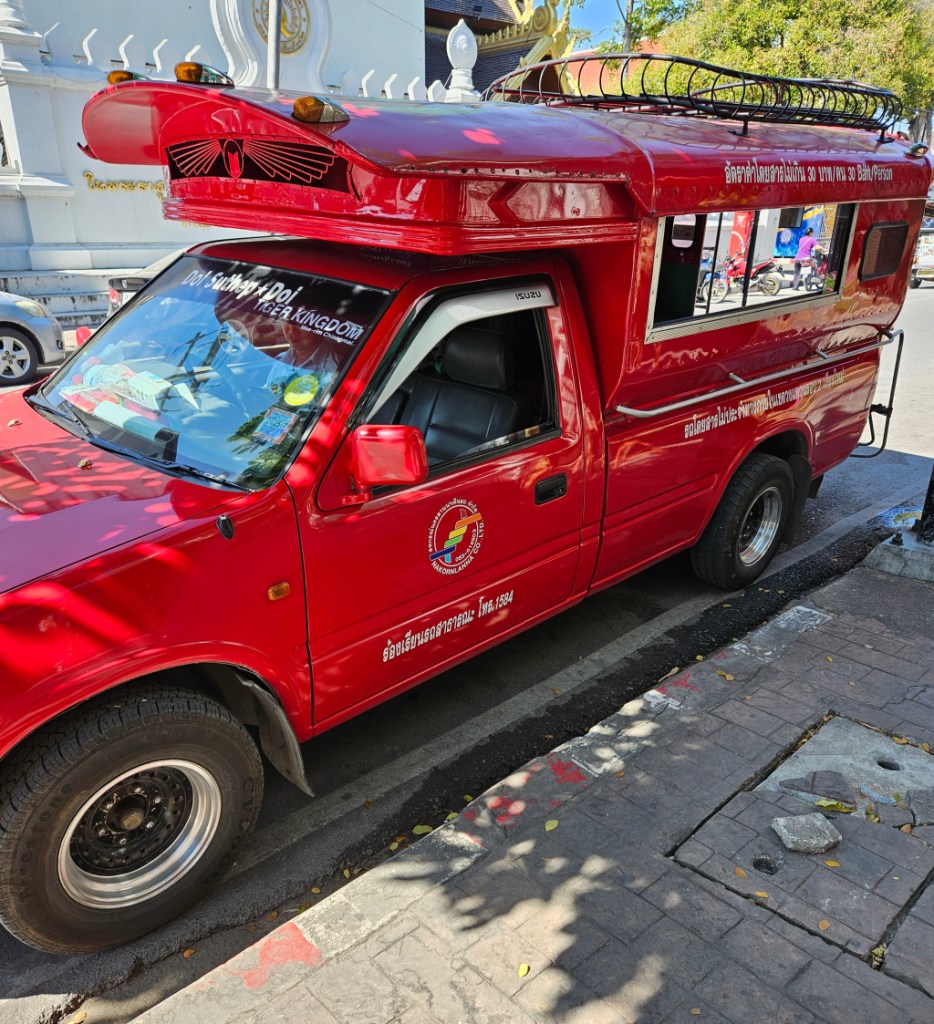
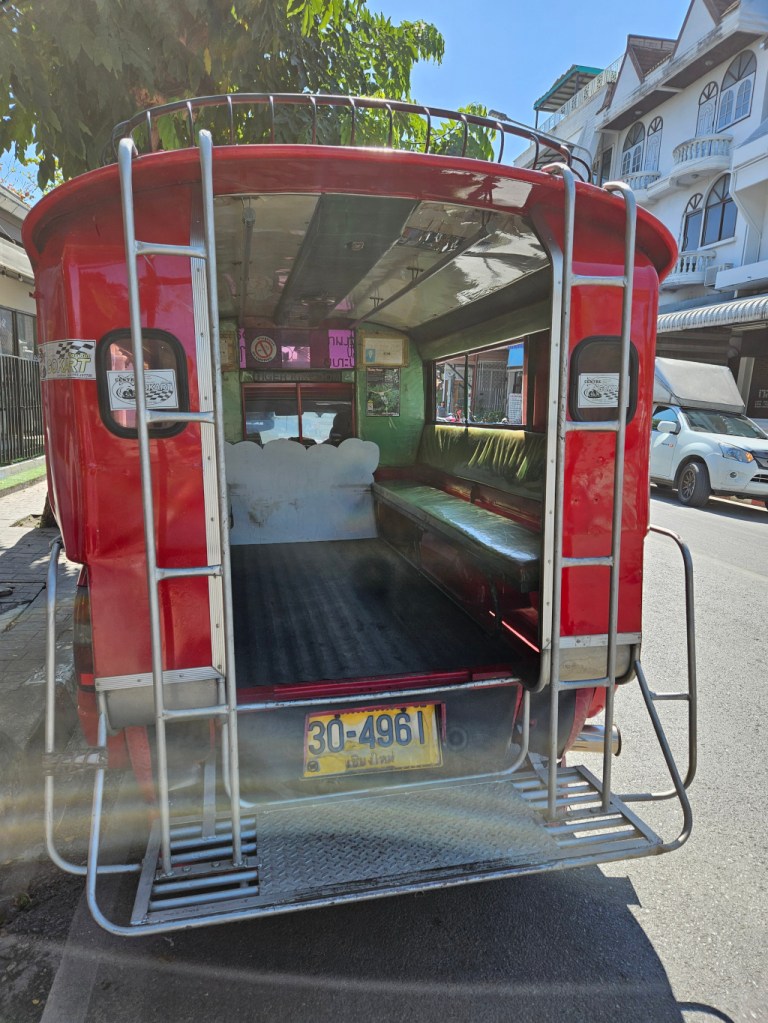
I am not a big fan of the songthaews. They are powered by 4-cylinder diesel engines that almost always seem underpowered and in desperate need of a tune-up or major engine repair. And sitting in the open back, the fumes almost always come in. On this visit to Chiang Mai (over 7 weeks now) I do not think I have been in a songthaew at all.
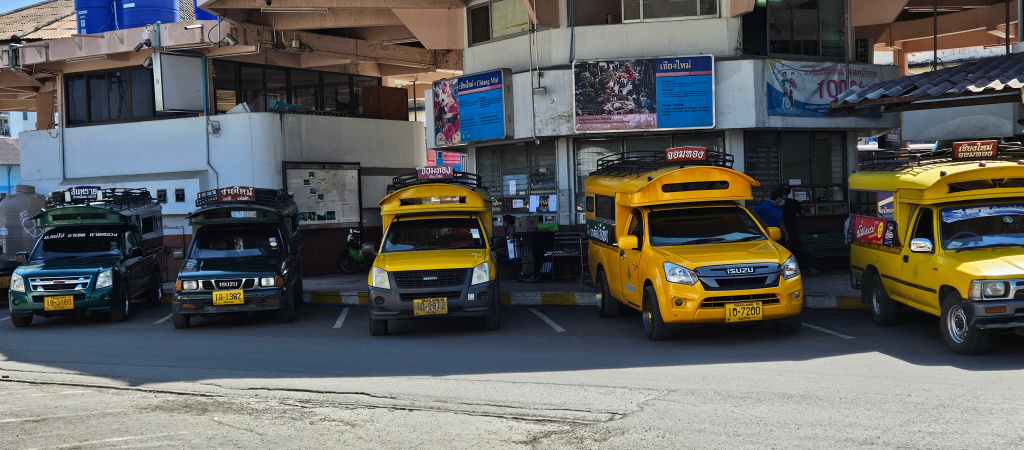
The various colors indicate where they are going. In Chiang Mai, almost all the songthaews are red which means they go in and around Chiang Mai. Yellow songthaews go south to Hang Dong and Mae Wang, and also to the east to Doi Saket. White songthaew trucks go north to Mae Rim, blue trucks go south to Lamphun and maybe to Lampang, and I do not know where the green or purple songthaews go. There are a few places in Chiang Mai where some routes interchange. On my walk back from strength training sessions with Ning, I walk by one such interchange point where I often see green, yellow, and white songthaews.
Tuk-Tuks
Songthaews are used quite heavily by local Thai people, either getting from towns outside the city into Chiang Mai for work, or around the city. The other commonly seen transportation, used mostly by tourists and seldom (if ever) by locals is what is known as the “tuk-tuk,” a 3-wheeled vehicle that is essentially a successor to the earlier cycle rickshaws, known in Thai as “Sam Lor” (“sam” translates to three and “lor” to wheel). The sam lors were introduced to Thailand in 1933. I read that they were later banned from main streets due to security reasons and could find no details about that statement. They have recently reappeared for tourists.
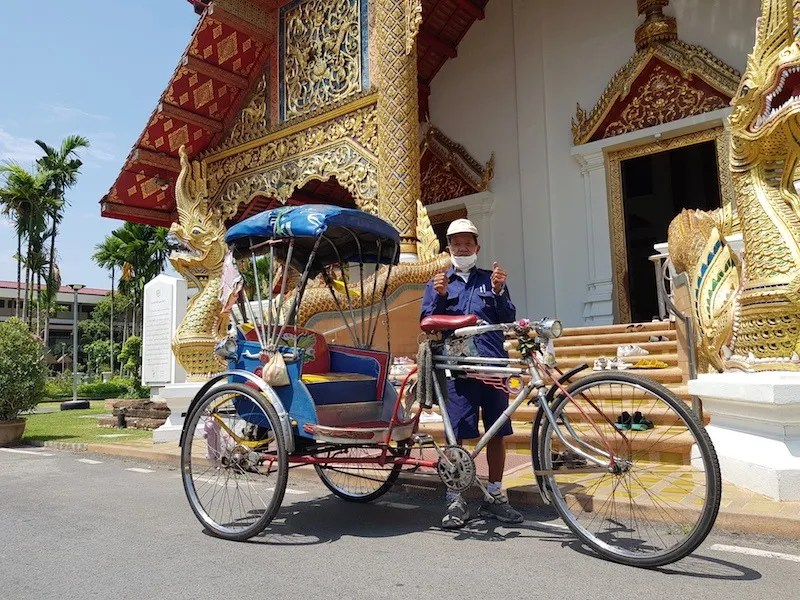
Thailand imported motorized auto rickshaws from Japan in the 1960s, developed to replace the cycle rickshaws. Tuk tuks are believed to get their somewhat out-of-the-ordinary name from the sound of the engine, a two-stroke small engine now powered by compressed natural gas. There is a push in all of Thailand to migrate to electric tuk-tuks, and a fair number are seen in Chiang Mai. With (as I’m told) over 4000 tuk-tuks in Chiang Mai, it will be a slow migration.
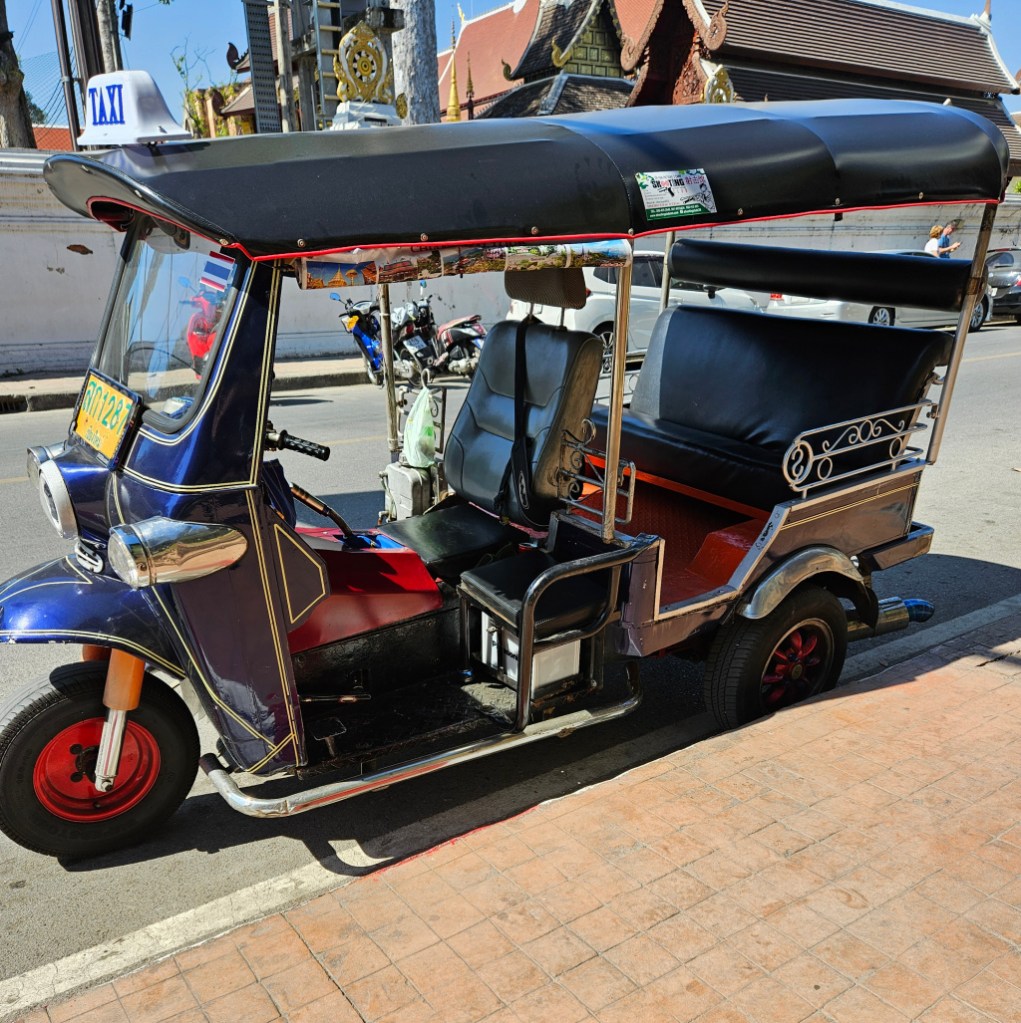
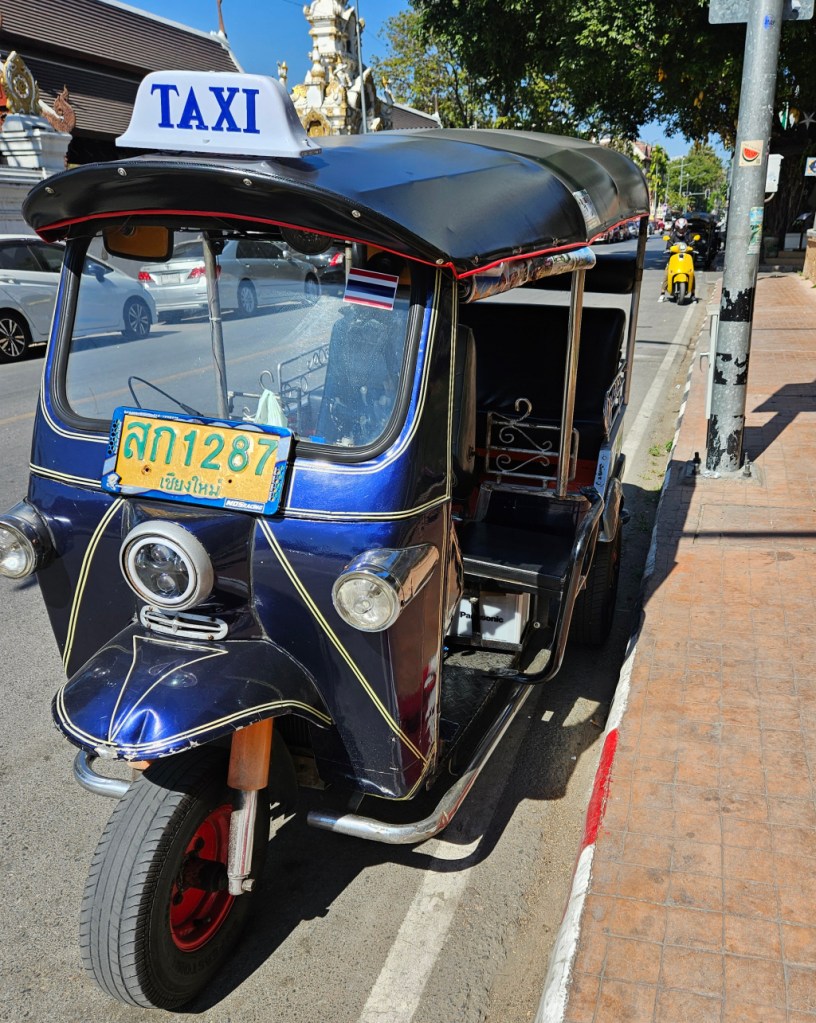
Tuk-tuks are also something I avoid. They are loud (often very loud) and, like the red trucks, seem to be in desperate need of repair, maintenance, and/or a replacement muffler. The drivers always think you are in a hurry and take unnecessary risks in their driving. Even worse, they ask too much money. For a ride I can get for 100 baht on Bolt or Grab in a car, a tuk-tuk asks 200 baht or more. I often see the drivers sitting outside popular tourist attractions (temples) smoking and drinking beer. I’m not a fan and avoid the tuk-tuks.
Getting to Lamphun
Other options being fairly expensive or less convenient, I was thinking I might try using a songthaew to get to Lamphun. There are two places where I have seen blue songthaews parked, at Warorot Market near the flower market, and at the east end of the Iron Bridge, across from Rimping Market. After my strength training workout at Pump Fitness with Ning, I returned to 3-Sis, cleaned up, packed up a few things in my backpack, and headed out. I went to the east end of the Iron Bridge and saw about a dozen blue songthaew trucks parked.
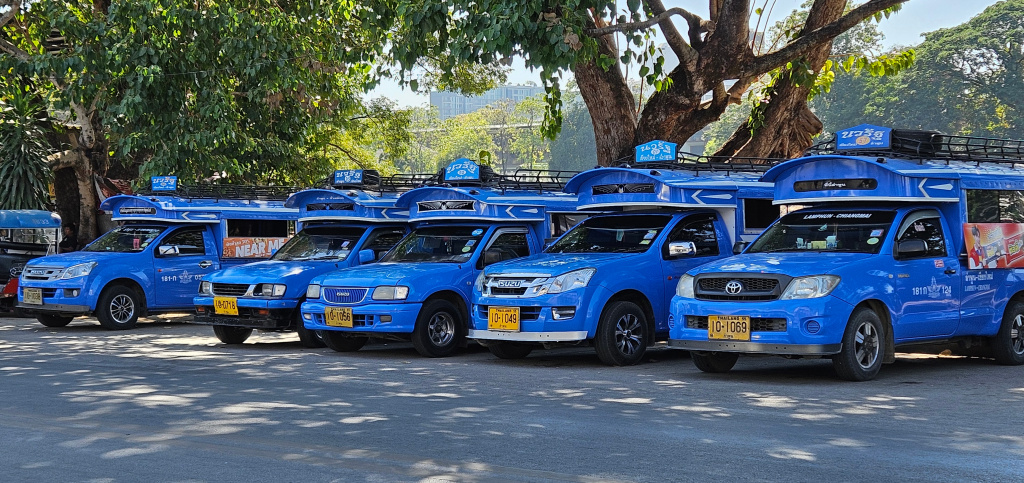
I approached a group of drivers, told them where I wanted to go, and it became clear that they typically do not drive south until the end of the day when people working in Chiang Mai want to return to their homes near Lamphun. So, being that they would not be able to fill the truck, they told me for 300 baht (about $9), they would take me there.
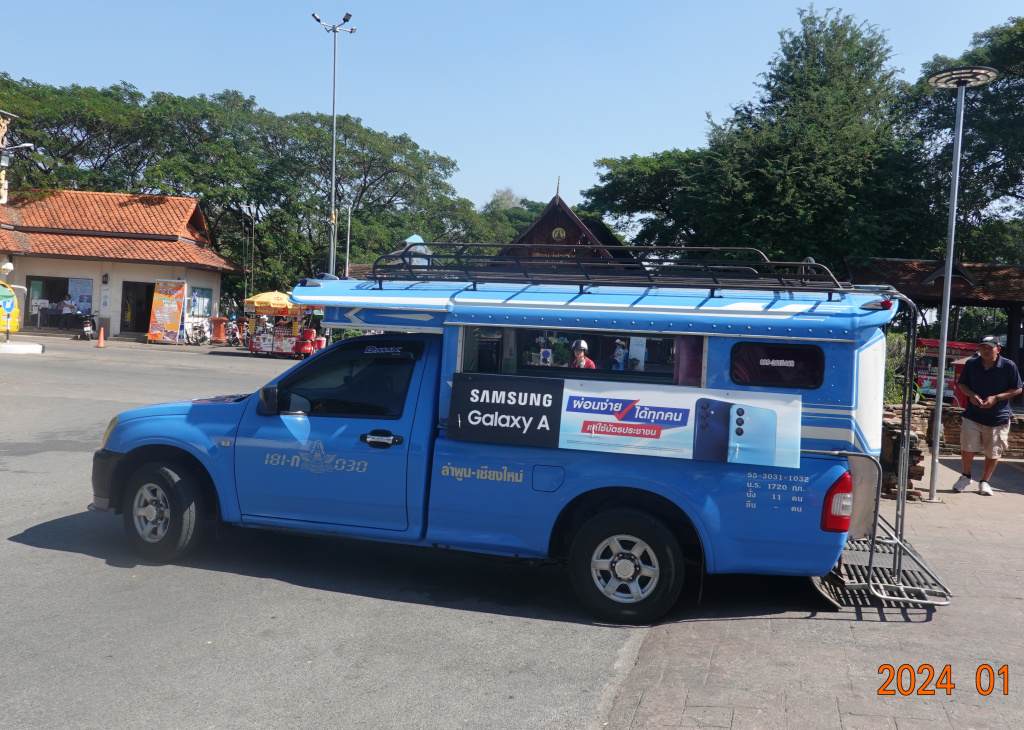
Not ideal, but really not bad, either. This is where I started to feel less than thrilled at how the day was progressing. The good thing was that because I would be the only passenger, the driver had me sit in the passenger seat for the 40-minute ride to Lamphun.
Next: Lamphun 2 – In the city

 James the Intrepid Pilgrim
Sounds ominous
LikeLike