Friday, December 1, 2023
Walking West to Wat Suan Dok
Today will be a very busy day. Because the morning is fairly cool, I wanted to get out for a walk and decided to walk out to Wat Suan Dok, one of my [many] favorite temples. Then I have scheduled yoga practice at 2 PM at Wild Rose Yoga, and then a Tok Sen session at 5 PM with Nun at Wat Sri Suphan.
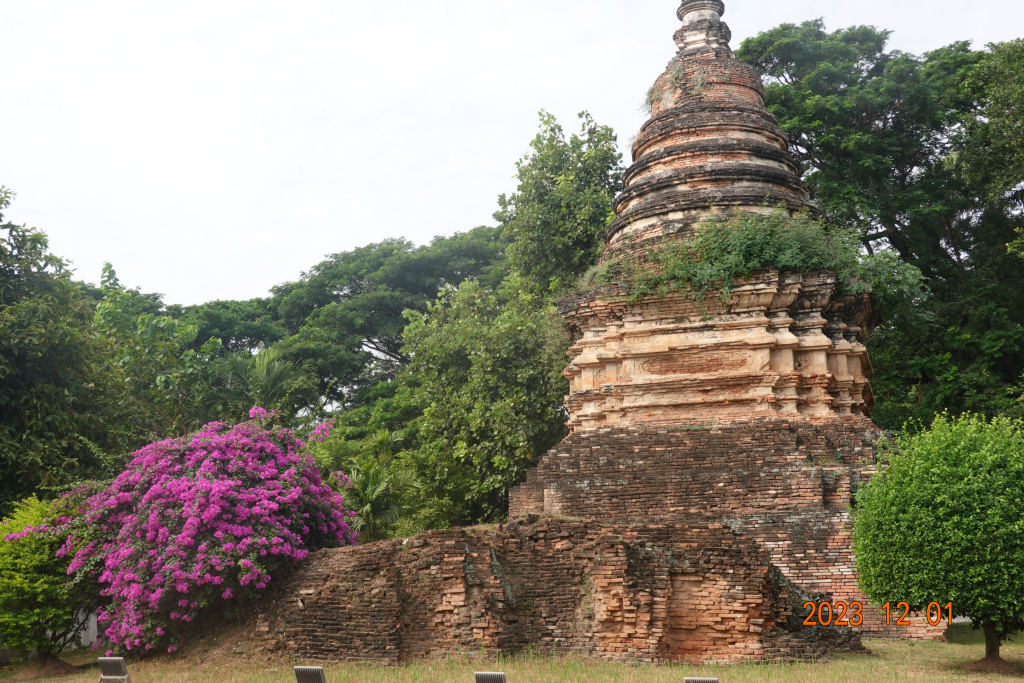
Chedi at Anniversary Archives of Thailand
Walking west from The 3-Sis, I exited the old city at Suan Dok Gate, crossed the outer moat road (called Bunrueang Rit Road here), and started down Suthep Road. Almost immediately to my left is the Anniversary Archives of Thailand. I know very little about this place and could find no information about it in English online. I love the look of the old chedi beside the parking area juxtaposed by the large bougainvillea beside the chedi. The chedi is the only remains of a temple long ago known as Wat San Ta Hoi.
Wat Suan Dok
After walking for almost 30 more minutes, I arrived at Wat Suan Dok, also known as Wat Buppaharam, meaning ” Flower Garden Temple” due to it being situated where in the 14th century King Kue Na’s flower gardens were located, a little over one kilometer west of the Suan Dok Gate.
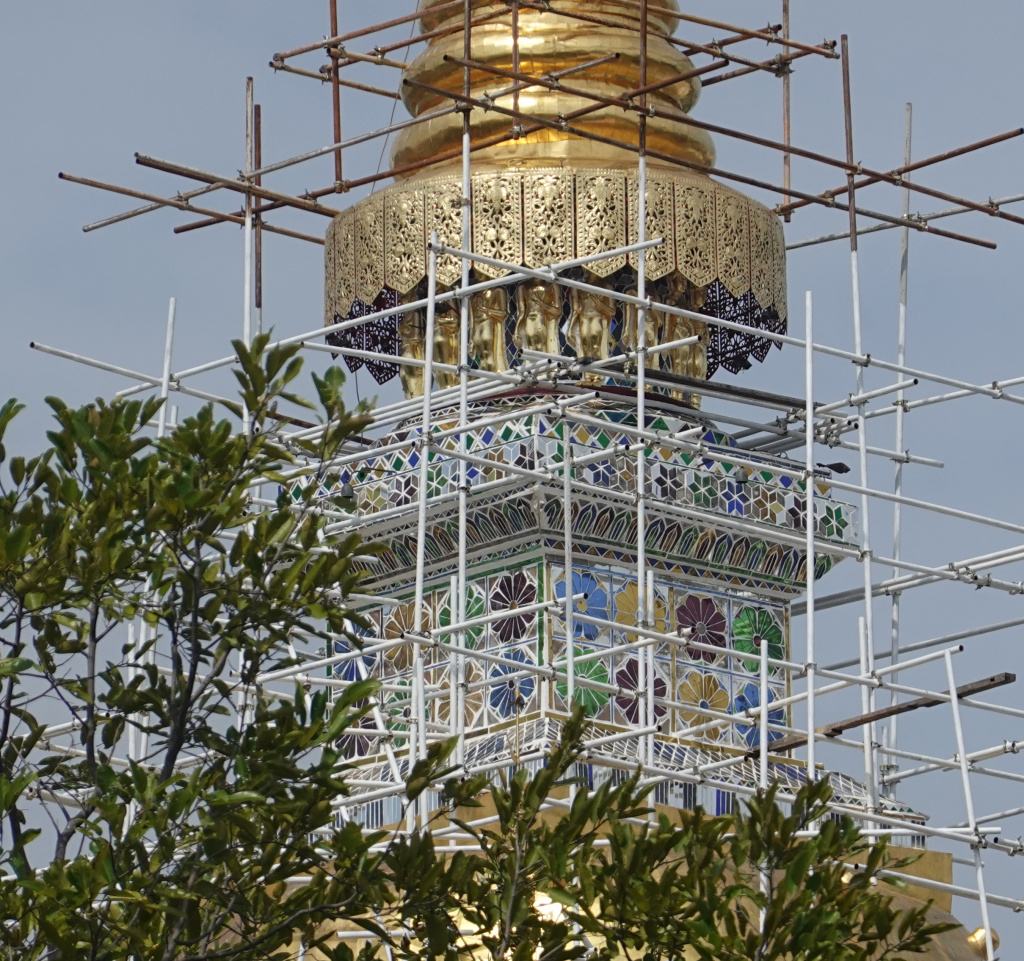
The first thing I always notice is the large gold chedi, currently undergoing cleaning and/or restoration. The importance of this temple and this chedi will be discussed further in this text.

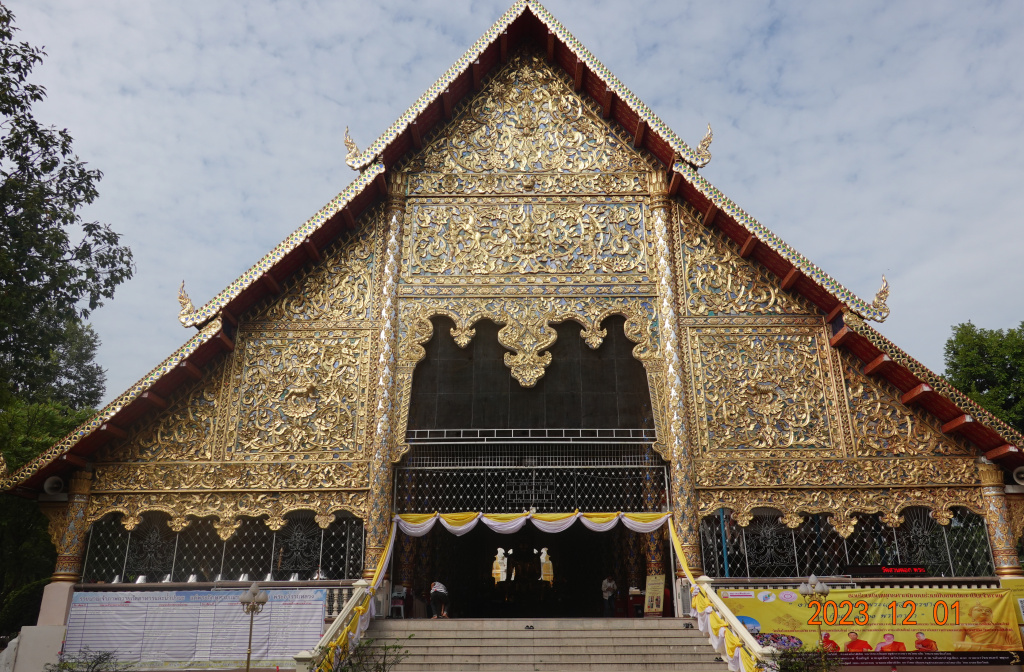
Then I see and am always impressed by the extremely large viharn (worship hall). The viharn is referred to as a “sala kan prian” due to its open structure and use as a general gathering place. This version of the viharn at Wat Suan Dok is not so old having been built in 1932 by a famous monk Phra Krubra Srivichai.

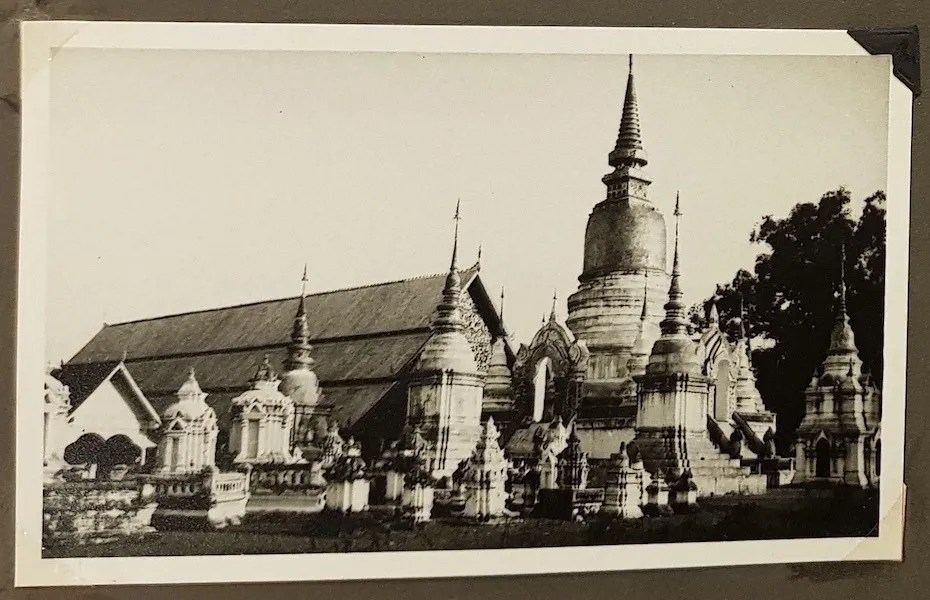
As is common, Wat Suan Dok has undergone many restorations in its history. Here is a photo from the 1930s by Edward Walter Hutchinson. The chedi is not yet gold (although difficult to tell in a black & white photo), and the large size of the viharn is evident. The gilding of the chedi turning it from white to gold took place during a renovation in 2003-2006.
A view of the entrance with the detailed front gable, a mass of foliate decoration in gilt with floral motifs.
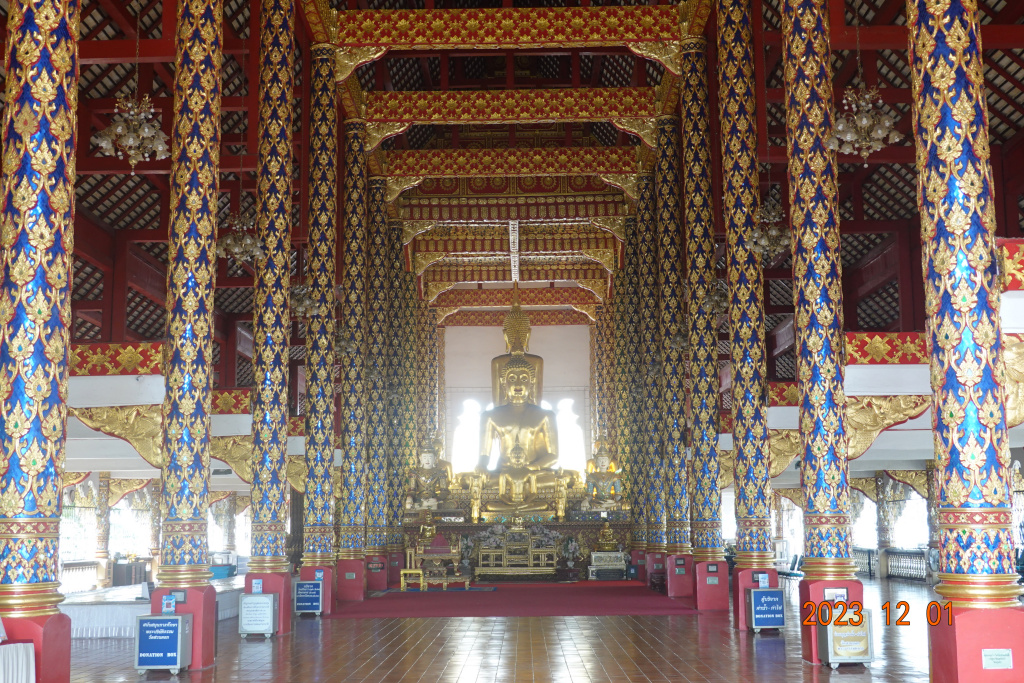
Inside, it is difficult to show in a photo just how large this hall really is, easily 40 meters from the doors to the Buddha statues.
Here are closer views of the main Buddha statues. The large seated Buddha is facing east into the hall, seated in the Subduing Mara mudra. The standing Buddha faces west towards the chedi, is standing dressed in long robes and carrying a bundle of straw in its right hand (unclear what exactly that means).
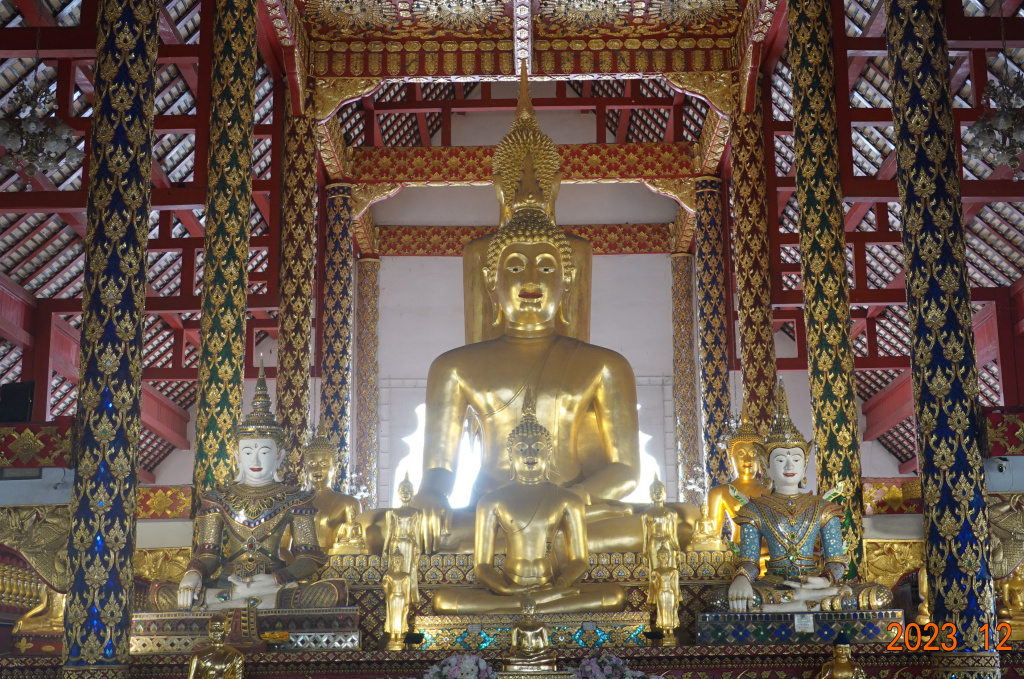
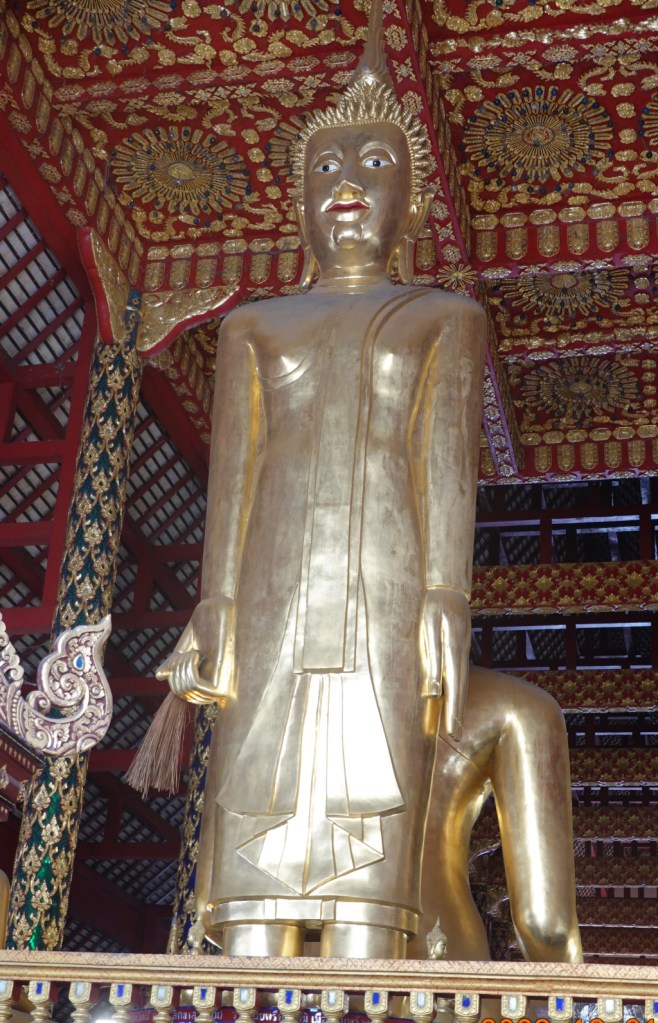
On either side by the large seated Buddha statue are two smaller Buddha statues I find particularly appealing in their detailed artistic styling:
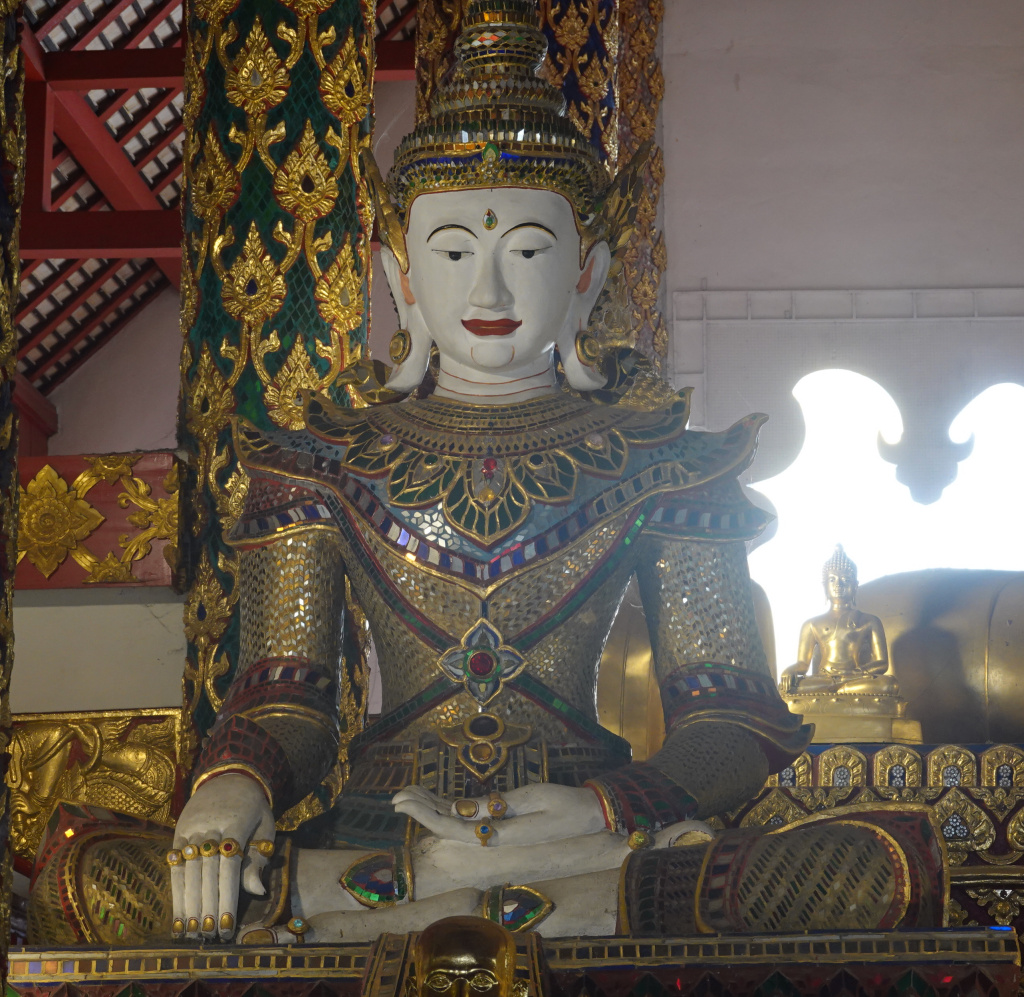
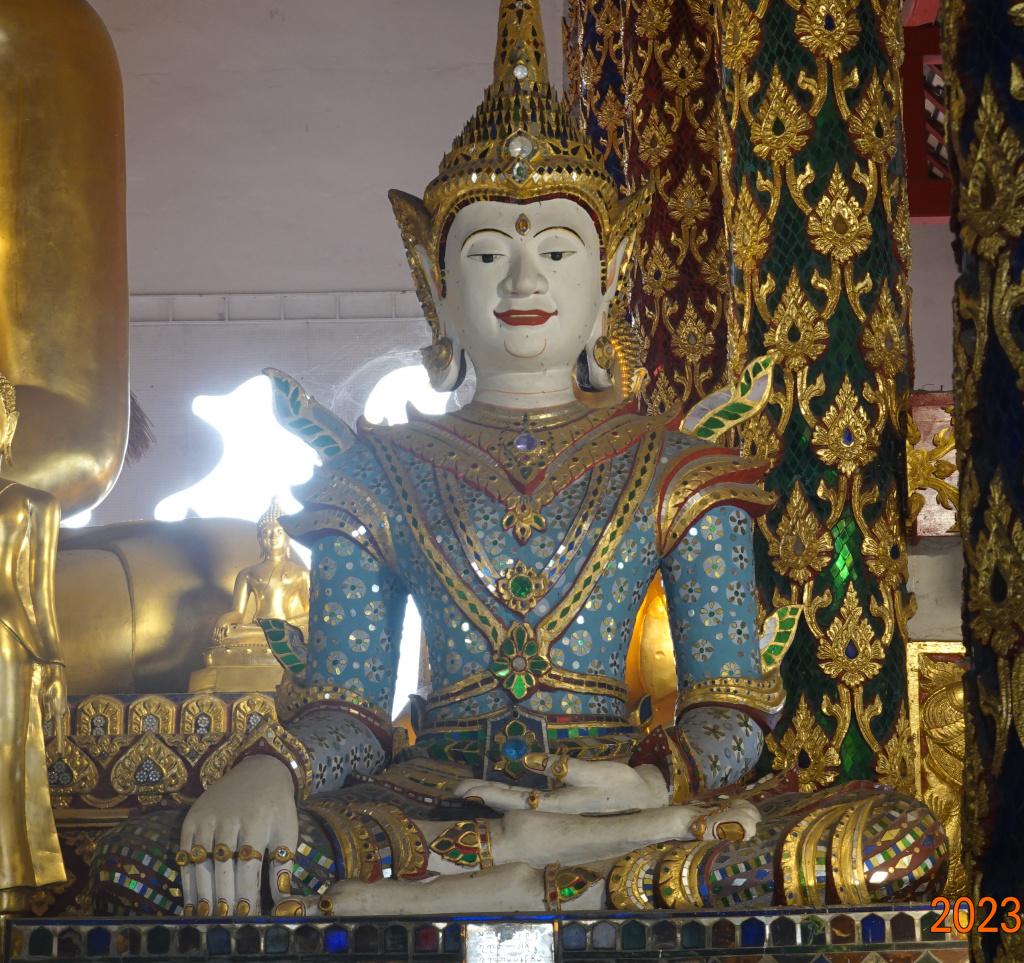
In 1963, some scenes in the film “Tarzan’s Three Challenges” were shot at Wat Suan Dok. Below is a still from the film, and again, the large size of the viharn is apparent:

Wat Suan Dok and the Legend
There is a legendary story relating Wat Suan Dok to the Wat Phra That Doi Suthep temple at the top of the mountain. In the mid-1300s, a monk in the Sukhothai kingdom named Sumanathera had a dream in which he was to go to Pang Cha and look for a relic. He went there and found a bone, which many claimed to be Gautama Buddha’s shoulder bone. The legend says that the relic displayed magical powers: it glowed, it was able to vanish and reappear, it could move, and it could replicate itself. Sumanathera took the relic to King Dhammaraja, the ruler of Sukhothai. However, when presented to King Dhammaraja, the relic displayed no magical powers, and the king, doubtful of its authenticity, told Sumanathera to keep the relic (and go away).
In 1368, King Nu Naone of Lanna heard of the relic and sent word to Sumanathera to come to Chiang Mai to bring him the relic and to disseminate Theravada Buddhism. A plaque at Wat Suan Dok states that Wat Suan Dok was, “the first temple in the Lanna Kingdom to be built according to the belief of Theravada Buddhism.”
When presented to King Nu Naone, the relic showed some of the magical powers, and the king ordered a chedi built at Wat Suan Dok to house the relic. When the chedi was completed and the relic was to be placed inside, it broke into two pieces. The smaller piece was placed into the chedi at Wat Suan Dok. The larger piece was placed on the back of a royal elephant which was released into the jungle. The elephant (followed by the king and his army on horseback) climbed up the mountain, now known as Doi Suthep, and near the top, stopped, trumpeted three times, and died. King Nu Naone ordered the construction of a temple and a chedi into which to inter the relic. This temple is the famous Wat Phra That Doi Suthep.
Thousands of tourists foreign and Thai visit Wat Phra That Doi Suthep every day. Wat Phra That Doi Suthep is a sacred temple to the Thai people and is a Royal Temple of the Second Class. Of the thousands of tourists that travel up the mountain daily to see Wat Phra That Doi Suthep, only a few visit Wat Suan Dok, even though it is a very important part of the story.
Chedi at Wat Suan Dok
Here is a view of the large gold chedi from the southeast and a close-up of the colored detail near the top:

Wat Kao Tue
Immediately south of Wat Suan Dok is what used to be Wat Kao Tue that has the Prajoe Kao Tue Buddha statue. I was told by a lady working at the temple that this used to be a separate temple but is now considered to be part of Wat Suan Dok. The viharn is relatively small and has been restored in the past 4 years since I first saw it. In researching this temple, I found the following: “information at the temple itself tells us that King Muangkaew (1495-1525) ordered a craftsman from Chiang Saen to make this statue. It was his intention to bring it to Wat Phra Singh. It turned out far too heavy to move it to Wat Phra Singh so he decided to build an ubosot to house it.” That ubosot or what I think was a small viharn at Wat Kao Tue:
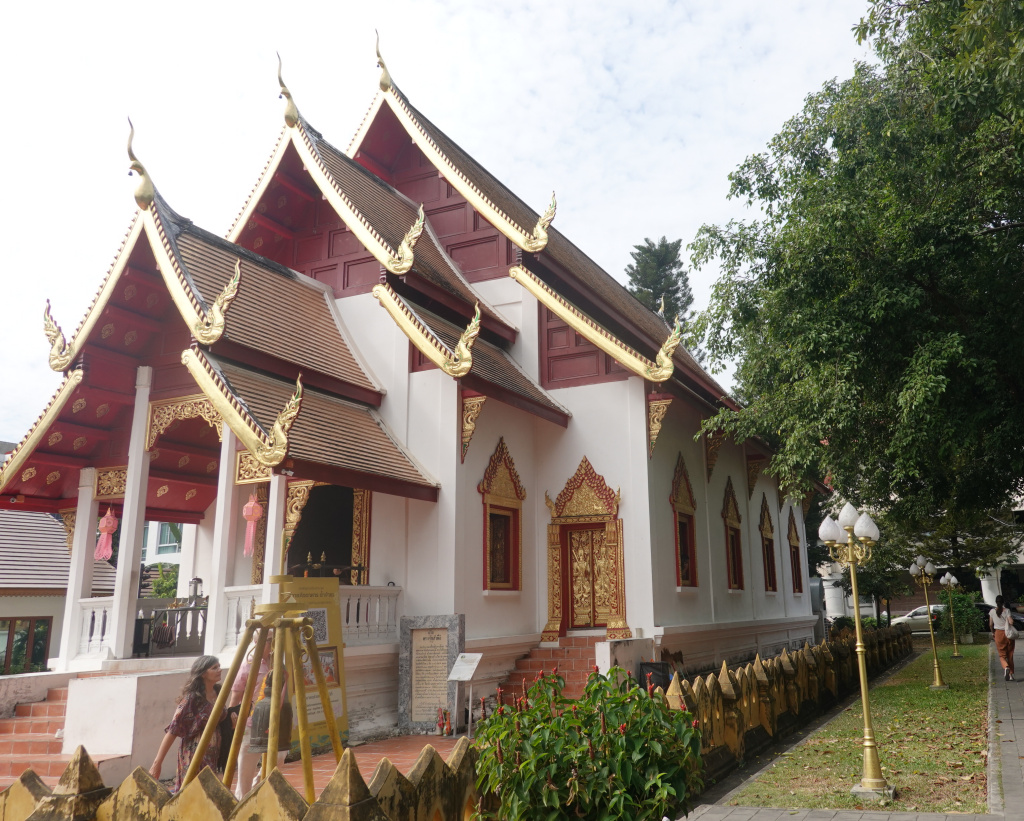

Inside the viharn is the Buddha statue called Prajao Kao Tue, said to be the largest bronze Buddha image in northern Thailand, and the most beautiful in Lanna art. When I was first here, it was all gold. Now it is black and in a three-day process of being covered in gold leaf. Three men are working the gold-leaf process, and a fourth man in dress clothes joined for just a few minutes, perhaps a ceremonial moment.


The picture does not convey well how beautiful it really looks in person, and also how large it is. I’m glad I was able to see this again, as often in past years the doors of this smaller viharn were closed.
I made the long walk back to The 3-Sis, rested, and then went to a very good yoga practice at Wild Rose Yoga. After, I made my way to Wat Srisuphan for a tok sen session with Khun Nun. Finally dinner at Archer’s where I forgot to photograph my meal: a salad, stir-fried cashew chicken, and a watermelon smoothie, mmmmm.
Next: more adventures in Chiang Mai

 James the Intrepid Pilgrim