Monday, November 27, 2023
Temples in the Neighborhood
After the long travel to Thailand, the hot & humid day in Bangkok, a long walk around the perimeter of the old Chiang Mai city, and perhaps some vestiges of jet lag, I thought it best to have a less energetic day and explore some lesser visited temples in the neighborhood near The 3-Sis. This will be in three parts to keep the posts of reasonable length. I planned to use Google Fit or Samsung Health to show a map of my walk, but I did not get either set up correctly, so maps of my walks will be forthcoming, just not today.
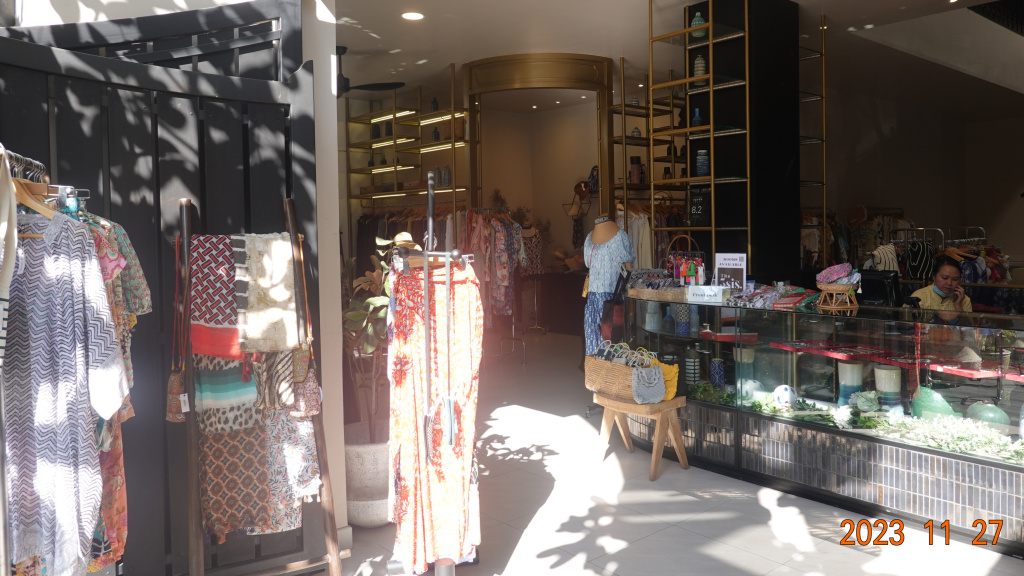
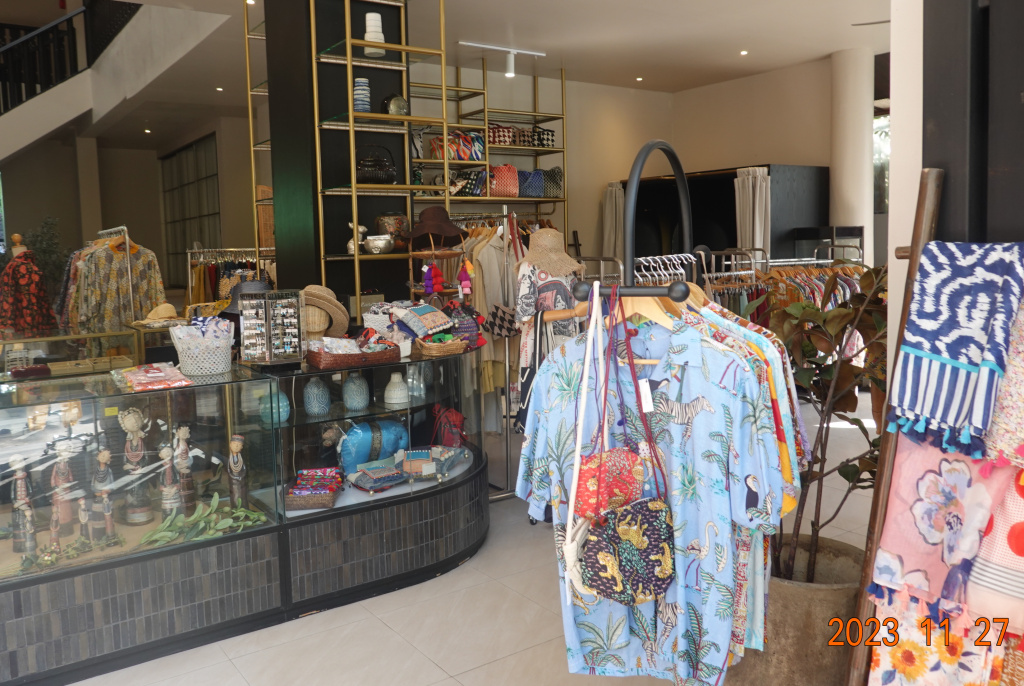
Here is the entrance to The 3-Sis. The two sisters that live in Chiang Mai (the third sister lives in Bangkok), Poppy and Ice, are businesswomen: they own several properties and businesses, and in both The 3-Sis and See You Soon, they sell gifts and clothing – mostly women’s clothing. After The 3-Sis remodeling was completed last year (it was still under some renovation when I arrived – my room was the only one complete), the lobby was nearly empty. Now the lobby area is a full-blown gift and clothing shop. Here are three photos, the entrance, looking to the left, and looking to the right.

I walked north to the first of the five temples I’ll visit and noticed this wiring. This is quite common in Thailand, not just Chiang Mai, and is so chaotic-looking that one wonders how the power and communications actually function.

Notice that the poles are concrete. Wooden poles would deteriorate or be eaten by termites quickly. Concrete is strong and lasts well in this climate.
Wat Pang Ping
Just north of the chaotic wiring, Wat Pan Ping is a quiet, relatively small temple in a very busy area, very near many tourist-centric sights such as The Three Kings Monument and Wat Chedi Luang. It is one of the oldest temples in Chiang Mai, having been built at about the same time as Wat Chiang Man, the temple King Mengrai built in which to live and worship as he supervised the construction of the city.

Because I was walking from the west to the east, I was at what can be considered the back of the temple. The “front” of a temple is the east, facing the rising sun. In almost all temples, the viharn (worship hall) doors open to the east, to greet the rising sun – the eastern rising sun represents the beginning of a day, or birth; the western setting sun represents the end or death. This is why the chedi (pagoda) in which the ashes of someone are interred are at the western side of the viharn.
I made my way over to a nice statue of the earth deity Phra Mae Thorani (Mother Earth). According to Buddhist myths, Phra Mae Thorani is depicted as a young woman wringing the cool waters of detachment out of her hair to drown Mara, the demon sent to tempt Gautama Buddha as he meditated under the Bodhi Tree. Statues of Phra Mae Thorani are seen at many temples in and around Chiang Mai.
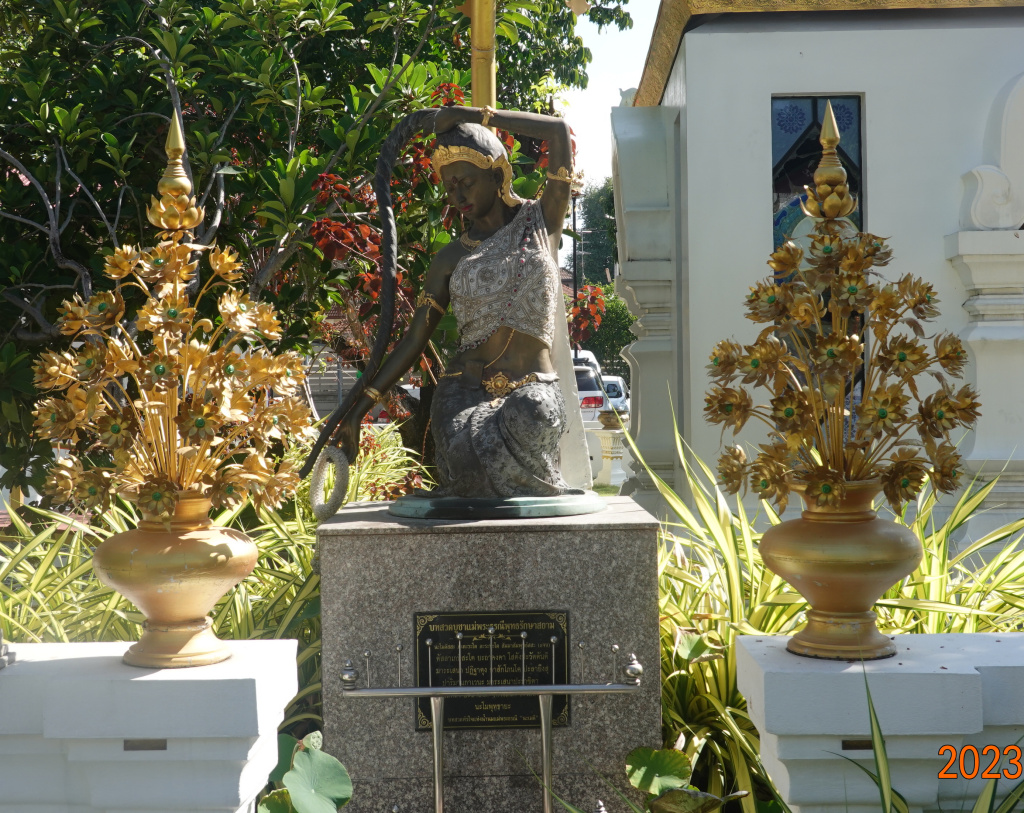
Here is a version of the story I found:
The Bodhisattva was sitting in meditation on his throne under the Bodhi Tree, Mara, the Evil One, was jealous and wanted to stop him from reaching enlightenment. Accompanied by his warriors, wild animals and his daughters, he tried to drive the Bodhisattva from his throne. All the gods were terrified and ran away, leaving the Bodhisattva alone to face Mara’s challenge. The Bodhisattva stretched down his right hand and touched the earth, summoning her to be his witness. The earth deity in the form of a beautiful woman rose up from underneath the throne, and affirmed the Bodhisattva’s right to occupy the vajriisana. She twisted her long hair, and torrents of water collected there from the innumerable donative libations of the Buddha over the ages created a flood. The flood washed away Mara and his army, and the Bodhisattva was freed to reach enlightenment.
Study of the History and Cult of the Buddhist Earth Deity in Mainland Southeast Asia
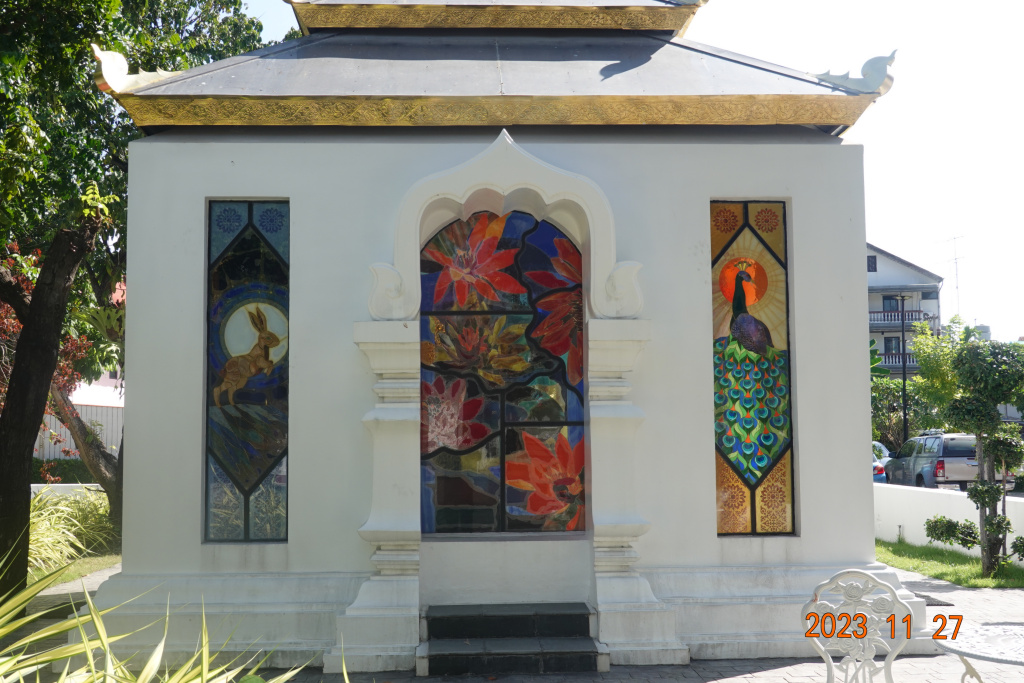
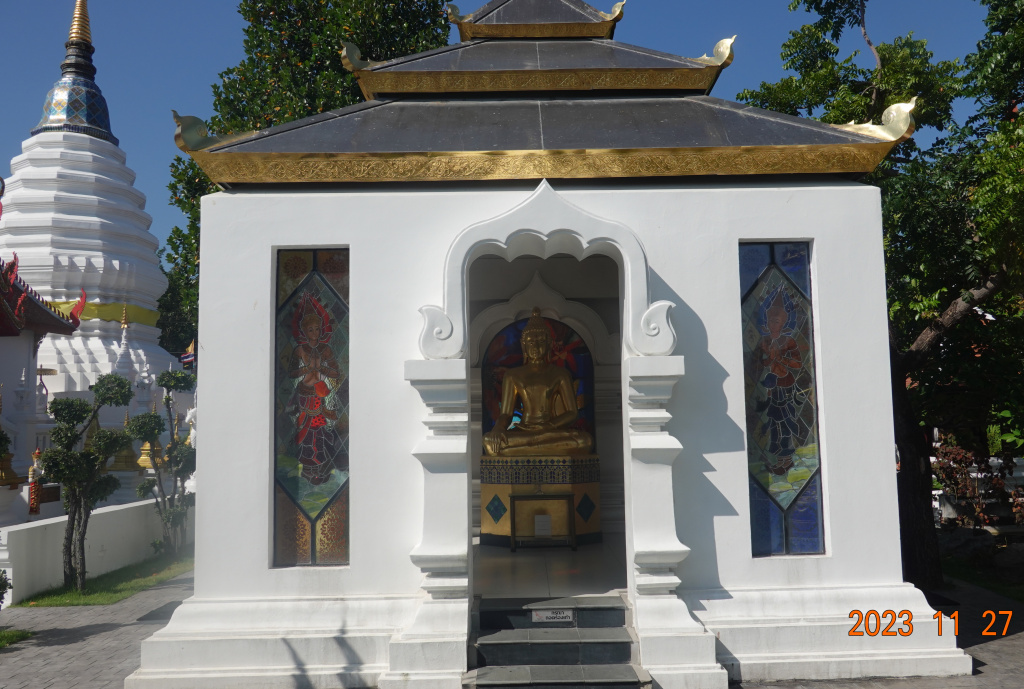
Behind the Mother Earth statue is a pavilion I do not remember. It is a very simple pavilion housing a large Buddha image with quite colorful panels of what might be stained glass. Here are three photos showing the back, front and inside:

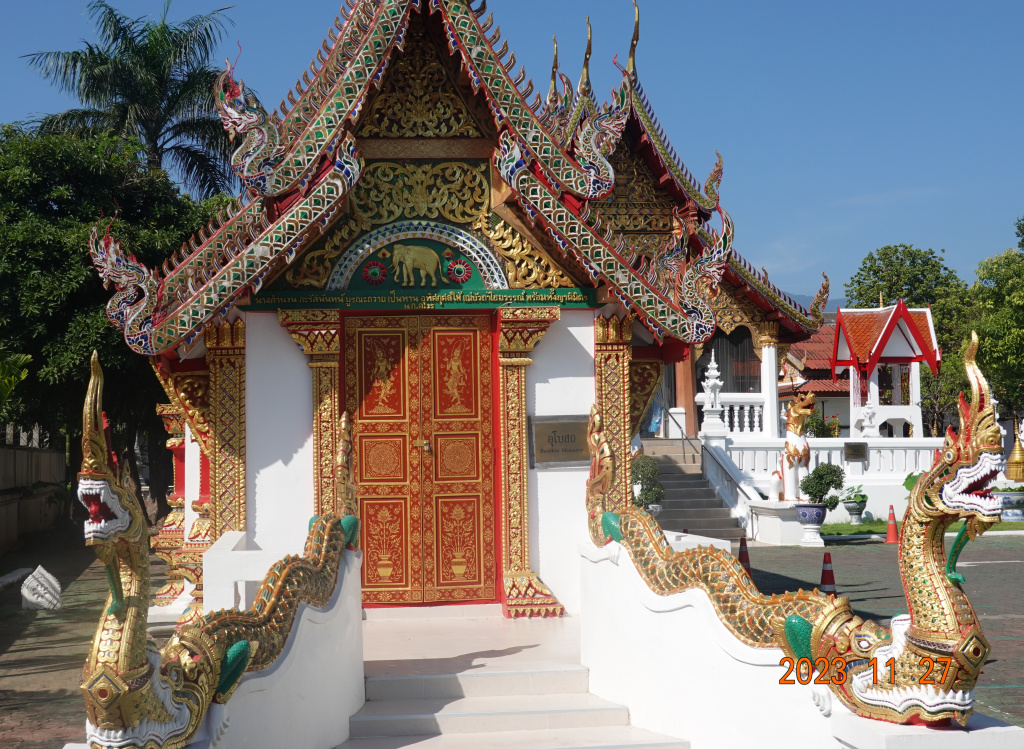
By the new Buddha pavilion is the ubosot, or ordination hall, looking much like a small viharn (worship hall).
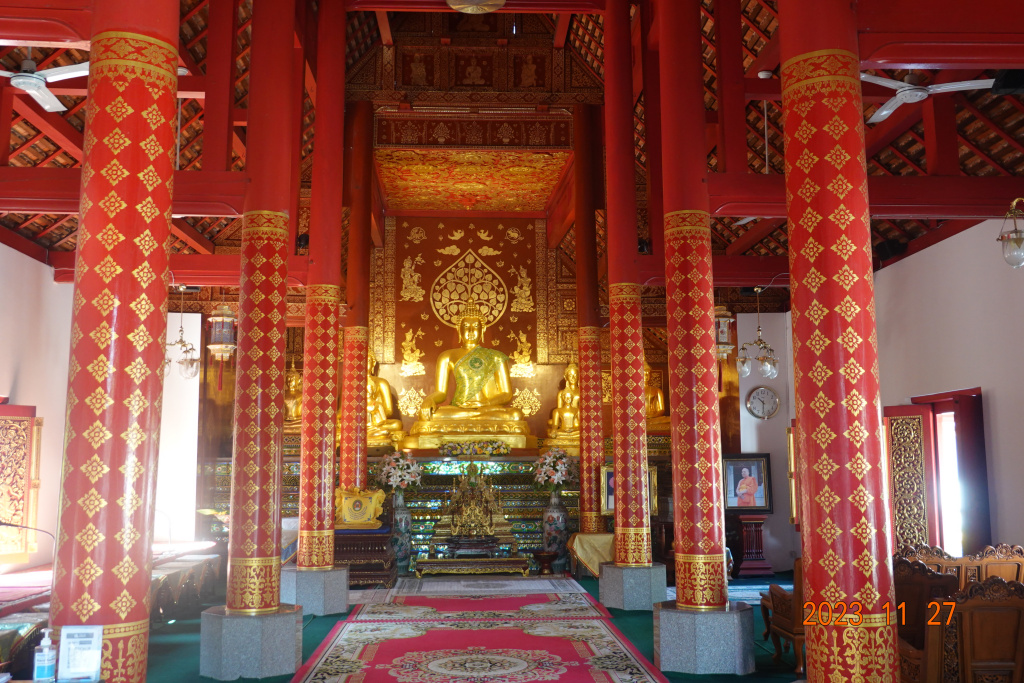
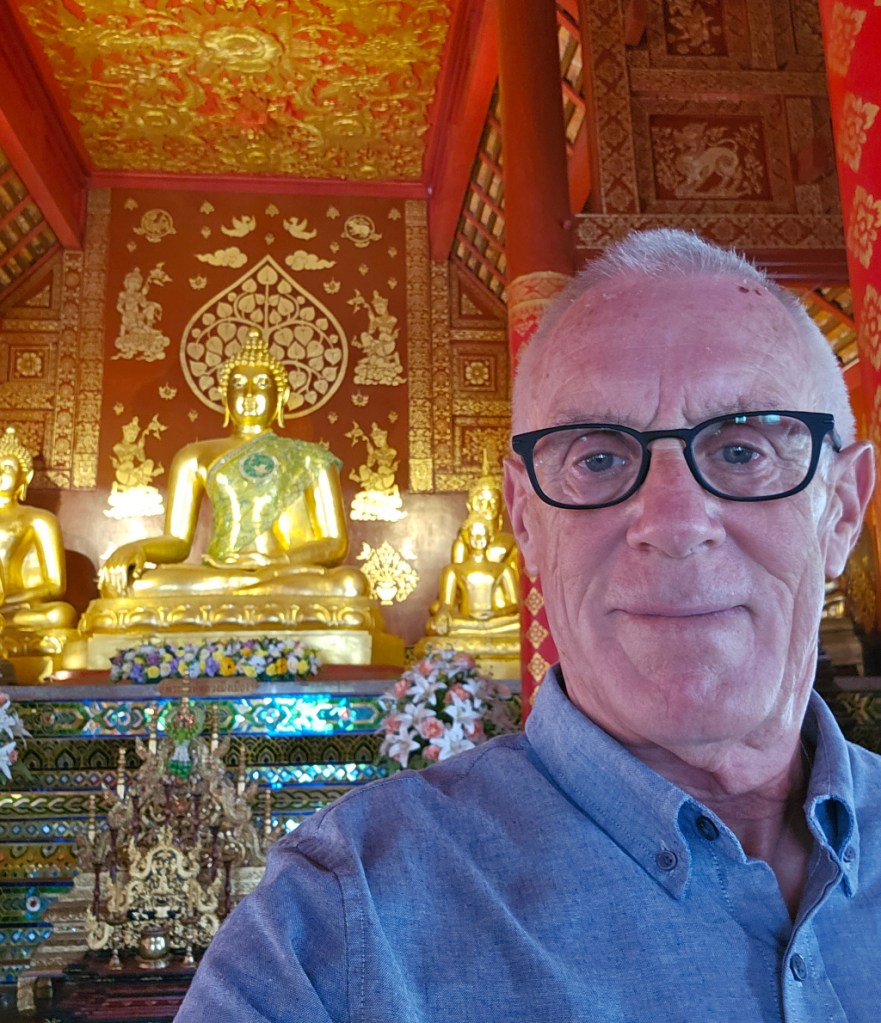
There was a photographer and two models at the front of the viharn, so I made my way inside from the side door and got a photo of the inside, and a photo of me also inside the viharn.
Behind the viharn is the chedi. When I was here four years ago, the chedi was a painted gold color. Now it is all white.

I left Wat Pan Ping and walked across the street to Wat Umong Mahatera Chan.
Next: Wat Umong Mahatera Chan

 James the Intrepid Pilgrim