Tuesday, November 21, 2023
Favorite Temples in Bangkok
My plans for today echo almost exactly my one full day in Bangkok last year in early December, so this post will be quite similar to that from last year, and years past when I only had one full day in Bangkok.
I arrived in Bangkok on Monday, very tired after the long journey from Los Angeles. Wednesday (tomorrow) I leave for Chiang Mai shortly after breakfast. Today, Tuesday, is my one day in Bangkok to see my favorite sights, namely Wat Arun, Wat Pho, and depending on my energy level, Wat Phrea Kaew (part of the Grand Palace).
The Novotel Hotel offers a rather extensive and delicious breakfast buffet. So, being on vacation, I splurge a little. My very Western-style breakfast is seen below:

After breakfast, I headed out to see the sights. As in the past, I took the BTS Sky Train up to the Siam Square interchange, changed trains from the Sukhumvit Line to the Silom Line, took the second train to the Saphan Taksin stop, and walked to the Sathorn Pier to catch an express boat to Wat Arun.
Wat Arun
Wat Arun is significant in Thai history, one of Bangkok’s best-known landmarks, and is depicted on the 10 baht coin. It is classified as a Royal Temple of the First Class, a category consisting of only six Thai Buddhist temples (there are over 30,000 active Buddhist temples in Thailand). In the 1700s, Wat Arun was then known as Wat Makok, after the village of Bang Makok in which it was located. It is likely that the current city name Bangkok evolved from the village name Bang Makok.
When the former capital Ayutthaya was overthrown in 1774, King Taksin and what was left of his army moved south along the Chao Phraya River, and it is believed that when Taksin saw this temple at dawn, he decided to make this the new seat of his kingdom. He rebuilt the temple and renamed it for Aruna, the Hindu Goddess of the dawn. Almost all Thai Buddhist temples have a formal or official name, a short name, and sometimes a nickname. Wat Arun’s formal name is Wat Arun Ratchawararam Ratchawaramahawihan. The most recent cleaning and renovation of Wat Arun took place from 2013 – 2017 during which time the towers were covered with scaffolding as workers carefully restored the surfaces.
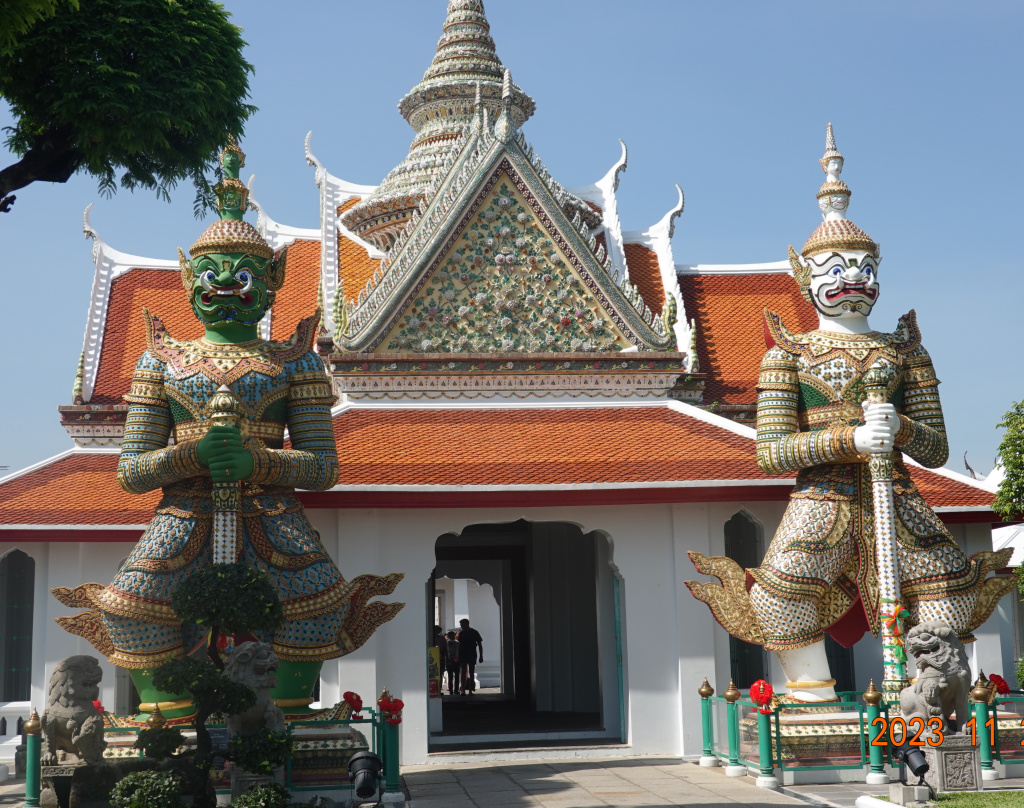
Wat Arun, like many Thai temples, is something of a small campus, with several buildings and structures. The entrance to the first viharn (worship hall) at Wat Arun is guarded by two large yak or yaksha figures. From Wikipedia, “yaksha are a broad class of nature-spirits, usually benevolent, but sometimes mischievous or capricious, connected with water, fertility, trees, the forest, treasure, and wilderness.” Here are the yaks standing guard at the entrance:
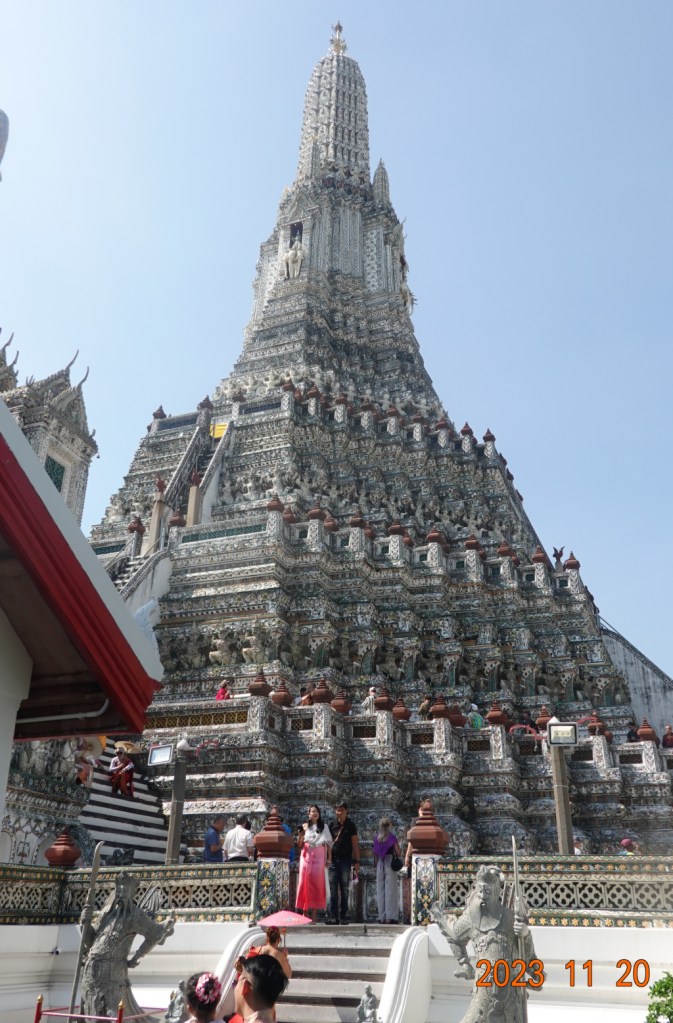
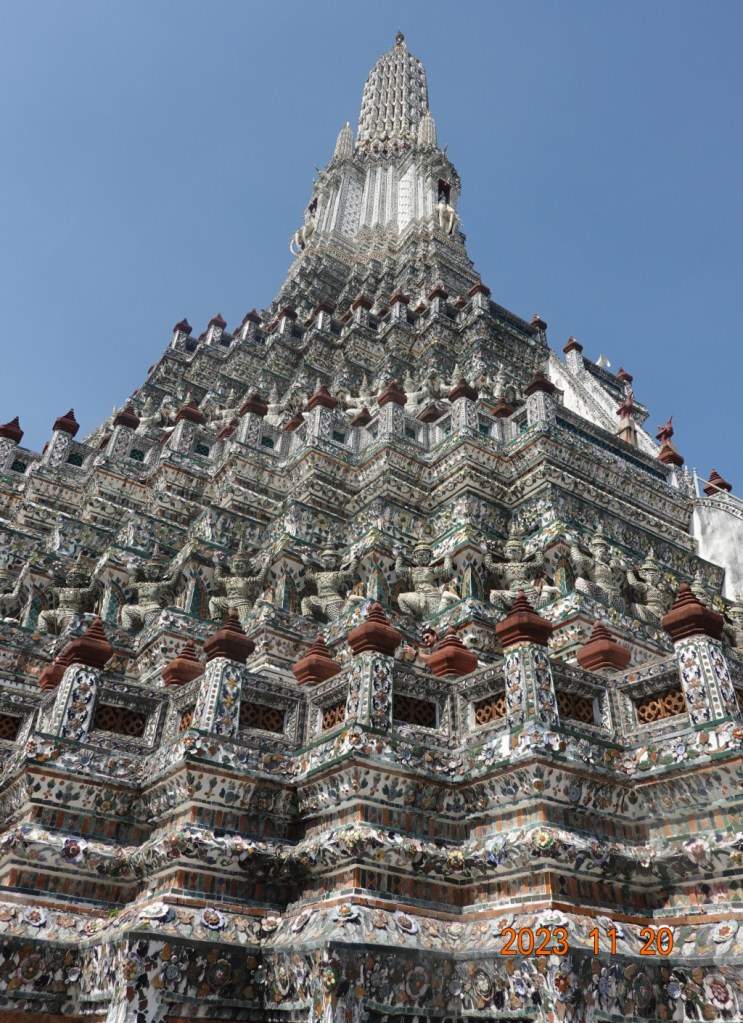
The main part of Wat Arun consists of four Khmer-style “prangs” (also known as prasat) and a fifth, larger one in the middle. This layout is a representation of the five sacred mountains which were home to the gods according to Khmer, Hindu, and Buddhist cosmology. The central prang represents Mount Meru, the center of the universe. When the height of the central prang was extended by King Rama III in the 1800s, he ordered that colorful ceramics and porcelain should be used to form elaborate motifs and designs. This unusual design feature makes the prangs shimmer and shine in the sunlight and gives the temple a unique appeal that has to be seen close up to be fully appreciated. A staircase, which is very steep with narrow steps (and no handrails), allows visitors to climb part way up the central prang to a platform that gives excellent views of the four smaller prangs.
It is difficult to get a good view of the towers. Here is the central prang towering high:
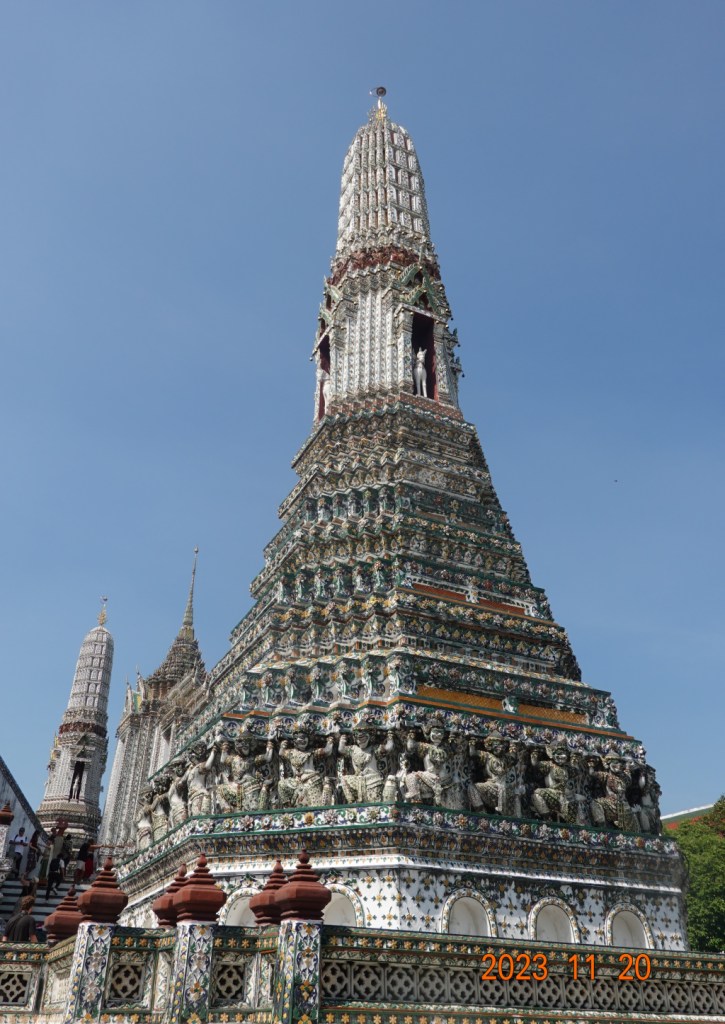
And here is one of the four smaller towers:
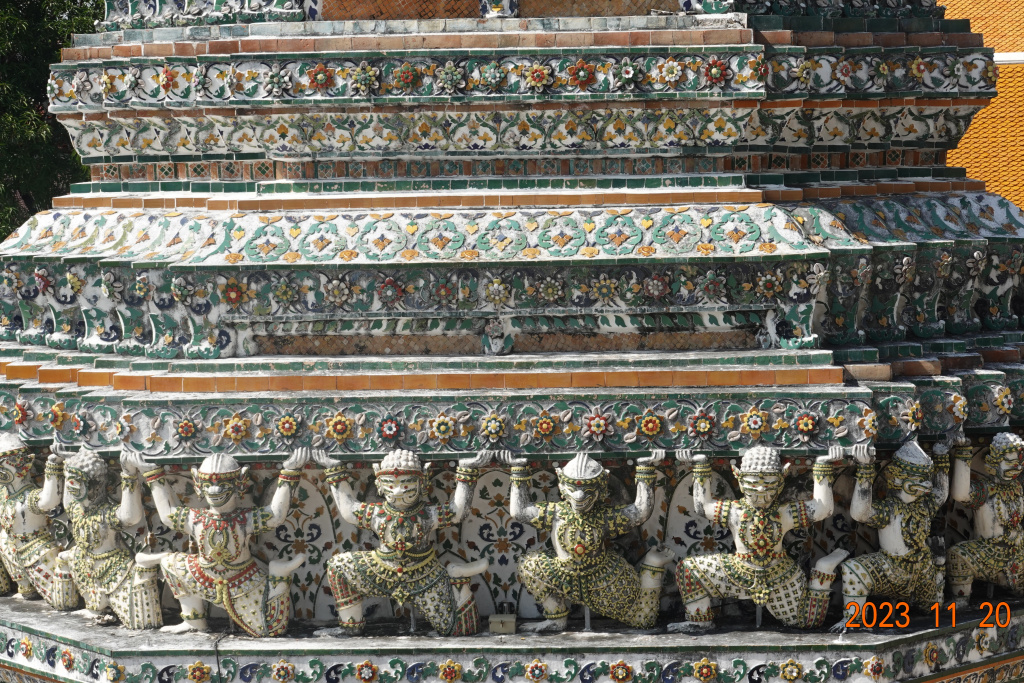
I climbed carefully up to the first landing (as far as tourists are allowed) and captured this detail of the central prang:

And I captured this detail of one of the smaller towers. It does look almost exactly like the style of the central tower.
And one more photo looking directly up at the very large central prang:
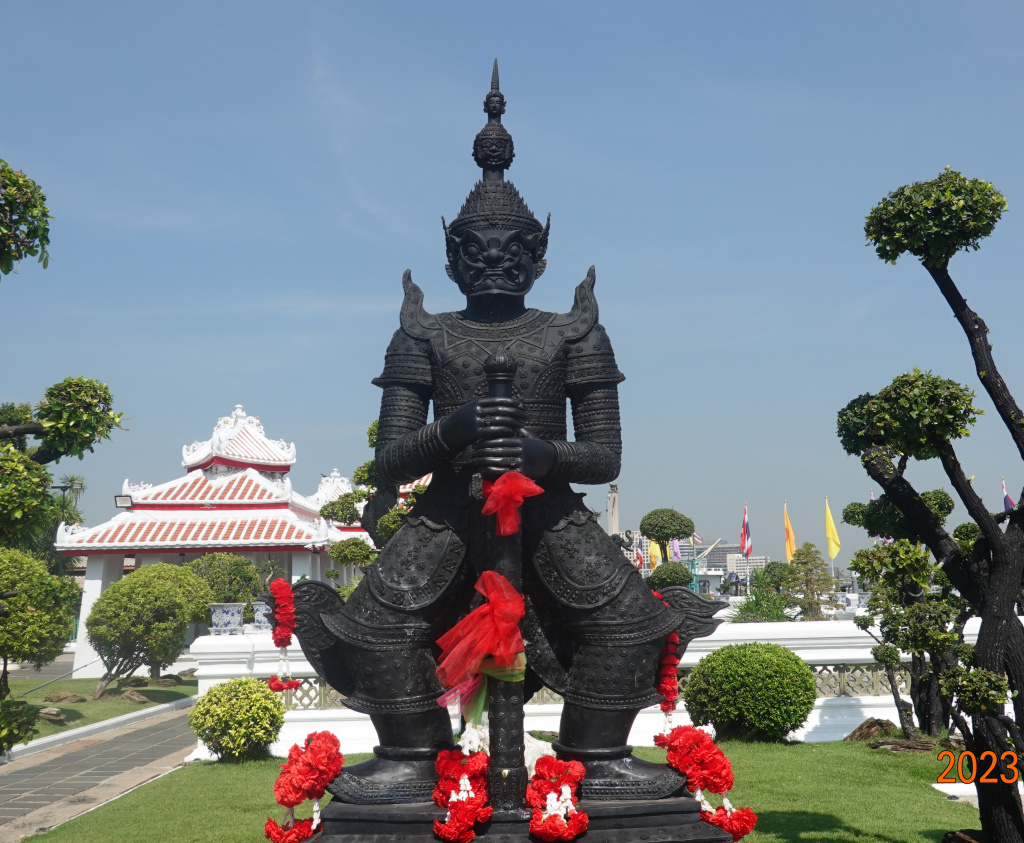
Walking over to the pier for the ferry across the Chao Praya River to Wat Pho, I saw this statue of a yak, unclear what it is guarding. A very nice statue, though.
Wat Pho – The Reclining Buddha
I got on the very crowded ferry, and for 5 baht (15 cents) crossed the Chao Praya River to visit Wat Pho. I do not take pictures while on the boats in Bangkok because the river is choppy and dropping my camera overboard would not make for a good day.
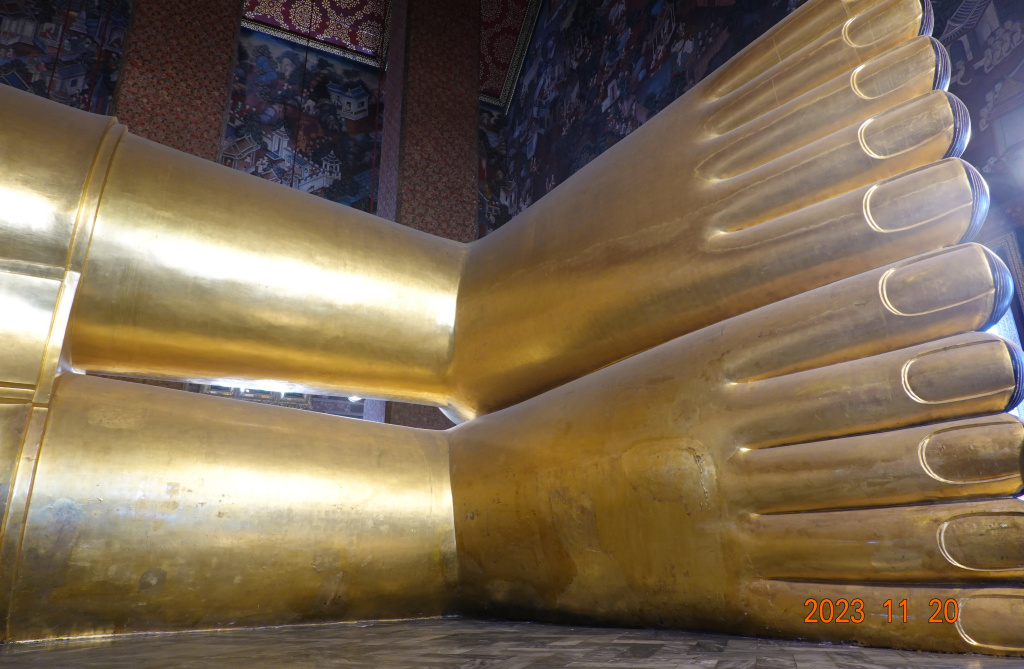
Wat Pho is known as the Temple of the Reclining Buddha, and its official name is Wat Phra Chetuphon Vimolmangklararm Rajwaramahaviharn. Wat Pho is first on the list of six temples in Thailand classed as royal temples of the first class. Wat Pho was built under the reign of King Rama I in the early 1800s. The most significant feature (and tourist draw) is the large Reclining Buddha, a 46 meter-long (155 feet) reclining Buddha statue. Wat Pho is considered the oldest center for public education in Thailand, also houses a school of Thai medicine, and is regarded as the birthplace of traditional Thai massage which is still taught.
Every time I have been here, there are many, many tourists, but I still love standing near the large statue and taking in the history, the relevance, and the beauty of this relic. It is difficult to get a good picture, because of the structure’s support columns, but here are a few photos:

Another view of part of the body and head of the Reclining Buddha at Wat Pho:

And views of the tops and bottoms of the feet of the Reclining Buddha:
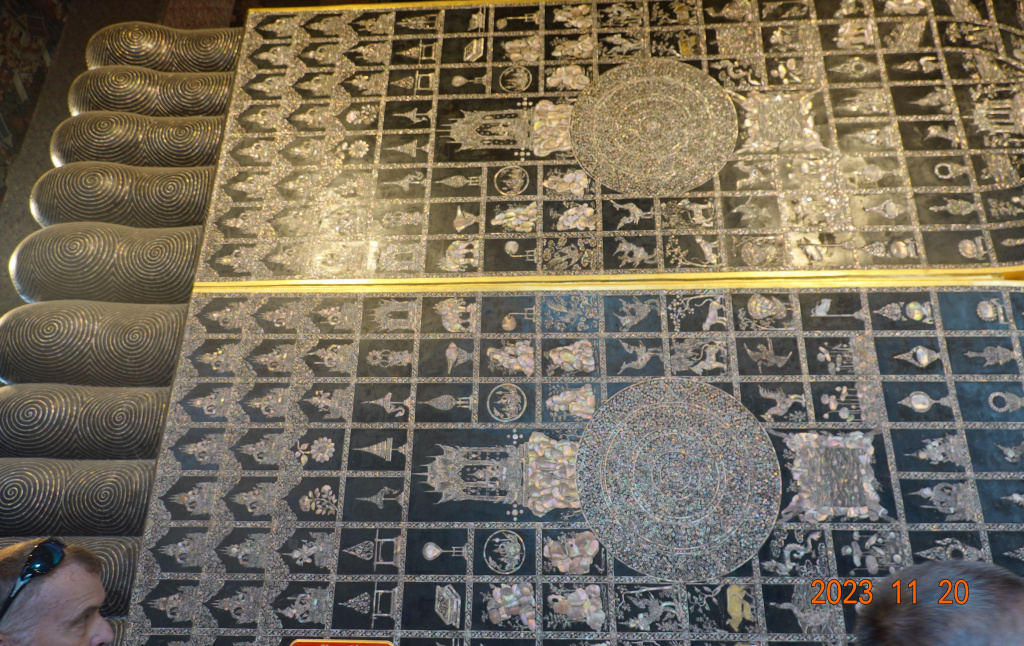
The symbols and icons on the bottoms of the feet are quite meaningful, but not a subject with which I am familiar.
Wat Pho is a fairly large campus. There is far more than the pavilion housing the Reclining Buddha. For example, I noticed this standing Buddha statue in a nearby smaller pavilion:
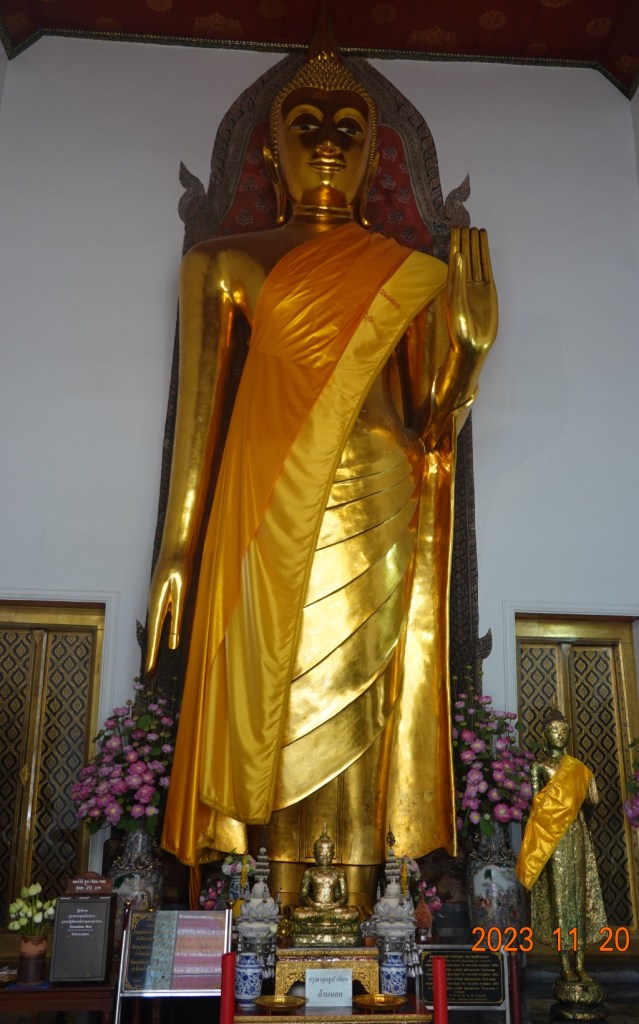
This Buddha image embodies the qualities of radiant inner calm and stillness, the products of supreme wisdom. The raised right hand is a gesture dispelling fear and imparting reassurance.
Nearby was this bell tower. The significance is unclear, but the structure was interesting and was of a detailed design similar to that of the towers at Wat Arun:

Wat Phra Kaew – The Grand Palace
On the map, the Grand Palace entrance seems fairly close to Wat Pho. It was a long and hot walk in the midday sun and humidity. I only wanted to see Wat Phra Kaew again, but the temple is inside the Grand Palace, so I joined the large crowds of tourists and paid 500 baht (about $16) for entrance to the Grand Palace. [To contrast, entrance to Wat Arun was 100 baht, and entrance to Wat Pho 200 baht.]
Quoting from the Grand Palace web site:
The Grand Palace complex was established in 1782 and it consists of not only royal and throne halls, but also a number of government offices as well as the renowned Temple of the Emerald Buddha. It covers an area of 218,000 square metres and is surrounded by four walls, 1900 metres in length. After King Rama I ascended to the throne in 1782, the palace was built. Prior to this, the royal palace and centre of administration had been located in Thonburi, on the west bank of the Chao Phraya River. For various reasons, the new King considered the former capital to be unsuitable and decided to establish a new capital on the other side of the river.
Grand Palace website
My Notes:
- The Temple of the Emerald Buddha is Wat Phra Kaew, where I was going.
- The Grand Palace at 1900 meters square is larger than the old city of Chiang Mai which is 1600 meters square. The Grand Palace is a very large campus.
- The former palace was at Wat Arun.
The inside of Wat Phra Kaew is among the most beautiful I have seen. Photographs are not allowed inside the temple and guards are watching everyone. Here are a couple of photos outside the temple, and nearby – there are many, many buildings and structures on the Grand Palace grounds, and I know little about what they are.
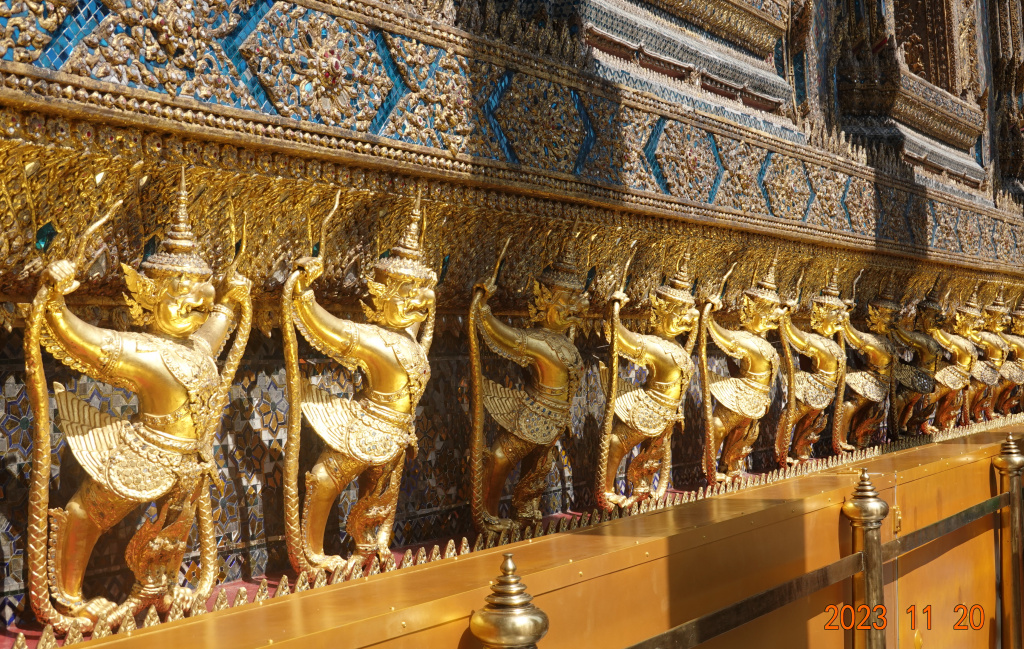
Here is a view I remember photographing in 2003 when I first visited Bangkok when a friend was managing the Bangkok International Film Festival:

And here is an unknown building that caught my attention because of its design and color:

And a tower similar to the Khmer-style towers at Wat Arun also caught my attention:
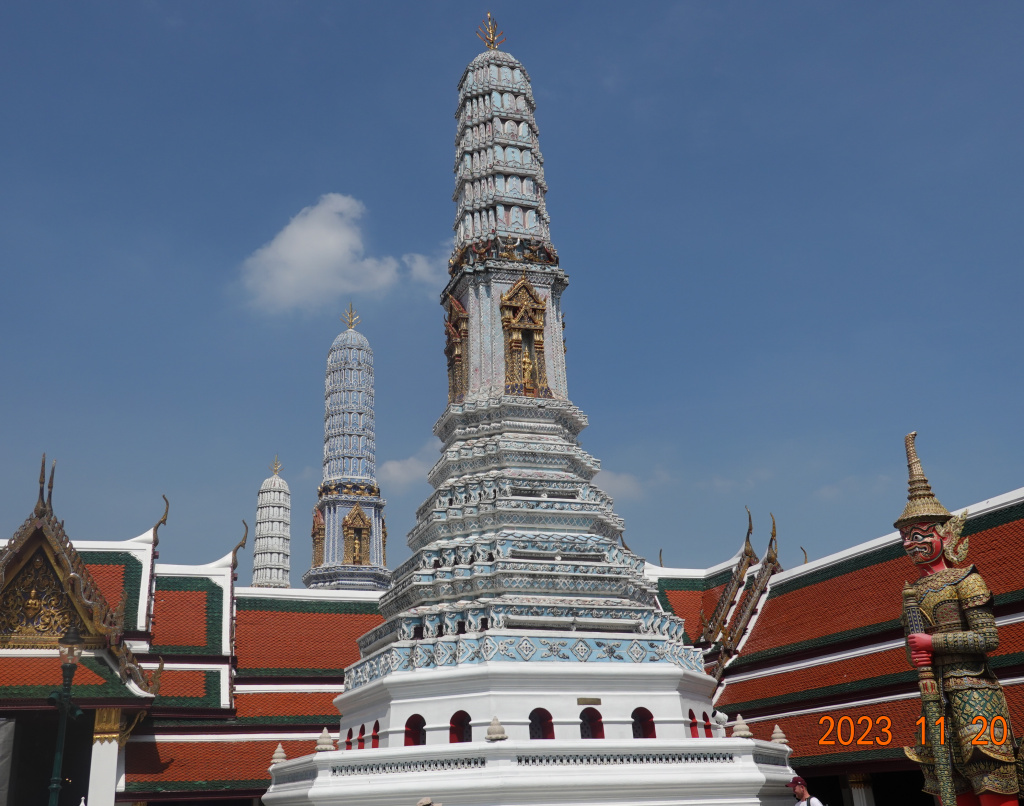
A gold chedi with similar detail at the base to the earlier photo:

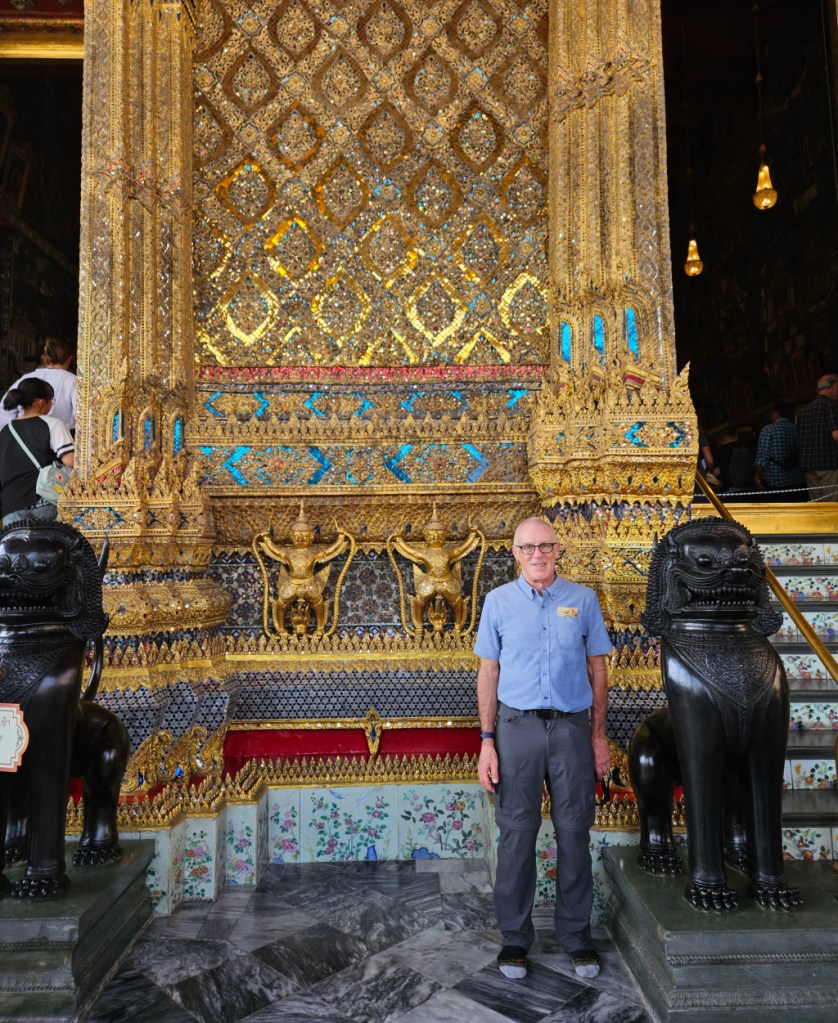
And finally, proof that I was actually there, a photo of me outside the entrance to Wat Phra Kaew:
By this time, I was very tired. Bangkok is hot, humid, and I have a long walk back to the pier near Wat Pho to catch the ferry to Wat Arun and then the boat to the Sathorn Pier near the BTS Skytrain. (There is no boat from the pier near Wat Pho directly to the Sathorn Pier.)
When I arrived at the pier near Wat Pho, the boat was boarding, so no waiting. Then once across the river, I walked down to the pier for the boat to the Sathorn Pier, and again, that boat was ready to board, so again no waiting (yay!).
Made it back to my hotel got a shower and collapsed for a short nap. Tonight I go in search of dinner and jazz.
Next: Jazz in Bangkok

 James the Intrepid Pilgrim