Saturday, April 22, 2023
Walking from Alcuéscar to Valdesalor
26.4 kilometers
We are closing in on having completed two full weeks on the Via de la Plata route of the Camino de Santiago collection of routes to Santiago de Compostela in northwest Spain. It rained overnight, at times quite hard, so we are expecting a cooler morning and puddles of various sizes along the way today.
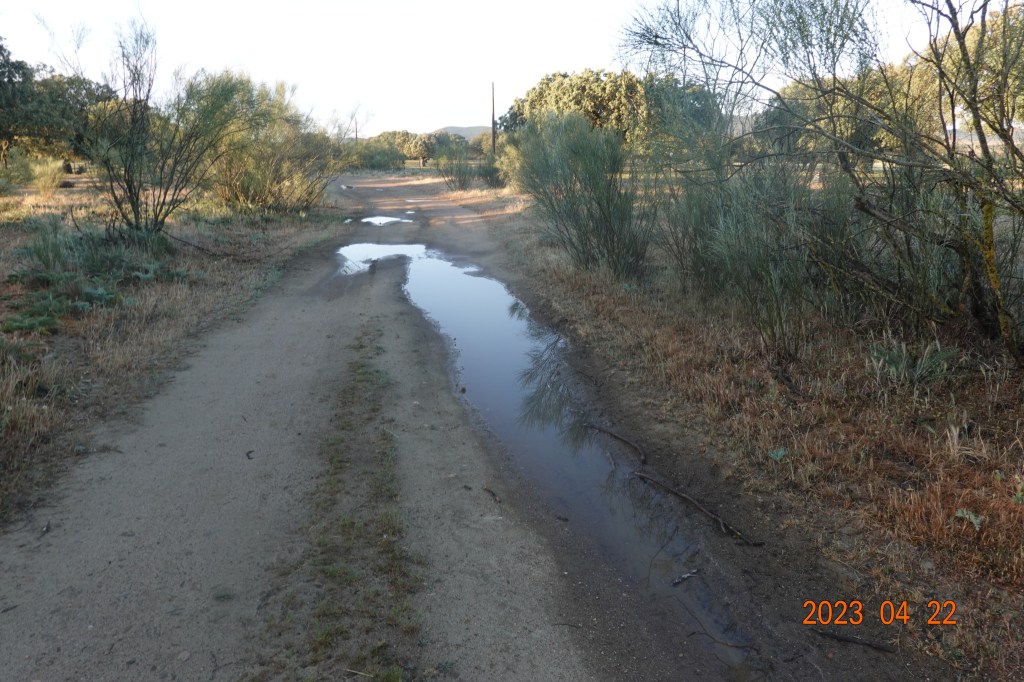
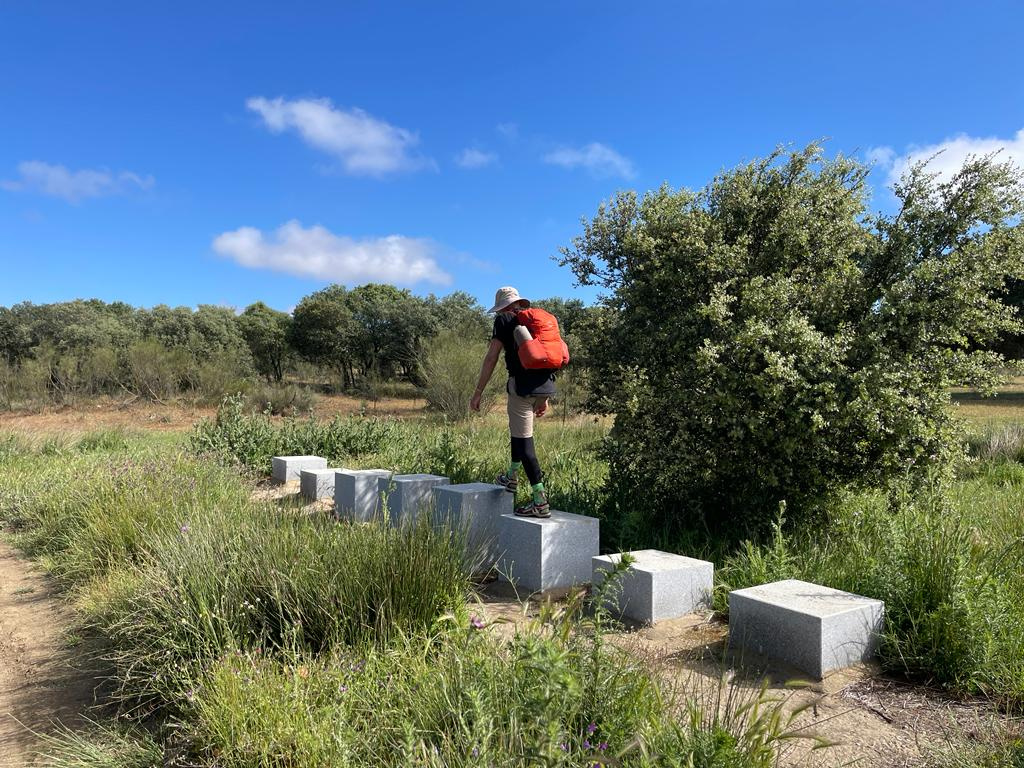
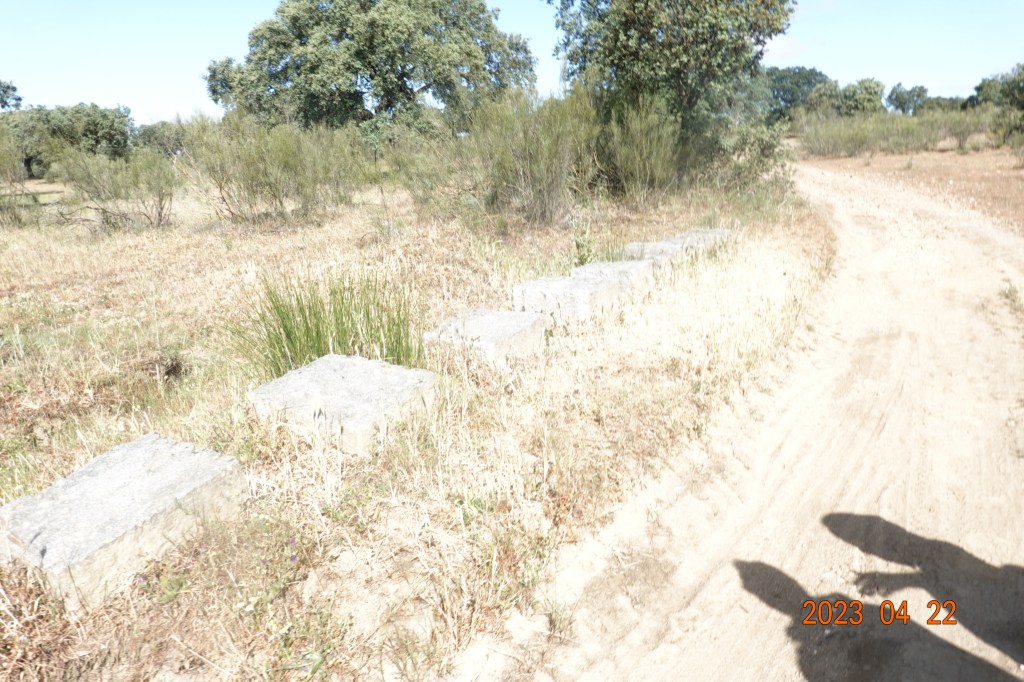
There were many puddles, but the drainage on these secondary, dirt/gravel roads is good enough that at no time was the road flooded or impassable. We did see many of the stepping-stone foot bridges along the road today, some quite old made of granite. Only one (as I recall in my now tired state) was really needed because most of the water drained away.
We started out early, at 7:00 AM, partly becauae I misunderstood the instructions. I thought the hospitalero said to be out by 7, when in fact he was saying lights on at 7 and to be out by 8. Both Tom and I were ready to go, so we headed out at 7.
The whole route today is near a major highway, but on dirt or gravel roads far enough from the highway that we will seldom see or hear the traffic. Starting out in the early morning we are quickly out of the town and in open fields.

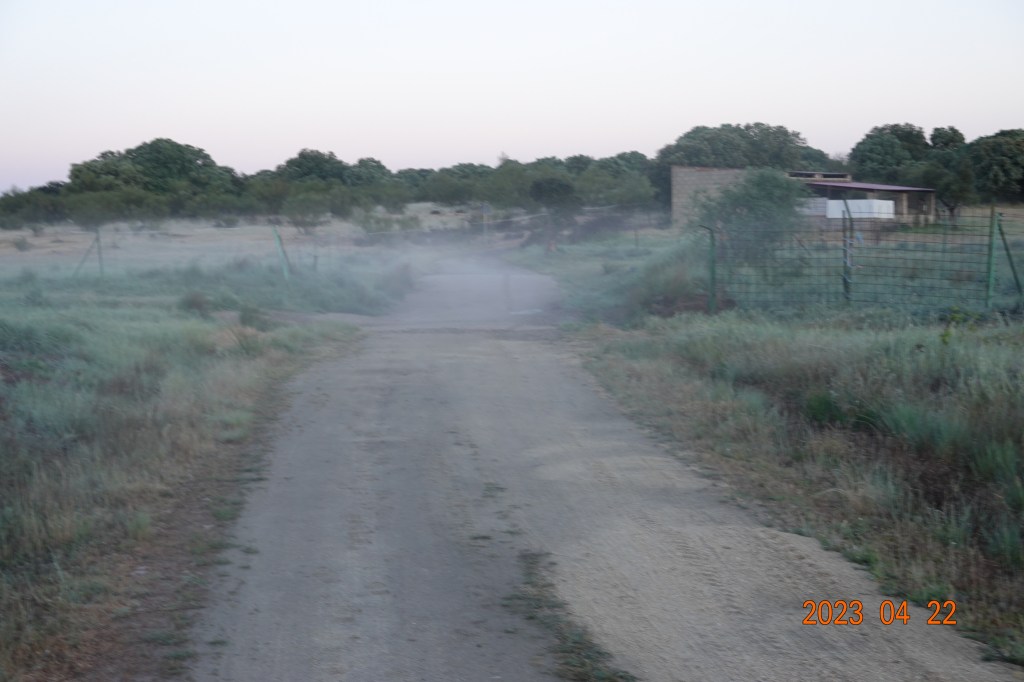
As the sun was rising, we occasionally saw the mist hovering over low points in the road. I was able to capture this at one point.
There are many puddles after the rain, some small, some larger, but as I said, none large enough to flood the road completely making it impassable.
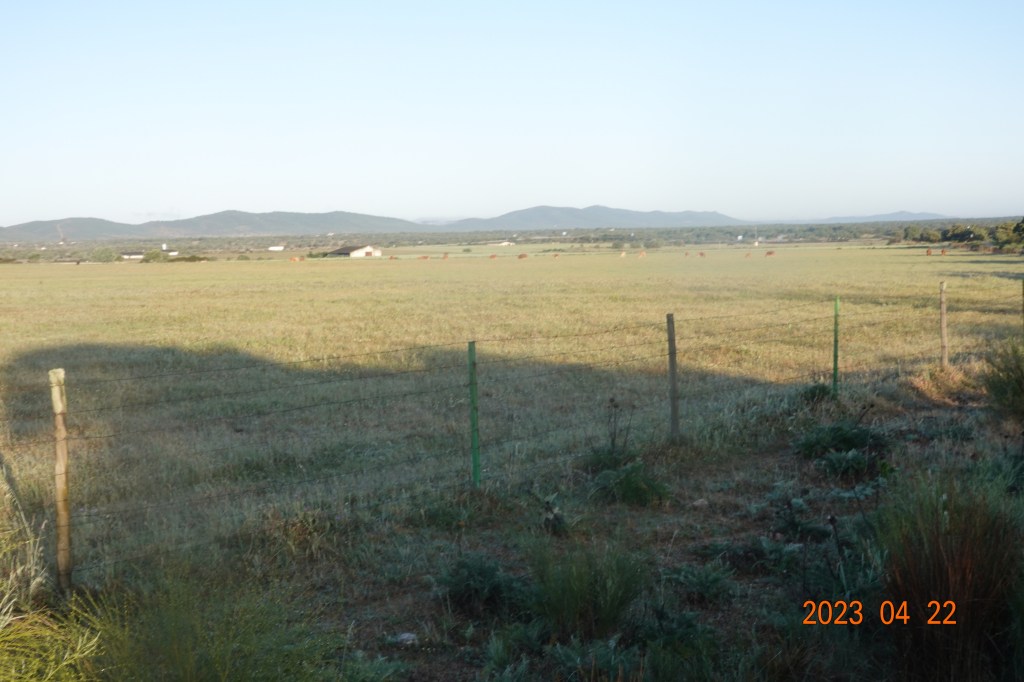
And we are back in pasture land, sometines open grazing land as seen in this picture, and often with trees and large bushes.
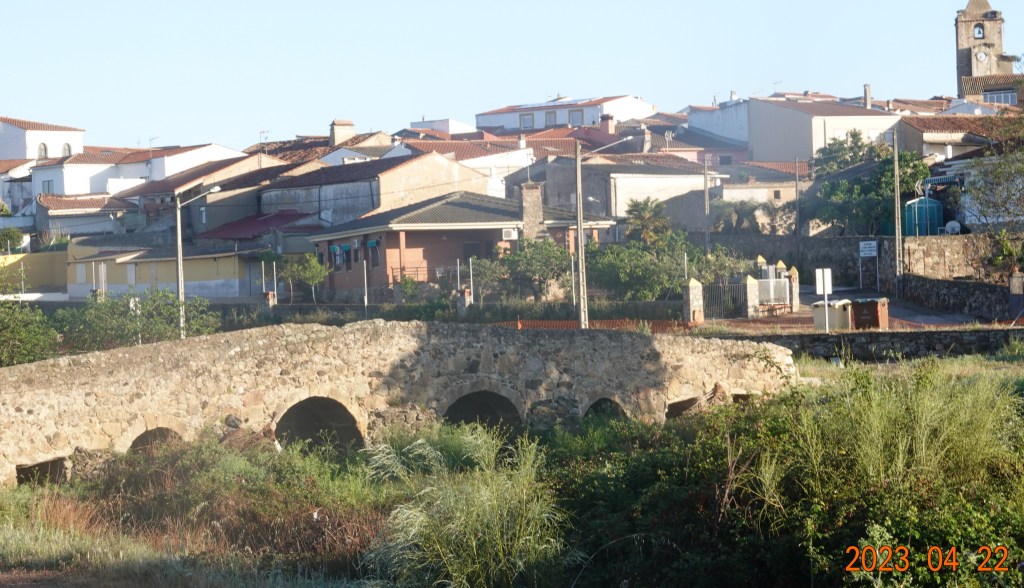
We came upon a town which the Camino path passes but does not go through. I was hoping for a stop in a bar/cafe to have a cafe con leche to start out the morning. Being a fairly long day, I did not want to make a detour, so we continued on the Camino route passing the town.
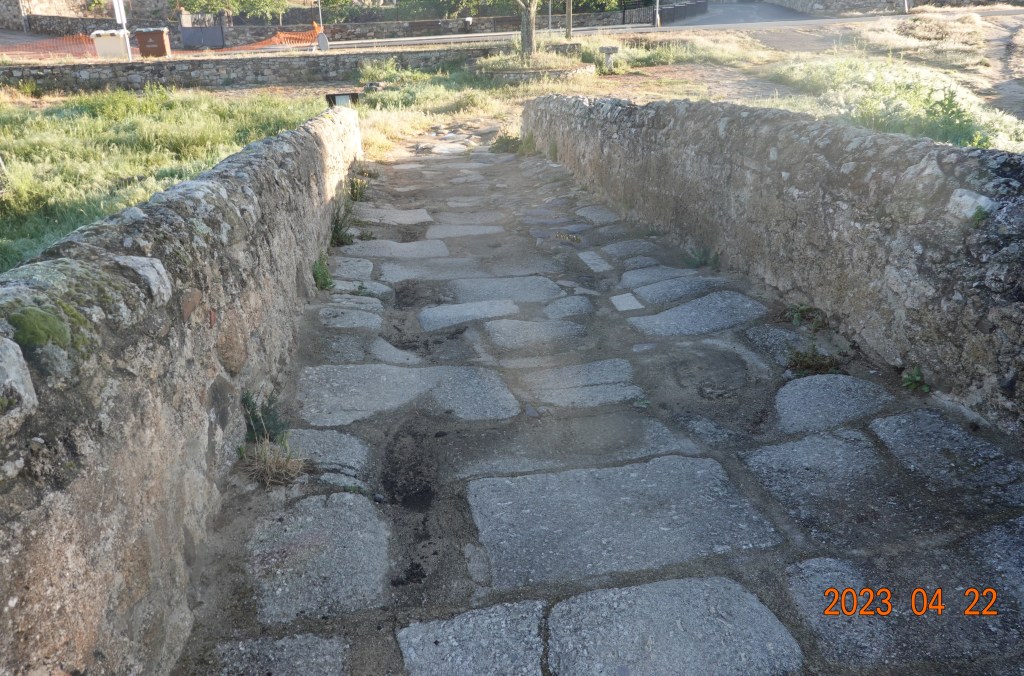
And here is the footpath on the bridge, very uneven and difficult for walking. Many are like this – one wonders how the Roman carts or wagons got across these without breaking an axle or worse.
We came to an area in the road where it is low enough and has flooded enough times that one of the stepping-stone type bridges was placed. I got a photo of Tom crossing over on that bridge.
After walking for about another hour, we were looking for a place to stop and eat something. And there appeared a sort-of rest area just off the path and with a picnic table. Better yet, our pilgrim friend Javier was there. He was talking to a Frenchman who is not a pilgrim but hiking around Spain and France. The Frenchman headed out while we took a break for breakfast and caught up a little with Javier. He is slowing down to meet with his sister who will walk with him for a a little over a week into Santiago de Compostela. So our group has grown from Tom and me to Tom, Javier and me. We do love Javier’s energy and humor. Having Javier with us lightens out mood. He has a good eye for a photo and a few of his are in this blog entry.
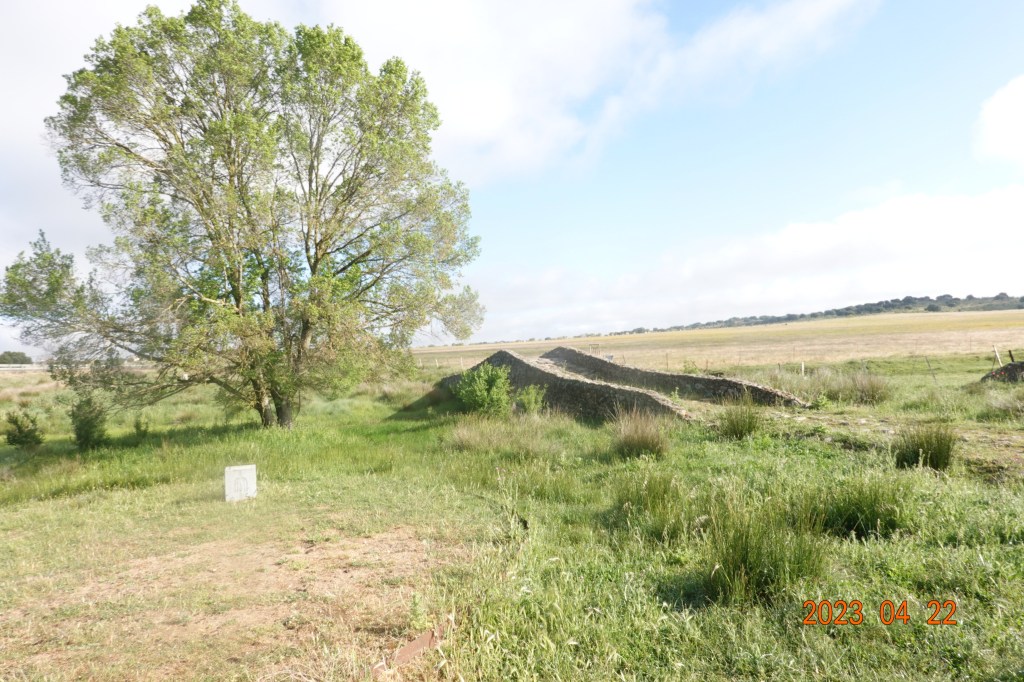
At the rest area was another Roman bridge to traverse right by this rather majestic-looking tree
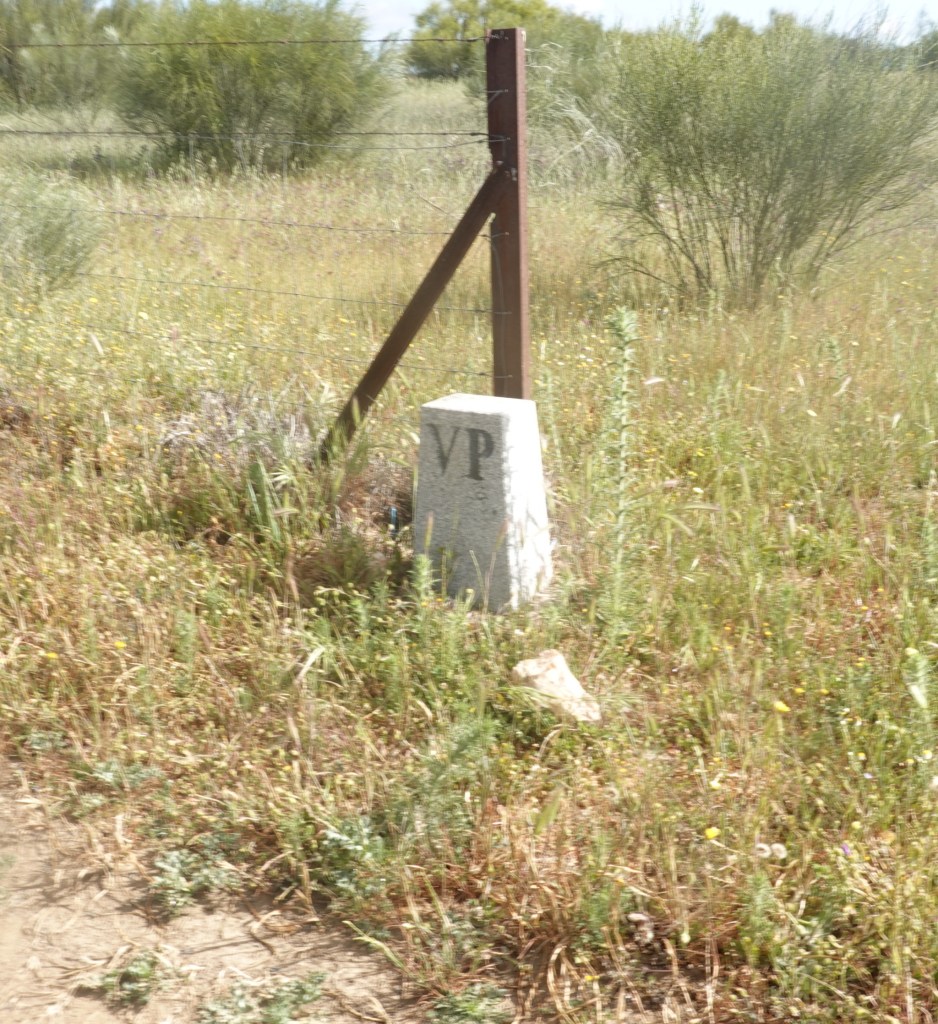
We walked through a pedestrian underpass to cross to the other side of the highway. No walking right along the highway today. We are back on dirt/gravel/rock roads through the farm land. We saw another of the “VP” Camino way markers. We presume the “VP” is for Via de la Plata. These markers are inconsistently placed, and we only saw a few today.
Javier took a photo of Tom and me ahead on the rock path. Today’s path is not as rocky as yesterdays, but still far more rocky than I like, and very hard on the feet. The good news is that my right foot is not painful at all. This is good, welcome progress.
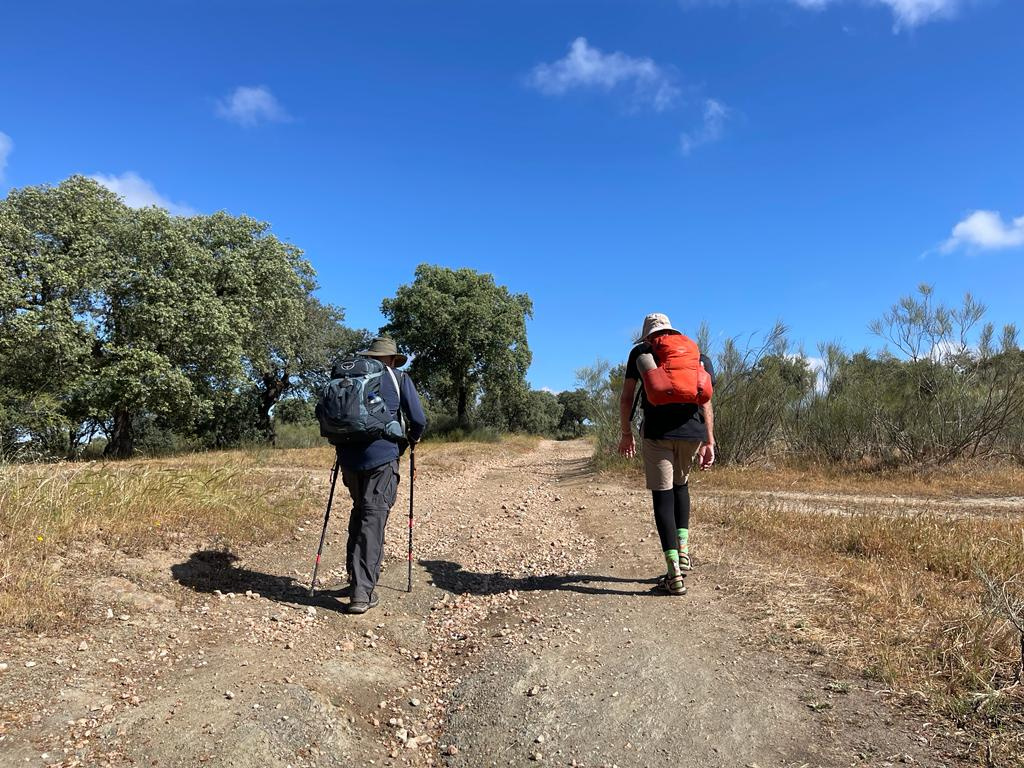
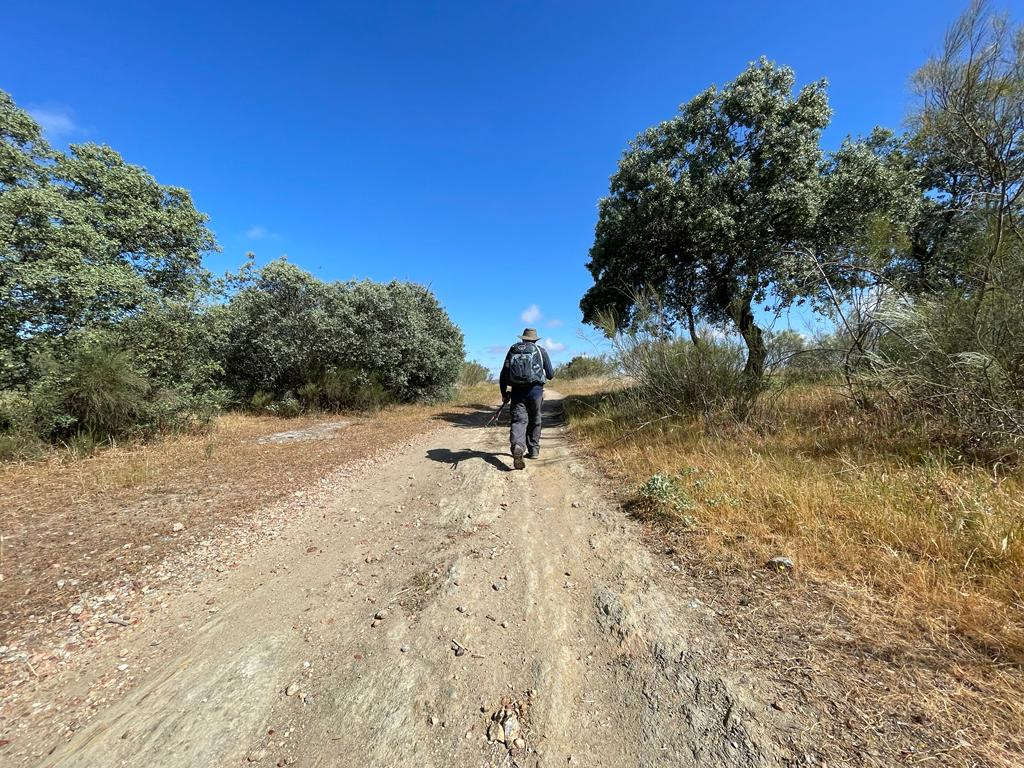
And Javier is always taking photos. He took another of me alone on the road. The day is quite beautiful today, a little cool but not cold – good for walking.
I say another of the stepping-stone type foot bridges. And I discovered I had changed a setting on my camera, so the next few photos of mine will look a bit washed out.
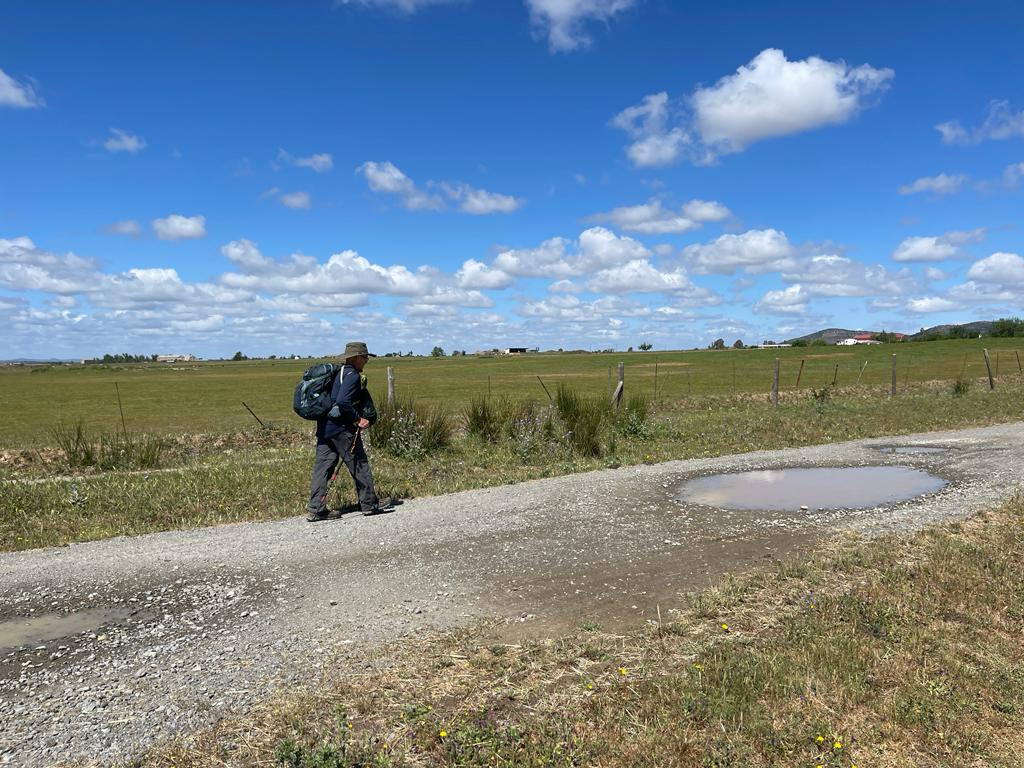
Javier took another photo of me skirting the edge of another puddle. There are many on this part of the route suggesting that the rain may have been a bit more here than where we started.
After some time walking, we came to another Roman bridge to cross. We are getting close to the end of the walking day now, and in the distance we can see the small town of Valdesalor.
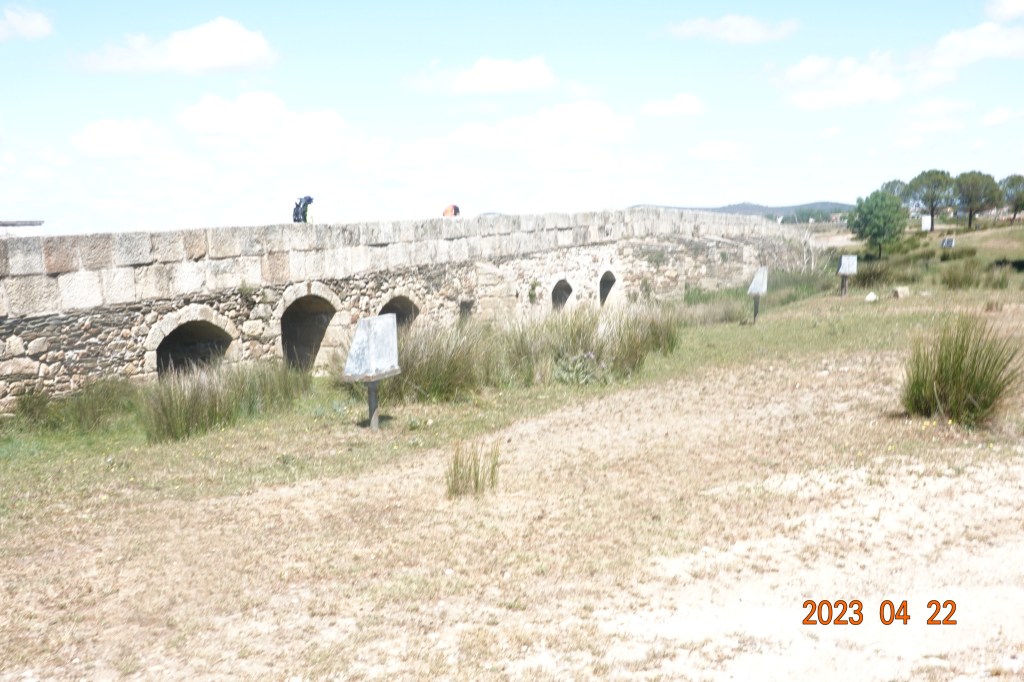
The foot path on this bridge is much better than most, not smooth, but not at all difficult on which to walk.
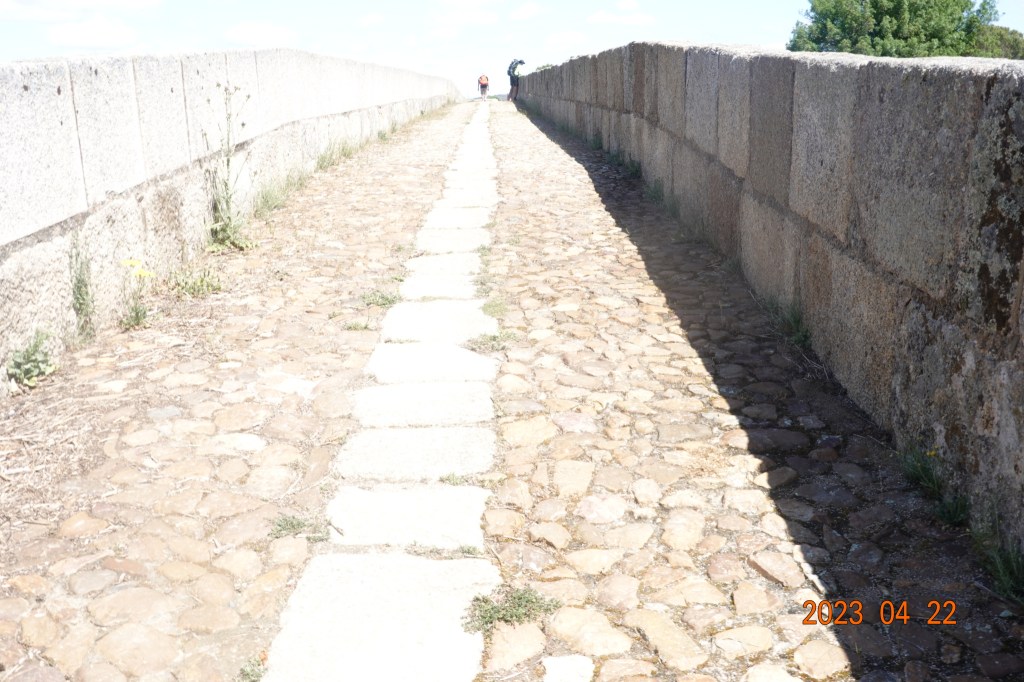
Javier took a photo of me coming off the bridge.
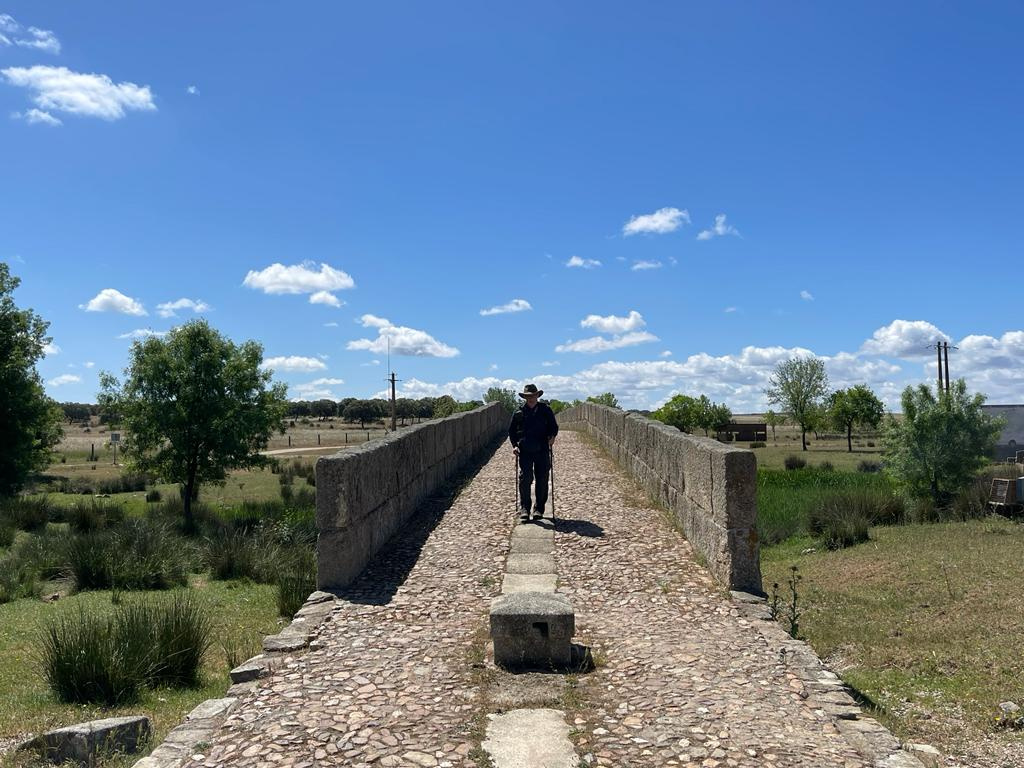
We are now very, very close to Valdesalor. There is another surprise. Leading into town, we have to cross one more Roman bridge. This bridge has the most uneven and difficult foot path of all we have seen. When I compare this to the previous, I wonder what happened, or did many, many years pass between the construction of the two bridges. Or, perhaps the smoother bridge was not build by the Romans at all, but later when better construction techniques had been developed.
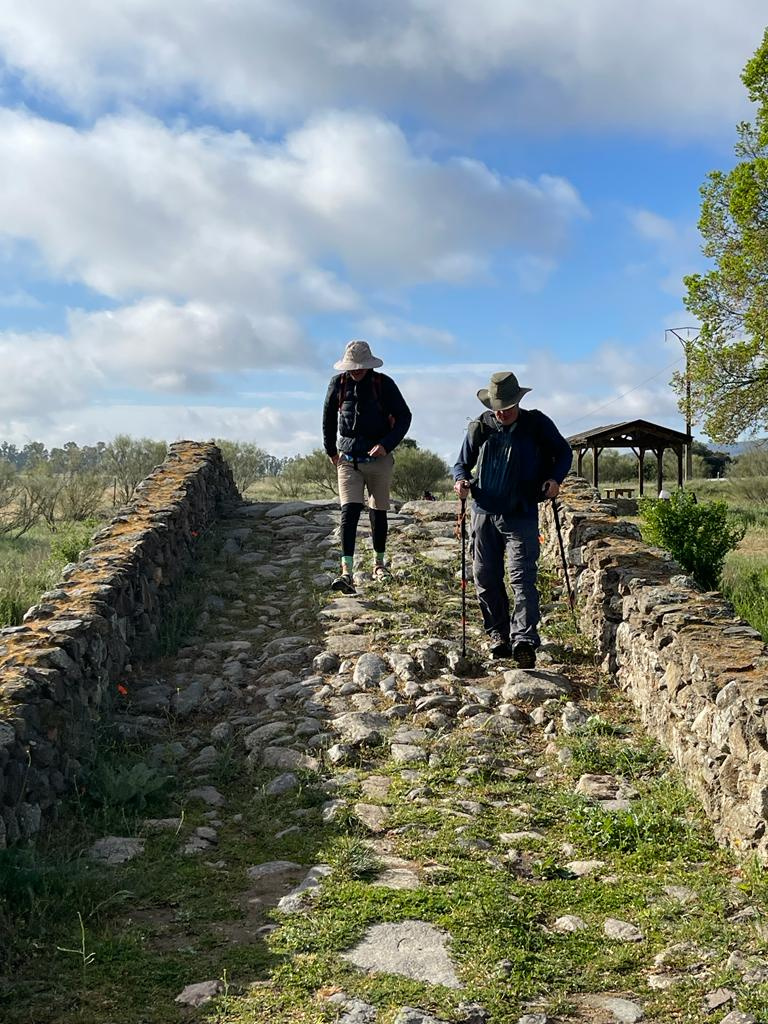
We made the last walk of about 1.5 kilometers into the small, quiet town of Valdesalor. Our albergue is right on the edge of the town, and while spartan, it is nicer than that in which we stayed yesterday.
Today was a very good day. I walked over 26 kilometers with my full backpack and no difficult pain in my right foot (or the left foot, either). While not perfect yet, the right foot is well on the mend and I am more optimistic. We have some longer days ahead, a few 30 or more kilometers. And we are getting into better condition for walking every day.
On Moday morning, I am going to send a few things I have been carrying ahead to Santiago de Compostela. Ivar, the man who runs the Camino Forum, has a service in which you can send things to him and he will hold them for you for a small fee until you arrive in Santiago de Compostela. I have the bag in which I checked my hiking poles on the airline that is taking room in my backpack. I do not need it until we are done and I am ready to return home.
I also have a sleeping bag liner. We were unsure of the state of Covid defense measures. In Andalusia and Extremadura, all of the albergues have provided blankets against the very cool nights. We are hearing that in Galicia (the region in which we will be for the last three weeks) the albergues are not providing blankets to prevent the spread of Covid. Therefore, a sleeping bag liner will not be adequate, and I’ll need space in my backpack for a lightweight sleeping bag. I can get a sleeping bag in Salamanca, a large university town in which we will be in 4 or 5 days. [The University of Salamanca, founded in 1218, is the oldest university in Spain and the third oldest Western university.]
Next: Valdesalor to Casar de Cáceres

 James the Intrepid Pilgrim