Friday, March 31, 2023
Planning a return to Spain
I am returning to Spain, leaving from home in a week on Thursday April 6, 2023. Very early on Friday I’ll fly from Los Angeles to Atlanta then to Madrid, arriving Saturday morning. That afternoon I’ll take a train to Seville where I’ll have two nights to adjust to the 9-hour time difference and ready myself for a long walk starting Monday, April 10, 2023.
In Seville, I’ll be meeting my friend, Tom from Sydney, Australia, whom I met at Wild Rose Yoga in Chiang Mai, Thailand in 2015. He and his girlfriend, Julie, and I walked the 500-mile Camino de Santiago route known as the Camino Frances in the autumn of 2017.
Some Camino de Santiago History
The Camino de Santiago is a collection of pilgrimage routes to Santiago de Compostela in northwestern Spain where in the cathedral there, the remains of Saint James are said to be interred. Pilgrims have been making pilgrimage to Santiago de Compostela for over a thousand years. The pilgrimage waxes and wanes in popularity. In medieval times, the Catholic Church encouraged the pilgrimage to stimulate the repopulation of Spain by Catholics after the Moors had been defeated. During times of war, the pilgrimage is not popular. In the 1970s after two world wars and the end of the Franco regime, the pilgrimage emerged, gradually at first, and now there are thousands of people making the pilgrimage walk to Santiago de Compostela over various routes, some starting in various European countries.
The Name Saint James
Saint James the Greater, Saint James the Elder, or Saint Jacob was one of the twelve apostles of Jesus. He was the second apostle to die (after Judas Icariot) and the first to be martyred. Saint James is the patron saint of Spain. In French, Jacob becomes Jacques and in English, James. In Latin, his name is Sanctus Iacobus. This translates to Diego in Spanish and Tiago in Galego, the language used in the northwest part of Spain called Galicia where Santiago de Compostela is located. Therefore, the city San Diego in California is Saint James, and Santiago in northwestern Spain is also Saint James.
Santiago de Compostela
Santiago de Compostela, also known as Compostela, is the capital of the autonomous community of Galicia in northwestern Spain. The city had its origin as the shrine of Saint James the Greater, which is now the cathedral of Santiago de Compostela and the destination of the “Way of Saint James” or “Camino de Santiago” since the 9th century.
The legend is that the remains of Saint James were re-discovered in the 9th century by a hermit named Pelagius, who observed strange lights in a local forest. He sought help from the local bishop, Theodemar of Iria, and they were then guided to the spot by a star. “Compostela” was given the etymology as a modification of “campus stellas” or “field of stars.” Some other traditions, somewhat more skeptical, point out that the name of Compostela comes from the Latin “compositum,” “cemetery,” as the place was already an old Roman graveyard.
My Pilgrimage
I have an auspicious name for the Camino de Santiago.
My parents named me for Saint James, and my middle name, Christopher, is for Saint Christopher (the patron saint of travelers), a very Catholic name. I had heard about the pilgrimage to Santiago de Compostela many times in my life and generally dismissed it. In 2015, my mother passed away at age 94 – she lived a good, long life. On my return to Southern California from the services in Washington State, the people next to me on the airplane were talking about the Camino de Santiago. It was almost as if someone were tapping me on the shoulder saying, “it’s time…” So my motivation for my first pilgrimage walk was to honor my parents who named me for Saint James…I became James on the Saint James Way.
Camino Frances
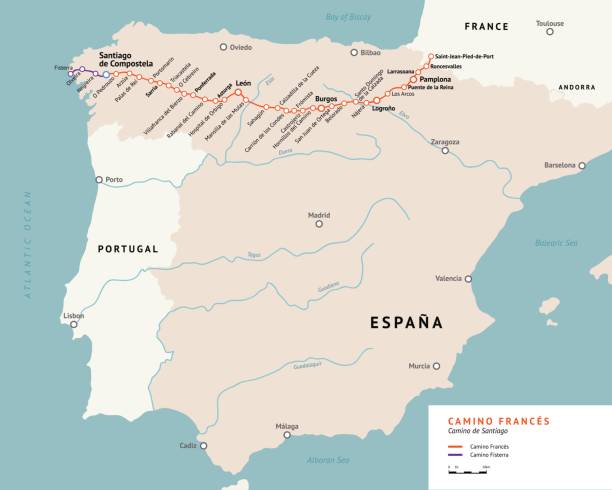
That first pilgrimage walk was on the route called the Camino Frances. Several routes emerged through France over hundreds of years and they converged at a small town, Saint Jean Pied de Port, in southwestern France where there is pass over the Pyrenees mountains (“pied de port” translates to “foot of the pass”). The Camino Frances starts at Saint Jean Pied de Port and covers 500 miles across northern Spain to Santiago de Compostela. I walked this route in the spring of 2016 by myself and again in the autumn of 2017 with my friends Tom and Julie from Sydney. Here is a diagram of the route of the Camino Frances:
Via de la Plata
The route know as the Via de la Plata starts in Seville in the south of Spain and follows or roughly parallels old Roman roads north to Astorga. When the Romans occupied the Iberian Peninsula, Astorga was their western capital. They discovered precious metals (copper, silver, and some gold) in the mountains near Astorga and built a road south to the ports at Cadiz and Malaga to ship the ore or metals back to Italy. The Via de la Plata which translates to “way of the silver,” actually its name has nothing to do with silver. The name is most likely derived from the Latin word “platea” meaning wide road or “Lapidata” meaning stone road.
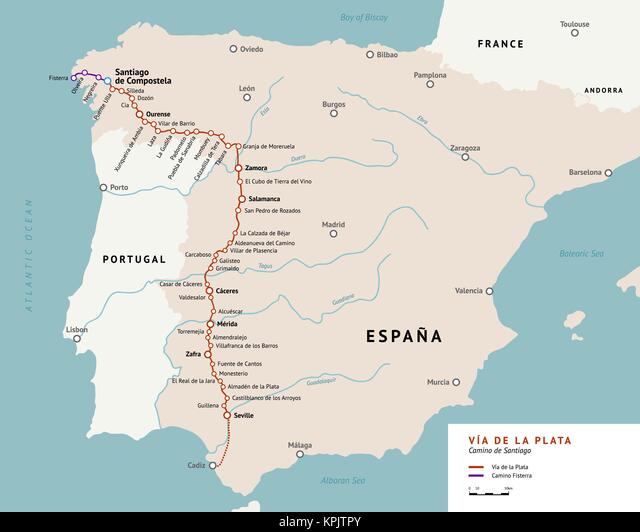
If we followed the Via de la Plata from Seville to its end, we would be in Astorga and could then follow the Camino Frances to Santiago de Compostela making for a total walk of 1200 kilometers or over 740 miles. Instead, we will turn left at Granja de Moreruela just after Zamora to travel roughly northwest to Santiago de Compostela over a route called the Camino Sanabres. Following the Via de la Plata from Seville then the Camino Sanabres to Santiago de Compostela is a 1000 kilometer walk or about 620 miles. Here is a diagram of the Via de la Plata / Camino Sanabres route we will be walking:
This will be along walk. I’m a little nervous and anxious, but I am also confident that things will work out. I’ll try to update this blog daily. I have a newer Samsung smart watch and coupled with the Samsung Health app on my Samsung phone, I can see a map of where I walked, so I will post that with my updates.
Next: Traveling to Spain

 James the Intrepid Pilgrim
Best wishes, Jim, for a safe and enjoyable journey
LikeLike
Sounds great. I love Sevil
LikeLike