Friday, January 13, 2023
Visit to Singharat Pharmacy and Wat Phra Singh
After visiting the Singharat Pharmacy, getting a supply of my blood pressure medication, and then visiting Wat Pha Bong, I crossed the street and entered Wat Phra Singh. As I have mentioned, Wat Phra Singh is a very important temple to the Thai people. It is one of about 20 temples in Thailand listed as Royal Temples of the First Class. It is one of only two in Chiang Mai on that list, the other being Wat Sri Suphan (the “Silver” Temple).
There are a small number of Buddhist temples in Thailand that are associated with years of the Chinese or Asian Zodiac. The animals are a little different in Thailand, for example, there are no oxen in Thailand, so the Year of the Ox is replaced by the Year of the Water Buffalo and the Year of the Snake is called the year of the Small Snake while the Year of the Dragon is called the Year of the Naga or Great Snake. It is often said that you should visit a temple associated with the zodiac symbol under which you were born and you will feel a strong connection to the temple.
I was born in the Year of the Naga (Year of the Dragon), and Wat Phra Singh is a “Year of the Naga” temple, but I have never felt a connection to Wat Phra Singh. I am not that big a fan, and see the temple as touristy and even the recent changes as somewhat gaudy. That is my view – the Thais love Wat Phra Singh, as much or maybe even more than Wat Chedi Luang.
Wat Phra Singh, or formally Wat Phra Singh Woramahawihan, is one of what are known as the “Big Three” temples in Chiang Mai: Wat Chedi Luang, Wat Phra Singh, and Wat Chiang Man. Wat Phra Singh was built in 1345 by King Phayu, who ruled the Lanna kingdom from 1336 to 1355, to enshrine the remains of his father King Kamfu, the previous ruler. The temple was originally called Wat Li Chiang Phra, and the name was changed after the Phra Singh Buddha statue was brought here in 1367.
Viharn Luang
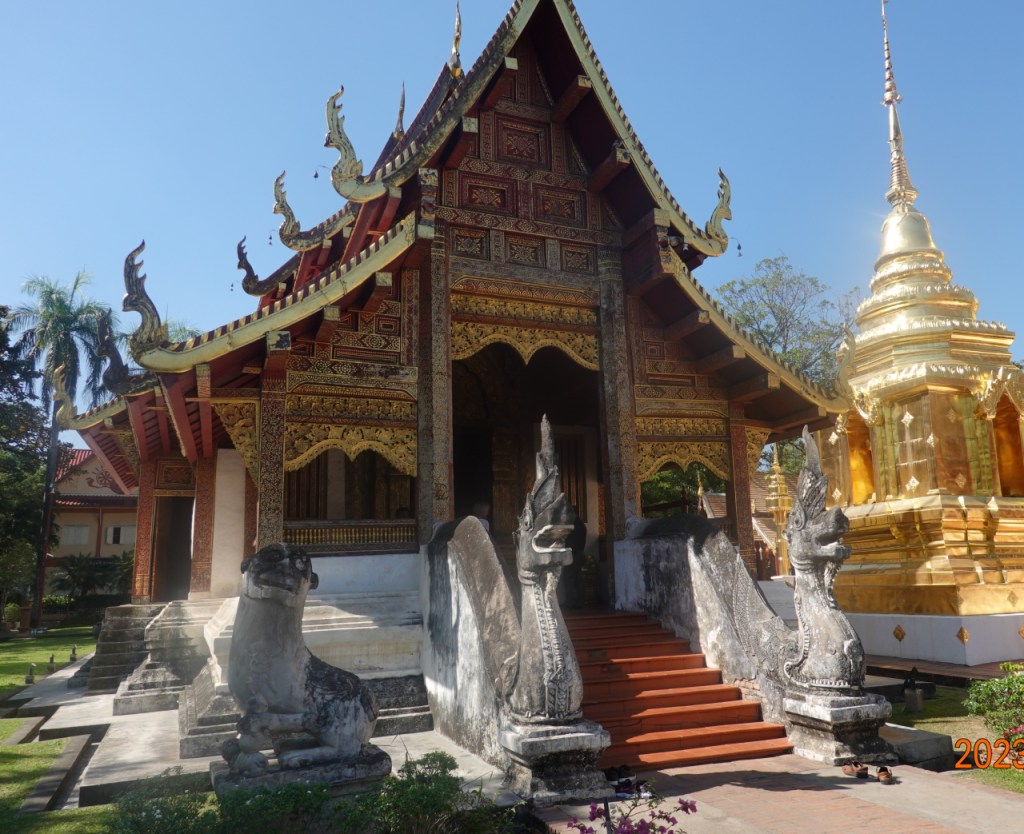
At the entrance to the temple grounds, the very large viharn (assembly or worship hall) dominates the view. And this viharn, called Viharn Luang, is very large, perhaps second only to the viharn at Wat Suan Dok. Appropriately named, as the word “Luang” translates to “really big.” The Viharn Luang structure is relatively modern, dating from 1925 when it replaced the original viharn built in the 15th century.

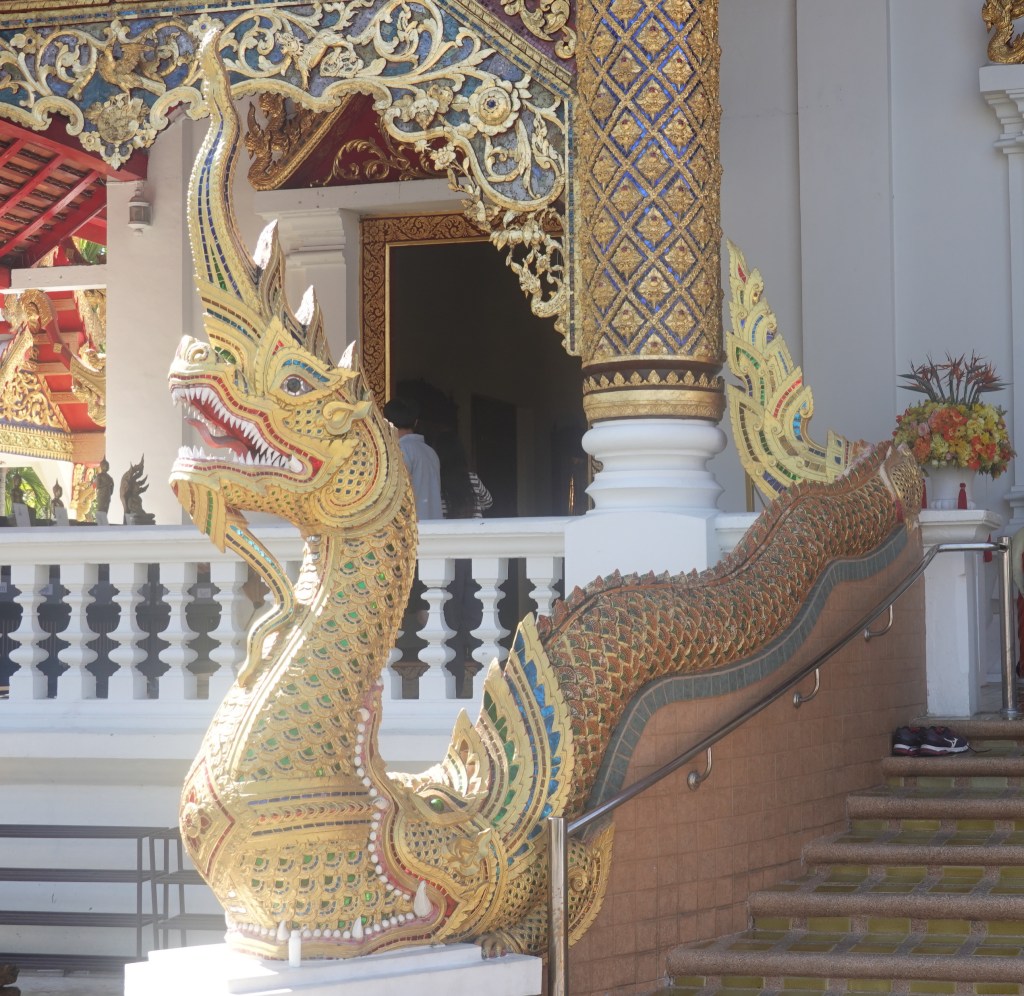
As is common at Lanna-styled temples, the entrance stairway is guarded by fierce naga figures.
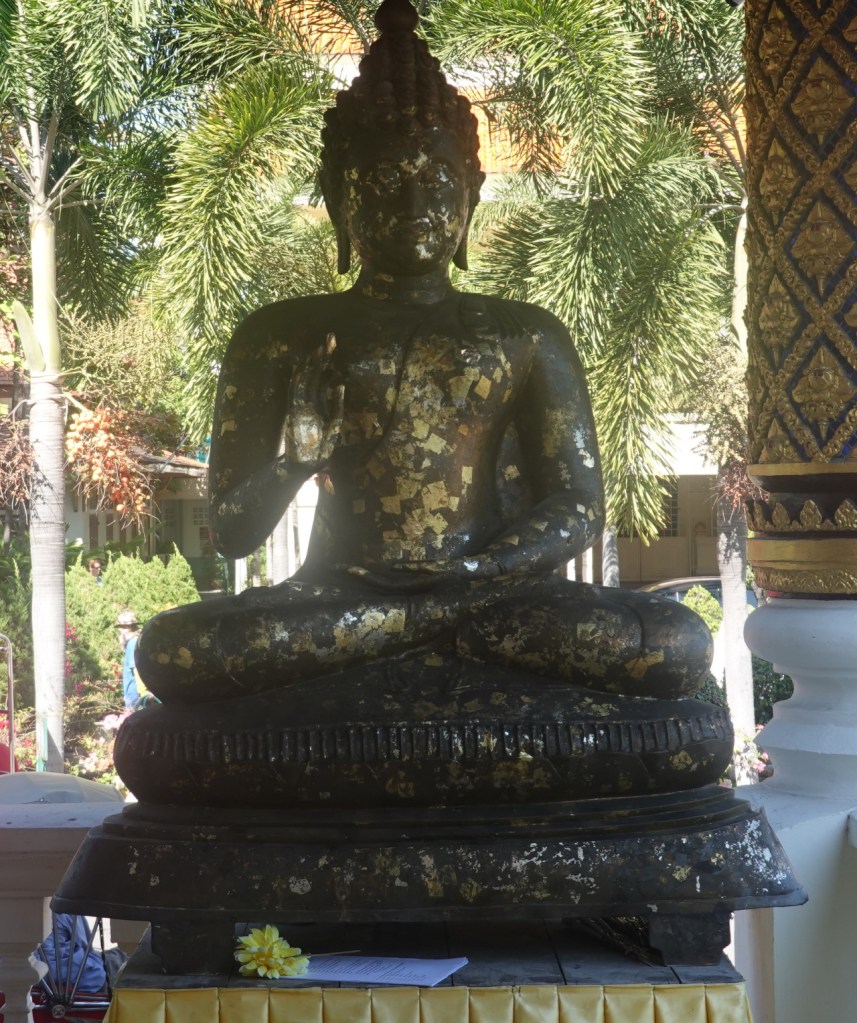
On the “porch” of the viharn I noticed this rather appealing Buddha image, looking very rustic. It is very similar to the Buddha image at the back of the viharn at the temple from which I had just come, Wat Pha Bong.
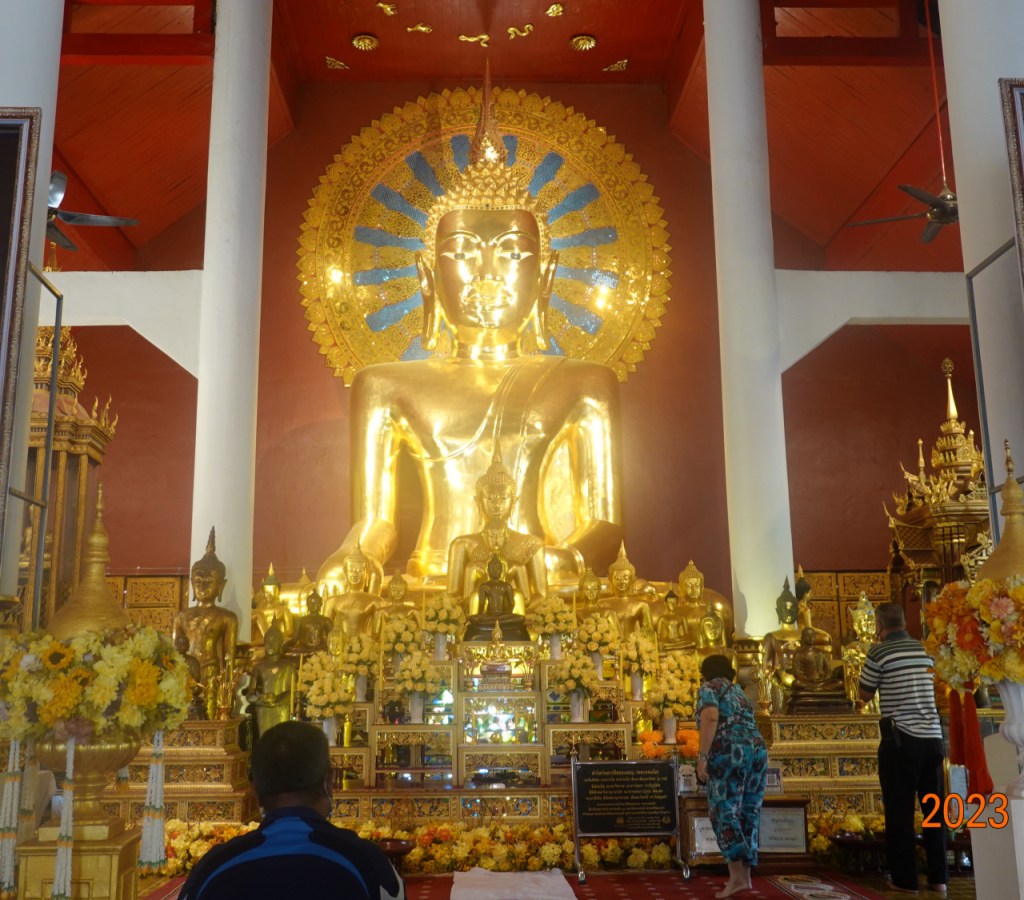
Phra Chaon Thong Thip Buddha
Inside the viharn, the bright gold, large Buddha is just that, large, bright, and gold. (Of course the spotlights illuminating the statue emphasize the brightness.) This Buddha image called the “Phra Chaon Thong Thip Buddha” was cast in 1477 and is composed of an alloy of gold and copper, thus its bright color. The statue is one of the most venerated Buddha images in Northern Thailand, having been given by monks from Southern Yunan province of China, and was orginally in the older viharn,
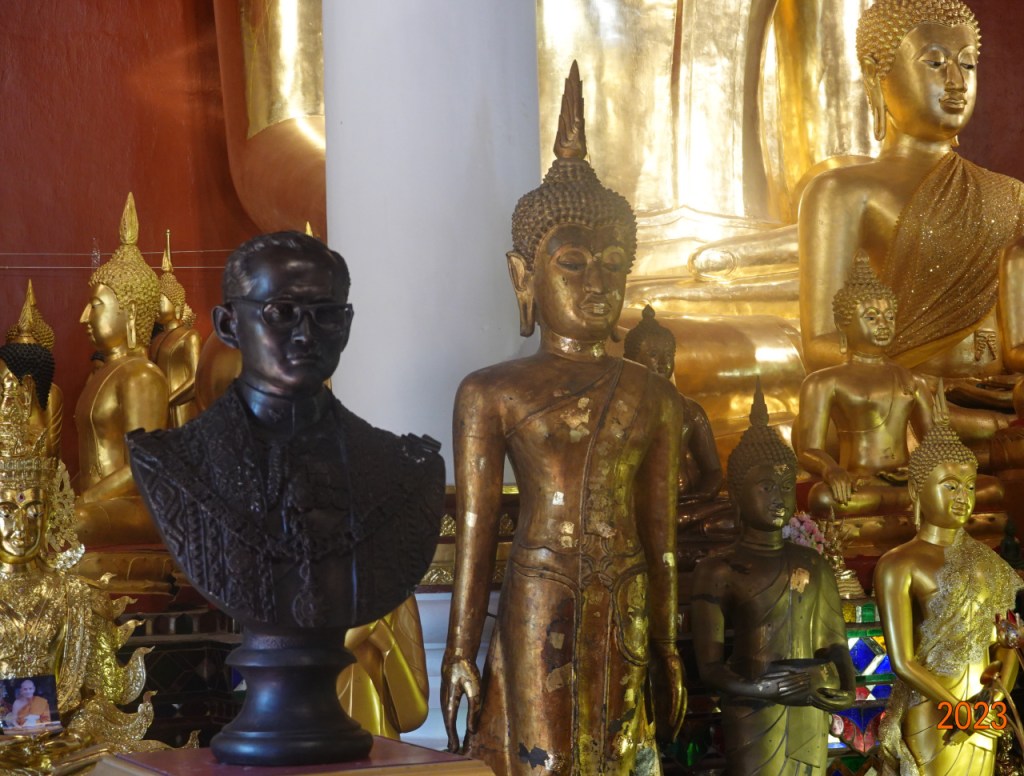
I noticed something new – on the alter area with all the Buddha statues, a statue of King Bhumibol Adulyadej, King Rama IX who ruled Thailand for 70 years from 1946 until his death at age 89 in 2016.
Viharn Lai Kham
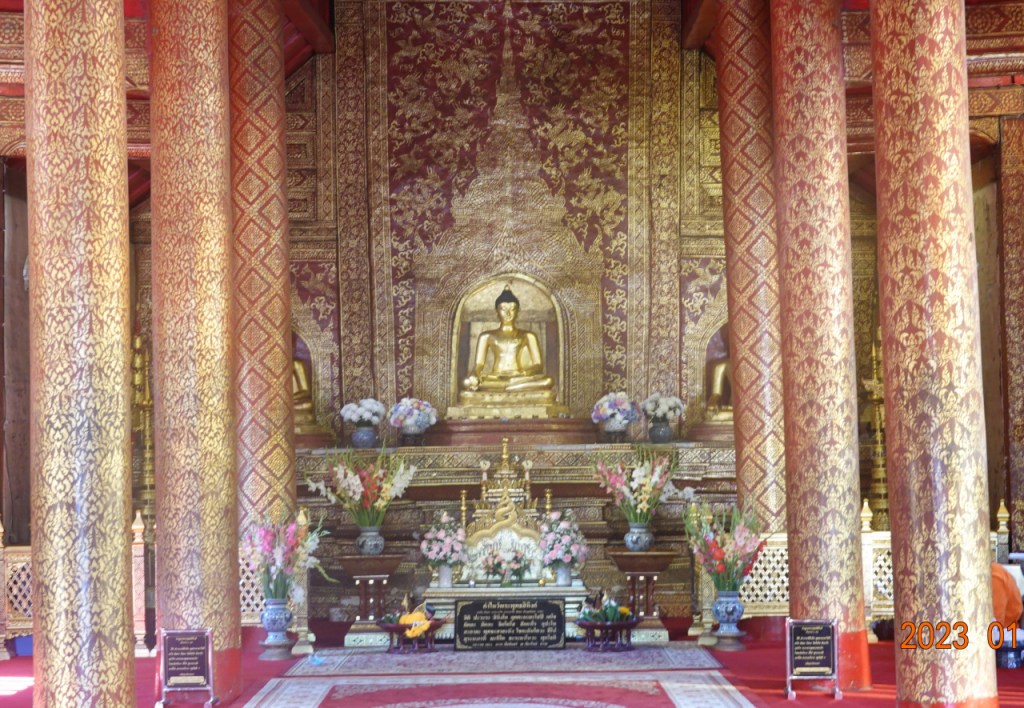
From the Viharn Luang, I walked to my favorite part of Wat Phra Singh, the old viharn, called the Viharn Lai Kham. This is a rustic wooden building, predominated by teak and decorated in a subtle style using earth tones. It was originally built in 1345 and was restored in 1772, after the Burmese left, by King Kawila. It has a famous Buddha image from which the temple gets its name as well as some fascinating murals from the 1820s along the sides of the interior.
Inside the viharn the mood is subued and almost pensive as the interior, like the exterior, is dominated by earth tones. The Viharn Lai Kham was constructed to house the Phra Singh Buddha image, brought here in 1367. The Buddha image was so important that the temple’s name was changed to Wat Phra Singh. The 14th century Phra Singh Buddha image had its head stolen in 1922 and has been replaced by a copy.
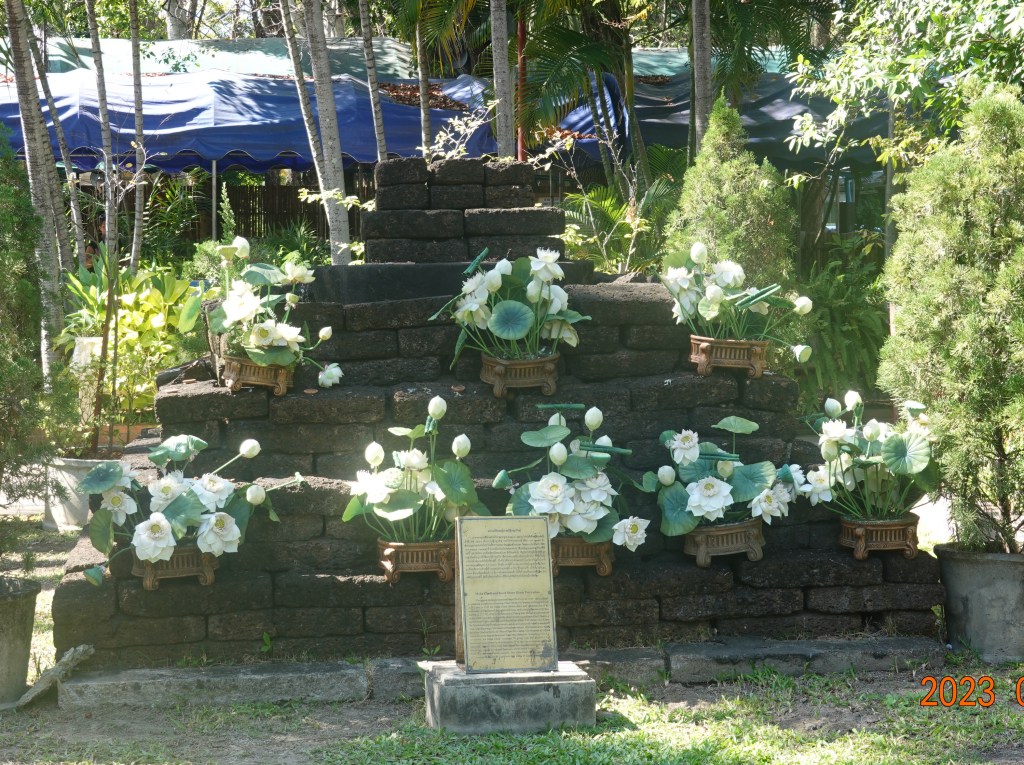
I dislike the two bright gold-metal-covered chedis, passed by them without a photo (this time), and wandered over to the park-like almost forested part of the temple grounds. Here I found the remains of a very old chedi, the Maha Chedi. It was constructed in 1345, and mostly damaged by the earthquake in 1545, the same earthquake that massively damaged the large chedi at Wat Chedi Luang.
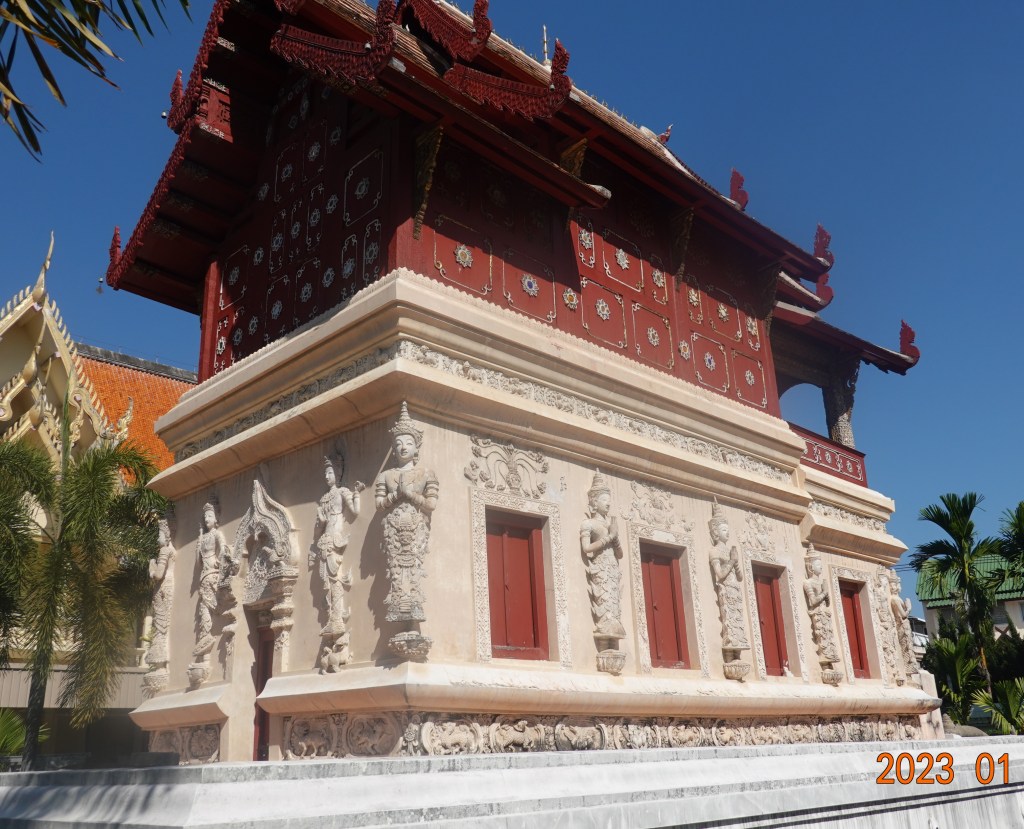
To the right (north) of the main entrance is my favorite building, the ho trai or library. This is used to house sacred Buddhist texts, orten written on palm leaves. Therefore the second story, in which the texts are stored, is teak, as teak is a natural deterent to most insects. I love the carved thewada on the sides of the first story. They seem to guard the building with a peaceful demeanor.
Thus concluded my day of visiting an interesting pharmacy, a temple I have never visited, and Wat Phra Singh, an important temple in Chiang Mai.
Next: Walk to lunch at Bake & Bite

 James the Intrepid Pilgrim
This tales me back… Wonderful city 🙂
LikeLike