Wednesday, January 11, 2023
Hiking all the way up Doi Suthep mountain
I recently heard that Rudy from France is back in Chiang Mai and then I saw him in a yoga class. We discussed making the long challenging hike up to Wat Phra That Doi Suthep again. This is a hike I have made many times, and Rudy and made this hike together last January.
Monument to the Three Kings
It took a few days to find a day when we were both free most of the day, and met at the Monument to the Three Kings at 12:30 PM. It is probably better to start earlier, as it will be hot hiking in the aternoon, but most of the hike will be in the shade of the jungle.
King Mengrai founded Chiang Rai, about 4 hour’s drive north of Chiang Mai. The story is that he became dismayed at the constant battles between the Burmese and his people, and consulted with two neighboring kings, the King of Payao and the King of Sukhothai, about where to build a new, more fortified city. They located a place to build the new city, now known as Chiang Mai, with a wall and moat to keep invaders out. “Chiang” historically meant a “walled city” and “Mai” is the Thai word for “new,” so properly translated, Chiang Mai is “the new walled city.” This monument to the three kings is a favorite of mine – they look very proud, and one is pointing, as if to say “here is where we shall build the new walled city.”
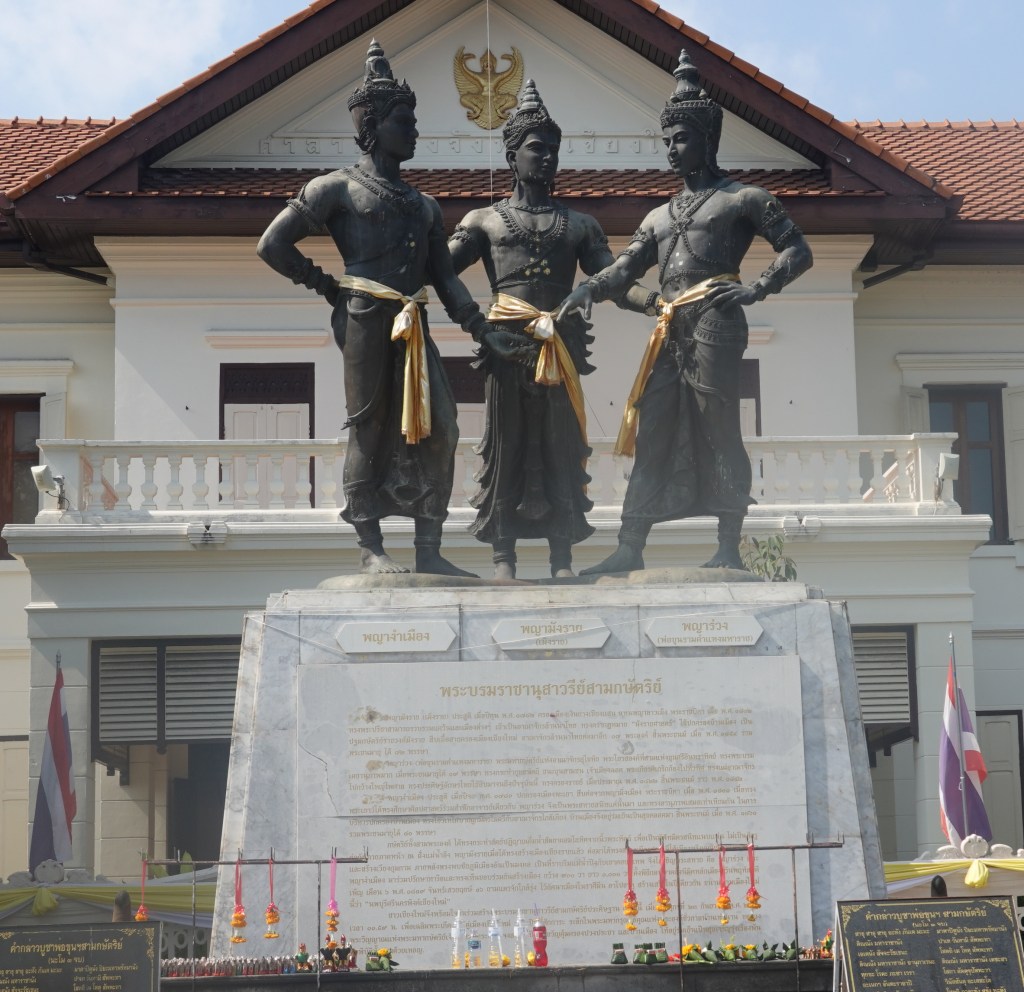
This is a large monument. Each figure is over three meters high (10 feet). Rudy and I met at the monument then got a Grab ride to the trailhead, about 6-7 kilometers to the west out on Suthep Road, past several hospitals, past Wat Suan Dok, then past Chiang Mai University, and up the hill.
Hike to Wat Phalad
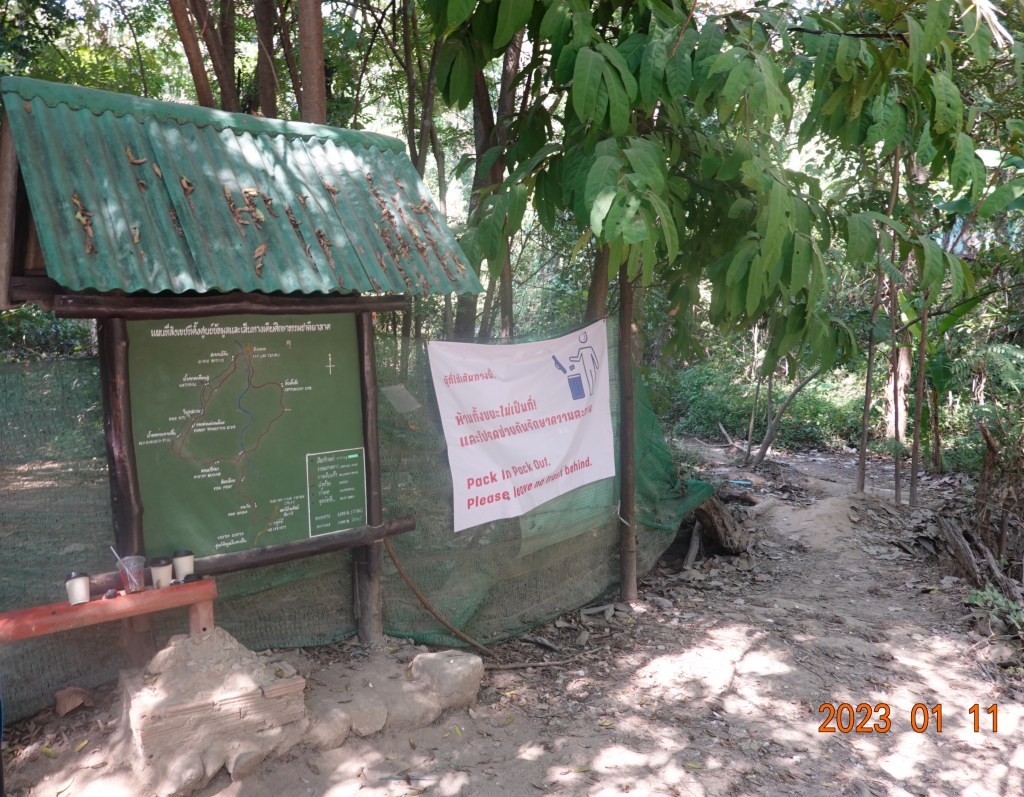
We started the actual hike just after 1 PM. The hike is in the jungle, but it is not a dense jungle, more like something in between a forest and a jungle. A good bit of the hike is in the partial shade from the trees. Because of the heavy rainy season late last summer and autumn, the jungle is greener than in some years past, and more dense in places. Here is the trailhead where we start the actual climb/hike up the mountain:
The second effect of the heavy rainy season is that in some places, the trail has been eroded, leaving more places with a very rocky path and difficult footing. A bothersome aspect of still photography is that it is difficult to show the steepness of the slop in front of the camera. I can assure you that in the following photos, the path is fairly steep. Several parts of the hike to Wat Phalad are steep enough to be similar to climbing stairs.
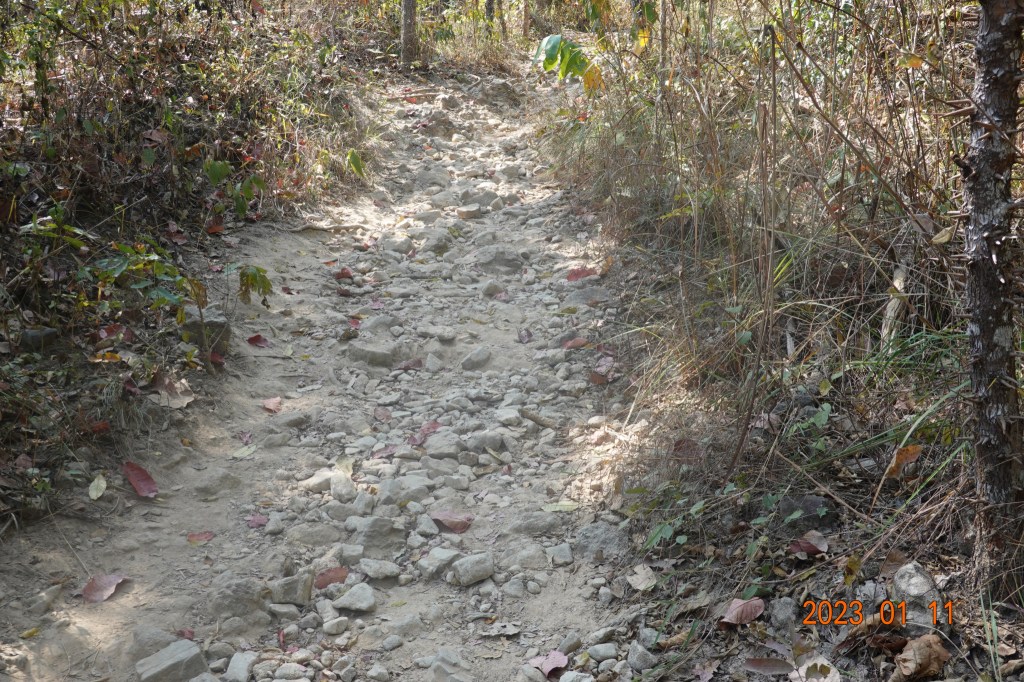
Even with the difficult footing, the steepness of the grade, our pace is moderate enough so we can continue talking. And being in the jungle, it is very quiet, unlike being in the city. All we hear is our steps, birds, and some insects. Occasionally we hear some hikers coming down the trail and greet them. It just feels good, peaceful, to be in the jungle hiking up the mountain.
In this next section of the path, the photo makes the path look almost flat – it is not, but not rocky and the footing is good.
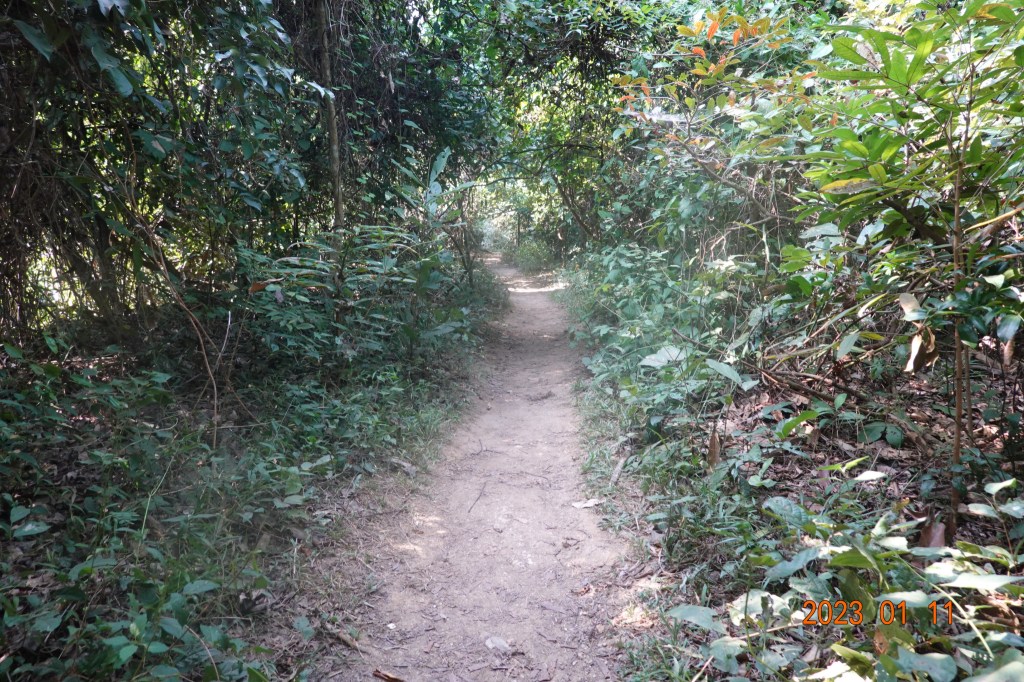
In a few places, the jungle is dense enough that the path seems to almost be a tunnel:
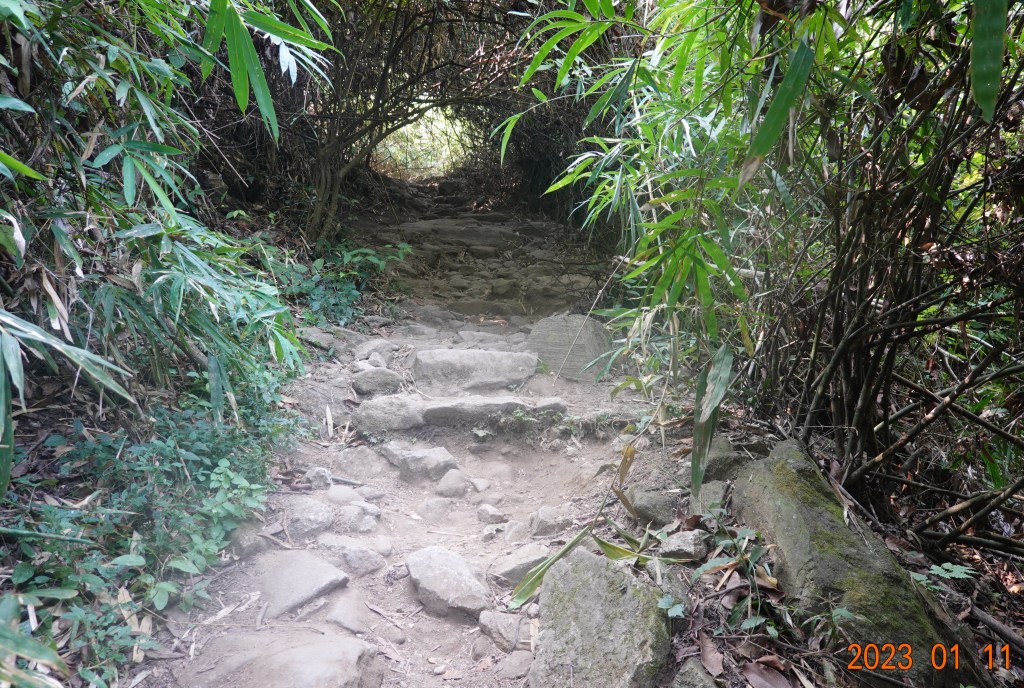
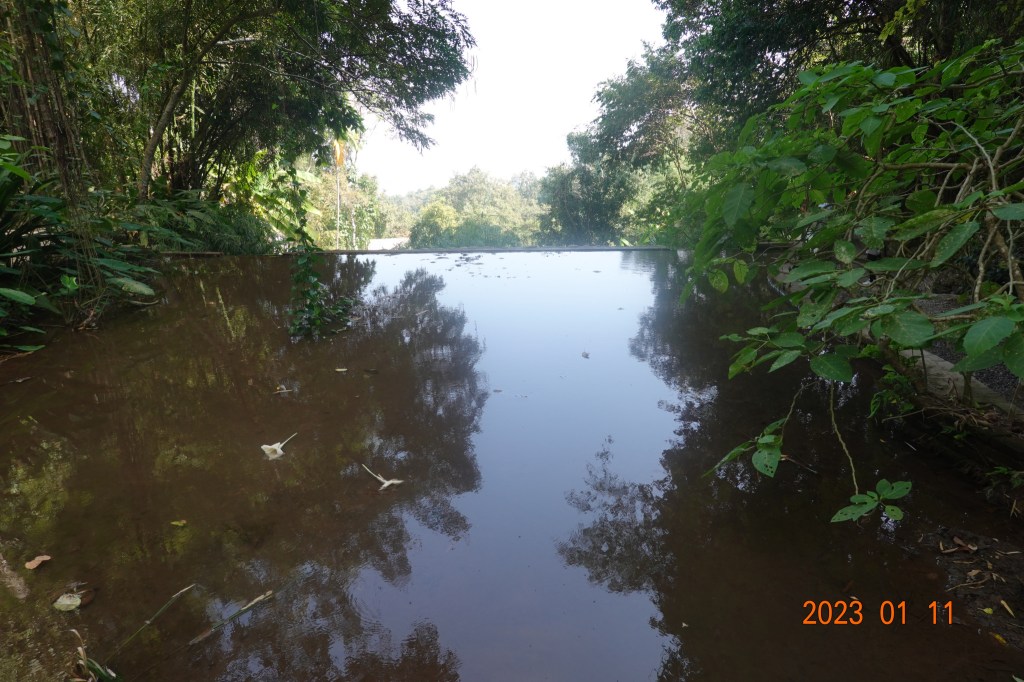
We made it to Wat Phalad. The first part of the hike took about 35 minutes. I took photos of the temple and shared some of them in my post on December 14. So today, I took this one photo as we crossed the bridge over the creek.
We did not stop at the temple itself, opting to continue to the most challenging part of the hike. There is a section of about 100 meters from behind Wat Phalad to the road. This is possibly the most difficult and steepest part of the whole trail. The last 30 meters were very difficult.
Hike to Wat Phra That Doi Suthep
We got to the road. There are new, higher guard rails, not easy to climb over (I should have taken a photo), and there is a crew working at repaving the road, so there is fresh tar on one of the three lanes as the equipment is adding a new layer of asphalt. We walked about 100 meters up the road to cross at a less difficult place.
The trailhead for the second section of the trail to Wat Phra That Doi Suthep used to be marked by a strip of orange cloth around some of the small trees. That strip of cloth is long-gone. I found the trailhead, recognizing it after having hiked this many times in years past. It is about 40-50 meters down from the well-signed entrance to view the waterfall. The start of this part of the trail is just a path between the trees and bushes, but as soon as we step into the jungle, the path is clear.
Almost immediately, the trail is steep, like climbing stairs, with almost step-like indentations having been worn into the hard earth. some of these are much higher than a typical step on stairs, two times or more. And this steep section is longer than I remember – maybe 300 meters. I was sweating and breathing hard – whew! When the path leveled off a little from the stair-like section, it was still very steep, and in places the footing very poor. Coming down this trail will be difficult and slow to avaoid slipping and falling.
I did not take out my camera – the steep section required full concentration and it was best to not stop. After that section, I did get a couple of photos, as I said earlier, they do not covey well how steep the trail really is.

I think of the trail from the road to Wat Phra That Doi Suthep as being in three sections: first the steep section, second, a less steep, but still very much uphill section, and third, after crossing the creek, another very steep section. Here is another photo of the middle part of the three sections:

After crossing the creek and climbing up that last, very steep section, we made it to the road, about 500 meters from the entrance to the temple grounds. We saw some other hikers go off to the right instead of following the busy road. I have never gone this way and Rudy and I thought why not and headed up a very steep narrow paved road. This road is apparently used by the people who support the temple, and we were passing through a sort-of village. The going on this alternate route was still steep – much moreso than using the road to the temple, but quiet, unlike the busy road with many cars, vans, and busses. When we came out, we were in the temple grounds, up at the highest level, above the naga stairway. (And, we were past the place where foreigners are to buy a ticket for 50 baht.)
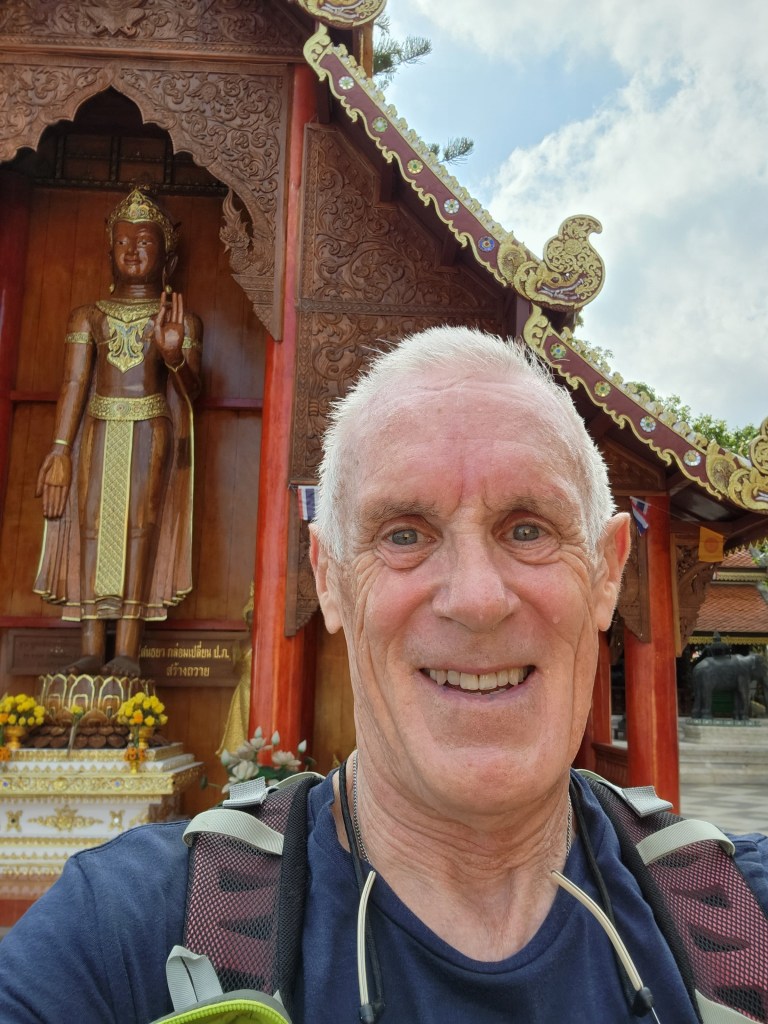
Here I am in front of the large wooden standing Buddha, hot, sweaty, and happy to have made it up the mountain again. This second part of the hike took about 50 minutes, and was a continual challenging effort.
Wat Phra That Doi Suthep
I have written about Wat Phra That Doi Suthep many times. In short, there was a relic discovered that had unique and mysterious powers, and King Neu Naone ordered a temple and chedi built to house the relic. This temple was Wat Suan Dok, which I visited in December. When the relic was to be placed into the chedi, it split into two pieces. One piece was placed in the chedi, and the other piece was placed on the back of a royal elephant. The king declared that wherever the elephant stopped, a temple would be built to house the second piece of the relic. The elephant, being followed by the king and his army, proceeded up the mountain, now known as Doi Suthep, stopped or maybe slipped and fell crossing the creek at Wat Phalad, and then stopped near the top of the mountain. The elephant trumpetted three times, sat down and died. This is where Wat Phra That Doi Suthep was built.
Typically shortened to “Wat Doi Suthep,” the temple is a very important temple to the Buddhist people. Of more than 30,000 active Buddhist temples in Thailand, Wat Phra That Doi Suthep is one of 40 classified as Royal Temples of the Second Class. There are only 25 Royal Temples of the First Class, and of those, two are in Chiang Mai: Wat Phra Singh and Wat Sri Suphan.
We did not stay at the temple long. Almost like pre-pandemic times, there are many, many pepople at the temple. And we opted not to go into the inner part of the temple with the large gold chedi housing the relic. I have been there many, many times and have shared many photos. I did take a few pictures walking around the outside. First, here is a better shot of the large wooden standing Buddha in the hand-carved structure:

Then off to the north is what appears to be a new pavilion with a statue of the king and two others. I found no description in English. Perhaps it is King Keu Naone of Lanna, of which Chiang Mai was the capital who established the temple more than six hundred years ago.
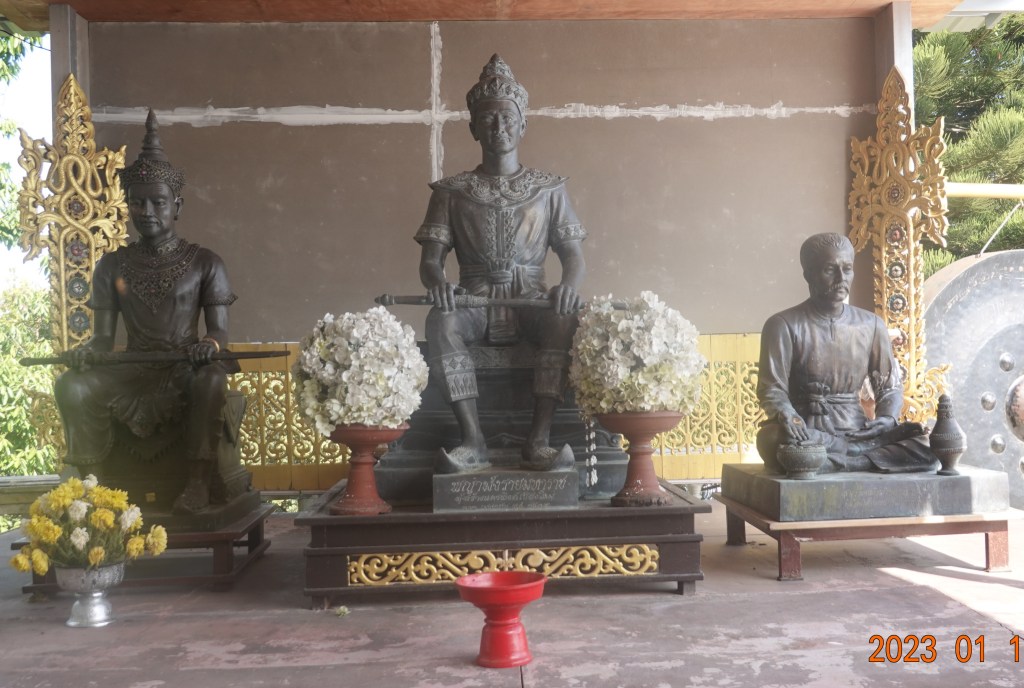
By this new pavilion, and barely seen in the picture above is another of the large gongs. I think there are four on this level of the temple grounds, all about 2-1/2 meters in diameter.
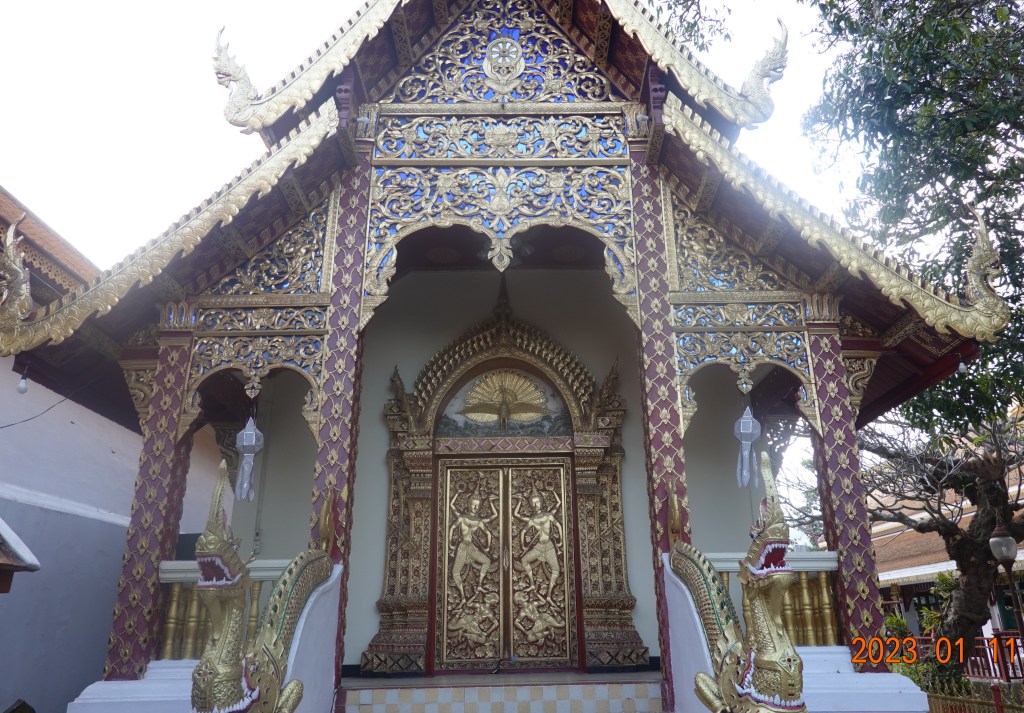
Then around to the west, also on the north side is this building with the dancing thewada on the doors. I take a photo of this every time I have been here – the building is decorated nicely and the dancing thewada look so fanciful and happy:
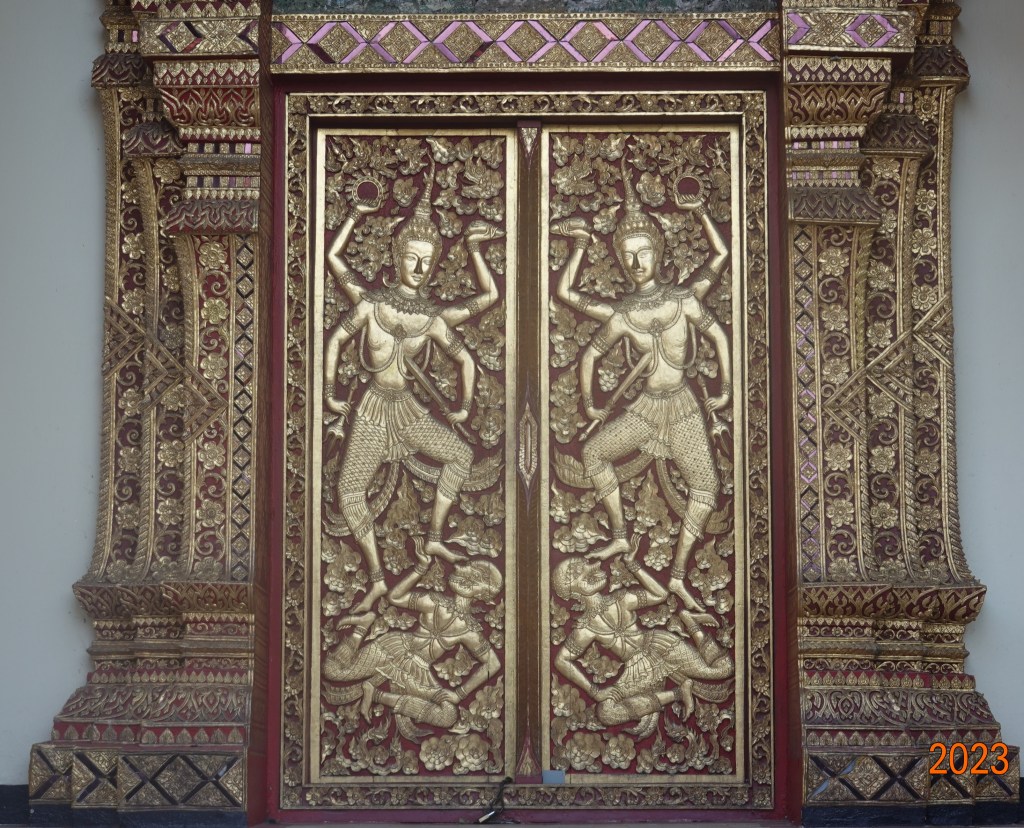
A closer shot of the dancing thewada:
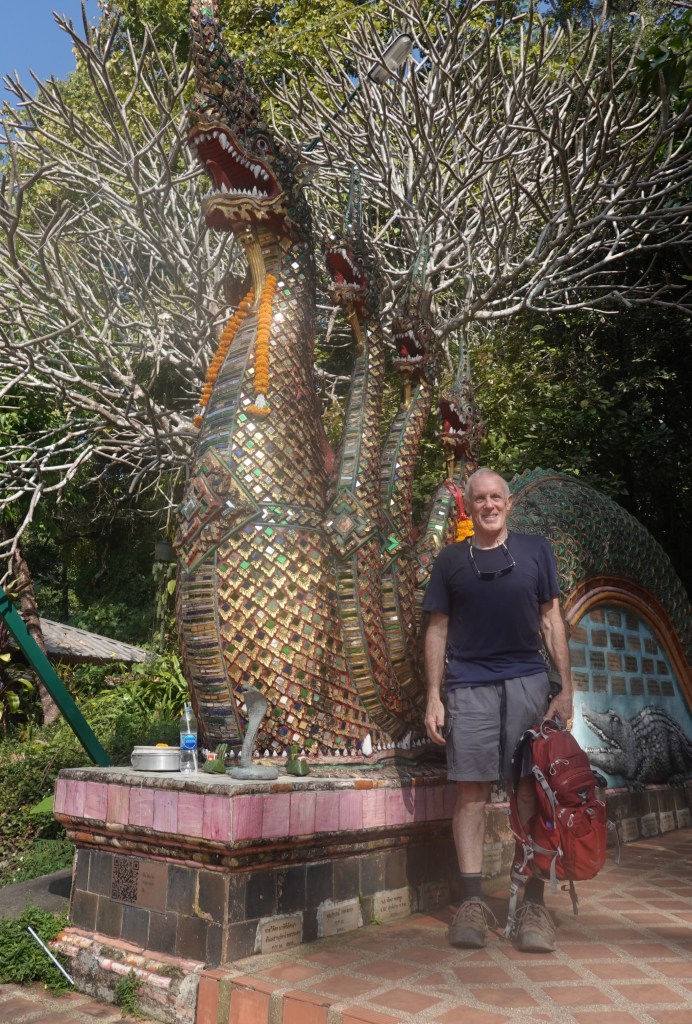
We then went down the steps of the Naga Staircase. The number of steps depends on from where you start counting. If you start from the road, there are a total of 309 steps to the top (I have counted many times). On the internet, I see reports of the stair count from 301 to 325, and one was 345 (who knows what they were counting). As I said, there are many visitors to the temple today, so the stairway is crowded, not as much as I have seen in the past, but more than a year ago. Much more shady and darker than in past years. The additional foliage growth likely due to the heavy rainy season.

And again, just to prove that I was there, here I am at the start of the Naga Stairway:
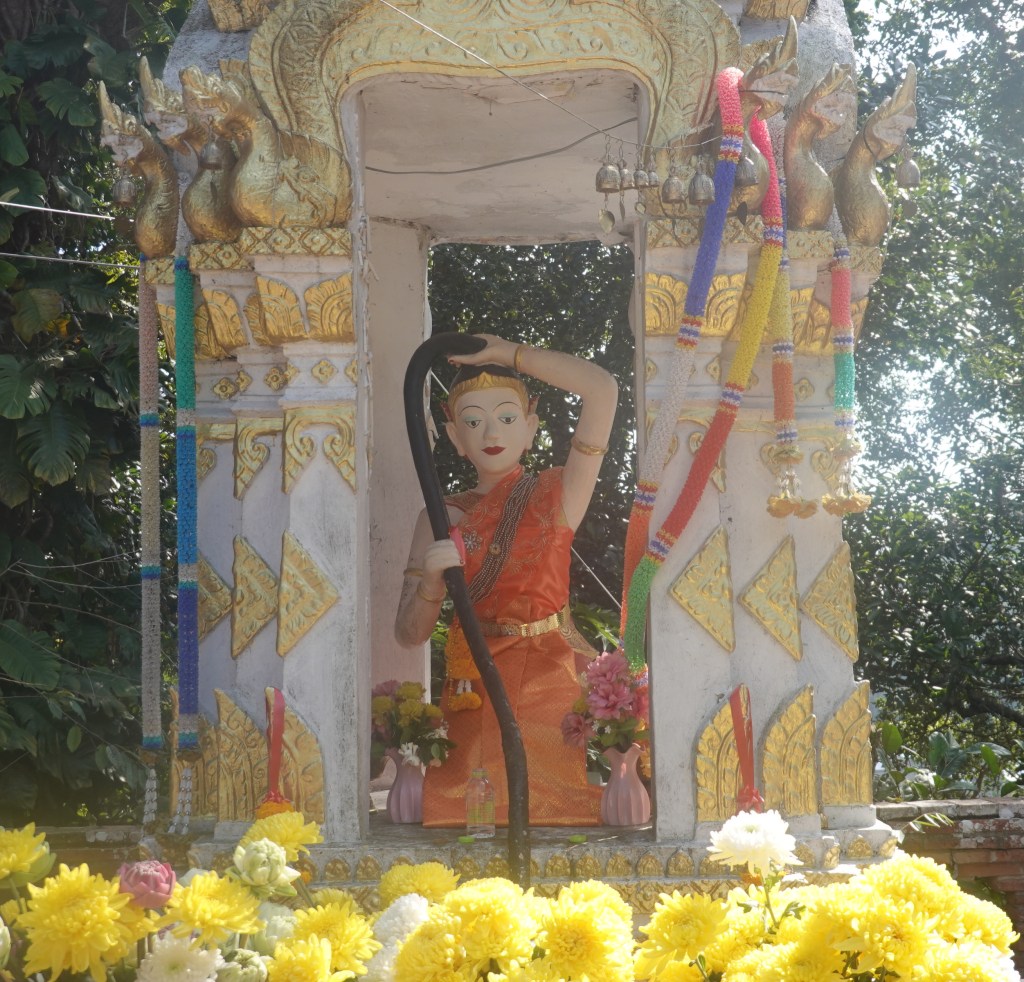
Over at the side of the landing at the base of the Naga Stairway is a statue of Mae Thoranee, also known as “mother earth.” As I reported in an earlier post, it is said that she wrung out her hair and washed away the demons that were preventing the Buddha from attaining enlightenment. Many temples have statues of her, often with a fountain.
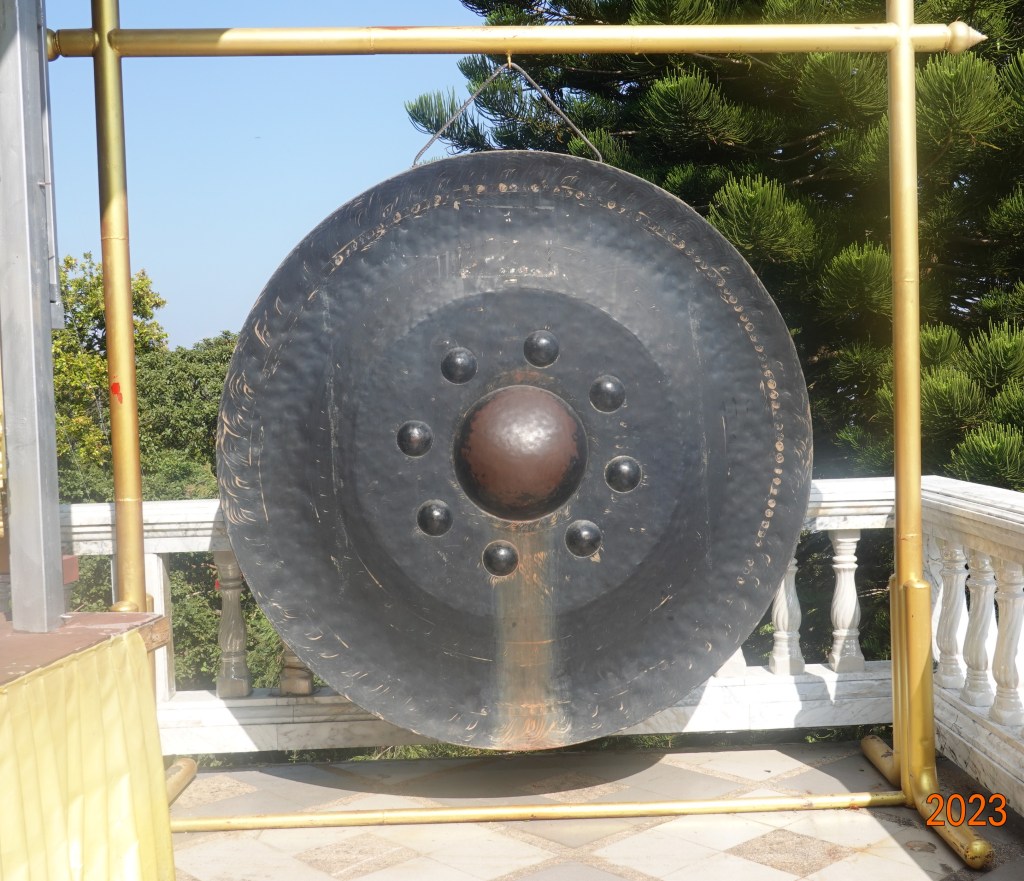
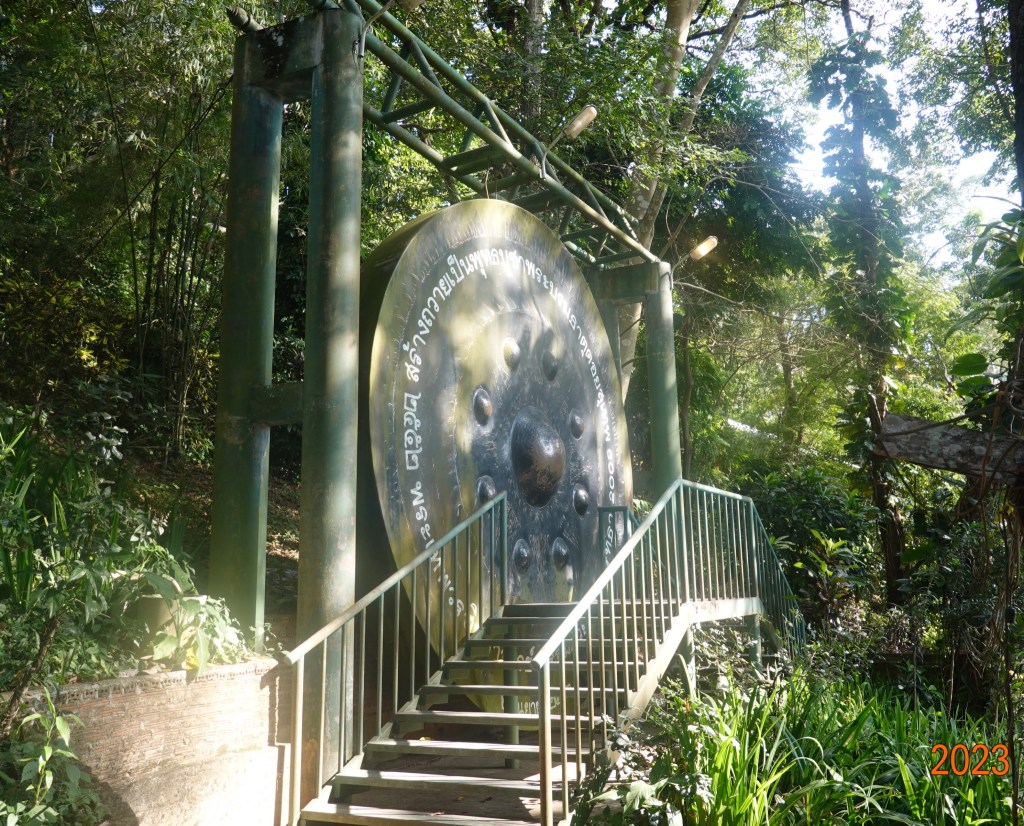
And then we saw a stairway I have never seen before, winding down an alternate path to the entrance, past this rather giant gong, said to be one of the largest in the world. I could find no description of the actual size. I think it is about 6 or maybe even 7 meters in diameter.
From here, I put away my camera. On the hike along the road to the start/end of the trail, about 500-600 meters, we had to be very cautious because of the constant stream of vehicles coming up to the temple. Then once we started down the trail, the going was slow and very deliberate. In some of the very steep sections, we had to use our hands and arms for balance. And in other places, we had to be very cautious to not slip – the leaves on the trail can be very slippery.
At Wat Phalad, we took a break to hydrate and eat some snacks. Then we proceeded from Wat Phalad down to the trailhead. From the trailhead to the Monument to the Three Kings is over six kilometers. It is a long walk, and there are many people all along the route at 5 PM on a Wednesday. We passed by Chiang Mai University, crossed two multi-lane highways, passed Wat Suan Dok, passed the hospitals, finally entered the old city at Suan Dok Gate, then passed Wat Phra Singh and finally to the Three Kings monument.
When we arrived at the Three Kings monument, we had been hiking for 5-1/2 hours and walked a total of 16.5 kilometers. Feeling the need for some iron, we decided to meet again at Three Kings, and get a ride to The Duke’s for dinner. The Duke’s is much like a 1960s or 1970s style American steakhouse. They import their beef from New Zealand, and all sauces are made in house. A very nice dinner followed by a walk back to The 3-Sis ended another very good day in Chiang Mai.
Next: A return to Wat Phra Singh

 James the Intrepid Pilgrim