Saturday, January 7, 2023
Exploring south of old Chiang Mai city – Wat Daowadung
I left Wat Phuak Chang through the entrance on Rangang Road, and walked down Rangang Road a bit (southeast). I turned down a soi in the direction that I thought would eventually lead me back to Wua Lai Road, the main road through the Hai Ya district, the area in which I was now walking. I was a little lost again, no, completely lost. I continued in the direction I was certain would lead me to familiar territory. I’m pretty sure I turned onto Rangang Road Soi 3, then turned again onto Suriyawong Soi 5, then another turn onto Rat Chiang Saen Soi 2 followed by the Thai character “gai”, almost shaped like a chicken ก่ . The intent was to get to Wua Lai Soi 4 that would lead me back to Wua Lai Road. Note: many of these sois are not well signed, or only have a sign at some of the intersections, inconsistent and unpredictable. As I said, I was basically lost, but confident I would find my way somewhere I would recognize.
Where Rat Chiang Saen Soi 2 ก่ ends at Rat Chiang Saen Soi 2 (with no “gai” symbol), I saw a temple I have never visited, Wat Daowadung. No sign in English, I only learned the name after getting back to The 3-Sis and researching.
Wat Daowadung
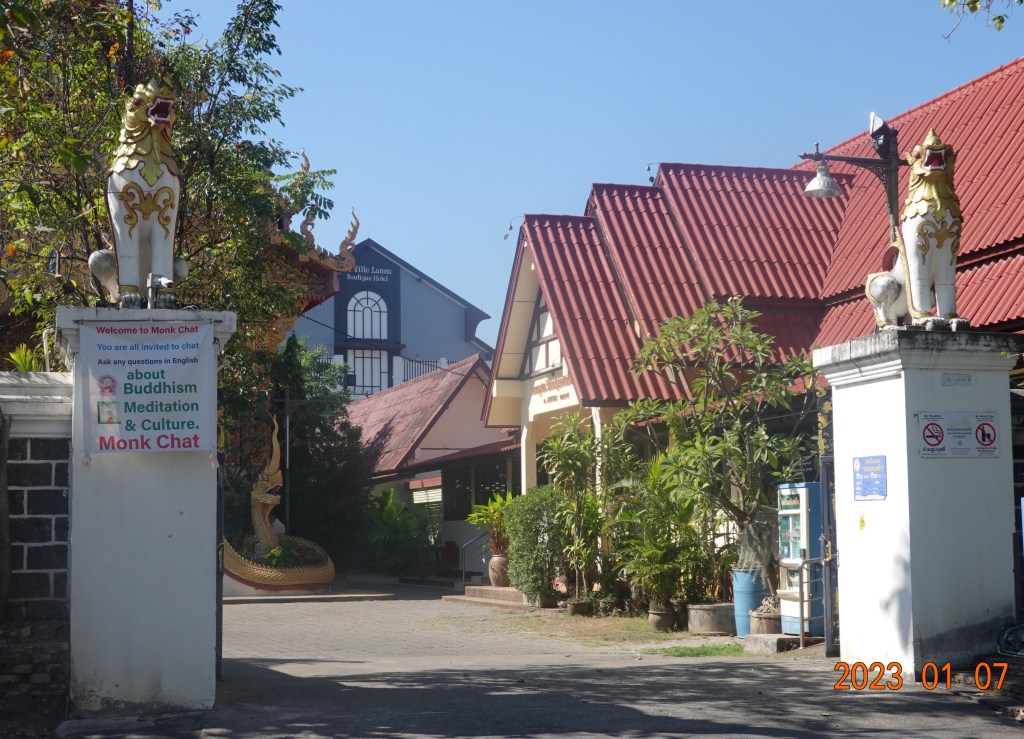
This temple is what I call a “local” temple – almost never visited by tourists, known and used by the local people. There were several Thai people there, and the monks were very friendly, going out of their way to say hello to me. The only English I saw there was a sign on the entrance pillar advertising Monk Chat. And the entrance is not elaborate or ostentatious, simple pillars with modest singha lion creatures guarding the entrance.
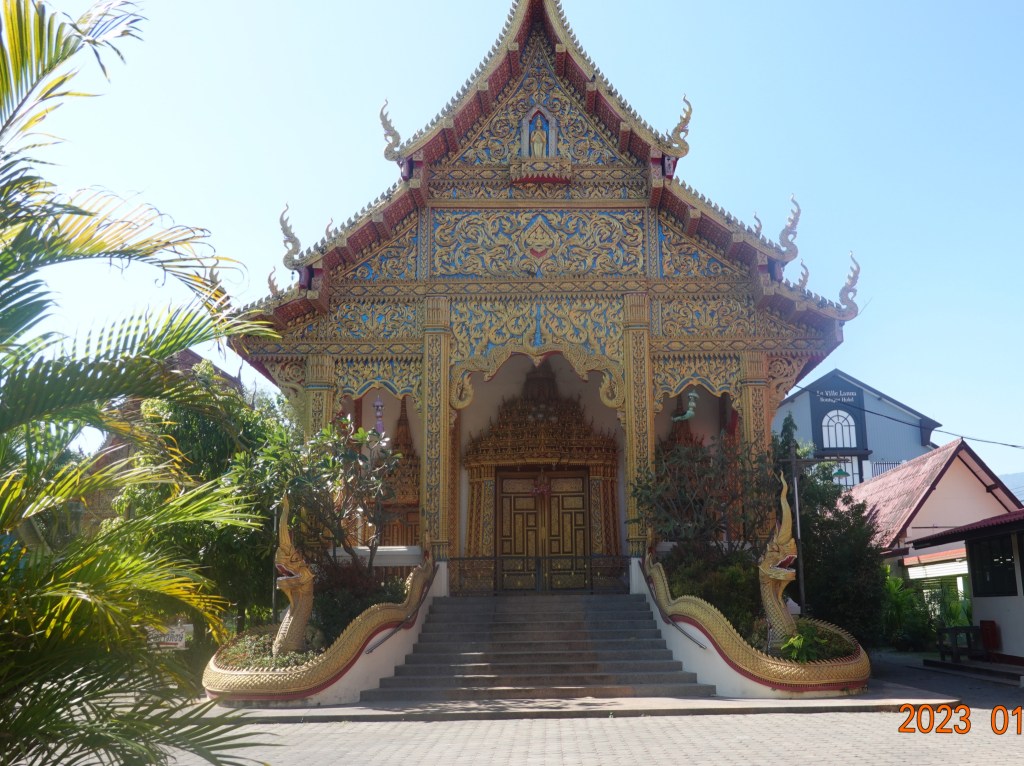
Once inside the temple grounds, the viharn dominates the view. For a local temple, the viharn is fairly large and in the Lanna style. The roof is multi-tiered with a triple split, and nagas decorate the edges of the rooflines. The nagas guarding the front entrance are exceedingly long, curling around and up the balustrade of the wide steps. The front facade is lavishly ornamented with gilt foliate work.
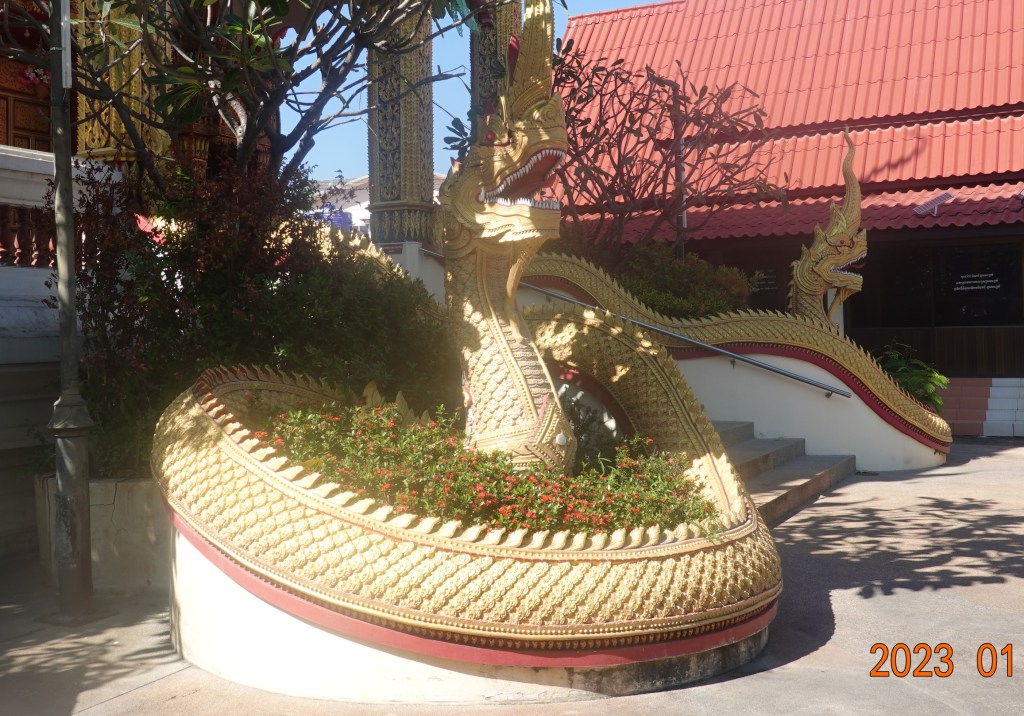
I took another photo showing some of the detail of the naga at the entrance to the viharn:
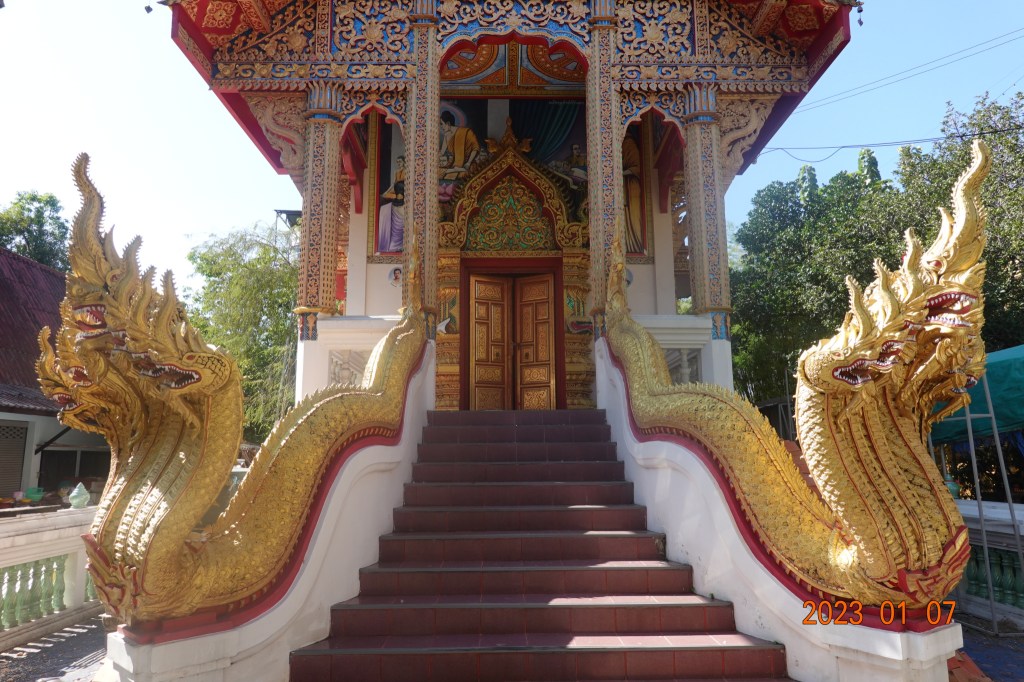
Because the doors were closed, I could not see inside. I walked over to see an ubosot (ordination hall) guarded by two seven-headed naga. The front of the ubosot is also elaborately decorated in the same style as the viharn:
As is typical at almost all Buddhist temples, there is a chedi behind the viharn. The chedi is in the Lanna style with a very high square base with indented corners rising to an octagonal mid-section which in turn supports the bell. It was difficult to get a good view of the chedi (maybe I could invest in a drone to get better pictures).

At some, maybe many, temples, there is a fountain or image of Mae Thoranee, a depiction of mother earth, and a symbol of Buddha’s goodness. A quote from Thaizer.com:
According to the legend, Buddha was meditating under the Bodhi tree when Mara (the Evil One or devil) tried to prevent him from reaching his goal of enlightenment. Mara, accompanied by his daughters and his demon army, set about dislodging the Buddha during his meditation. It is said that the gods protecting Buddha were driven away by Mara and his army leaving the Buddha alone to face his demons. Stretching down his right hand, Buddha touched the earth and summoned her to be his witness to his previous good deeds and merit. The earth deity in the form of a beautiful woman rose up from the earth. Twisting her long hair, she created floods of water that represented the good merit that Buddha had previously earned. The waters from Mother Earth washed away Mara and his demons and freed the Buddha to attain enlightenment.
Thaizer.com, Roy Cavanagh
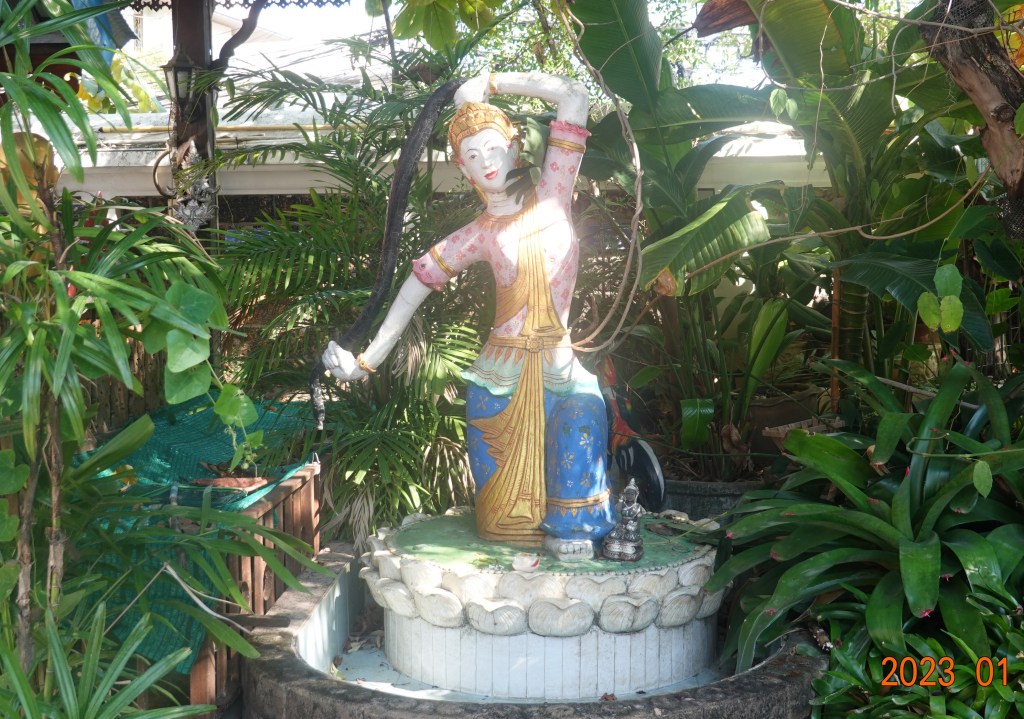
I left Wat Daowadung, feeling a little accomplished at having discovered this nice, peaceful local temple.
I turned onto Rat Chiang Saen Soi 2, then made a left onto Rat Chiang Saen Soi 1 Kor (have no clue what the “kor” means). At this point I am still lost, but had a feeling I was going in the right direction based on the sun and shadows. Rat Chiang Saen Soi 1 Kor ends at (you guessed it) Rat Chiang Saen Soi 1. Continued south for a hundred meters or so, and saw a sign for Suriyawong Soi 2. I know I have been on Suriyawong Road before, so I made the right turn, and was now walking west (according to the sun and my handy compass app). The soi did lead me to Suriyawong Road, and I do recognize where I am now. I turned left, then right onto Nantaram Soi 1 which led me to Nataram Road. Nantaram Road will lead to Wat Nantaram. I have been there in one of my first explorations to find the Kamphaengdin, and was basically scared off by some very territorial and loud dogs who did not want a foreigner on “their” property. I turned onto Nantaram road, then almost immediately onto Wua Lai Soi 4 which took me back to Wua Lai Road, a place with which I am very familiar.
I used the work “lost” several times, and while technically correct, I never really felt lost. I know the general area, and exploring the sois is interesting and this time led me to a temple I have never seen. A very good day exploring the Hai Ya sub-district of Chiang Mai, and more to come.
Next: Return to Wat Phra Chao Meng Rai

 James the Intrepid Pilgrim