Thursday, January 5, 2023
Two temples walking back from Blue Diamond Part 1 Wat Lam Chang
After a brisk walk to the O2 Gym and a challenging strength training session with Ning, I decided to forego breakfast at The 3-Sis (the restaurant is actually Poppy’s Kitchen) and change my routine a bit. I went to Blue Diamond, a very popular restaurant in the northeast quadrant of the old city (inside the moat, as is typically said here in Chiang Mai). Blue Diamond is a classic in chiang Mai. Khun Knee owns and manages the restaurant. She always remembers me, even after having been away for a year. All baked goods are baked on premesis, including normal, vegan, and gluten-free options. And their chocolate-dipped coconut macaroons are the best I have ever had, including those at Canter’s deli in Los Angeles. I opted for breakfast “A” which is two eggs, bacon, whole wheat roll, fruit plate, and a small salad, plus coffee. Just the right size and very tasty.
Wat Lam Chang
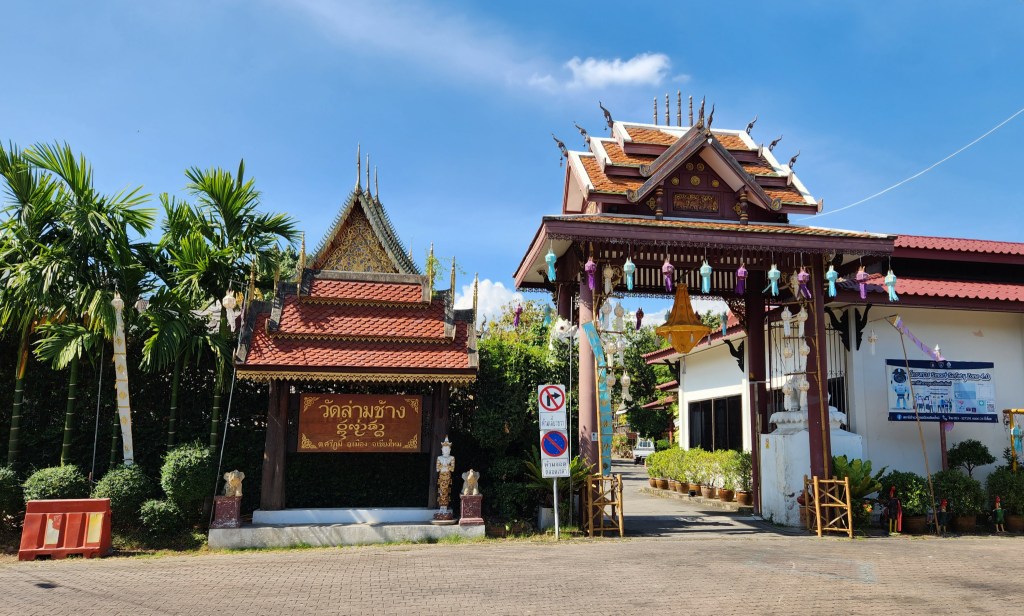
On the walk back to The 3-Sis, I deviated slightly, turning right on Moon Muang Soi 7 at Khun Kae’s Juice instead of left and was walking directly into Wat Lam Chang, a temple I have not ever really visited, although I have walked by many times.
Wat Lam Chang is the temple of the tethered elephant, a 14th century temple, having been built on the grounds where royal elephants were housed and fed. Royal elephants were a slightly different breed than the typical gray elephants, and a reddish-brownish-gray in color. The royal elephants were used to carry members of the royal household and were not used for labor. There are many elephants in the motif at Wat Lam Chang making for excellent viewing for elephant lovers. I did not know the history of the temple, so I did not focus on capturing the elephants in various places.
The entrance into which I entered the temple grounds is actually the back – the main entrance is on Ratchapakhinai Road, about 50 meters south of Wat Chiang Man. Wat Chiang Man was the first temple built in Chiang Mai by King Mengrai as a place to live and worship as he supervised the building of the walls, moat, and city. It therefore makes sense that the royal elephants were tethered just 50 meters away from where King Menrai was living.
The first thing that caught my eye was this stone in a little pavilion to itself just to the left of the back entrance. I learned in subsequent research that this is a sacred stone inscription relic. It is less than a meter high, and I could not make out any inscription. The text at the back was all in Thai (there is no English at this temple). It is important enough to have its own pavilion:
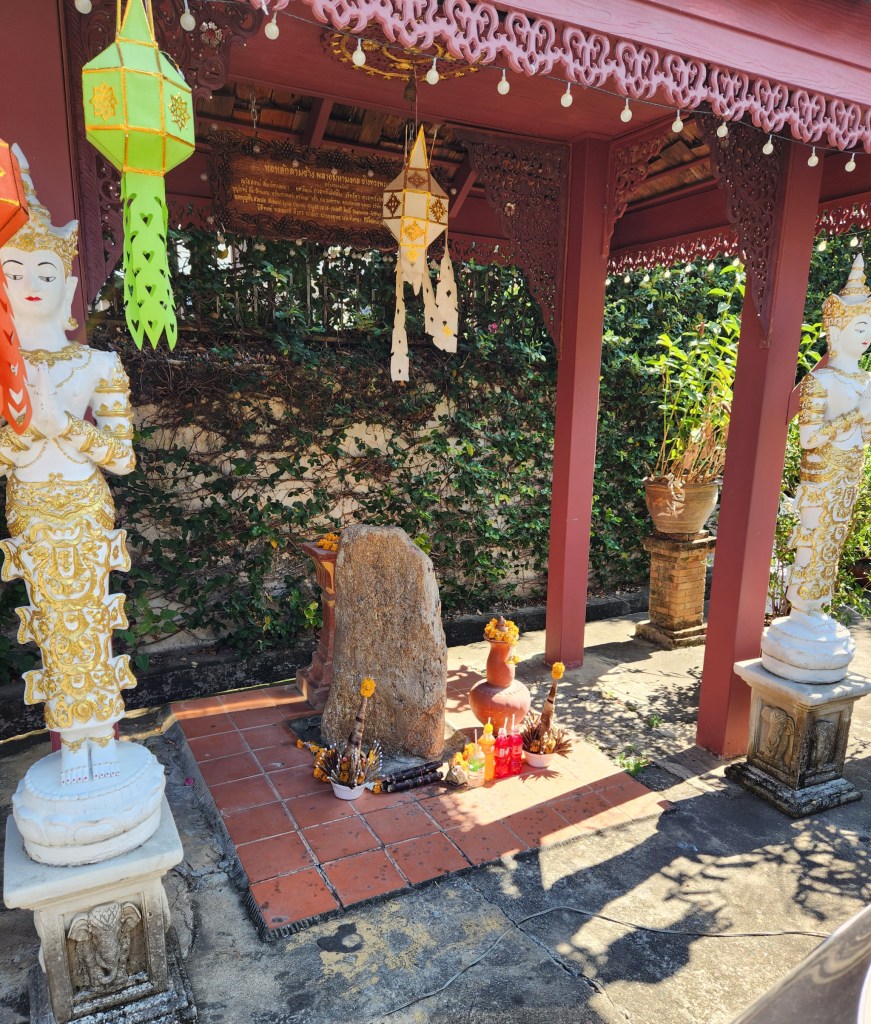
In the pedestal on which the thewada stands, stands, notice the elephant on the face. The elephants are seemingly everywhere here in the motif at Wat Lam Chang. A thewada is a angelic being that lives in the heavenly realm, genderless, but can look very male or very female depending on the artist.
The viharn (worship or assembly hall) is fairly typical Lanna styled viharn with a multi-tiered roof that extends low at the sides, the naga dragon decorations on the gables, and the entrance stairway guarded by the naga dragons. Also very common of Lanna style temples is the thewada on the entrance doors.
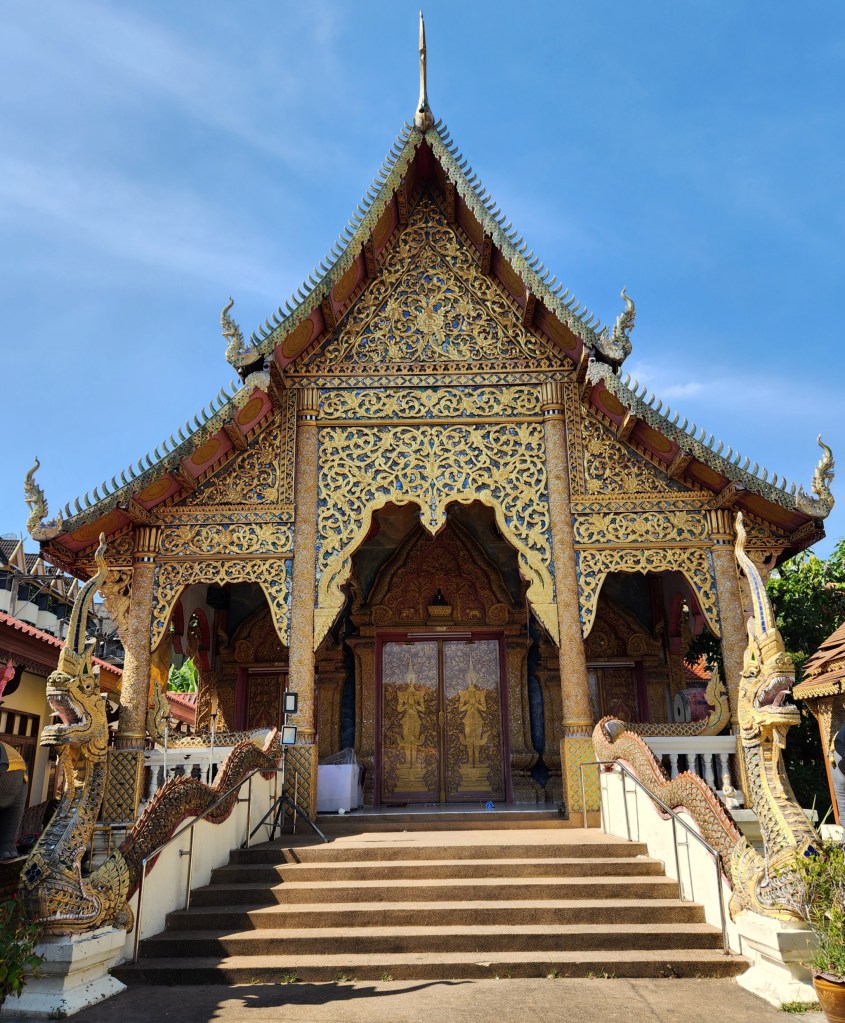
Unfortunately, the viharn was closed. I subsequently learned that the paintings on the walls inside also have an elephant theme. Maybe I’ll stop by another day and see if the viharn is open.
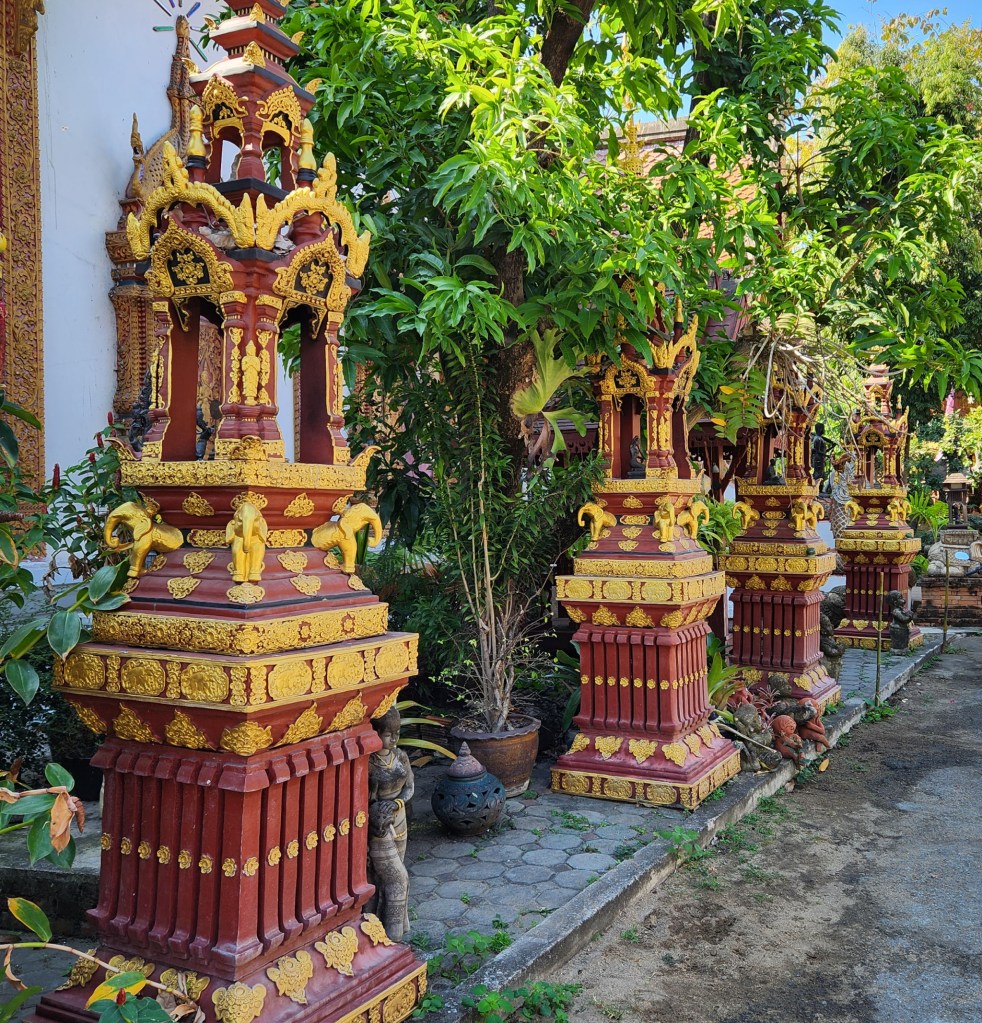
Walking by the viharn, there were a series of pedestals. Unclear what these are for, but notice the elephants where the top larger open section meets the base.
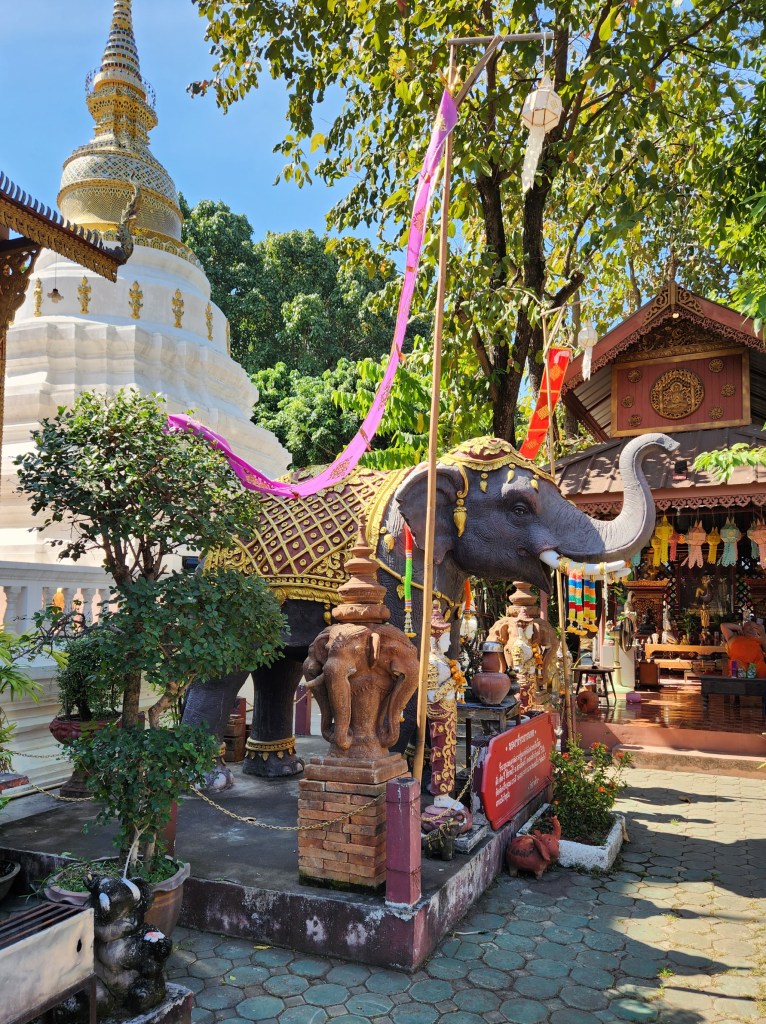
I walked around to get a picture of the newer chedi, and also saw this full-sized elephant statue. It is gray, not the reddish-brownish-gray of the royal elephants. The description of this elephant statue is on a sign, but in Thai only.
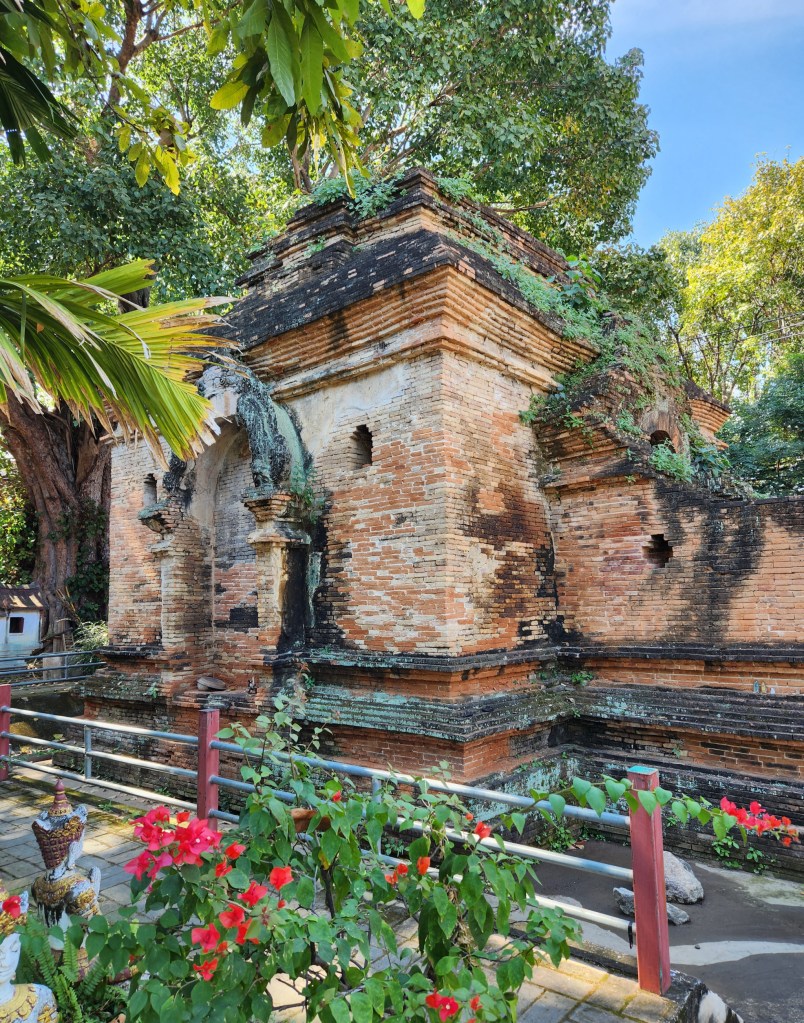
In the back, are the remains of what was once the original 14th century brick chedi. All that is left is the large square base. At some point the top came off or was taken down. There are niches in the four sides in which I would expect to see Buddha images, but are now empty. This old chedi appears old, tired, and somewhat abandoned.
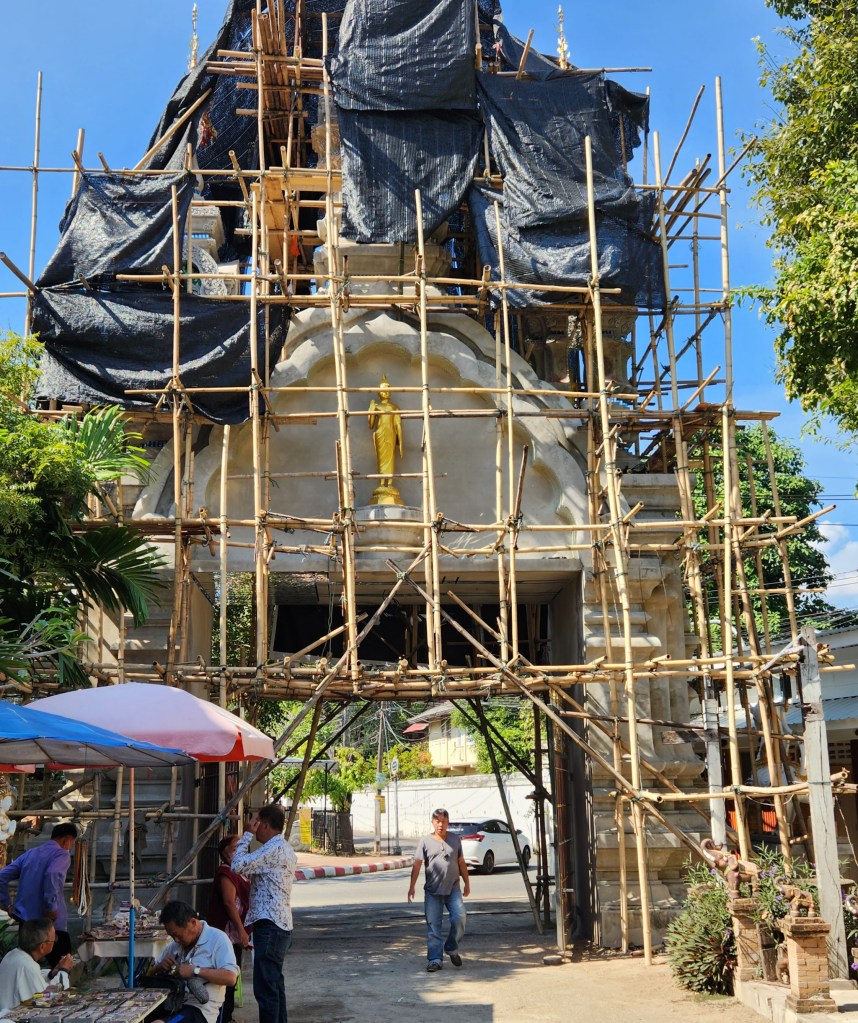
I left from the main entrance, under renovation, surrounded by that precarious-looking (to me) bamboo scaffolding. A number of men were there, apparently on a break, as it was lunchtime. Here is the inside of the main entrance:
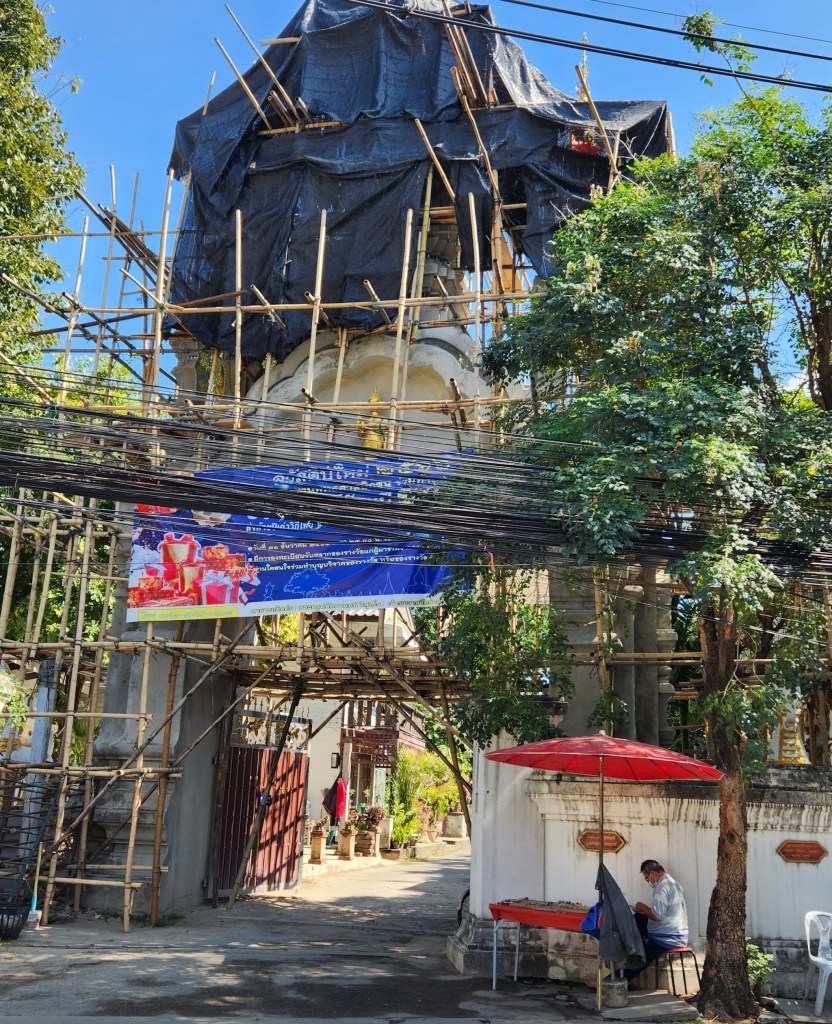
And the outside of the main entrance, also with the bamboo scaffolding. Even when finished, those wires will get in the way of the entrance. The wires everywhere in Thailand are sort-of fascinating to see. It is unclear how all the communication works with the fairly messy wiring, but communications work well here (communications: phone, cable-TV, high-speed internet).
Next: Walking back from Blue Diamond Part 2 Wat Umong Mahathera Chan

 James the Intrepid Pilgrim