Monday, December 19, 2022
Investigating a Gym
Over about the last six months I have augmented my activities, walking, cycling, and yoga practice with what I call “strength training.” I work with a trainer at a smaller local gym where with his knowledge of fitness, and evaluation of my strengths and weaknesses is helping balance my overall fitness and strength. For over 45 years, my primary exercise has been cycling (road cycling – I do not ride off-road). When at home recently, I have been riding about 140 miles per week (about 225 kilometers). And over those many years, imbalances in my fitness have emerged. For example, while I have very strong quadriceps and calves, my hamstrings and glutes are comparably weak. The strength training has been a great benefit – when I ride down the road it feels like my whole body is working together better. The result is a more enjoyable ride. And I love that – I have always enjoyed riding; it is just a little better now.
My friend John (husband of Rose, the owner of Wild Rose Yoga where I practice yoga) was going to show me some local gyms in Chiang Mai to which I could walk. The first had a pool, sauna, and steam room, things I do not need. And they were a little more expensive than I had hoped for. The second he described as very basic. This is O2 Gym, and is fairly large, with much equipement. This is where he works out, and I liked it. I did not take photos out of courtesy to the people working out. O2 on Kamphaengdin Road is about 2 kilometers from The 3-Sis, where I am staying, so about a 25-minute walk. The “drop-in” rate is 60 baht per session (less than $2), a little ambiguous in that a “session” is ill-defined, but at least an hour.
Since I am relatively inexperienced in the world of strength training, I prefer to use a trainer to watch and help me keep good form (and make sure I take breaks and rest between sets). There were some brochures at O2 I photographed to contact later. Then John and I went off to have a coffee at Akha Ama, a favorite in the old Chiang Mai city neat Wat Phra Singh. A quote from Akha Ama’s web site:
We are Akha Ama Coffee and pleased to meet you. We are community based social entrepreneurs and committed to growing, processing, roasting and brewing a sustainable coffee. We were gifted with this fabulous coffee and always happy to share with you. Thank you so much for having coffee with us.
While enjoying our coffee, I called one of the trainers, but got no answer. I called the second one, a lady highly recommended, and she answered. She wanted to meet at 3:00 at the O2 gym to discuss what I wanted.
At 2:30, I left The 3-Sis for the walk to O2 Gym, and met with PT Ning. I believe the “PT” stands for “Personal Trainer.” Miss Ning speaks very good English, attributing it to having an American boyfriend for eleven years. She understood everything I described about how the imbalances in my fitness evolved, and my goals. I sent her the session outline my trainer at home sent me as a guide for continuing my training while in Chiang Mai. She said she would review it more before our first session which we scheduled for 9 AM Wednesday.
So here I go:
- yoga four times per week at Wild Rose
- strength training twice a week with Ning at O2.
Two Local “Dok” Temples
On my walk back to The 3-Sis, decided to stop at two temples I pass often and seldom visit. One just north of Tha Phae Gate, Wat Dok Kham, and the other slightly north and slightly west on Ratvithi Road, Wat Dok Euang. The work “dok” in Thai refers to a flower.
Wat Dok Kham
After passing Tha Phae Gate, the entrance to Wat Dok Kham is only about 50 meters north. I believe “Dok Kham” is a medicinal plant used in ayurvedic medicine. One source I found indicates that Wat Dok Kham gets many visitors being close to Tha Phae Gate. I have walked by countless times and have never seen visitors. The temple underwent renovations about four years ago and was closed for about a year. The grounds at Wat Dok Kham are small, almost cramped. Here is the entrance from Mun Mueang Road, the inner-moat road running north along the east side of the old city.
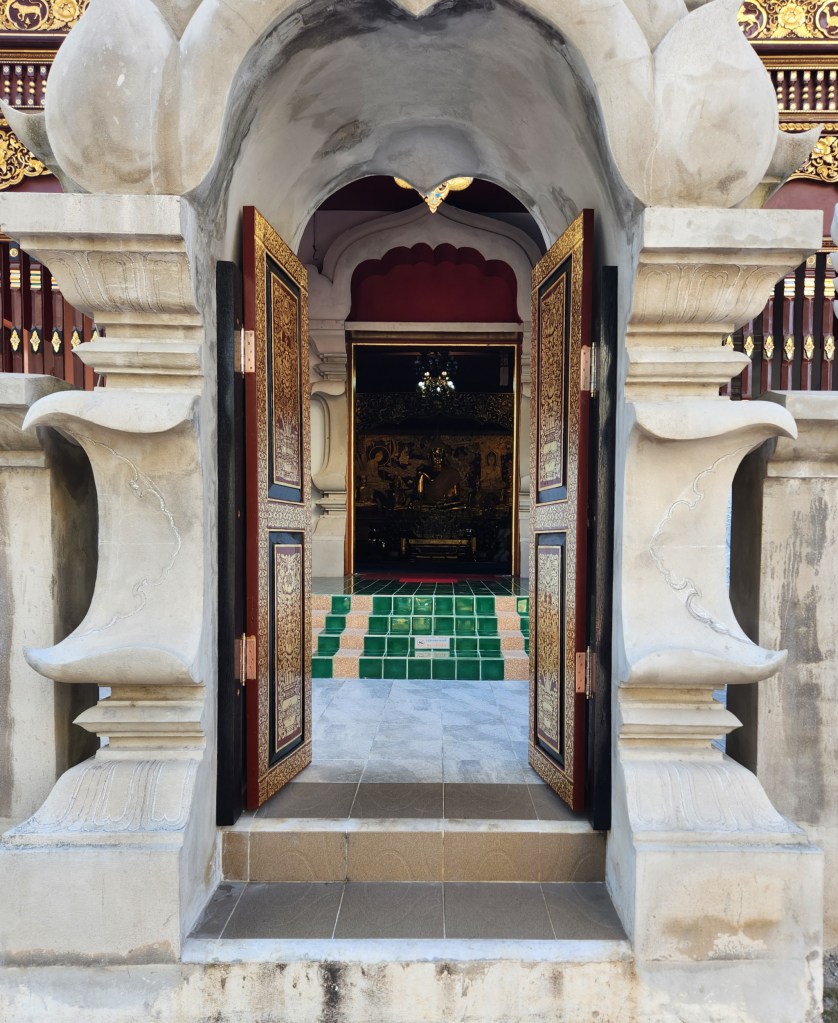
There is no courtyard, you pass through the entrance in the wall and in just a few steps you are at the door to the viharn (assembly or worship hall). Flanking the doors and the very short stairs to the viharn are the common Lanna style naga creatures.

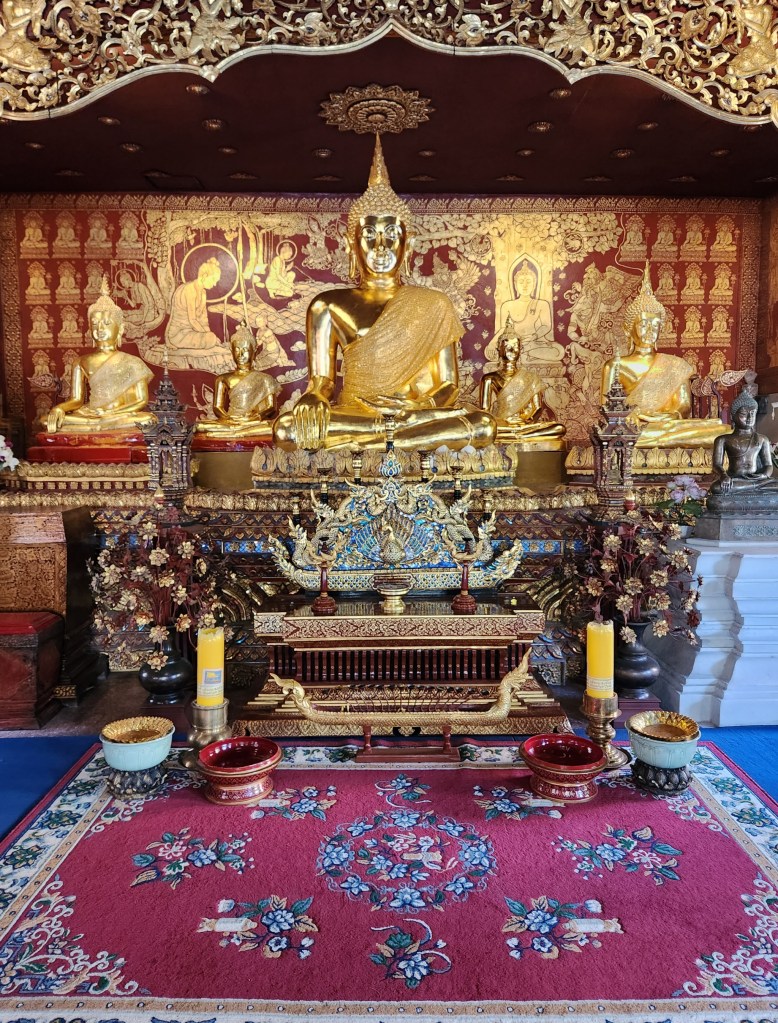
Inside the fairly small viharn, the ceiling is mostly plain dark red with a few embossed floral motifs and the room seems spacious as there are no large supporting columns to obstruct the view. The alter has one large and several smaller Buddha statues in the “Lanna” or “Chiang Saen” style.
The Lanna images are usually made of bronze and the main characteristics are: “the fullness of the body, the smiling face (no teeth shown), the round bud-like halo, the spiral hairstyle (showing no hairline), the arched eyebrows, small aquiline nose, seamed robes, lion-curved torso, and seated in the lotus posture.”
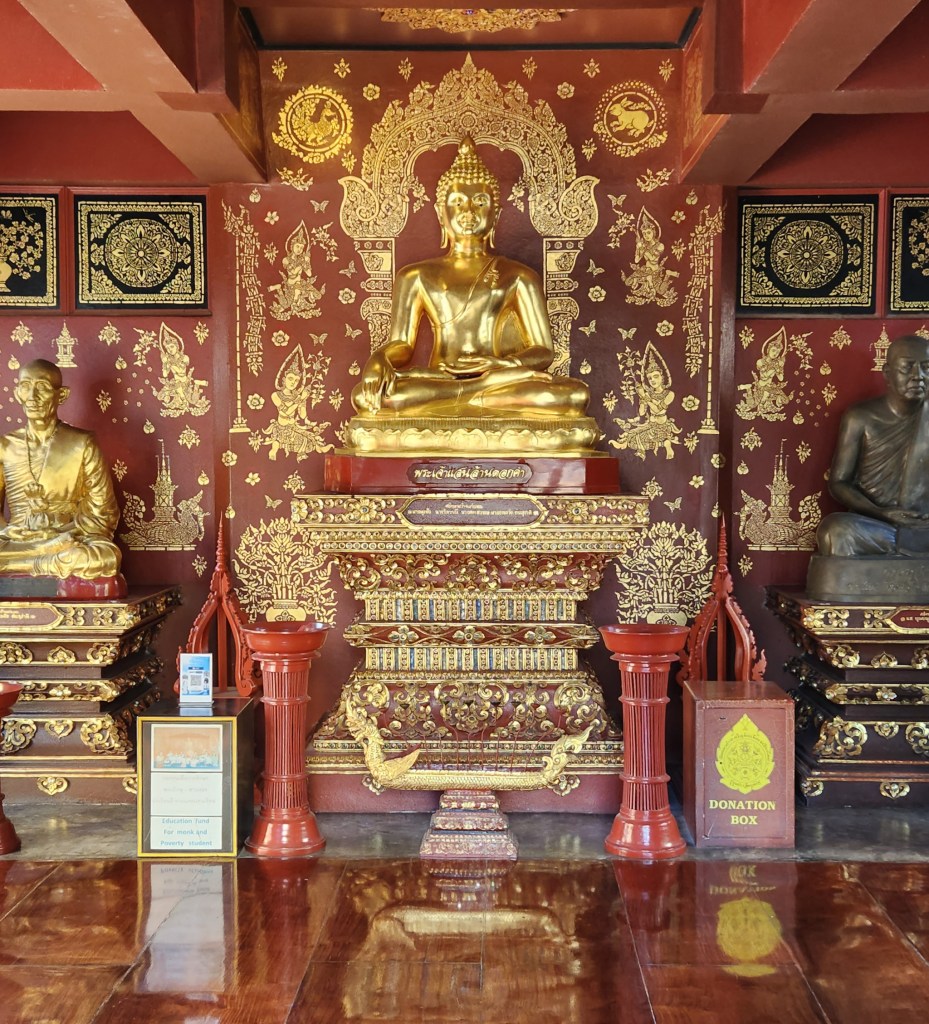
There is a secondary building on the small temple grounds. It is not an ubosot (ordination hall). The entrance is flanked by two fierce-looking mom creatures, common for a library (ho trai), but the inside appears to be more of a secondary viharn, or a pavilion.

Inside the secondary building at Wat Dok Kham. The floor is very clean and polished, giving a clear reflection:
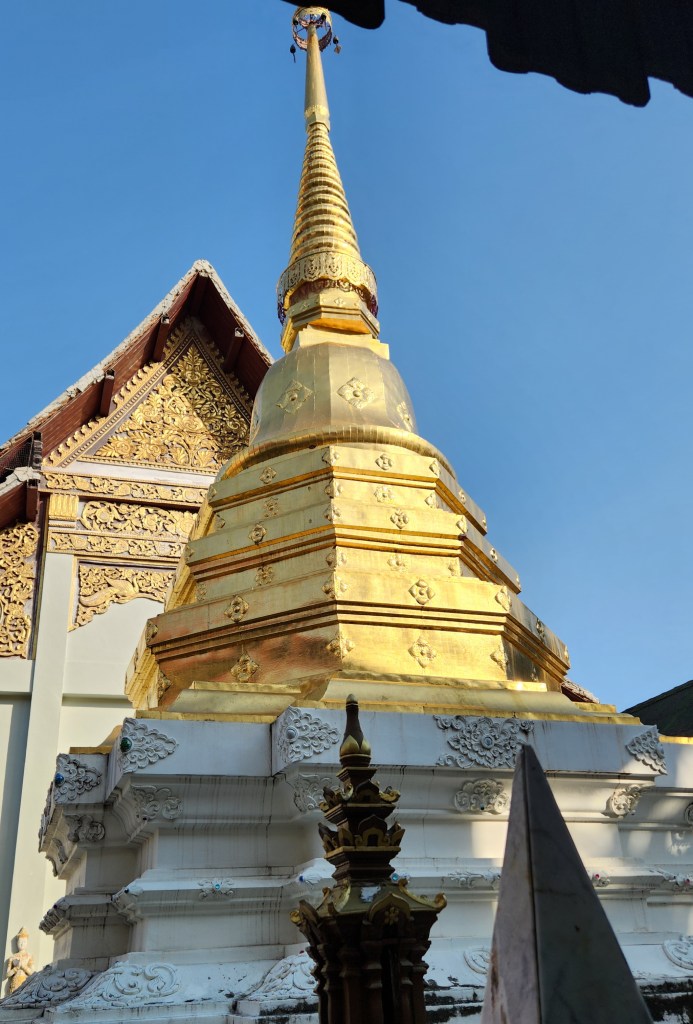
As is common with almost all Buddhist temples, there is a chedi in the small space at Wat Dok Kham. Typically, this is where the remains of someone important are interred. The chedi, large for the space, and difficult from which to get a good photo angle:
Wat Dok Euang
Leaving Wat Dok Kham, I went north to Ratvithi Road, turned left and was walking west when another temple I seldom, if ever, visited was on my left. The name is Wat Dok Euang. On the sign, It says Welcome to Wat Dok Euang, and underneath it used to say, “We love cleaning.” The “we love cleaning” is now taped over. The temple used to have a reputation for being spotlessly clean. Perhaps it was too expensive to maintain the level of cleanliness for which they strove in the past.
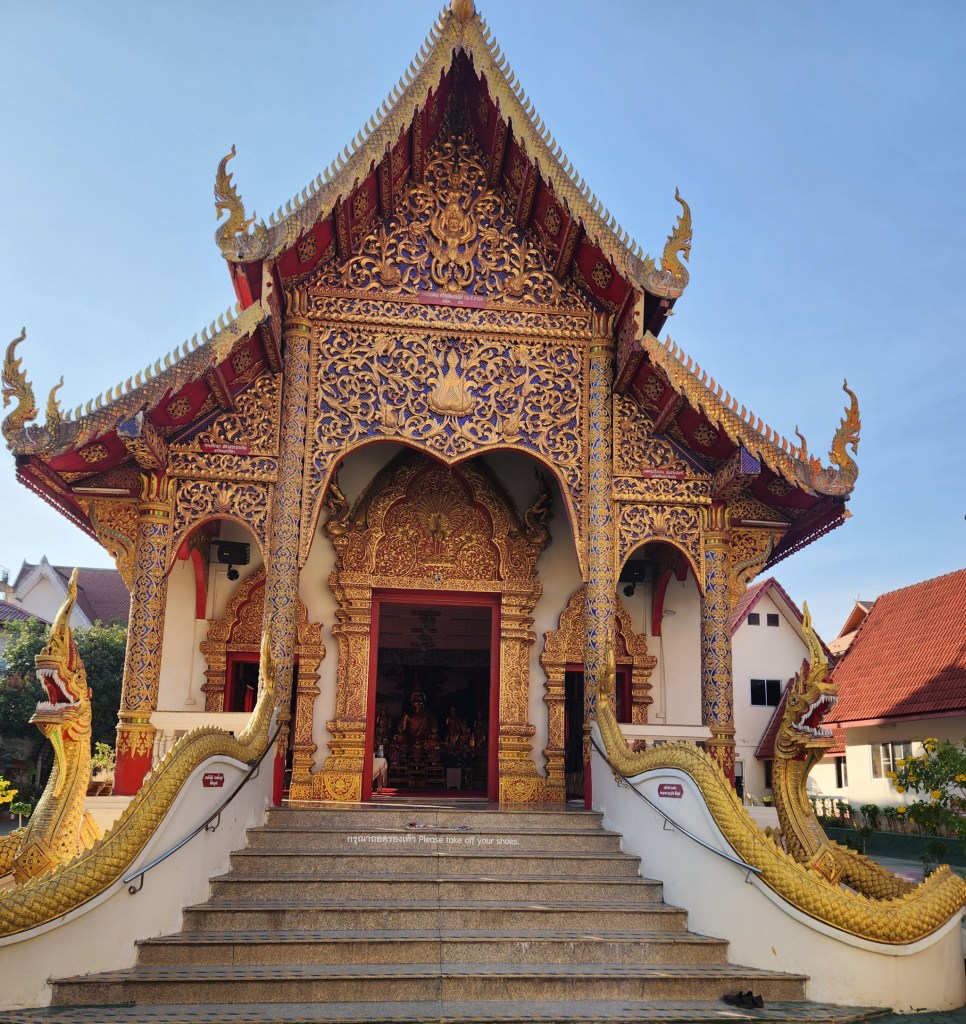
Wat Dok Euang is another not-so-small “neighborhood temple. Not frequented by tourists, but quite nice nonetheless. The viharn is fairly large, and of the Lanna style with overlapping roof tiers, and the front stairway guarded by fierce-looking Naga creatures:
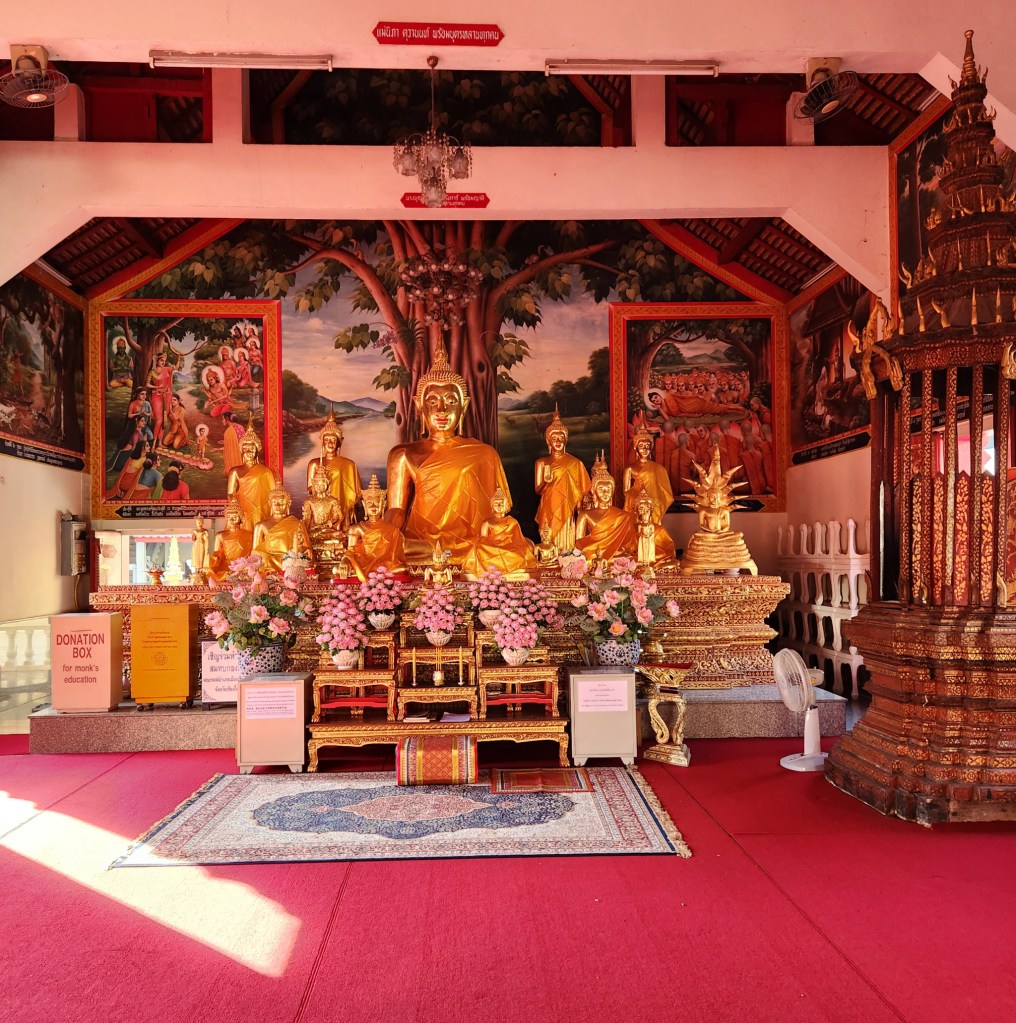
Inside the viharn, the bright fuscia capet is almost shocking.
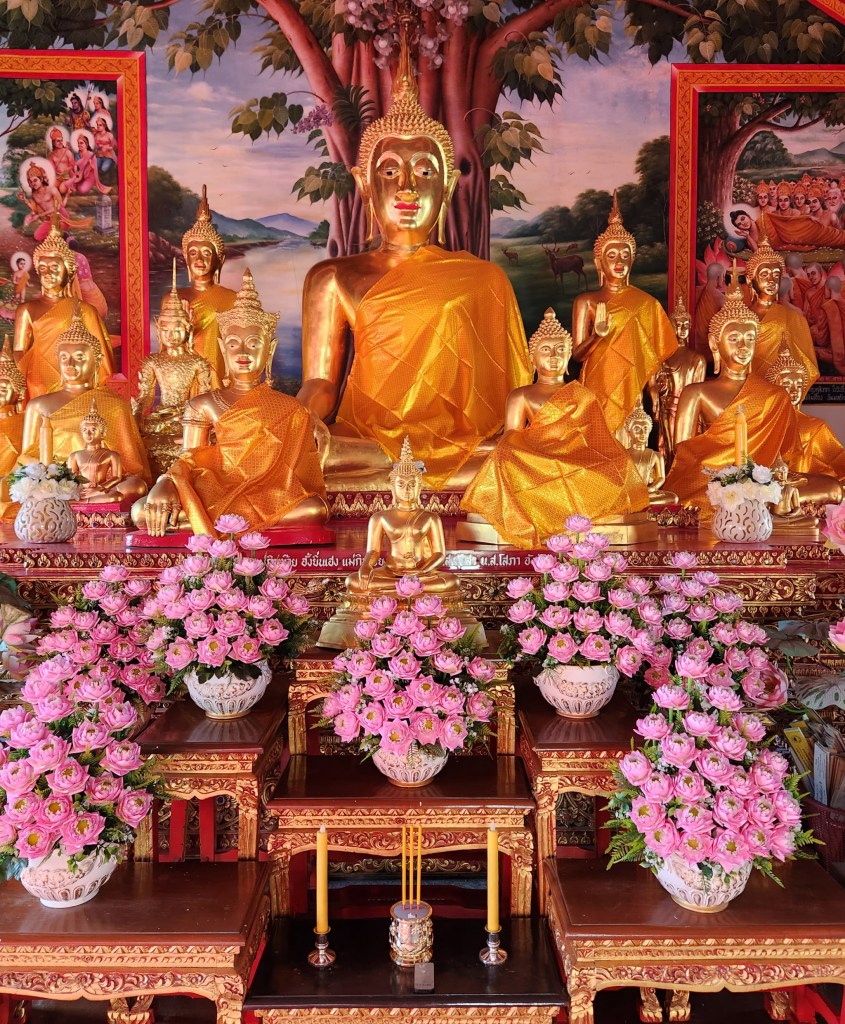
A closer view of the Buddha images show them to be in the Lanna style, as is common in the former Lanna, northern Thailand.
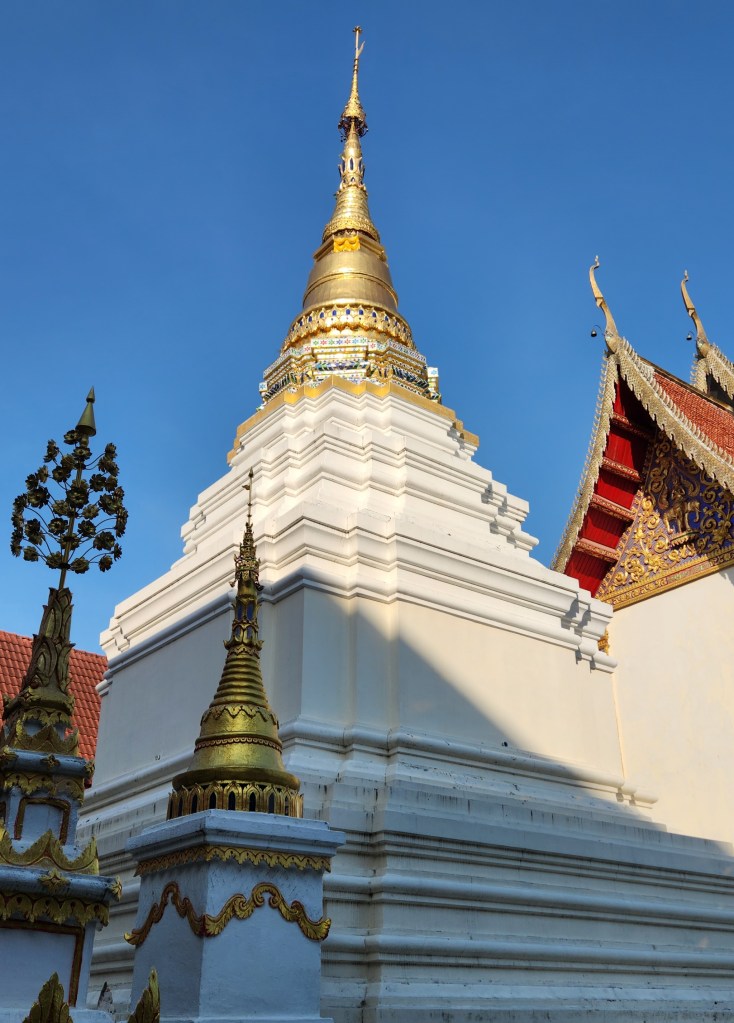
To the west of the viharn, the chedi is also fairly large:
I was about to leave the grounds when I noticed a nicely decorated building in the corner along the south and east walls. This I learned is an ubosot (ordination hall), the most sacred building at a Thai temple, and as is typical, it is closed to the public.
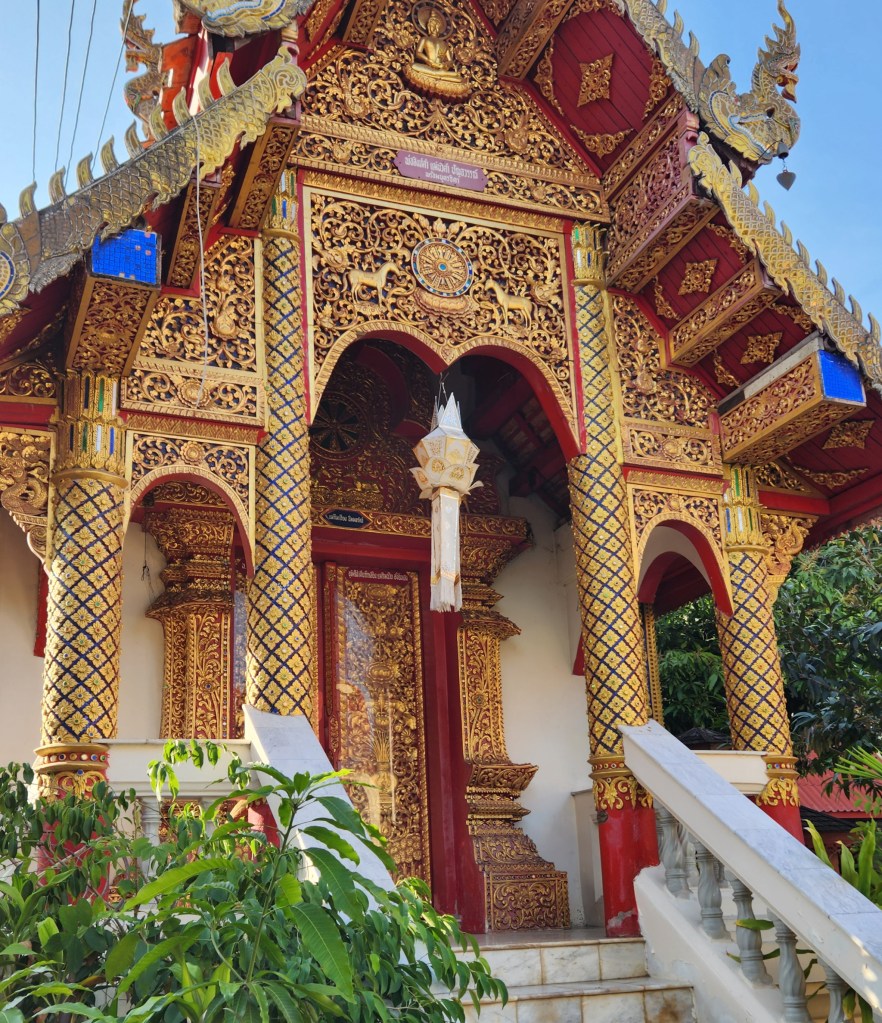
What drew me to this ubosot was the small chedi behind it. The tile work, intricate gold work, and design are quite nice.

Two very nice “local” or “neighborhood” temples in the old Chiang Mai City. It is said that there are at least 52 temples inside the old city. Given that the old city walls make up a rectangle about 1800 by 2000 meters, which is 3,600,000 square meters, 1.4 square miles, or 890 acres, this is a large number of temples in a relatively small area. After visiting Chiang Mai and being interested in the temples for ten years, I’m not even sure I have seen them all. I’ll keep looking.
I went back to Mush for a Thai dinner of pineapple fried rice with chicken and vegetables, a very touristy type dish (but I love it). And as is often the case, I get so hungry and start eating, or finish eating before I rememer I should have taken a picture. There will be more meals to share.
Next: Return to the Flower Market and Wat Kate Karam

 James the Intrepid Pilgrim