Saturday, December 17, 2022
Wat Chai Si Phum on the return walk from Jing Jai Market
Jing Jai Market is a very large local market about 2 kilometers from the northeast corner (Si Phum Corner) of the Chiang Mai old city wall/moat. This is a local market, not a tourist attraction, but is gradually attracting more and more non-Thais. It is known as a Sunday market, but recently expanded to Saturday as well. Jing Jai is a very large market, with farmers selling all types of produce, many clothing stalls from which to buy almost any type of clothing, and of course, many food vendors. I would estimate that about 4-5 thousand people were in attendance. And, Saturday is less-attended than Sunday. There is live, fairly mellow music which goes well with the overall casual “vibe” of Jin Jai.
Note: I did not take pictures at Jing Jai. There are new privacy laws in Thailand that prohibit publishing pictures of people without their explicit consent. And with the large number of people at Jing Jai, it would be impossible to get permission.
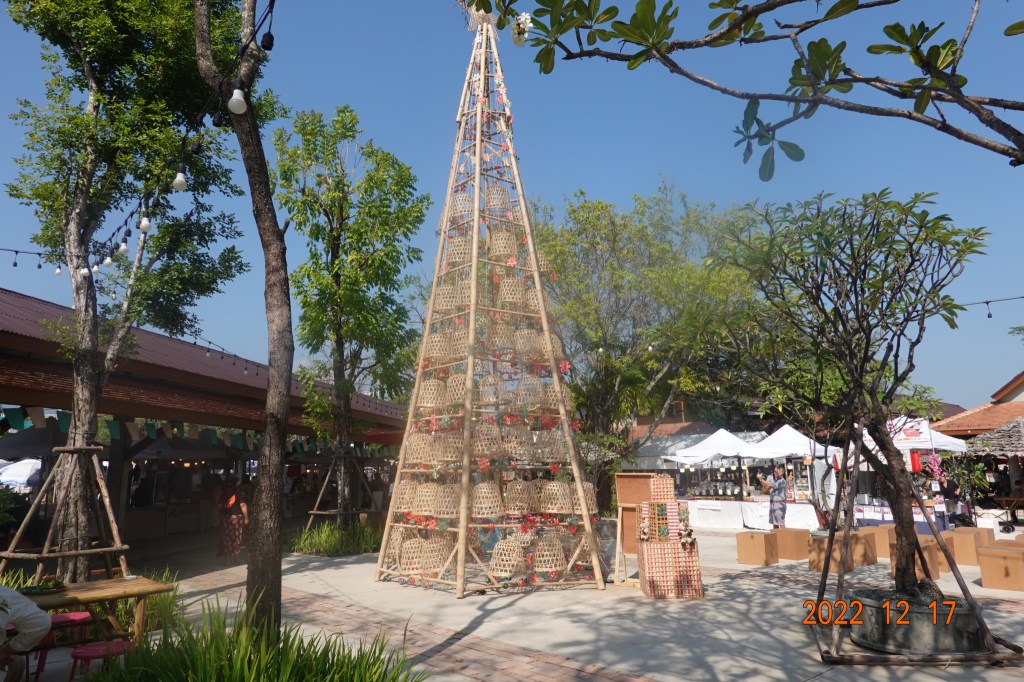
I met Rose and John at Jing Jai at about 10:30 AM, and Jing Jai was very busy already. Here is the sort-of pyramid or tower on which the sign announcing Jing Jai is on the opposite side.
We perused the overall market, and then had a few snacks they wanted to share with me for a light lunch. I went off to find a restroom, went the wrong way, and Rose & John and I became separated. After walking around for about another hour, I found four restrooms, one very close to where John, Rose, and I were having snacks. Knowing that John and Rose would have to get home fairly soon to store the produce they bought in the refrigerator, and without getting phone response, I decided to make the exploratory walk back into the city.
Wat Chai Si Phum
Much of the walk was along a busy road, but with a wide sidewalk it was a fairly safe walk. In Thailand, sidewalks are not well-defined, and do not always exist. So by some businesses, there were trucks unloading things on what I thought of as the sidewalk. There was always a way around them, and I continued onward.
Closer to the old city, close to Si Phum Corner, I was able to walk along a klong (small creek or drainage canal), after going down about a half-flight of steps to the walkway along the klong. It was immediately quiet, and the klong walkway stretched for about 400 meters, exiting at a temple I have never visited, Wat Chai Si Phum, so named because it is right outside Si Phum Corner. Sometimes both are spelled in English as “Sri Phum.” Here is a photo essentially from the entrance of Wat Chai Si Phum where Si Phum Corner is clearly visible and close.
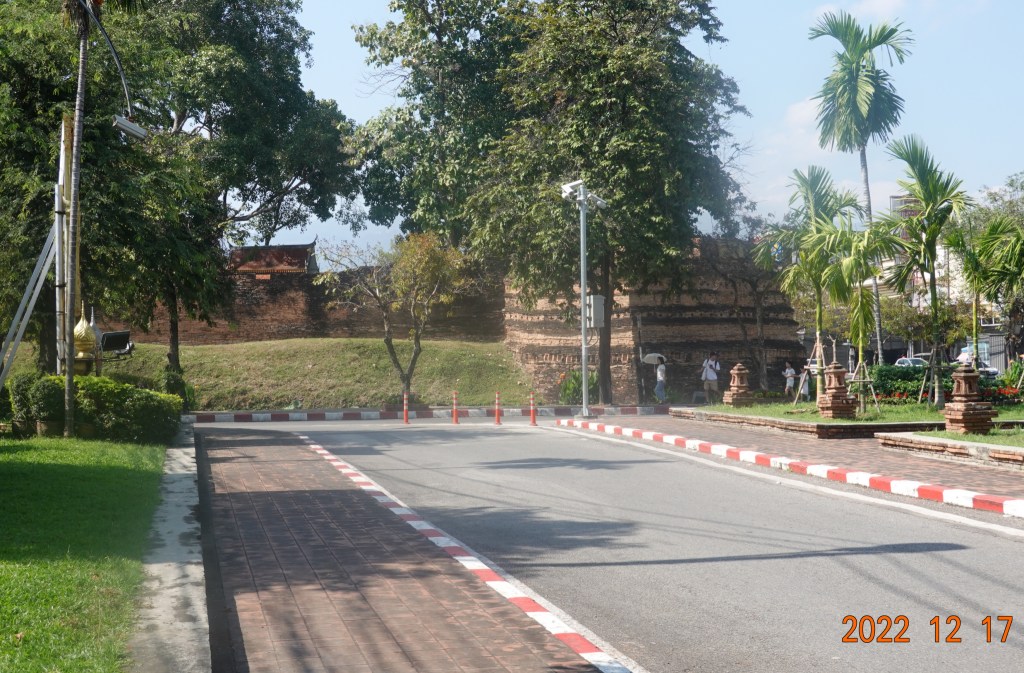
“Sri Phum” means “prosperous land” from which the temple Wat Chai Sri Phum (or Si Phum) takes its name, according to the plaque near the entrance. The temple was established in 1519 by King Phra Muang Kaeo next to a Bodhi tree which he saw as an auspicious sign, and is situated next to the moat on the north east corner, Si Phum Corner. I read that it was renovated in 1837 by King Phuthawong of Chiang Mai and is popularly known as Wat Phan Ta Koen. Almost all Buddhist temples have a formal name and a common name. How Wat Phan Ta Koen and Wat Chai Si Phum relate is unclear.
The viharn (assembly or worship hall) at Wat Chai Si Phum is quite large. Although closed, I could see it to be a large structure, larger than the viharn at most temples. Here are the eastern-facing doors and entrance to the viharn:
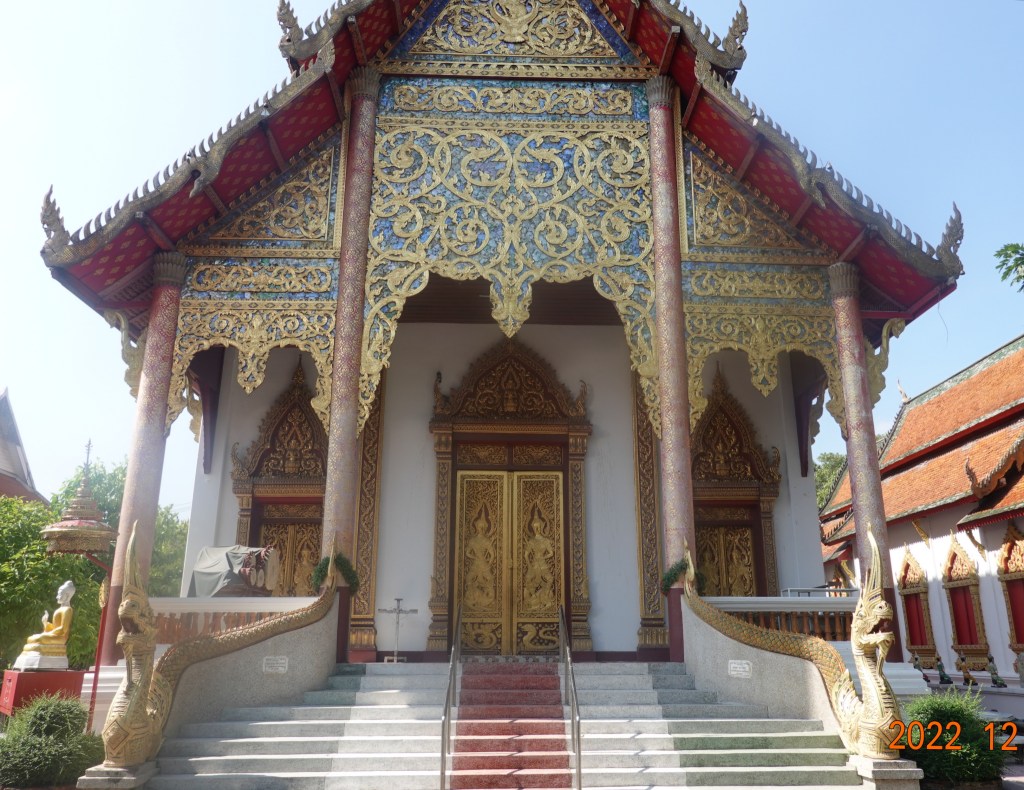
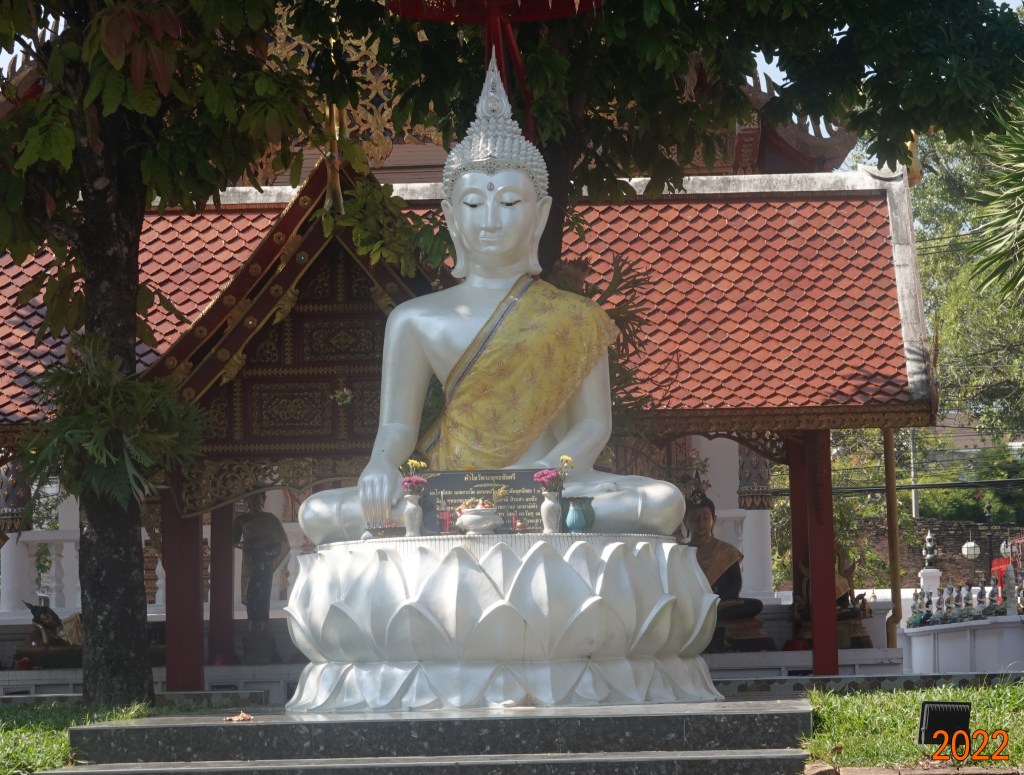
This is clearly in he Lanna style, with the Naga dragon-like creatures on the stairway bannister, and the dancing thewada (angelic beings that live in the heavenly realms) on the doors. Also clearly indicating Lanna style is the roof, with overlapping tiers. (I did not get a photo – there was not room for a good angle). Near the front of the viharn, across a small courtyard is a small pavilion with a large Buddha statue, striking in white alabaster:
There was not much more I could see becasue much of the grounds were blocked off for the renovation of the large chedi. To get the photo below of the chedi, I went outside the temple grounds and down an adjacent soi (larger than an alley, smaller than a road, perhaps like a “lane”) and even then could not get a good angle.

The scaffolding is all bamboo. This is how it is done in Thailand – I saw similar scaffolding in Bangkok. How exactly the workers get up into and traverse the scaffolding, I’m not sure I want to see. I doubt that it would pass an OSHA inspection.
For the rest of the day, I worked a little on older blog postings, then went to a Thai restaurant named Mush for a light dinner, avoiding the Sunday Night Market, also known as the Walking Street. I don’t dislike the Sunday Night Market, but it is crowded, and essentially the same every Sunday. Two main roads that cross in the old City, Phrappkloa and Ratchadamneon are completely closed, and craft and clothing vendors set up along those two streets and in the middle. Everyone just walks up and down the streets, thus the nickname “Walking Street.” The Sunday Night Market is a big social and family event for the Thais. They seem to particularly like the food vendors that set up in the temple courtyard areas along the market streets.
The Sunday Night Market is “controlled,” everything sold must have been made in Thailand or by the seller. This is unlike the Night Bazaar outside the old city. The Night Bazaar is in every guidebook, and I avoid it. The sellers are aggressive, often grabbing you and telling you, special deal for you.” Most of what is sold there are knock-offs from China or elsewhere. No good deals are found at the Night Bazaar.
Next: Evaluating a gym and two local temples

 James the Intrepid Pilgrim