Friday, December 16, 2022
Return to a favorite: Wat Lok Moli
If you have been reading my blog, you know that I seem to have many favorite temples. I confess, I do have many favorites, like Wat Chedi Luang, Wat Phalad, and Wat Suan Dok to name a few. The staff at The 3-Sis sometimes ask me, “what is your favorite temple today?” One of my favorites that is equal to the three I just mentioned is Wat Lok Moli (sometimes spelled Wat Lok Molee).
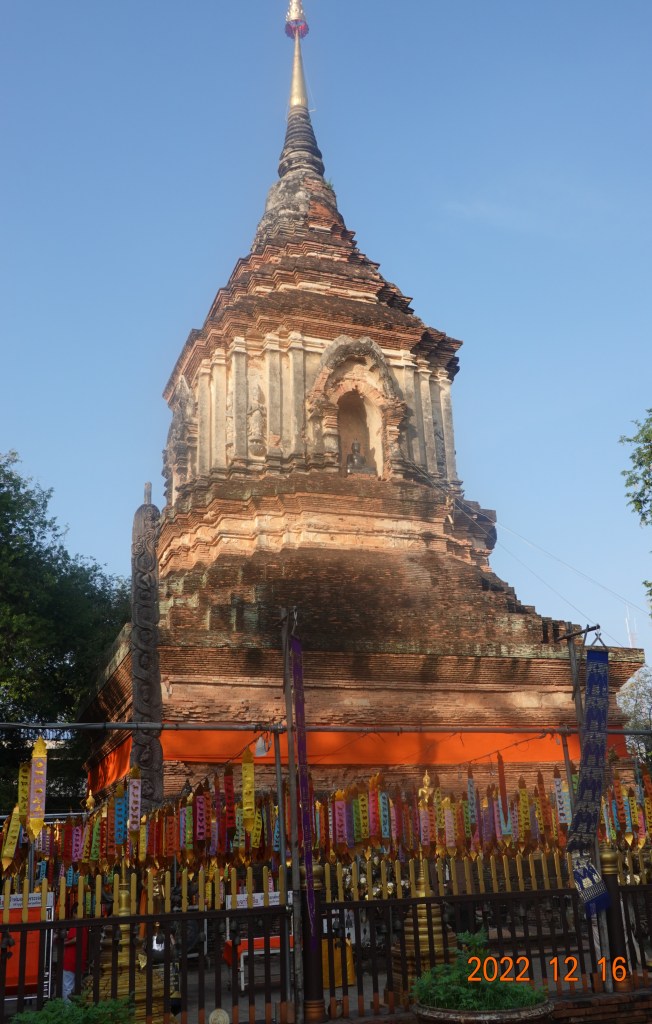
Wat Lok Moli is a very old temple. The temple was known as a royal temple as members of the Mengrai Dynasty, who ruled the Lanna kingdom from the 1290s to about 1600, maintained it during their rule. The chedi which is seen today dates from the 1520s and was built by King Ket, the 12th Lanna king, to house the ashes of members of the Mengrai Dynasty.
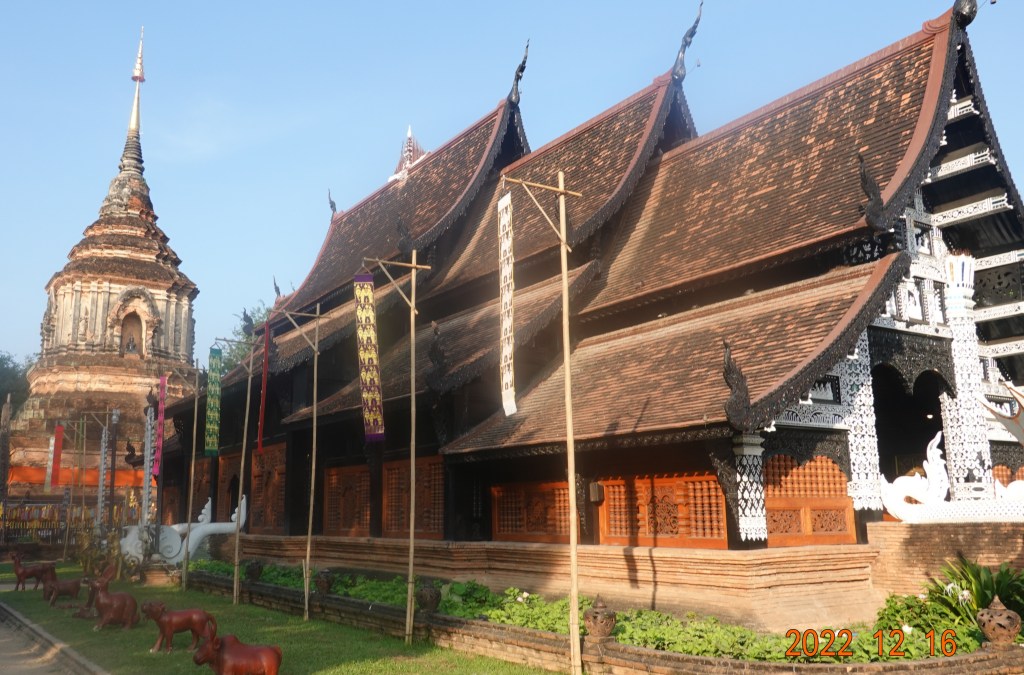
The viharn (assembly or worship hall) is of the Lanna style, made of teak, covered in black lacquer, with overlapping roof sections consisting of several tiers pitched steeply and sweeping very low almost to the ground as can be seen in this picture.
The front entrance of the viharn is guarded by two fierce-looking naga creatures as is also common at Lanna style temples.
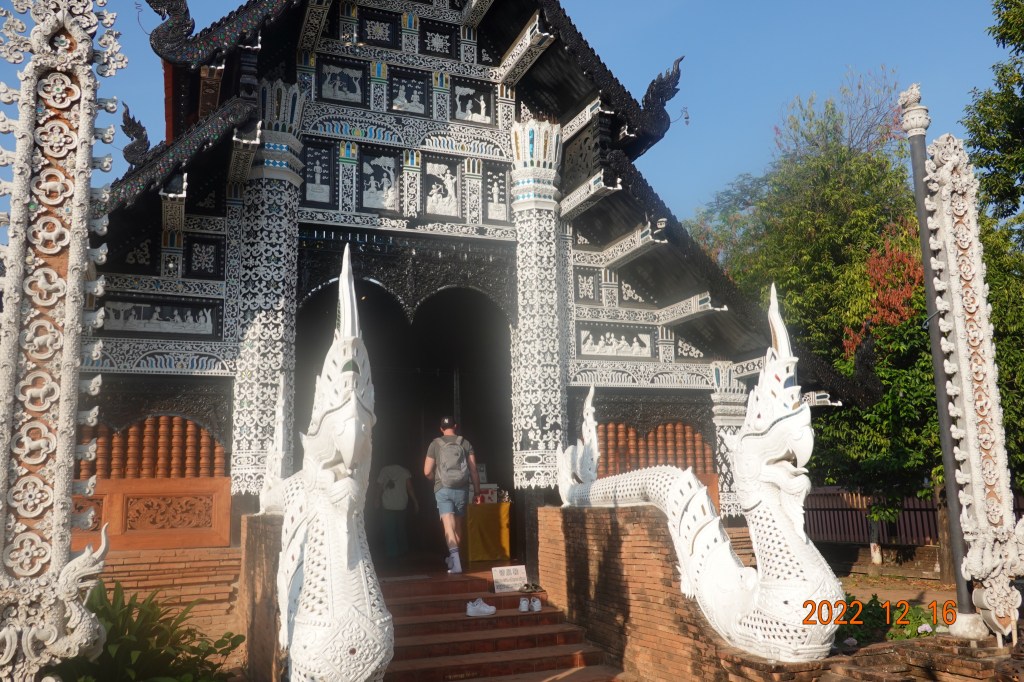
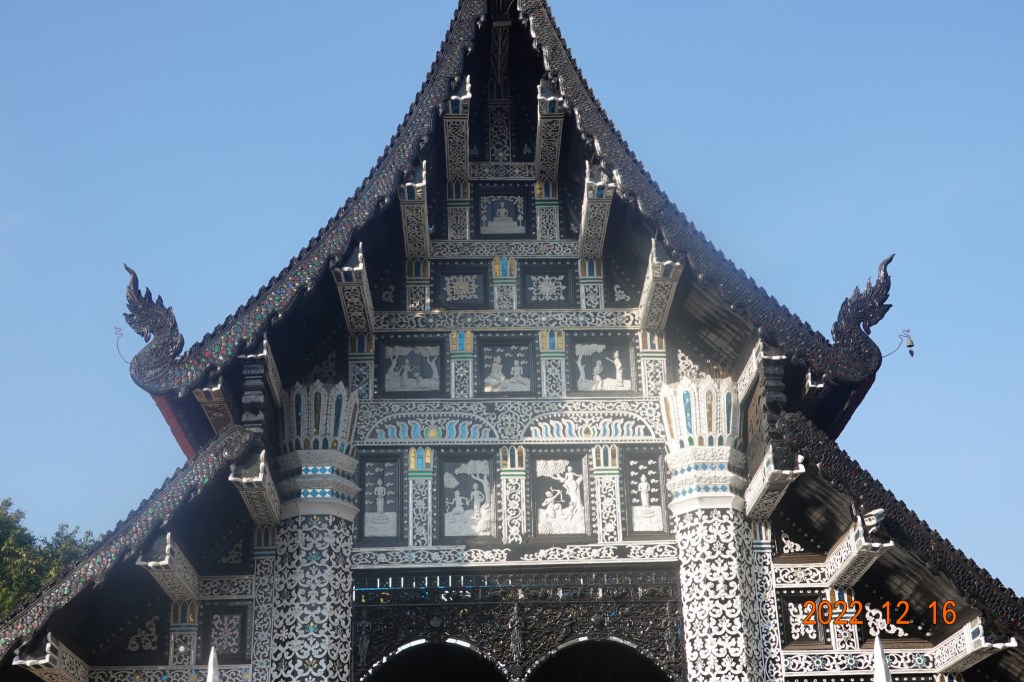
Flanking the naga on the stairway are two Tagundaing style, decorative poles about 20 feet high depicting animals of the Thai zodiac The front of the viharn is very detailed in its intricately carved stucco decoration. This decorative style is also used on the other buildings at Wat Lok Moli. Here is a closer view of the front above the doors:
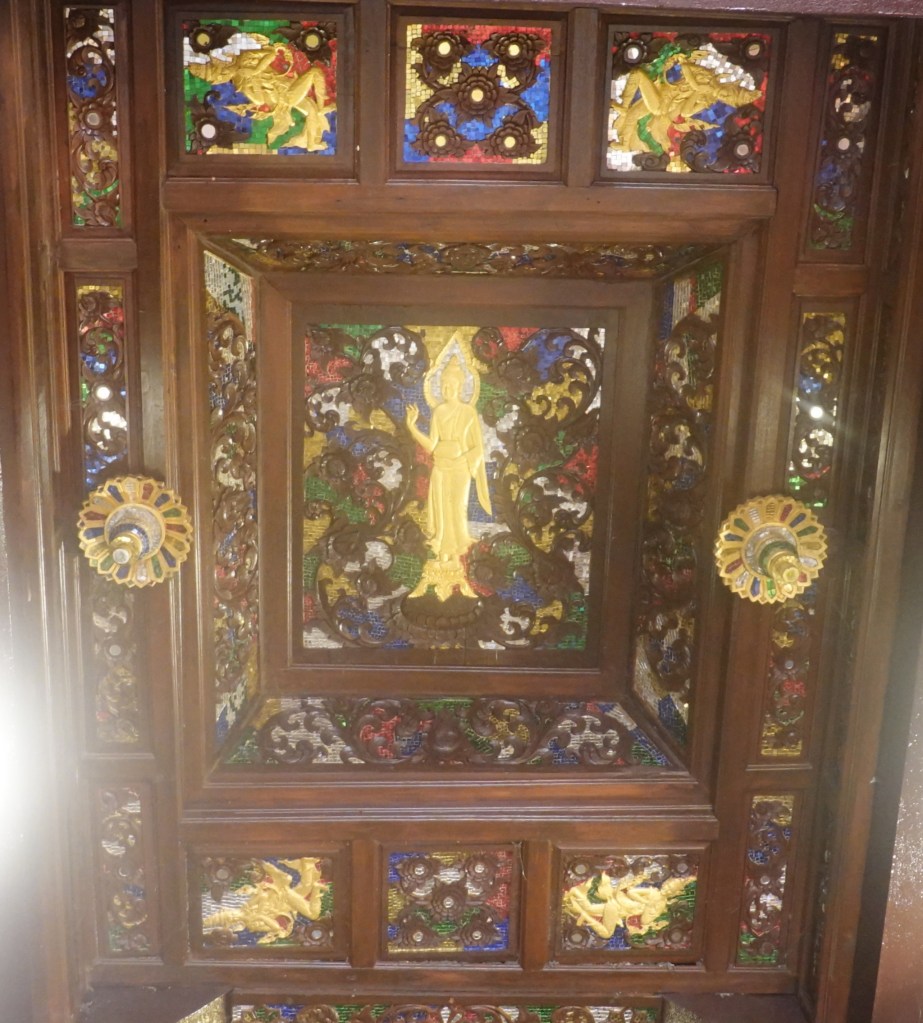
One of the things I like about Wat Lok Moli is the mosaic art on the ceiling. It is difficult to get a good photo due to the glare of the lights hanging from the ceiling. Also, it is late afternoon, the sun is low and shining directly into the viharn creating more glare in this relatively dark space. Here is one example:
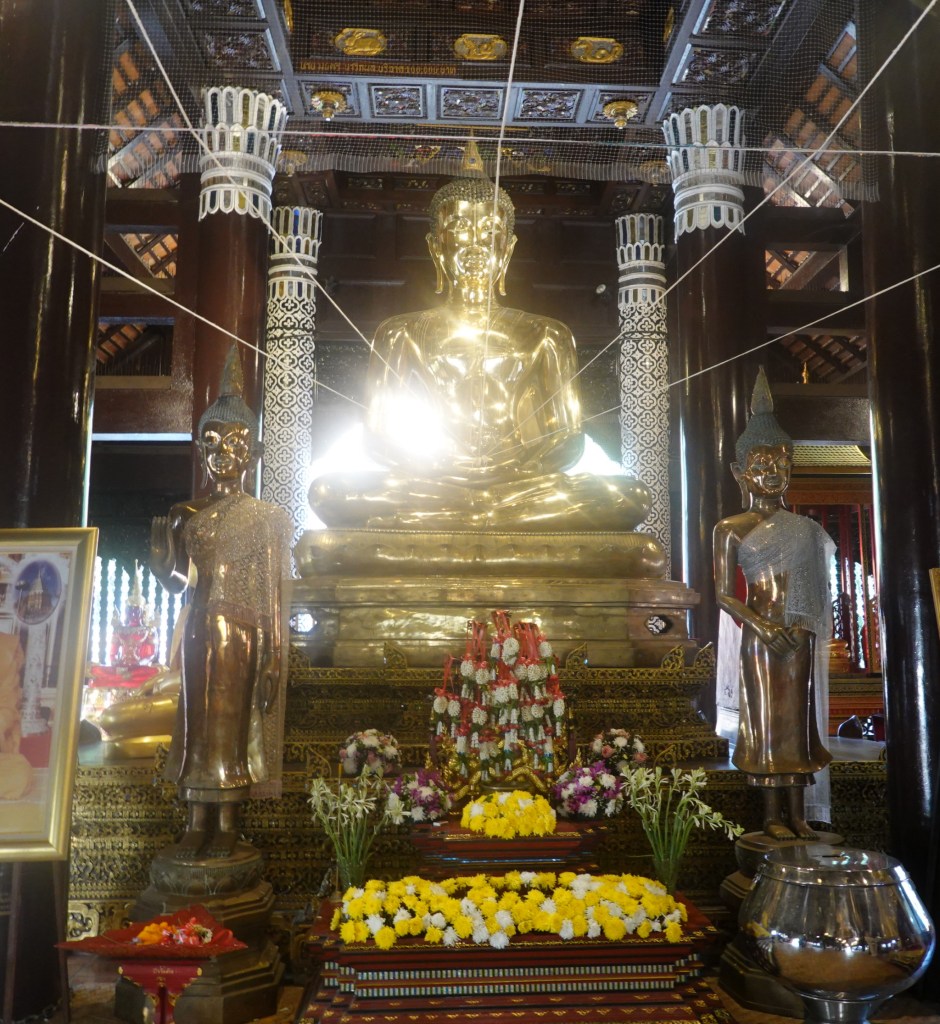
I have been having a little challenge getting my camera settings corrected. Today, this is exacerbated by the sun being low and shining into the back of the viharn right behind the large Buddha statue. The inside of the viharn at Wat Lok Moli is dark with the black lacquered teak making up the walls and columns, and the windows are small and with wooden bars. This causes a start contrast to the bright gold Buddha statue at the front. Here is a photo. I’ll try to get another earlier in the day when the glare is not so great.
Almost all Buddhist temples in Thailand are made up of several buildings: a viharn (assembly or worship hall), sometime an ubosot (ordination hall), sometimes a library (ho trai), and often other buildings in which the monks study and live. At Wat Lok Moli, there are several buildings. Here is the front of a building I suspect might be a library (ho trai), because it is guarded by two mom creatures, as is the tradition for a ho trai:
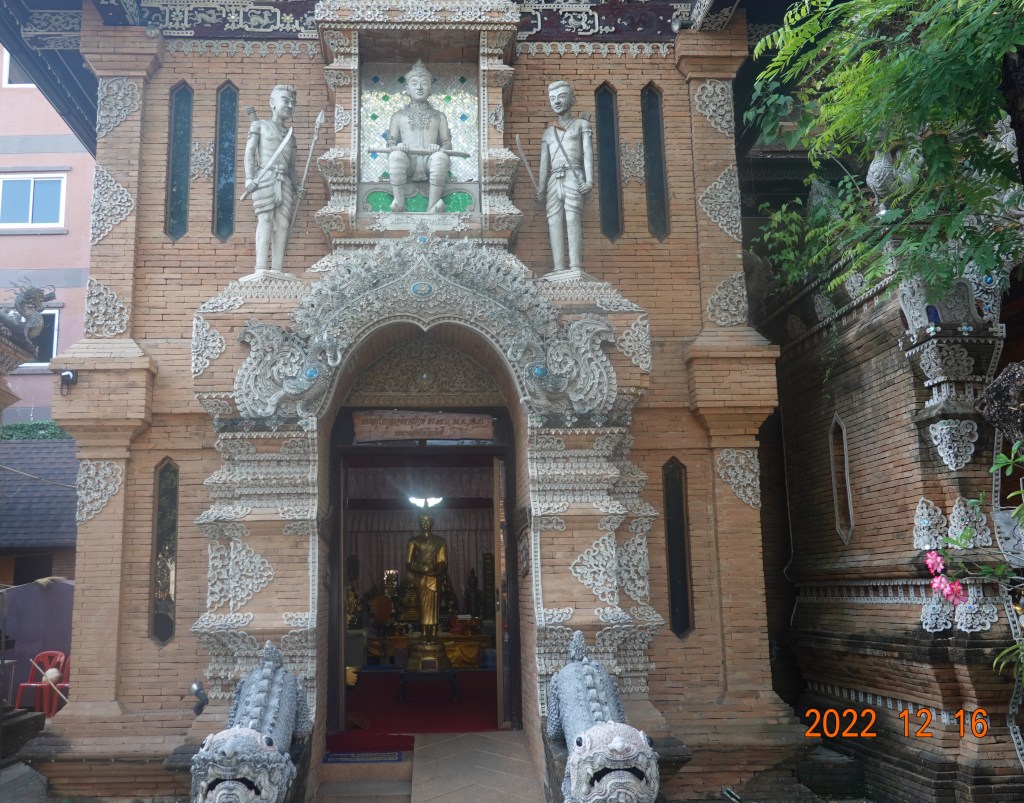
Notice the two mom (pronounced moam) guarding the entrance. Also notice the style of carved stucco decoration is the same as that seen on the front of the viharn. Above the entrance is what appears to be King Kuena who established the temple in the 14th century, or possibly just a depiction a king from the Mengrai dynasty flanked by two angry-looking soldiers carrying swords and spears. Here is a closeup of the king and the soldiers:
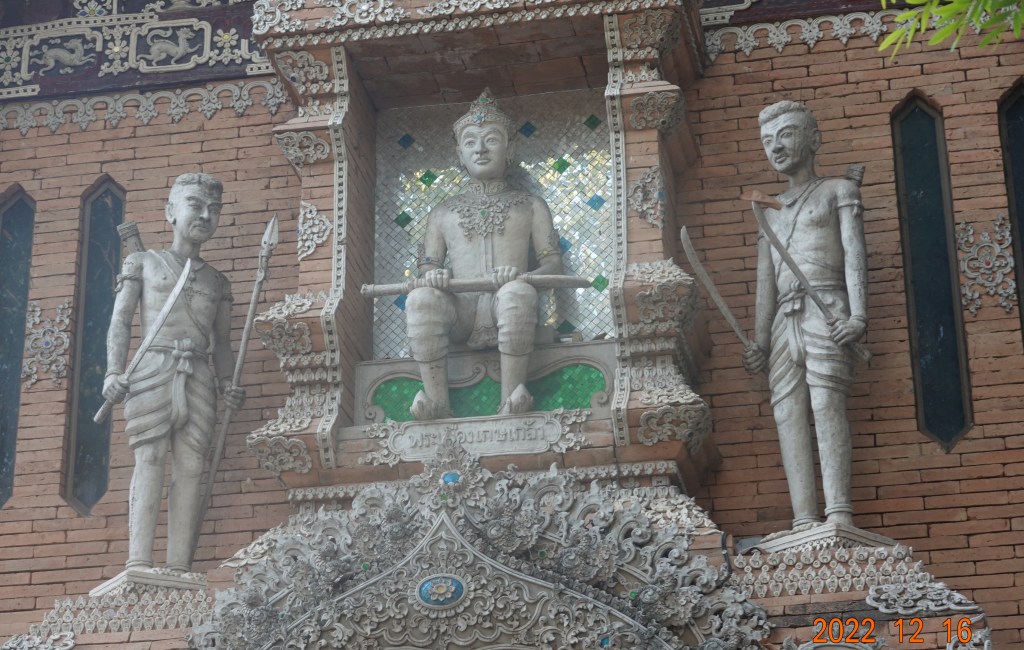
In the closeup, the carved stucco decoration stands out in its intricate detail.
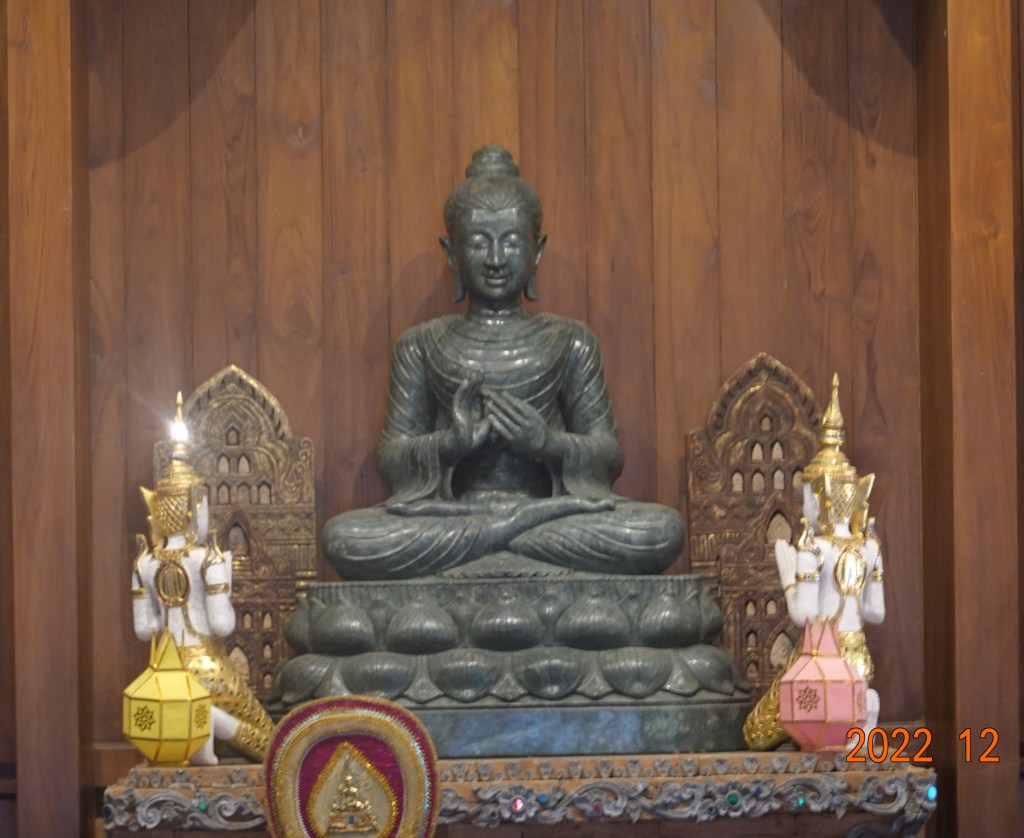
Very near the ho trai is what has been described as a multi-purpose building. It was first under construction during my second or third winter in Chiang Mai, completed a year or two later. I did get to see the men working on the carved stucco decoration, a very slow process. It is used by the monks to receive worshipers and offerings. Here they give blessings and give instruction to people who enter. The outside was blocked by parked cars, but I got a shot of the inside, fairly plain with a very nice Buddha statue:
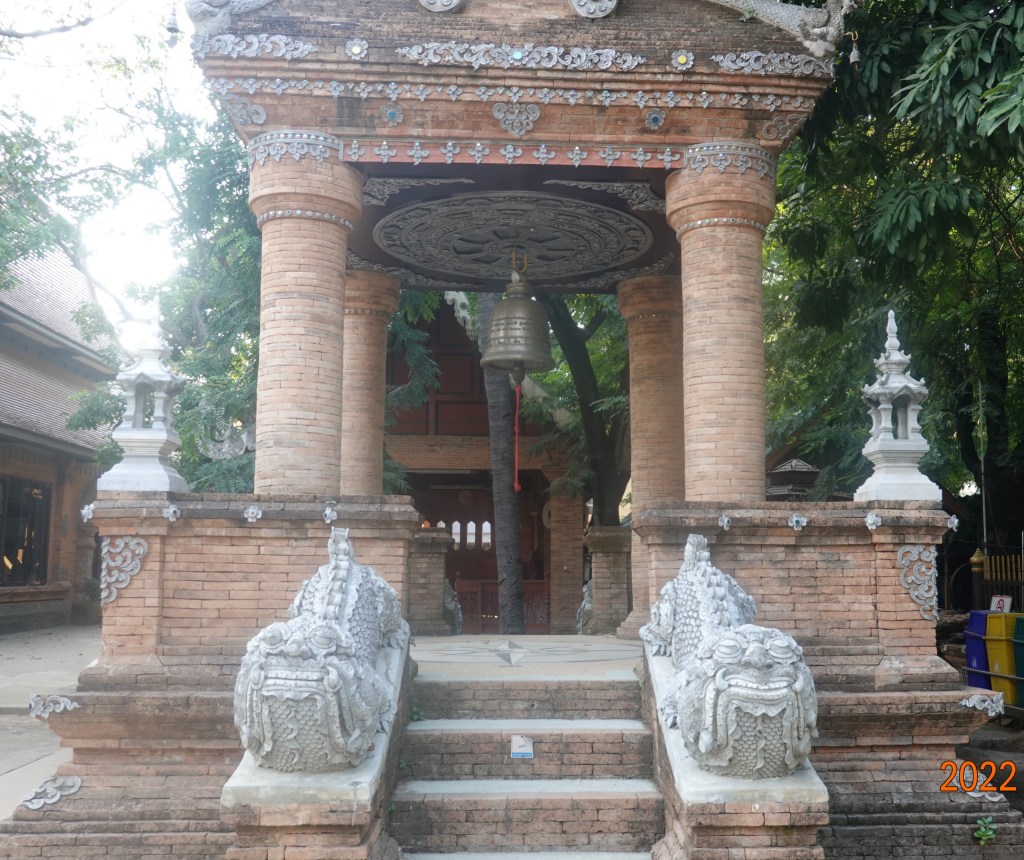
And between the multi-purpose building and the chedi is this new bell pavilion. This was still under construction last year, and looks to be just completed. Notice the same carved stucco decoration on this structure, a recurring theme at Wat Lok Moli. This is not a ho trai (library) but is also guarded by the two mom creatures at the entrance.
Then there is the chedi, tall and magnificent. Its mostly bare brick base and top section are in striking contract to the old stucco-covered middle section.
Wat Lok Moli mystery
Almost every Buddhist temple I have seen has the viharn oriented east-west. The doors open to the east to great the rising sun, and the chedi, in which the ashes of someone are interred, is on the west of the viharn, as the setting sun represents the end or death. The viharn at Wat Lok Moli is oriented north-south, with the viharn doors opening to the south. In almost ten years of asking people here and researching, I can find no reason fir this diversion from the traditional orientation. I know of no other temples in the Chiang Mai area, or even those I have visited in Bangkok, where the viharn doors do not open to the east. I’ll keep looking for the reason, and continue looking for other exceptions.
Next: A couple of local temples

 James the Intrepid Pilgrim