Friday, December 10, 2022
Back to Chiang Mai
Bangkok left me somewhat tired – Bangkok has a frenetic pace – many people, much traffic, all in a hurry, and it is hot and humid. I love many things about Bangkok including some sights I like to see, the food, the people, and after a couple days, I am tired. Returning to Chiang Mai feels like slowing down and relaxing after the intense activity of Bangkok.
I arrived on Friday, checked in to The 3-Sis, a guest house (small hotel) and restaurant owned by three sisters and their parents. I know the whole family, having stayed at The 3-Sis and/or See You Soon for ten years. The three sisters are Poppy, Ice, and Uey. Poppy runs The 3-Sis, Ice and her husband Ball run See You Soon, another restaurant, shop, and smaller guest house down the street about 75 meters. Uey and her husband live in Bangkok with their 5-year-old and occasionally come to Chiang Mai which is how I met them.
For dinner Friday night I went to La Fontana, close to The 3-Sis, had my favorite gazpacho and a pizza. La Fontana is an Italian restaurant run by an Italian who is married to a Thai. Their food is fresh and very good – the pizza is beter than any I can find at home. I did not take pictures of the food this time, but I’ll be back there and will share pictures. I know that gazpacho is really Spanish, not Italian. When I pointed that out to the owner a few years ago, he said that the ingredients are available fresh, and customers like gazpacho, so he keeps making it.
It is surreal to be back in Chiang Mai. I will explore the city to see what has changed soon.
Saturday, December 11, 2022
A Rest Day in Chiang Mai
I am the only guest in The 3-Sis. They closed down for a major remodel shortly before the pandemic, and then were unable to make progress over the duration of the extended lockdown. A year ago when I was here, Poppy showed me that the restaurant remodel had been completed, and it was very nicely designed and the workmanship superb. The restaurant is connected to the guest house, and has been rebranded as Poppy’s Kitchen. She was not opening it last winter because there were not enough tourists, and it was unclear whether the government might initiate more restrictions to tourism. With things gradually opening up fully, Poppy’s Kitchen is open, and progress on The 3-Sis has continued.
When I contacted Poppy in July asking her if The 3-Sis would be open in December, she said they would be and booked me in for December 9. Basically, they got one room done, the room I am in. There is work taking place every day, and the overall completion is clearly near. Poppy might open for other guests in a week. The remodeled rooms are much nicer than before.
Today, Saturday, I took essentially a rest day. I did walk around a little, but mostly I stayed in my room and started working through the process to make a blog post. In past years, I had a Windows laptop and had a process to crop and resize the pictures, upload them, and write the blog text using Windows-based tools or apps. This year, I am using my Samsung Galaxy tablet, and I’m learning a new process. Actually, the process is essentially the same, but the tools and steps are different and new to me. It is not difficult, just different, and not everything is obvious. Much to learn. And it is fun. I did finish the blog post, and being a low-key day, had a Thai stir-fry dinner at Poppy’s Kitchen.
Sunday, December 11, 2022
Walking the Circumference of the Old Chiang Mai City
Note: After making the walk described below and examining my pictures, I discovered that some settings on my camera were wrong, so some of the following pictures are over exposed. I think I have restored the settings I prefer.
After breakfast this morning, I decided to walk the entire curcumference of the old Chiang Mai city. The word “Chiang” in the city name historically translates to “walled city,” meaning a city with a wall around it. There are several cities with that prefix in northern Thailand: Chiang Mai, Chiang Rai, Chiang Saen, Chiang Khong, Chiang Kam, Chiang Klang, and a few others. King Mengrai founded and built Chiang Rai (the walled city of King Mengrai). The stories say that because it was close to Burma, the Burmese and his people battled many times. So he, working with the two neighboring kings (there were smaller kingdoms at the time), the king of Phayoa and the king of Sukhothai, they designed a new walled city also with a moat around the walls. The word “mai” in Thai translates to “new,” so properly translated, Chiang Mai is the “new walled city.”
Around the old city of Chiang Mai, the moat still exists. Much of the wall is gone except at the corners and at the gates. After investigating what might have happened to most of the wall, I learned that when the Japanese occupied this area during World War II, they dismantled much of the wall to use the bricks to pave the road to Pai to move military equipment as construction materials were in short supply. Here is a picture from about 1900 showing most of the wall intact, although deteriorating.
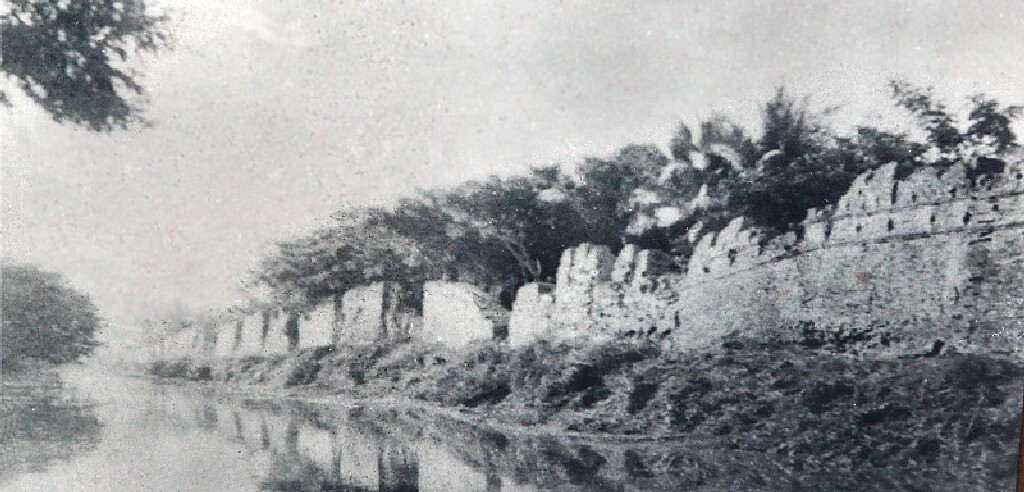
The walls formed a rectangle, 1800 meters by 2000 meters. Originally, there were four gates in the wall, Chiang Mai Gate on the south, Suan Dok Gate on the west, Chang Phuak Gate (originally Hua Vieng Gate) on the north, and Tha Phae Gate (originally Chiang Ruak Gate) on the east. Suan Pung Gate was added in the 1500s by King Saen Muang Ma for his wife whose palace was outside the city walls.
I started my walk at Chiang Mai Gate. Currently, there is a very busy market there, so I got through the market and headed west. Here is a view of the moat as I was walking west:
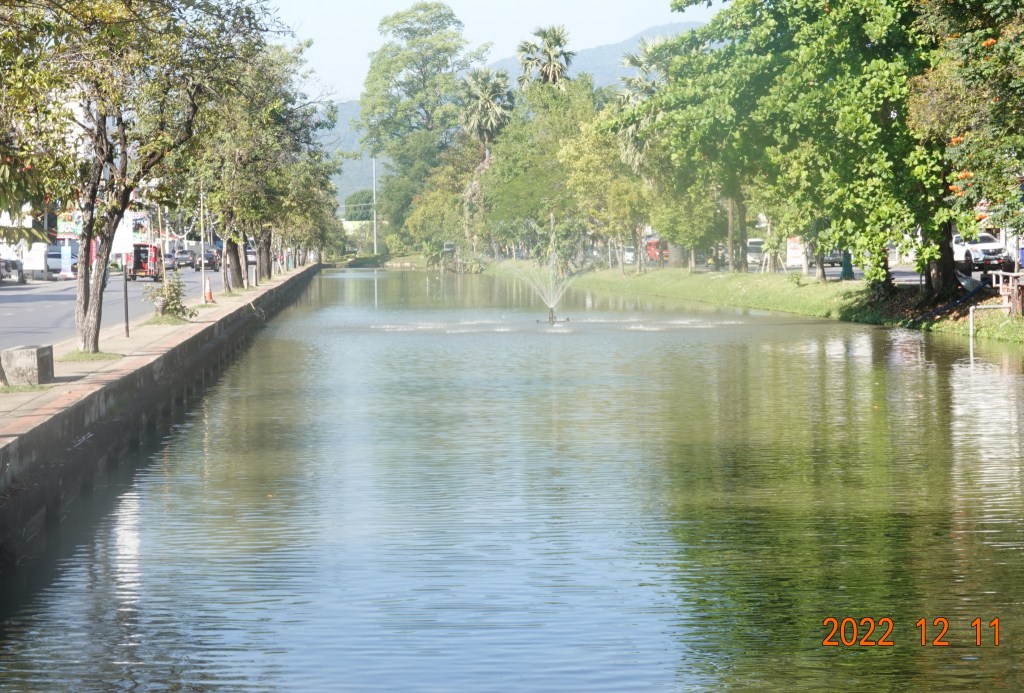
There are roads along the moat/wall, and all have specific names. Traffic on the “outer moat road” goes clockwise, and traffic on the “inner moat road” goes counter-clockwise. There are many crossovers. I continued walking and soon got to the second gate on the south side, Suan Pung Gate.
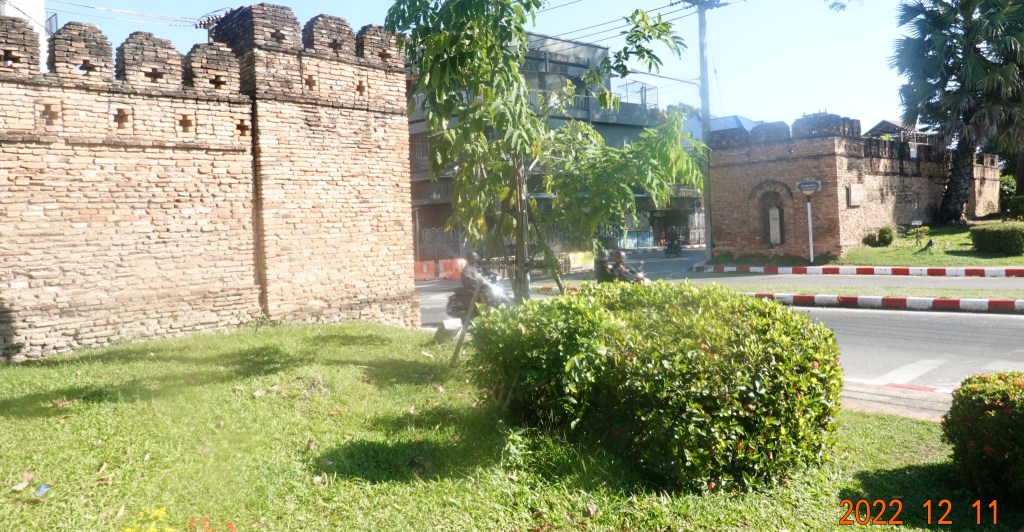
Suan Pung Gate was riginally built to allow the queen to efficiently move between her palace outside the city and where she was supervising the construction of the large chedi at Wat Chedi Luang. Later, it was sometimes used as a place to execute rebels, and later used to move cadavers out of the city for cremation. In Thai culture, there is belief in spirits, both good and bad. To this day, some Thais avoid using Suan Pung Gate, believing there to be bad spirits there.
Continuing on, I arrived at Ku Huang Corner, the southwest corner of the wall. The four corners are large, much larger than the gates, and have rooms inside. These are the ramparts from which the army watched over the walls and moat looking for intruders.
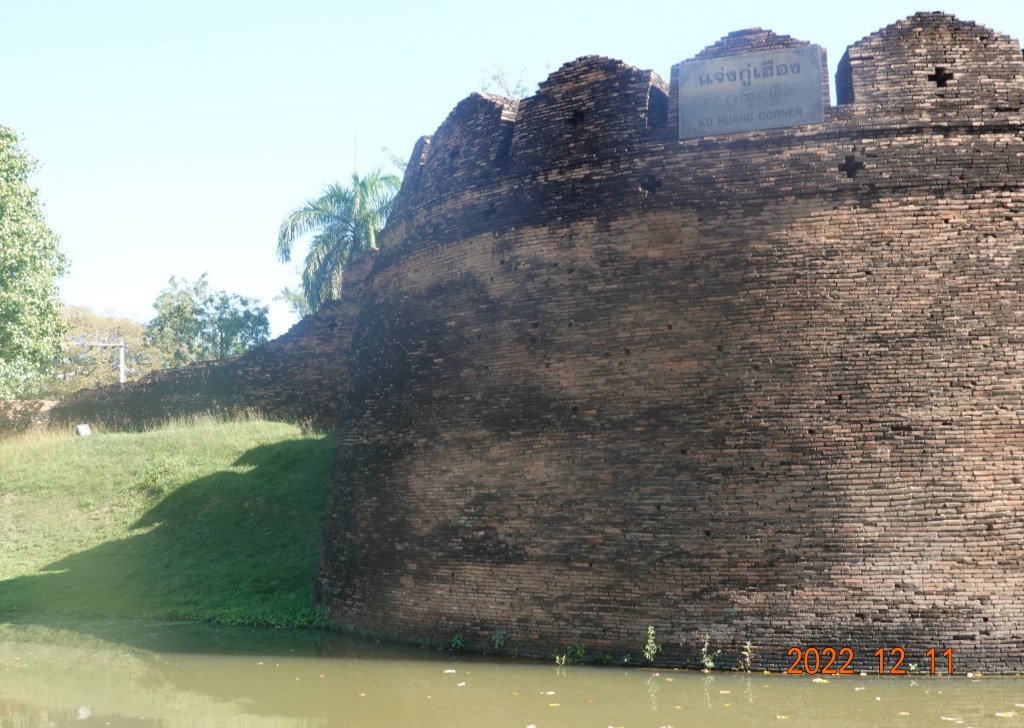
Continuing north along the moat, here is a view leaving Ku Huang corner. Some of the wall connected to Ku Huang Corner is stilll in place in the upper right of the picture:
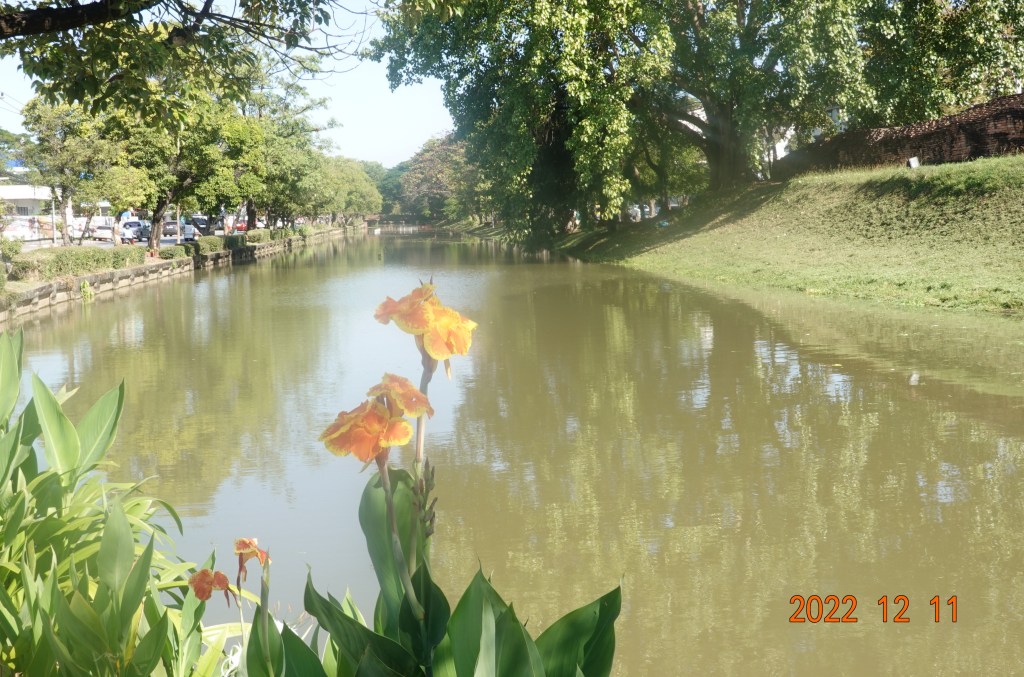
Traffic on the outer moat road going north was fairly heavy. This road connects to the road leading to the airport and districts south, so it is almost always busy. Soon I came to Suan Dok Gate. Suan Dok tranalates to “flower gardens” and the king’s flower gardens were to the west of the city. Now, this is a very busy area with a couple of hospitals, a medical school, and Chiang Mai University.
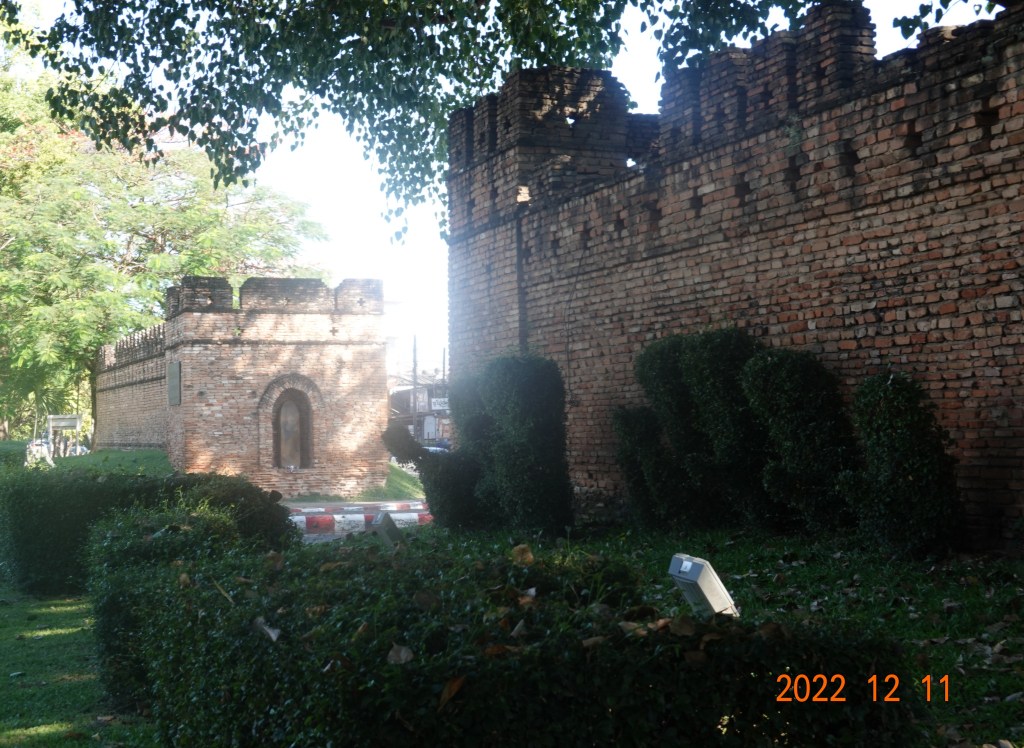
Continuing north, here is a view of the moat, and in the distance, the northwest corner, Hua Lin Corner can be seen…barely:
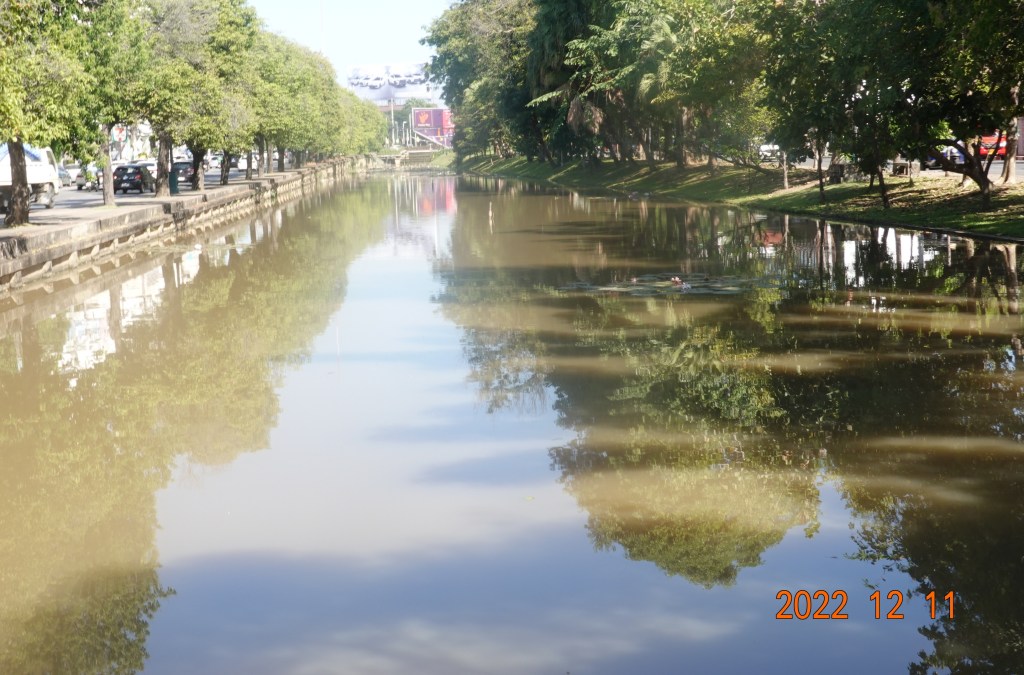
I finally got to Hua Lin Corner, the northwest corner of the moat. My walk is just about half complete.
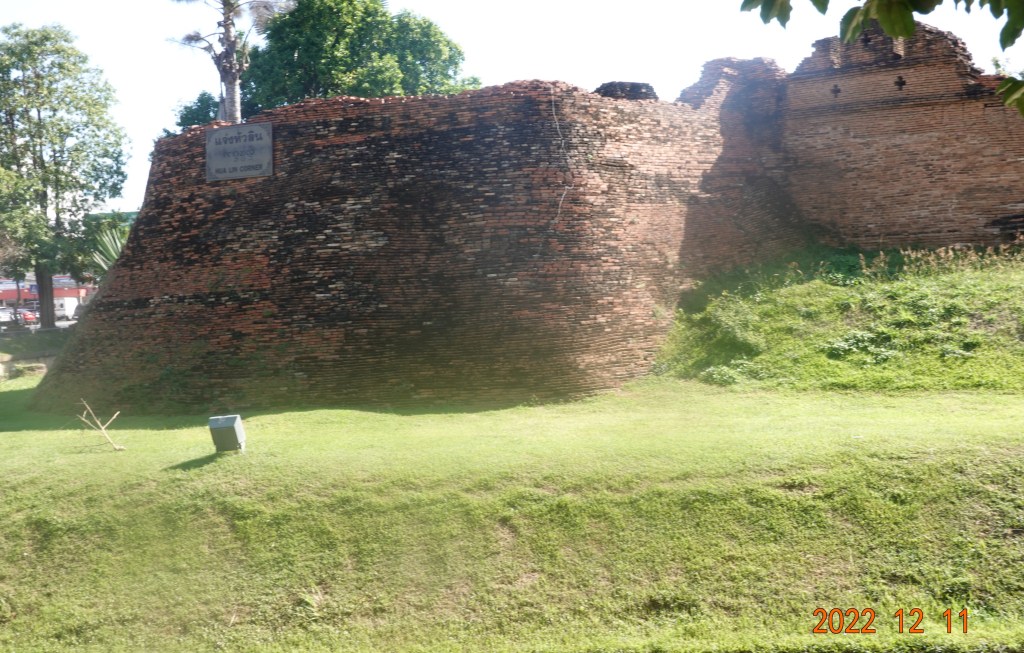
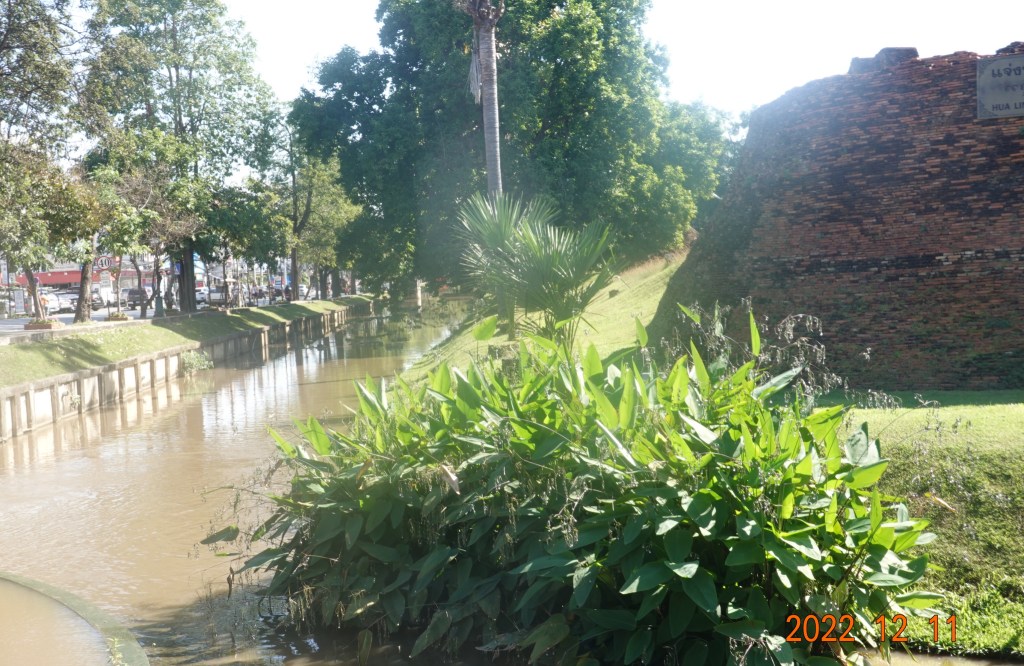
As I rounded the corner, here is a picture looking east along the moat. There is a bit of the wall connected to Hua Lin Corner, but it is obliterated by Hua Lin corner in this angle:
Soon I arrived at Chang Phuak Gate. This past rainy season saw much more than normal rain. A couple months ago, part of Chang Phuak Gate was undermined and collapsed. The gate is now being renovated:
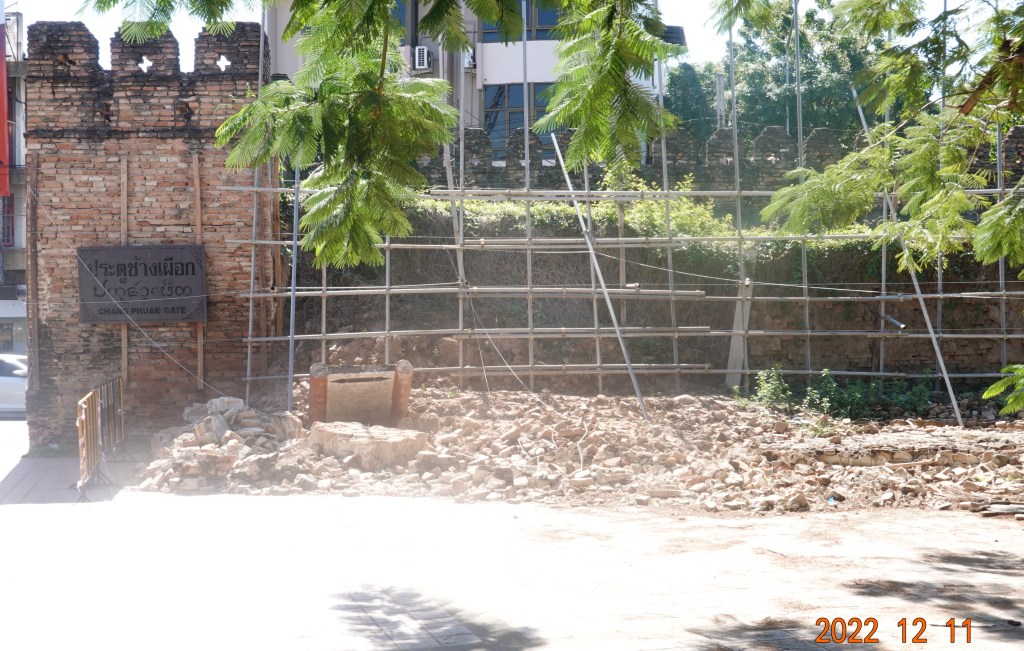
This gate was originally called Hua Vieng Gate, and was considered the most important gate. It was the gate used by royalty on state occasions. The name was changed to Chang Phuak Gate in honor of two servants who saved King Saen Muang Ma’s life. The name is often translated as White Elephant Gate. There are no white elephants. Chang (pronounced “chong”) translates to elephant. Phuak by itself translates to ivory or off-white. However, in the context of a large animal (a water buffalo or elephant), “phuak” does not mean ivory or off-white, phuak means “not the normal color.” The royal elephants are a breed that is a reddish-brownish gray. Most elephants are gray. So the royal elephants are chang phuak, elephants that are not the normal color.
Not fat from Chang Phuak Gate I came to the northeast corner, Si Phum Corner.
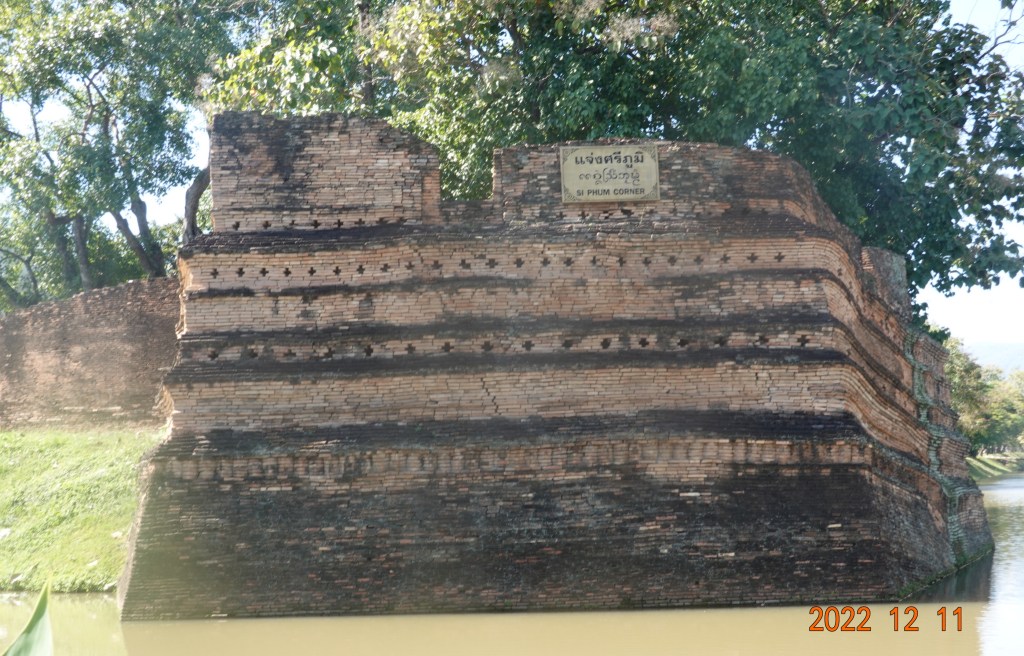
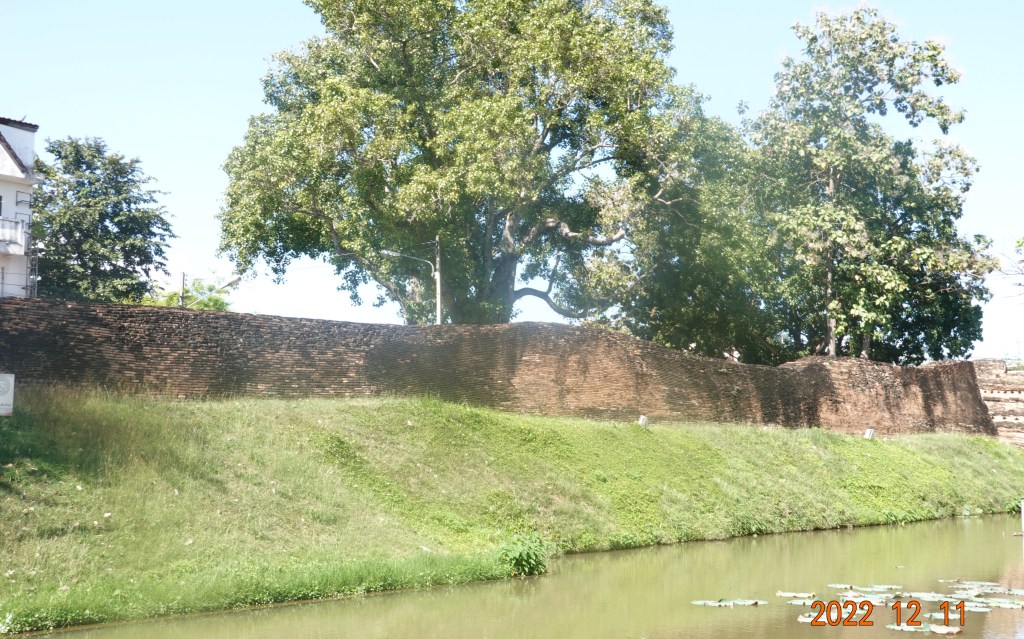
There is also a section of the wall connected to Si Phum Corner. The trees there are large:
Walking south, I arrived at the somewhat famous Tha Phae Gate. The moat between Tha Phae Gate and the road is covered, and is has become the city square of Chiang Mai. The big open ground in front of the gate is the site of many cultural activities and festival celebrations all year round, such as the Flower Festival, Songkran (Buddhist New Year), Loy Krathong, and Yee Peng Lantern Festivals. There are always many tourists here getting their picture taken, and [unfortunately] feeding the pigeons.
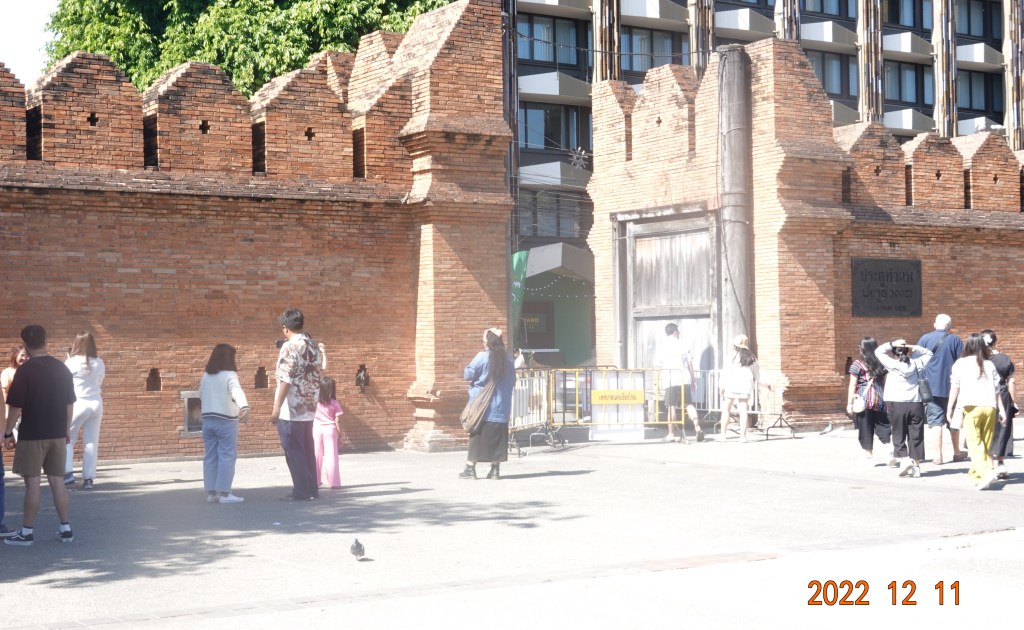
Tha Phae Gate was originally Chiang Ruak Gate, named for the small village on Chiang Ruak nearby.
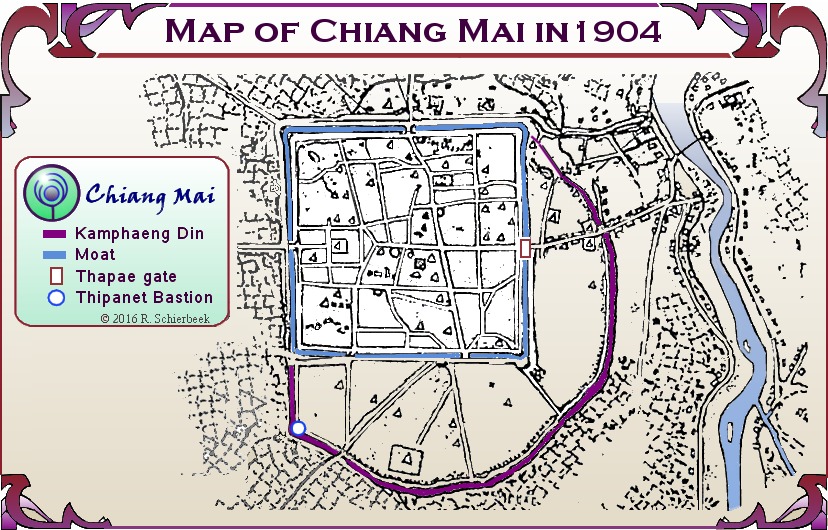
Tha Phae translates to “raft landing.” Closer to the river, there was an earthen and clay wall protecting the east and south of the city from floods. This was the Kamphaeng Din (which translates to “earthen rampart). Tha Phae Gate was the name given to the gate in the Kamphaeng Din as it was close to the boat and raft landing on the river. Since a road ran from Chiang Ruak Gate to Tha Phae Gate and on to the river, Chiang Ruak Gate became known as “Inner Tha Phae Gate” and the gate in the Kamphaeng Din became known as “Outer Tha Phae Gate.” in the early 20th century, the gate in the Kamphaeng Din was dismantled, and Chiang Ruak or Inner Tha Phae Gate became known simply as Tha Phae Gate. Here is a map of Chiang Mai from 1904 showing the location of the city wall and the Kamphaeng Din:
While I am in Chiang Mai, I’ll continue exploring for evidence of the Kamphaeng Din. But today, I continued south to Katam Corner, the southeast corner of the wall:
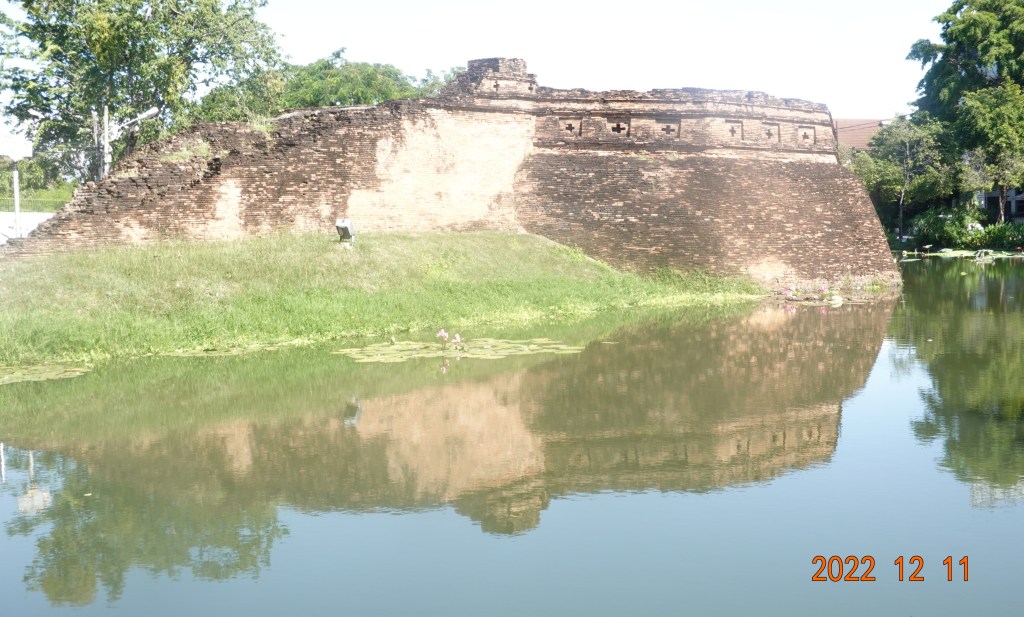
Water flowed into the moat at the northwest corner, Hua Lin Corner, flowed south and east, leaving the moat at Katam Corner. That “exit” is now underground. In the past, fishermen would use a bamboo cage, a katam, to catch fish as the water and fish left the moat. Thus the corner got its name.
A long walk around the perimeter of the old Chiang Mai city. I’ll be revisiting temples and sights and sharing those views in this blog. Tomorrow, I am thinking about hiking up to Wat Phalad. For now, another very good day in Chiang Mai has ended.
Next: Hiking to Wat Phalad and back to Wat Suan Dok

 James the Intrepid Pilgrim
The adventure continues.
LikeLike
My partner and I walked around the outer circumference back in 2010, thank you for the info on the history of the wall…and the gates. Looking forward to reading more of your adventure(s).
LikeLike