Thursday, December 8, 2022
Seeing Favorite Sights in Bangkok
I arrived in Bangkok Wednesday tired after the long journey from Los Angeles. Friday (tomorrow) I shall leave for Chiang Mai shortly after breakfast. Today, Thursday, is my one day in Bangkok to see a few of my favorite sights, namely Wat Arun, Wat Pho, and depending on time and my energy level, Wat Phrea Kaew.
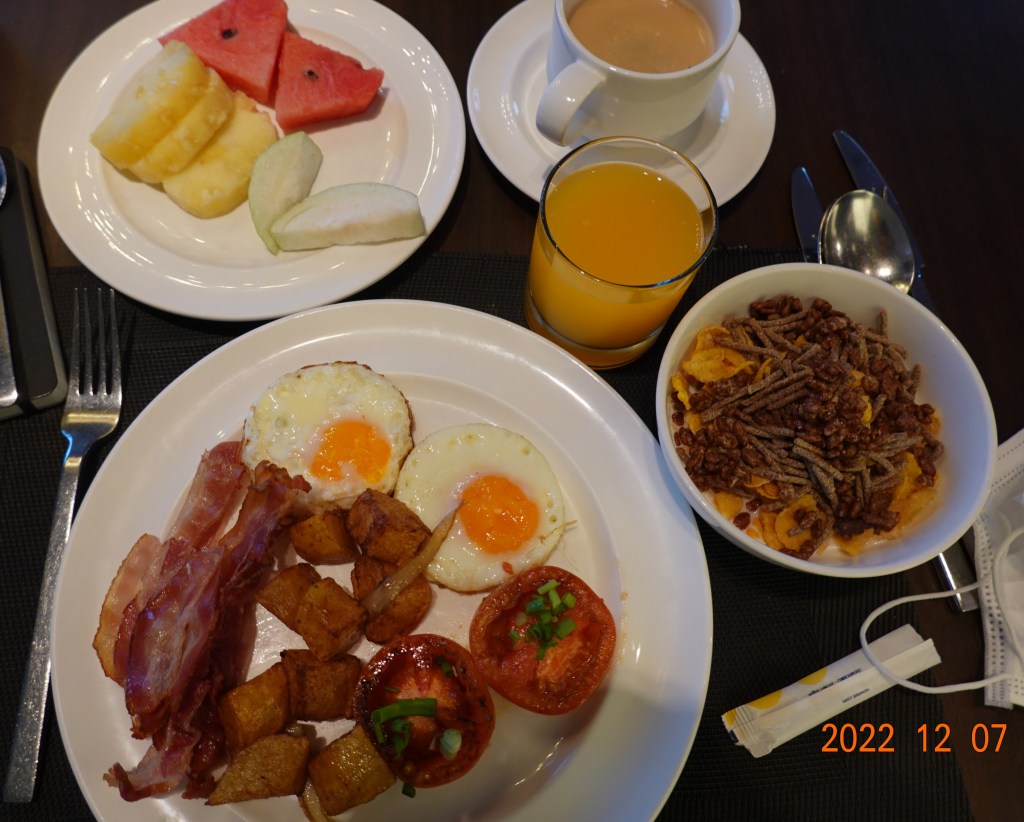
The Novotel hotel offers a rather extensive and delicious breakfast buffet. So, being on vacation, I splurge a little. My very Western-style breakfast seen below:
After breakfast, I cleaned up and headed out to see the sights. As I have done in the past, I plan to take the BTS Sky Train up to the Siam Square interchange stop, change trains, take the second train to the Sapphan Taksin stop, walk to the Central Pier and take a boat to Wat Arun. Round trip on the boat is about 50 baht ($1.50) After visiting Wat Arun, then take the ferry across the river to see Wat Pho, just about a block from where the ferry lands.
Wat Arun
Wat Arun is significant in Thai history, one of Bangkok’s best known landmarks, and is depicted on the 10 baht coin. It is classified as a Royal Temple of the First Class, a category consisting of only six Thai temples (there are 35,000 active Buddhist temples in Thailand). In the 1700s, Wat Arun was then known as Wat Makok, after the village of Bang Makok in which it was located. It is likely that the current city name Bangkok evolved from the village name Bang Makok.
When the former capital Ayutthaya was overthrown in 1774, King Taksin and what was left of his army moved south along the Chao Phraya River, and it is believed that when Taksin saw the temple at dawn, he decided to make this his new seat of government. He restored the temple and renamed it Wat Arun for Aruna, the Hindu Goddess of the dawn. Almost all Thai Buddhist temples have a formal or official name, a short name, and sometimes a nickname. Wat Arun’s formal name is Wat Arun Ratchawararam Ratchawaramahawihan. The most recent cleaning and renovation of Wat Arun took place from 2013 – 2017 during which time the towers were covered with scaffolding as workers carefully restored the surfaces.
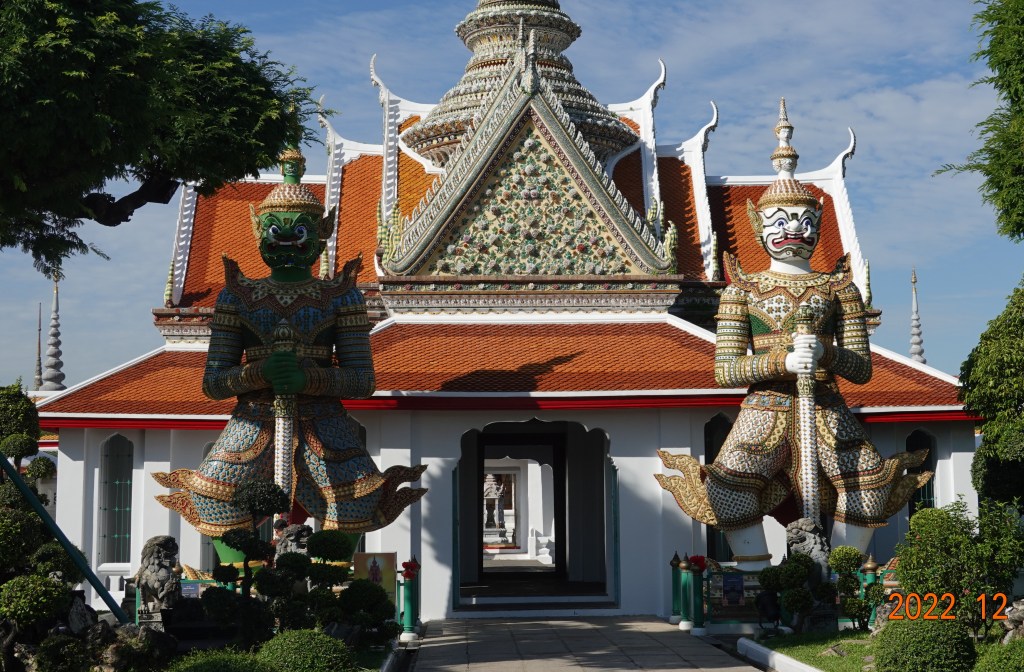
Wat Arun, like many Thai temples, is something of a small campus, with several buildings and structures. The entrances to the first viharn (worship hall) at Wat Arun is guarded be two large yak or yaksha figures. From Wikipedia, “yaksha are a broad class of nature-spirits, usually benevolent, but sometimes mischievous or capricious, connected with water, fertility, trees, the forest, treasure and wilderness.” Here are the yaks standing guard at the entrance:
And, just to prove that I’m actually there, here I am in front of one of the yaksha – I’m the smaller figure in the shadow:

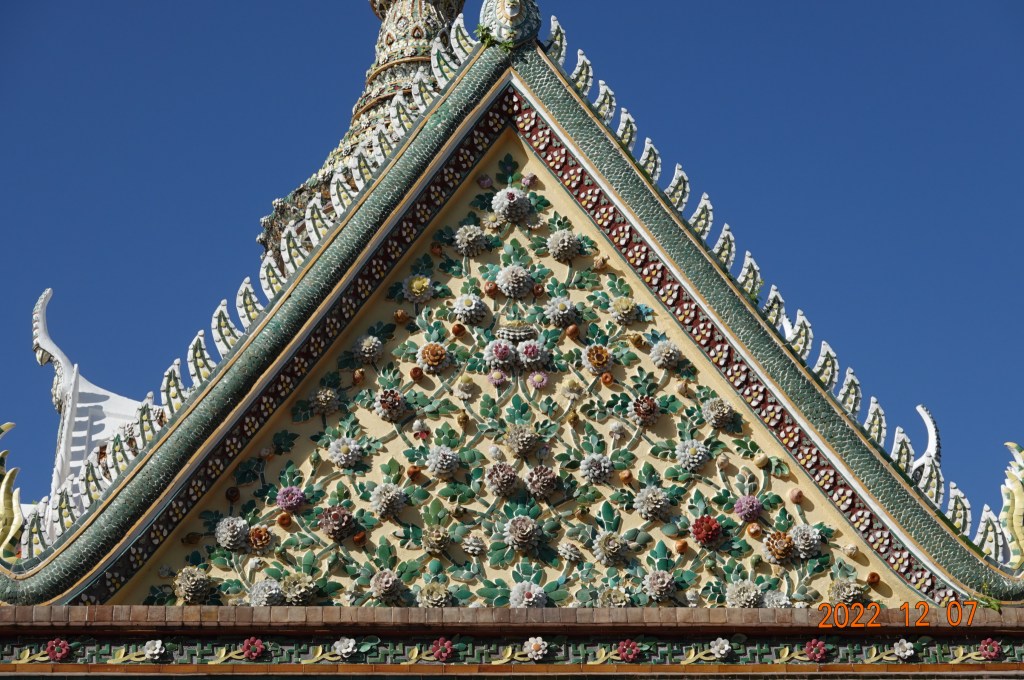
Here is some detail of the structure above the entrance, this is similar to the detail of the large towers.
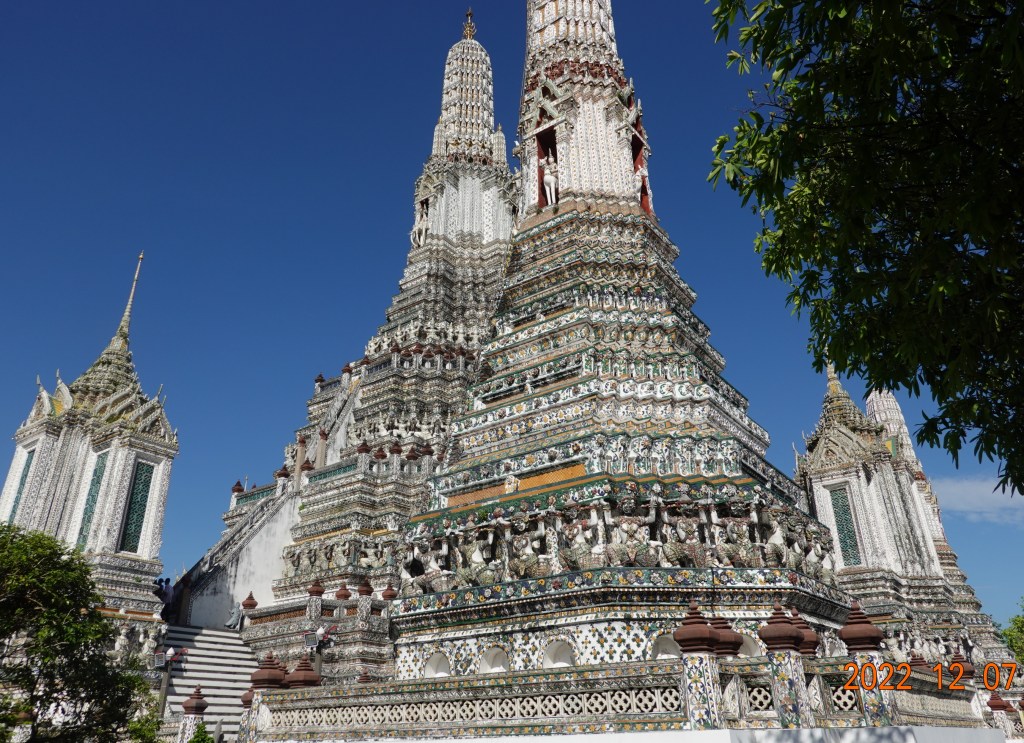
I entered the temple grounds, and there before me is one of the large Wat Arun towers. Although the temple had existed since at least the seventeenth century, its distinctive prang (a prang is a Khmer-style spire or tower) were built in the early nineteenth century during the reign of King Rama II.
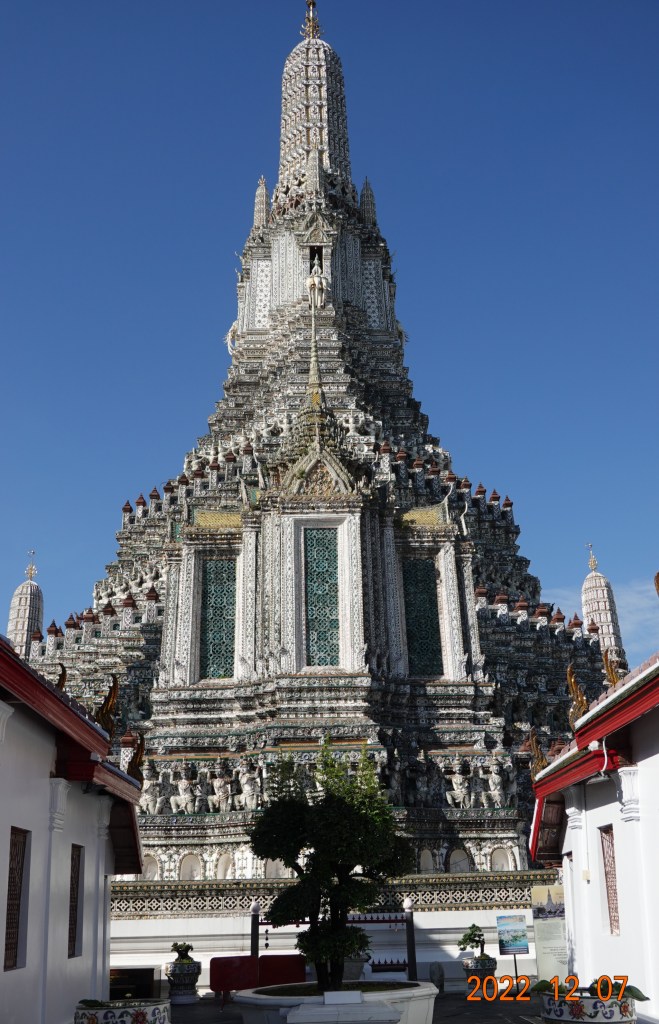
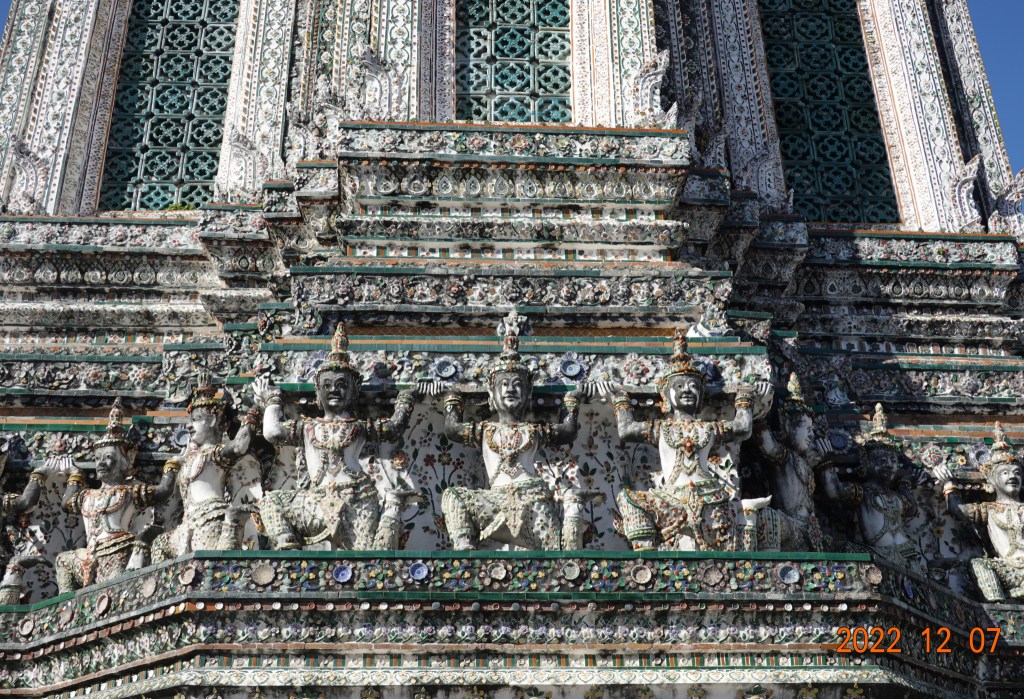
I approached the tower. Here is a more detailed view of the first prang tower:
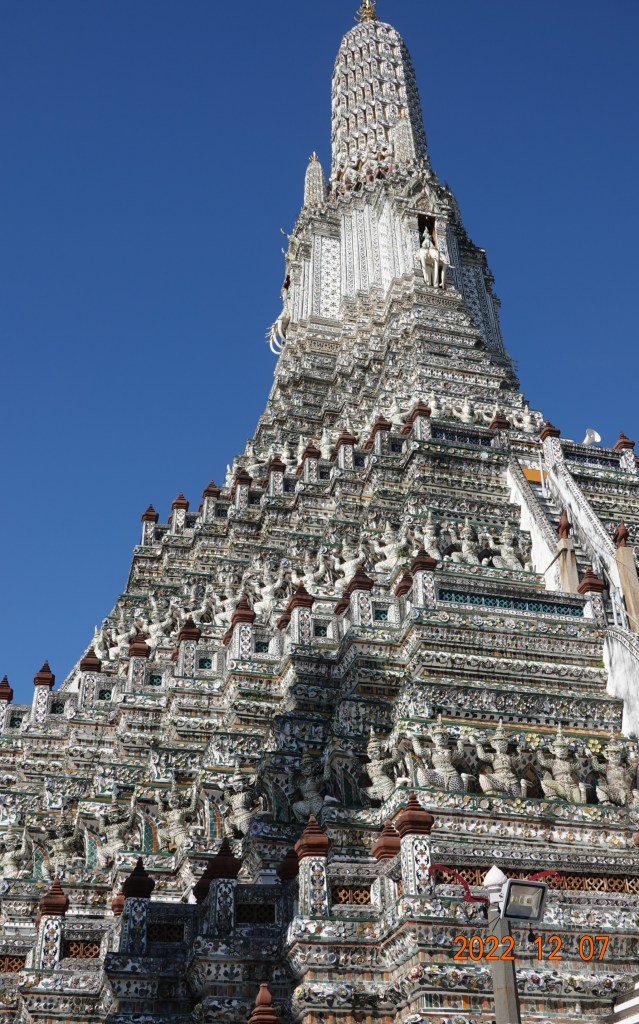
To see a little more, something of a corner view of the large prang tower:
I did climb up the very steep stairway to the first level and walked around the main tower.
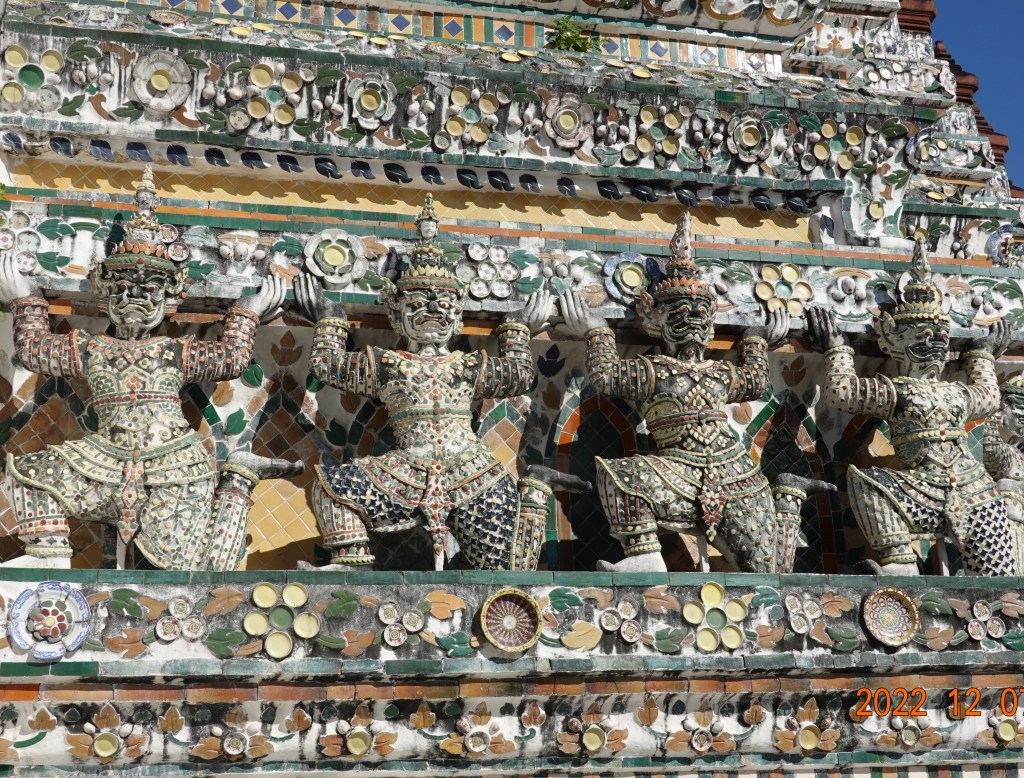
And more detail of the flower motif on the main tower:

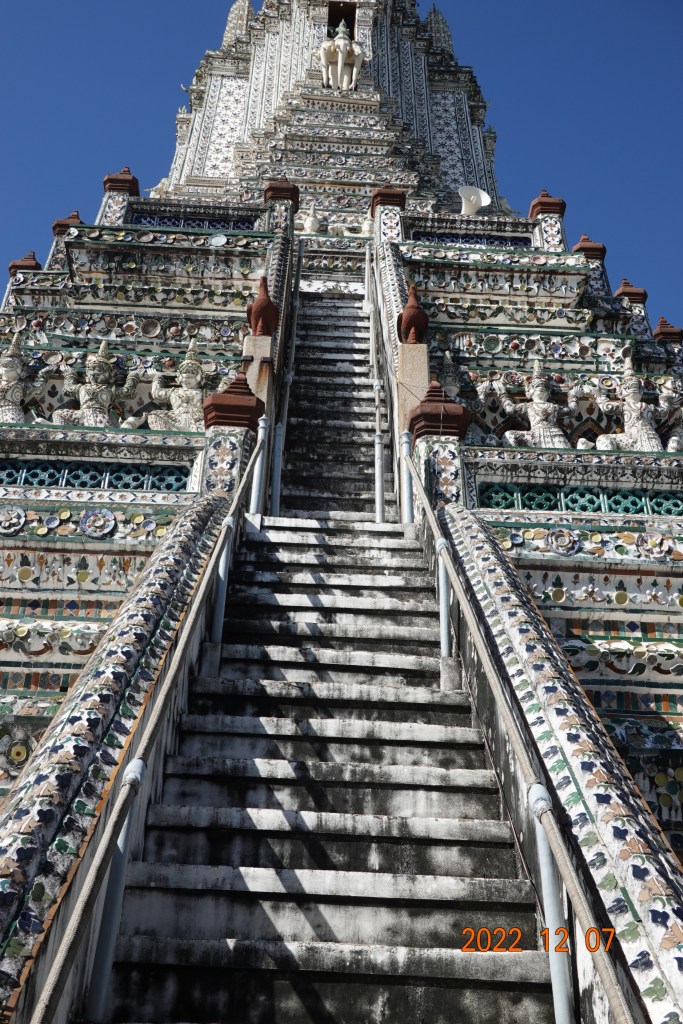
A view of the stairs to the second and third levels of the tower. The public is not allowed beyond the first level.
Another corner view of the main tower in which the complexity of the structure is seen:

A view of the main and secondary towers, also showing how complex their construction is:
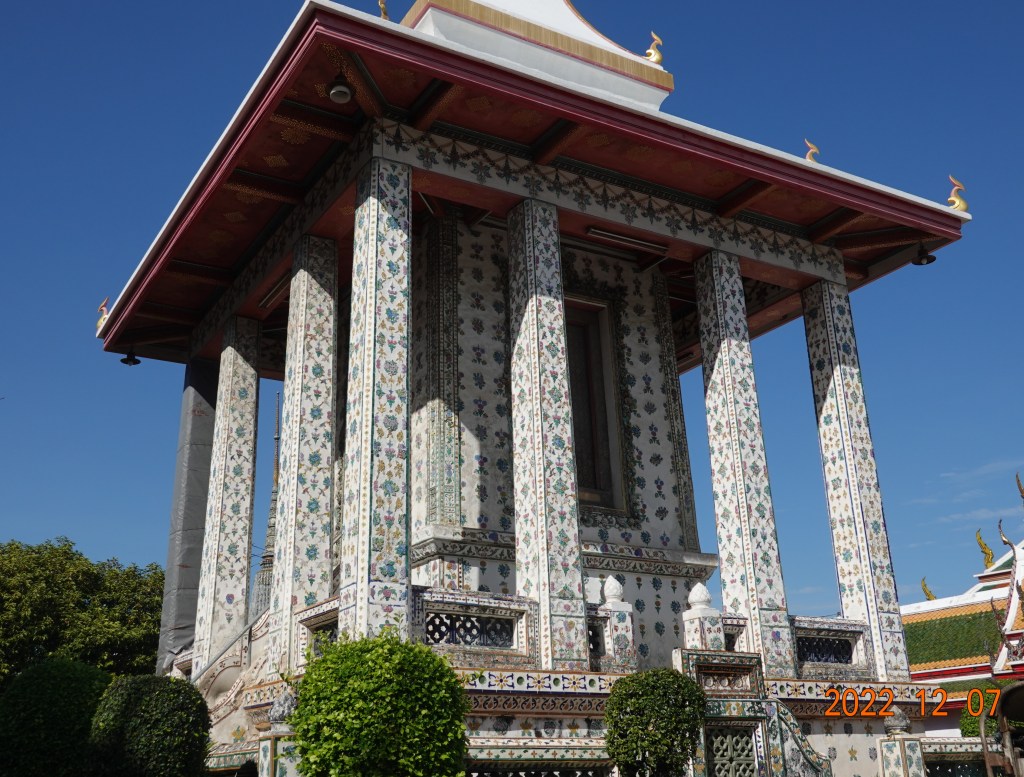
Off to the side of the towers, I came across this pavilion:
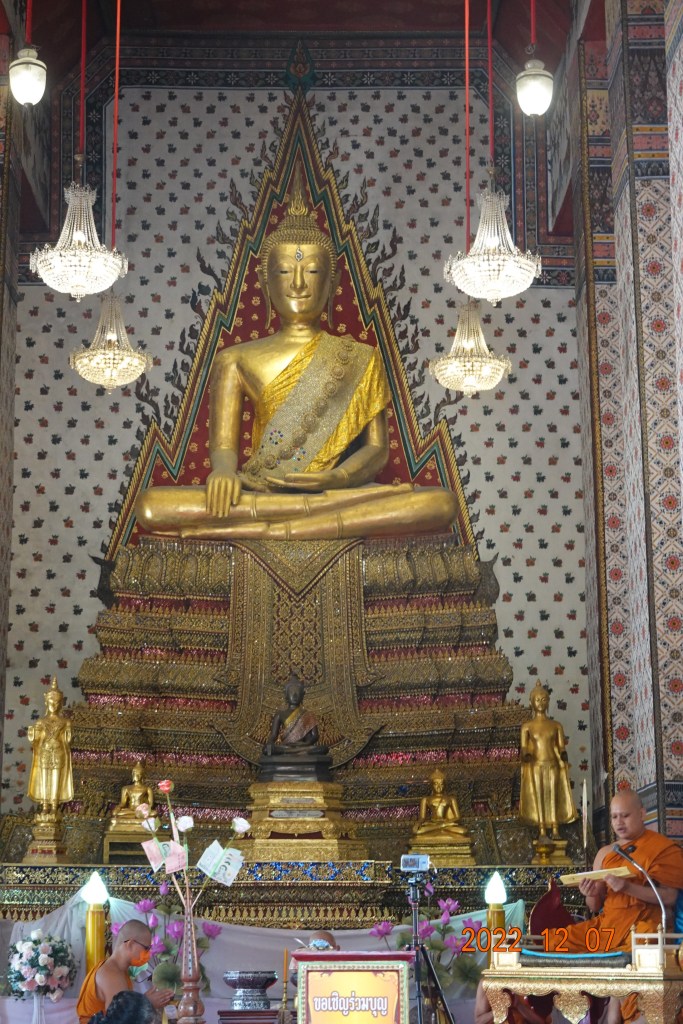
And inside was what appears to be an older-style viharn (worship hall) in which a monk was chanting:
After walking around and Wat Arun for well more than an hour, it was time to go across the river to see Wat Pho.
Wat Pho – The Reclining Buddha
The ferry across the river cost 5 baht (about 15 cents). I do not typically take pictures while on the boats in Bangkok becasue the river is choppy and dropping my camera overboard would not make for a good day.
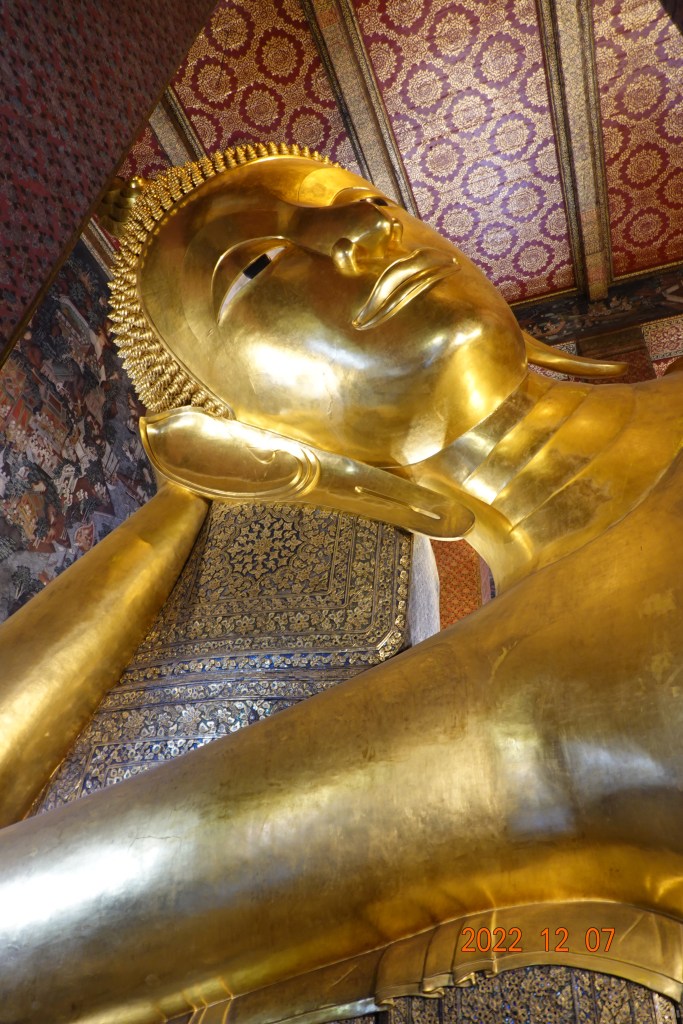
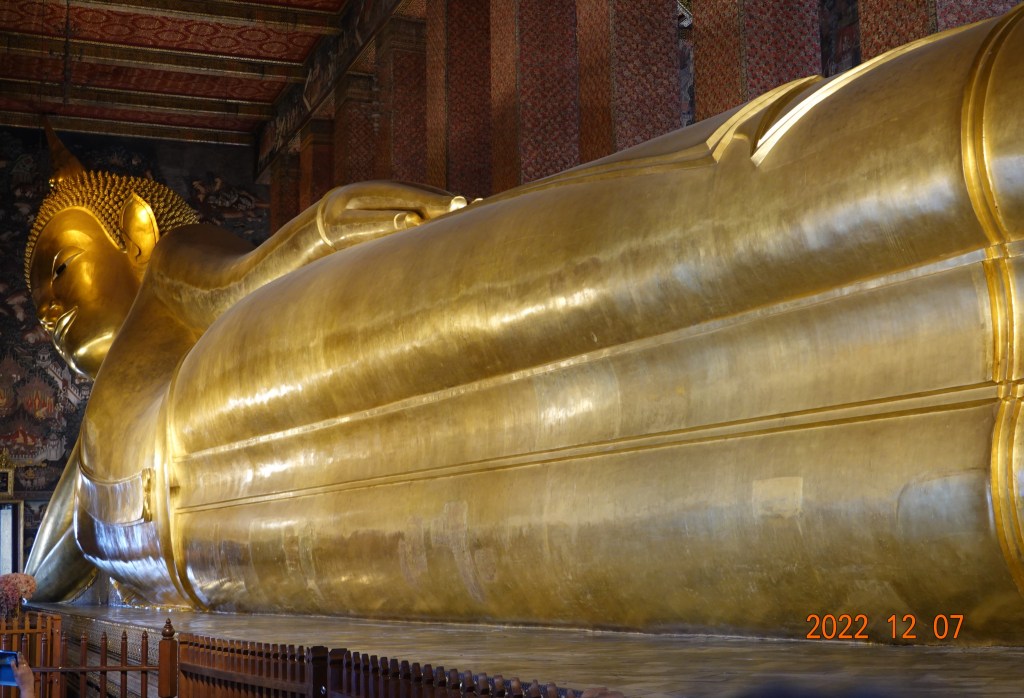
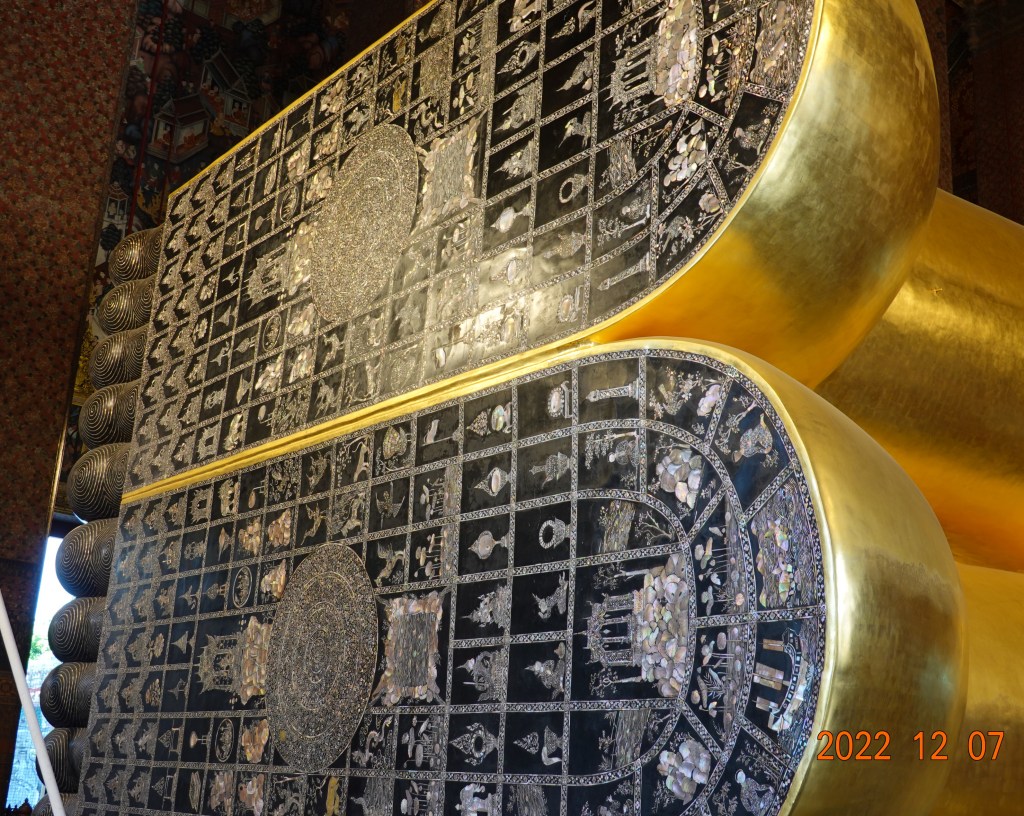
Wat Pho is known as the Temple of the Reclining Buddha, and its official name is Wat Phra Chetuphon Vimolmangklararm Rajwaramahaviharn. Wat Pho is first on the list of six temples in Thailand classed as royal temples of the first class. Wat Pho was built under the rein of King Rama I in the late 1800s. The most significant feature (and tourist draw) is the large Reclining Buddha, a 46 meter-long (155 feet) reclining Buddha statue. Wat Pho is considered the oldest center for public education in Thailand, and also houses a school of Thai medicine, and is regarded as the birthplace of traditional Thai massage which is still taught.
Every time I have been here, there are many, many tourists, but I still love standing near the large statue and taking in the history, the relevance, and the beauty of this relic. It is difficult to get a good picture, because of the structure’s support columns, but here are a few photos:
The Thaiger
The Thaiger is a Thailand-based news and social media company originally started by an Australian man in Phuket. Now based in Bangkok, The Thaiger delivers news and information from across Thailand to English and Thai-speaking audiences, reported in written format on their website, mobile app, social media channels and in video format through daily YouTube shows. I watch the program “Good Morning Thailand” almost daily as well as other English-language videos they produce. I have been a YouTube member of The Thaiger for well over a year. Because they do not want interruptions, visiting is discouraged, and they do not publish their office location. However, members may, if previously requested and agreed, visit The Thaiger briefly. I made such arrangements, was able to say “Hello” to the on-air English-language staff, and of course we posed for a picture.

The Thaiger does a good job. They are young, and are continually evolving. It was an honor to be allowed to stop in and say hello briefly. (And, no, I’m not revealing their office location.)
Sunrise Tacos
I’m in Thailand, and I will eat a good deal of Thai food. However, being in Bangkok for a very short time, I wanted to go to Sunrise Tacos. Why? I can get good tacos in my home of San Diego. True. However, when the pandemic hit Thailand, businesses shut down, and many people were without work, the owners of Sunrise Tacos started preparing and delivering meals and other essential items (like cooking oil, soap, toothbrushes, etc.) for those in need. They started a foundation, The Bangkok Community Health Foundation, and continue their mission today. So even though I have donated to the foundation, I wanted to go to one of the Sunrise Taco locations and support them a little more. One of their locations is in Terminal 21, a large shopping mall at the Asoke BTS Sky Train stop, two stops from my hotel. I went to Terminal 21, found Sunrise Tacos, and was surprised to see Chris, one of the owners there. Not being particularly shy, I approached him and thanked him for all the work he is doing. then I sat down for a very good, filling dinner:

And some detail of the meal:
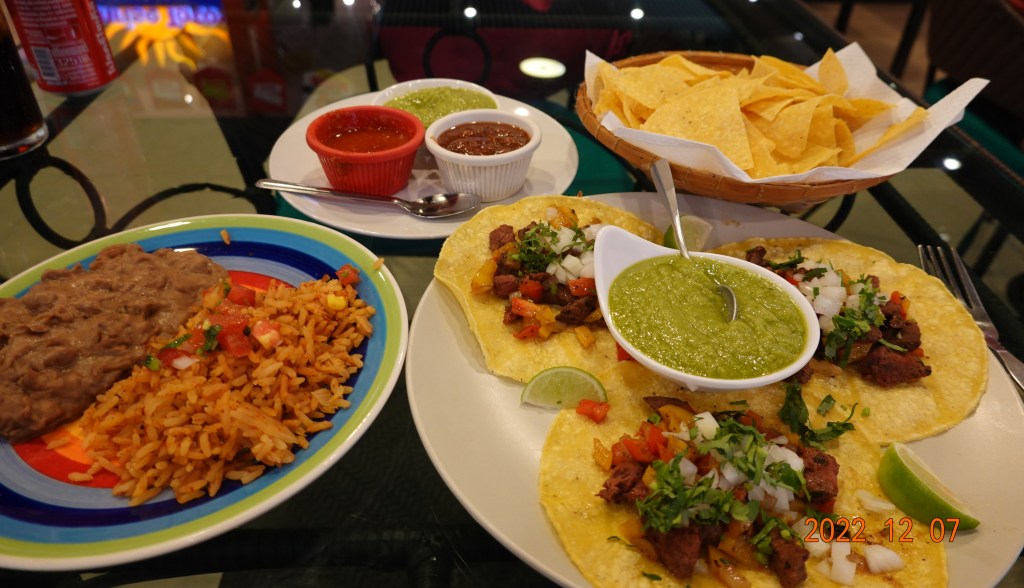
The meal was corn chips, multiple salsas, carne asada tacos, refried beans and rice. Very tasty – they have it right! A fitting end to a very busy day, but I had one more item on my agenda.
(Oh, and if you notice that the date is wrong on some of my pictures, they were showing the date on my camera before I corrected it for the Thailand date.)
The Crimson Room
In junior high and high school, I played saxophone and fell in love with jazz. On one of The Thaiger’s Good Morning Thailand programs a couple months ago, Jay mentioned the Crimson Room and that it was a jazz club. I investigated, and found that it is a 20-minute walk from my hotel. so I had to check it out.
I was told that the area of Bangkok in which the Crimson room is located is somewhat upscale and many embassy workers live there. The actual Crimson room is a little hard to find, but as I was told by an American I met there, “when you know … you know.” The Crimson room is indeed crimson inside. It was designed and built for acoustics, so the band was only minimally amplified. It is a small, intimate room, likely seating 40-50 people, maximum. Pictures were not allowed while the band was playing, but I got a shot between sets:
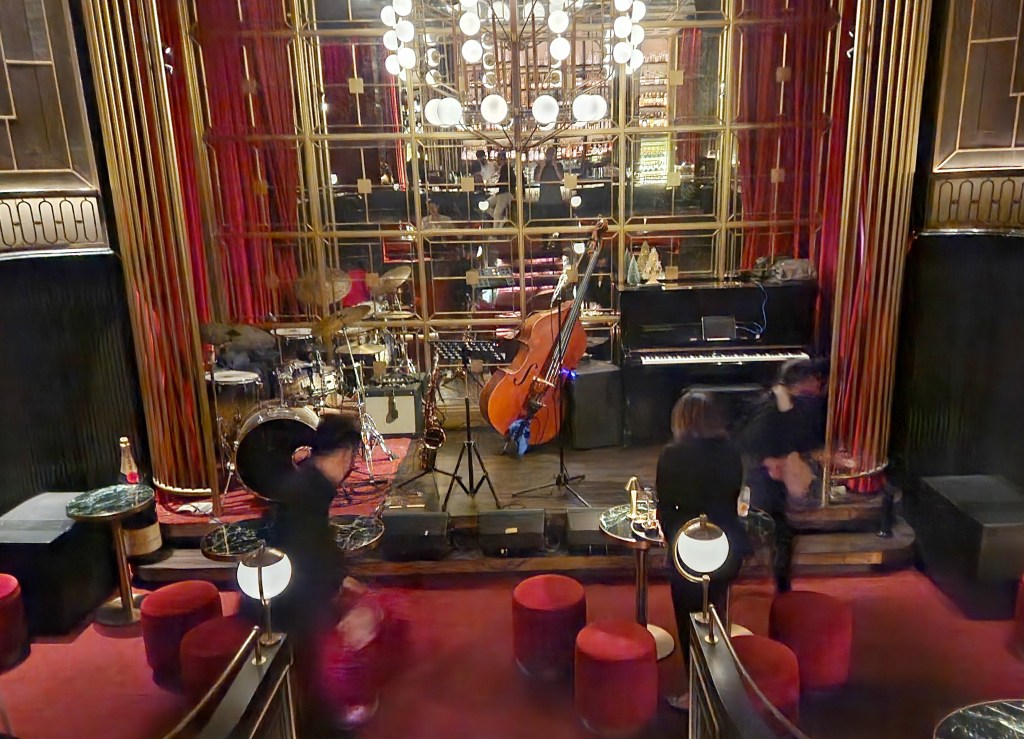
The band I hear was NRG Jazz Group with vocalist Lisa Morgan. The NRG Jazz Group is drums, string bass, piano, and tenor saxophone. The performance was outstanding. The musicians are masters of jazz, and their passion for jazz really comes through. Wow, what an honor to see this. The Crimson Room changes performers frequently. The web site is http://crimsonroombkk.com. If you happen to be in Bangkok and like jazz, a visit to the Crimson Room is a must.
An excellent wrap up to a very good day in Bangkok.
Next: Back in Chiang Mai

 James the Intrepid Pilgrim