Thursday, January 13, 2022
Mae Wang and Wat Luang Khun Win
Note: this will be long post in two parts with many pictures, less narrative.
After practicing yoga almost every day and walking or hiking around Chiang Mai every day, I took a day off from yoga today to spend some time with Nam, my long-time foot-massage friend. Nam (pronounced with an up tone, like you are asking a question) is a Thai lady I met during my first year here ten years ago at the Sunday Night Market. The Sunday Night Market in Chiang Mai is a market on two main streets in the old city (inside the moat). This is a “controlled” market – everything sold there must have been made in Thailand, and most things are sold by the people who made the items.
The Sunday Night Market is unlike the Night Bazaar which [unfortunately] is in every guidebook, takes place every evening outside the old city, and is not at all controlled. Much of the what is for sale in the Night Bazaar are knock offs from China, the sellers are very aggressive, and there are no bargains, even though they will prod you with “special deal for you” as you walk by. I detest the Night Bazaar, and after one visit have never returned.
The Sunday Night Market is fun, although about the same every Sunday. The people attending are about half Thai and half tourists. There are many places to eat and socialize, and before the pandemic, this is what the Thai people did. There were also a good number of places where you could sit in a nice chair, put your feet up, and get a foot massage – one hour for 150 baht (about $5). My very first time at the Sunday Night Market, I sat down, and Nam was massaging the feet of a lady from Belgium in the chair next to me. The Belgian lady told me that Nam was the best and massaged her feet every week. I waited and Nam massaged my feet next. It is more than just the feet, really from the knees down, and most of the ladies doing the massages also know reflexology. After walking around all day, a foot massage in the evening is great just before turning in for the night. I enjoyed my foot massage with Nam, and the next Sunday, I found her again. Since that first Sunday, Nam has massaged my feet every Sunday at the Sunday Night Market, for the past eight years, except for last year when Thailand was closed to tourism. I have met her sister who also massages, her daughter and son-in-law, all very nice people. This year, because of the pandemic, Nam is not massaging on Sundays. She and her daughter have a copy and sign shop in Mae Wang where they live, about 40 kilometers (25 miles) south and slightly west of Chiang Mai. She invited me to join the the family as they were to visit to Wat Luang Khun Win in the mountains west of Mae Wang.
Mae Wang Sign Shop
Nam and her son-in-law picked me up at See You Soon at noon. Nam does not drive a car, her son-on-law drove. We went to the copy & sign shop down near Mae Wang, and I got to see the shop. Here is a picture of Nam outside the shop:
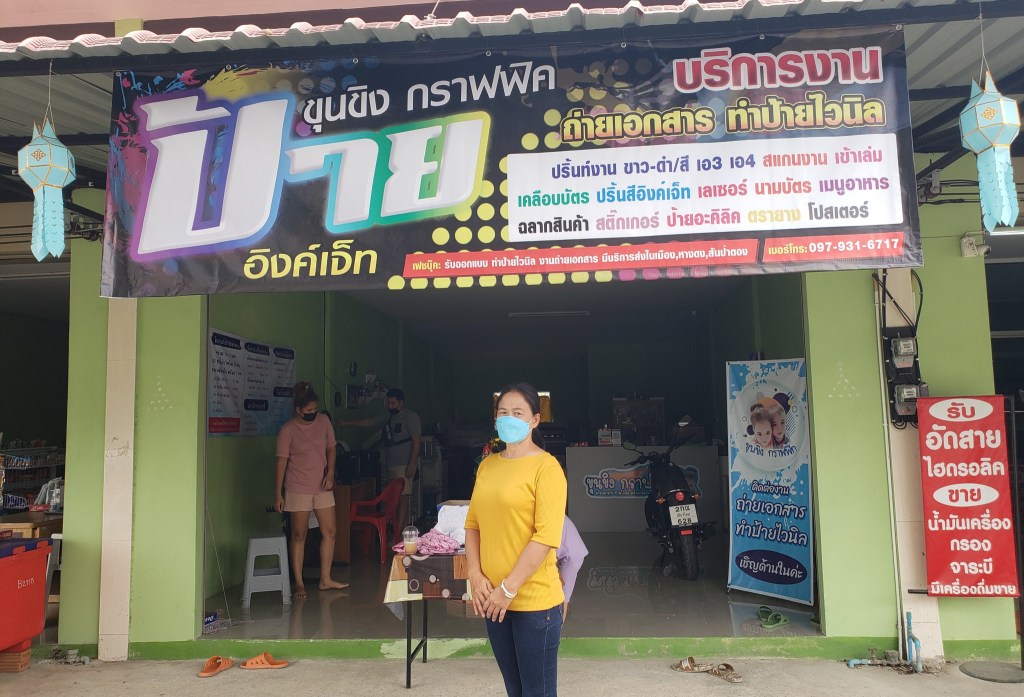
I think the sign says Mae Wang Sign Shop. After a little time at the shop, Nam, her daughter, son-in-law, and two grand children, ages 6 and 9, got into their small SUV (as I recall, it is a Chevrolet) and started the fairly long drive to the mountains. After climbing on a very twisty and difficult road, we arrived at a large grass parking area. Here you hire drivers with four-wheel-drive trucks to continue up the mountain to Wat Luang Khun Win. The trucks have seats in the back and are covered so it is fairly safe. And the four-wheel-drive vehicle is needed. Some of the second half of the road was very steep and very twisty, mostly dirt/gravel with some stretches of concrete. (How they got the concrete up here would be an interesting story.) It was slow-going. After about 40 minutes in the truck we arrived at Wat Luang Khun Win.
Wat Luang Khun Win
Wat Luang Khun Win is a 700-year-old temple almost hidden away in the Khun Win forest in the Mae Wang district of Chiang Mai province. No electric lines go up this mountain, so what little power is at the temple is solar powered. On first arriving and getting out of the truck, we were near a monk’s residence.
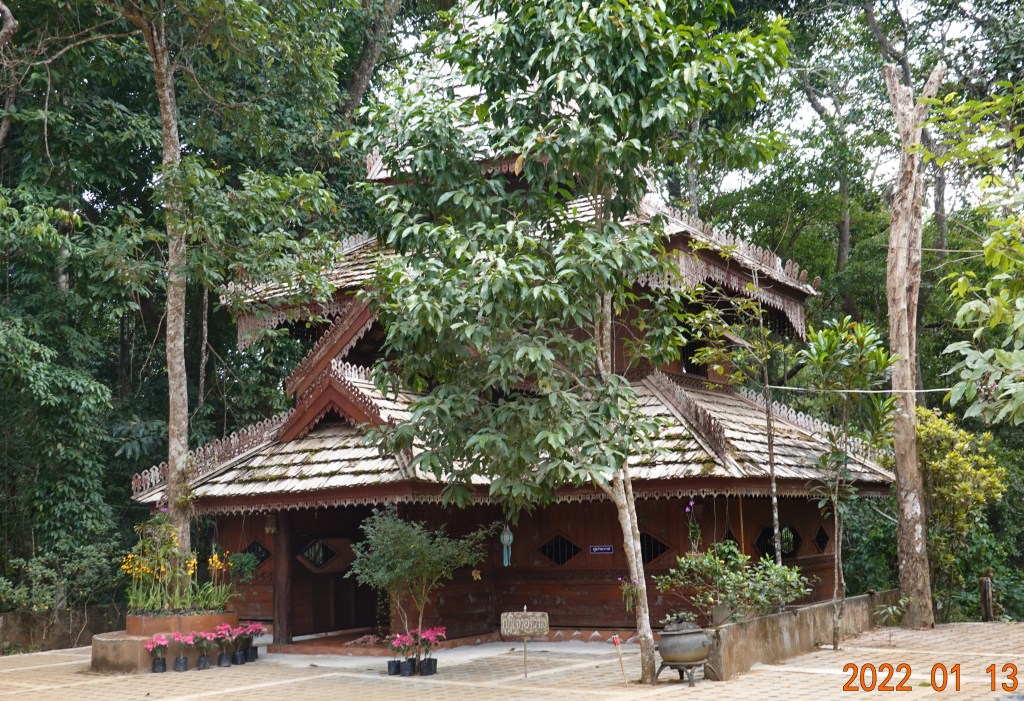
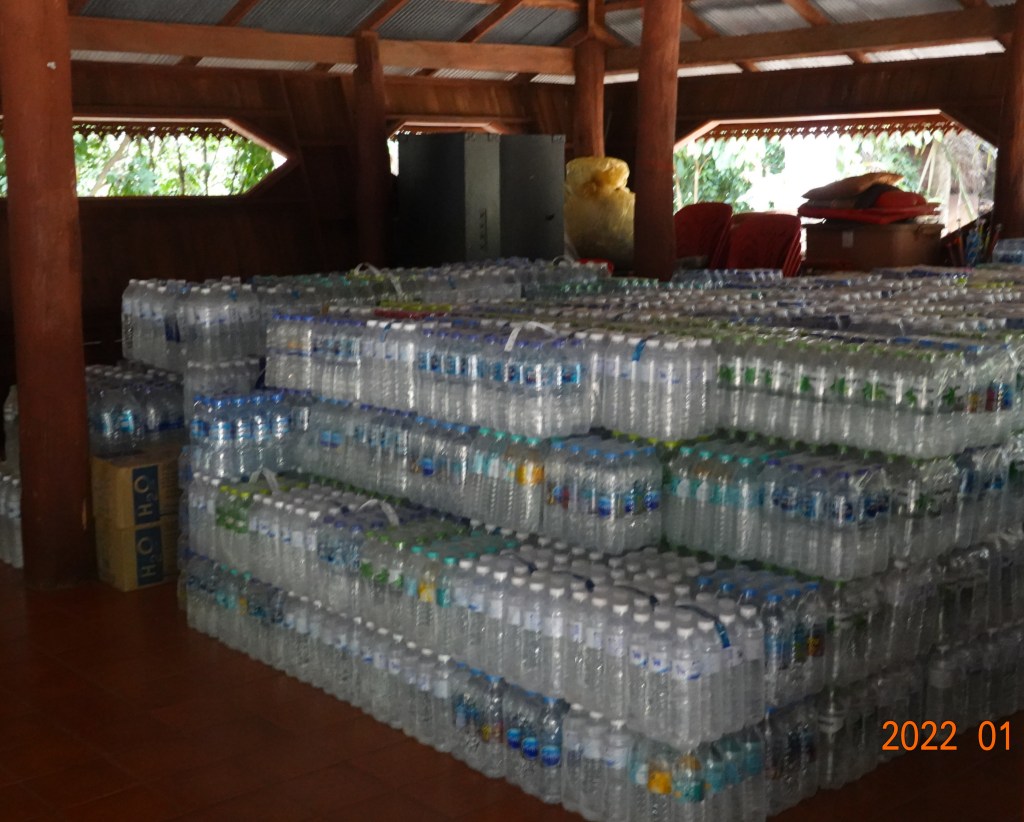
Just behind me as I was taking this picture was what appeared to be a small viharn (assembly or worship hall). Inside, I saw that they are using this for storing bottled water.
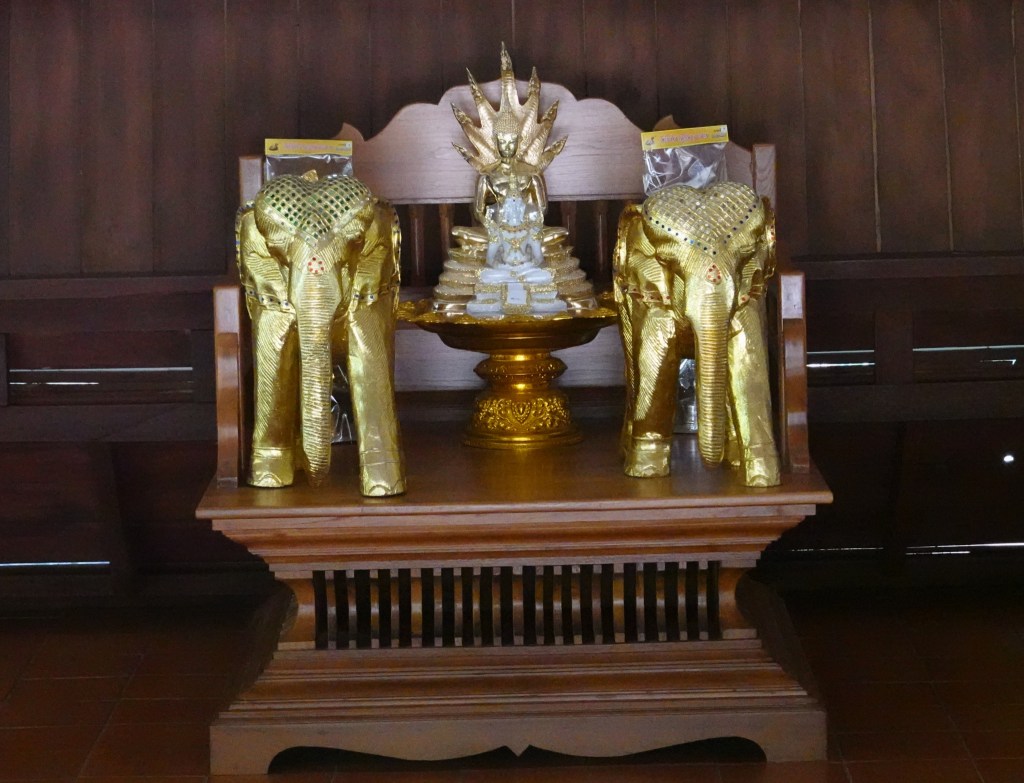
In the center, to the left of the water storage was this small area for worship, only about one and one-half meters tall.
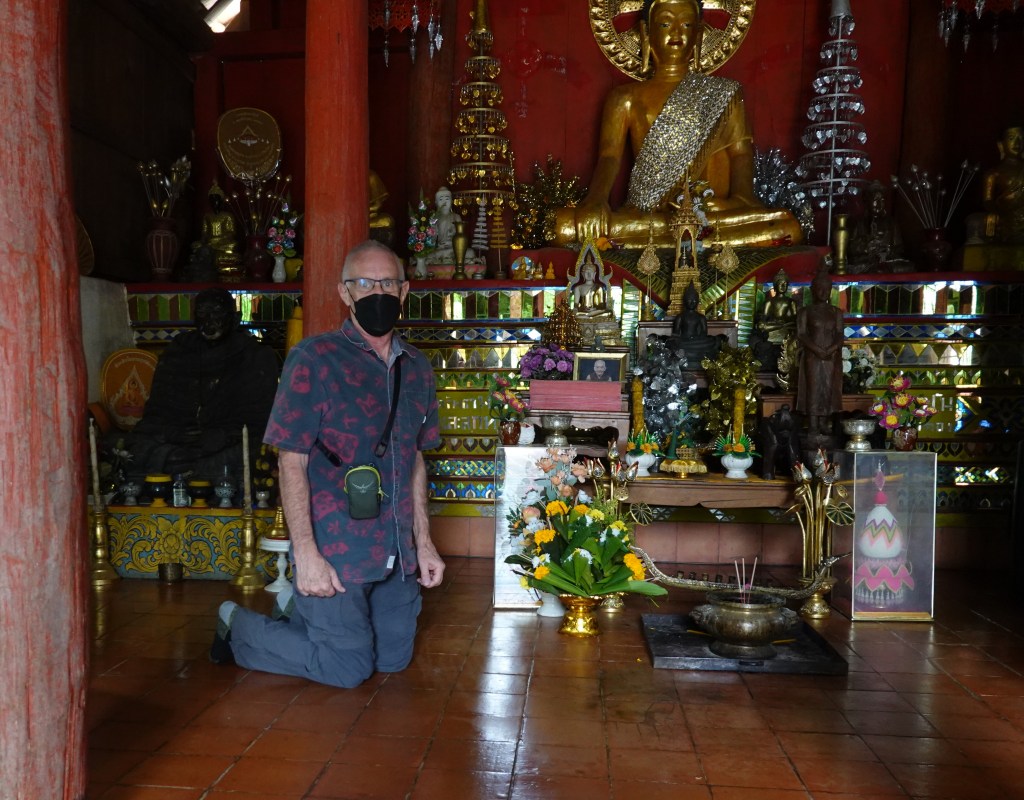
Then nearby there was an actual viharn, in which Nam took my picture.
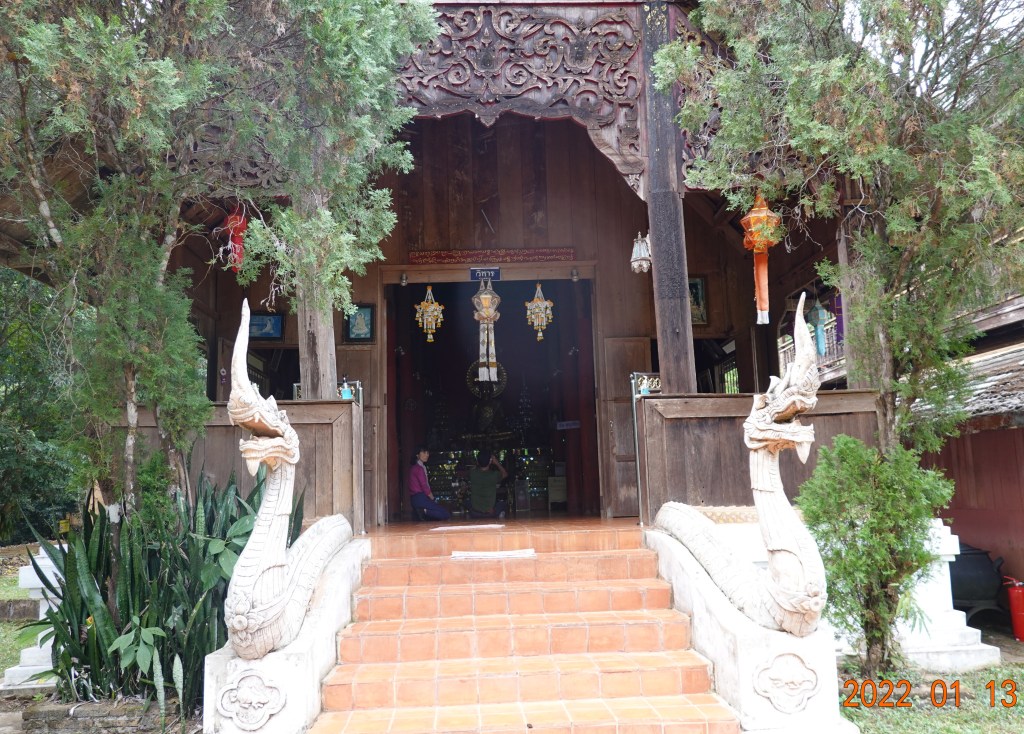
Here is a picture of the entrance to the small viharn:
Between this and another building, I got a picture of Nam, her daughter, and two grandchildren. Her son-in-law was exploring somewhere.

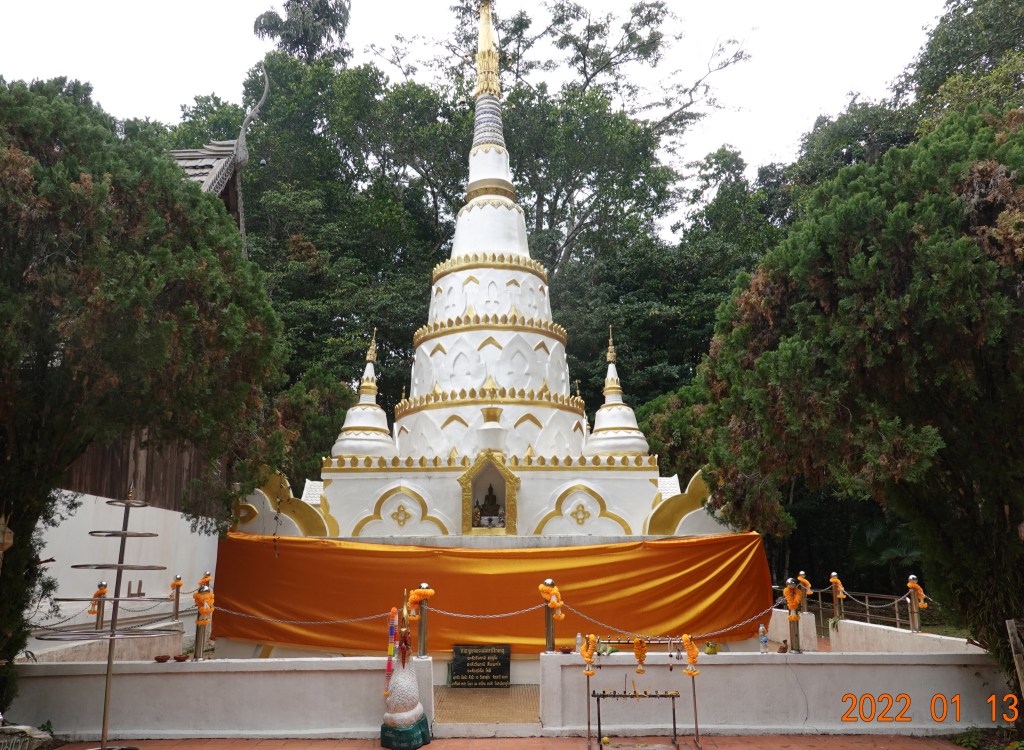
Behind the small viharn was this very white, almost bright white chedi:
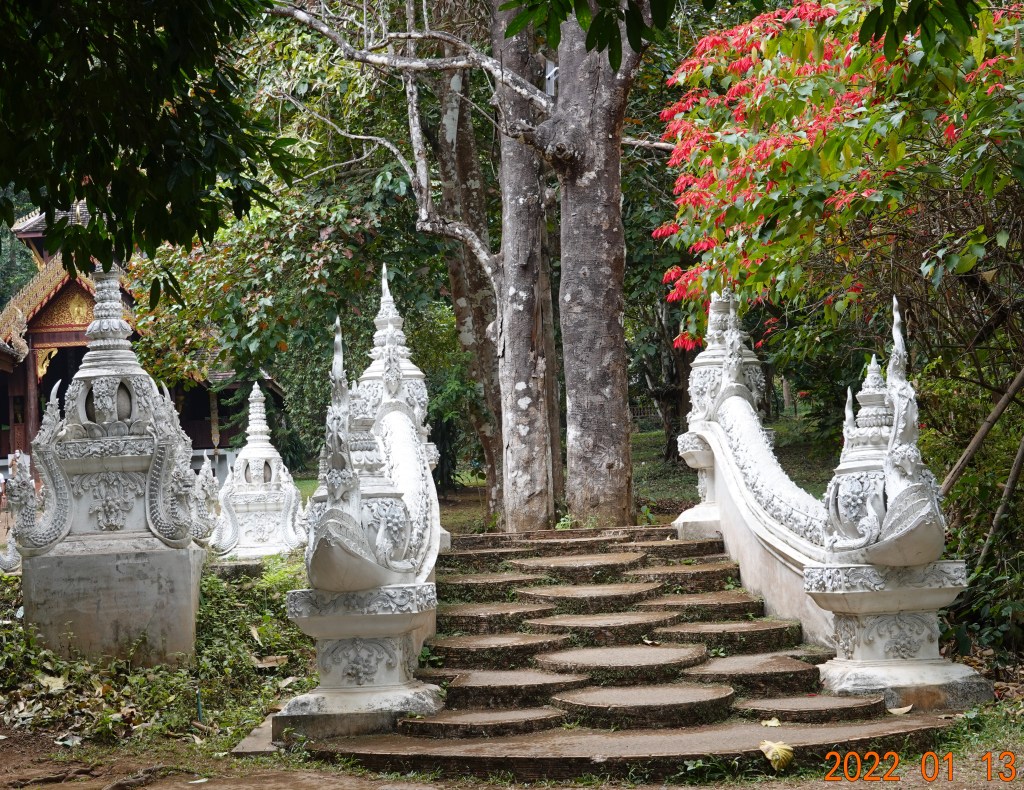
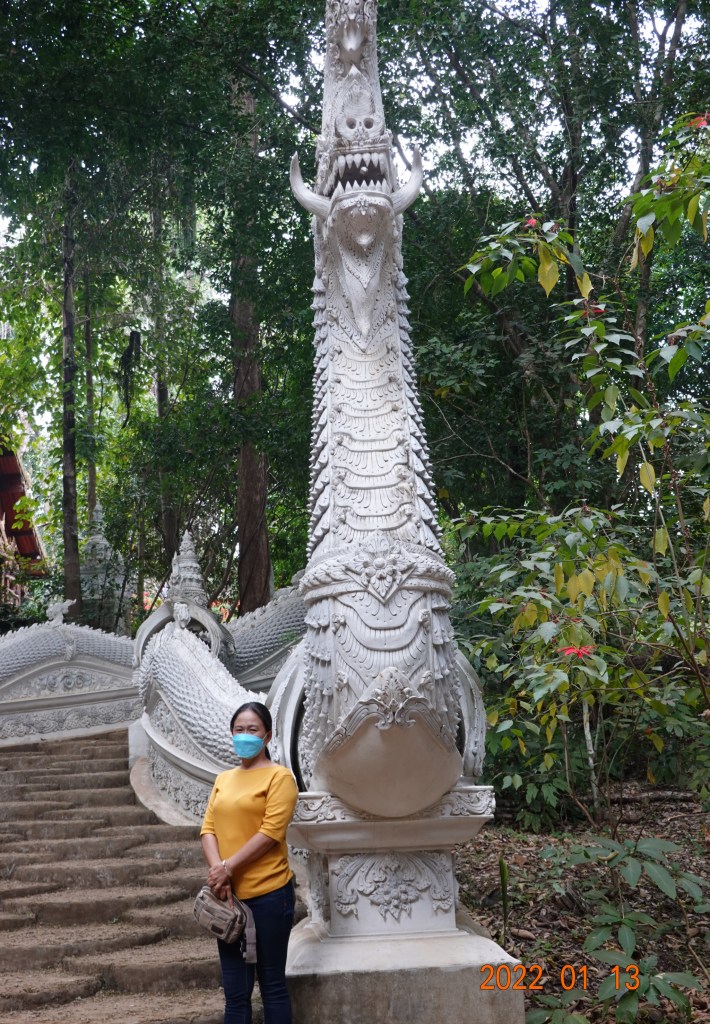
We then walked up the hill to the main two assembly halls, viharn. Here are the odd steps up to the next level where the two main viharn are located:
Here, almost hidden in the forest, is this very beautifully crafted viharn. The woodwork is nothing short of astounding.
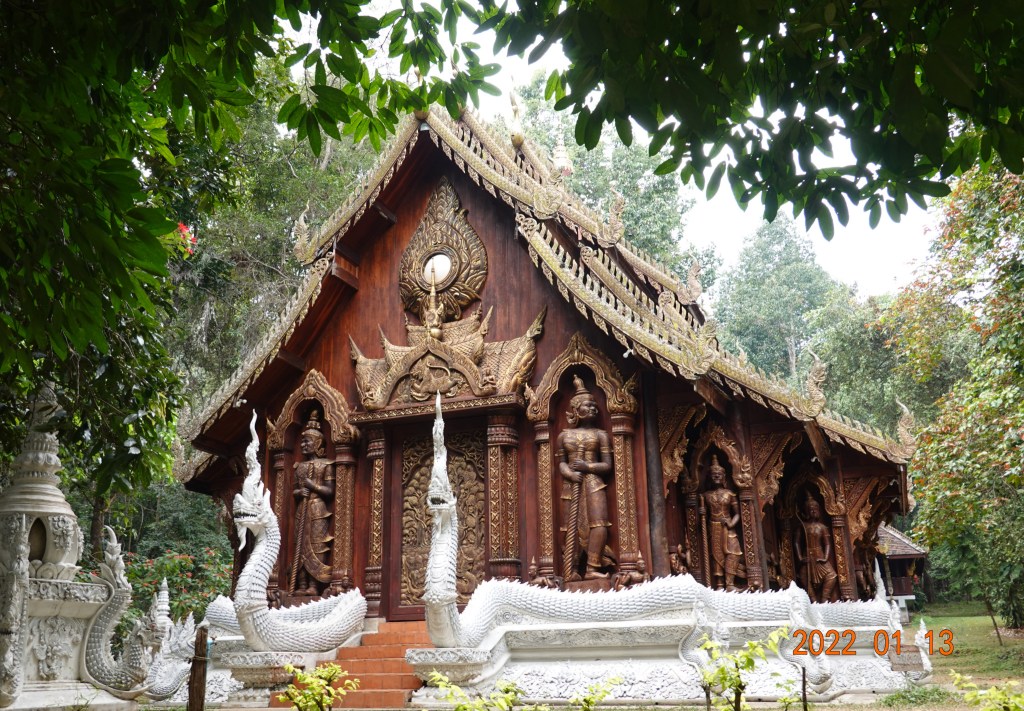
Here is more detail of the doors. These seem to me to be at the front, but the other side was open. An odd arrangement – typically the viharn doors are only on one side.
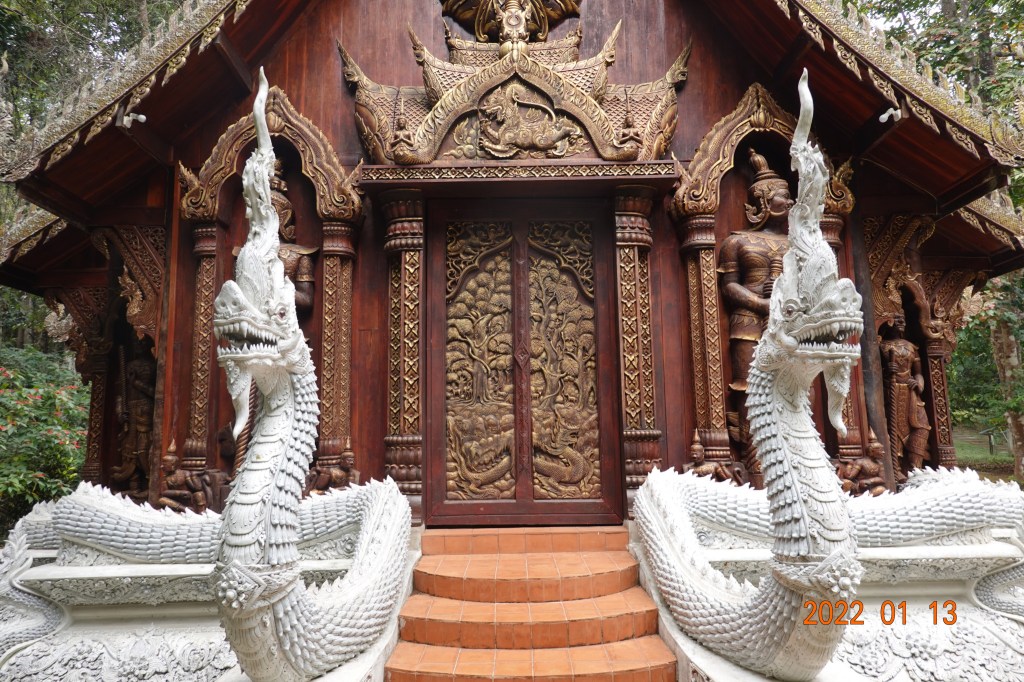
Detail of the yaksha (mythical giant guardians who keep away evil spirits) guarding the entrance:


The yakshas, while they appear very similar, are different. Yakshas are a class of nature-spirits, usually benevolent, but sometimes mischievous, connected with water, fertility, trees, the forest, treasure and wilderness. The yaksha has a dual personality. On the one hand, a yaksha may be an inoffensive nature-fairy, associated with woods and mountains. There is also a darker version of the yaksha, which is a kind of ghost or spirit that haunts the wilderness and might devour travelers. Yakshas are commonly seen at temples in central Thailand (Bangkok), and only seen infrequently at temples in northern Thailand. And when seen in Bangkok, they are often very large, 6-8 meters high (20-25 feet). The yakshas I have seen in northern Thailand are typically smaller, like these, only about 2-1/2 meters high.
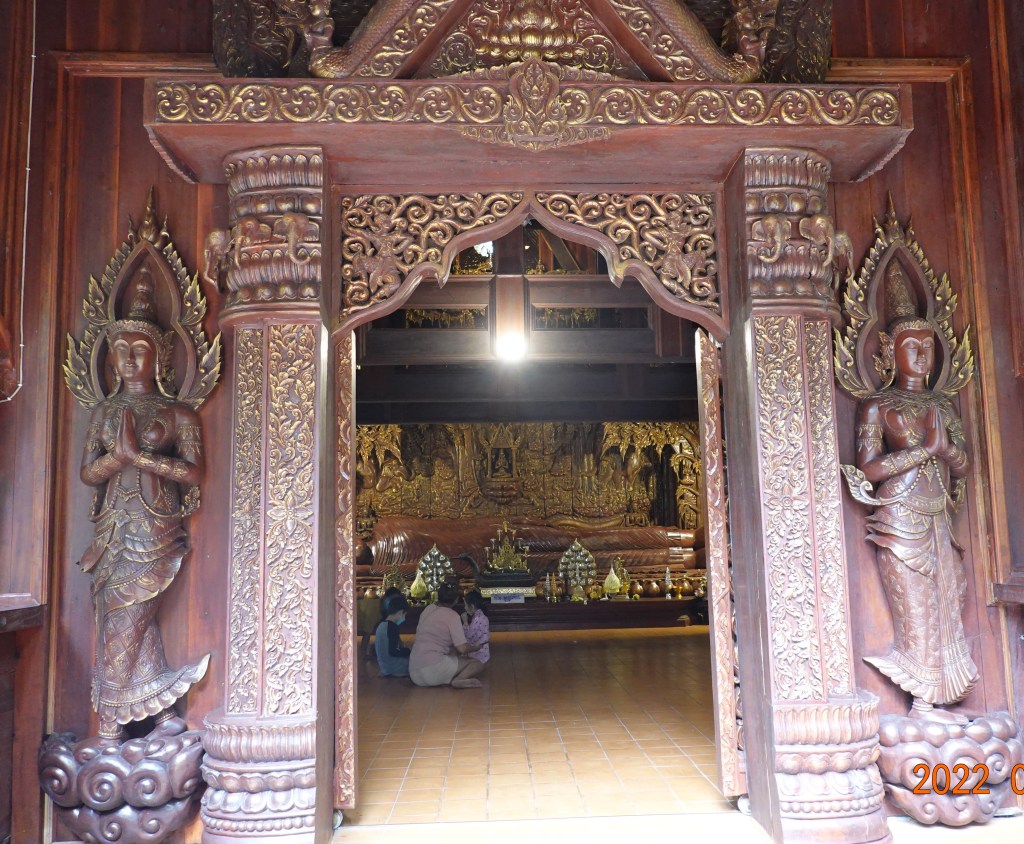
On the opposite side of the Yakshas, the doors were open. And the detail of the wood craftmanship, as I already said, is astonishing and beautiful.
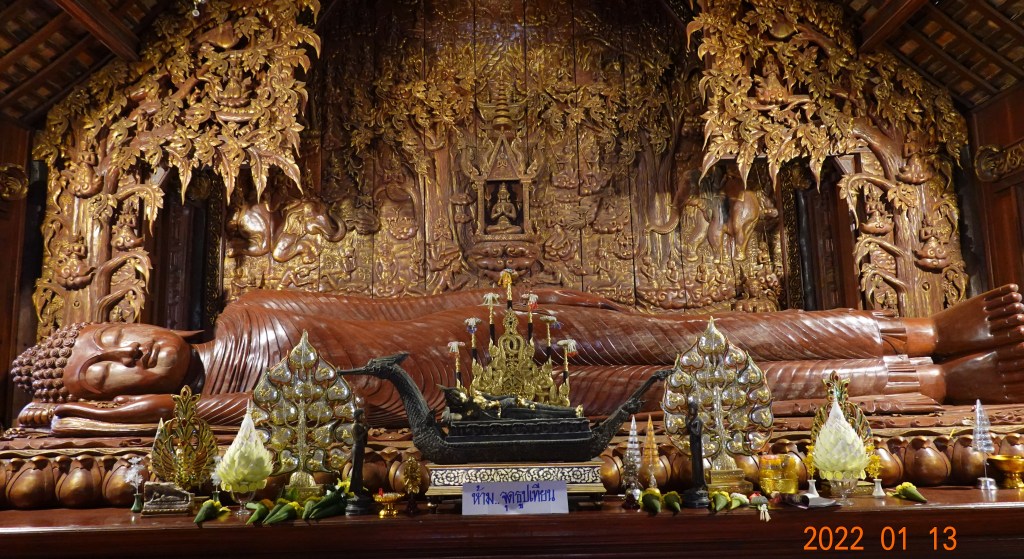
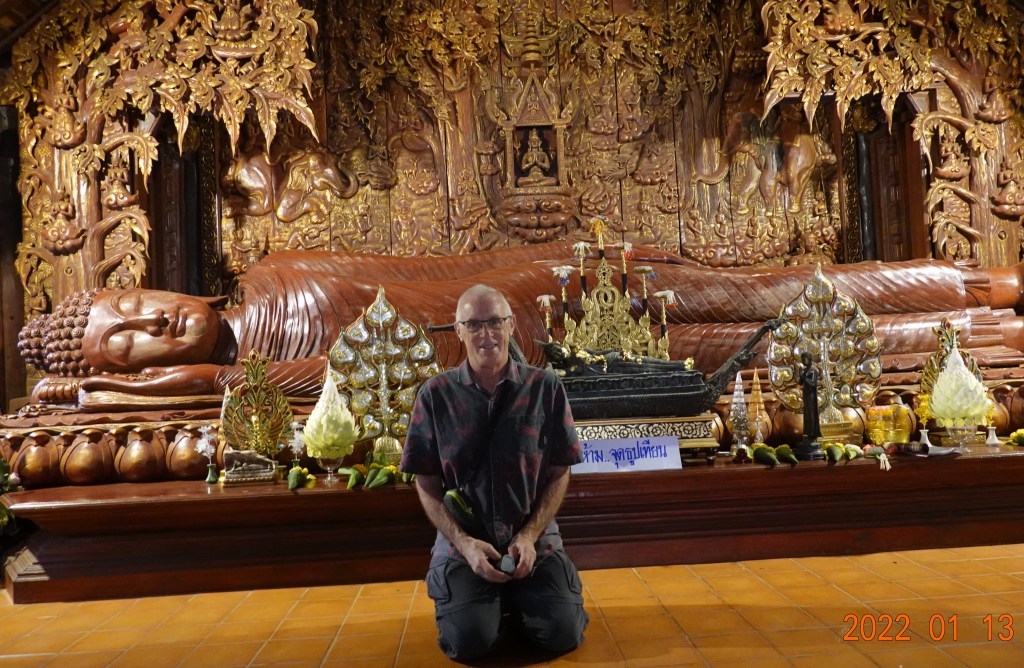
Inside is this reclining Buddha, about 7 meters long, carved from a single Champa tree that grows in the region:
Nam took a picture of me in front of the reclining Buddha:
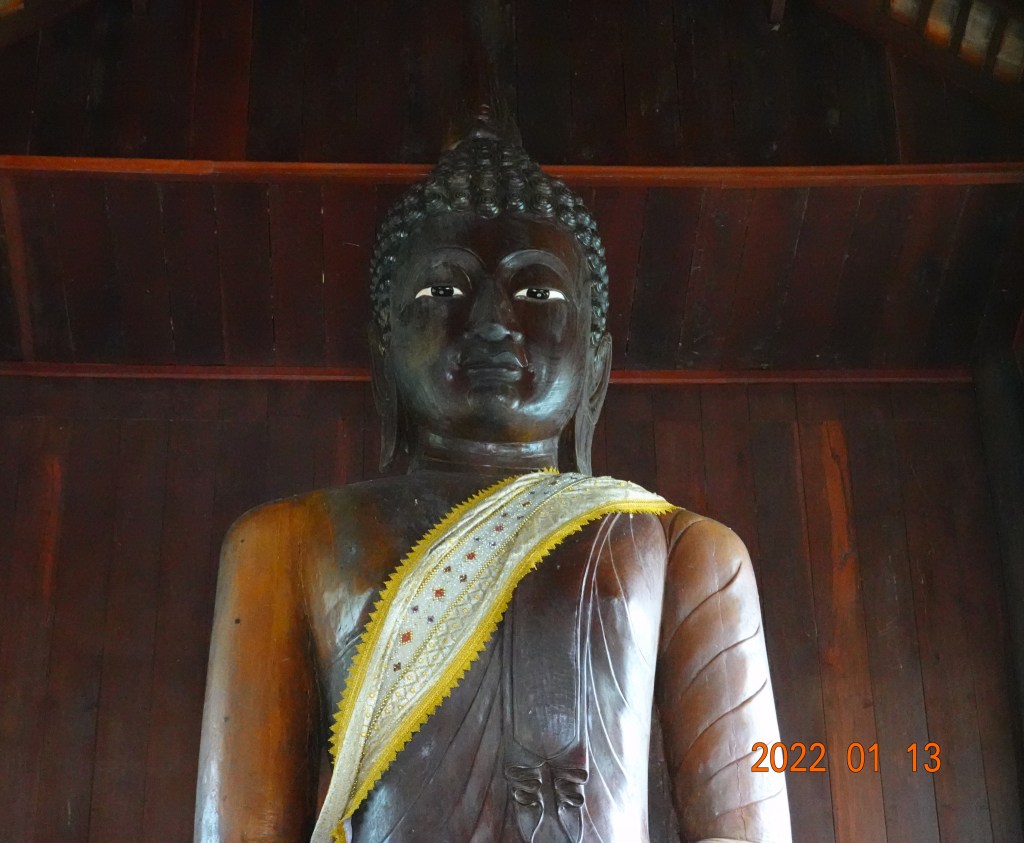
In the next building, perhaps an ubosot (ordination hall), was this 9-meter (30 feet) tall Buddha image, also carved from one large Champas tree.
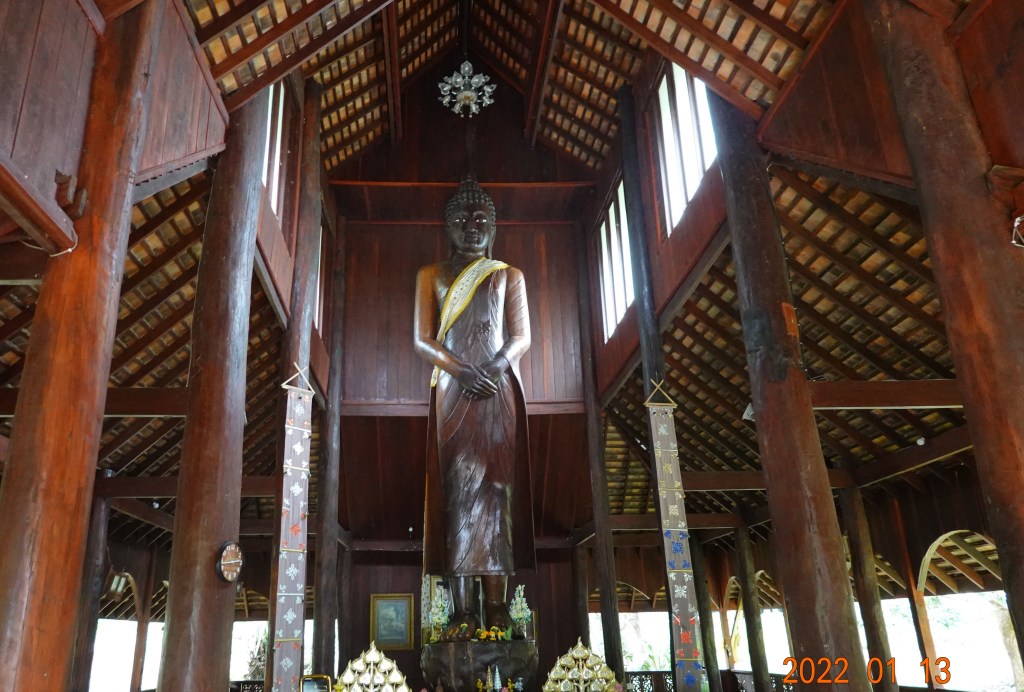
It was darker in this building and the detail of the craftmanship does not come through well. It is stunning and beautiful (I know, I already said that…but is really is quite beautiful).
After lingering in the viharn and the ubosot and enjoying the beauty, it was time to make the journey in the truck down the mountain.
We boarded the truck and started the slow ride down the mountain. The drivers all know the road well, where the shoulder is wide enough to allow another truck to pass, and they beep their horn when coming to a tight curve in which visibility is low. Several times, we pulled over to allow a truck going up to pass by. The temple is getting a number of visitors today. After getting back to the large grass parking area, we said goodbye to the driver, and started the drive to the flower gardens.
Next: Mae Wang Part 2: The Flower Gardens

 James the Intrepid Pilgrim