Sunday, January 2, 2022
Exploring South of the Old City
After breakfast, catching up on some work e-mail, and waiting eagerly for the results of my PCR test yesterday, I decided to go out exploring to find the second khao soi restaurant south of the old city. I chose this one because it is open today – many places are closed for the entire New Year’s weekend. The place is Khao Soi Lung Prakit Kaat Gorm, located directly south of Chiang Mai Gate on Suriyawang Road.
Suriyawang Road
I am certain I have walked down this road before, but that may have been years ago, and it was fairly unfamiliar. Occasionally I find an old chedi in a field or right by a building with no evidence of a temple nearby. It is difficult to get the story or learn of its history, because it is just a structure that has been there for maybe hundreds of years. On the walk down Suriyawang Road, I saw two of these and also a temple I had never explored.
The first chedi is large but not strikingly large. Obviously old, and while not in perfect condition, it is not deteriorating significantly.
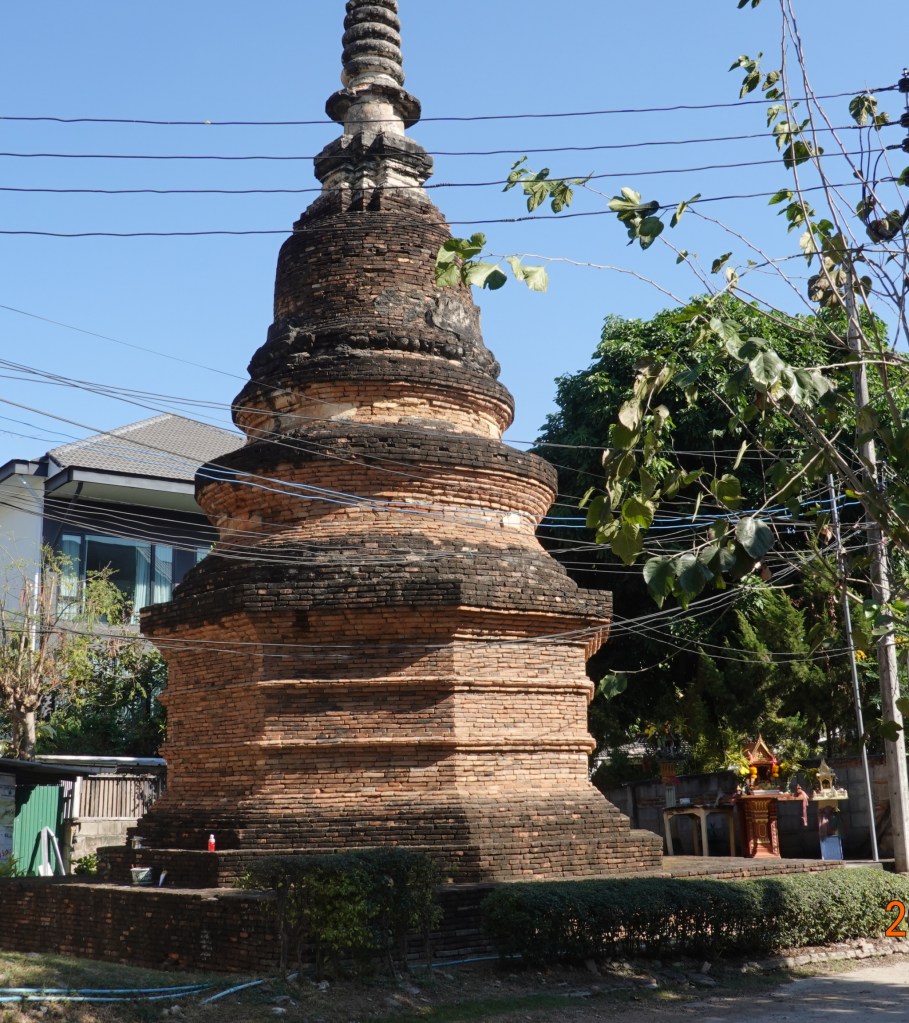
About five minutes’ walk further south is this much larger chedi. It was difficult to get a good picture without stepping into the street, and there was a bit of traffic. There is a sign in the foreground, so old and faded that no lettering is visible at all.

Like the first, while not in new condition, it is not significantly deteriorated or crumbling. This is a testament to the construction method.
Wat Yang Kuang
Just north of Khao Soi Lung Prakit Kaat Gorm, I found this temple I had never visited. Wat Yang Kuang, also spelled Yang Guang, was being renovated in 2017, and ruins were discovered of a much older temple. The ruins were being excavated by the Thai National Department of Fine Arts and a news article mentions that the old temple was probably built during the King Mengrai era and records show the presence of a temple here in 1517. King Mengrai was the founder of Chiang Mai and was the first king of the Lanna Kingdom ruling from 1292 to 1311. The area where the excavation may still be taking place was blocked off from my wandering. Here is the entrance to Wat Yang Kuang:
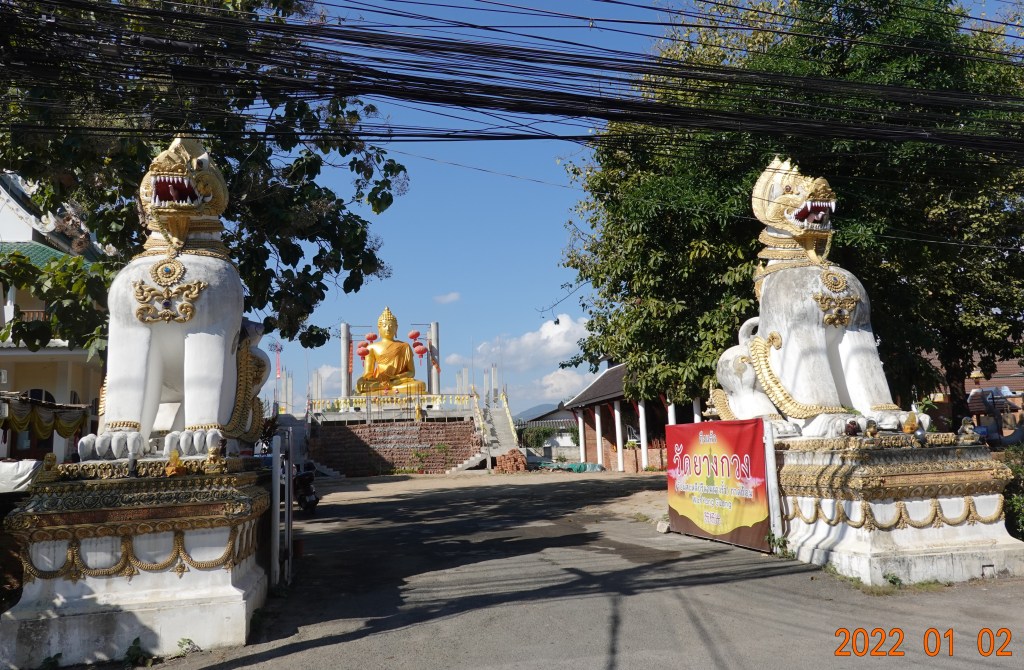
Directly inside the temple grounds is this large structure still under construction for a very large seated Buddha image:

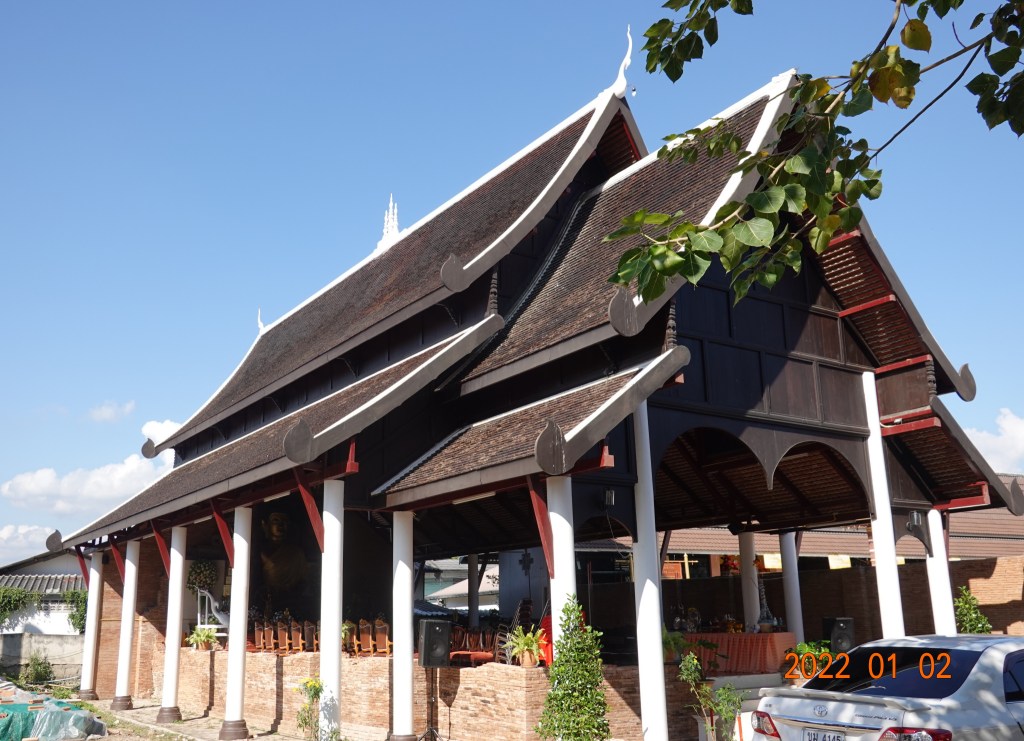
Over to to the right is this large open-air viharn (worship or assembly hall), sometimes called a “sala.”
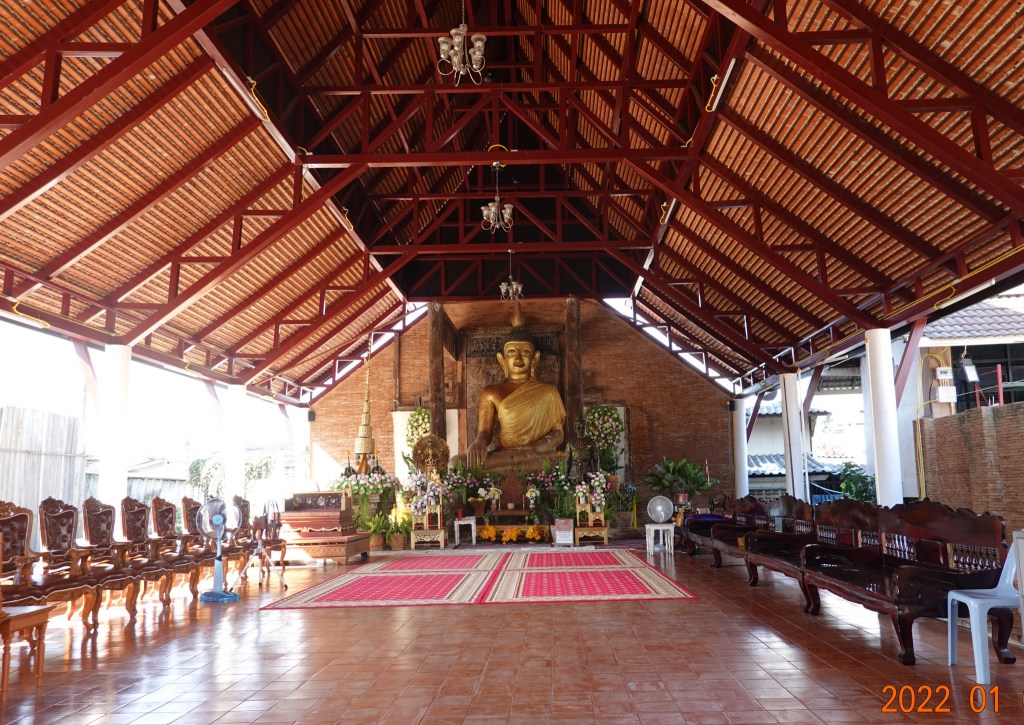
And inside the sala is this view:
As I was leaving, a long string of cars was entering and people were gathering for some event.
Khao Soi Lung Prakit Kaat Gorm
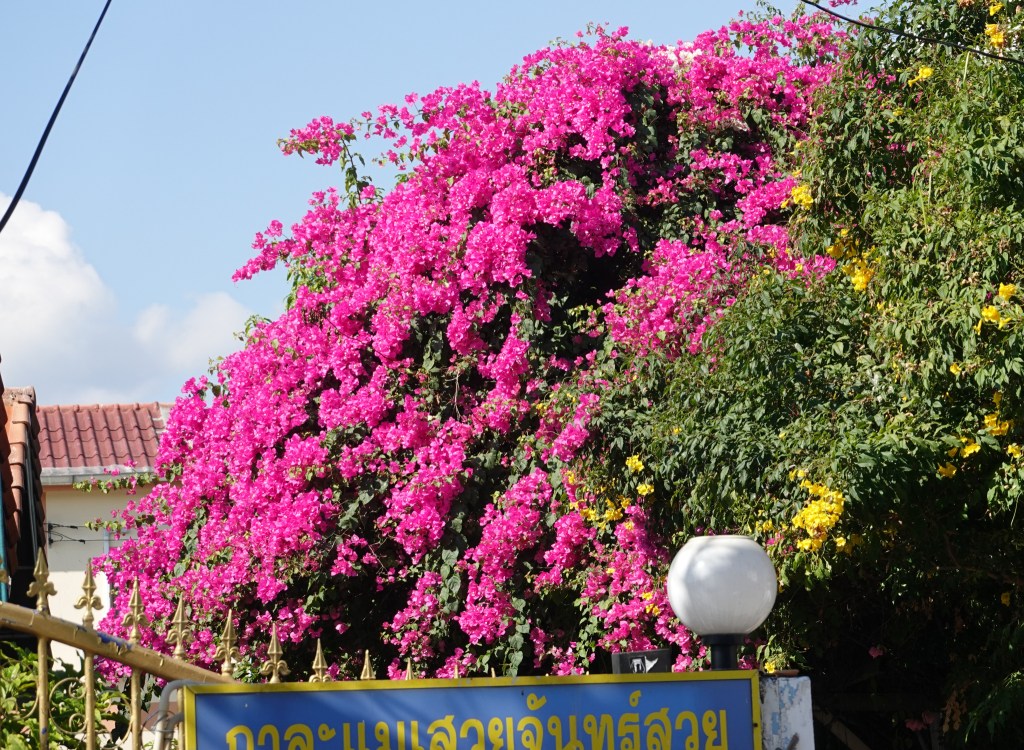
Just before I found the Khao Soi Lung Prakit Kaat Gorm, I saw this rather striking and large bougainvillea plant. These are common in Southern California, and also here in Chiang Mai. They are much like a poinsettia in that the color is not the flower, rather the leaves. There is a very small white flower surrounded by the colored leaves.
Just a short walk further south I found Khao Soi Lung Prakit Kaat Gorm and it was crowded at 11:00 AM. This picture is from later so there is no crowd, but when I walked by on my reconnaissance, there were at least 30 people waiting, all Thais. I was the only foreigner that I could see. One person told me the wait was over an hour. Obviously a very popular restaurant. This is good.
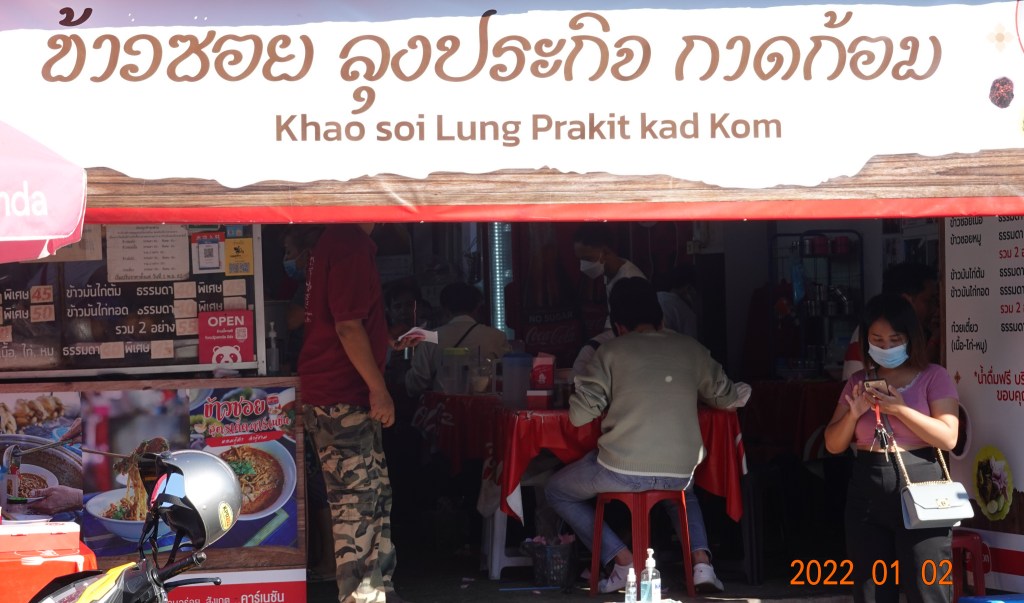
The restaurant closes at 4:30 PM so I planned to return at about 3:00 and hopefully the crown will diminish somewhat. I continued south exploring, looking for more evidence of the second, earth & clay Kampaengdin wall. I did find the creek that was just outside that wall, but there were too many buildings to really see if evidence of the wall still exists in this area.
Wat Sri Ping Muang
Along Sri Ping Muang Road, came upon a smaller, neighborhood temple, Wat Sri Ping Muang. The temple is very new, compared to many Thai Buddhist temples, having been built in 1950 since there was not a temple in the village. There was some renovation started in 2007. Notable to me are the yak (or yaksha) guarding the viharn.

Yakshas or Yaks are Buddhist mythical guardian warriors who keep away evil spirits. These are often seen at temples in central Thailand (Bangkok), but only occasionally seen in northern Thailand (formerly Lanna). And those I have seen in Bangkok are very large, 5-8 meters tall.
Eventually I walked west and found myself at Thipanet Road, one of the two main roads leading south and to the Chiang Mai airport. I headed north and then right onto Wua Lai Road. Wua Lai Road will take me back through the silver district and eventually to Chiang Mai Gate. Before I got far, I passed The Artisan, a very nice coffee shop which is compatible for hanging out and working on one’s computer. I have done this many times in the past, and their coffee is very good. Needing a bit of a rest, I stopped, ordered a piccolo latte’ and a ham & cheese croissant for light lunch.
Wat Sri Suphan
A few hundred meters north of The Artisan, off the main road is Wat Sri Suphan, another of Chiang Mai’s important and popular Buddhist temples. As usual it was quite busy, with many Thais in large groups. Here is some of the history before a few pictures.
Wat Sri Suphan, sometimes Wat Srisuphan, is on most of the “must see” lists of temples in Chiang Mai because of its “silver” ubosot or ordination hall. It’s situated a short walk down Wua Lai Road, diagonally southwest from Chiang Mai Gate. This is the Haiya area of the town, the old silver quarter where still today there are many silver craftsman’s shops, and if you walk around you can hear the continual tapping of them at work.
Wat Sri Suphan was established in 1502 during the reign of King Kaeo, the eleventh ruler of the Mengrai Dynasty. Nothing but some old pillars remain of the original construction and the temple has been rebuilt many times.
The most recent reincarnation of the temple began in 2004 under the direction of the abbot, Phra Kru Phithatsuthikhun. Instead of using standard temple renovation techniques, the abbot utilized the skill and knowledge of local silversmiths. The result is a building covered in silver metal which shimmers in the sunlight and is full of intricate details.
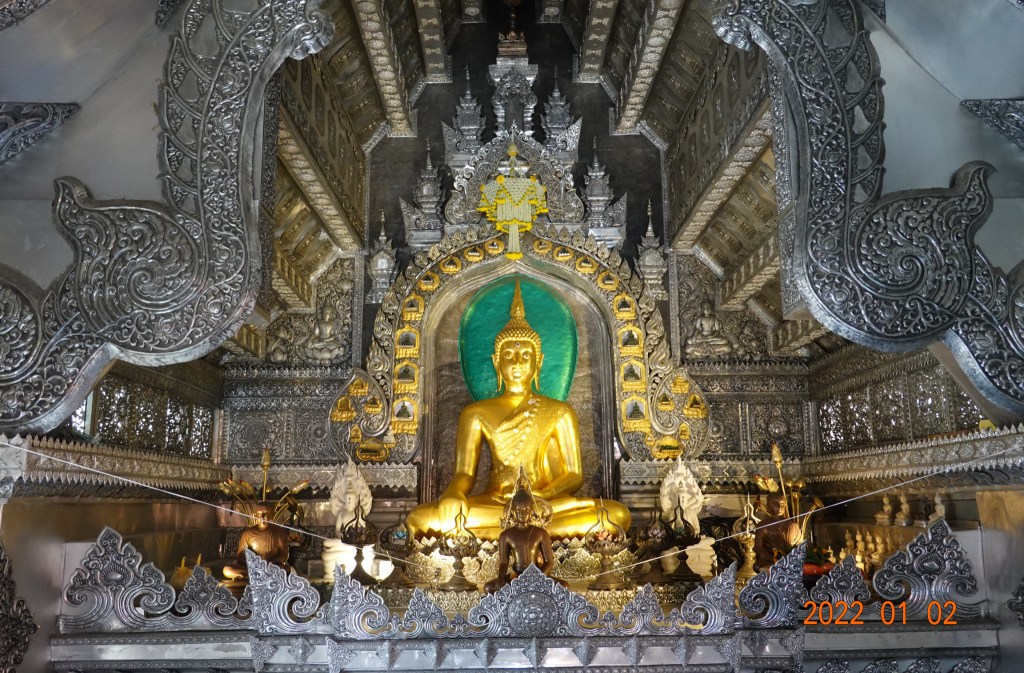
The craftsmen at Wat Sri Suphan work with nickel and aluminium for the ordination hall, although there is also some silver used in the construction of important images. The effect is certainly dazzling and unusual with a mass of repoussé and chased work, as well as carved figures, covering the exterior and interior and certainly makes for a great photographs.
“Repoussé” working literally means “pushed from behind” and refers to the working of the malleable metal sheets from behind with hammers creating reliefs. “Chasing” is the opposite and refers to the working of the metal from the front to create the finished design. Both methods are used for the decoration of the Silver Ubosot at Wat Sri Suphan.
The first thing noticeable after entering the temple grounds is this silver Ganesh, an elephant Hindu deity representing wealth, success and good luck, at which people are almost always praying or worshiping.:

To the left of the silver Ganesh is this statue of King Kaeo and his wife the Queen.

Behind the statue of the King is the Silver Ubosot, an ordination hall, where monks are ordained. I started at the back to avoid the glare of the sun, and because the back is intricately decorated.
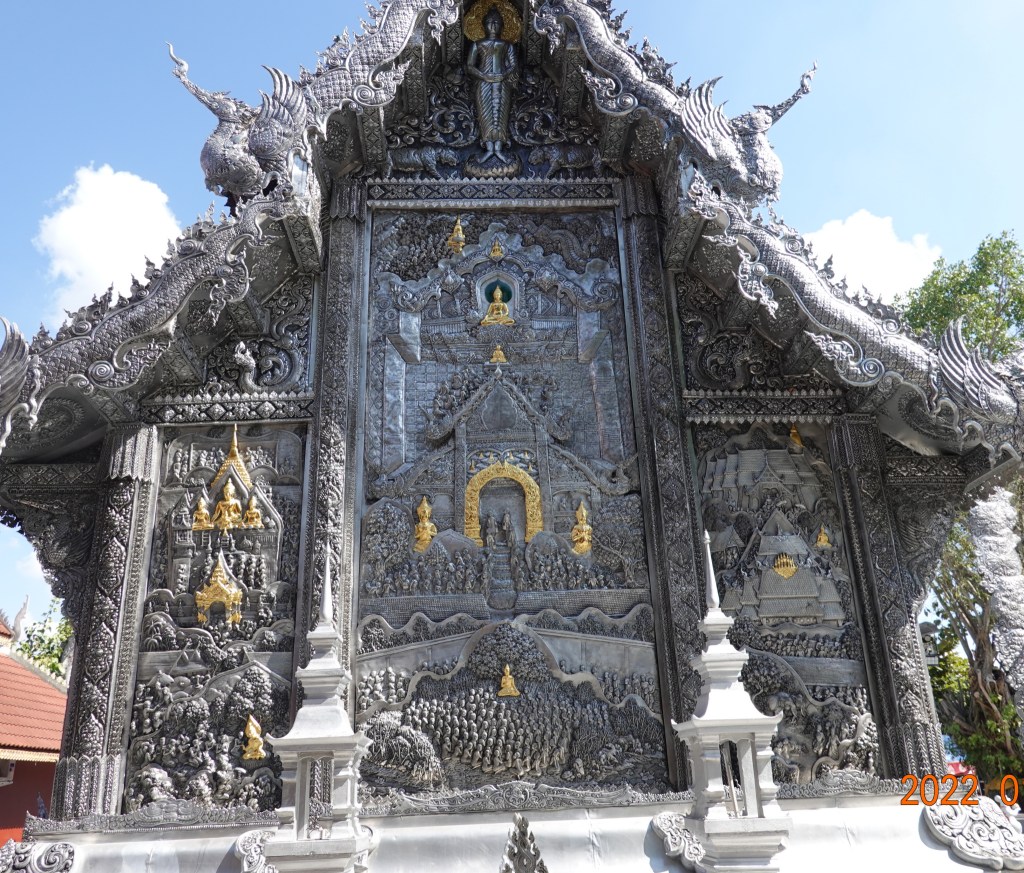
Than the side and on to the front of the Silver Ubosot:
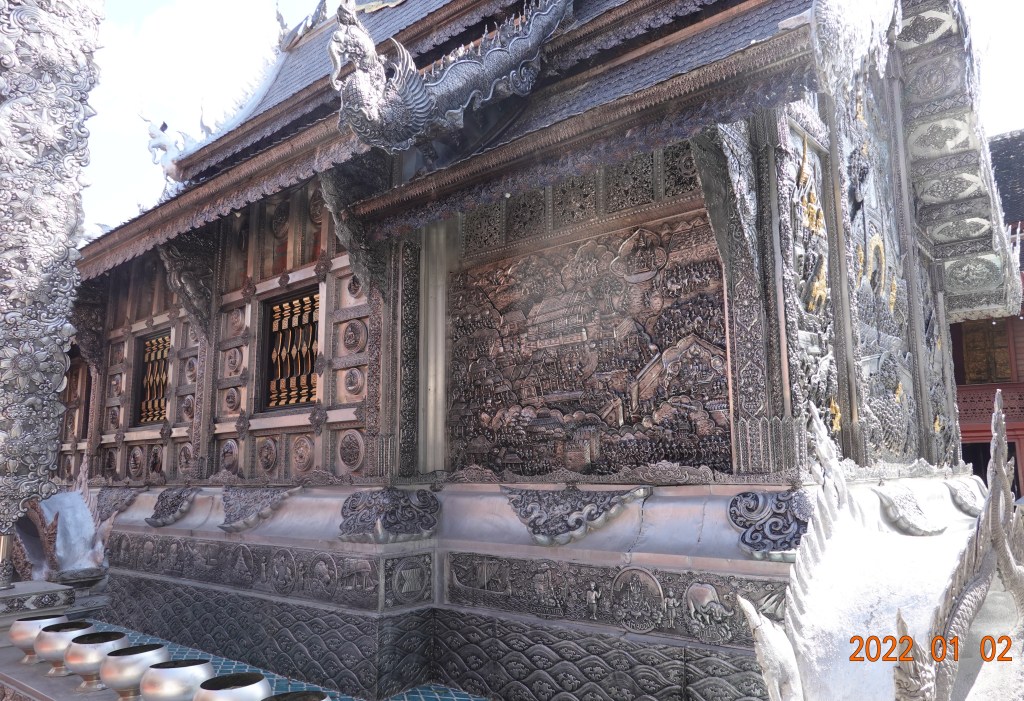

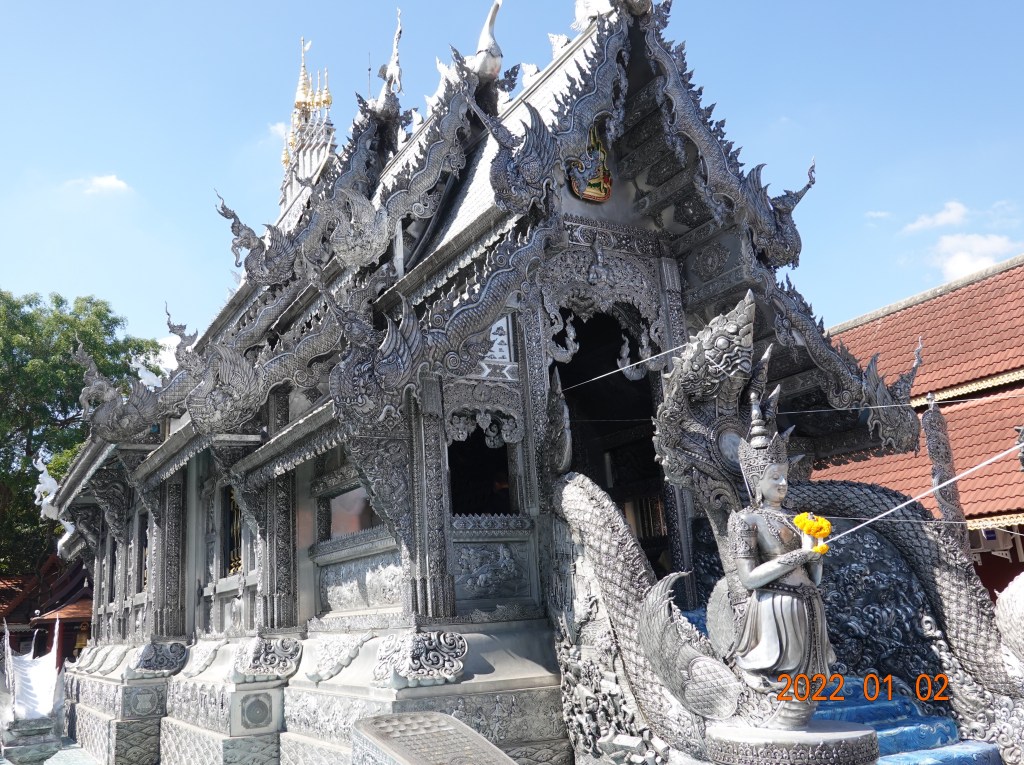
The entrance and inside the ubosot is more and more of the intricately hammered silver alloy. Inside, the Buddha image is in gold, contrasting with the silver all around.
I found a tok sen massage shop on the grounds of Wat Sri Suphan. Tok Sen massage involves a wooden hammer being tapped along your Sen energy lines. It is said to relax the muscles, heal chronic pains, and improve the pathways of the nervous system. I have had tok sen done before at a different temple, and while interesting, did not seem to do much. I decided to try and opted for a 15-minute session to work the shoulders and upper back. This lady, Noon, is very good, and I liked the result. Working on a computer much of the time can cause tightness in the shoulders and upper back. Noon seemed to really help the area. I got her number and will book a longer session soon.
Khao Soi Lung Prakit Kaat Gorm
Just before 3, I again headed south to Khao Soi Lung Prakit Kaat Gorm. The wait was only about 15 minutes, and the service was fast. Here is my khao soi number two in two days:
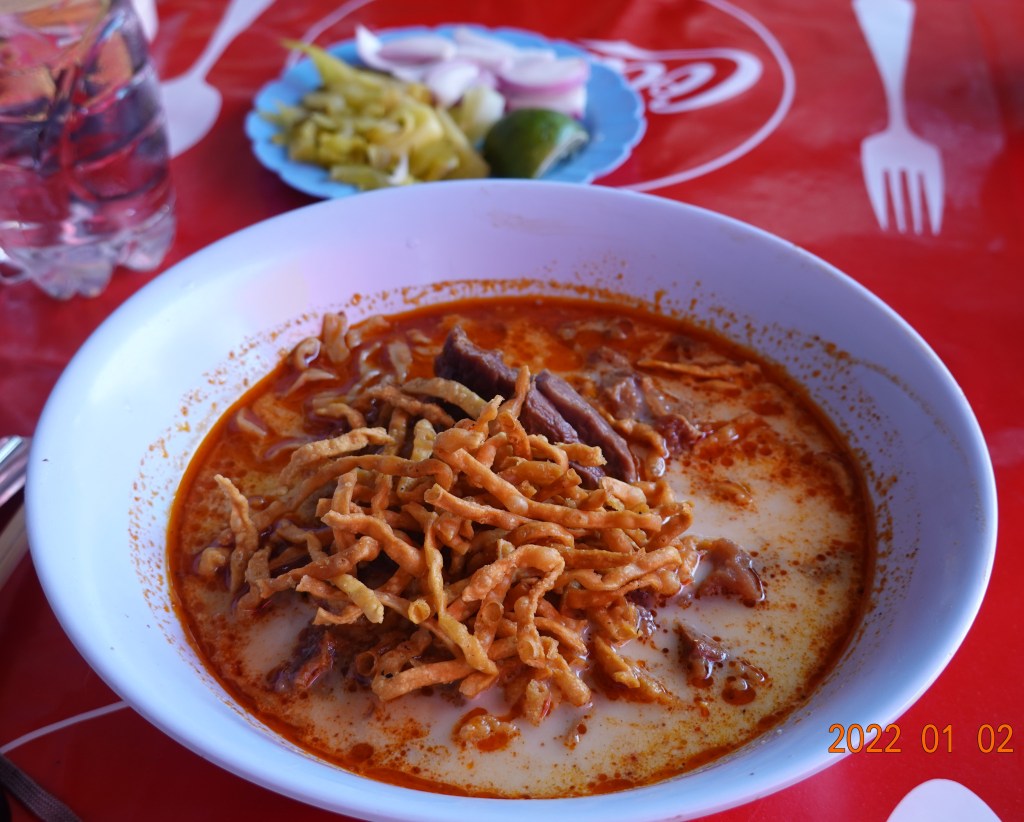
This is before I added the pickled mustard greens and shallots. This bowl of khap soi was much spicier than that at Khao Soi Islam, so no chillie paste added. And this bowl was a bit more greasy and the beef had more fat. Overall it was all right, a little too spicy for me, but not great. Tomorrow I’ll go up to Khao Soi Khun Yai and see how number three is.
Next: More Khao Soi

 James the Intrepid Pilgrim