Wednesday 22 January, 2020
Visiting Wat Lok Molee
My visit to Chiang Mai is nearing the end; I’ll be starting the journey home in just four more days. Knowing that, after yoga practice today and a fruit smoothie at the Amazing Alleyway, I pondered what to do or where to visit in my last few days. Immediately one of my favorite temples, Wat Lok Molee, came to mind. I love Wat Lok Molee.
Wat Lok Molee
I had a chi nei tsang session with Om this afternoon, and being more than half-way up to the north side of the old city where Wat Lok Molee is located, after the session, I made the walk up north and west, across the moat, and to Wat Lok Molee.
This is another temple name where the translation is open to interpretation. Wat Lok Molee is sometimes spelled in English Wat Lok Moli. The date when the temple was originally built is not known, but it was already established in the 14th century as records show that the sixth king of the Menrai Dynasty, King Kuena, invited Burmese monks to come, live in the temple and spread the teachings of the Buddha. Wat Lok Molee was known as a royal temple as members of the Mengrai Dynasty, who ruled the Lanna kingdom from 1292 to 1598, maintained it during their rule. The tall chedi seen today dates from the 1520s and was built by King Ket to house the ashes of members of the Mengrai Dynasty.
Wat Lok Molee Mystery
I have visited many, many temples in both the Chiang Mai area and the Bangkok area. Almost all Buddhist temple viharn (worship or assembly hall) are aligned east-west, so that the main doors greet the rising sun. The rising sun represents the beginning or birth. The chedi, in which the ashes of someone are interred is at the west of the viharn, as the west is the setting-sun side, and the setting sun represents the end or death. I know of only two exceptions to this east-west alignment in Chiang Mai, Wat Lok Molee, and Wat Sri Suphan. The main viharn at Wat Lok Molee opens to the south, and the main viharn (as well as the ubosot) at Wat Sri Suphan opens to the north. To date, I have not been able to learn why these two temples are constructed differently from the overwhelming norm. This remains a mystery, albeit not an important mystery to solve. But I am very curious why these two temples were constructed very differently than the norm, and perhaps someday I will learn why.
Entrance to Wat Lok Molee
This picture is from across the main street, and shows one of the pair of yaks beside the entrance archway, the roof line of the main viharn, and the very prominent, large chedi.
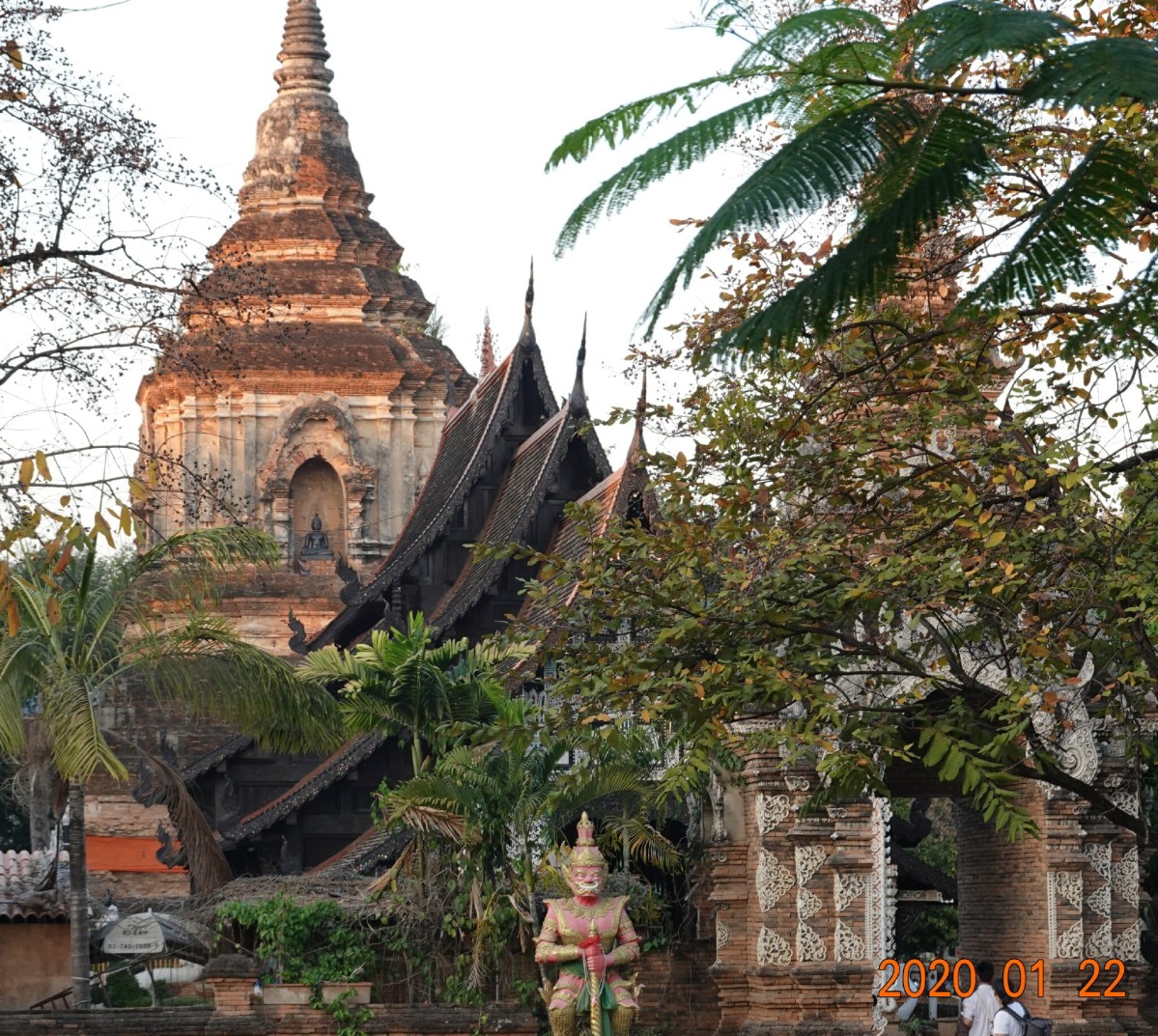
View of the temple Wat Lok Molee.
Crossing the street, here is the official entrance archway in front of the viharn, and guarded by two yaksha (more common at temples in central and southern Thailand). The entrance to Wat Lok Molee:

Main entrance archway at Wat Lok Molee.
Looking at the entrance archway from the other side, there are two elephants greeting visitors.

Inside the entrance archway at Wat Lok Molee.
The Viharn at Wat Lok Molee
The viharn at Wat Lok Molee is made of teak, covered in black lacquer, and the roof is Lanna-style, with overlapping tiers with a steep pitch sweeping very low.
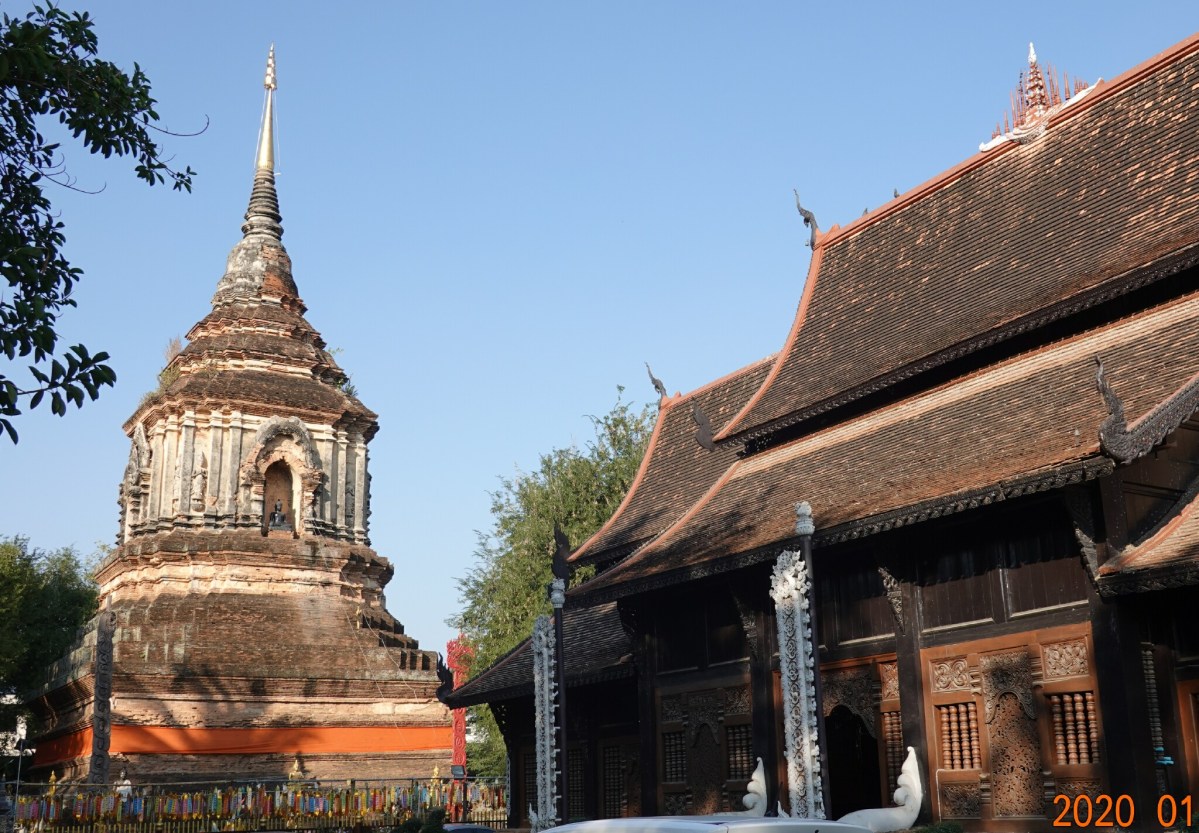
Side of the viharn and view of the chedi at Wat Lok Molee.
The front of the viharn is nicely decorated, and the entrance guarded by nagas on the stair banister, as is common in Lanna-styled temples.

Entrance to the viharn at Wat Lok Molee.
Inside the viharn, it is dark with black-lacquered teak making up the walls and columns. Windows are small, so while there is some light, the overall mood is quiet and peaceful, maybe a little dark. At the alter, this darkness is a sharp contrast to the large golden Buddha image sitting on a high base in the basic meditation posture, Dhyanna mudra.
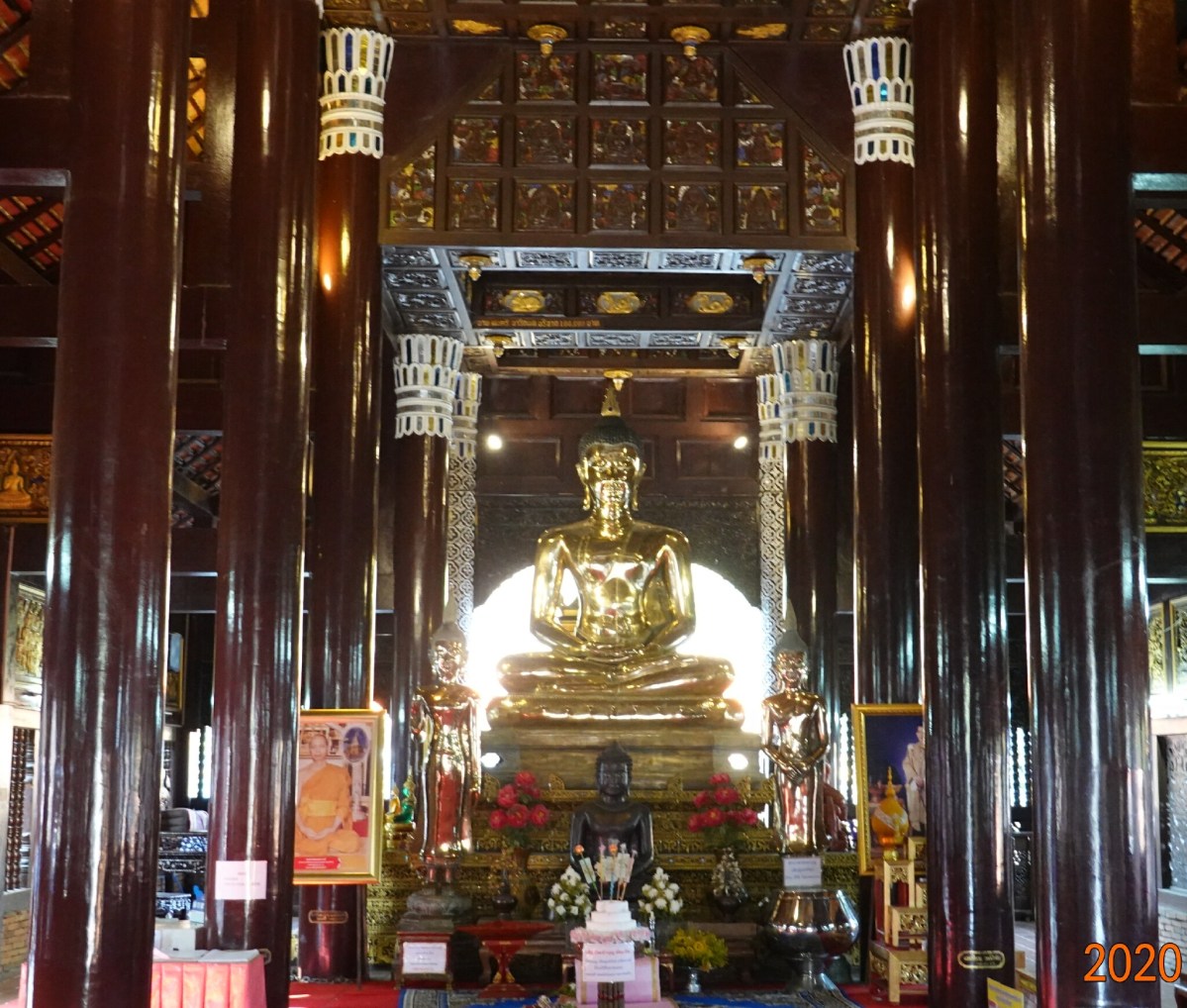
Inside the viharn at Wat Lok Molee.
There are carved panels on the walls depicting scenes from Buddhist texts, and mosaic panels on the ceiling – if you do not look up, you miss them. Here are two.


The Chedi at Wat Lok Molee
The chedi at Wat Lok Molee is very large, massive in size and in comparison to most temples in the Chiang Mai area. The chedi is bare brick with no covering of stucco, on a square base with a number of layers of diminishing size to support the middle section that has most of the old stucco in place.

Massive chedi at Wat Lok Molee.
Wat Lok Molee, like all Buddhist temples, is a small campus with several or many buildings. At Wat Lok Molee, the grounds are not large, and there are a couple other buildings that look like libraries or study areas for monks, but not worship halls. One is fairly new, having been built since my first visit here eight years ago. This building is fairly plain outside, and inside sparsely decorated. Above the door of this hall is a statue of King Kuena who established the temple in the 14th century, flanked by two soldiers armed with spears and swords.
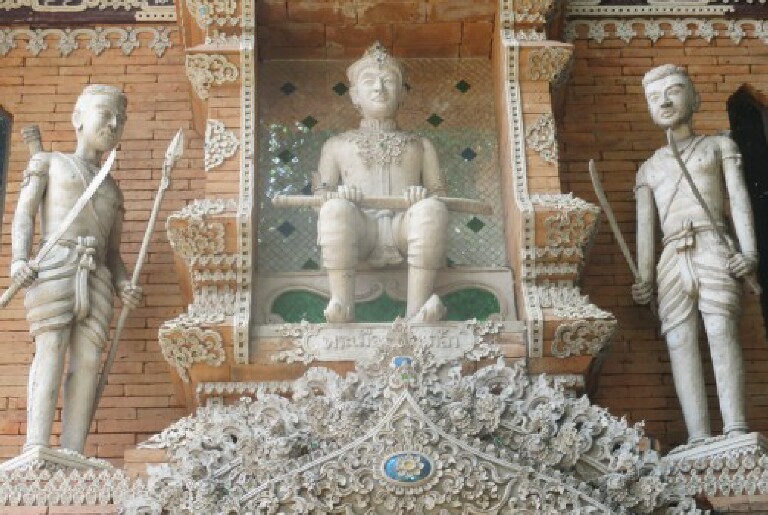
Statue of King Kuena at Wat Lok Molee.
This room used by the monks to receive worshipers and to receive offerings. Here they give blessings and give instruction to people who enter.
And nearby the statue of the King, is this statue of Vishnu with 20 arms (if I counted correctly). Notice the decoration on the brick is similar to that of the building in which the statue of the king is over the entrance.
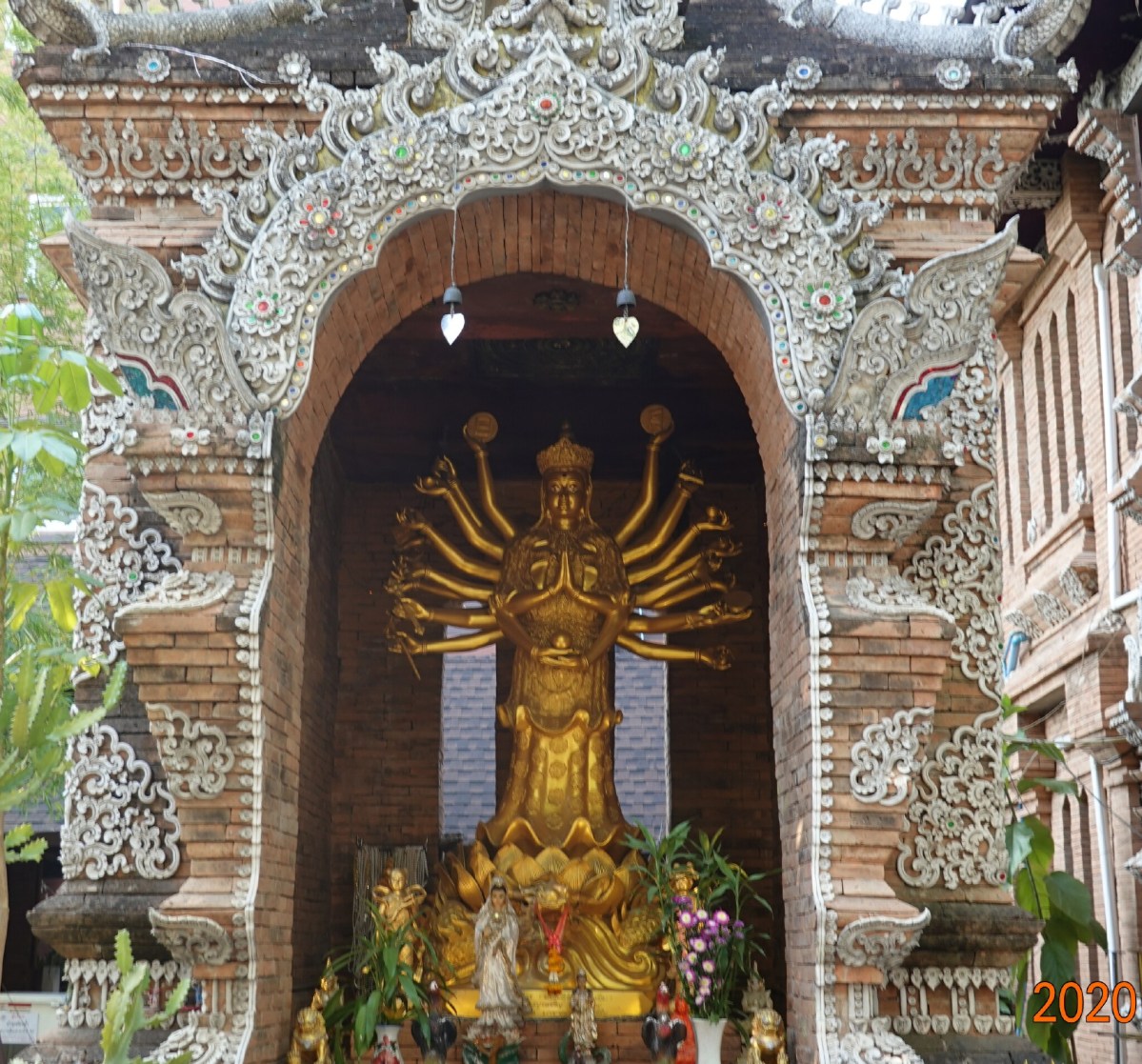
Vishnu statue at Wat Lok Molee.
Vishnu, one of the principle deities in Hinduism, considered a preserver, and to some, considered a supreme being. Vishnu means all pervasive, one who is everything and inside everything. Vishnu is notable for adopting various incarnations to preserve and protect dharmic principles whenever the world is threatened with evil, chaos, and destructive forces.
Three Kings Monument
Walking back to See You Soon from Wat Lok Molee, I passed the Monument to the Three Kings. I posted more detail on December 31. The monument depicts the three kings that founded Chiang Mai in 1296: King Mengrai of Lanna in the center, and his two friends, King Ngam Muang of Phayao (left) and King Ram Nhamhaeng of Sukhothai (right). I walk by this monument often, and just love it. They look proud and self-assured.

Monument to the Three Kings at the center of Chiang Mai
Wat Inthakin Sadeu Muang
Very close to the Monument to the Three Kings is a small temple, Wat Inthakin Sadeu Muang. This is where the city pillar called “Inthakin” was erected in 1296 by King Mangrai when Chiang Mai was founded. (In about 1800, the Inthakin was moved to Wat Chedi Luang and is now housed there in a new building.) Wat Sadeu Muang means “Temple of the naval of the city” reflecting its central position in the old town.
The viharn is a beautiful example of the Lanna temple architecture, the combination of the dark teak, with its coating of almost black lacquer, and the ornate gilt decoration results in a striking and memorable look. The roof slopes steeply, and low in the Lanna style, like the protective wings of a bird. As is typical in Lanna style temples, the entrance stairs are protected by naga.

Viharn at Wat Inthakin Sadeu Muang.
To the left of the viharn, and likely part of the temple, is a building with these rather striking doors, looking like they belong more at Wat Sri Suphan (the temple with the silver ubosot) than here in the center of the city:
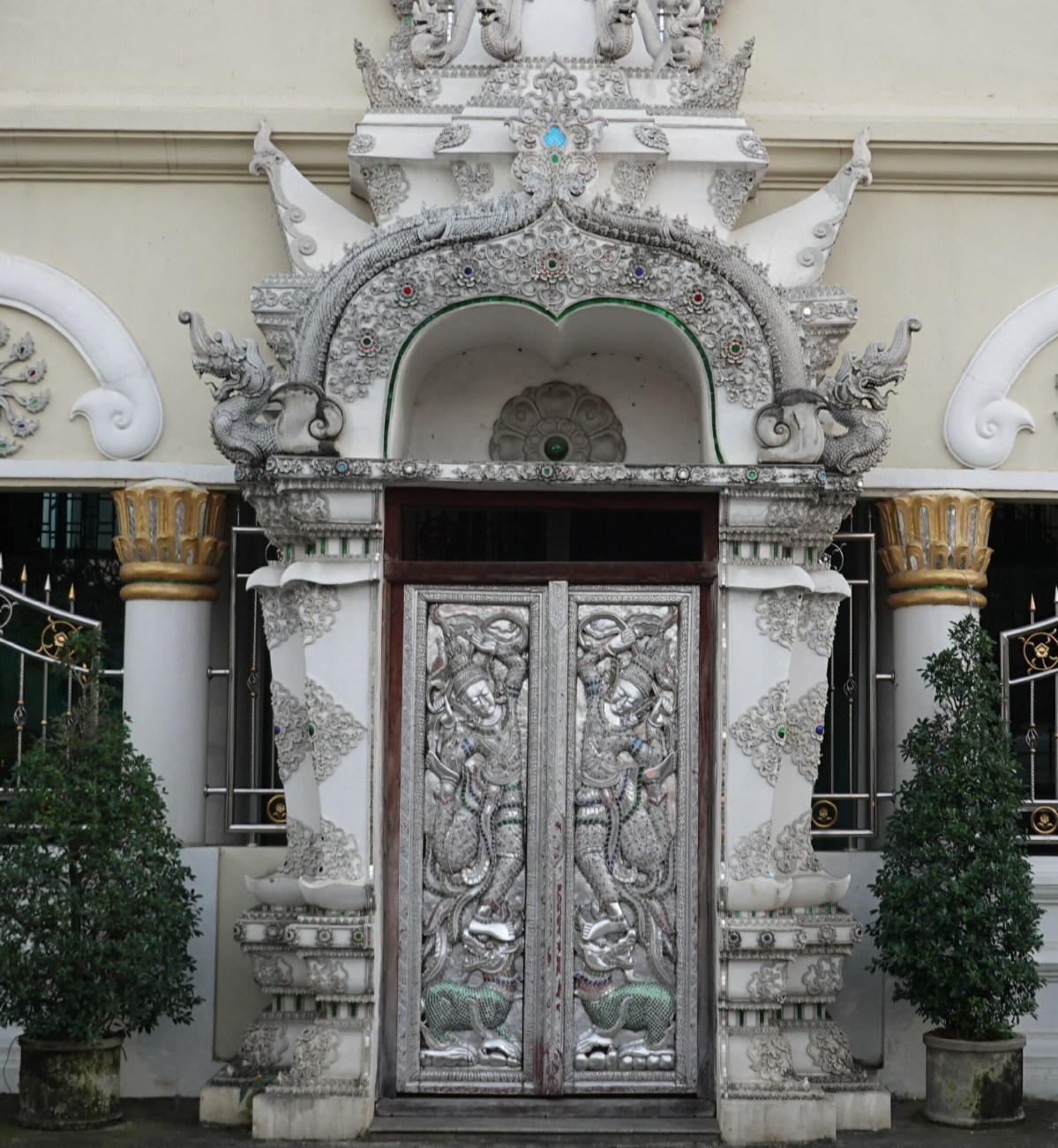
Silver ornate doors by Wat Inthakin Sadeu Muang.
I walked the last 300 meters to See You Soon, got a shower, changed clothes, and took a rest before dinner. Another good day in Chiang Mai walking the old city and enjoying the sights.
Next: Shopping in Chiang Mai

 James the Intrepid Pilgrim