Sunday, January 12, 2020
Returning to Wat Sri Suphan
Yoga practice today was with Annie, a very strong practice, as they all are at Wild Rose Yoga. I like all of the teachers at Wild Rose, they all are very skilled at yoga asana, very adept at demonstrating, and very good teachers. This is a credit to Rose, the owner, who selects the teachers. This year I have practiced with Sera, Annie, May, Airy, Earthy, and Jear. All are strong, all are a little different, and I enjoy practicing with all…but I have to work hard and I sweat heavily. It is all good.
Wat Sri Suphan
After a rest and some lunch, I decided to return to Wat Sri Suphan, the “Silver Temple”. Wat Sri Suphan, sometimes Wat Srisuphan, is on most of the “must see” lists of temples in Chiang Mai because of its “silver” ubosot or ordination hall. It’s situated a short walk down Wua Lai Road, diagonally southwest from Chiang Mai Gate. This is the The Haiya area of the town, the old silver quarter where still today there are many silver craftsman’s shops, and if you walk around you can hear the continual tapping of them at work.
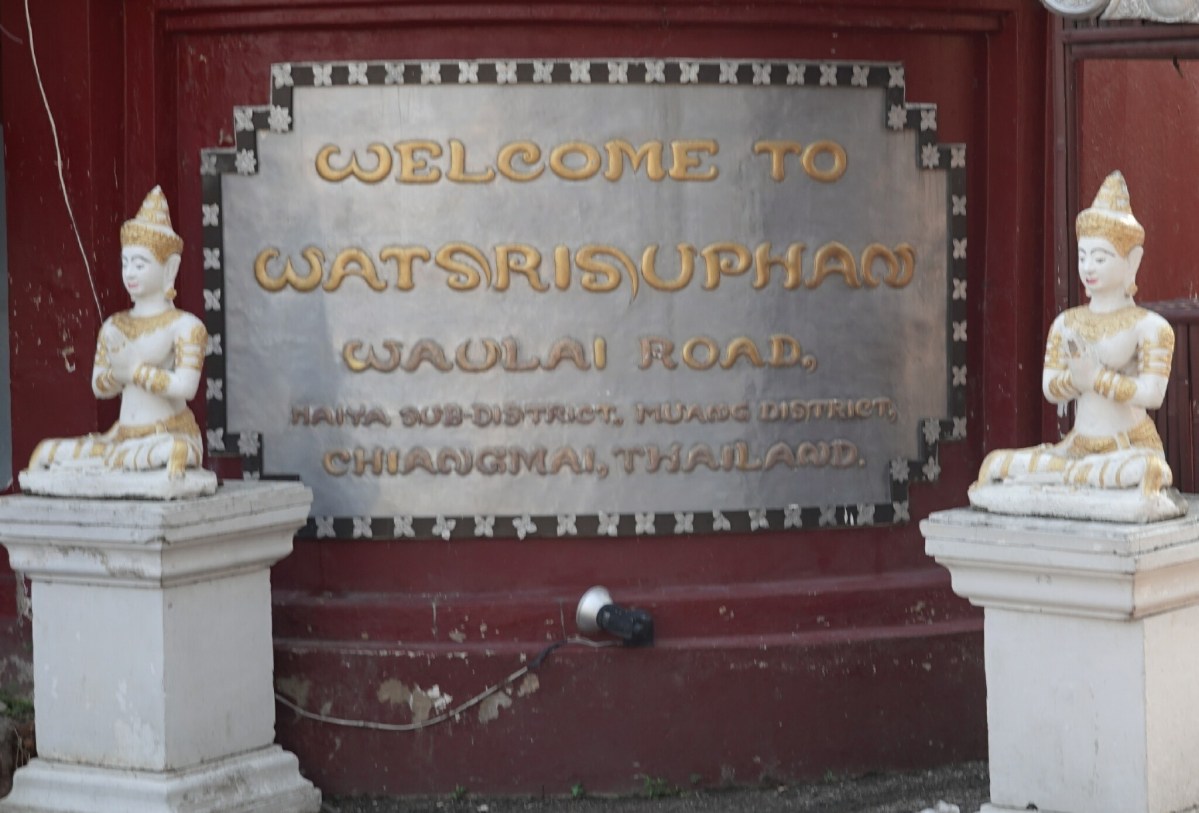
Entrance to Wat Sri Suphan temple grounds
Wat Sri Suphan was established in 1502 during the reign of King Kaeo, the eleventh ruler of the Mengrai Dynasty. Nothing but some old pillars remain of the original construction and the temple has been rebuilt many times.
The most recent reincarnation of the temple began in 2004 under the direction of the abbot, Phra Kru Phithatsuthikhun. Instead of using standard temple renovation techniques, the abbot utilized the skill and knowledge of local silversmiths. The result is a building covered in silver metal which shimmers in the sunlight and is full of intricate details.
The craftsmen at Wat Sri Suphan work with nickel and aluminium for the ordination hall, although there is also some silver used in the construction of important images. The effect is certainly dazzling and unusual with a mass of repoussé and chased work, as well as carved figures, covering the exterior and interior and certainly makes for a great photographs.
“Repoussé” working literally means “pushed from behind” and refers to the working of the malleable metal sheets from behind with hammers creating reliefs. “Chasing” is the opposite and refers to the working of the metal from the front to create the finished design. Both methods are used for the decoration of the Silver Ubosot at Wat Sri Suphan.
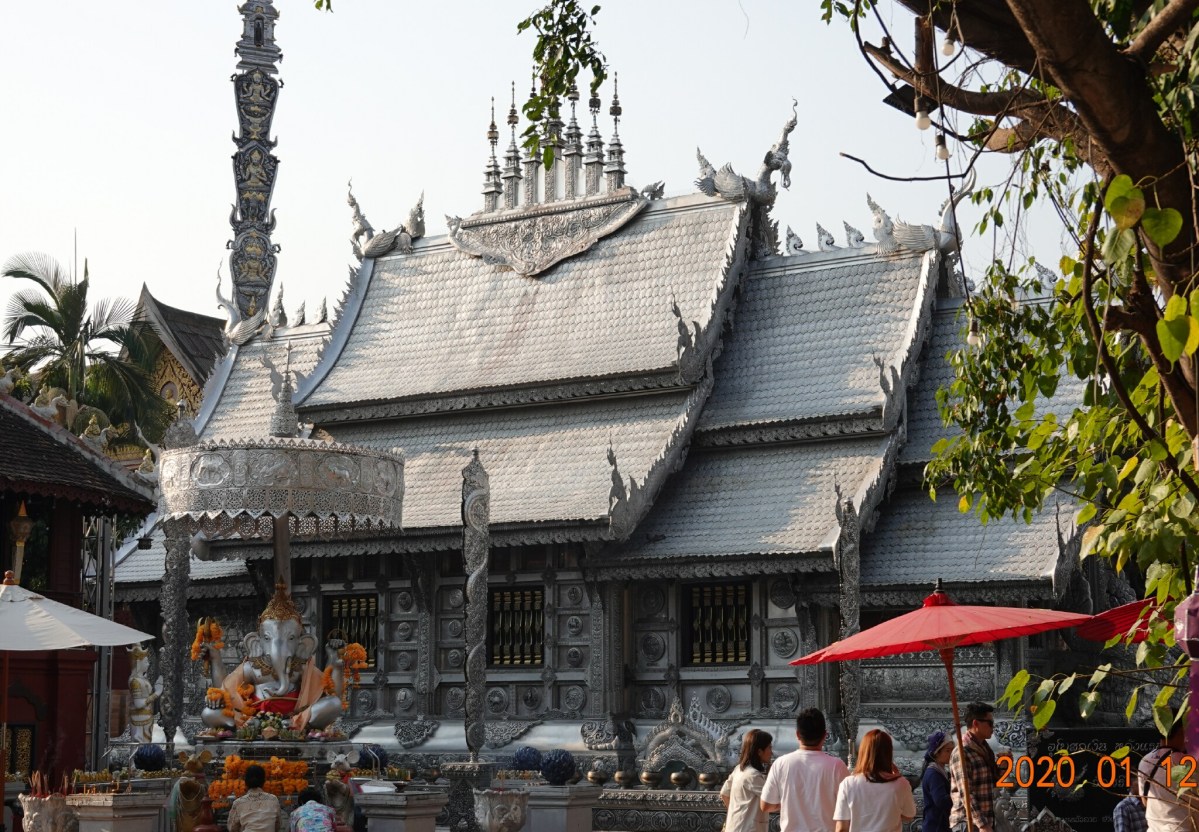
First view inside the entrance of the Silver Ubosot at Wat Sri Suphan.
On the short walk over to the silver ubosot (ordination hall, where monks are ordained), there is this silver Ganesh, an elephant Hindu deity representing wealth, success and good luck, at which people are almost always praying or worshiping.
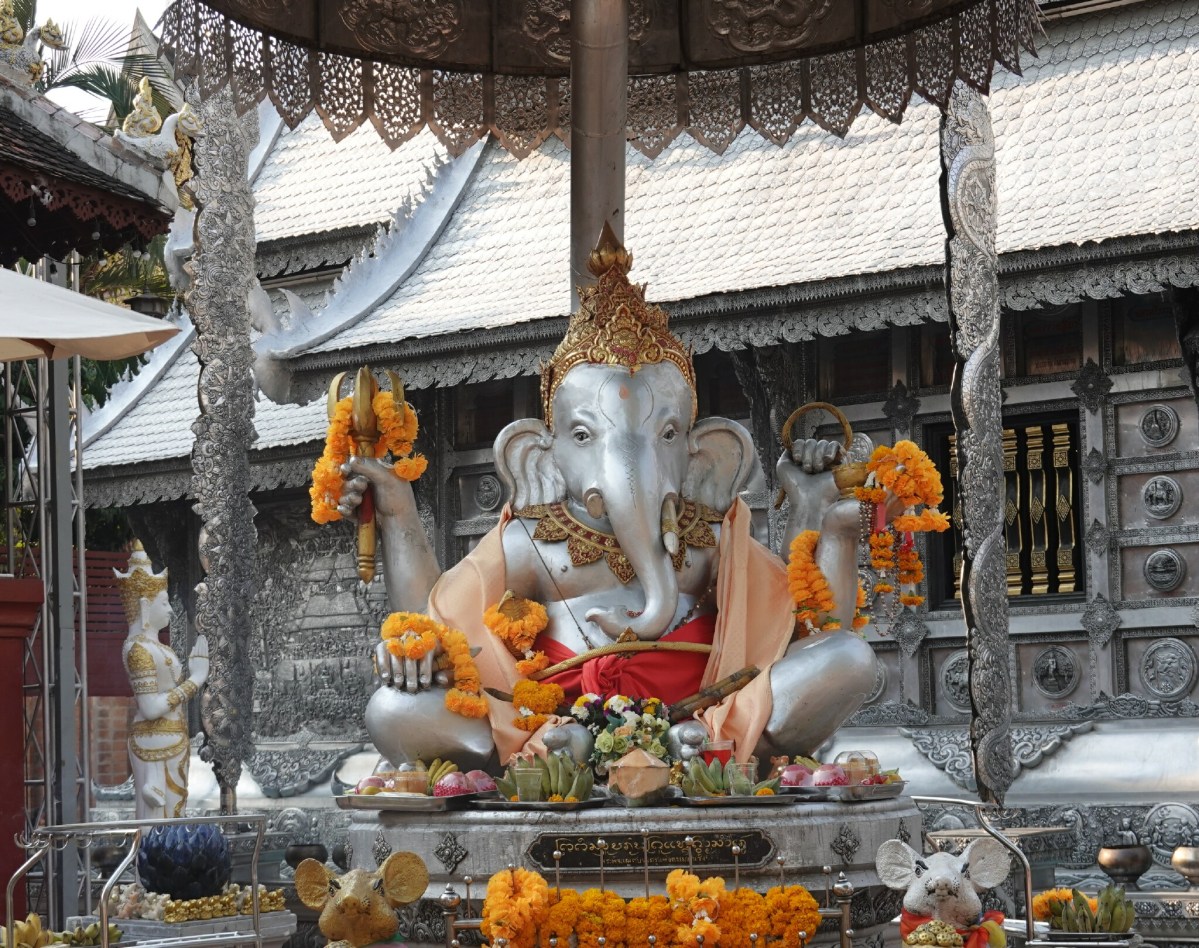
Silver Ganesh at Wat Sri Suphan
And to the left of the Ganesh is this statue of King Kaeo, and possibly his wife, the Queen.
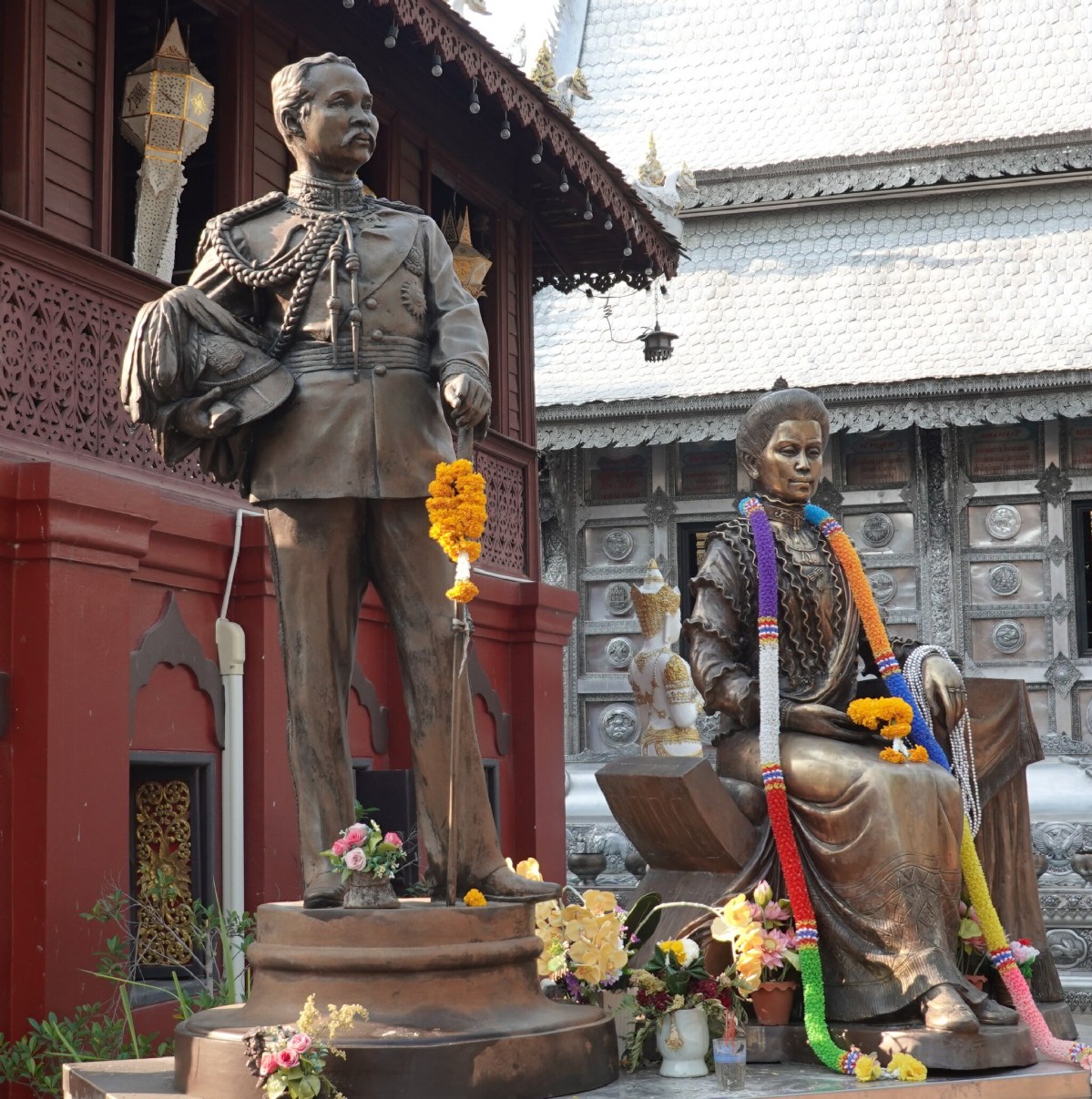
Statue of King Kaeo and Queen
From there, I walked around to the back of the silver ubosot to get a few photos without pointing into the sun.
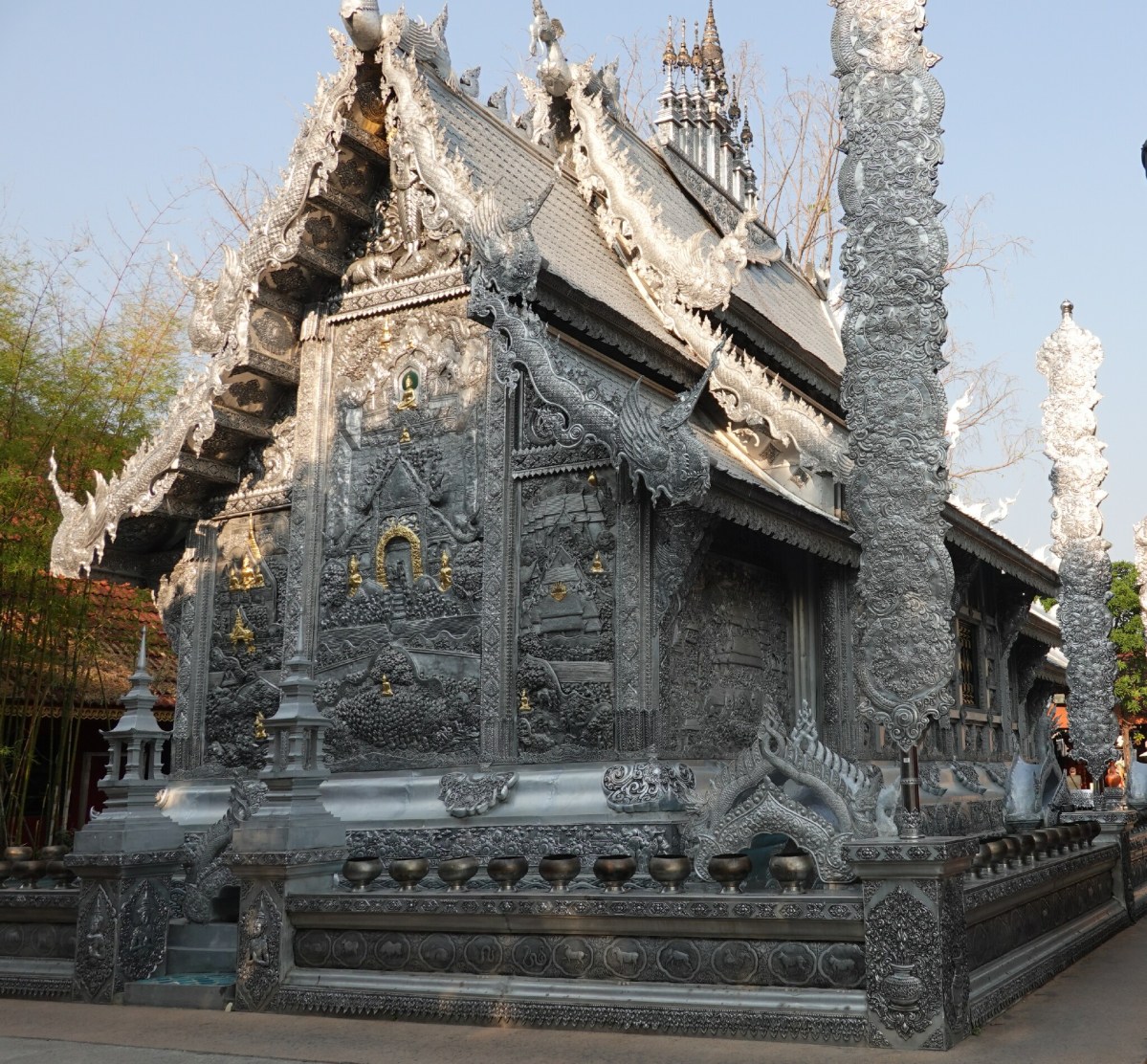
Back view of the silver ubosot at Wat Sri Suphan
And this photo is of the back, showing some of the detail in the handiwork on the ubosot.
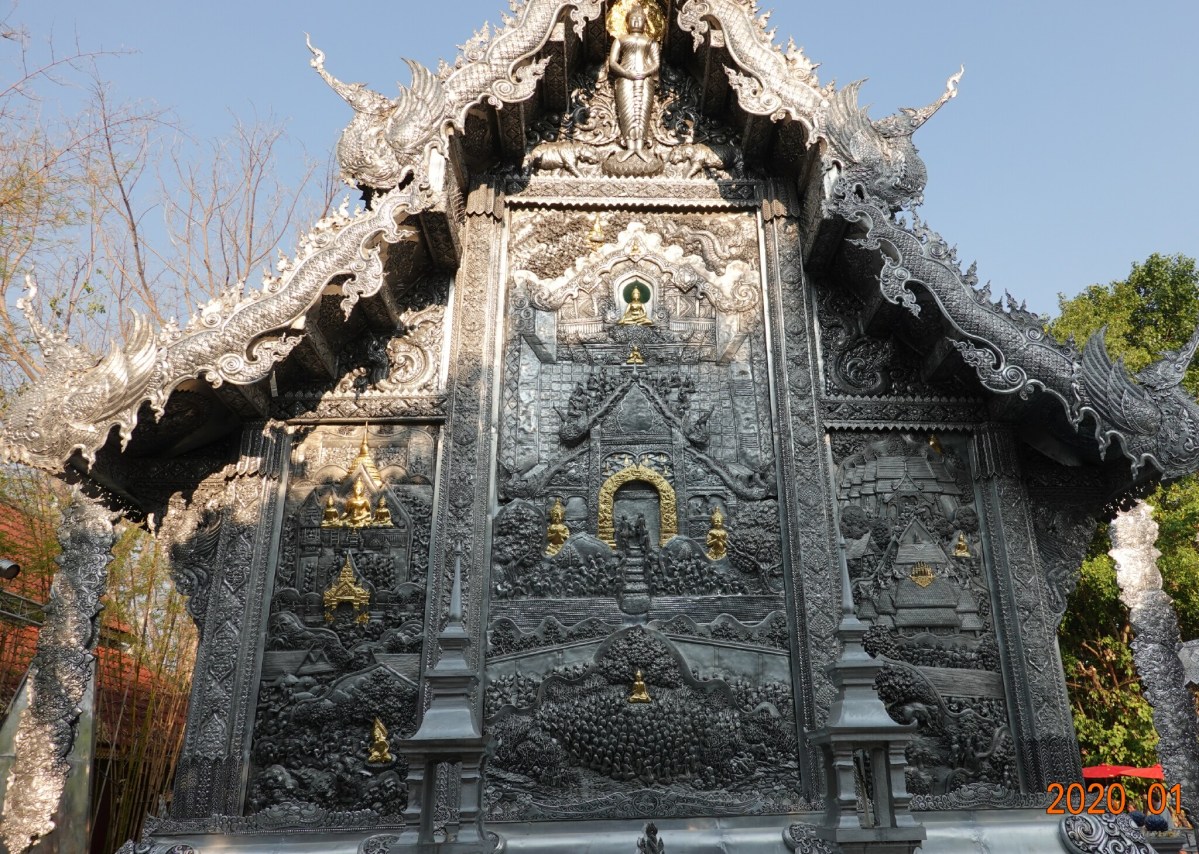
Back of the silver ubosot at Wat Sri Suphan.
And then to the front of the Silver Ubosot:
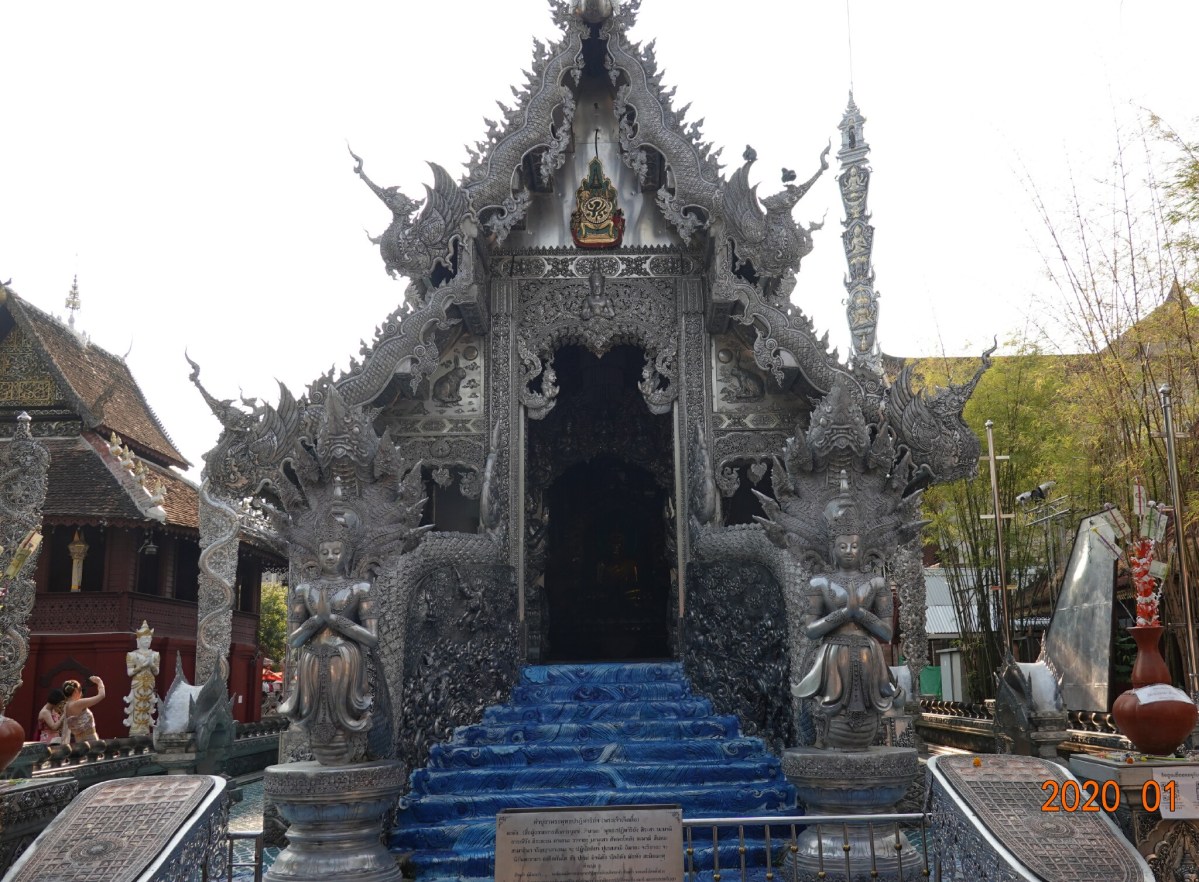
Front of the Silver Ubosot at Wat Sri Suphan.
Notice the two Buddha footprints. These are relatively new, having appeared only two years ago, as I recall. The entrance is guarded by two silver thewada (angelic beings that live in the heavenly realm). Women are not allowed to enter the ubosot at most temples. Here is a quote at Wat Sri Suphan explaining why:
Beneath the base of Ubosotha in the monastic boundary, many precious things, incantations, amulets and other holy objects were buried 500 years ago. Entering inside the place may deteriorated the place or otherwise the lady herself. According to this Lanna belief, ladies are not allowed to enter the Ubosotha.
While not an entirely satisfying explanation, but it comes down to custom and the Thai beliefs, and while a guest in Thailand, I honor and follow their customs and beliefs. Being a man, I entered the ubosot (after removing my shoes, as is the custom at all temples). Here is detail of the archway over the entrance to the ubosot:
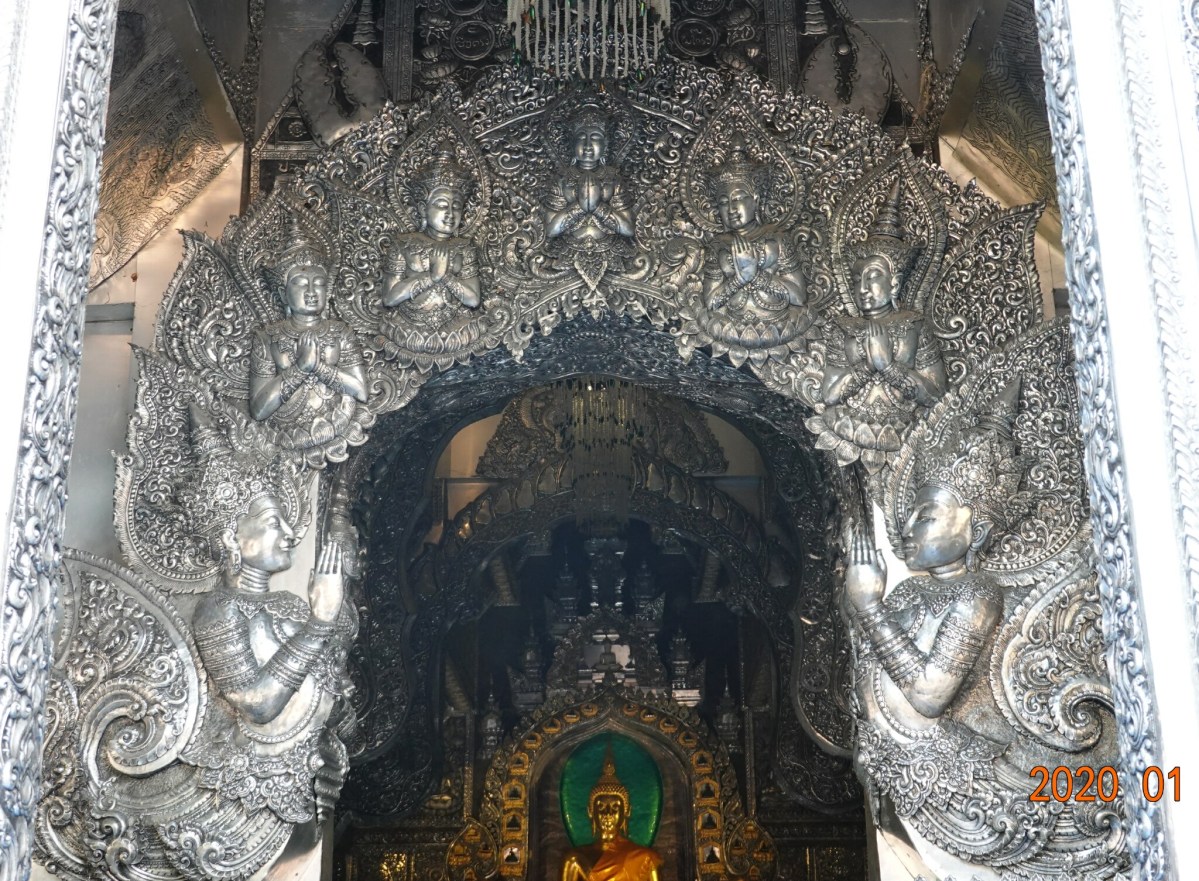
Entrance archway to the ubosot at Wat Sri Suphan.
And inside the ubosot is more silver and a single Thai gentleman worshiping:
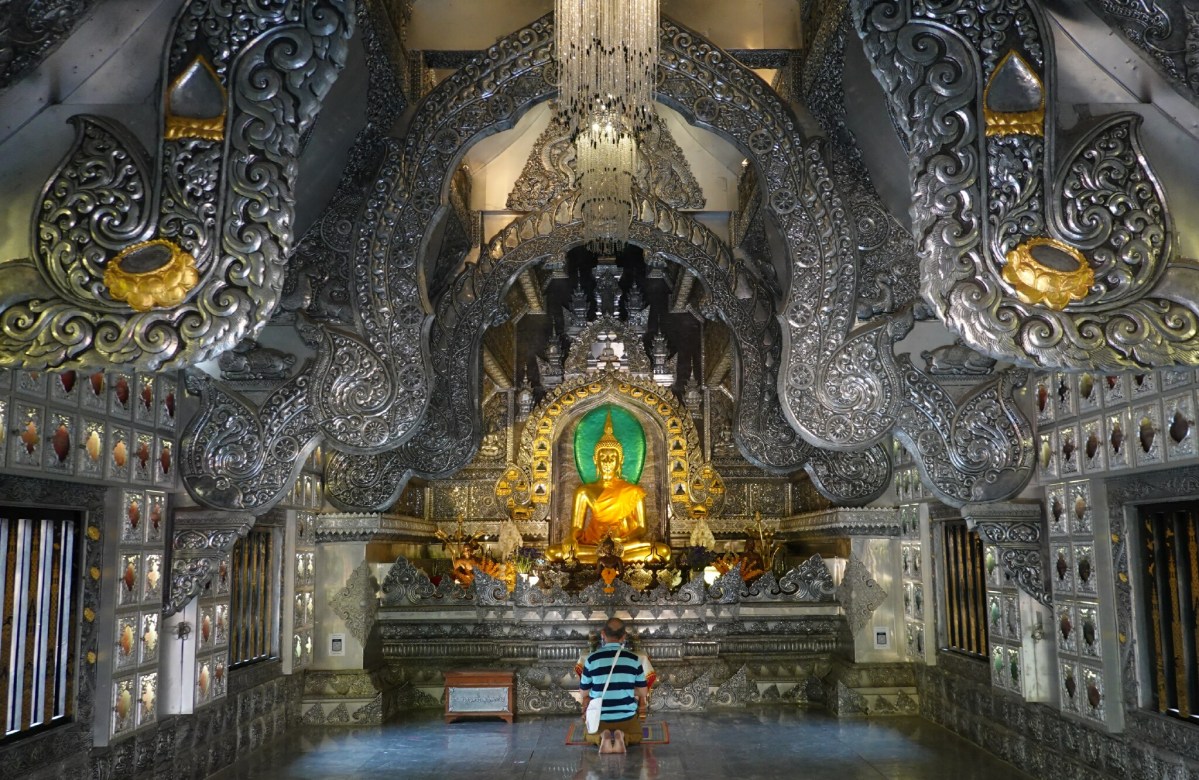
Inside the Silver Ubosot at Wat Sri Suphan.
Opposite the Silver Ubosot is this replica of the Emerald Buddha. I could not find a reason for its being here, all the description was in Thai, but it is striking:
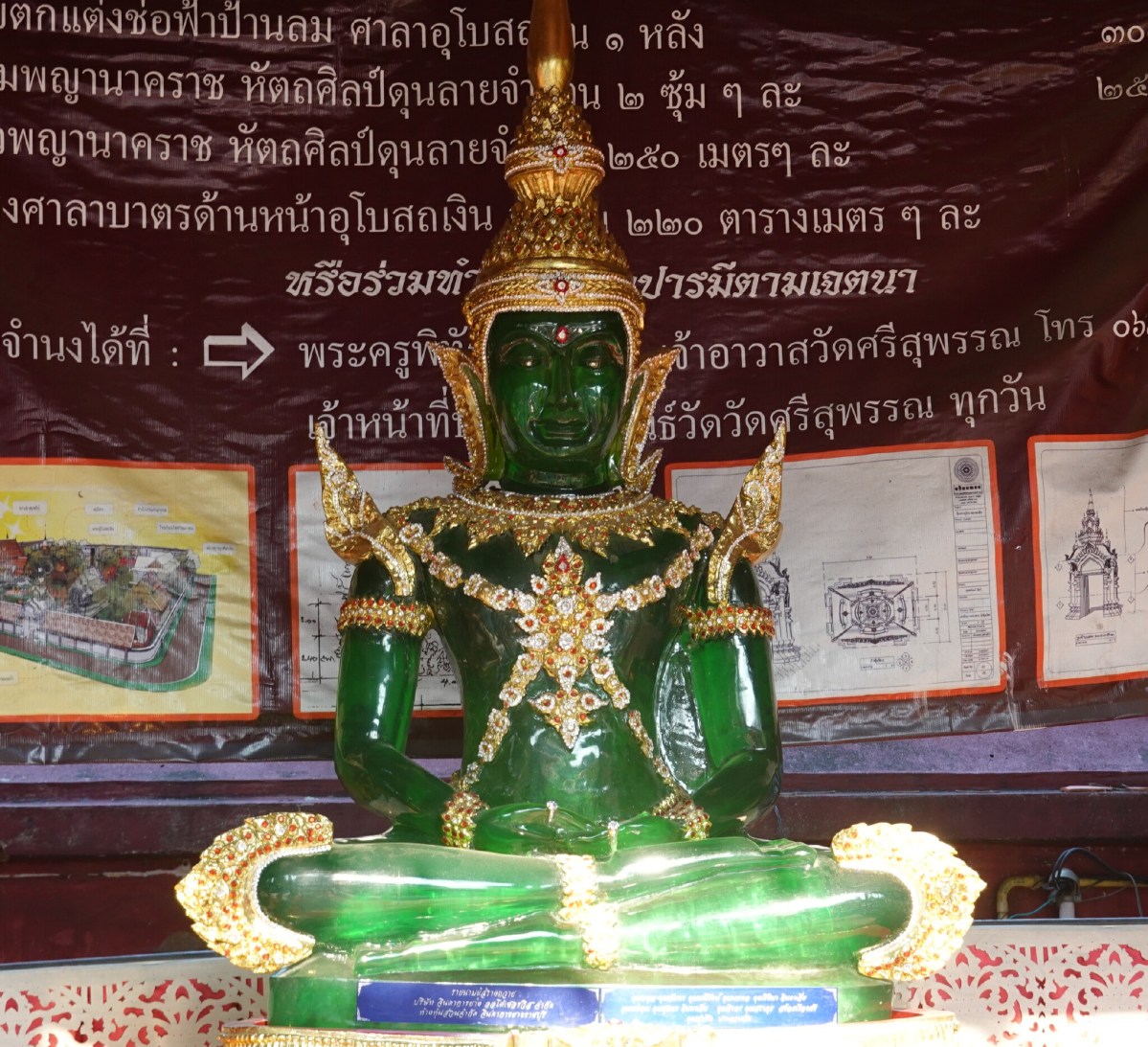
Emerald-colored Buddha at Wat Sri Suphan.
And Wat Sri Suphan is not only the Silver Ubosot, although that is the attraction. The viharn is also quite nice, and very typical of Lanna-style temples. As I have written previously, almost all Buddhist temple viharn are aligned east-west, so that the main doors greet the rising sun. I know of only two exceptions in Chiang Mai, Wat Lok Molee, and Wat Sri Suphan. The main viharn at Wat Lok Molee opens to the south, and the main viharn (as well as the ubosot) at Wat Sri Suphan opens to the north. To date, I have not been able to learn why these two temples are constructed differently from the overwhelming norm.
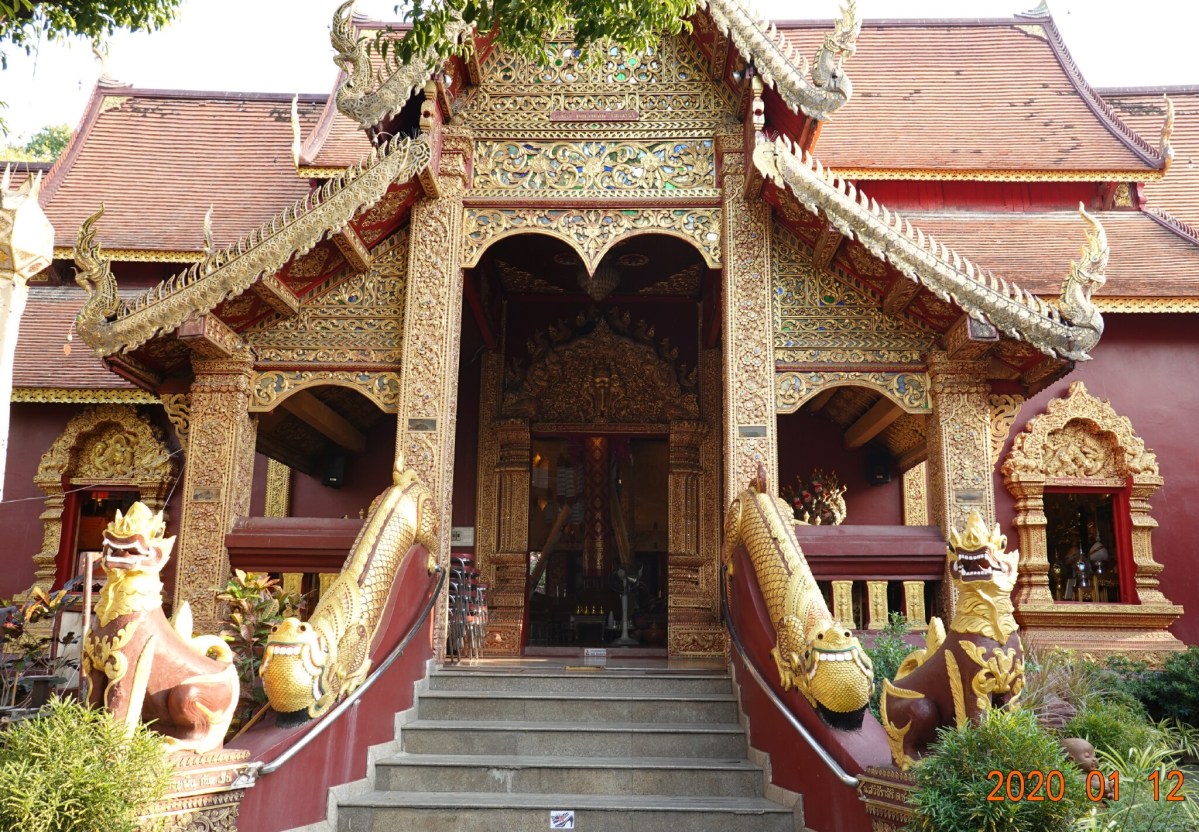
Side entrance to the main viharn at Wat Sri Suphan.
And inside the main viharn is a fairly common-looking alter of Buddha statues, the brilliant gold a striking contrast to all of the silver at the temple.
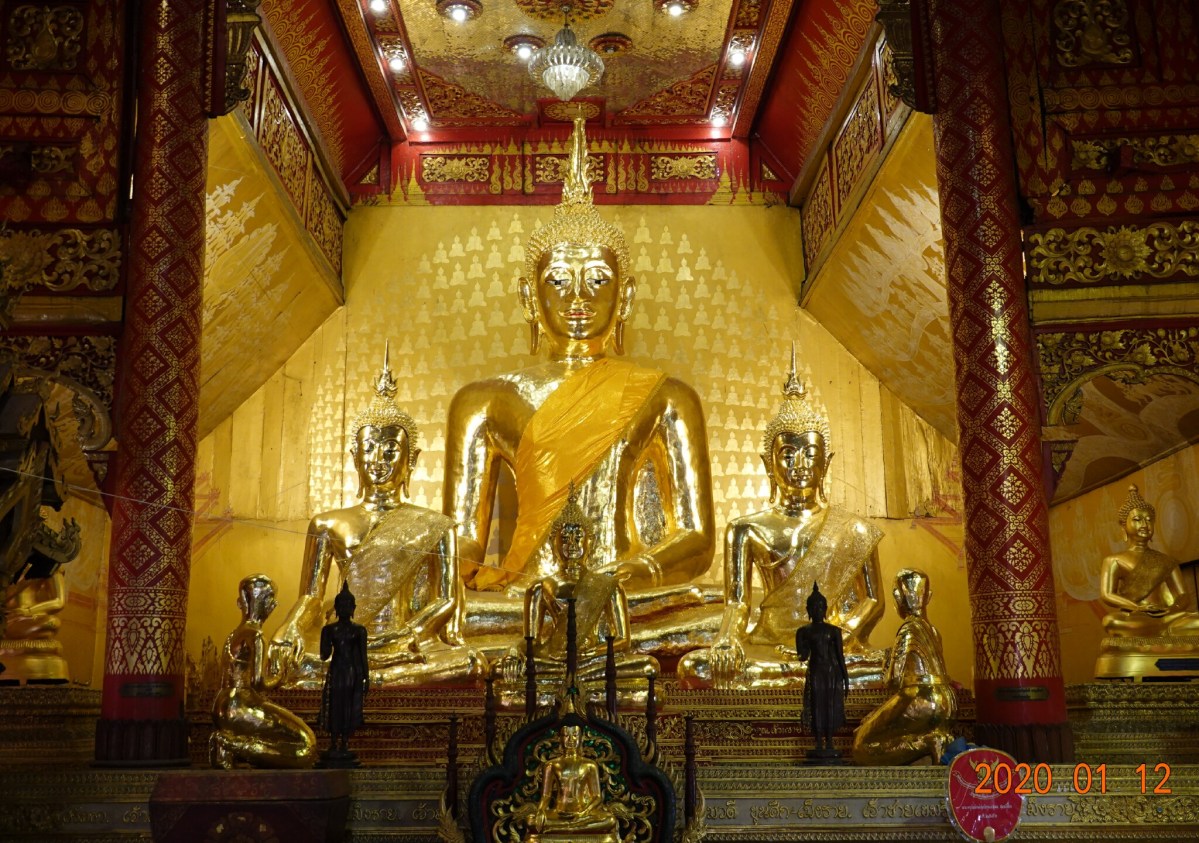
Inside the main viharn at Wat Sri Suphan.
In many viharn, the walls have murals of various stories of the Buddha. In this viharn, instead of painted murals, the murals are made in the same technique as that used for the Silver Ubosot. Here are two:


I finally left Wat Sri Suphan. There are more and more people here now. When I first visited Wat Sri Suphan eight years ago, much of the work on the Silver Ubosot was not complete, and as the work has neared completion, more and more visitors are coming.
Wat Muen San
A short distance from Wat Sri Suphan is Wat Muen San, the other Silver Temple.
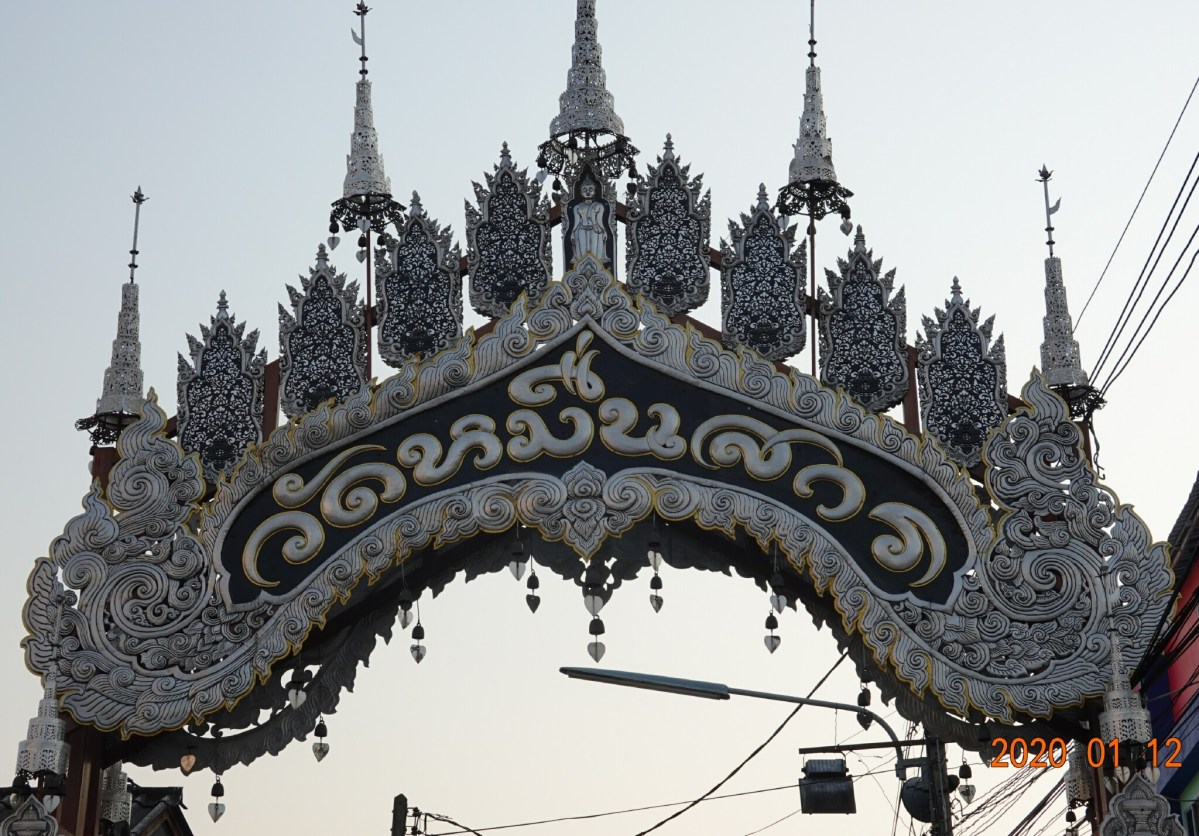
Entrance to Wat Muen San.
This lesser known temple much less commercialized than Wat Sri Suphan; when I was there, I was the only visitor. And women may enter the silver covered building, unlike at Wat Sri Suphan, because the building is a pavilion and not an ubosot. Being late in the day, the building was locked, so I was not able to enter. The style of craftsmanship is very much like that at Wat Sri Suphan.
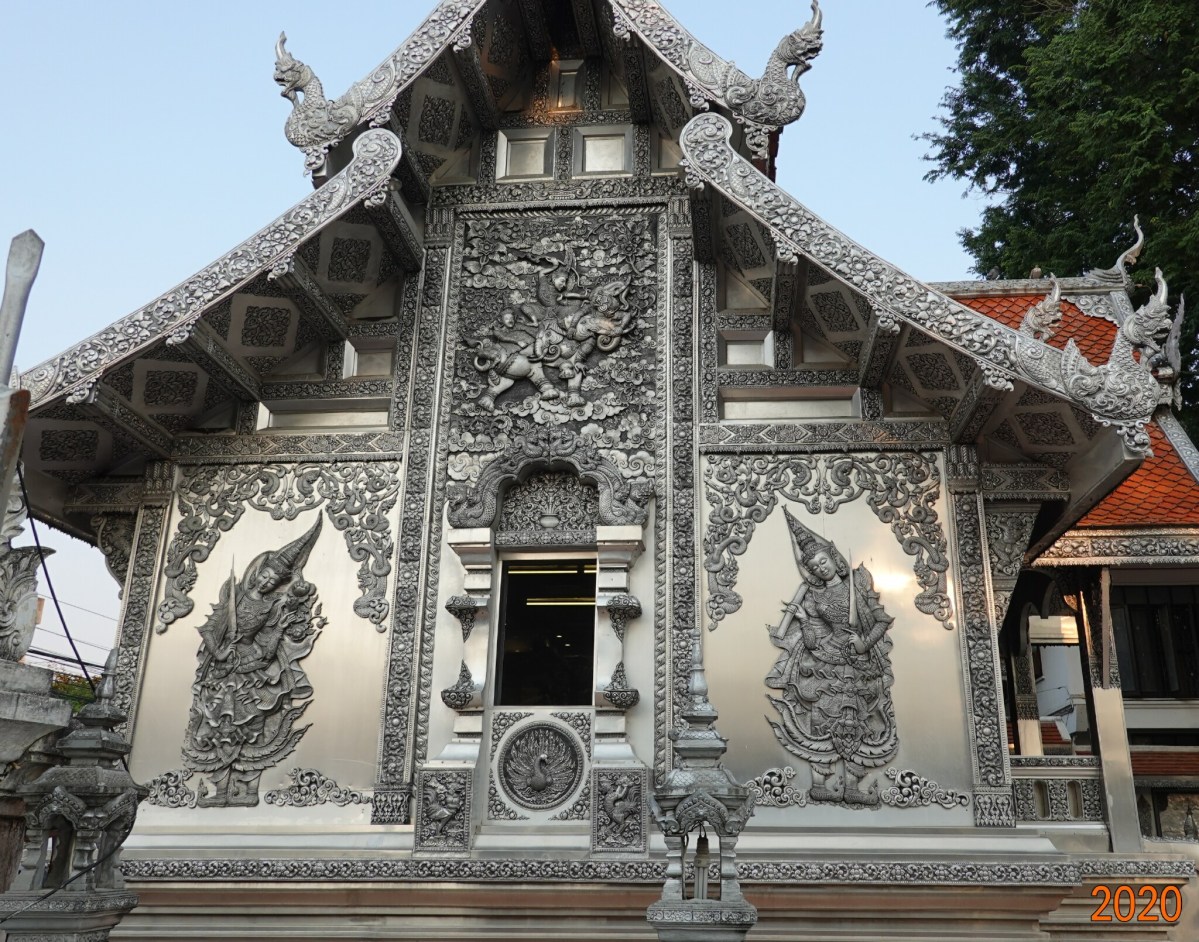
Silver pavilion building at Wat Muen San.
The other buildings at Wat Muen San are under construction or renovation, so today, there is not much to see.
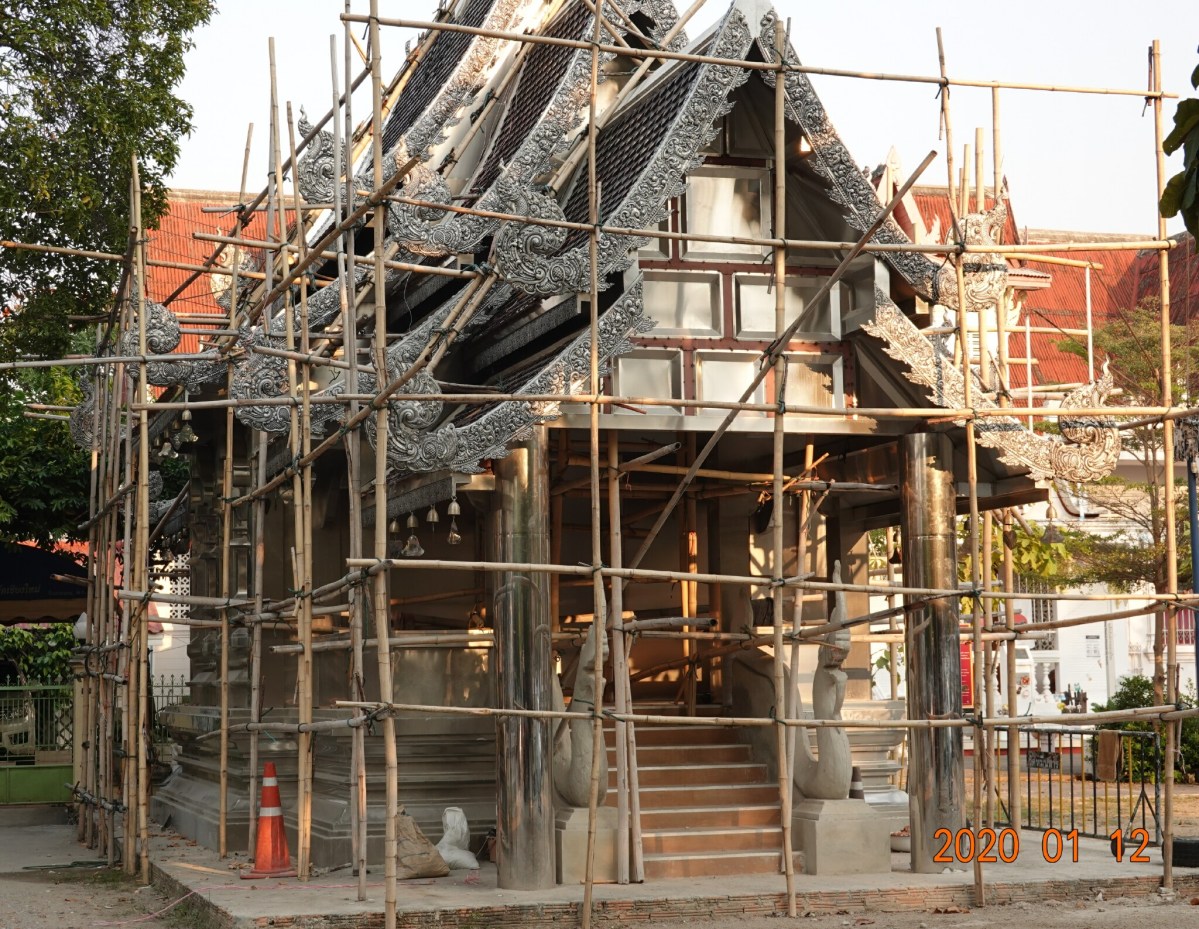
Construction/renovation at Wat Muen San.
I walked back up Wua Lai Road to Chiang Mai Gate and back to my room for a rest and contemplation of dinner.
Next: Return visit to Wiang Kum Kam

 James the Intrepid Pilgrim
What if you were a woman dressed as a man?
LikeLike