Tuesday, December 31, 2019
Chiang Mai Second Day Walk Inside the Old City
After another very strong yoga session bright and early at 8 AM, I had breakfast and decided to make a walk inside the old city. Seemed appropriate after walking the circumference of the wall/moat yesterday. And, I might see what preparations are being made for the New Year celebrations. After King Bhumibol Adulyadej (King Rama IX) passed away three years ago, there were no New Year’s celebrations at all for the first two years, and very limited celebrations last year. It seems that there is to be a slightly larger celebration at the Three Kings Monument tonight. I shall walk by and observe the preparations; I have no plans to stay up late and see what unfolds at midnight.
Wat Jetlin
Just to the north of the soi (small lane) on which Wild Rose is located, is Wat Jetlin, or sometimes spelled Wat Jet Lin, Wat Ched Lin, or Wat Chedlin. Wat Jetlin is a very old temple, said to have been used in the 16th century for the coronation of kings of Lanna (the country making up northern Thailand and Laos until the mid-19th Century when Lanna and Siam merged to become what is now Thailand). I have taken and posted many photos in the past of this temple, because I often walk by it on my way to or from Wild Rose Yoga. Here is a photo of the chedi at the west or back side of the viharn (worship hall):

Chedi at Wat Jetlin
Notice the green and yellow tiles covering the ground in front of the chedi; these were not here last year – all of the entrance, parking area, and approach to the viharn and chedi was sand. Now it is all covered with these tiles; quite a project.
Wat Muentoom
Almost directly across the street is this temple, Wat Muentoom. This was a fairly worn-looking, old temple with a closed-off entrance area on the main street. Last year, there was much construction and rebuilding evident of this main-street entrance, and this year, the project has been completed, giving this old temple a well-deserved and inviting new look.

Main street entrance at Wat Muentoom
And here is some detail of the artistry of the wall by the entrance:
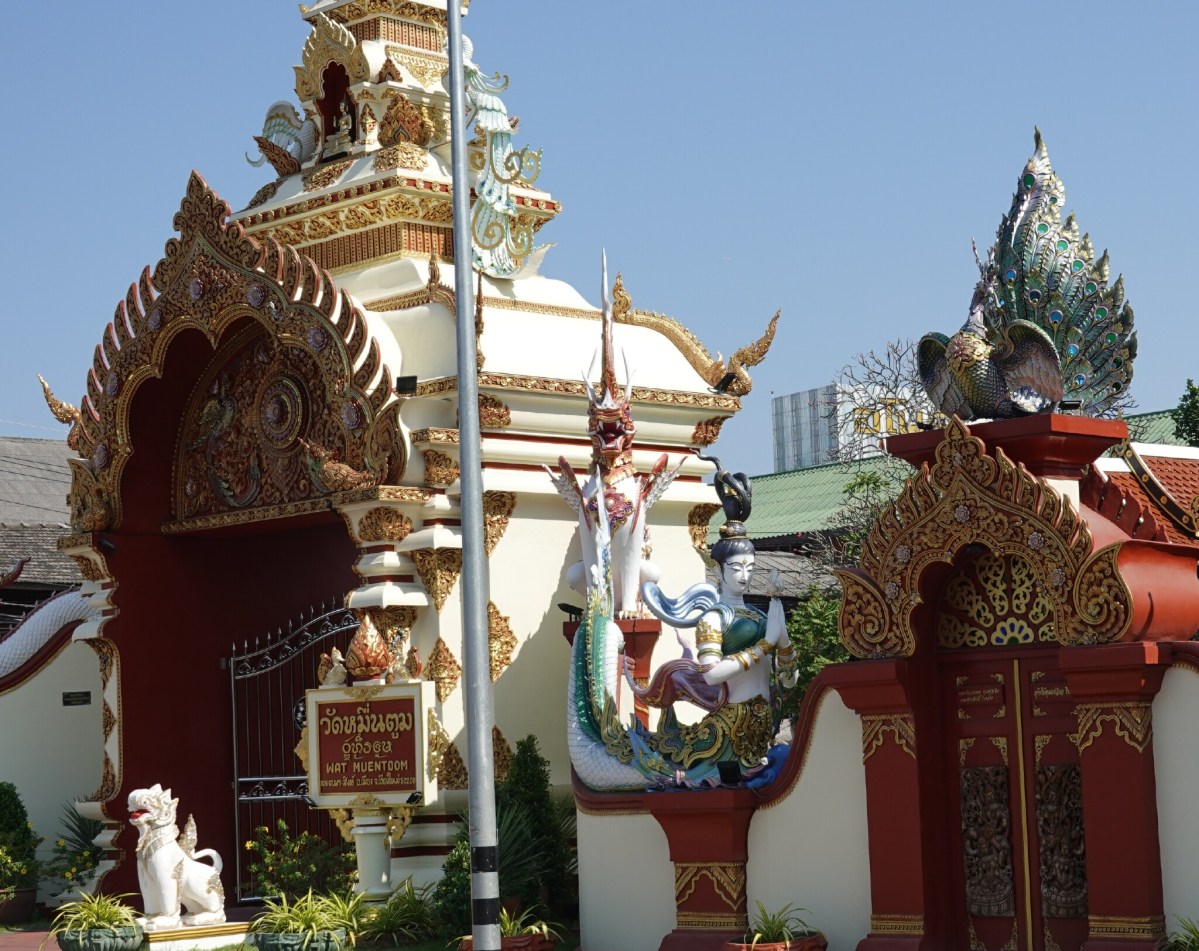
Detail of the entrance wall at Wat Muentoom
Notice the giant peacock on the pillar to the right. This is, as I said, a well-deserved face lift, and has noticeably attracted more visitors.
The 3-Sis Guest House
I have stayed at the 3-Sis Guest House for the last seven winters in Chiang Mai. However, a few months after making a reservation for this winter, I was informed that because of construction delays, the remodeled hotel would not be ready in time for my stay in Chiang Mai. I walked by the location, and it is indeed under massive construction:

Entrance area to 3-Sis Guest House now under a massive reconstruction.
From the look of the restaurant, which is complete, I believe the remodel will result in a very nice small hotel. Previously, there were 31 rooms, after the remodel in which more space was given to the restaurant, there will be 21 rooms.
Wat Chedi Luang
Probably my favorite temple in Chiang Mai is Wat Chedi Luang. This is a very important temple, and the large chedi was the largest and tallest structure in all of Lanna for several hundred years. Busloads of tourists come to Wat Chedi Luang every day, many Thai.
Construction of Wat Chedi Luang started in the 14th century when King Saeng Muang Ma planned to build a chedi (pagoda) to inter the ashes of his late father. After 10 years of building, it was left unfinished, only to be continued after the death of the king by his widow. It was not finished until the mid-15th century. By then, the chedi was 82 meters high (270 feet) with a base diameter of 54 meters (178 feet), and was by far the largest structure in all of Lanna. The famous Emerald Buddha was housed in the eastern niche of the chedi. An earthquake in 1545, caused the collapse of the top 30 meters of the chedi. The top portion has never been restored, because there is no documentation of how it appeared, and to restore it incorrectly would cause it great dishonor. So it is left as is. Shortly after the earthquake, the Emerald Buddha was moved to a temple in what is now north-central Laos. The Emerald Buddha now resides at Wat Phra Kaew in Bangkok on the grounds of the Royal Palace. [Note, the Emerald Buddha is called “emerald” for its color; it is not a Buddha statue made of the emerald jewel stone.] A black marble replica of the Emerald Buddha now sited in the eastern niche of the chedi at Wat Chedi Luang.
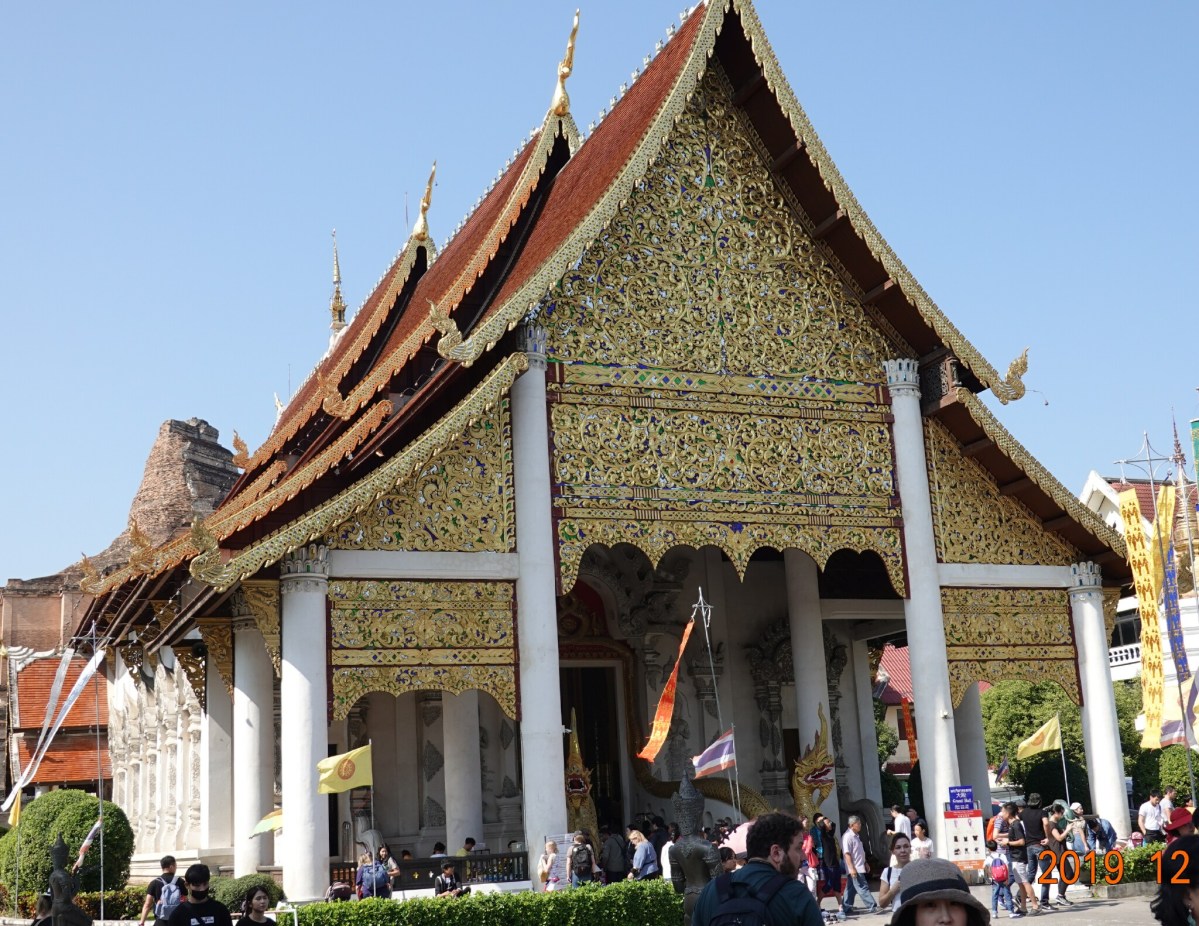
Main viharn at Wat Chedi Luang, large and very busy every day.
In the top left of this picture, you can see part of the top of the chedi at the western (back) side of the viharn. Here is closer view of the entrance to the viharn with the naga (dragons) on the stairway banisters and the thewada flanking the doorway.

Detail of the entrance to the main viharn at Wat Chedi Luang.
Walking around to the back, the large chedi is massive, reverent, and has a great presence:

Large chedi at Wat Chedi Luang
When I stayed at the 3-Sis across the street from Wat Chedi Luang, I did my morning meditation seated at the foot of this large chedi. Another view of the large chedi from that seat:

Second view of the large chedi at Wat Chedi Luang
Then towards the west are several smaller viharn (worship halls), a structure for a medium-sized reclining Buddha, and two smaller buildings with green stone sculptures. Three years ago, I watched and photographed the unloading of these sculptures onto bases that had been built for them. The stone was quarried near Chiang Rai, and the sculptures took over two years to complete before they were moved to Chiang Mai. After unloading the sculptures onto the bases, buildings were built around them. Those buildings were complete last year, but were undergoing some improvements. Here are the sculptures in their now completed small buildings:
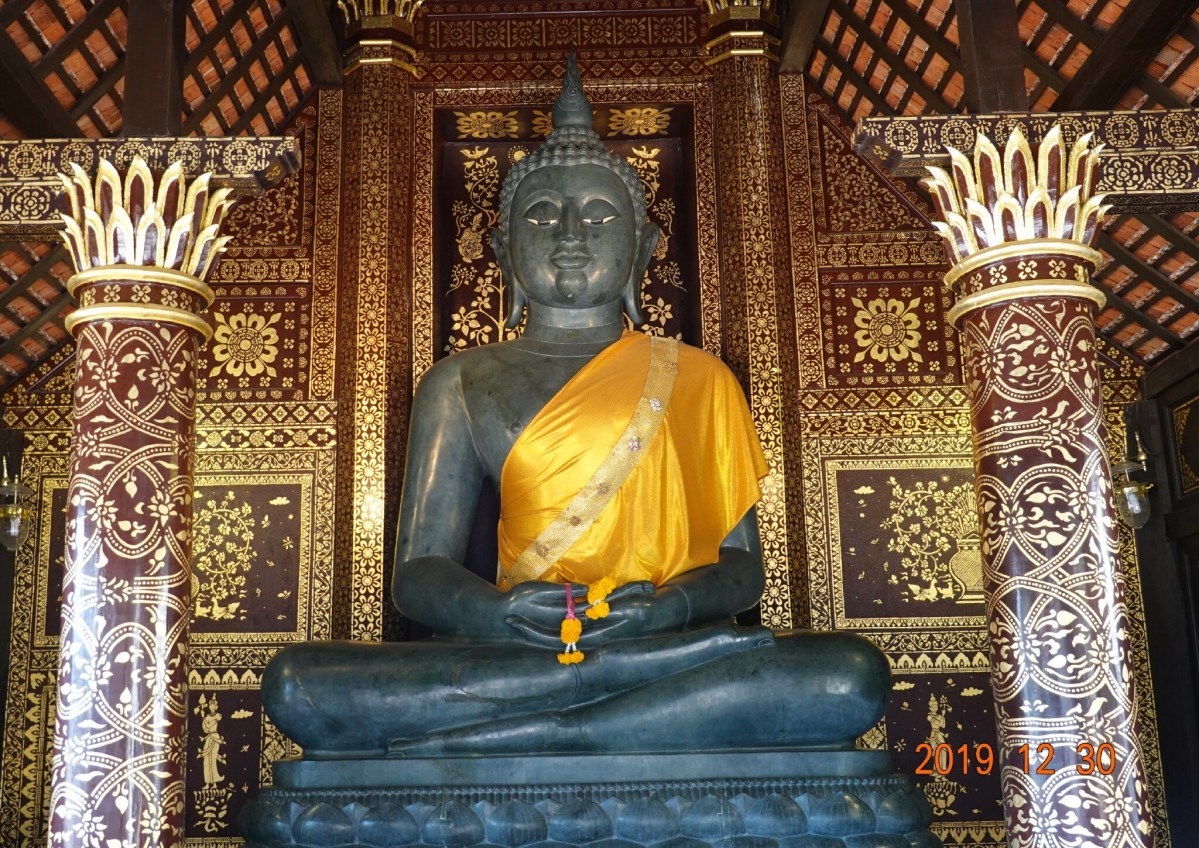
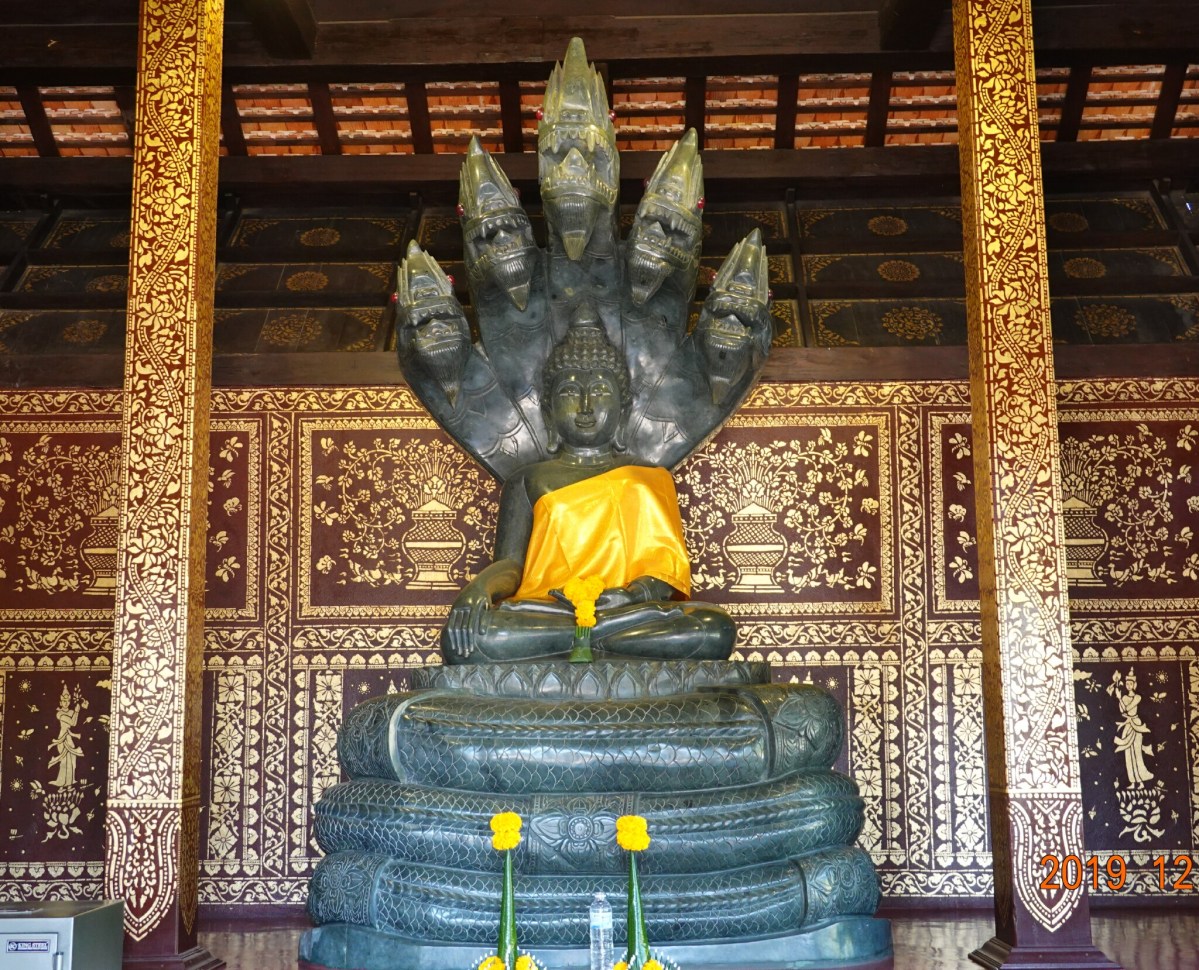
It is hard to know the size from the photos. They are each about 3 1/2 meters high (12 feet). Very beautiful stone sculptures.
At the north side of the chedi, there is a library, almost a museum. The entrance is guarded by two “mom” (pronounced moam) creatures. These are guardians, similar to the yaks seen guarding the entrances to some temples.
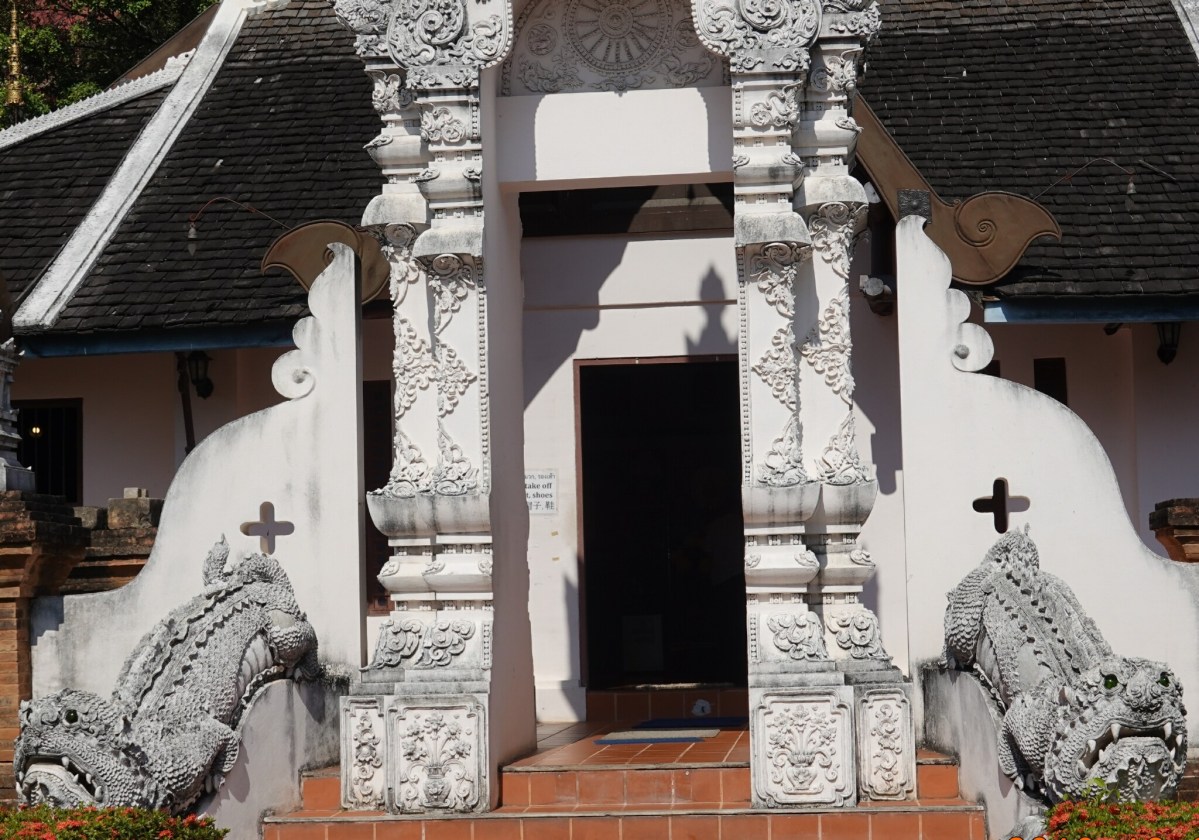
Fierce-looking mom creatures guarding the entrance to the library at Wat Chedi Luang.
Wat Pan Tao
Next to Wat Chedi Luang is Wat Pan Tao, a much smaller temple than its next door neighbor. Wat Phan Tao still stands out as a favorite, and gets many visitors each day. The teak main building dates back to the late 1870s. The teak panels were formerly part of a royal palace belonging to the ruler of Chiang Mai, King Mahotra Prathet, who ruled the city in the mid 1800s when Chiang Mai was part of the Lanna kingdom. Following his death, his royal residence was no longer used. Then, in 1875, Prince Inthawichayanon decided to dismantle the unused royal palace and recycle it as a temple at Wat Phan Tao.
I love the character of Wat Pan Tao, its teak building is rich and stands out from the mostly white buildings at most temples. Over the years, Wat Phan Tao has undergone numerous rebuilds and renovations with the main wooden viharn (worship hall) being erected in the late 1870s. And today, the main viharn is again under reconstruction or restoration:
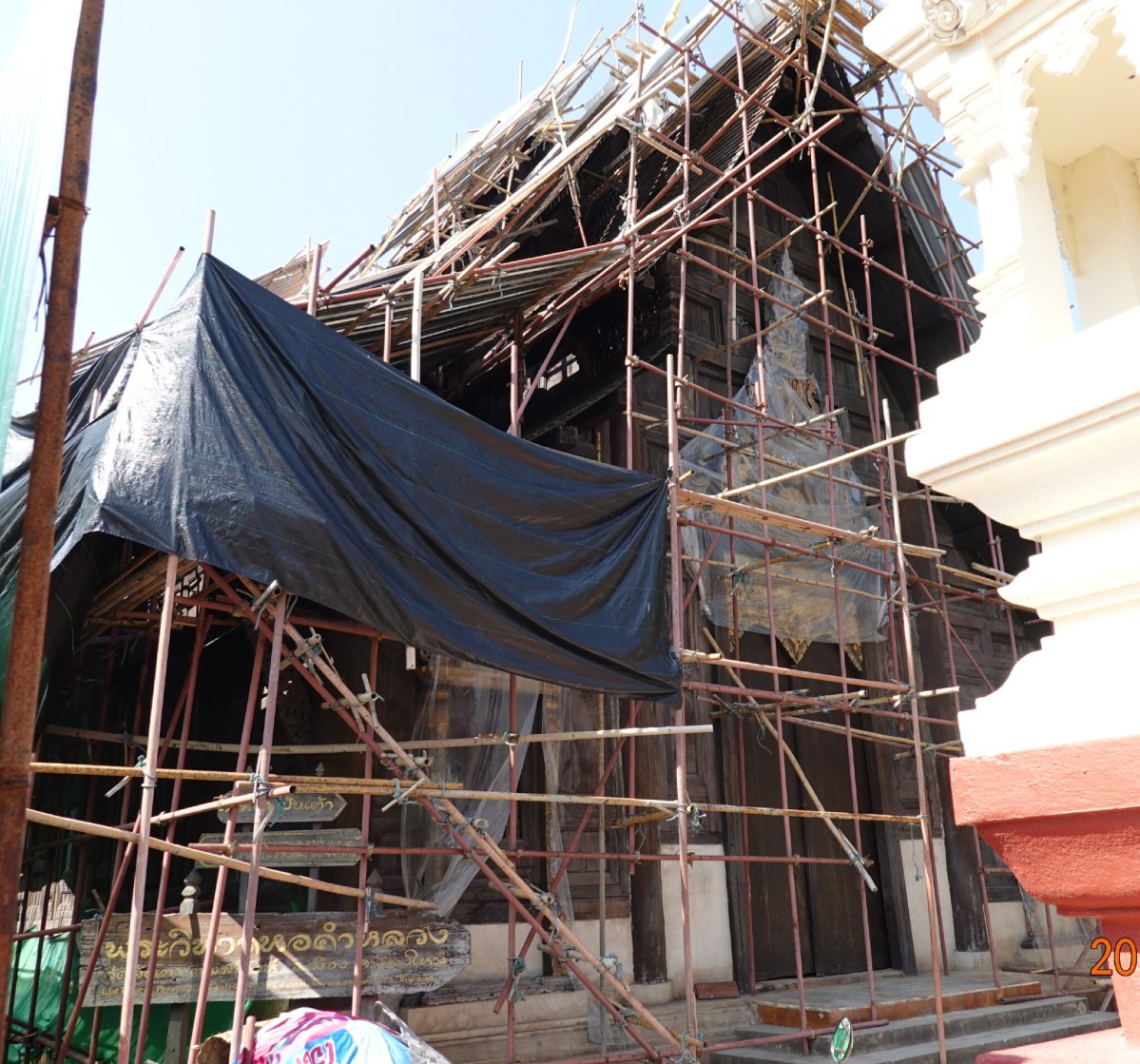
Main viharn at Wat Pan Tao again undergoing reconstruction or restoration.
It might be that the teak side panels require more maintenance then other materials. Nevertheless, I will not be able to visit Wat Pan Tao this winter.
Monument to the Three Kings
King Mengrai build Chiang Rai, a little to the north and west of Chiang Mai in the late 1200s. Chiang Rai was close to Burma, and the Burmese and his people battles many times. So he and two neighboring kings, the King of Sukhothai and the King of Phayao got together and starting in 1296, built a new walled city, further from Burma, and they also added a moat around the wall. Here is the Monument to the Three Kings. I walk by this monument often, and just love it. They look proud and self-assured.

Monument to the Three Kings at the center of Chiang Mai
The monument depicts the three kings that founded Chiang Mai, King Mengrai of Lanna in the center, and his two friends, King Ngam Muang of Phayao (left) and King Ram Nhamhaeng of Sukhothai (right).
There is a good deal of setup being done here in this square for the New Year’s festivities. I shall not be here for those festivities – I plan on being asleep when the new year rolls around.
Wat Saen Muang Ma Luang
This is a temple I can find little information about. It appears to be very old, and the name is interesting. It was King Saen Muang Ma who had Wat Chedi Luang built in the thirteenth century in which to bury the ashes of his father. After 10 years of building, it was left unfinished, later to be continued after the death of the king by his widow. So it is interesting that the king who had Wat Chedi Luang built, one of northern Thailand’s most important temples, has his name on this temple, Wat Saen Muang Ma Luang.
The “Luang” on the end of Wat Chedi Luang and Wat Saen Muang Ma Luang translates to “royal” or “really big”. And the chedi at Wat Chedi Luang is really big, having been the largest structure in all of Lanna for several hundred years. Might the “luang” in the name Wat Saen Muang Ma Luang translate to royal and the chedi here be where King Saen Muang Ma’s ashes are interred? Even asking locals has revealed almost no information more than this speculation. The temple has undergone recent renovations and looks very new, except for the old chedi in which possibly King Saen Muang Ma’s ashes are interred.
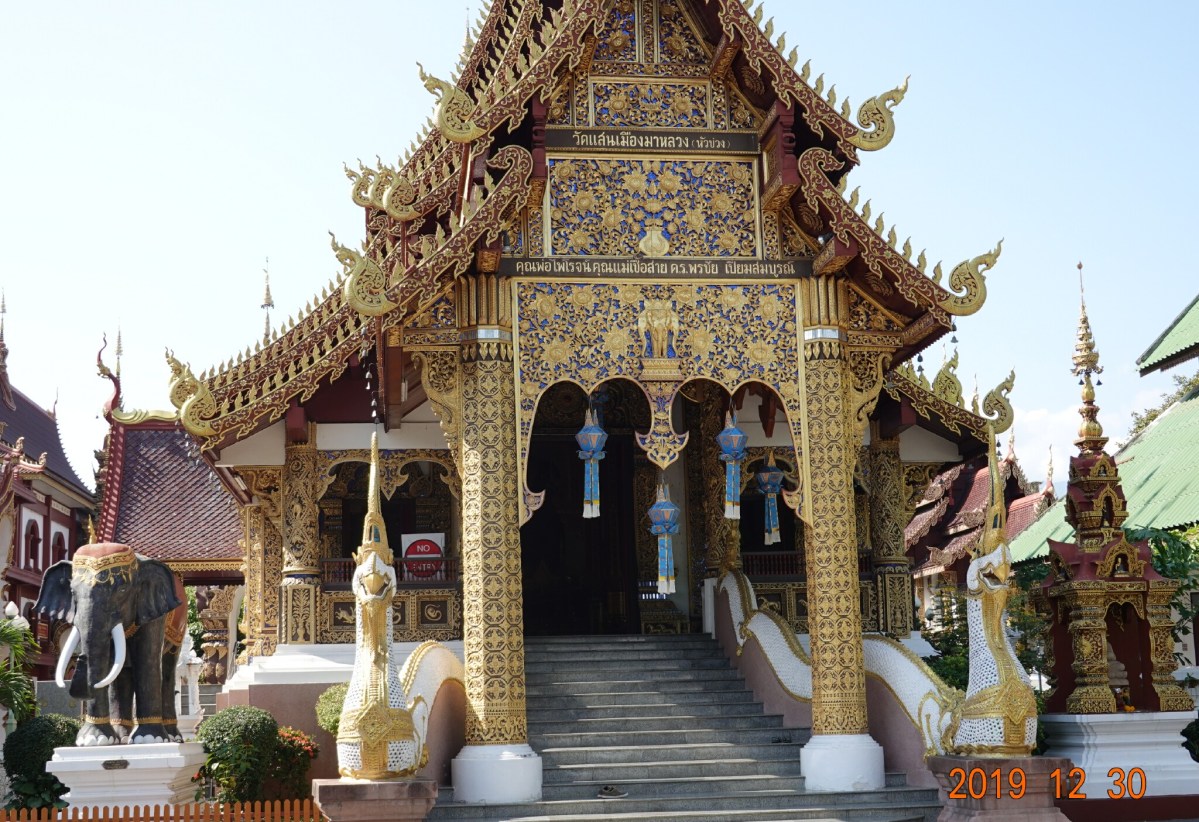
The main viharn at Wat Saen Muang Ma Luang
I like the unbalanced look of this viharn, an elephant on one side, and what appears to be a spirit house on the other.
Here is what appears to be a secondary viharn, or possibly an ubosot (ordination hall).
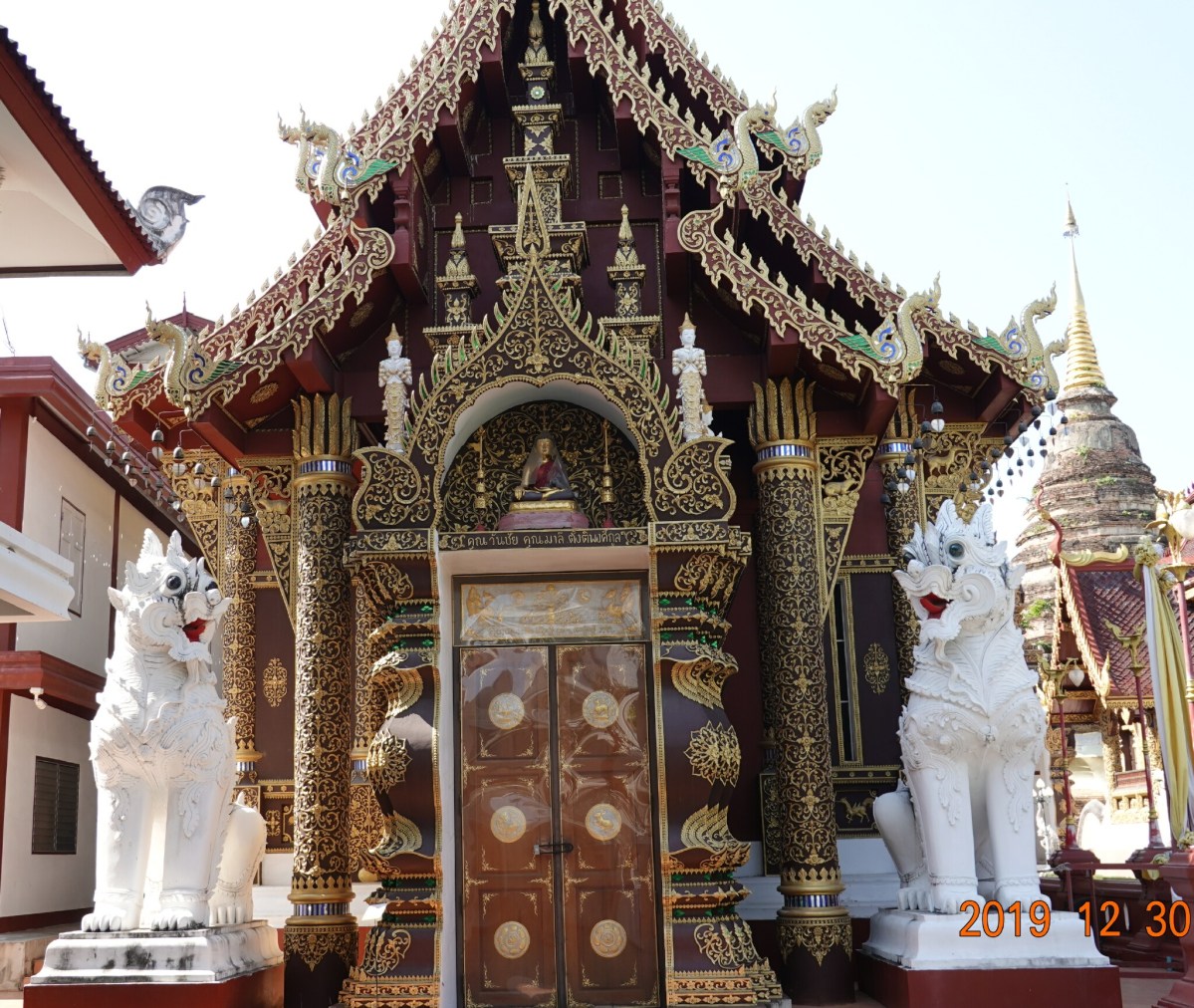
Secondary viharn or ubosot at Wat Saen Muang Ma Luang.
And then there are these rather colorful and artistic depictions of thewada (angelic beings that live in the heavenly realms) on the doors of another building.
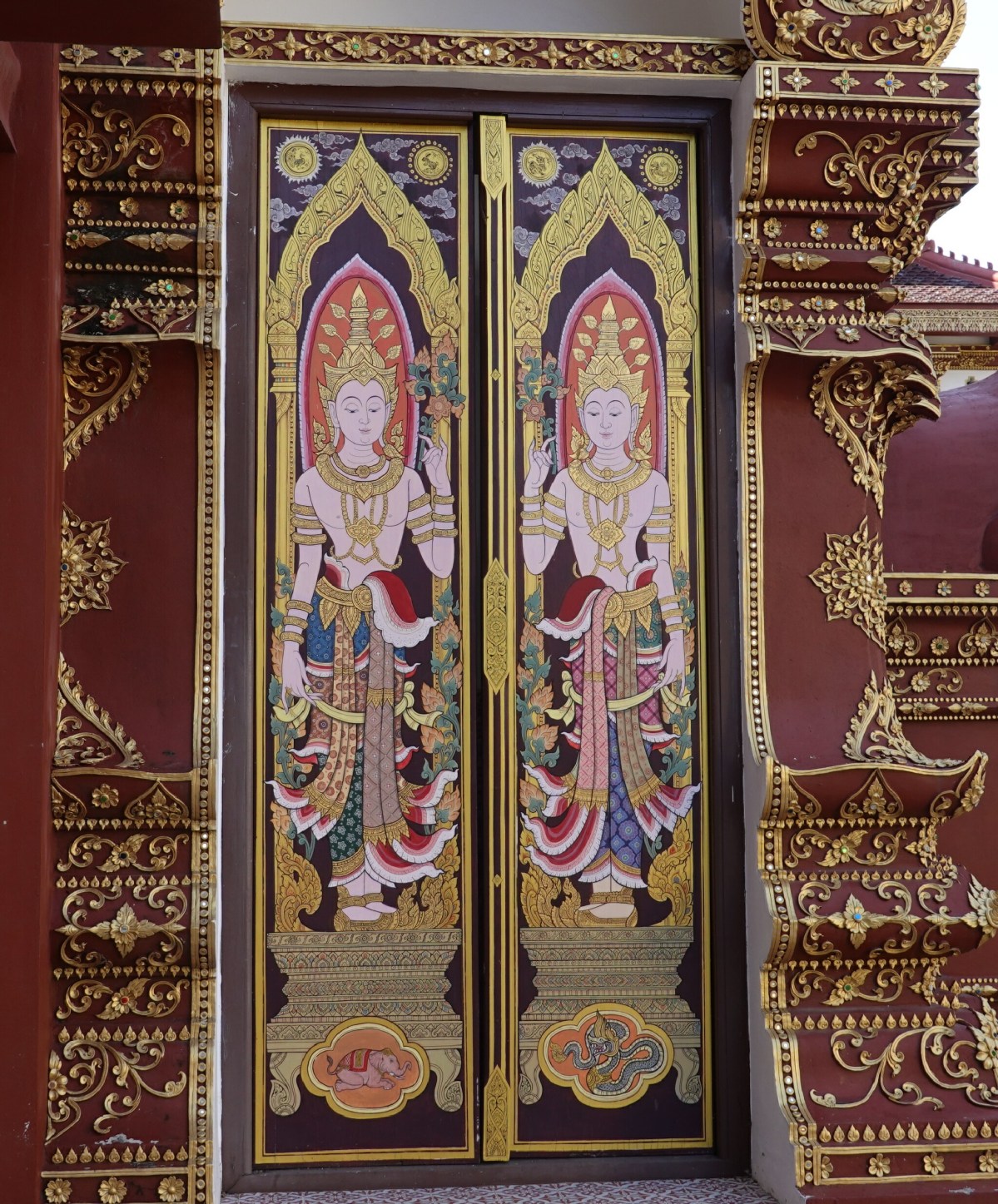
Colorful thewada on the doors of a secondary building at Wat Saen Muang Ma Luang
Thewada often are depicted on the doors of the viharn. Sometimes they are also on the walls beside the doors so they can be seen when the doors are open. Almost always they are gold color on black or dark backgrounds. Seldom are they this colorful. The artistry is striking and nice. Thewada are seen at northern Thai temples, seldom on temples in Bangkok. It is no surprise that there are differences, because Lanna (northern Thailand and Laos) and central Thailand (Siam) were separate countries until the mid-19th century.
The chedi stands out as very rustic amidst the recently renovated buildings at Wat Saen Muang Ma Luang. And it appears to be overdue for a cleaning.
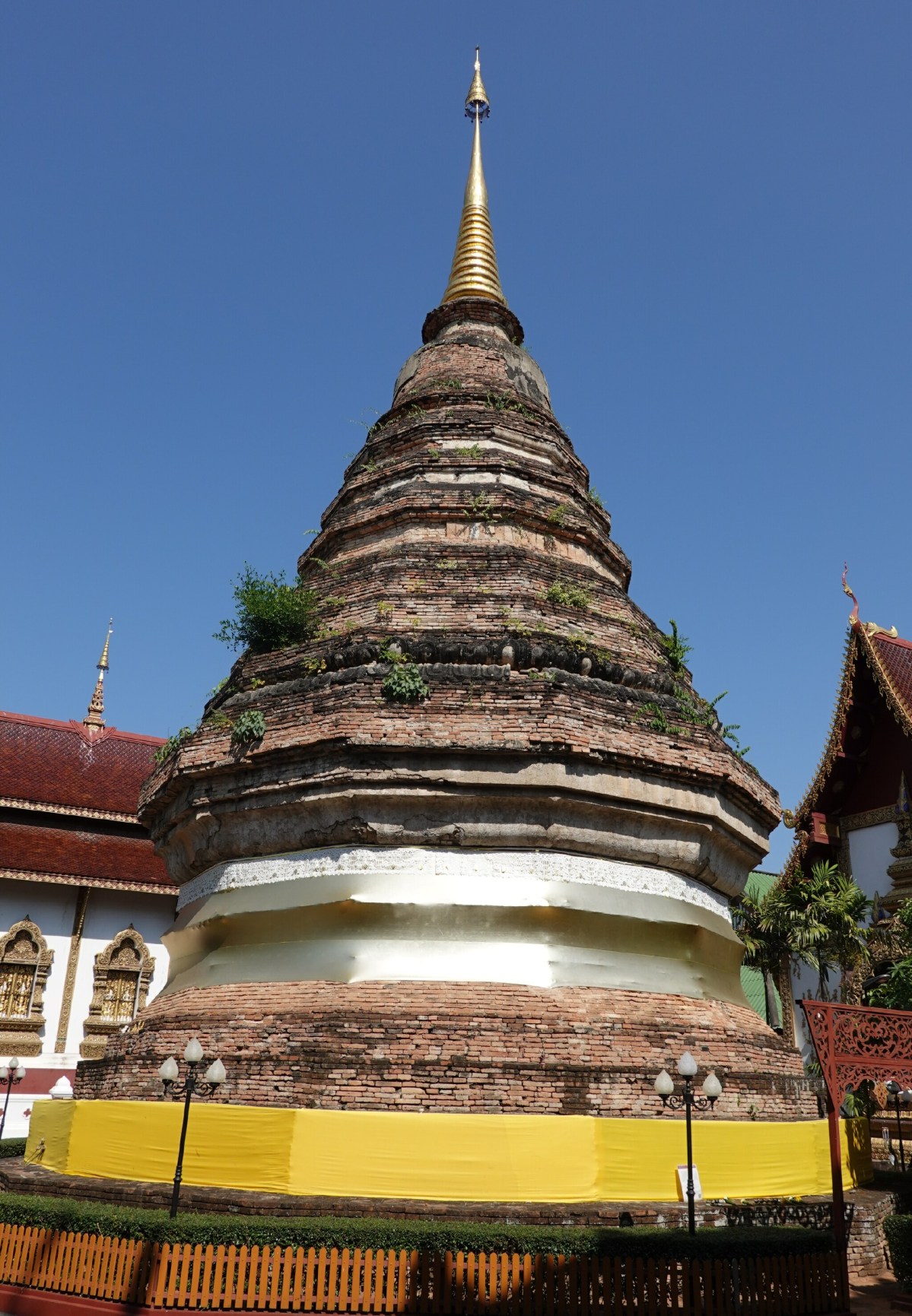
Chedi at Wat Saen Muang Ma Luang.
And more colorful depictions of thewada on this building beside the doors.

Next: New Year’s Day hike to Wat Palad

 James the Intrepid Pilgrim
Lots of construction
LikeLike