Monday, December 30, 2019
Chiang Mai First Day Walk Around the Wall/Moat
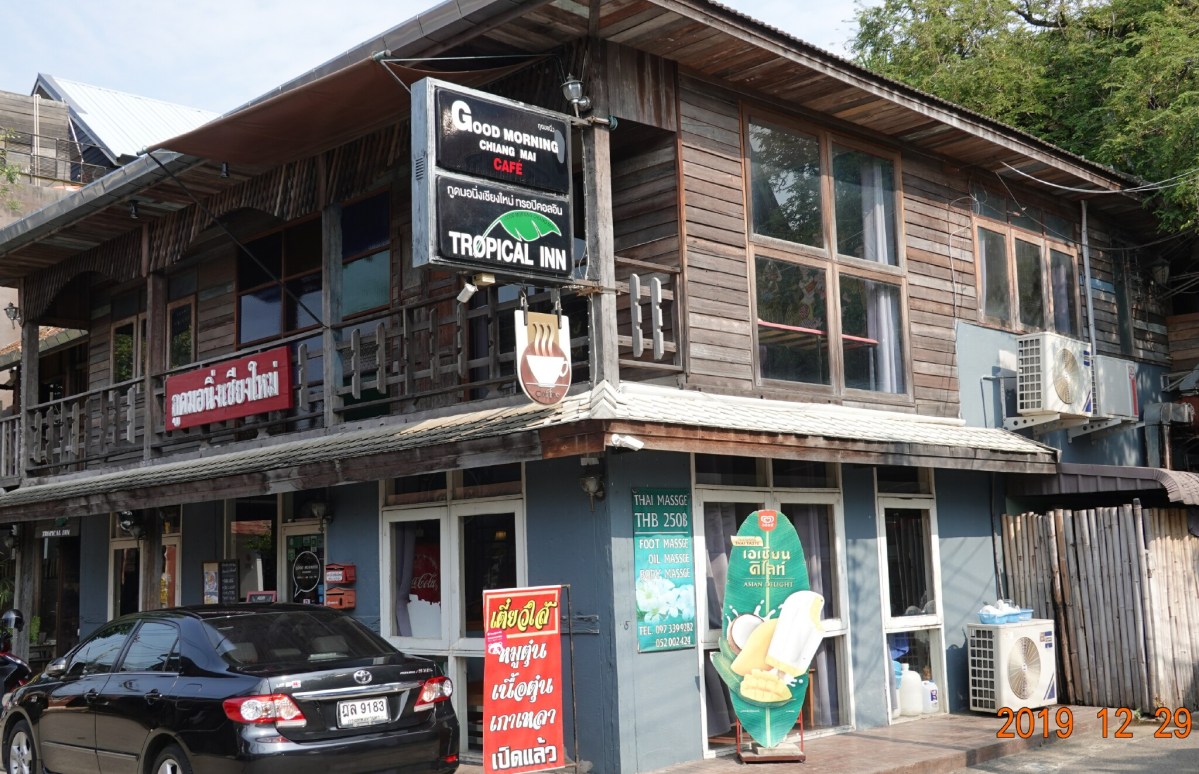
After a strong yoga session bright and early at 8 AM, I had breakfast at the Good Morning Chiang Mai cafe (Good Morning Chiang Mai is the cafe/coffee shop and Tropical Inn is the guest house). Breakfast is included with the room, so it is convenient. Here is photo of the entrance area of Good Morning Chiang Mai/Tropical Inn.
I decided to sort of celebrate my first full day in Chiang Mai with a walk around the entire circumference of the moat/wall. Chiang Mai was built in 1296 as a walled-city, with a wall and moat around the city as protection. Much of the wall is gone now except at the five gates and the four corners, but the moat remains. The wall was built as a square, approximately 1600 meters on a side (very close to 1 mile), and inside that square mile are at least 50 temples ranging from those important to the Buddhist religion frequented by many tourists, to what I call “neighborhood” or “local” temples, frequented by people in the neighborhood, and seldom visited by tourists. The wall was large and meant to be imposing. The moat was wider than it is today, having been narrowed to build the outer-moat road in the early 1920s. I found this picture taken about 1900 showing the city wall and what appears to be a wider moat than today:
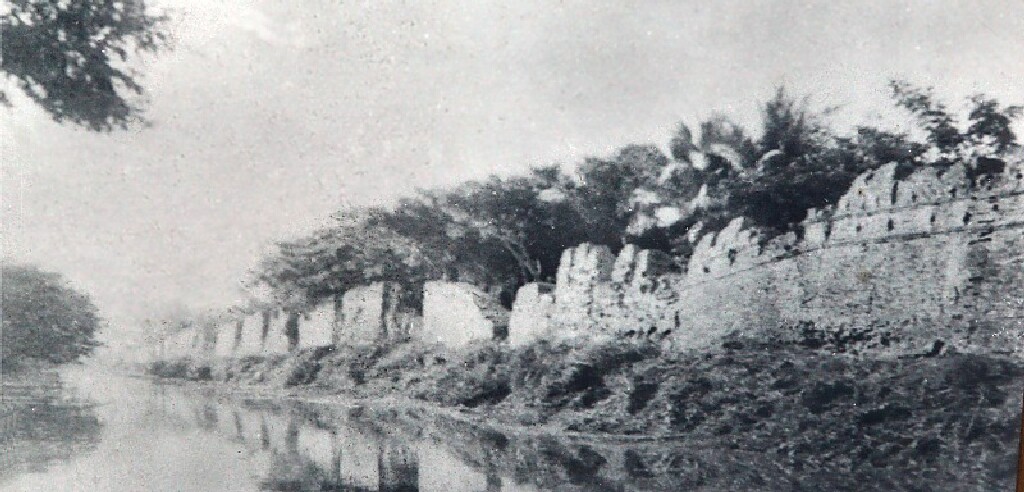
Chiang Mai city wall circa 1900
Even then, parts of the wall were no longer in good shape. Much of wall is gone today, and I learned that when the Japanese were in this area during World War II, they dismantled large sections of the wall to use the bricks to pave the road to Pai to move military vehicles and equipment.
I started my walk directly south of Good Morning Chiang Mai, and decided to go clockwise around the wall. Almost immediately I saw a fire station – it looks much like our fire stations except the writing on the trucks is in Thai.
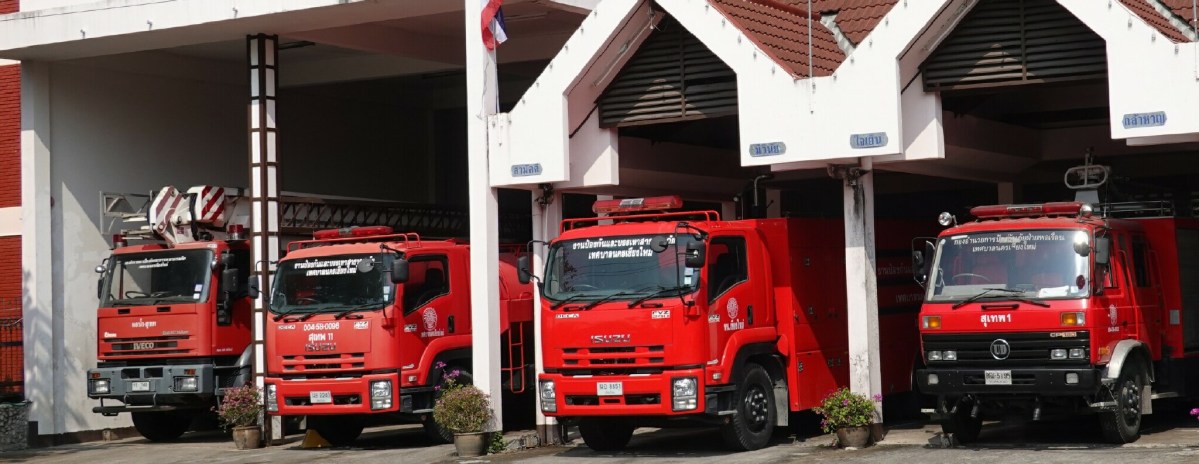
Thai Fire Station in Chiang Mai
Soon I was over near Suan Prung Gate, the westernmost of the two gates on the south side of the old city.
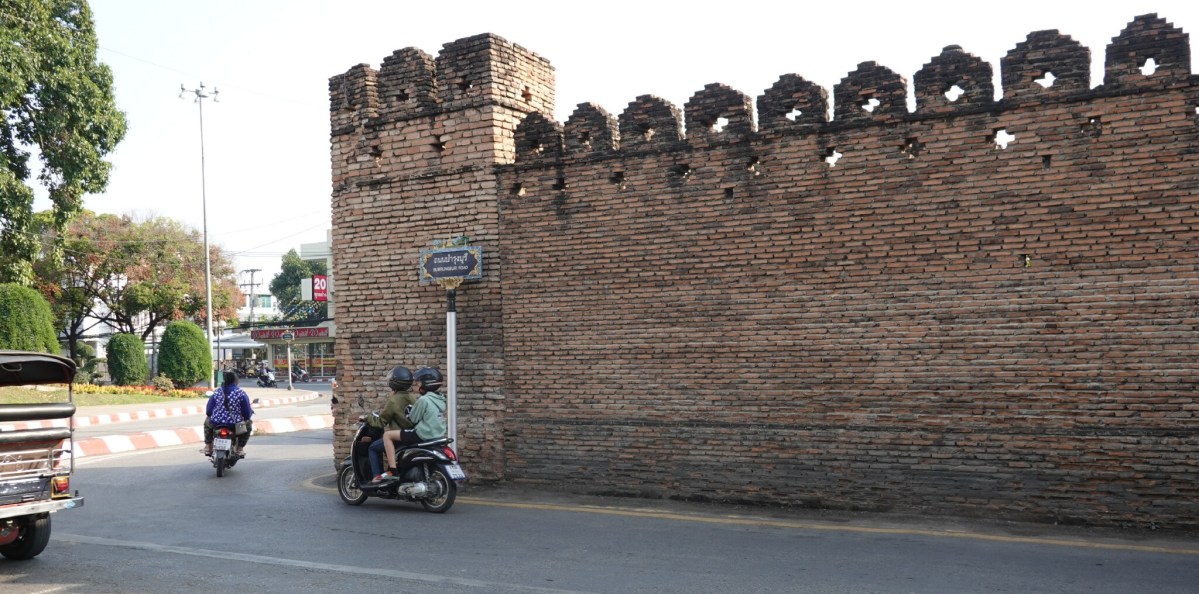
Suan Prung Gate
Suan Prung Gate was originally built so that the queen could have an entrance to the city close to her home to supervise the construction of the large chedi at Wat Chedi Luang. (For some reason, she preferred to live outside the city.) Later, it became the gate through which cadavers were moved out of the city for cremation. Thus it has a sigma of the presence of bad spirits, and some Thai people to this day prefer not to use that gate.
Continuing a short distance, I came upon Ku Rang Corner, the southwestern corner of the wall.

Ku Rang Corner, the southwest corner of the Chiang Mai city wall
Looking north from Ku Rang Corner over the moat. On the left are some remnants of the wall, but the wall disappears just after the first tree.
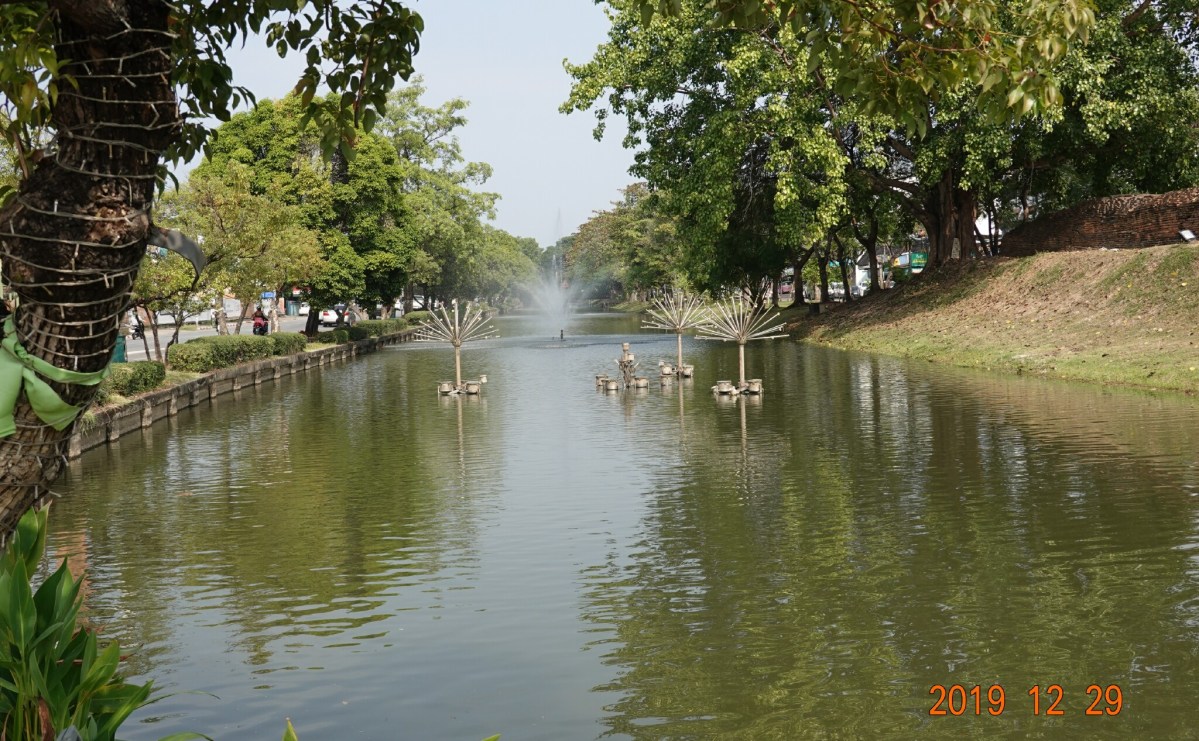
Looking over the moat northward from Ku Rang corner
I walked the 1600 meters from the southwest corner to the northwest corner, passing Suan Dok Gate, the western gate. Here is a view of Hua Lin Corner (sometimes spelled Hua Rin, the actual sound is somewhere in between).

Hua Lin Corner, the northwest corner of the Chiang Mai city wall
And rounding the corner, another view of Hua Lin Corner

Hua Lin Corner looking eastward
Walking east along the moat, I pass by Wat Lok Molee, one of my favorite temples in Chiang Mai. Here is the entrance, flanked by two yaks, one of which can be seen in this photo, and in the background part of the roof of the viharn (worship hall) and the top part of the rather large chedi at the back of the viharn:

Wat Lok Molee
The viharn (worship hall) at almost all Buddhist temples is oriented east-west. The doors face east to greet the rising sun, and the rising sun represents birth or the beginning. The chedi, where the ash remains of someone are interred, is at the back or western part of the viharn, as the setting sun represents the end or death. I have visited many, many temples in Thailand, and with only two exceptions, the viharn is oriented east-west. Wat Lok Molee is one of those two exceptions with the viharn doors opening to the south and the chedi at the “back” to the north. This is a very old temple, possibly built by King Mengrai (who supervised the construction of Chiang Mai) to house the ashes of part of his family. So it is likely not an accident that the orientation is north-south rather than east west. I have yet to learn the reason, and I’ll keep trying to find that information.
A bit of a walk from Wat Lok Molee and I was at Chang Phuak Gate, the northern gate in the Chiang Mai city wall.
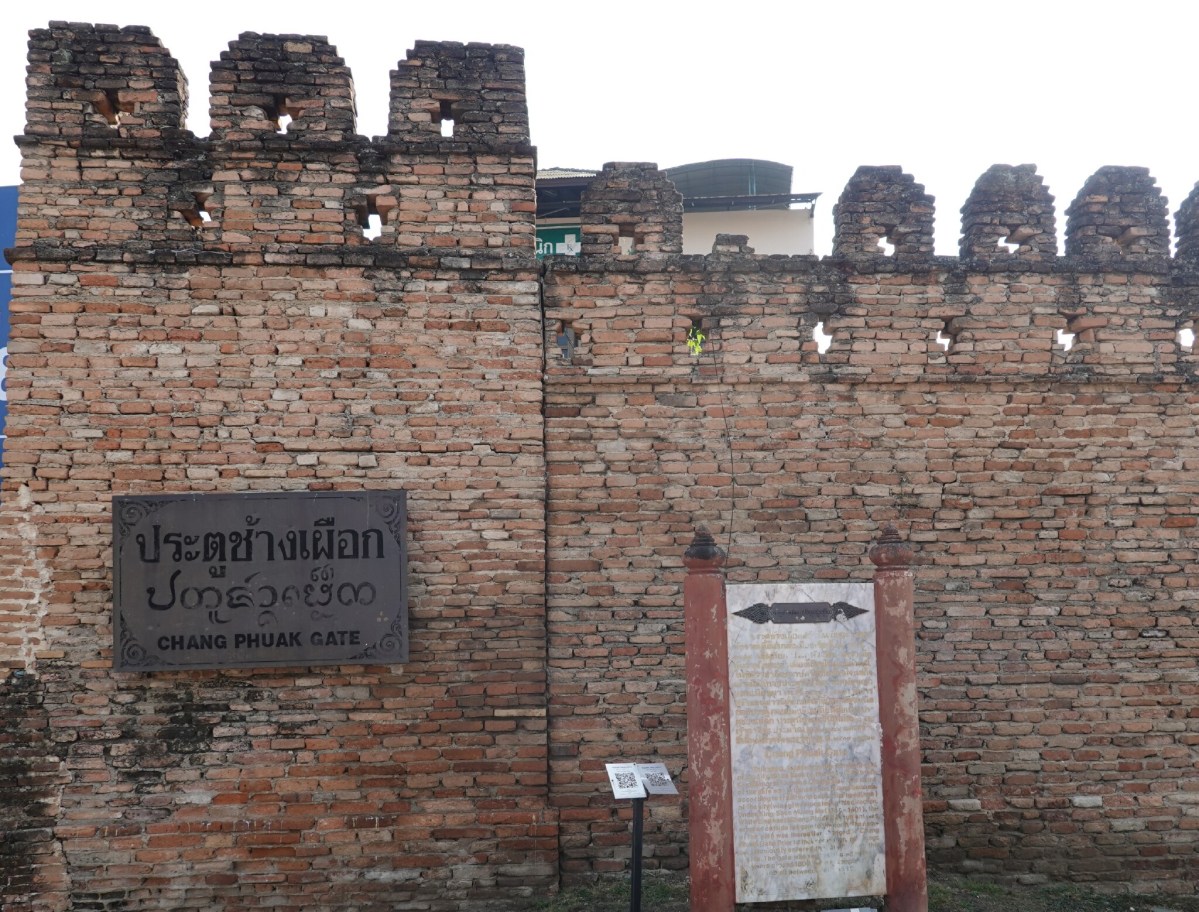
Chang Phuak Gate, the northern gate on the Chiang Mai city wall
The term “Chang Phuak” is an interesting term, an example of translating words without understanding the context or the culture. “Chang” is “elephant” and “Phuak” translates by itself to “ivory” or “off-white.” There are no white elephants – no such thing exists. There are “Royal” elephants, those owned by royalty. The royal elephants are not the normal gray color of elephants, rather, they are a reddish-brownish gray. (This is all described and shown at the Elephant Museum in Bangkok.) The term “Phuak” by itself means ivory or off-white. BUT, in the context of a large animal, like an elephant or a water buffalo, “Phuak” really means “not the normal color.” So a Chang Phuak is an elephant that is not the normal color, and this almost always refers to the royal elephants that were reddish-brownish gray.
Looking east over the moat from Chang Phuak Gate, in the distance I can see Sri Phum Corner, the northeast corner of the Chiang Mai city wall:
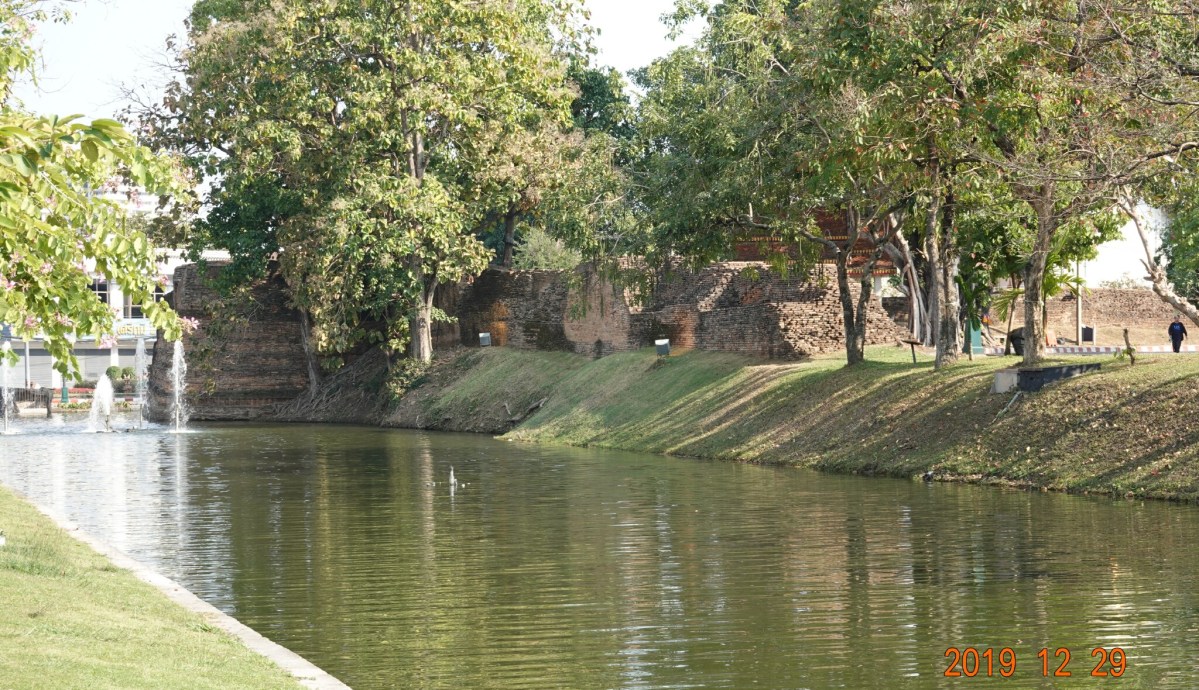
Sri Phum Corner in the distance, the northeast corner of the Chiang Mai city wall
Finally, at Sri Phum Corner. The corners were large and served as the living quarters to those guarding the city. This view is at the corner as I am starting to walk south.
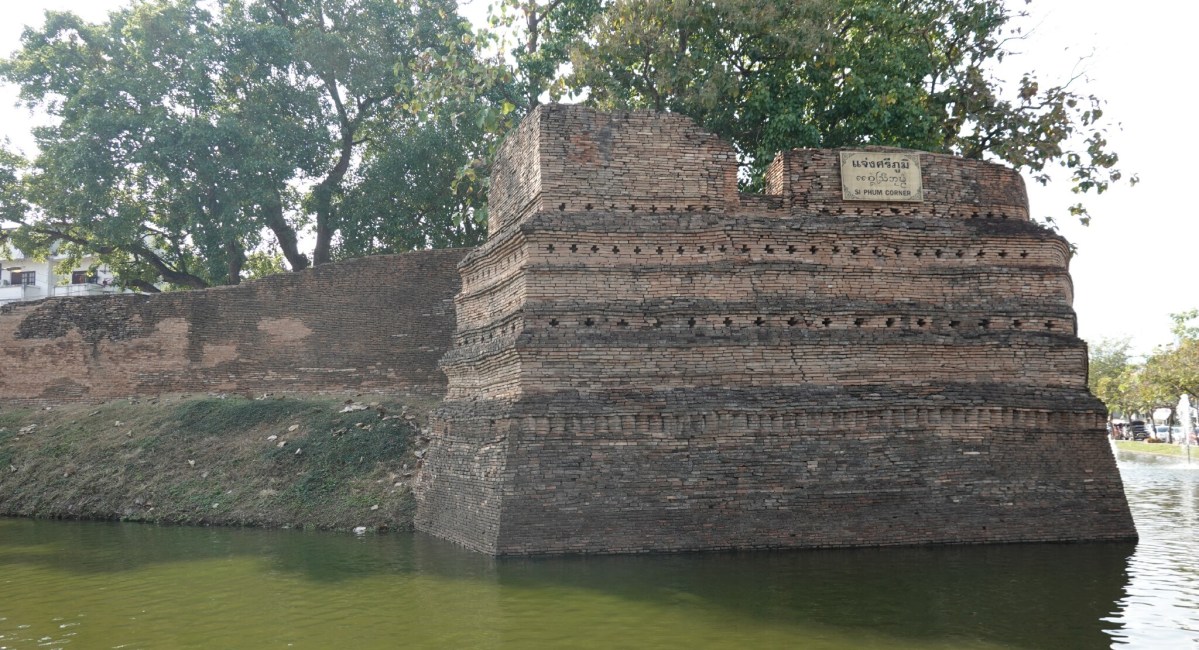
Sri Phum Corner, the northeast corner of the Chiang Mai city wall
Walking south along the moat, I came to the sort-of famous Tha Phae Gate, the eastern gate on the Chiang Mai city wall. Outside Tha Phae Gate is a square covering the moat. Many events are held here, and this is the eastern end of the Sunday Night Market held every Sunday.
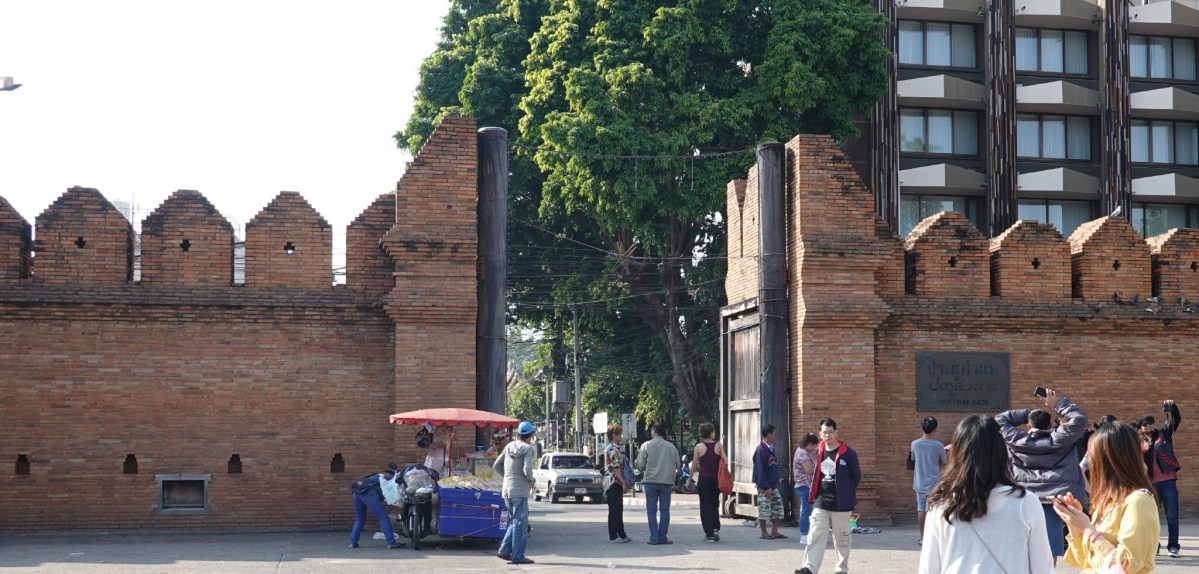
Tha Phae Gate, the eastern gate in the Chiang Mai city wall
Continuing south, I came to Katam Corner, the southeast corner of the Chiang Mai city wall. A Katam is a bamboo trap for catching fish. The water for the moat flowed in at the northwest corner, Hua Lin Corner, traveled south and east through the moat leaving at Katam Corner into a nearby creek. People would catch fish where the water left the moat using the bamboo traps, giving the corner its name.
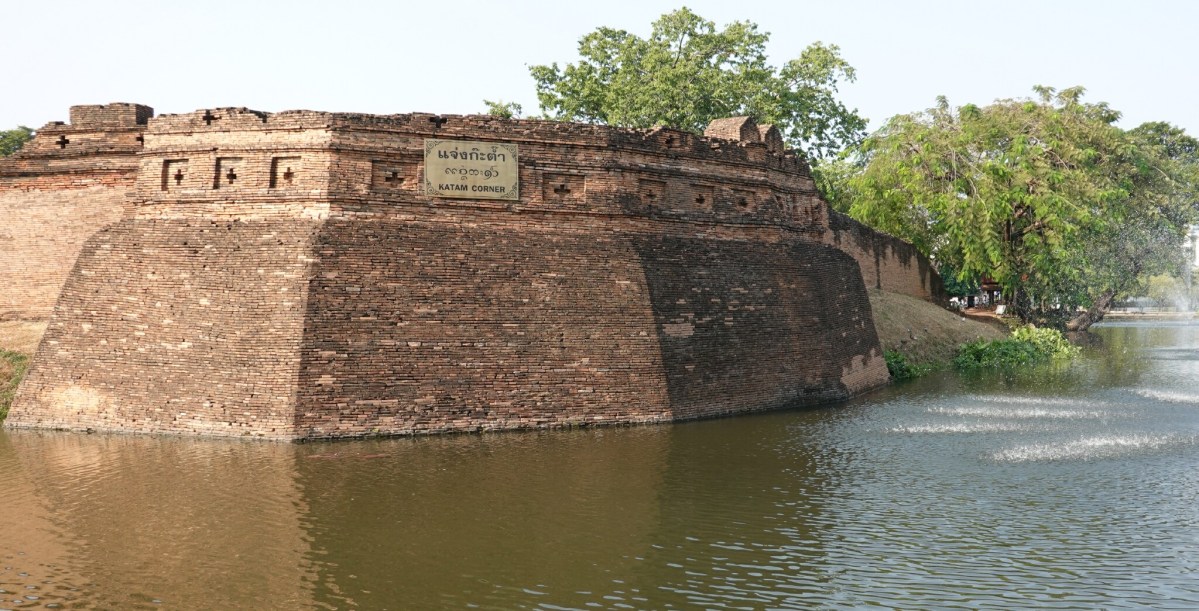
Katam Corner, the southeast corner of the Chiang Mai City Wall
Rounding Katam Corner, I headed westward to the Chiang Mai Gate and back to Good Morning Chiang Mai / Tropical Inn.

Looking west over the moat from Katam Corner
After that long, 6.4 kilometer walk (4 miles), I cleaned up, checked e-mail, and headed out for a comfort food dinner. I decided to return to La Fontana, an Italian style restaurant that is a favorite of Rose and John’s (the owners of Wild Rose Yoga where I practice yoga every day). They often have gazpacho, and theirs is very good, but not tonight. I had a salad and then a pizza. Very, very good.
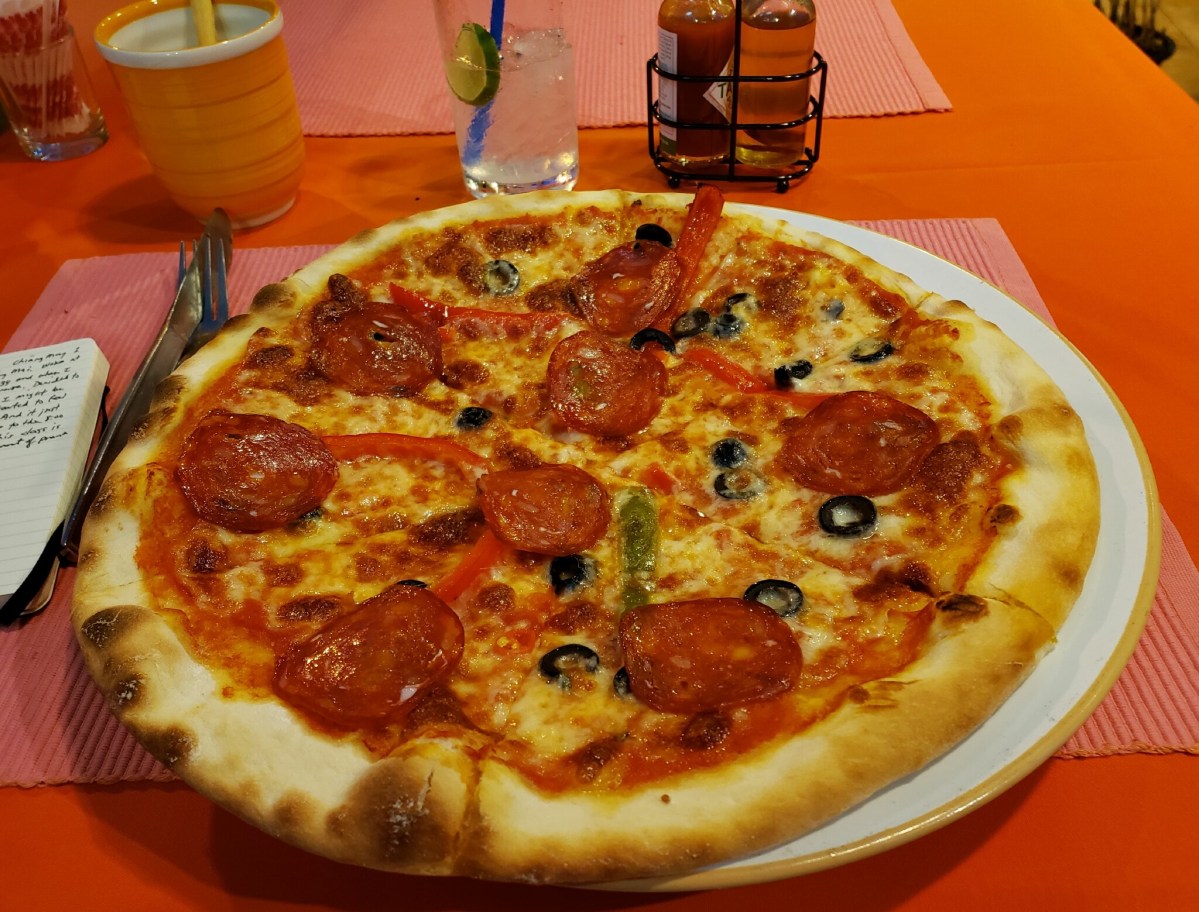
Pizza at La Fontana
Next: a walk inside the old city

 James the Intrepid Pilgrim
I hope you are doing some cardio.
LikeLike