Sunday, January 20, 2019
Four Local, Neighborhood Temples, Part 3
Wat Pan Ping
Leaving Wat Umong Mahathera Chan from what was actually the front entrance, I was directly across the street from Wat Pan Ping. Wat Pan Ping is not a high tourist destination, and thus is a quiet temple in a very busy area, and a very old temple in Chiang Mai. It is very close to other more tourist-centric destinations, like the Three Kings Monument, Wat Chedi Luang, and the Lanna Folk Museum. I have read that it is one of the oldest temples in Chiang Mai, having been built at the same time as Wat Chiang Man, the temple King Mengrai built in which to live and worship as he supervised the construction of the city.

Entrance sign announcing Wat Pan Ping
And again, because I was walking from the west to the east, I was at what can be considered the back of the temple. The “front” of a temple is the east, facing the rising sun. In almost all temples, the viharn (worship hall) doors open to the east, to greet the rising sun – the eastern rising sun represents the beginning of a day, or birth; the western setting sun represents the end or death. This is why the chedi (pagoda) in which the ashes of someone are interred are at the western side of the viharn. So coming in to the Wat Pan Ping temple grounds from the west, the first thing I saw is the large chedi.

Wat Pan Ping chedi at the western entrance
While old, this is a small temple with only a very few structures: a viharn (worship hall), a ubosot (ordination hall), a chedi, and a bell tower. I wandered over to the viharn, and took a few photos. The viharn is guarded by two large singhs (mythical winged lion-like creatures)

Viharn (worship hall) at Wat Pan Ping
And near the viharn is the ordination hall, or ubosot:

Ubosot at Wat Pan Ping
This ubosot is quite small, as is the whole temple. There are many guests, and the cars are packed into every space.
Back over towards the viharn, I found this statue of the earth deity (mother earth), called Phra Mae Thorani. According to Buddhist myths, Phra Mae Thorani is depicted as a young woman wringing the cool waters of detachment out of her hair to drown Mara, the demon sent to tempt Gautama Buddha as he meditated under the Bodhi Tree. Statues of Phra Mae Thorani are seen at many temples in and around Chiang Mai. This one at Wat Pan Ping is quite nice:
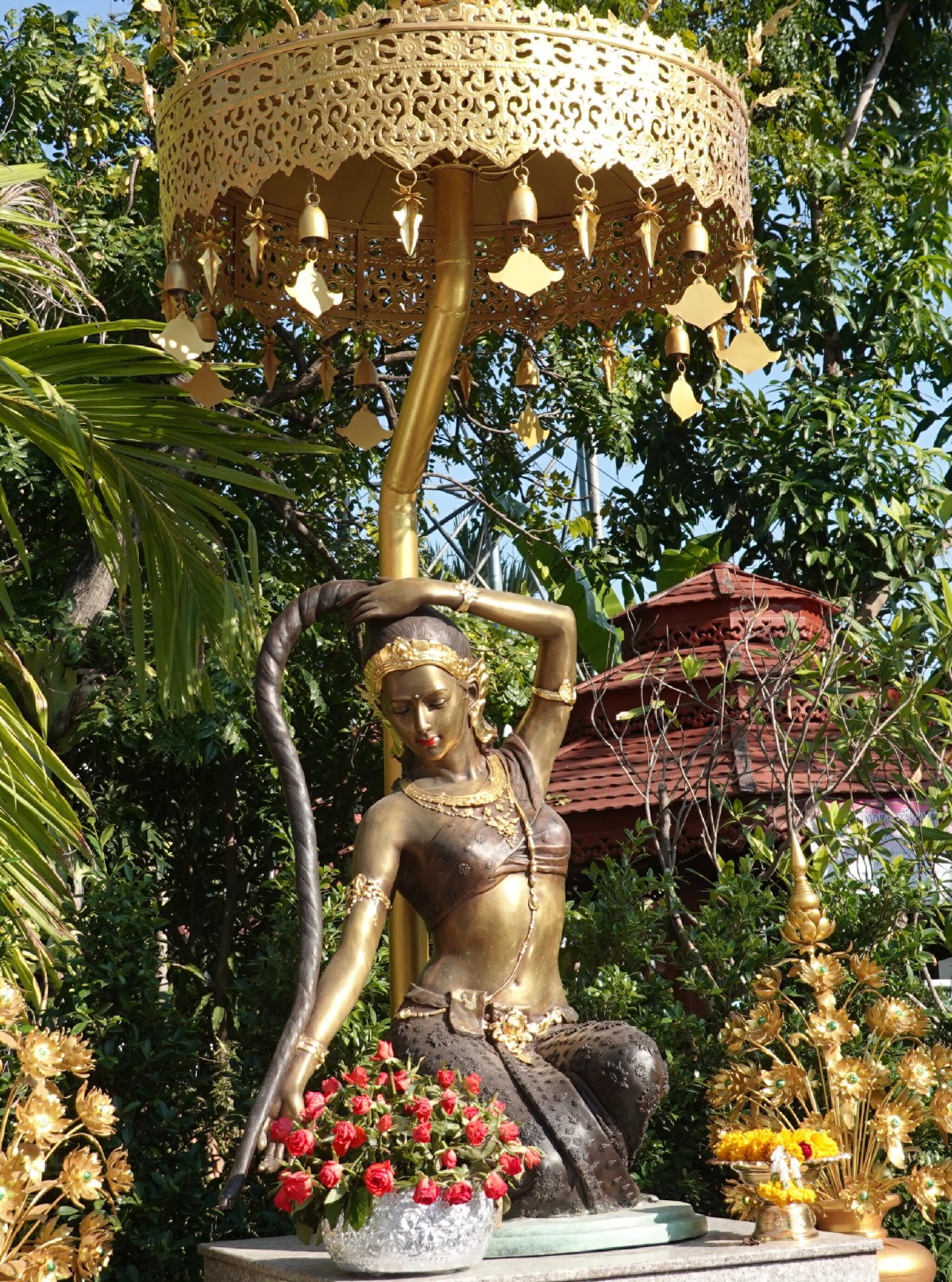
Phra Mae Thorani statue at Wat Pan Ping
Here is version of the story I found:
The Bodhisattva was sitting in meditation on his throne under the Bodhi Tree, Mara, the Evil One, was jealous and wanted to stop him from reaching enlightenment. Accompanied by his warriors, wild animals and his daughters, he tried to drive the Bodhisattva from his throne. All the gods were terrified and ran away, leaving the Bodhisattva alone to face Mara’s challenge. The Bodhisattva stretched down his right hand and touched the earth, summoning her to be his witness. The earth deity in the form of a beautiful woman rose up from underneath the throne, and affirmed the Bodhisattva’s right to occupy the vajriisana. She twisted her long hair, and torrents of water collected there from the innumerable donative libations of the Buddha over the ages created a flood. The flood washed away Mara and his army, and the Bodhisattva was freed to reach enlightenment.
— Study of the History and Cult of the Buddhist Earth Deity in Mainland Southeast Asia

 James the Intrepid Pilgrim