Wednesday, January 9, 2019
Temple on the Golden Mount
In preparing for my trip to Chiang Mai, I stumbled across information about this temple very near Chiang Mai, one that I have not visited in my many trips to Chiang Mai. Partly that is because I walk almost everywhere, and this is to far to walk, about 30 kilometers southwest of the main city. It appeared interesting, so Tom, Julie, and I made plans to go there. We hired a driver for the half-hour ride by car.
Wat Phra That Doi Kham
Wat Phra That Doi Kham is a temple with a large presence, but not a strong tourist following. The large presence is twofold, first, a large standing Buddha statue that can be seen from several kilometers away as we approached the mountain by car, and second, a large, 17 meter (55 feet) tall seated Buddha. I have learned that this temple is where Thai people go to pray for something they want to happen in their lives. When we arrived, only a few signs had English, another indication of few tourists visiting this temple. The temple was originally constructed in the 7th century, several hundred years before the city of Chiang Mai, but most of the structures have since been rebuilt, except the chedi. The name Doi Kham translates to Golden Mountain.
With the name including “Phra That,” I now know that Phra entails of an honorific Buddha image, and That means a relic. So Phra That in the name tells that there is a relic of Buddha’s in the sanctity of the temple. I have found no more detail about this, and am curious.
After we arrived and parked, the first thing we pass is the main viharn (worship hall):
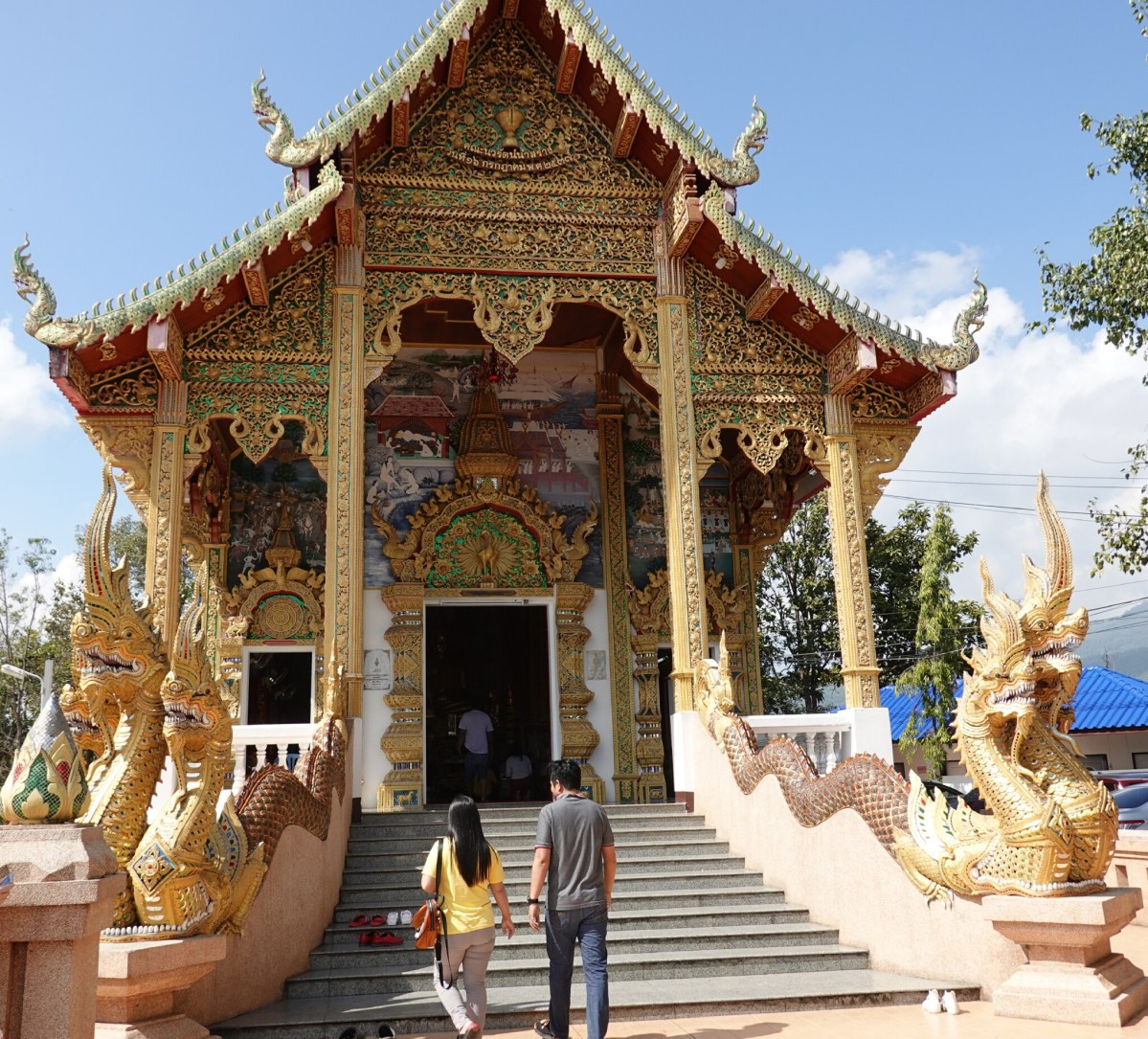
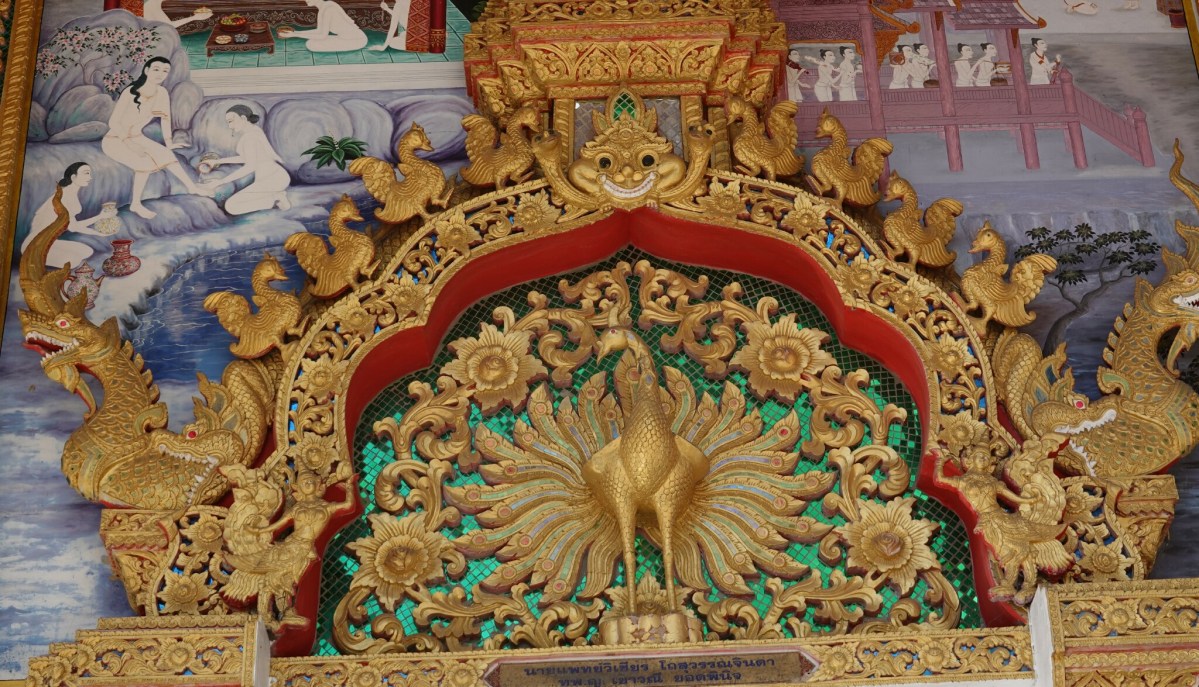
Very impressive in the Lanna style with the naga (dragon) stairway. Above the door is the now familiar peacock over the main viharn entrance symbolizing royalty and wisdom:
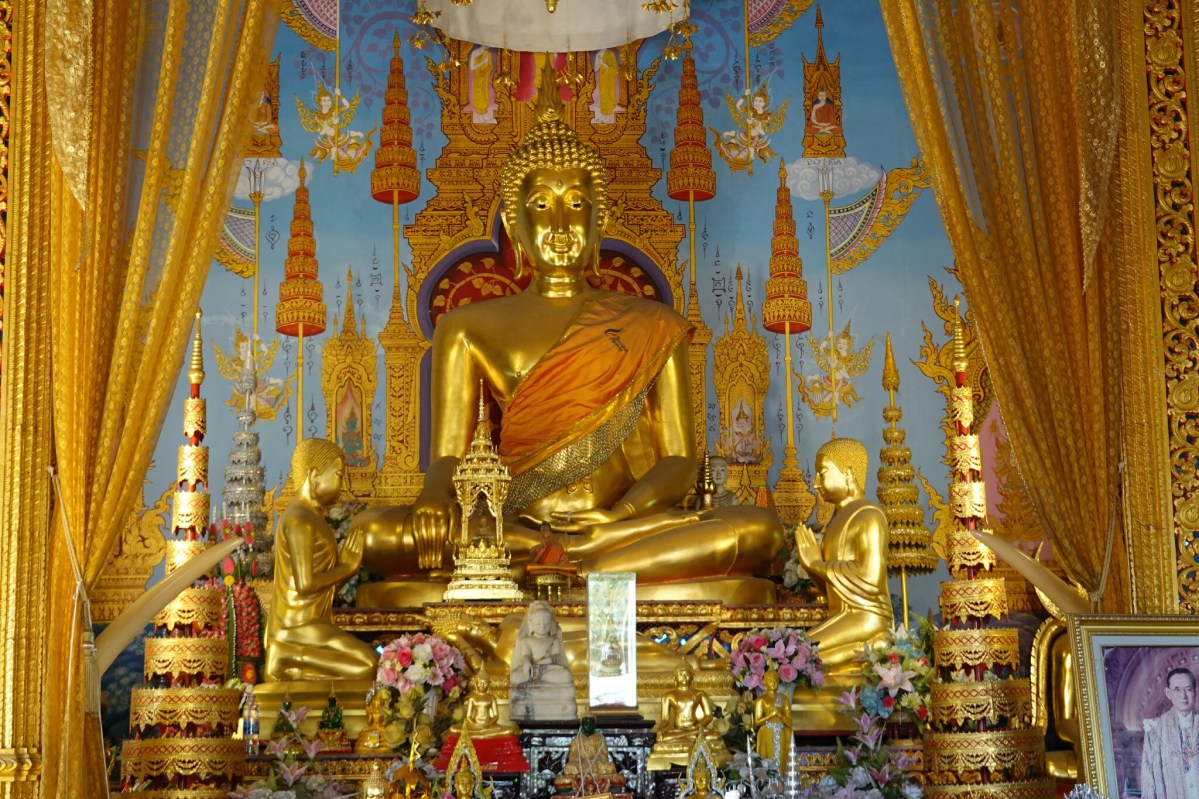
The inside of this viharn is quite impressive with much gold:
After leaving the viharn, we walked over to the main temple area, where the chedi, ubosot (ordination hall), and other structures are.
Just before the entrance to the main area is a large sign, with the entrance protected by two purple yak (giant guardians). Here I am resting by the sign and one of the yak. The yak appears to be resting with his head leaning on his hand and his eyes closed. It is a hot day; I could use a rest, too.
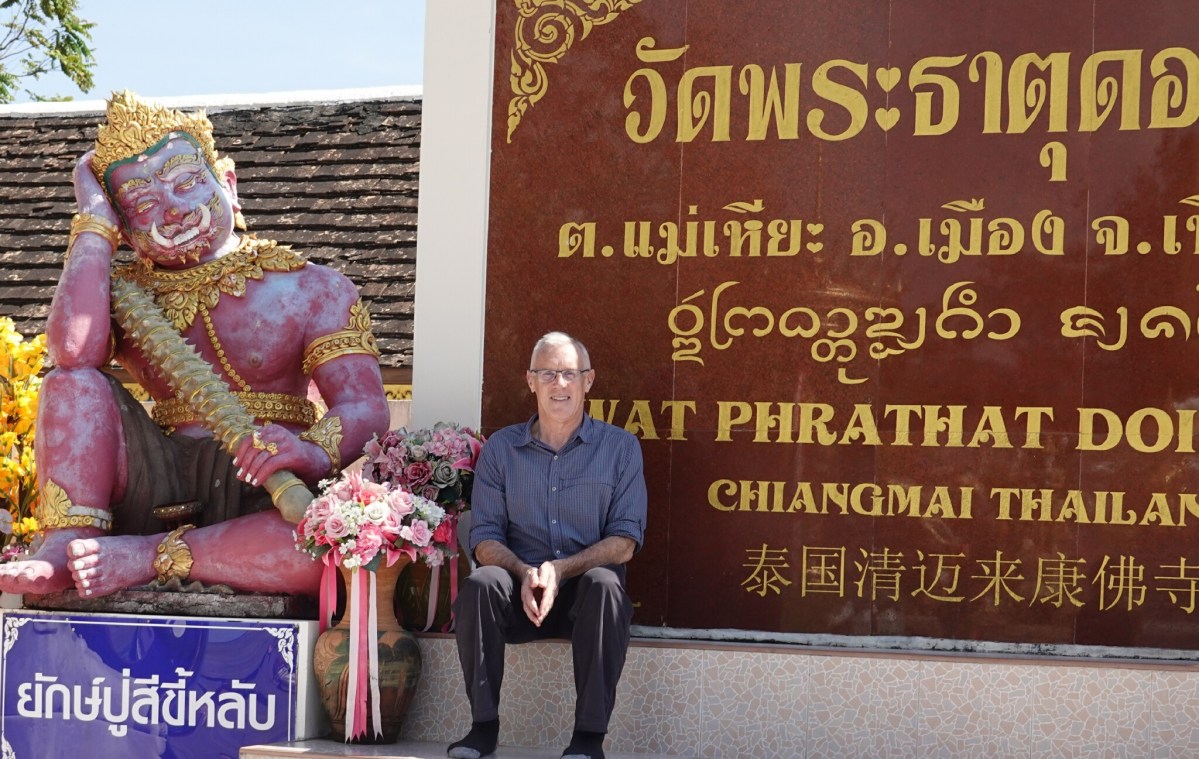
We are welcomed by a sign in English, one of only a few here:
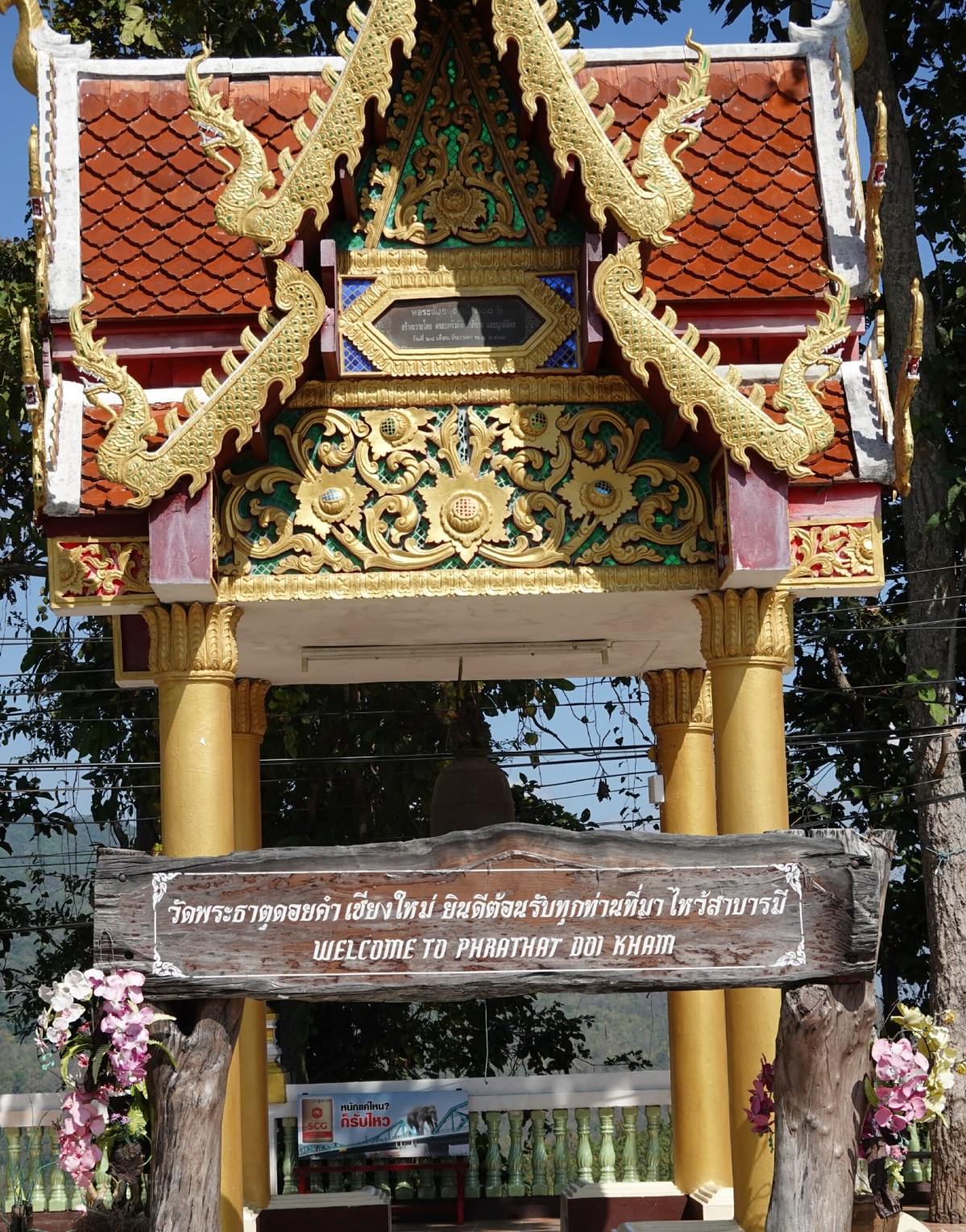
One thing to note – what appears in Thai to be three really long words are really three sentences. In Thai, a space delimits a sentence – all words in a sentence are together. How do they know the words…it is their native language, so they know. [This also leads to some interesting translation quirks. By their nature, they are tempted to put words together, so sometimes in a translation to English, the space is left out. I have seen the highway signs with Thai and English, announcing Chiang Mai 20 kilometers, then further down the same road, another sign announces Chiangmai 15 kilometers. It is interesting because the signs came from the same highway department.]
Just inside the welcome entrance is a covered area where Thai people are leaving offerings, apparently to help get whatever that are asking in their prayers.
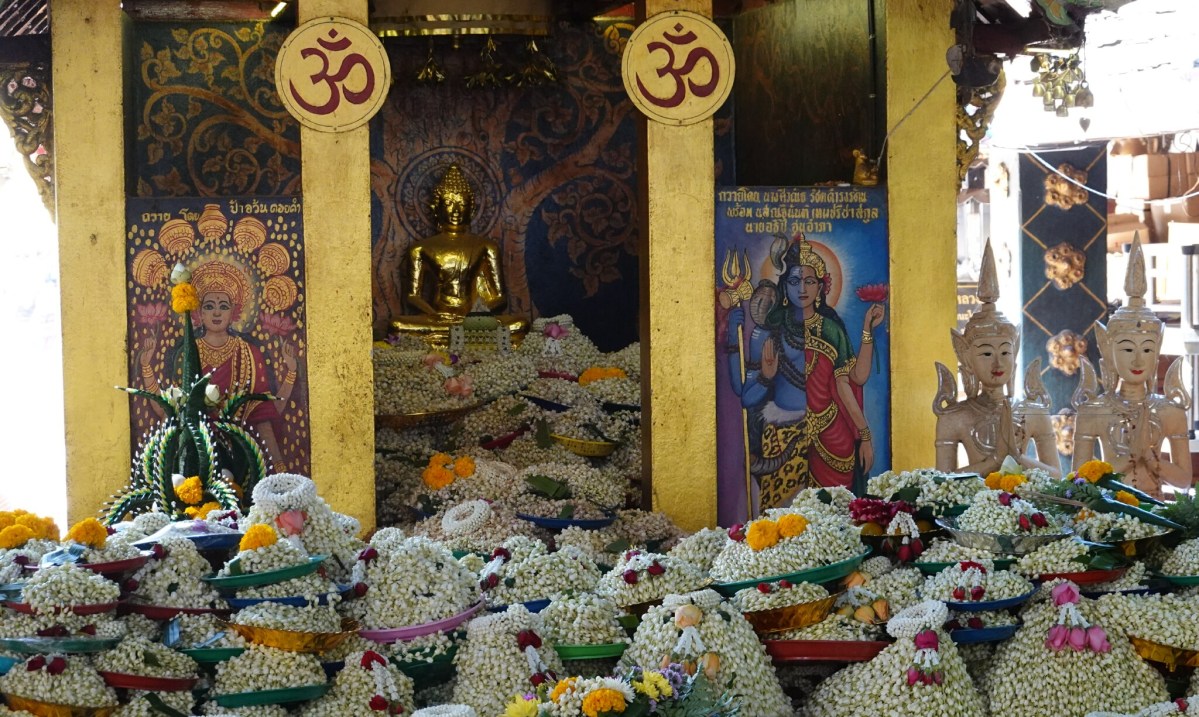
It is unclear what these flowered bunches are or symbolize, but there is a ritual one does to pray, place the flower bunch, and then more praying. I saw a number of people (both men and women) doing this. The pile of flowers is large, at least three feet deep, and growing.
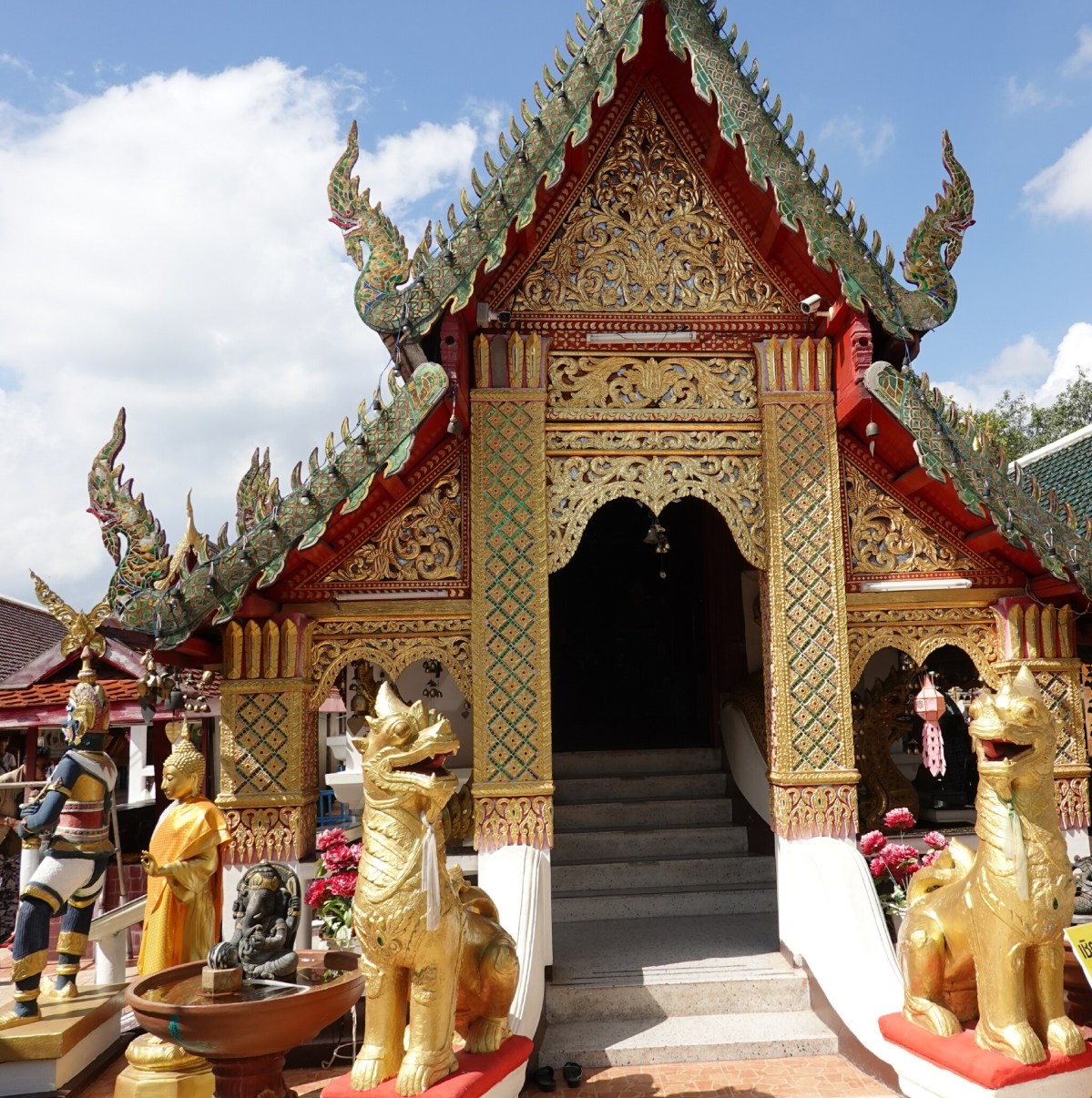
Just past the hall with the flower offerings is this ubsot (ordination hall). This is small, as most are, and quite elaborate. The entrance is protected by two large cinthes (mythical lion creatures).
Further in is what we might call a viewing area, a large area with one edge allowing one to look out over the mountain and Chiang Mai in the distance:
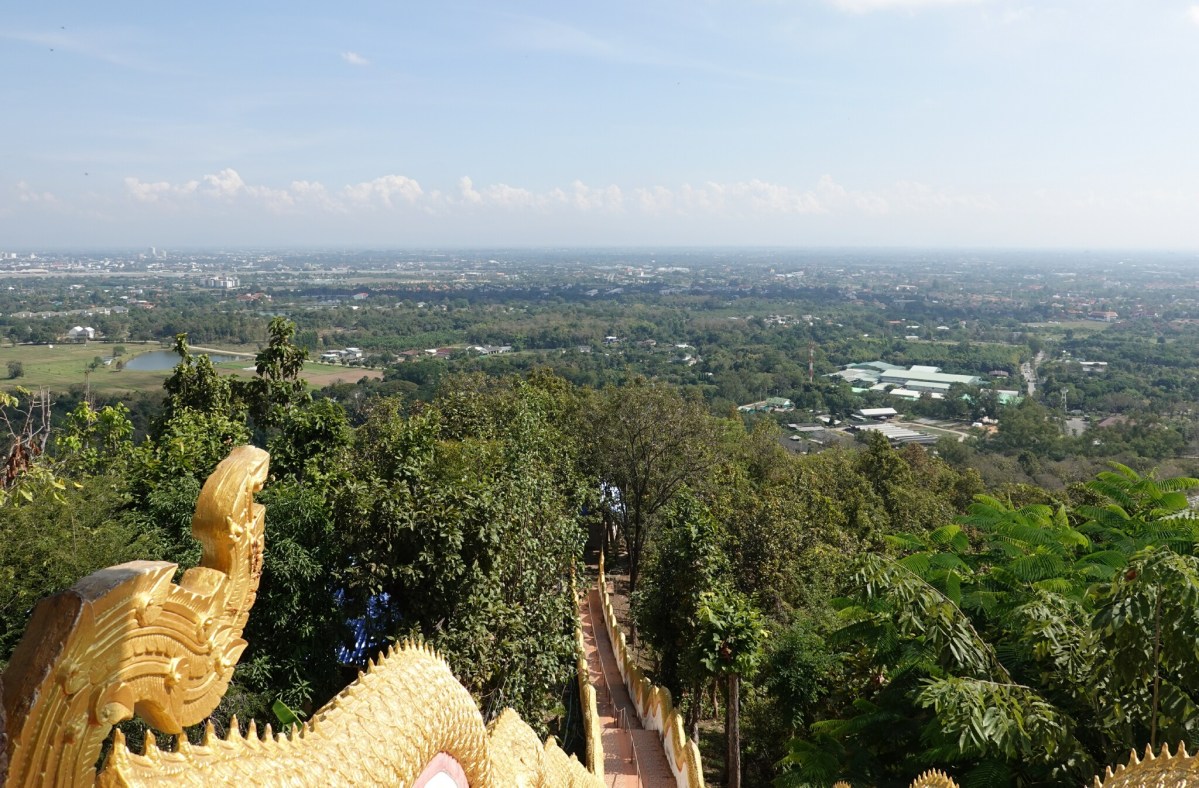
There is a long Naga stairway leading down to something in the distance. I think I read that there are over 700 steps, and neither Tom, Julie, nor I had the energy to climb back up those steps.
On the viewing area is this very large standing Buddha, the statue we could see as we approached the mountain.
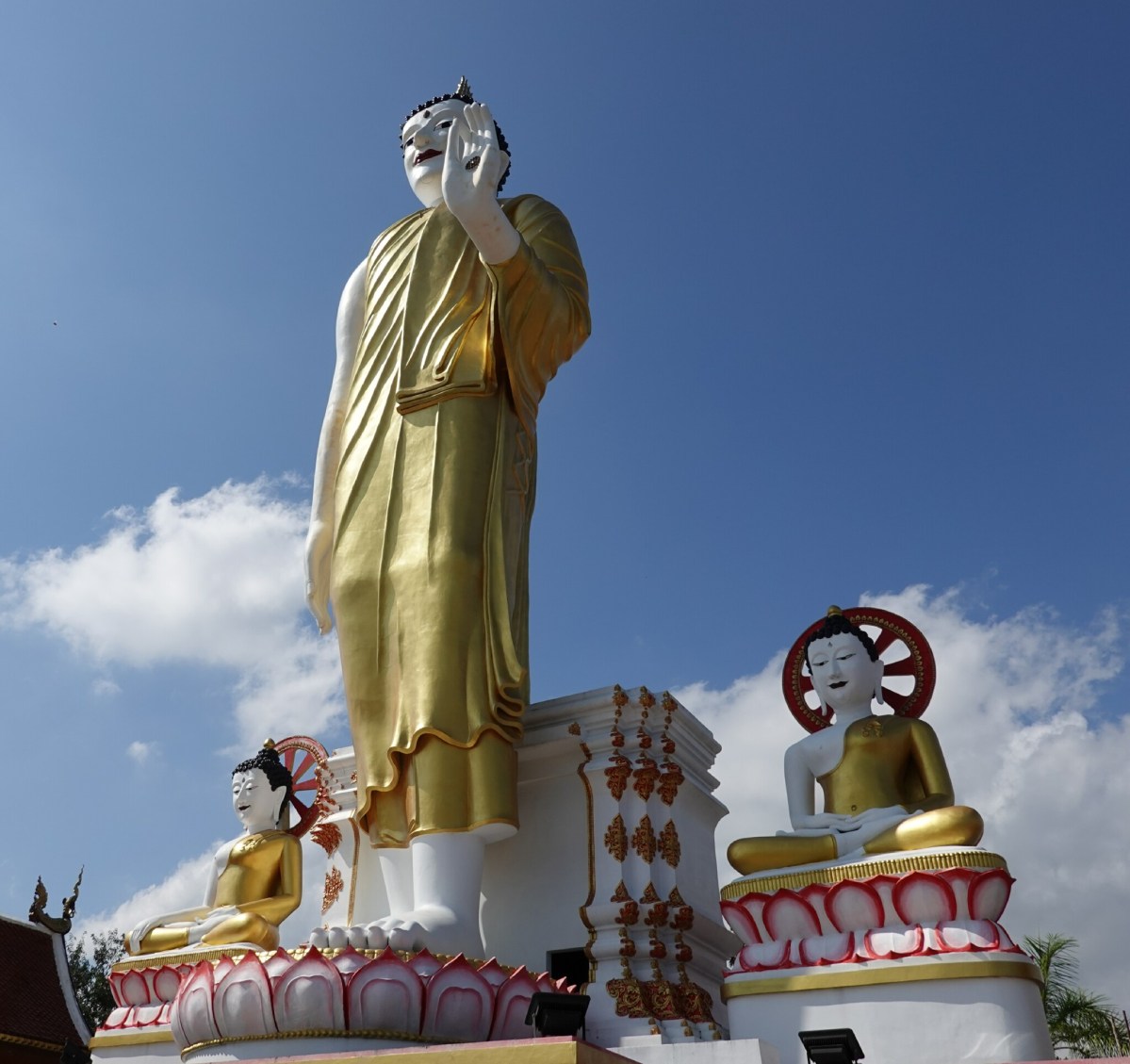
I would estimate its height at about 25 meters or about 80 feet. I could not get further away to get a better angle without falling off the mountain, and I avoided that drama today.
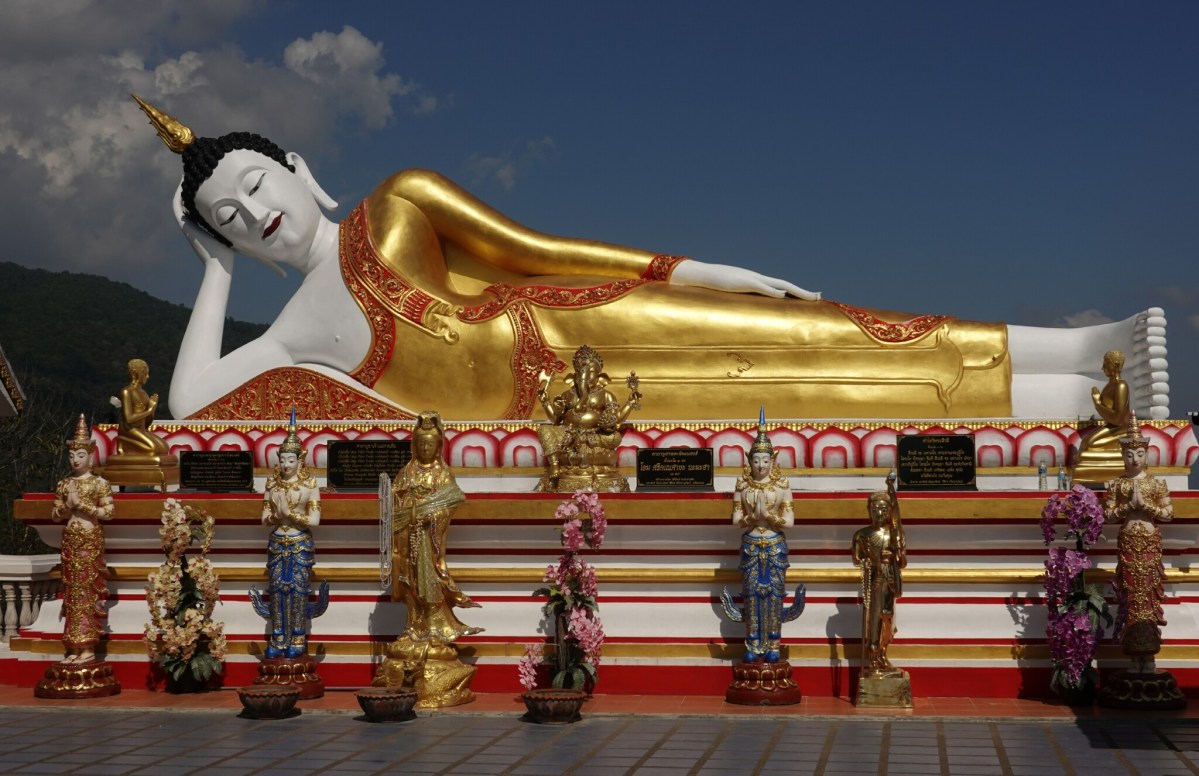
On the other end of the viewing area is this reclining Buddha, about a quarter the size of the 46 meter long Reclining Buddha at Wat Pho in Bangkok. Still large at over 10 meters (33 feet).
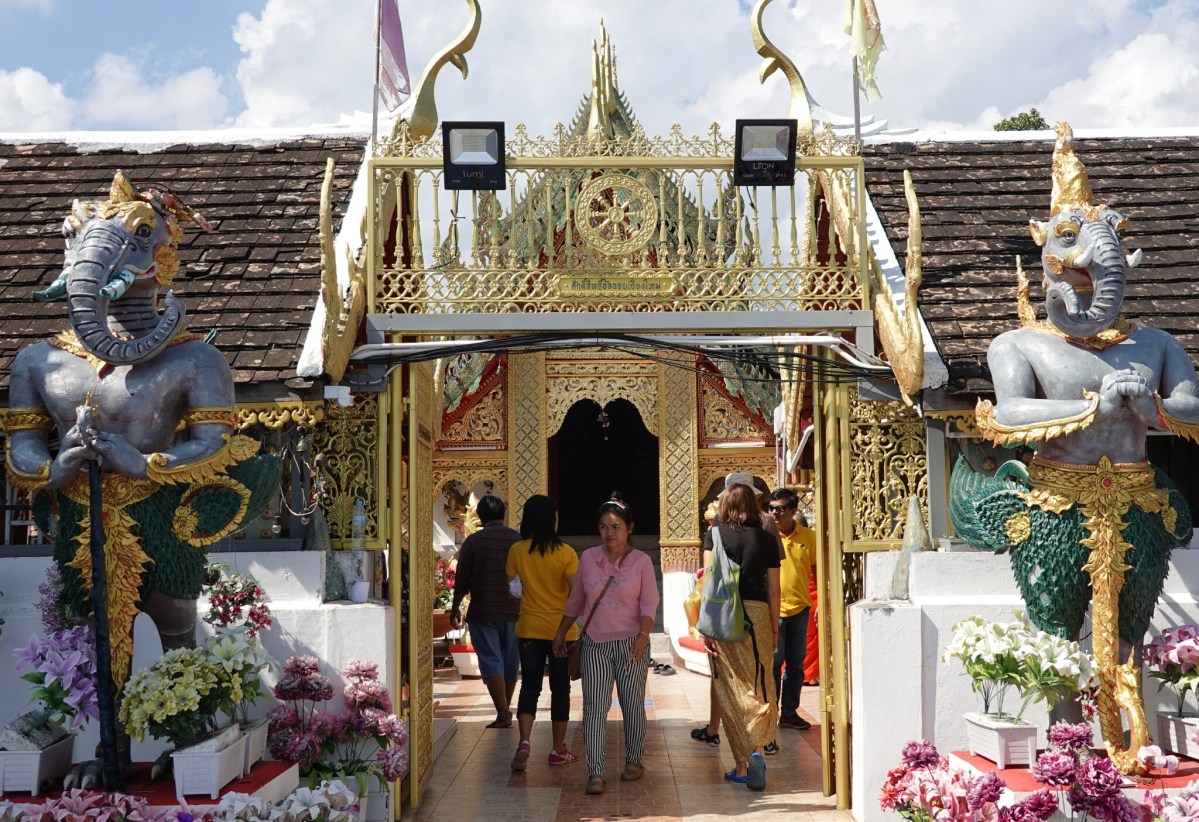
We then walked out of the viewing area to see the chedi in the main area. The entrance to the main area from this direction is protected by two interesting mythical elephant-like yak-like creatures. I do not recall seeing these before, or maybe 6 years ago at a temple at the Mae Rim area north of Chiang Mai. I’ll peruse my old pictures when I get free time.
And we came upon the chedi. This is the oldest structure at the temple, as most structures have been rebuilt over the almost 1300 years during which a temple has been here.
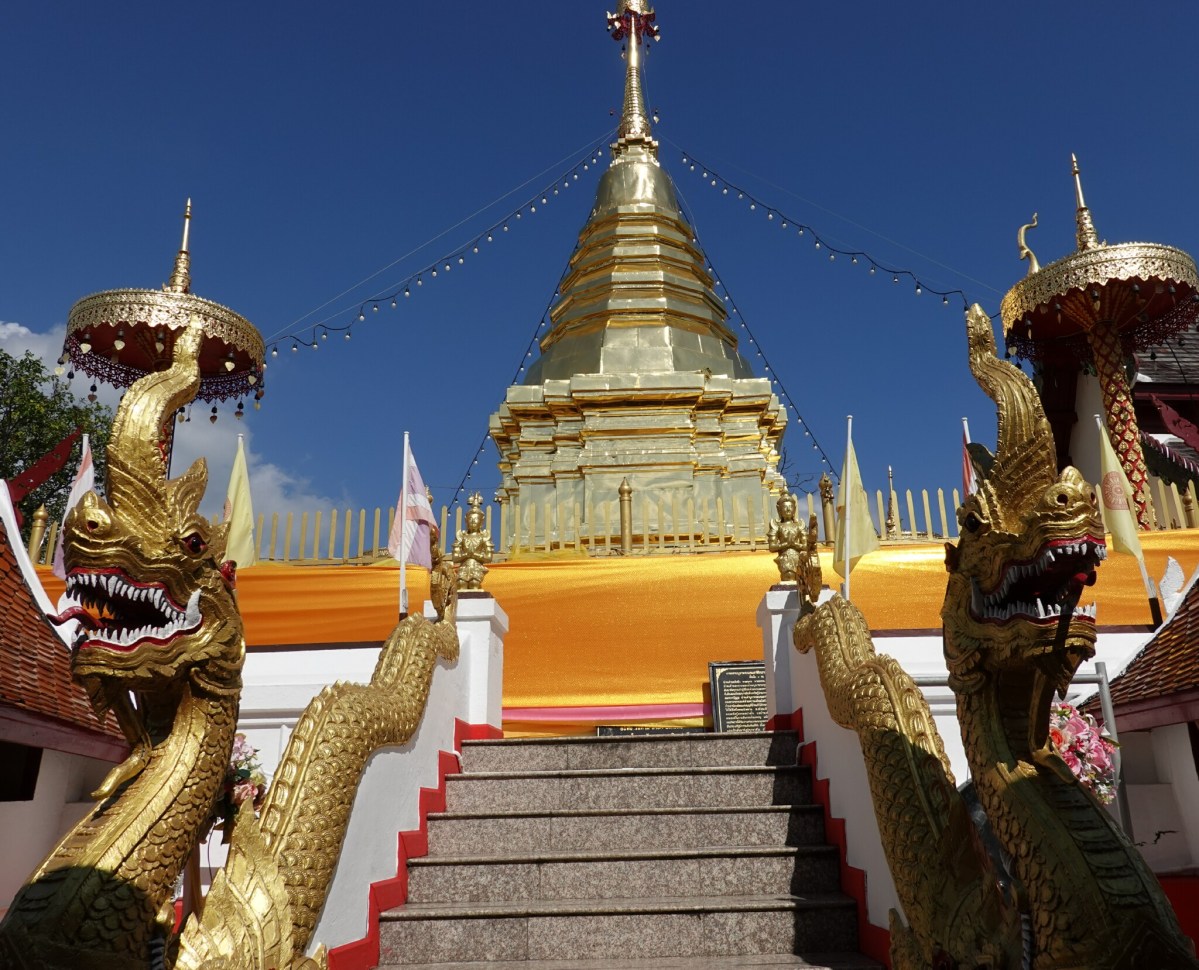
Quite beautiful, and in a similar style to the large gold chedi at Wat Phra That Doi Suthep. We could not get closer as the stairway was blocked.
And finally, the large 17-meter (55 feet) high seated Buddha. Very dramatic. I am still wondering how old this statue is, but have not been able to find this information yet.

Difficult to see the scale, but the statue of a yak under the Buddha’s right hand is larger than a person.
So that was my visit to Wat Phra That Doi Kham. I am glad I saw it, it is interesting. But oddly, there is nothing about it that compels me to return. At least not now. It was a hot day. We went back to Chiang Mai, got a fruit smoothie, and bid farewell. I was off to catch up on some work, and rest for another vigorous yoga session to start the next day. This was a very good day in Chiang Mai.
Next: Suan Prung Gate and the barber

 James the Intrepid Pilgrim
You should climb the 700 steps.
LikeLike