Monday, January 7, 2019
Temples across the street
I have not posted for some time. I apologize. My daily routing has been quite full with yoga, eating, some part-time work, and socializing with friends. I am hopeful that I am getting a little more time to attend to sharing my Chiang Mai visit through my blog.
There are two temples across the street (Prapokkloa Road) from the 3-Sis Guest House where I am staying and have in the past. Both are important temples to the Thai people. I see them every day as I am walking around, and frequently do my morning meditation at the foot of the large chedi at Wat Chedi Luang.
Wat Chedi Luang
Wat Chedi Luang is a large, very old, and very important temple in Chiang Mai. Busloads of tourists come to Wat Chedi Luang every day, many Thai. Construction of Wat Chedi Luang started in the 14th century when King Saeng Muang Ma planned to build a chedi (pagoda) to inter the ashes of his late father. After 10 years of building, it was left unfinished, only to be continued after the death of the king by his widow. It was not finished until the mid-15th century. By then, the chedi was 82 meters high (270 feet) with a base diameter of 54 meters (178 feet), and was by far the largest structure in all of Lanna (the country making up most of northern Thailand). The famous Emerald Buddha was housed in the eastern niche of the chedi. An earthquake in 1545, caused the collapse of the top 30 meters of the chedi. The top portion has never been restored, because there is no documentation of how it appeared, and to restore it incorrectly would cause it great dishonor. So it is left as is. Shortly after the earthquake, the Emerald Buddha was moved to a temple in what is now north-central Laos. The Emerald Buddha now resides at Wat Phra Kaew in Bangkok on the grounds of the Royal Palace. [Note, the Emerald Buddha is called “emerald” for its color; it is not a Buddha statue made of the emerald jewel stone.] A black marble replica of the Emerald Buddha now sited in the eastern niche of the chedi at Wat Chedi Luang.
I went with my camera in the fading light of the day, so many of my photos are too dark to share. I will return in the daytime and share better photos. Here is a picture of the yak (giant, guardian) standing watch near the entrance to the temple grounds.
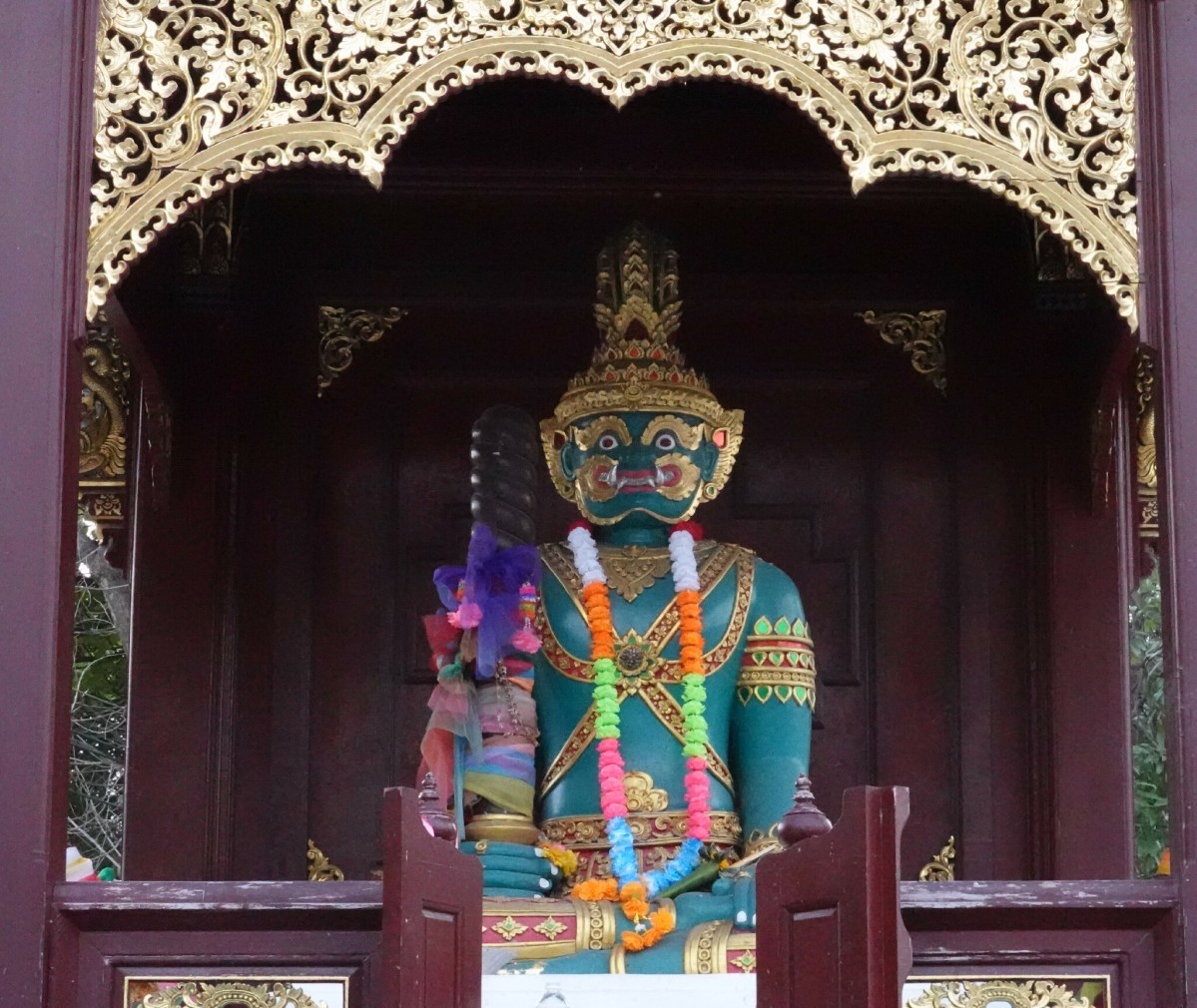
It is a little difficult to make out, but he and his companion on the opposite side of the grounds are holding a bat-like weapon in their right hands…to protect the temple.
Chiang Mai City Pillar
On the temple grounds is the building housing the Chiang Mai City Pillar. It was moved to this more central location in the 1800s, and three large dipterocarp trees were planted to assist the city pillar in protecting the town. Here is one of the trees, the largest, against the setting sun:

And here is a picture of the ubosot (ordination hall) housing the city pillar with what I believe is a statue of King Mengrai:
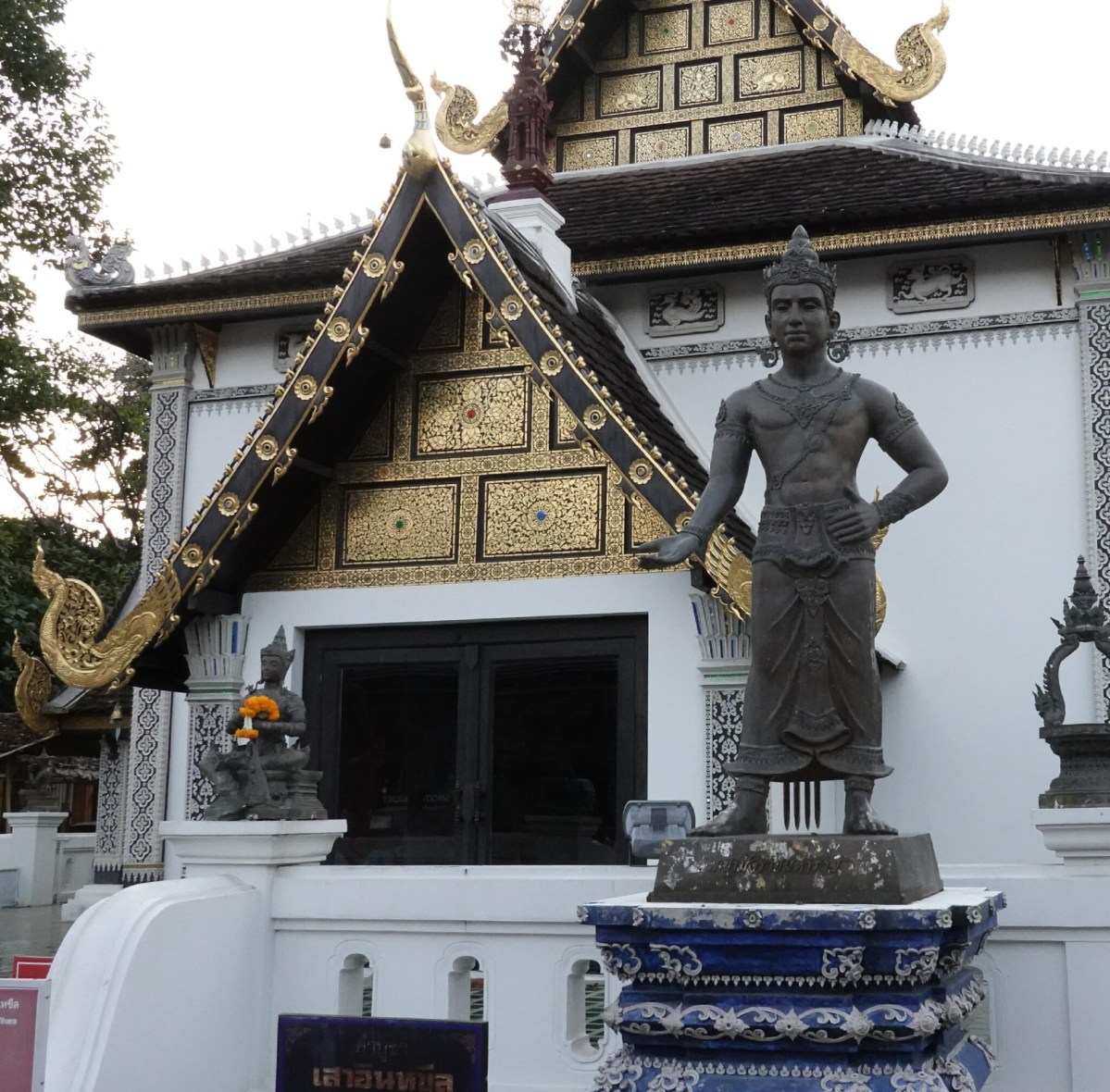
My photos of the viharn (worship hall) are too dark…not only was it early evening, but I also figured out that some settings on my camera were not optimal; not allowing my camera to make adjustments for the light. I have corrected this (I hope), and will get better pictures soon.
This is a photo of the large chedi from where I often sit for my morning meditation:
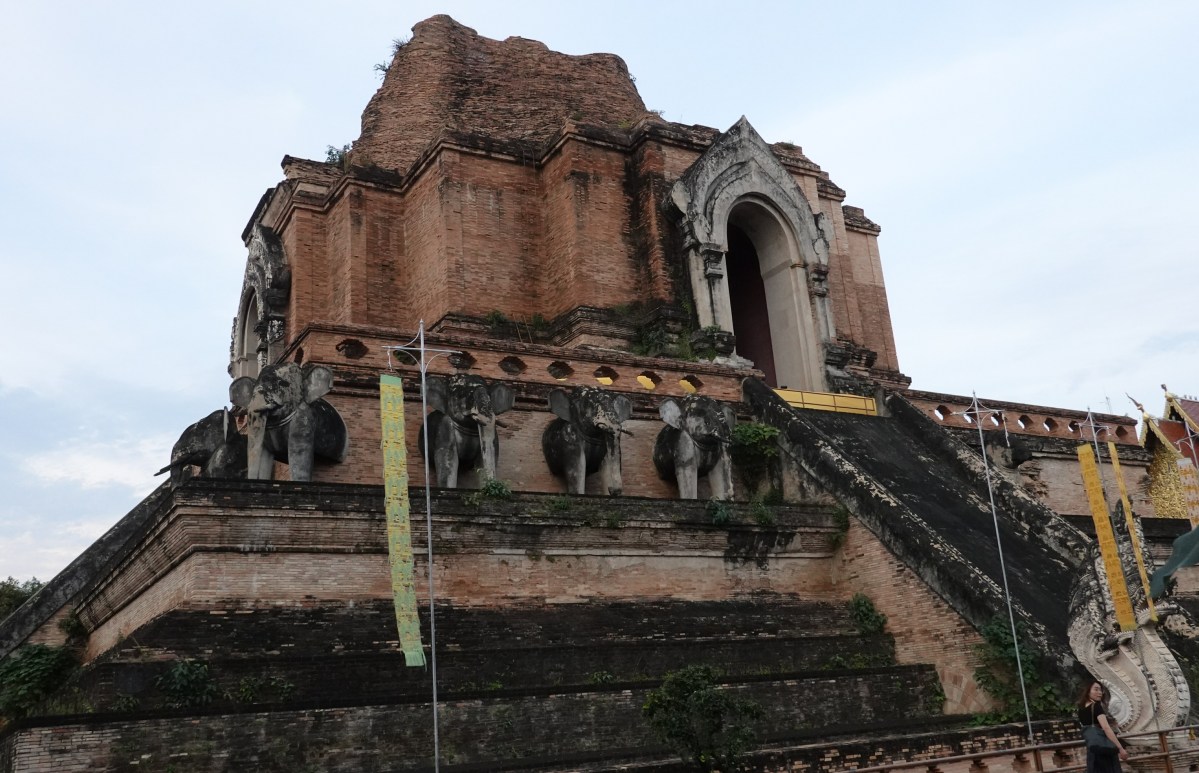
Those elephants are full-size statues. Unfortunately, most of them were destroyed in the earthquake in 1545 and were not restored.
Wat Phan Tao
A much smaller temple than its next door neighbor, Wat Phan Tao still stands out as a favorite, and gets many visitors each day. Beautifully carved from teak, the main building dates back to the late 1870s. The teak panels were formerly part of a royal palace belonging to the ruler of Chiang Mai, King Mahotra Prathet, who ruled the city in the mid 1800s when Chiang Mai was part of the Lanna kingdom. Following his death, his royal residence was no longer used. Then, in 1875, Prince Inthawichayanon decided to dismantle the unused royal palace and recycle it as a temple at Wat Phan Tao.
I love the character of Wat Phan Tao, its teak building is rich and stands out from the mostly white buildings at most temples. While the building is relatively modern, records show that this temple has existed since the 14th century, shortly after construction of Wat Chedi Luang began. Over the years, Wat Phan Tao has undergone numerous rebuilds and renovations with the main wooden viharn (worship hall) being erected in the late 1870s.
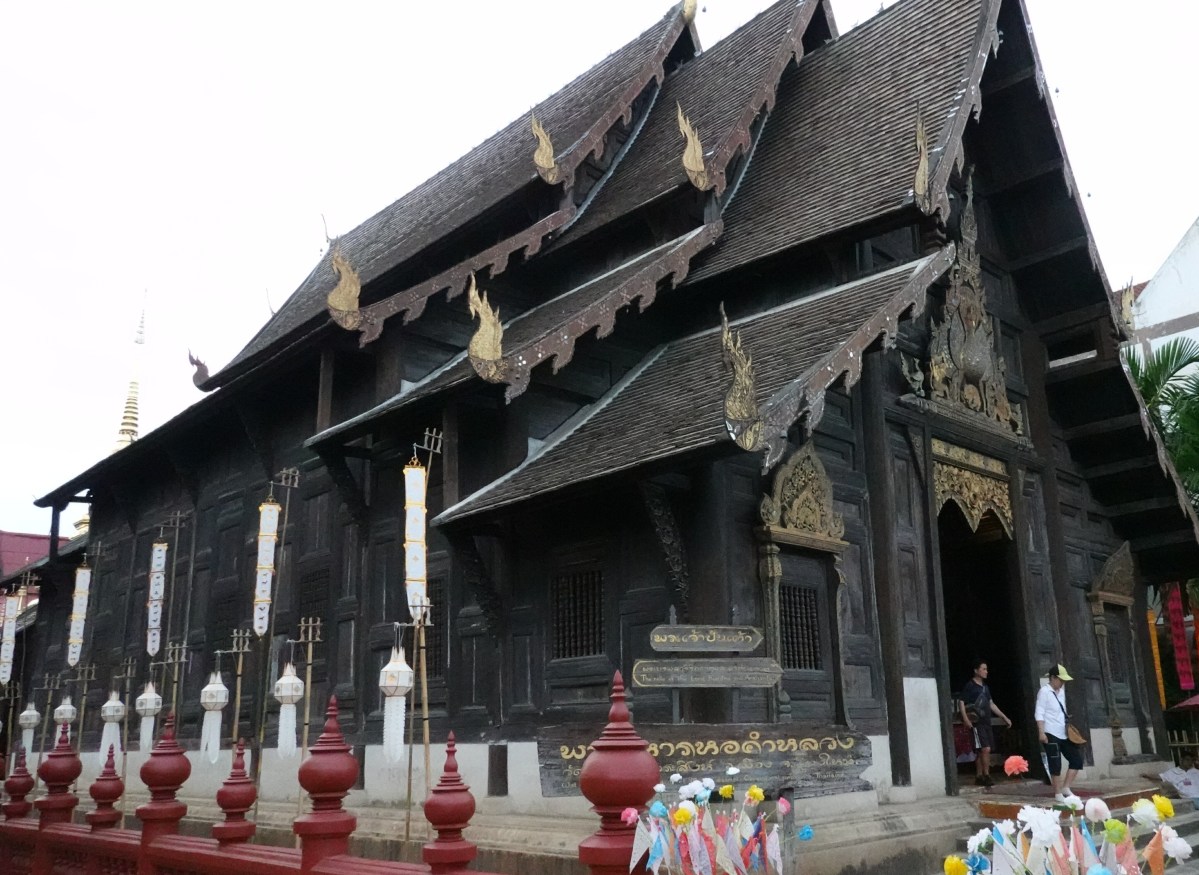
My interior photos were too dark, so I shall return during the daytime. But the outside is quite beautiful with the rich teak wood.
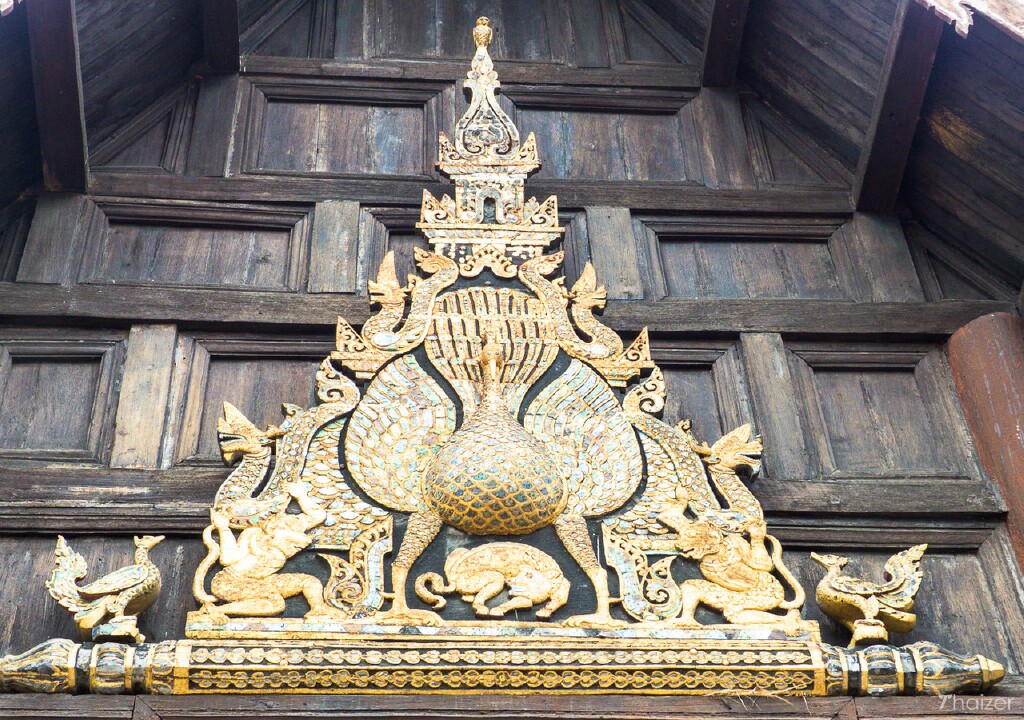
Over the entrance to the viharn is this royal symbol belonging to King Mahotra Prathet which serves as a reminder of the original palace. The gold-colored design is inlaid with mosaic glass and features a peacock, a dog and nagas (protective dragons). The peacock was a Lanna royal symbol and also represents wisdom.
In the back is this chedi, much much smaller than that at Wat Chedi Luang (but all chedi at temples are smaller than that at Wat Chedi Luang). This chedi used to be a very striking gray color, was restored in the last two years, and is now this gold:
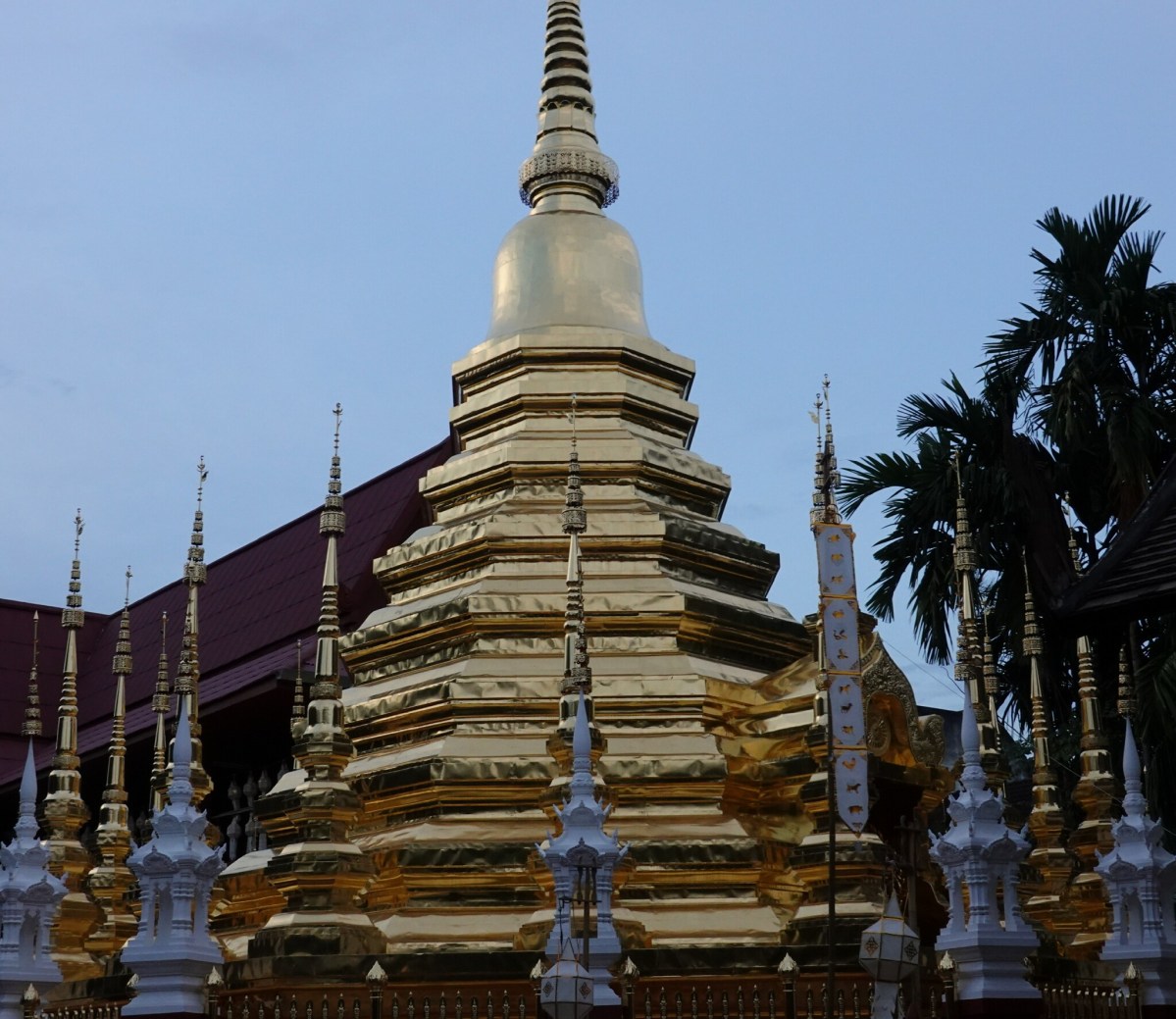
I rather liked the gray color – this gold looks almost garish to me. Much time and money went into the restoration, so there must be a reason for the change.
Next: Temples on Thapae Road

 James the Intrepid Pilgrim