Monday, January 22, 2018
Return to Wat Phra Singh
There are over 33,000 Buddhist temples in Thailand in current use. Of those, 272 are classified as Royal Temples, and only two temples in Chiang Mai are classified as a Royal Temple of the First Class. The first is Wat Srisuphan, and the second is Wat Phra Singh. Other temples in Chiang Mai are very important to the Thai people and are classified as Royal Temples, among them are some of my favorites: Wat Suan Dok (third class), Wat Chedi Luang, Wat Chiang Man, Wat Phra That Dio Suthep (second class), and Wat Lok Molee.
Another, less well-know characteristic of some Buddhist temples in Northern Thailand is that each Chinese Zodiac symbol has an official temple in Northern Thailand. In Chiang Mai are:
- Wat Jed Yod – Year of the Snake (known as small-snake in Thailand)
- Wat Kate Karam – Year of the Dog
- Wat Phra That Doi Suthep – Year of the Ram
- Wat Phra Singh – Year of the Dragon (known as great-snake in Thailand)
Thai people from all over Thailand aspire to make a pilgrimage to the temple that represents their birth year as it is said to yield long life and prosperity. I was born in the year of the dragon. So with Wat Phra Singh being a Year of the Dragon temple and also a Royal Temple of the First Class, it seems that I should feel a strong connection to Wat Phra Singh. I visit Wat Phra Singh at least once every time I am in Chiang Mai, and while I see that it is a nice temple, I have not felt a strong connection.
Today I am going back to Wat Phra Singh. It is always crowded as bus loads of tourists arrive every day, all day. Wat Phra Singh was first built in 1345. King Rama VIII bestowed on it the status of Royal Temple of the First Class in 1935. The main entrance to the temple grounds is guarded by large Singhs (lions). The temple houses an important Buddha statue, the Phra Buddha Sihing which gives the temple its name. It is alleged that the head of the statue was stolen in 1922, so it is possible that the present statue, or maybe only the head, is a copy.

Front of large, main viharn at Wat Phra Singh
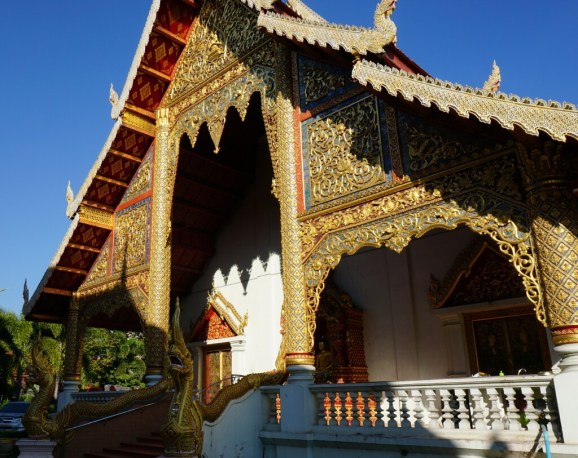
Back of main viharn at Wat Phra Singh
Inside the main viharn are several large Buddha statues. The famous Phra Buddha Sihing statue is in the second, smaller viharn.
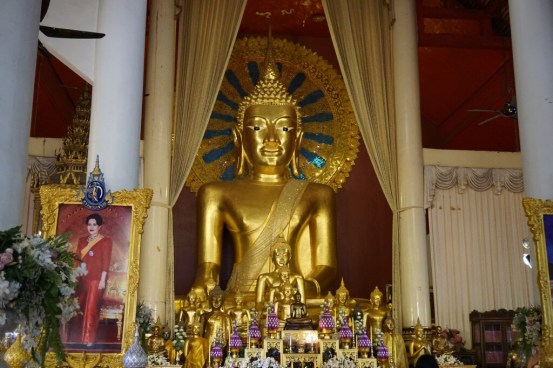
Large Buddha statue inside the main viharn at Wat Phra Singh
Behind the main viharn, as is common in Thai Buddhist temple design, is the main chedi. This chedi was built to hold the remains of King Phayu’s father (fifth king of the Mangrai dynasty) in the mid-1300s.
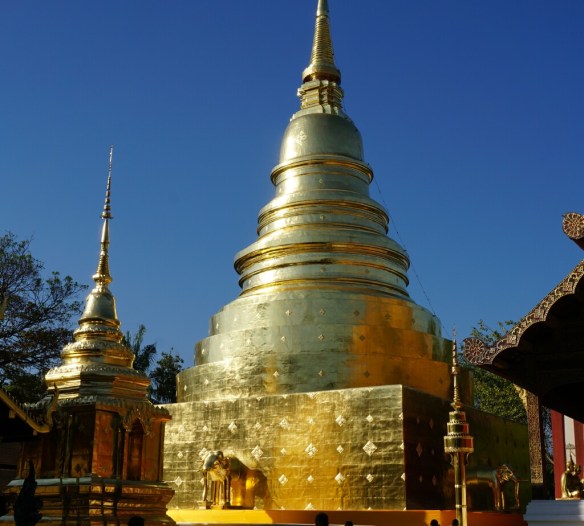
Gold chedi at Wat Phra Singh
Walking around a little, i came upon this monument to King Mengrai. I am not sure if this is two statues of King Mengrai, or of him and someone else.
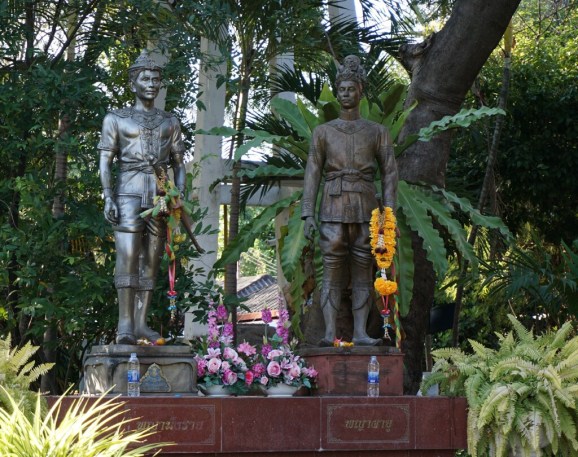
King Mengrai monument at Wat Phra Singh
The famous Phra Buddha Sihing statue is in this smaller, older viharn. Some event or preparation was taking place, because after I took this picture, the doors were closed, so I could not go inside to get a photo of the famous statue.
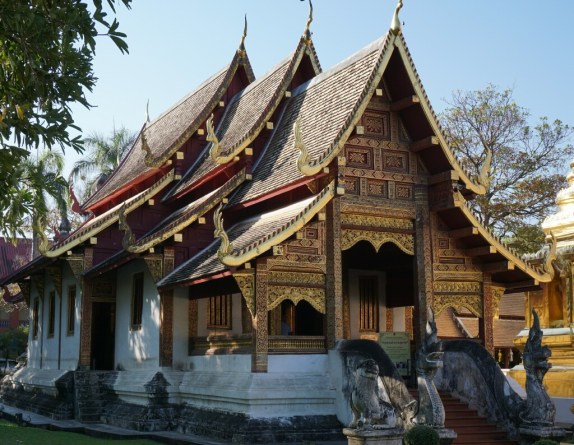
Secondary viharn housing the Phra Buddha Sihing statue at Wat Phra Singh
As with many of the more major temples, there are many buildings. Here is what is called an ubosot, or ordination hall. There were many monks inside, with some type of a ceremony in progress, so I only got a photo of the entrance with the carved thewada flanking the door and the naga over the doorway. Very detailed carving.

Ubosot (ordination hall) at Wat Phra Singh
And as I made my way to the temple entrance, I passed by this old library with the thewada on the sides.
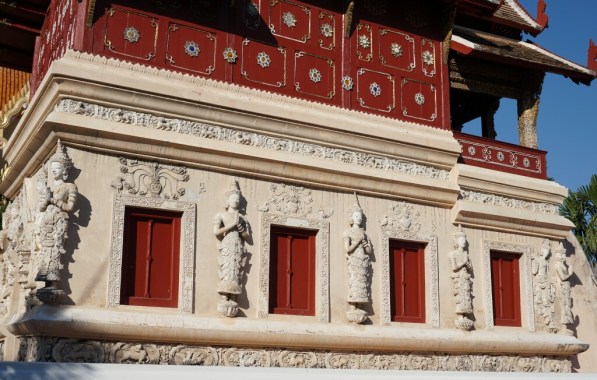
Library of Buddhist scripture at Wat Phra Singh
I headed back to See You Soon, cleaned up, and then headed to the Yoga Tree for the Tibetian Singing Bowl meditation. I finished the day at the Italian restaurant La Fontana with a cool bowl of gazpacho and a small pizza.
Next: Looking for evidence of the second, earthen wall,

 James the Intrepid Pilgrim