Thursday 18 January 2018
Return Visit to the Silver Temple, Wat Srisuphan
I am a computer system administrator. During my visit to Chiang Mai, the agreement I have with my manager is that I will work half-time while I am here doing yoga every day and enjoying being in a different culture. This works fairly well because the computers I manage do not really care where I am, and internet access is very good in Chiang Mai. I typically work in the afternoon when it is hot out and I would rather be out of the sun. Sometimes I work from my room, but more often I like to get out – the room can feel somewhat confined. I often go to one of a few coffee shops with which I am familiar so I can have a snack and work for a few hours. Today, I decided to go to my favorite place, the Artisan Coffee Shop, down on Waulai Road, a little south of the old city. From See You Soon where I am staying, the walk to the Artisan is about 1.5 kilometers (about a mile). It is not a bad walk, through what is the traditional silver-making district of Chiang Mai. In this area are many silver shops and many places making silver jewelry and other silver household items.
Wat Srisuphan
Since I was practically walking by Wat Srisuphan (also known as Wat Srisupan), I made the diversion from Waulai Road to visit the temple. Here is the sign over the lane leading from Waulai Road to Wat Srisuphan letting me know I am in the right place (but having been here many, many times, I already knew I was in the right place). Wat Srisuphan is a Royal Temple of the First Class, one of only two in the Chiang Mai area of that class (the other being Wat Phra Singh), and thus very important to the Thai people:
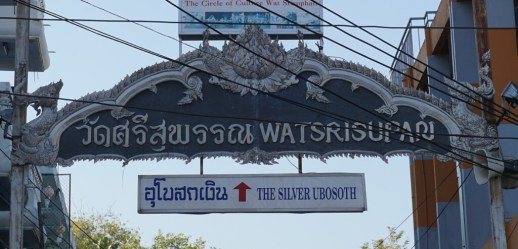
And a short distance down the lane (called a “soi” in Thai) is the sign announcing the entrance to the temple:
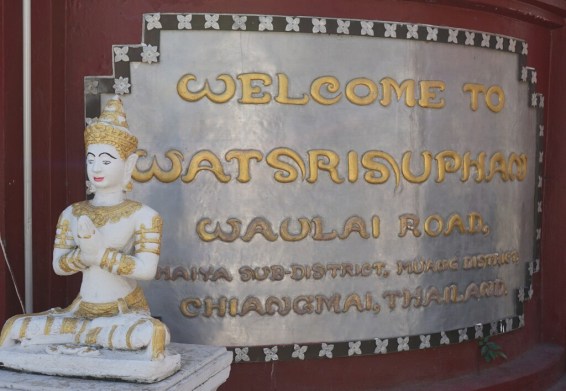
[Though the sign says Waulai Road, Wat Srisuphan is about 100 meters away from Waulai Road down a soi, but close enough.]
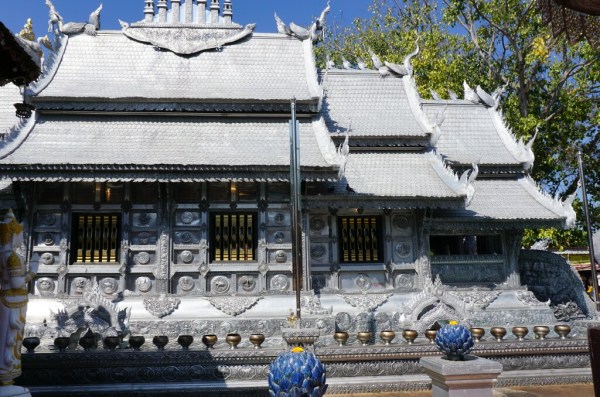
The temple was first founded in 1501 under King Mengrai and given the name Wat Srisuphan Aram. The temple has been renovated and redesigned a number of times since the first construction (as is common with older temples). The most recent reincarnation of the temple began in 2004 under the direction of the abbot (head monk of the temple), Phra Kru Phithatsuthikhun. Rather than using standard temple renovation techniques, the abbot chose to make use of the skill and knowledge of local silversmiths. This is most evident in the design of the main ordination hall (ubosot). The result is a silver-colored building which shimmers in the sunlight and is full of intricate details. Most of the work is carried out using aluminum and zinc alloy with precious silver being reserved for the holy images.
Of all the temples I have visited in Bangkok and Chiang Mai, Wat Srisuphan is only the second in which the viharn (worship hall) and ubosot (ordination hall) entrances do not open to the east to greet the rising sun. The other is Wat Lok Molee in which the main viharn opens to the south. At Wat Srisuphan, the main viharn and the ubosot open to the north. Nobody I have talked to knows why these two temples do not follow what is considered to be a rule of the main doors opening to the east. I am sure that I will learn why someday.
Here is a side and little distant view of the silver ubosot showing the silver-covered building (including the roof):
Here is the north-facing viharn at Wat Srisuphan. The style of the roof tells those that know that this is a Lanna-style temple.
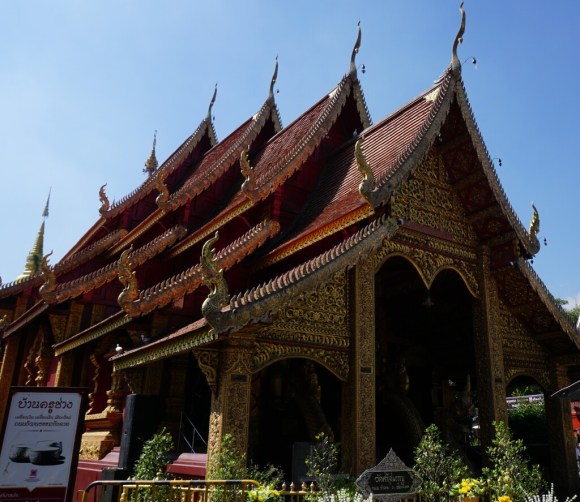
- Main north-facing viharn (worship hall) at Wat Srisuphan.
The stairway banisters have the dragon-like creatures, called naga. Behind the stairway, flanking the doors are the green giants or guards, called yaks. Yaks are more common in central Thai temples (Bangkok) than in northern Thai temples, but there are a few around in Chiang Mai, just not commonly. (Having said that, there are yaks at the entrance arch at Wat Lok Molee also…Wat Lok Molee and Wat Srisuphan have a few things in common.)
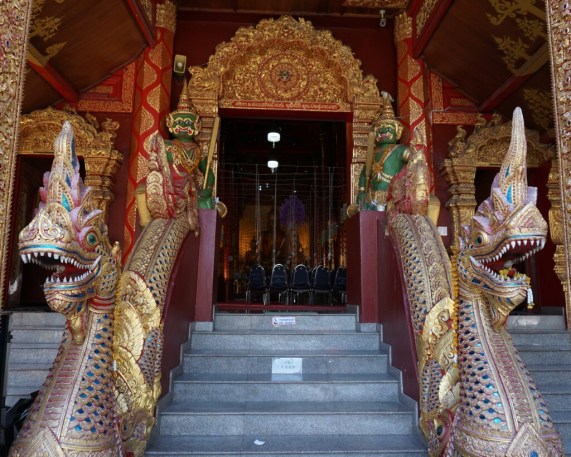
North-facing entrance to the viharn at Wat Srisuphan.
And inside the viharn among other Buddha statues is what looks like a replica of the Emerald Buddha made of glass.
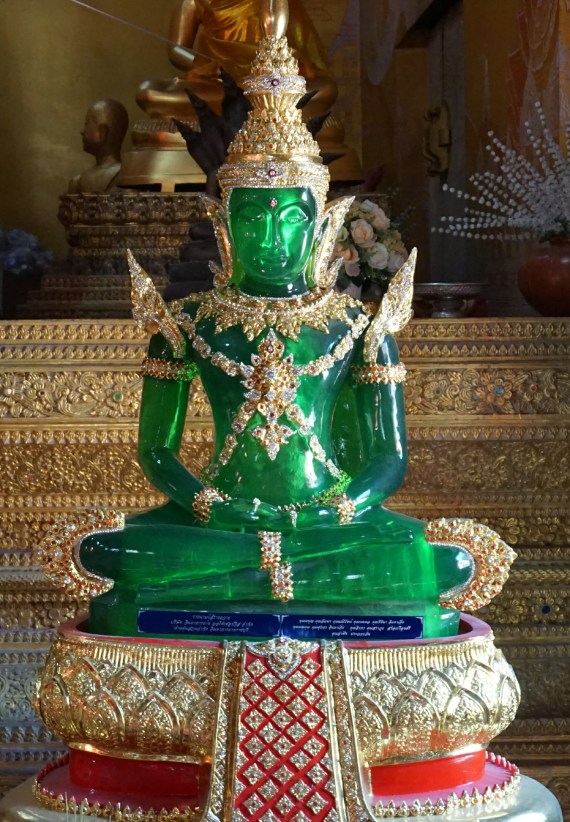
A model or replica of the Emerald Buddha in glass.
The actual Emerald Buddha is at Wat Phra Kaeo in Bangkok at the Grand Palace, and not emerald, but a green jade from northern Thailand. The nickname Emerald Buddha refers to the color, not the stone. The Emerald Buddha is of Lanna origin, and was in Lampang for 32 years, then in Chiang Mai at Wat Chedi Luang from 1468 until 1552 when it was moved to Vientiane, the capital of Laos, back to Chiang Mai, and later back again to Vientiane. In 1779 it was moved to to Siam at the new capital in Thonburi (predecessor to Bangkok) and installed in a shrine close to Wat Arun.
Chao Phra Chakri then took over the reins, founded the Chakri Dynasty of Rattanakosin Kingdom, and adopted the title King Rama I. He moved the capital from Wat Arun across the Chao Phra river to its present location in Bangkok, and constructed the new Grand Palace including Wat Phra Kaew within its compound. The Emerald Buddha was moved with great pomp and pageantry to its current home in the Wat Phra Kaew temple in March, 1784.
Here is the side entrance of the main, north-facing viharn at Wat Srisuphan with the mom (pronounced “moam”) serpent-like creatures and singhs:
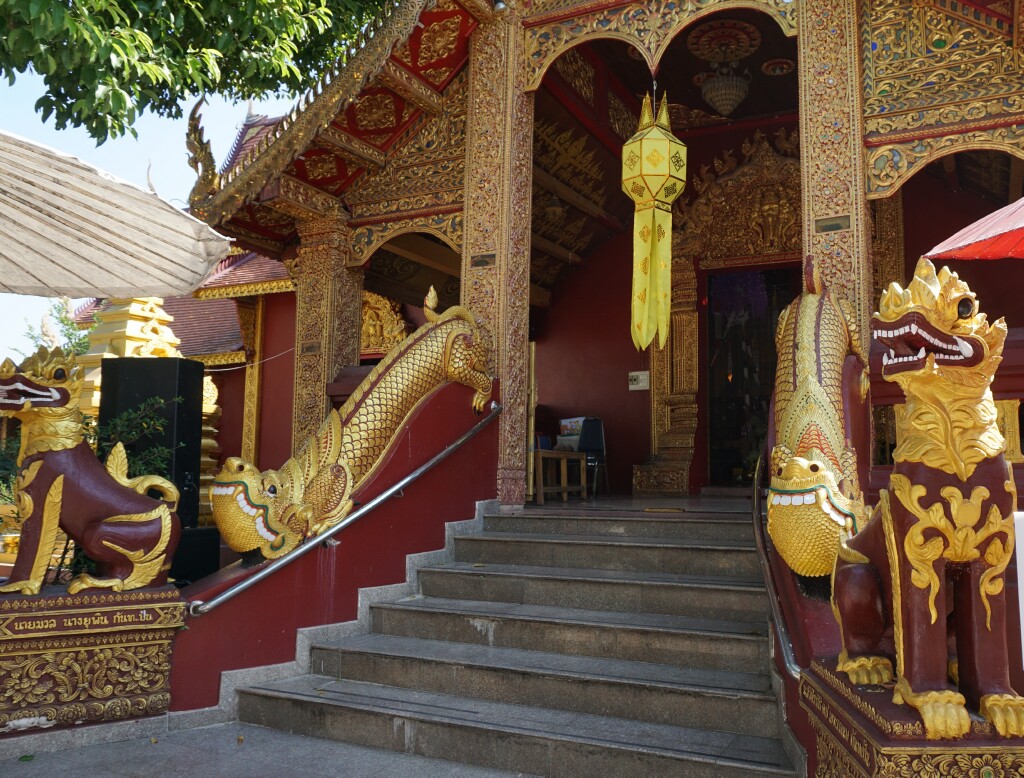
Side entrance to the north-facing viharn at Wat Srisuphan
After spending a little time in the main viharn, I made my way over to the silver ubosot. An ubosot is the holiest prayer room, also called an ordination hall, as this is where monks are ordained.
The term ubosot, shortened to bot in Thai colloquial speech, is derived from the term uposathagara, which refers to a hall used for rituals on the uposatha days — the Buddhist Sabbath, which falls four times a month on the full moon, new moon, and eighth day after each.
An ubosot stands within a boundary formed by eight boundary stones buried at cardinal points of the compass which separate the sacred from the profane, and thus differs from a viharn. A ninth stone sphere, usually bigger, is buried below the main Buddha image of the ubosot. Both ubosots and viharns typically house Buddha images.
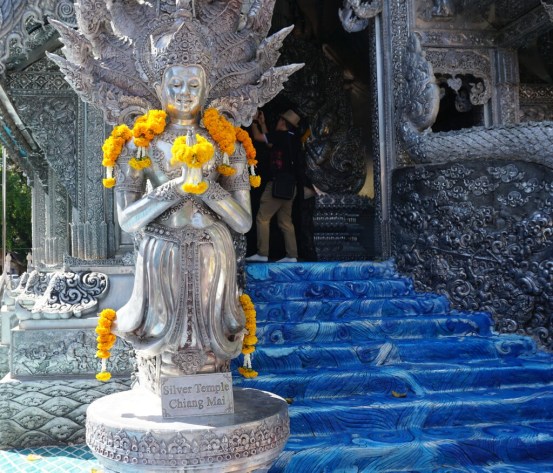
- Approach to the Silver Ubosot entrance at Wat Srisuphan
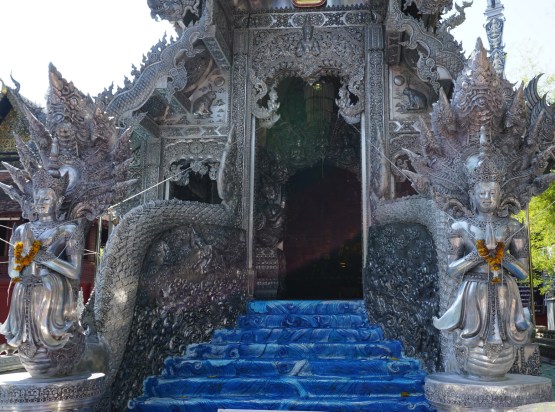
Another view of the entrance to the Silver Ubosot at Wat Srisuphan
The blue stairs, possibly painted to look like the ocean, are new as of just over a year ago – when I visited Wat Srisuphan a year ago, the blue stairs were new.
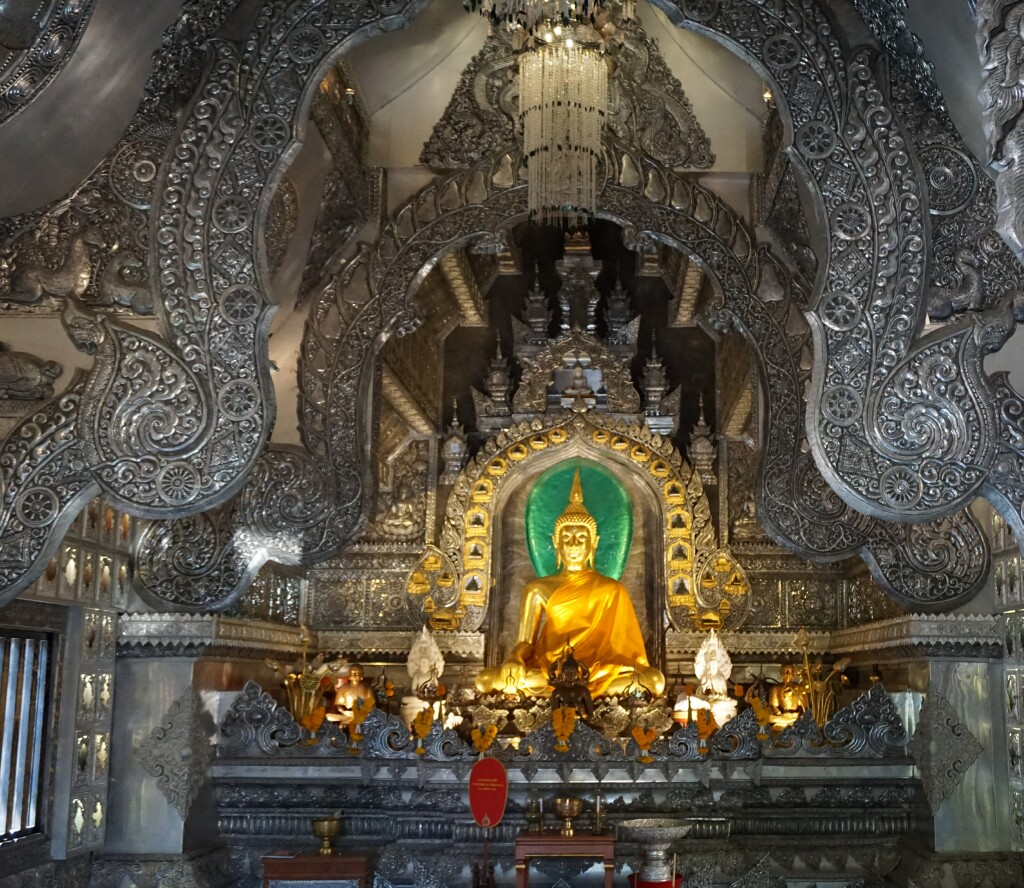
Inside the Silver Ubosot at Wat Srisuphan
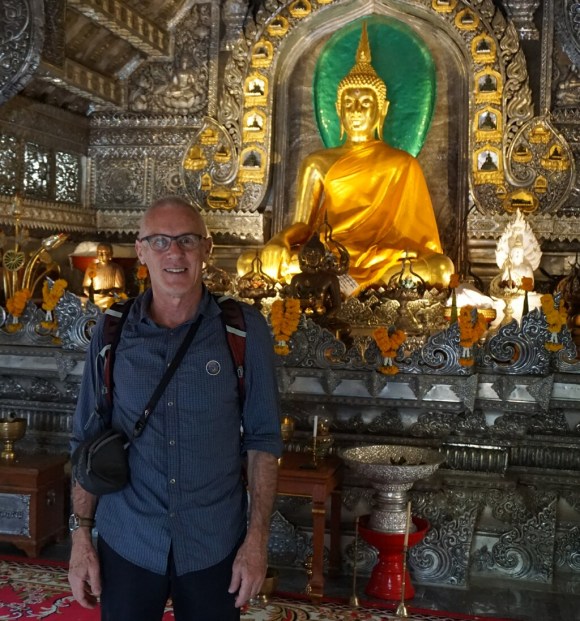
And a picture of me in the ubosot at Wat Srisuphan.
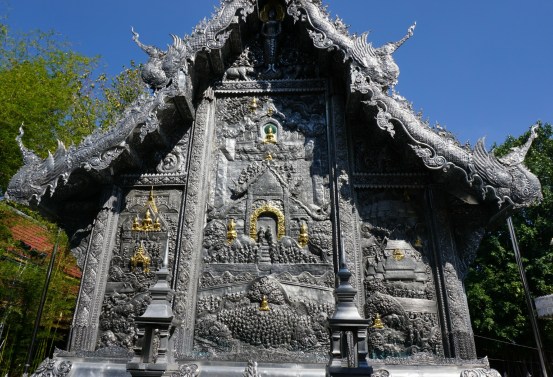
And the back of the Silver Ubosot at Wat Srisuphan:
After visiting Wat Srisuphan, I walked further down Waulai Road and on to the Artisan, where I had a piccolo latte and set about getting caught up with some computer work. All in all, visiting Wat Srisuphan made the day nicer – it is a beautiful temple with great history and a little mystery as to why the viharn and ubosot doors open to the north. Another good day in Chiang Mai!
Next: A return visit to Wat Phra Singh, the other Royal Temple of the first class in Chiang Mai.

 James the Intrepid Pilgrim
The metalwork is amazingly intricate.
LikeLike