14 January 2018 Sunday
A Walk along the West side of the Wall/Moat
Today my Australian friend Tom is leaving Chiang Mai for his home after yoga and lunch. We met at Amrita Garden restaurant in the old city after yoga at Wild Rose Yoga. I had to rush up to 3-Sis to change clothes and check-out, as I am moving to See You Soon today. The 3-Sis is owned by a family of three sisters, managed by Poppy. One of the other sisters, Ice and her husband Ball opened a restaurant and guest house about 75 meters down the street named See You Soon. The family thought I should spend part of my time at each, and since I like both places, that became the plan. I got back to Amrita Garden just after Tom and just before we were joined by Rose and her husband John. We had a very nice lunch, and said our good-byes to Tom.
Around the Moat/Wall
On my last walk around the wall, I entered the old city at Sean Prung Gate, the gate where in much older times cadavers were moved out of the old city for cremation. I had never explored that part of the old city so took the opportunity. Originally, there were only four gates in the wall. The fifth gate was added later in the 15th century. This was Sean Prung Gate which King Sam Fang Kaen built to allow his mother to travel easily from her palace outside the old city to supervise the building of the Wat Chedi Luang. This also became the gate to be used for funeral processions from the city. Today, since Amrita Gardens is just about 150 meters from Sean Prung Gate, I went down that direction and proceeded to walk west to complete my walk around the moat with my camera in hand. [I have made a few complete circuits of the wall/moat on other days but without my camera in hand.]
Ku Hueng Corner
The first major site is the southwest corner, Ku Hueng corner. The corners of the wall were almost like buildings, from which the guards watched the outside of the city from inside. Here are a couple of photos, the first approaching the corner, showing the small waterfall in the moat with the corner in the background, and the second showing the structure of the corner bastion.
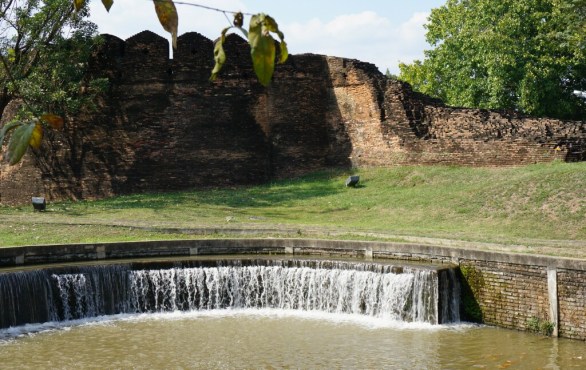

Then a view from the corner up to the north of the moat on the west side of the wall. There are less remains of the wall on the west side than the others. From Ku Hueng corner half-way up the west side to Suan Dok Gate, there are almost no remains of the wall, and then from Suan Dok Gate to Hua Lin corner, the northwest corner, there are almost no remains.
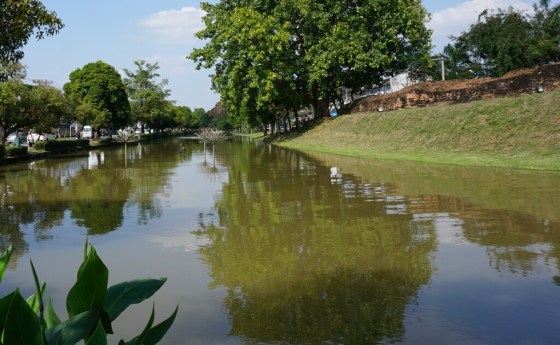
On the right of this picture, part of the wall can be seen. This is a part extending from Ku Hueng corner. Beyond that large tree, there is almost no wall remnants until I reach Suan Dok Gate:
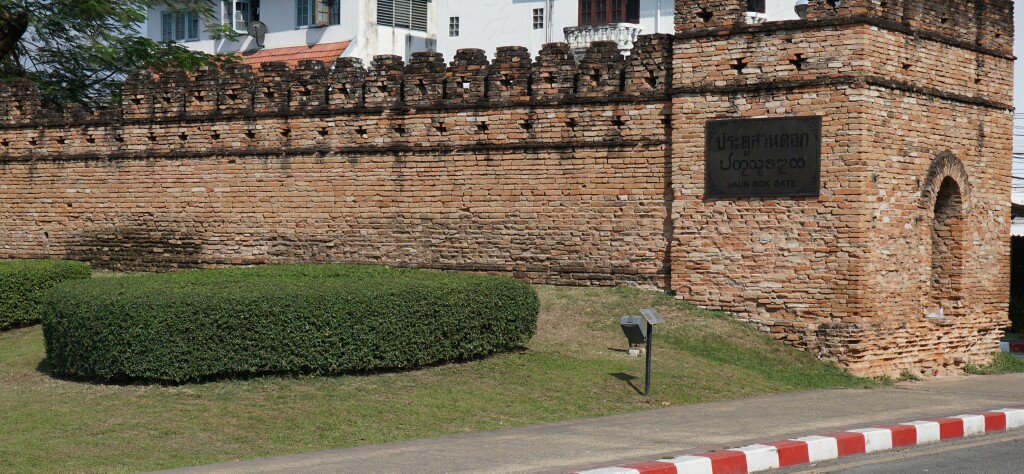
The structure looks a lot like the other gates, as they were built basically the same, and then restored in the 1890s and again in the 1960s.
Wat Pansao
Across the road just north of Suan Dok Gate and just south of Chiang Mai Ram hospital is a temple I have never visited in the past, Wat Pansao. It is obviously quite old, and a very nice temple. Almost no visitors are here, not even more than a very few Thai people, so it is quite peaceful. Wat Pansao has all the elements of a temple worth visiting: a pleasant garden, a classic Lanna-style main viharn (worship hall), and an old brick chedi. The chedi is actually hollow, which suggests that it is Burmese influenced, as most Chiang Mai chedis are not hollow.
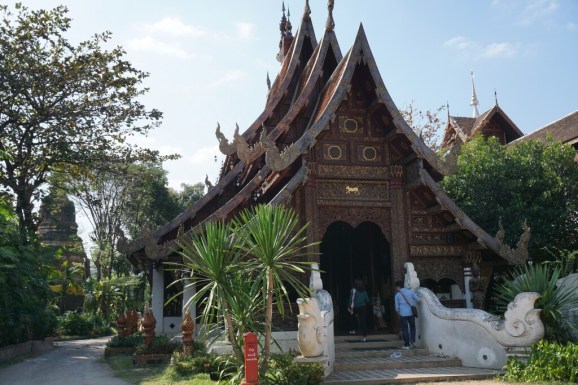
Wat Pansao Viharn

Wat Pansao Chedi from back
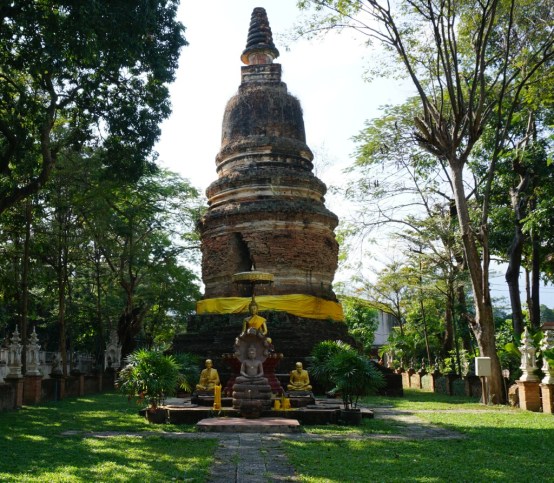
Wat Pansao Checi from front with garden

Inside Wat Pansao Viharn
A very peaceful temple along a very busy section of the outer moat road. I am surprised I had never been to Wat Pansao before.
Hua Lin Corner
Walking further north, I reach Hua Lin Corner, the northwest corner of the wall, and where water entered the moat from a nearby stream (I am not sure this is still true, but there is water in the moat, and it is always flowing slowly).
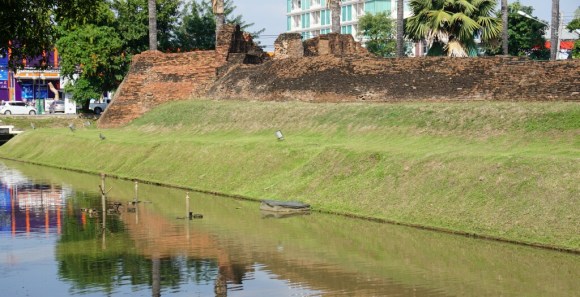
Approaching Hua Lin Corner from the south
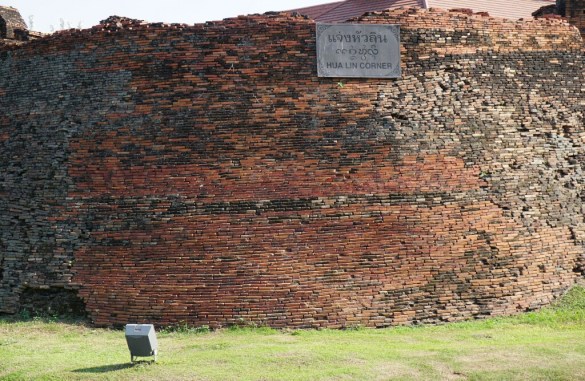
The Bastion at Hua Lin Corner
Around the corner and just about 200 meters to the east I am across from Wat Lok Molee, one of my favorite temples.
Wat Lok Molee
Wat Lok Molee (sometimes spelled Wat Lok Moli) is an old temple, but it is not known when it was first built. From Wikipedia: “it was first mentioned in a charter in in 1367 CE. The sixth king of theMengrai dynasty, King Kuena (1355-1385), invited ten Buddhist monks from Burma to spread their teachings on Theravada Buddhism. The monks were housed in this temple.” So a temple was built here before 1367. The large, tall chedi was commissioned by King Ket (Mueangketklao or Phra Kaew Muang) in 1527 to hold the ashes of several members of the Mengrai dynasty. The same king had the viharn built in 1545, and it was reconstructed in the 1990s.
Some photos of Wat Lok Molee. The inside is mostly teak and very dark, too dark for a good photo, but I have documented the inside of the viharn previously. I did get a couple of photos of parts of the painted ceiling.
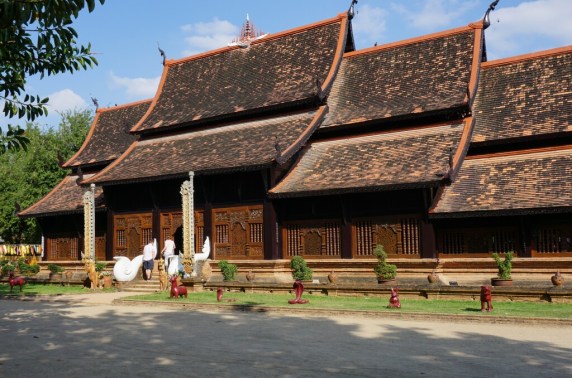
Wat Lok Molee Main Viharn
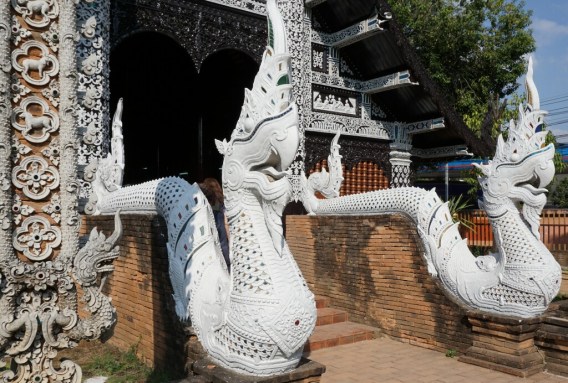
Entrance to Wat Lok Molee Viharn

Wat Lok Molee Viharn Ceiling Painting 1
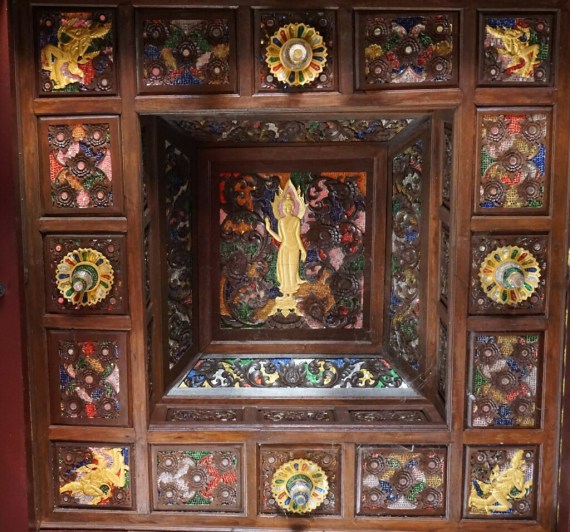
Wat Lok Molee Viharn Ceiling Painting 2
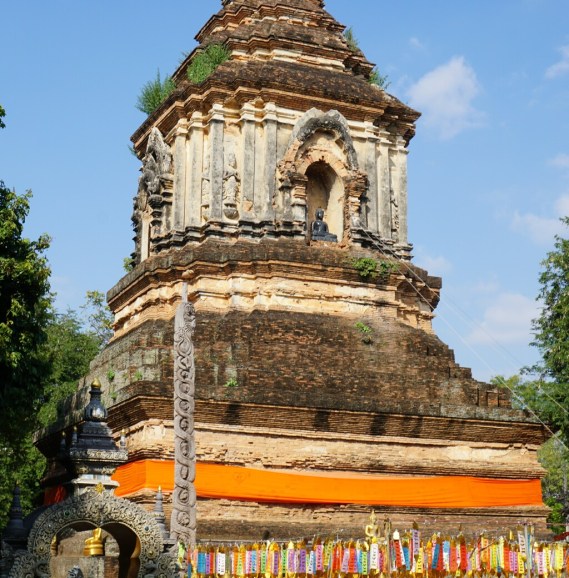
Another view of the Wat Lok Molee chedi
From Wat Lok Molee, I walked back to See You Soon, my home for the next two weeks, checked in, and started considering a little rest, dinner, then a foot massage with Nam at the Sunday Night Market.
Another good day in Chiang Mai.
Next: The flower market and Wat Kate Karam across the Mae Ping River.

 James the Intrepid Pilgrim