Thursday 11 January, 2018
Exploring Wiang Kum Kam
My Australian friend Tom and I decided to visit Wiang Kum Kam. I had been to a few of the sites three years ago, and I knew that Tom was interested in history. And, Tom has a motorbike, and will only be here for a few more days.
Before the current old city of Chiang Mai was built by King Mengrai and his two friends, in 1296, the capital was relocated from Chiang Rai to the new city located at Wiang Kum Kam in 1288. Wiang Kum Kam is southeast of the Chiang Mai old city by about 6 or 7 kilometers and across the Ping River. It was a good location with proximity to the river, but was very low and because of frequent flooding, King Mengrai abandoned the site at Wiang Kum Kam and located the new Chiang Mai city on higher ground north and west of Wiang Kum Kam in 1296. Repeated flooding left the largely abandoned Wiang Kum Kam sites buried under 4 – 10 meters of mud. Some people continued to live in the area, and there has been evidence uncovered suggesting that people lived in the area as far back as the eighth century.
Wiang Kum Kam Rediscovery
In 1984, Thai authorities were alerted to the discovery of a number of ancient tablets found under Wat Chang Kam just 5 or 6 kilometers southeast of the Chiang Mai metropolitan area. Archaeologists from the university were contacted, quickly moved in and uncovered the remains of the ancient lost city of Wiang Kum Kam.
Over thirty archaeological sites including many ancient temples were found within the ancient rectangular shaped city wall and just beyond. From my previous visit, I thought there were only about 4 or 5 sites – Wiang Kum Kam is far more extensive than I thought. The area is quite spread out, and the sites are difficult to locate even with a map. Tom and I drove around and saw some of the sites. Unfortunately, I did not record the names of all of the sites. And, because Tom and I did not know much about the area, how many sites or where they were, my pictures are thus a little disorganized. I find Wiang Kum Kam fascinating. Although the ruins were largely destroyed after repeated floods and having been buried in mud, there is evidence that much construction of the city was completed in the eight years before it was abandoned. We visited a few sites, and then found an information center and got something of a map. We did not have time to systematically see the sites, but visited a few more before heading back to Chiang Mai.
Wat That Kaow
All of the sites have names, and some have plaques describing the site in Thai and English. I photographed some of the plaques, but some are in such poor condition they could not be read. Wat That Kaow is a site I had seen before so I knew we were on the right road.
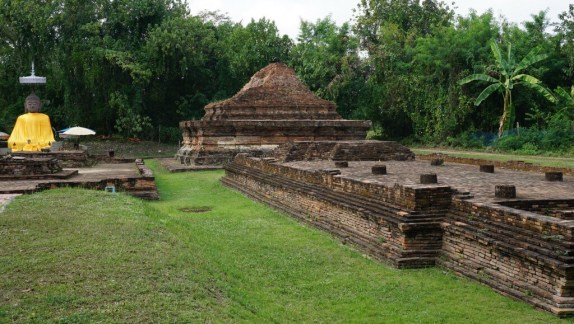
Wat That Kaow
You can see the rectangular viharn (worship hall) with the foundations for the pillars that would hold up the roof. And behind the viharn is a chedi (pagoda). To the left of the main viharn is a secondary viharn, or perhaps an ubosot (ordination hall) with a large Buddha statue.
Wat Nanchang
This is another site I had visited before.
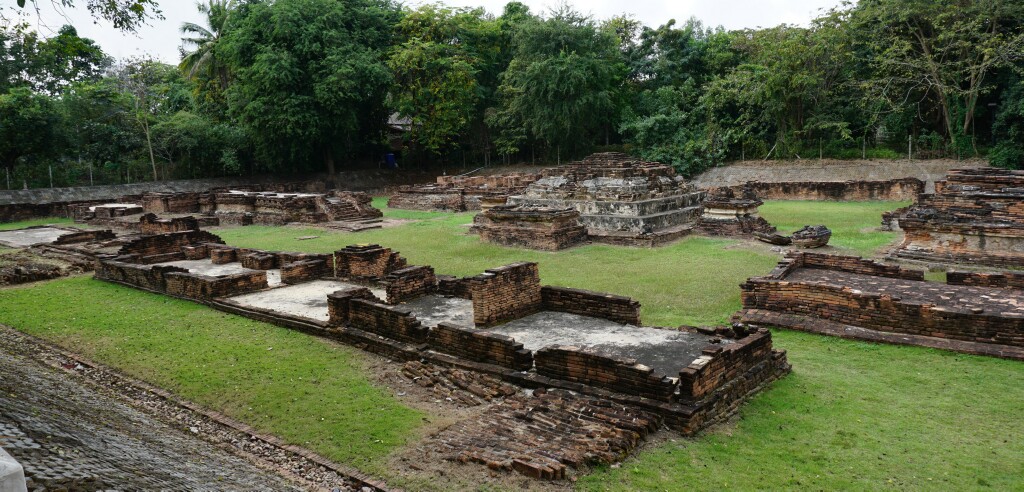
Wat Nanchang Overview

Wat Nanchang Detail
More obviously in the second picture you can see that the site is below ground outside the site with the sloping sides on the left and in the back of the picture. Most of the sites are below ground level, some much more than this. This temple is more complex than the previous with what appears to be at least two chedi and the foundations to several worship halls of varying sizes. The second picture shows the largest viharn foundation.
Wat E-Klang
Wat E-Klang is so called because, when discovered, the area around the site was inhabited by monkeys and in the northern Thai dialect, e-klang is monkey. This temple was one of the early excavations in 1984-1986, and then in 2003, evidence of a wall to the west of the chedi was discovered, so more excavation work is planned.
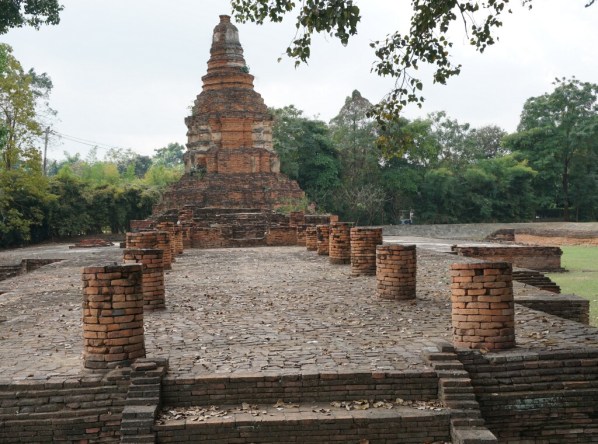
Wat E-Klang Viharn and Chedi
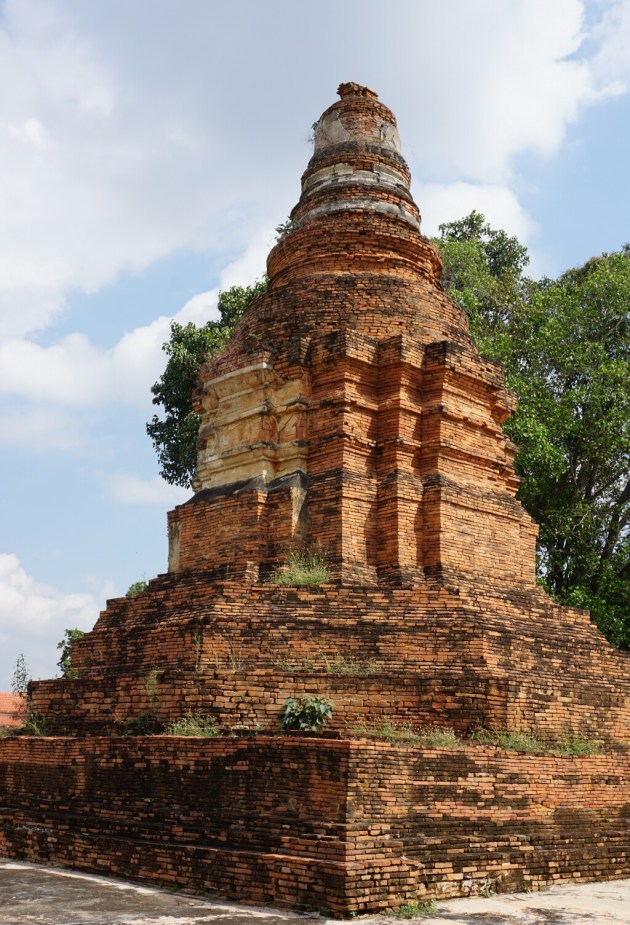
Wat E-Klang Chedi Detail
Wat Chang Kam
Wat Chang Kam was excavated in 2002-2003 and is slightly unusual because the viharn entrance points north instead of east to greet the rising sun. Almost all viharn at Buddhist temples open to the east, a very, very high percentage, maybe 99% or higher (of all the existing temples I have visited, I only know of two that do not open to the east). It is believed that the viharn opened to the north because of the importance of the Ping River which was to the north.
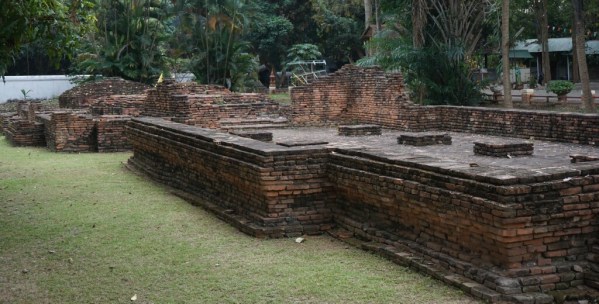
Wat Chang Kam
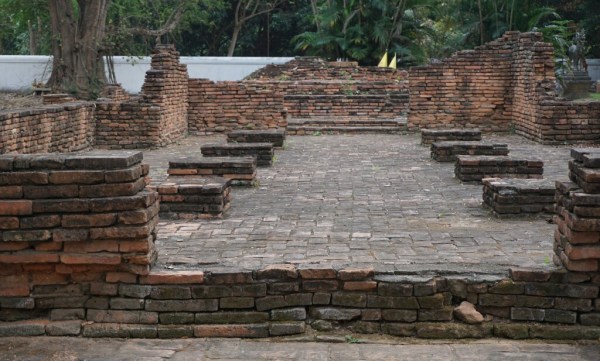
Wat Chang Kam Viharn
Adjacent to Wat Chang Kam is a modern temple, adding to the evidence that people continued to live in this area. (I did not get the name of this relatively modern temple.)
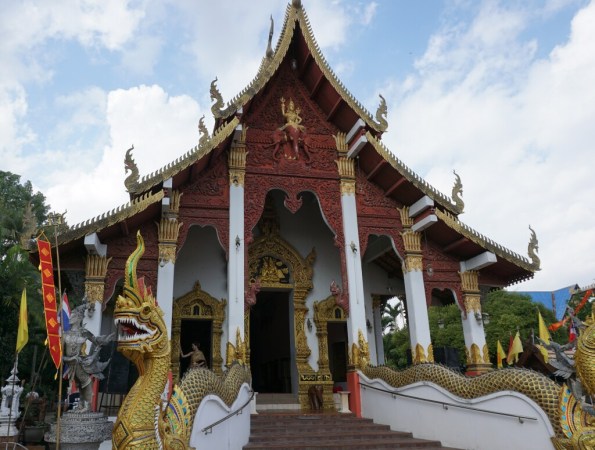
Modern Temple Viharn by Wat Chang Kam
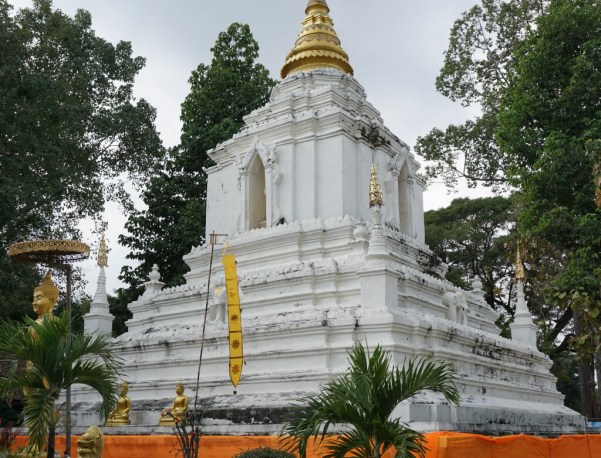
Modern Chedi by Wat Chang Kam
Wat Kam Thom
Another of the sites, but one for which I have little detail. The ruins of the viharn show a more complex structure with multiple levels and many steps.
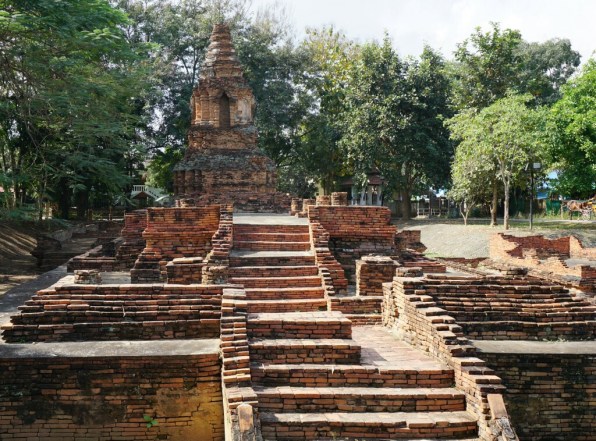
Wat Kam Thom Viharn Foundation
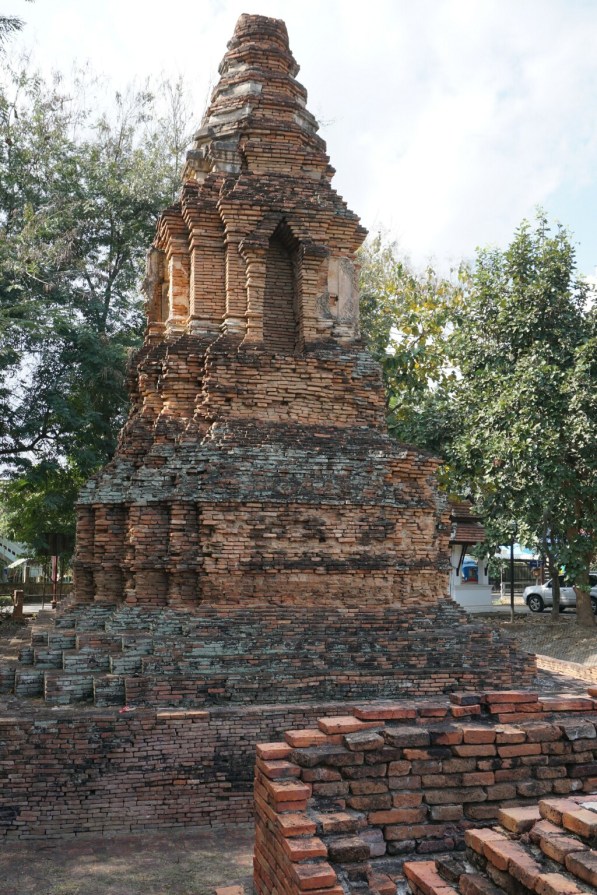
Wat Kam Thom Chedi
Unknown Solitary Chedi
This chedi is unusual in appearance with its rather massive foundation and base. There are no other structures at this site. I’m sure it has a name, I may try to find it.

Solitary Chedi with massive base
Neighborhood Sites
Some of the Wiang Kum Kam sites are in neighborhoods right by people’s homes and businesses. I am hoping that in the excavations, people were not displaced from their homes. Here are a two examples of neighborhood sites in which the adjacent homes can be seen:
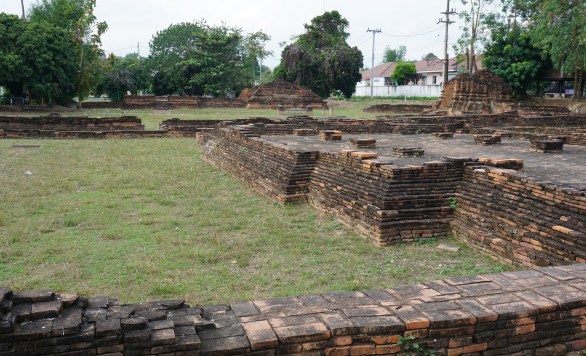
Neighborhood Site A
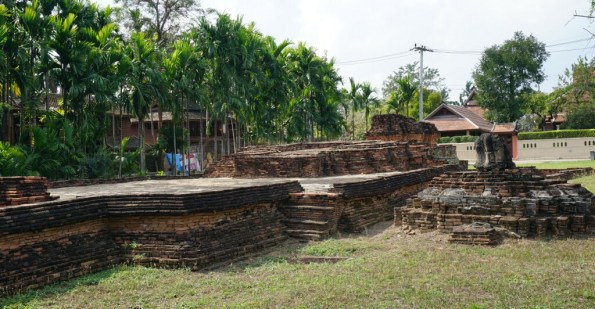
Neighborhood Site B
Wiang Kum Kam is far more expansive than I knew. Today was another peak into the rich history of Chiang Mai. It would be fun to explore Wiang Kum Kam systematically and understand more. Unfortunately, I have only two weeks remaining in Chiang Mai and far too much to do in that time.
Next: West side of the wall/moat and a return to Wat Lok Molee

 James the Intrepid Pilgrim