Wednesday 10 January, 2018
Hiking up through the jungle to Wat Phalad
Wat Phalad (sometimes spelled Wat Pha Lat or Wat Palad, the formal name is Wat Skadagamiwanaram) is a peaceful temple in the jungle a little less than half way up the mountain to the famous Wat Phra That Doi Suthep. I will go up to Wat Phra That Doi Suthep another day and share pictures. But in the jungle, near the main road leading up the mountain is Wat Phalad. Tourists seldom stop here, and there is a hiking trail starting a little farther out from Chiang Mai University. The trailhead is near the back entrance to the Chiang Mai Zoo, and near Wat Fai Hin.
It is a longer story, but when the special relic was being placed into the chedi at Wat Suan Dok, the relic split into two pieces. One was placed in the chedi at Wat Suan Dok, and the other was placed on the back of a white elephant (white elephants are actually reddish brown, not the normal gray elephant color), and it was decreed that wherever the elephant stopped, a chedi and temple would be built to house the second half of the relic. Being followed by the king and his army on horseback, the elephant went almost all the way up the mountain now known as Doi Suthep, and near the top, stopped, trumpeted three times, sat down and died. That is where Wat Phra That Doi Suthep is to this day, and it is a very special temple, being a Royal Temple of the Second Class. This story is well-known. What is not as well-known is that at the waterfall/creek where Wat Phalad is today, the elephant slipped, stopped briefly, and then continued up the mountain. A temple was built at the location, now known as Wat Phalad. The nickname may have been derived from the Thai pha-lert which means to slip and fall…pha-lert can become phalad.
And a second fact about Wat Phalad is that after being exiled from Vietnam, the well-known Buddhist monk Thich Nhat Hanh lived at Wat Phalad in the late 1960s and early 1970 for possibly up to four years. (He is currently living at Plum Village Thailand, recovering from his stroke of three years ago.)
Wat Phalad is a very special place, peaceful, serene, with just the jungle noises and sometimes the waterfall noise in the background. A very good place for a peaceful meditation, something I have done many times. Although not far from the main highway to Wat Phra That Doi Suthep, the noise of the highway is not heard.
Lunch at Goodsouls
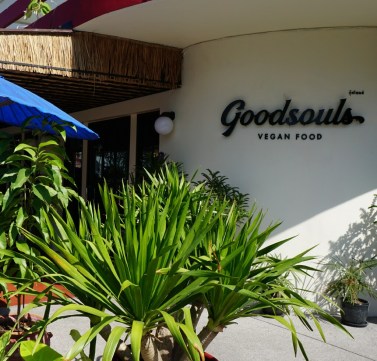
Before Tom and I headed up to the trail head, we stopped at Goodsouls Cafe for lunch. Goodsouls is a vegan restaurant and the quality of the food is quite good. Tom had pumpkin soup with red curry, brown rice and a hot ginger tea, and I had pineapple fried rice with vegetables. Everything we have had at Goodsouls has been excellent. But there is no shortage of very good food in Chiang Mai as I have found in the past.


Hiking up to Wat Palad
We arrived at the trailhead for the hike up to Wat Phalad.
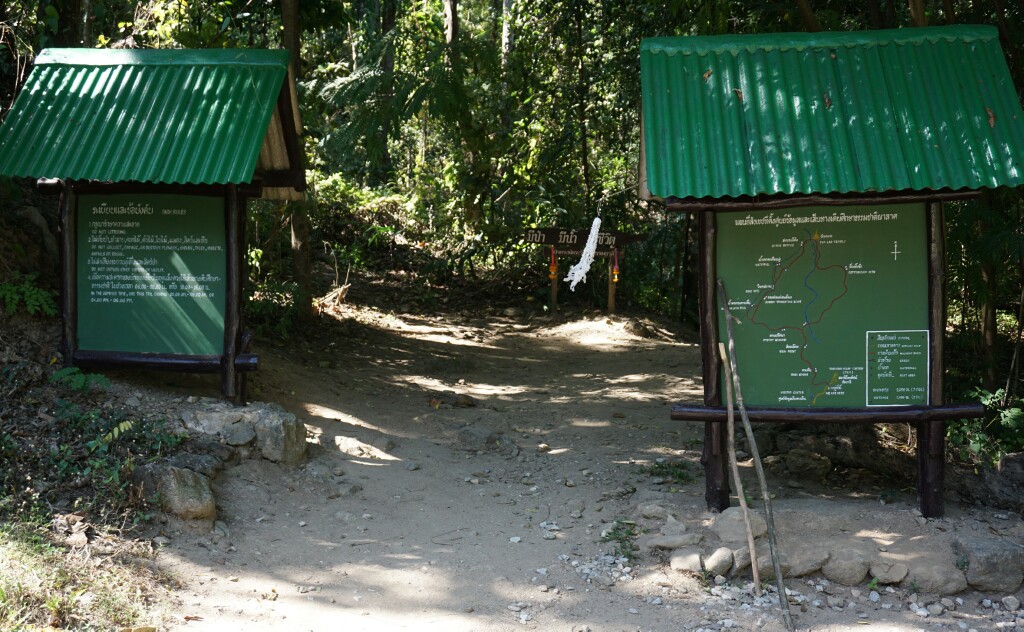
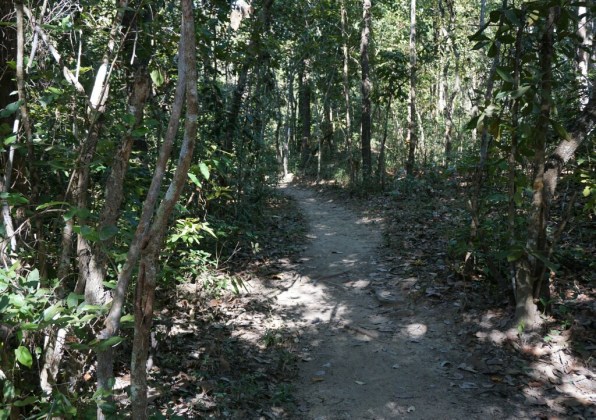
This is start. It is a little less than 3 kilometers (2 miles) up to Wat Phalad from here. And because of the wetter-than-usual winter so far, the jungle/forest is greener and more lush than in previous years. Here are a couple of views of the hike through the jungle:


In the last picture, you can see the creek alongside the trail. Although not always visible, we heard water running almost all of the hike up to Wat Phalad.
Wat Phalad
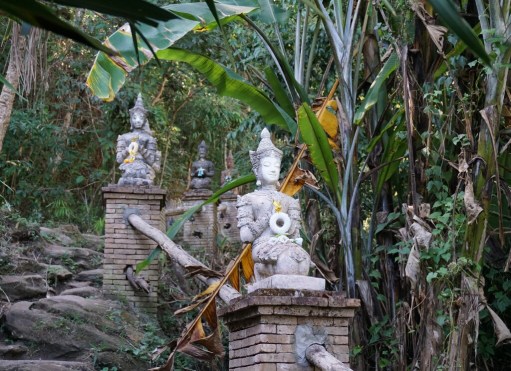
And finally, we were at the final section, the path lined by the Thewada (angelic beings who live in the heavenly realms):
Almost the first things to see (and cross) is the creek, and just before it spilled over the rocks, there is a large pool, larger than I have ever seen because of the recent rains:
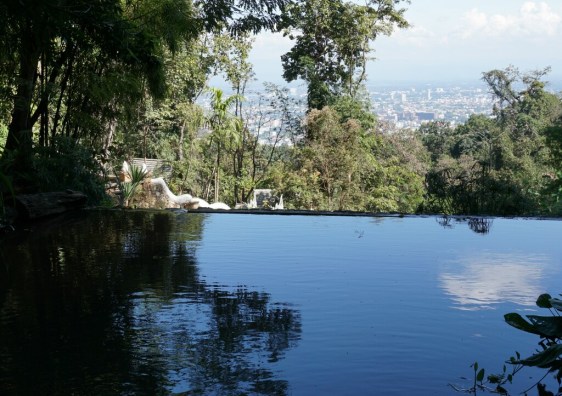
In the distance Chiang Mai is visible. Chiang Mai is almost always hazy because it is a city in a valley surrounded by mountains. There are several viharn (worship halls) at Wat Phalad. One of the first is this one that is always closed, but has very colorful, almost playful-like doors:


Someday I’ll get to see inside, but for now, I’ll just enjoy the artistry of the outside.
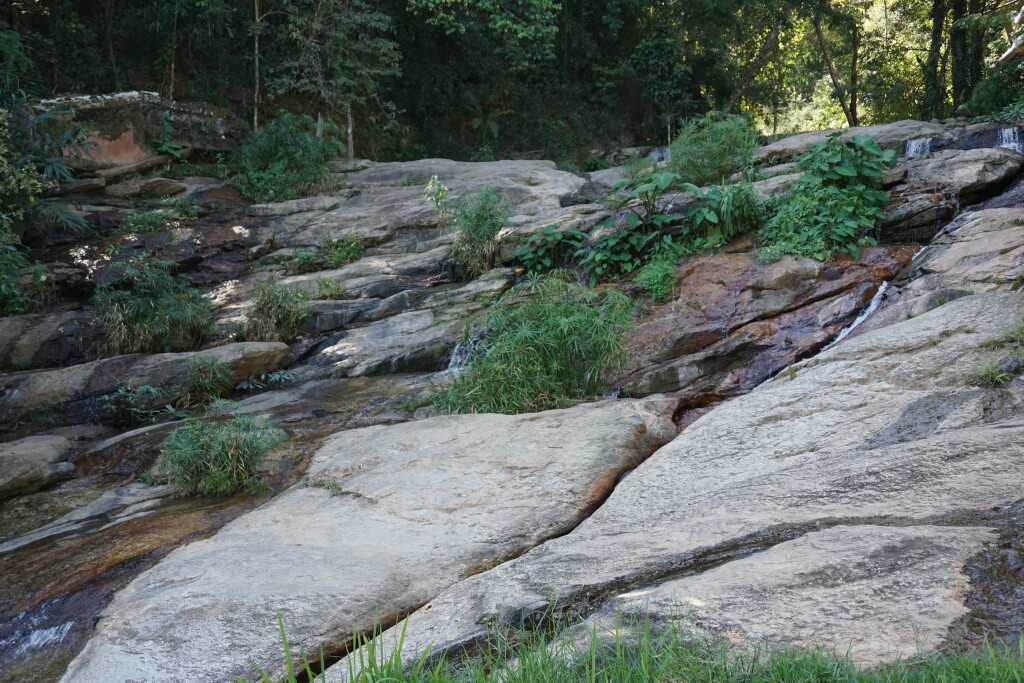
At the lower part of Wat Phalad, one sees these rocks where when it is even more rainy, the water rushes over.
Then it is up the stairway guarded by two giant Singhs:

At the top of the stairway is the main part of the temple grounds. There are several other viharn to see, three of them with open sides, here is one. Notice there are no sides to the structure, and two tree trunks are right there in the hall:


Here is another open-sided viharn a little higher up the hill than the previous: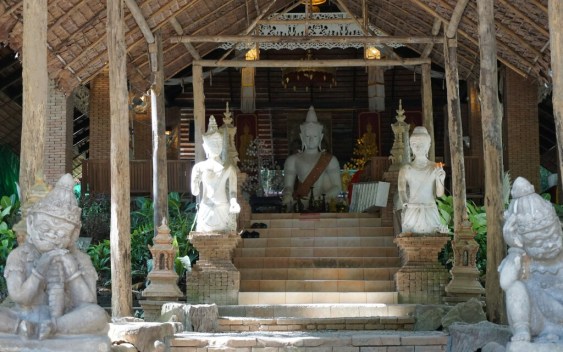
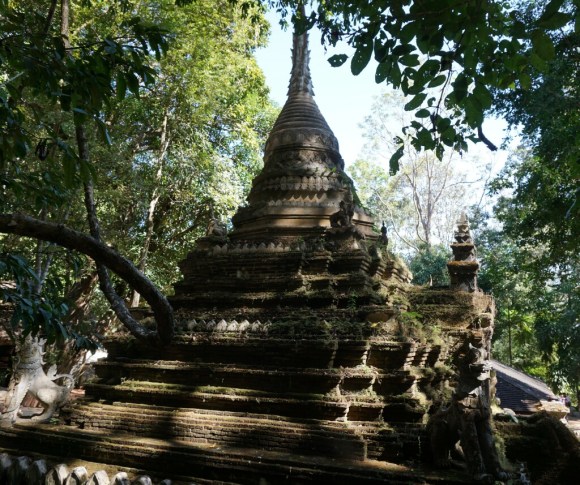
And there is this very old chedi, very rustic-looking, and probably in need of a serious cleaning or restoration:
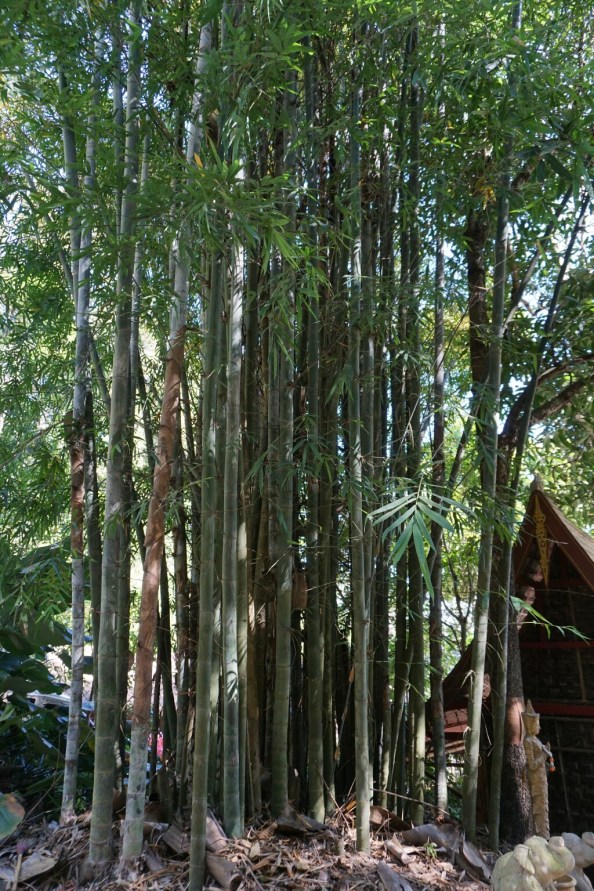
I also noticed a few stands of what I call giant-bamboo. The stalks are almost as big as a human leg. Very large bamboo:
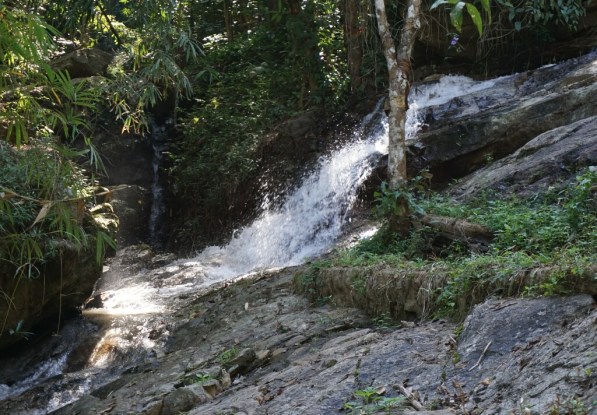
Then I wandered over to one of the waterfalls. The water is really coming down today, and the sound is very nice.
Then we headed down the hiking trail, back to civilization after a brief respite from the hustle and bustle of the city. Although Chiang Mai is a less-intense and much more peaceful city than Bangkok or Los Angeles, it is a city with more than 1.5 million people, so while relatively peaceful, it is a busy city. Down the hill we went, through the jungle, our last bit of quiet with just the jungle noises and sounds of the water nearby.
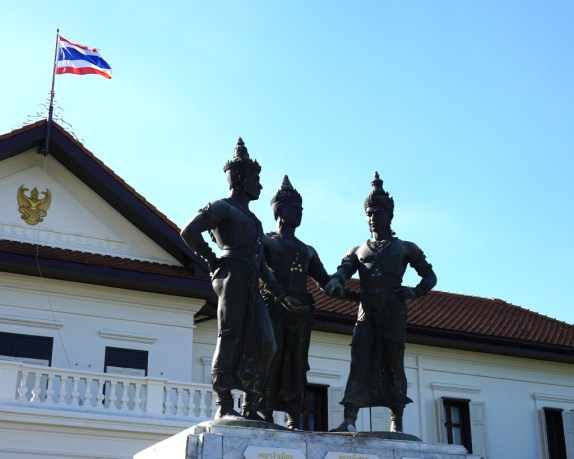
Tom was headed back to Doi Saket and dropped me near Wat Phra Singh to walk the rest of the way back to 3-Sis. On the way, I passed the Three Kings Monument. This monument commemorates the alliance forged between by King Mengrai of Chiang Mai, King Ngam Meuang of Phayao, and King Khun Ramkhamhaeng of Sukhothai in the founding of the city. It is a little difficult to see detail because of the angle of the sun, but the figures are each more than 3 meters (10 feet) tall.
Another good day in Chiang Mai
Next: visiting Wiang Kum Kam, the predecessor to the current city of Chiang Mai.

 James the Intrepid Pilgrim
Excellent post, excellent photos
LikeLike