Saturday January 6, 2018
First Walk Around the Wall/Moat
Chiang Mai was built starting in 1296 as a walled city, also with a moat around it. The earth excavated from the moat was used as the foundation for the wall, ultimately covered in brick. Some, less than half, of the wall still exists, and almost all of the moat still exists. The wall is approximately square, about 1.5 kilometers on a side or about one mile square. Inside the wall/moat are about 50 temples. Chiang Mai is deep in Buddhist history. Many of the temples are smaller, local or neighborhood temples, and a few are larger, more important temples, like Wat Chedi Luang (with the City Pillar Shrine) and Wat Phra Singh (a temple of the Royal First Class). Note: There are about 34,000 Buddhist temples in use in Thailand, and less than 300 are considered Royal temples.
When I was walking the Camino de Santiago, it became a fairly easy part of my routine to review my daily photographs while resting in the afternoon, then select some that represented the day, and make a blog post in the evening after dinner based on the pictures I selected. In Chiang Mai, I do not have as well-defined or as simple a routine as I had on the Camino de Santiago. My days start similarly, with a morning meditation at the foot of the large chedi across the street at Wat Chedi Luang, then breakfast, and then a yoga session at Wild Rose Yoga. After yoga, I typically have lunch with my Australian friend Tom, and then go back to my room to clean up and prepare for the afternoon or evening events. In previous years, the morning yoga was earlier, and I spent the time in the mid-to-late morning walking around, visiting temples, and photographing the city, the markets, and the temples. This year, when I am done with lunch, it is hot and humid outside, and walking around in the sun, heat, and humidity is not appealing. And, the last week has been noticeably more humid than in past years – very sweaty weather. So all that combined has resulted in fewer blog posts. My intention is to break that pattern and get back to sharing my time here in Chiang Mai.
Katam Corner
So with that in mind, I took an afternoon walk with one of my cameras around part of the wall and moat, starting at Tha Phae Gate (shown in a prior post) on the east side of the wall, and heading south and then west. Here is a view approaching the Katam Corner, the southeast corner of the wall:
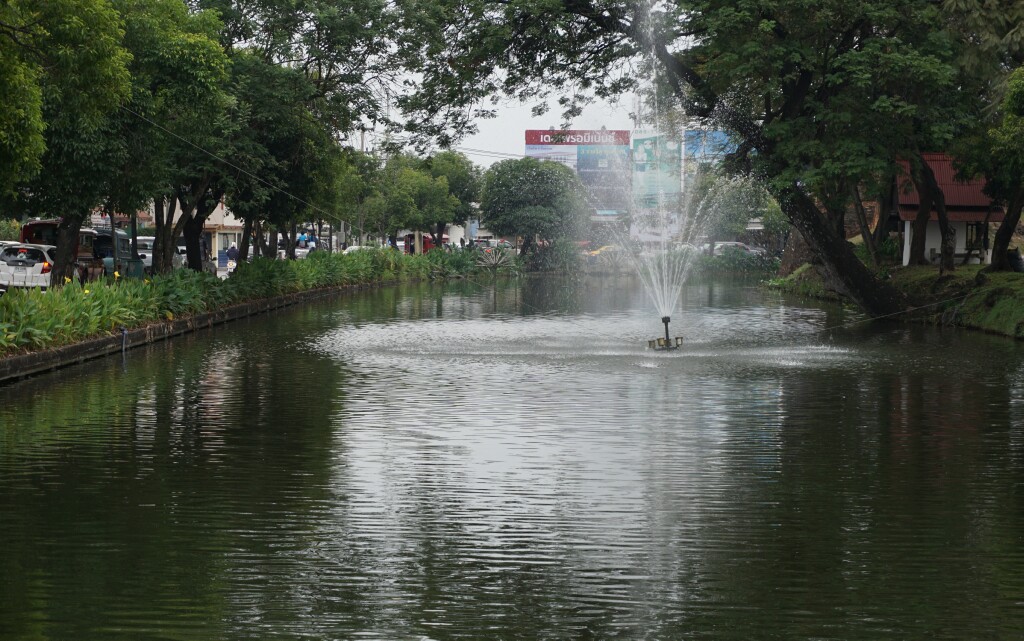
There are two roads along the wall/moat, the outer moat road is one-way going clockwise around the wall/moat, and the inner moat road runs counter-clockwise. Both are always very busy, and in the picture you can see cars on the left on the outer road.
Then I got to Katam Corner. In earlier times, water flowed in the moat, entering the moat at Hua Lin Corner, the northwest corner, flowing south and east from there, finally exiting at the southeast corner, Katam Corner. Fish would be caught as the water flowed out of the moat and into a creek using a bamboo trap, called a katam. From that the name of the corner evolved, Katam Corner. Here are a couple of views of the actual corner of the wall:


Chiang Mai Gate
Walking around Katam corner, and going west, after a few hundred meters I come to Chiang Mai Gate, the main gate on the south of the wall. Chiang Mai Gate is probably the busiest of the five gates – always a lot of traffic here. Chiang Mai Gate was historically the most used gate by the people in the city. Here are views of the sides of the gate.


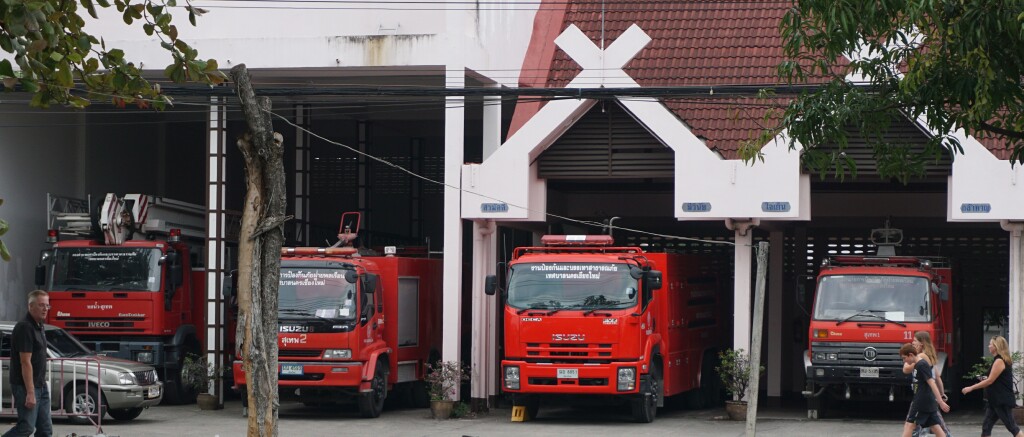
I continued walking west and noticed a fire station. It is not new, but I never noticed it before. The trucks are red and ready to go. Not a very close view, because I am on the other side of the moat, and this is the closest I could get with the camera lenses I brought with me.
Saen Prung Gate
Continuing west, I came upon the second gate in the south part of the wall, Saen Prung Gate (sometimes spelled Suan Prung Gate). This gate is not as heavily used; some Thai people avoid it because of superstitions that there are bad demons here. The source of these superstitions is that historically, cadavers were brought out of the old city through Saen Prung Gate for cremation. Saen Prung Gate looks like the other gates to me, structurally the same as Chiang Mai Gate:


Wat Puak Hom
I went inside the old city at Saen Prung Gate, something I have never done before to see what is inside the southwest part of the old city, a section I seldom have a reason to which to go. Walking from Saen Prung Gate up Samlarn Road that eventually goes to Wat Phra Singh, I came across Wat Puak Hom, a very charming local neighborhood temple with a large, very old chedi:


I headed back to my home away from home, The 3-Sis Guest house. Here is the entrance, a little crowded by motorbike parking:
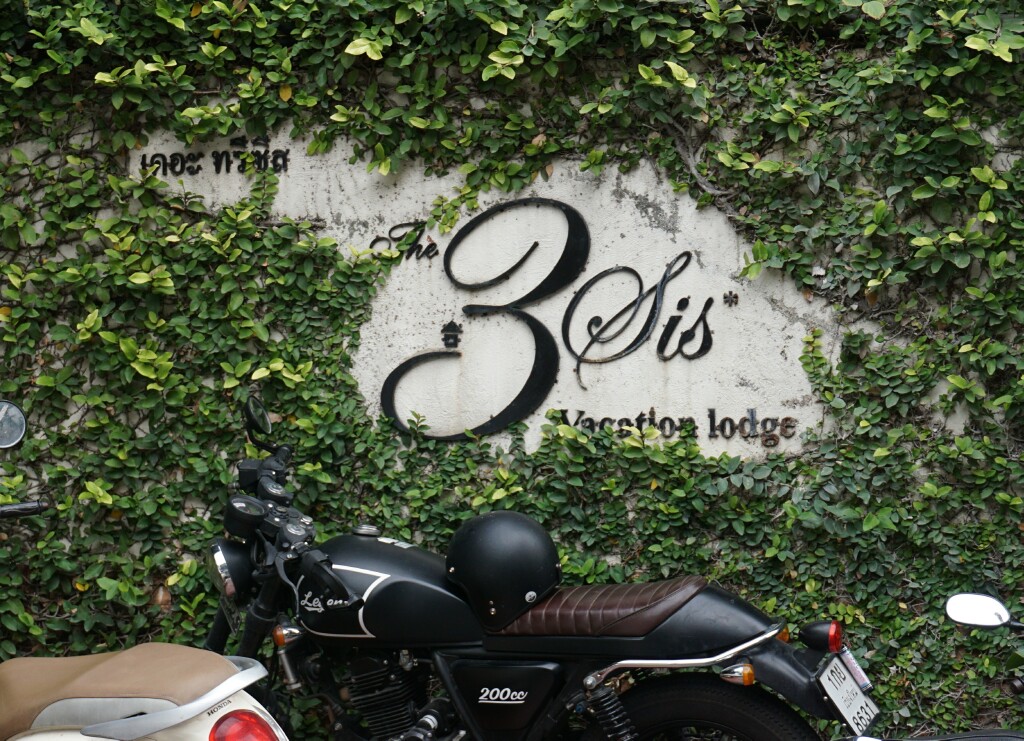
The ivy is encroaching on the sign a little more each year.
A good, but a bit humid and sweaty day in Chiang Mai.

 James the Intrepid Pilgrim
Happy New Year, Jim! I hope that you have fabulous adventures in Chiang Mai during your 2018 stay.
LikeLike