New Year’s Eve
Sunday, 31 December 2017
Today was my first full day in Chiang Mai. And it is New Year’s Eve. There is much celebration as the tourists and Thai people prepare for and start their new year’s celebrations and events both inside and outside the old city.
The word “Chiang” in the city name historically meant “walled city.” In the thirteenth century, King Mengrai built a walled city to the north called Chiang Rai. Unfortunately, it was close to Burma, and there were many battles with the Burmese people. So King Mengrai and his two friends, King Ngam Meuang of Phayao and King Khun Ramkhamhaeng of Sukhothai formed an alliance and together built the new walled city in the late thirteenth century. The word “mai” in Thai means “new” so properly translated, Chiang Mai is the New Walled City. They also build a moat around the wall. Most of the moat and much of the wall still exist. The wall/moat makes a square approximately 1.5 kilometers on a side, or about 1 mile. The “old city” refers to things inside the moat.
This is also Sunday, so the Sunday Night Market, also known as “Walking Street, Chiang Mai” will be in full force tonight. The Walking Street is inside the old city of Chiang Mai along two main streets which are closed to traffic allowing people to freely walk peruse things for sale and stop at mini food courts. Everything for sale at the Sunday Night Market must be made in Thailand or by the people selling. It is “controlled” compared with the Night Bazaar, outside the moat closer to the river where there is essentially no control and many knock-off goods from China can be found. About half the people at Walking Street Chiang Mai are Thai people. No alcohol or smoking are allowed, and it is strictly enforced, making it very much a family-oriented event.
My first agenda item of the day was to start slipping into a morning routine of sorts. The general idea is to start the day with a meditation at the base of the large chedi (pagoda) at Wat Chedi Luang across the street from the guest house in which I stay, The 3-Sis Guest House, so named because it is owned by three sisters. One of the sisters, Poppy, runs the guest house and adjoining restaurant daily. Then breakfast in the restaurant followed by 10:00 yoga down the street (about 0.5 kilometers) at Wild Rose Yoga. After yoga, either a walk and/or things to do in the old city, or lunch. Then work (I am working half-time in my job as a computer system administrator while I am here), and in the evening dinner.
Today I shall walk around the old city a bit to see some of my favorite places and see the preparations for New Year’s Eve. In most Asian countries, New Year’s is celebrated far more exuberantly than in the States. The celebration in Chiang Mai is larger than our Fourth of July celebrations combined with New Year’s.
First stop on my walk was the temple named Wat Chiang Man, the temple built by King Mengrai for his daily worship as he oversaw the construction of the city. The two viharn (worship halls) are nice, but of more interest is the chedi at the back of the main viharn. This is where King Mengrai’s ashes are interred.


After a walk north towards the wall and moat, I found myself at the northern gate, Chang Phuak Gate. “Chang Phuak” translates approximately to “white elephant”. The word Chang (pronounced like chong) means elephant, and the word Phuak translates to ivory. However, in Thai, when something is not its normal color, it would be called phuak. White elephants are not white or ivory-colored, they are really a reddish-brown color, not the normal gray color of an elephant. Chang Phuak gate was where royalty entered on the back of elephants in the early days of Chiang Mai. Here is a view of Chang Phuak gate:
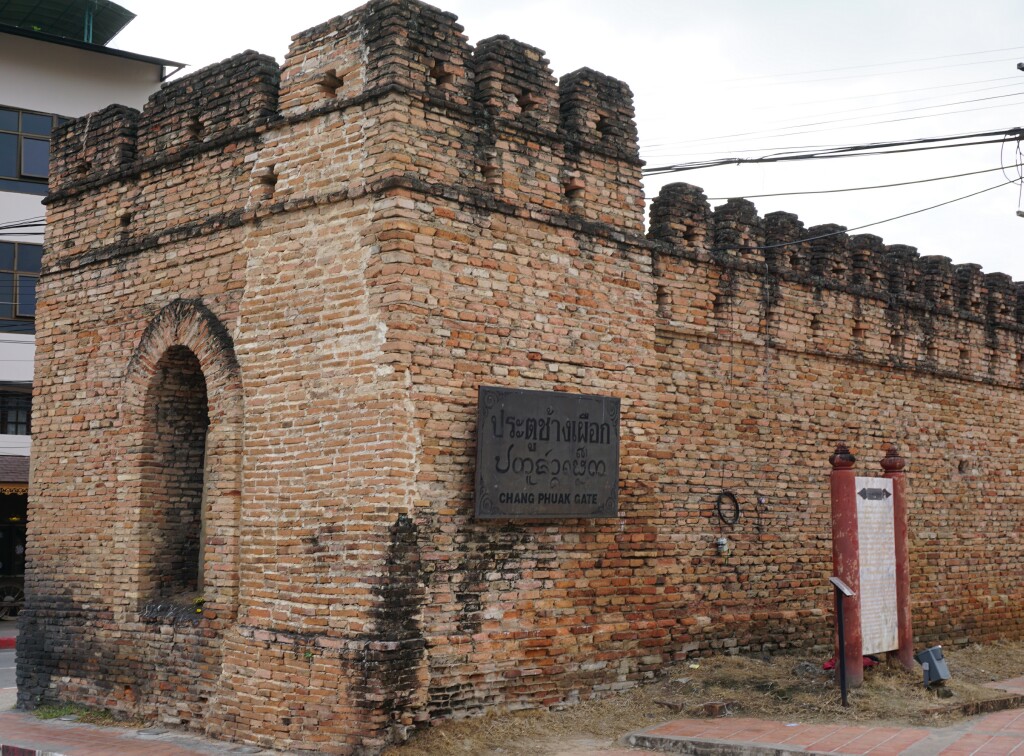
And here is a view of the moat looking west from Chan Phuak Gate:
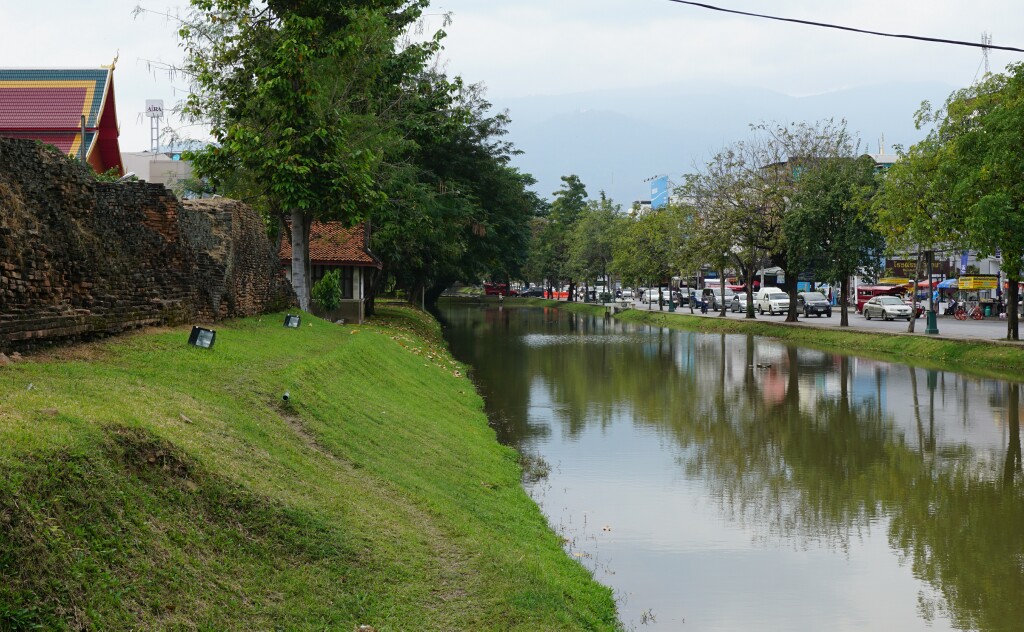
Part of the wall can be seen of the left of the picture. I continued walking along the moat to the west and finally got to Wat Lok Molee, another favorite temple of mine. Almost all temples in Thailand have a very standard layout. The main viharn (worship hall) doors open to the east to greet the rising sun. The rising sun also represents birth, and the setting sun death. In back of the main viharn, on the setting sun side, is a chedi (pagoda) in which someone important’s ashes are interred. Then there are also other buildings, secondary (or more) viharn, possibly an ubosot (ordinance hall), and maybe a second chedi, depending on the size and importance of the temple. At Wat Lok Molee, the main viharn’s doors open to the south, one of only two I know of that does not follow the basic layout. After much research and asking many people, I still do not know why this temple is oriented differently. The newer viharn at Wat Lok Molee points east.
Here is the entrance to Wat Lok Molee as I look from the south directly north across the street. The first photo is the entrance to the temple grounds, and the second the entrance to the main viharn.
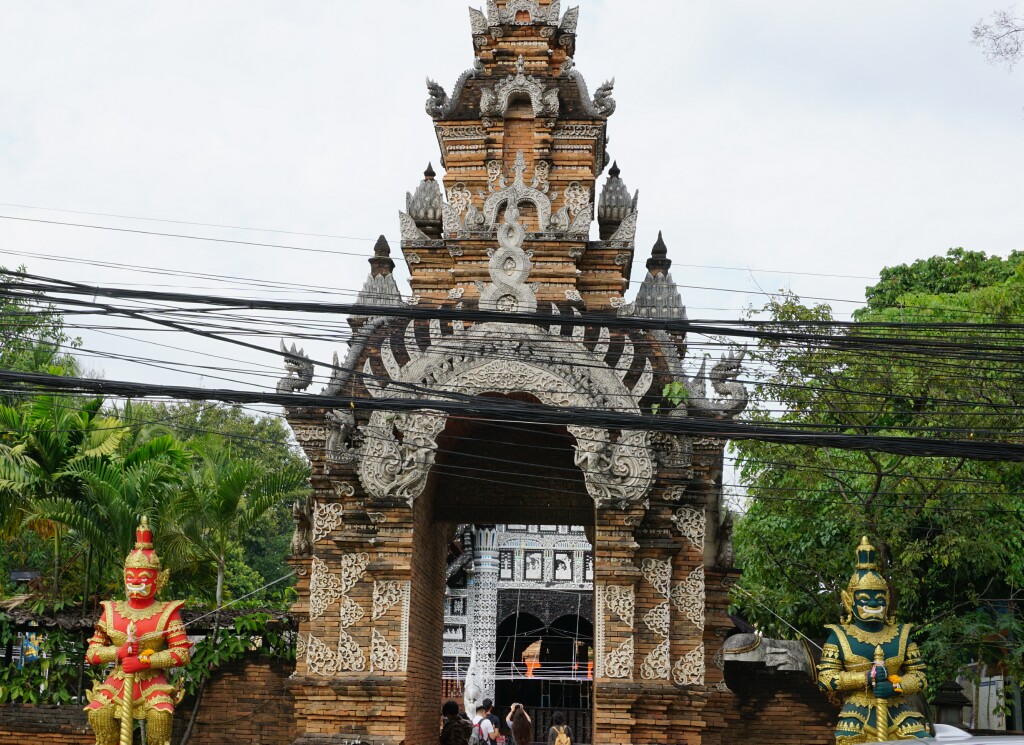
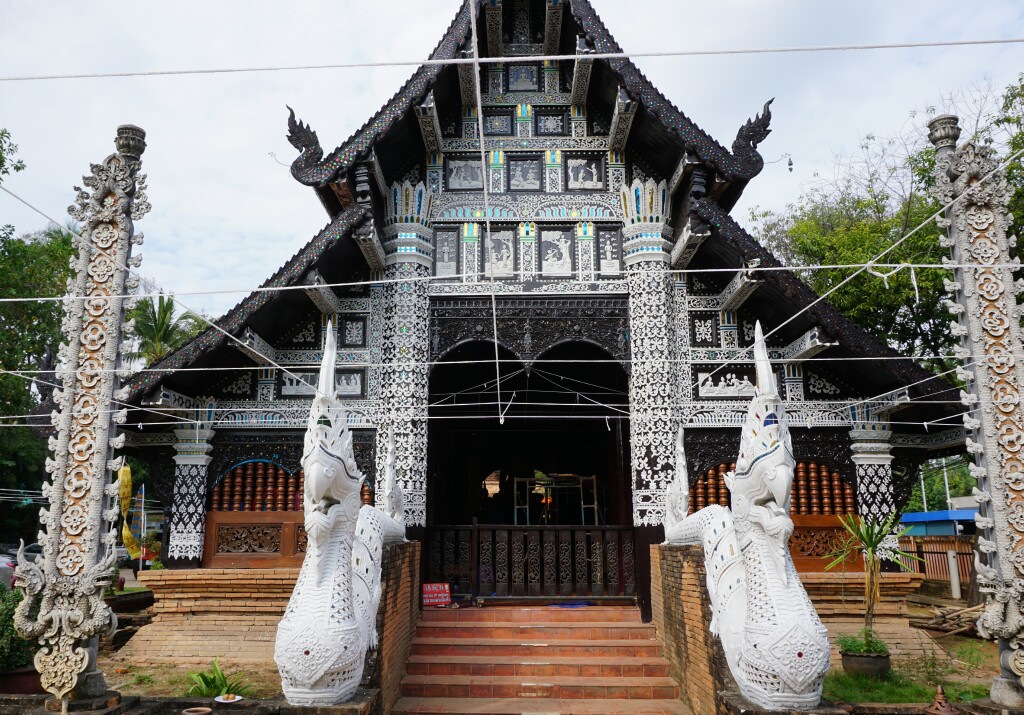
The main viharn is undergoing a cleaning and/or restoration and is currently close. A bit of scaffolding can be seen just inside the door.
The main chedi at the north of the viharn is where King Mengrai’s family’s ashes are interred.

The chedi is very tall, and very old, having been built in about 1527. Here is some detail of part of the chedi:

Walking east I got to Sri Phum corner at the northeast corner of the moat.

And walking south, I got to the Tha Phae Gate on the east side of the wall/moat. Tha Phae Gate translates to “raft landing” gate, but there is no raft landing here, and no river on which a raft would be used. The story of the name is on a plaque just outside the gate, and while easily accessible, most Thai people do not know the story, and most Thai people also do not know that there was a second, earthen wall closer to the Mae Ping River. Here is the story:

And here is Tha Phae Gate:

From Tha Phae Gate, it is a short walk to the 3-Sis. I went across the street to Wat Chedi Luang to get a couple pictures. The first is the old chedi. This was built in about the 1460s, and at 82 meters high and a base of 54 meters, it was the largest structure in all of Lanna (the country making up most of northern Thailand until is merged with Siam to become Thailand in the 1800s) for a few hundred years. In 1545 the top 30 meters collapsed after an earthquake, and most of the elephant statues around the base were destroyed. There is no documentation of what the top of the chedi looked like, and to restore it improperly would be to bring it great dishonor, so it is left as is.

Here s a view from the bench at which I do my morning meditation. From this view the remaining elephant statues round the chedi can be seen.
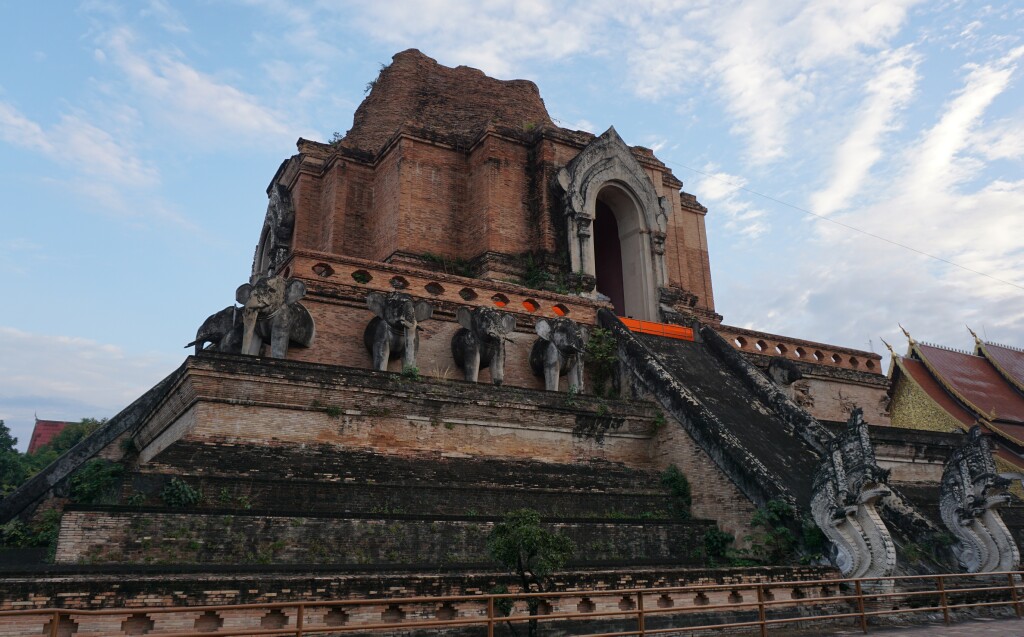
sitting here and doing a meditation in the presence of this great structure is a very good way to start the day in Chiang Mai.
Next: the lanterns of New Year’s celebration

 James the Intrepid Pilgrim