Thursday 28 December 2017
The journey from Los Angeles to Bangkok:
On my travel to Chiang Mai, Thailand, I am spending two nights including one full day in Bangkok to recover from the long travel day and enjoy a few of my favorite sights in Bangkok. Bangkok is a large and almost chaotic city with twice as many people as Los Angeles in a space the size of Los Angeles. It is winter in Thailand now, and even so, the afternoons in Bangkok will be almost 90 degrees Fahrenheit with humidity in the 80% or more range. Being outside for long can feel oppressive. Fortunately for me, Chiang Mai, being up in the hills of northern Thailand, is very slightly cooler and the humidity is about 15% or more lower than in Bangkok.
The journey to Bangkok was over two flights on Korean Air. The first (KE012 on an airbus A380-800) was 12 1/2 hours from Los Angeles to Incheon (the airport for Seoul, S.Korea) and then after an almost three hour layover, a 5 1/2 hour flight (KE657 on a Boeing 747-400) from Incheon to Suvarnabhumi Airport, Bangkok’s new international airport since 2006. After almost a whole day of travel, and sleepless flights, I was tired and ready for some downtime. The Bangkok airport was busy, a little busier than I have seen in years past, but I got through the long lines at immigration and on to baggage claim just as my bags were arriving on the carousel. Then the long walk to the Airport Rail Link for a 45-minute train ride into town (cost 45 Thai Baht or about $1.50) to the BKS Skytrain Paya Thai stop, and then just a few stops on the Skytrain to the Chit Lom stop (cost 25 Thai Baht or 85 cents) at the Intercontinental hotel where I shall be for almost two days. The first late afternoon and evening was one of recovery – a shower, change of clothes, a walk to the Siam Parragon for dinner, and attempt at sleep to start the adjustment to Thailand time, 15 hours ahead of Pacific Time.
Friday 29 December 2017
A Full Day in Bangkok
Though tired and not fully adjusted to Thailand time, I am planning a full day today in Bangkok. On my list is to have breakfast at the Intercontinental’s elaborate breakfast buffet, then visit Wat Arun, visit the Reclining Buddha at Wat Pho, visit the Jim Thompson House, and then have dinner.
First on my agenda is breakfast. The breakfast buffet at the Intercontinental is a large, extensive, multinational breakfast buffet.
 I chose the familiar, very western breakfast dishes: orange juice, coffee, cold cereal, an omelette, bacon, fruit (watermelon, melon, dragon fruit), and pastry. This is pretty filling in itself, so while I could go back for more, I thing this is enough.
I may have a second cup of coffee — the Thai coffee is very good.
Wat Arun – Temple of the Rising Sun
After a bit of a cleanup, I headed out onto the Skytrain to the Saphan-Taksin stop by the Chao Phraya River. There, I bought a ticket for the Wat Arun dock and got on the boat, just me and a hundred or more tourists.
After rounding a corner in the river, Wat Arun appeared almost suddenly.
 Wat Arun has been undergoing a multi-year cleaning, and the towers have been partially or completely covered in scaffolding for my past three visits to Bangkok. The cleaning and restoration has been completed, and the scaffolding is now down, so the main tower at Wat Arun looks quite stunning in the morning sun.
Wat Arun is a campus, and my first stop is the main entrance with the giant yak guardians on either sides and the main viharn (worship hall).


Inside the main viharn (there are a few at Wat Arun), is this figure of what I think is that king Taksin who, after the former capital at Ayutthaya was overthrown by the Burmese, re-established the capital at what is now Bangkok. After seeing this temple at dawn, formerly called Wat Makok, he renamed it Wat Arun after the Hindu goddess of the rising sun, Arunya, and set about rebuilding and expanding the temple.
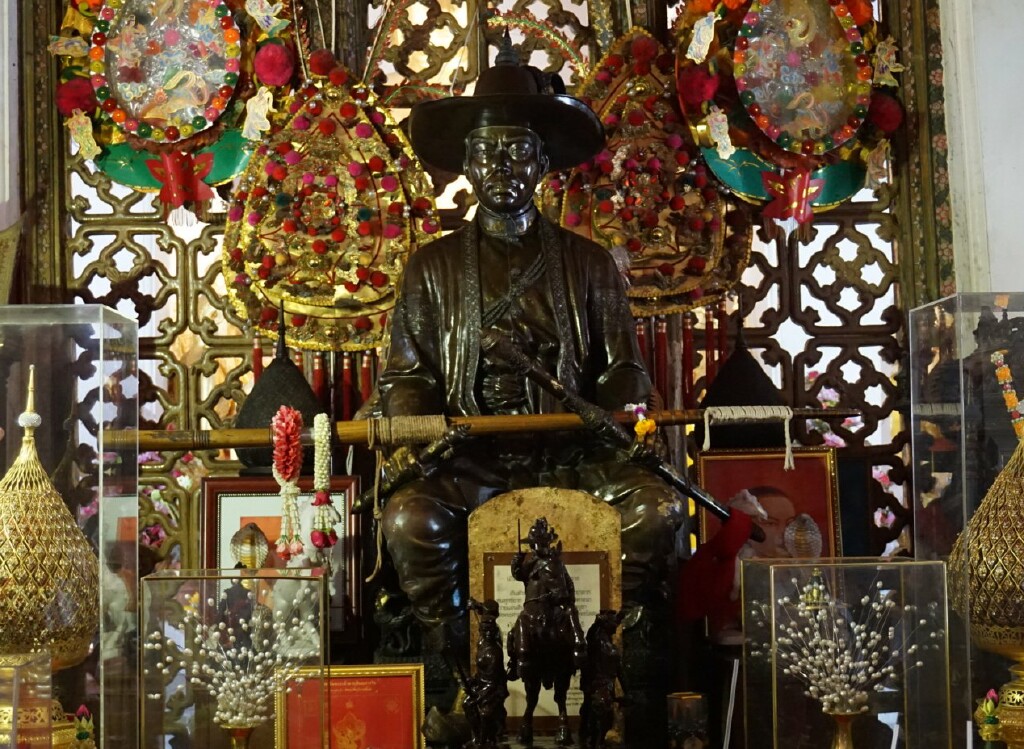
Wat Arun was the location of the palace during the rein of King Taksin, and also where the Emerald Buddha was housed until it was moved across the river to Wat Phra Kaew on the grounds of the current Royal Palace. The main feature of Wat Arun is the large central prang (Khmer-style tower) encrusted in colorful porcelain.
I shall not document all of the history of Wat Arun here, there is much available on the Internet. Suffice it to say, this is a beautiful temple, one of the landmarks of Bangkok. And, the remains of King Rama IX who passed away in October of 2016 shall be interred into the large chedi at Wat Arun. Here are a few photos of the towers at Wat Arun.


After walking around, taking in the ambiance, and climbing up onto the main tower (with very steep steps), I went back to the dock to take the ferry across the river to Wat Pho, where the large reclining Buddha is housed.
Wat Pho and the Reclining Buddha
As is true of most Thai Buddhist temples, they have a formal or official name, a short name, and sometimes a nickname. Wat Pho is known as the Temple of the Reclining Buddha, and its official name is Wat Phra Chetuphon Vimolmangklararm Rajwaramahaviharn. Wat Pho is first on the list of six temples in Thailand classed as the highest grade of the first-class royal temples. Wat Pho was built under the rein of King Rama I in the late 1800s. The most significant feature is the large Reclining Buddha, a 46 meter-long (155 feet) reclining Buddha statue. Every time I have been here, there are many, many tourists, but I still love standing near the large statue and taking in the history, the relevance, and the beauty of this relic. It is difficult to get a good picture, because of the structure’s support columns, but here are a few photos:
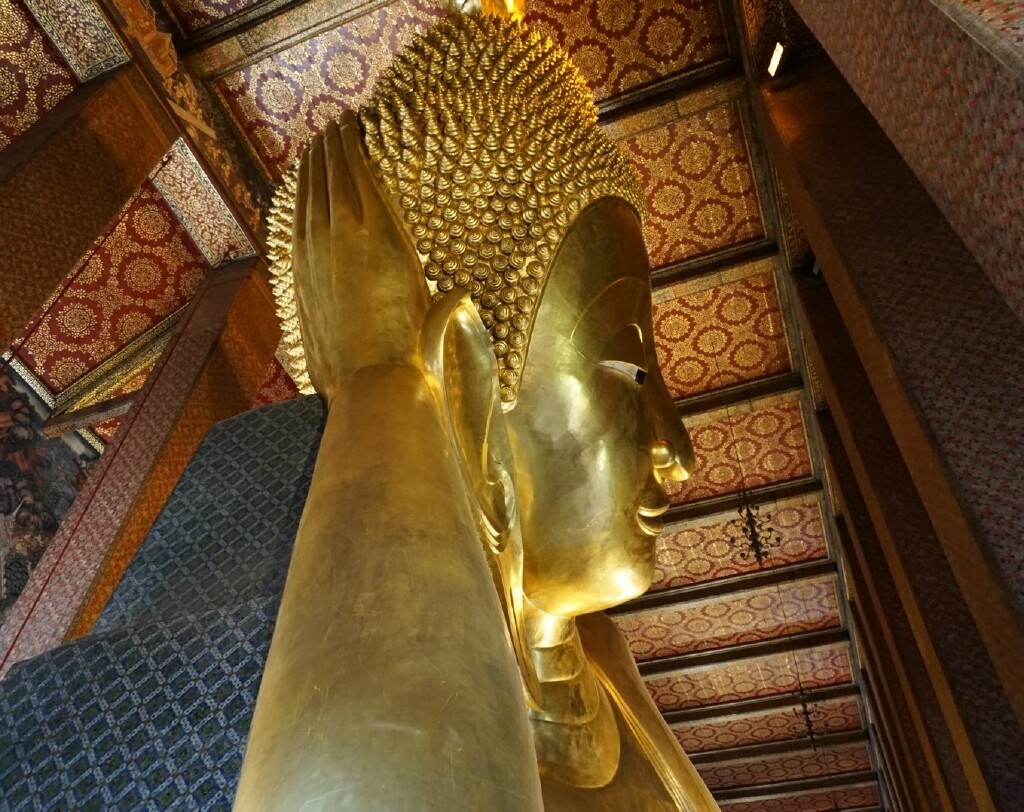
Looking up at the Reclining Buddha head.
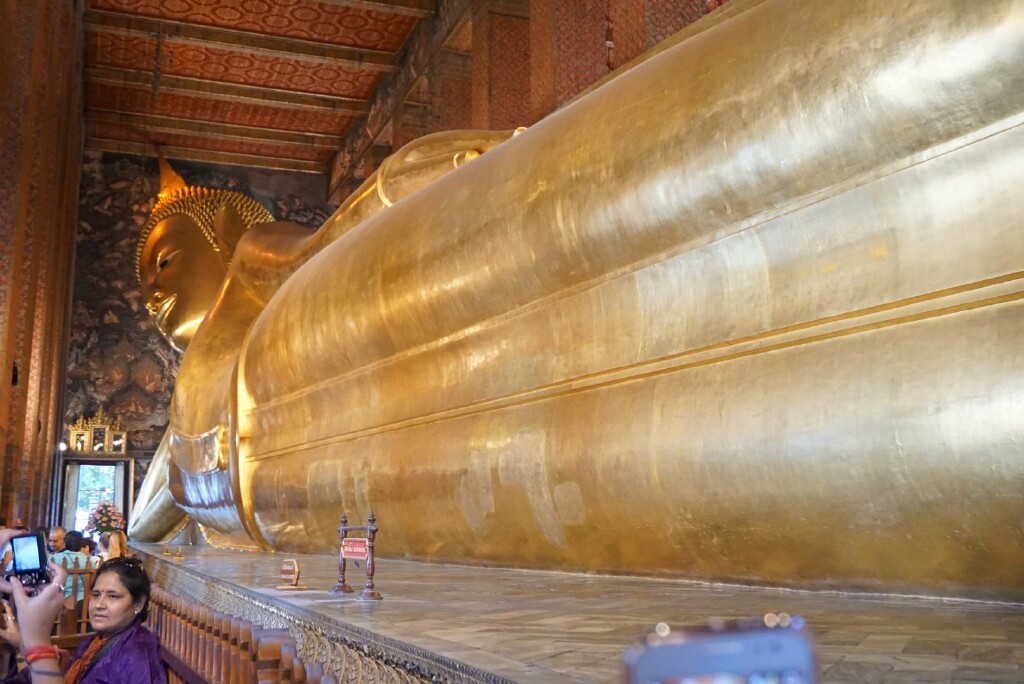
A view of the Reclining Buddha body and head.
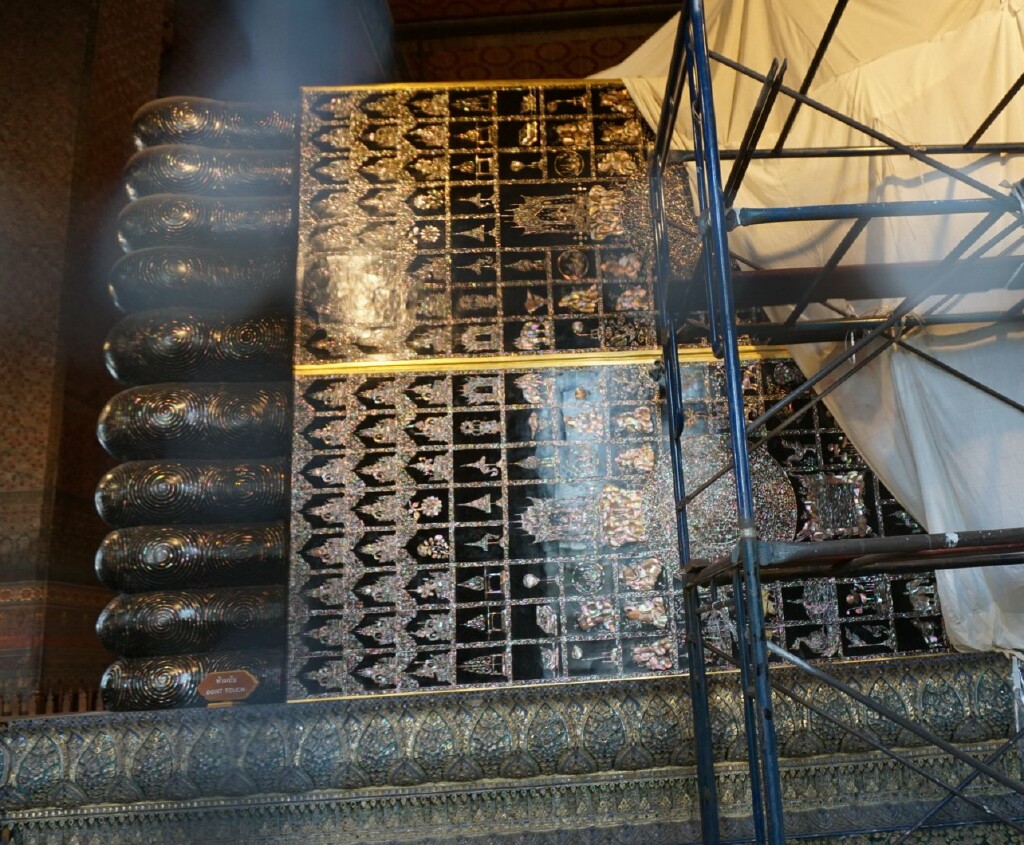
Bottom of the Reclining Buddha feet.
Next: Part 2 of A full Day in Bangkok

 James the Intrepid Pilgrim