04 October 2017
Walking Day 21:
23 Kilometers
30,737 steps
Yesterday I took a rest day in León. I even rested from my blog. While a rest day from walking on the Camino de Santiago, it was not a complete rest day. León is a historically rich and significant city, and while its population is only 140,000, its stature is that of a much larger city. There is history, culture, and museums all around – the city’s main Santa María de León Cathedral, also called The House of Light or the Pulchra Leonina is the key and most identifiable structure in the old city of León. There are other significant churches, and in history, there were as many as 15 fully functioning monasteries in León.
On my rest day, I spent a bit of time at the Basilica de San Isidoro, partly with Tom and Julie (my friends from Sydney, Australia). On the way to the Basilica de San Isidoro, we passed by the church of San Juan and San Pedro. This church was built in the mid-20th century in Neo-Renaissance style by the will of the local bishop, Luis Almarcha Hernandez. Its main artistical feature is the entrance gate, in Baroque style taken (moved) from the ruined monastery of San Pedro de Eslonza, located 22 kilometers outside León. It dates from 1711 and was designed by the architect Pedro Martínez de Cardeña.
 After a picture, we headed to the Basilica. We will cover this same route tomorrow morning as we resume walking on the Camino de Santiago, but the church and museum will not be open in the morning.
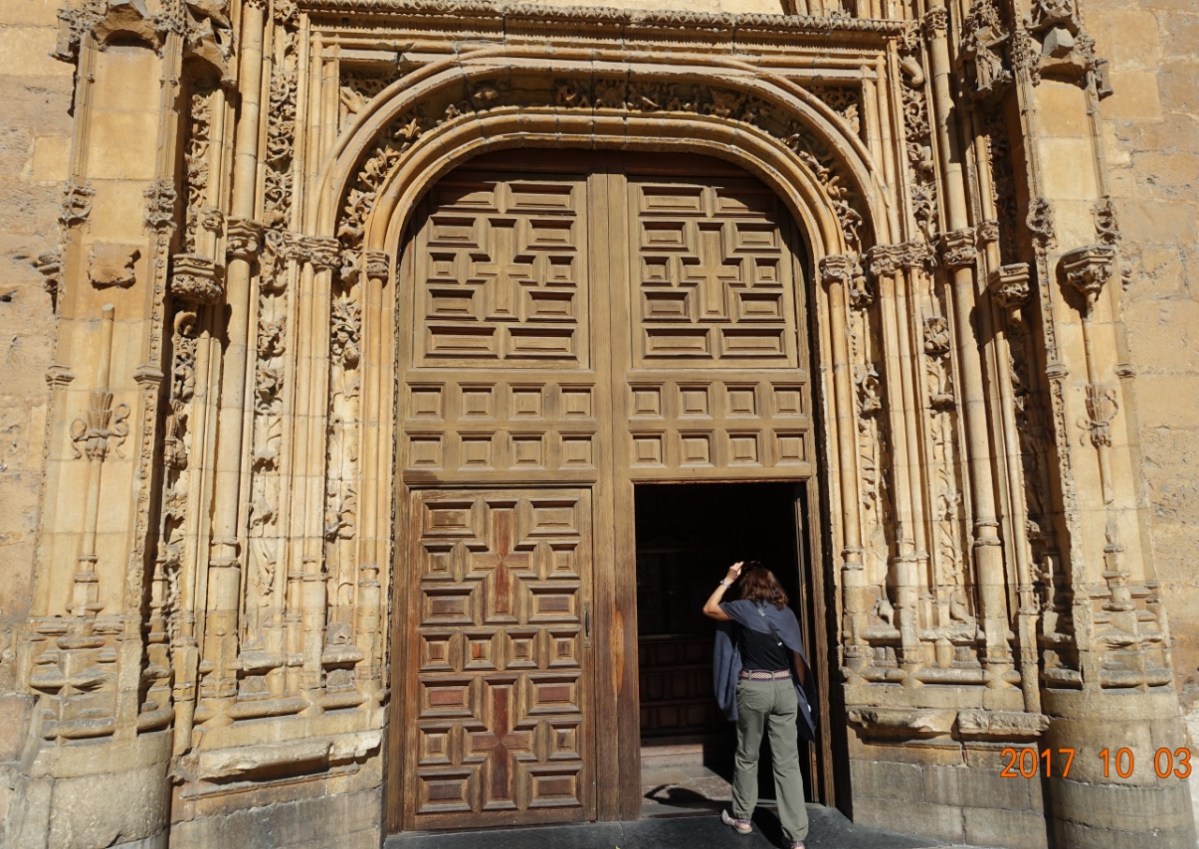
Detail of the entrance of the Bascilica (that is Julie going in the door).
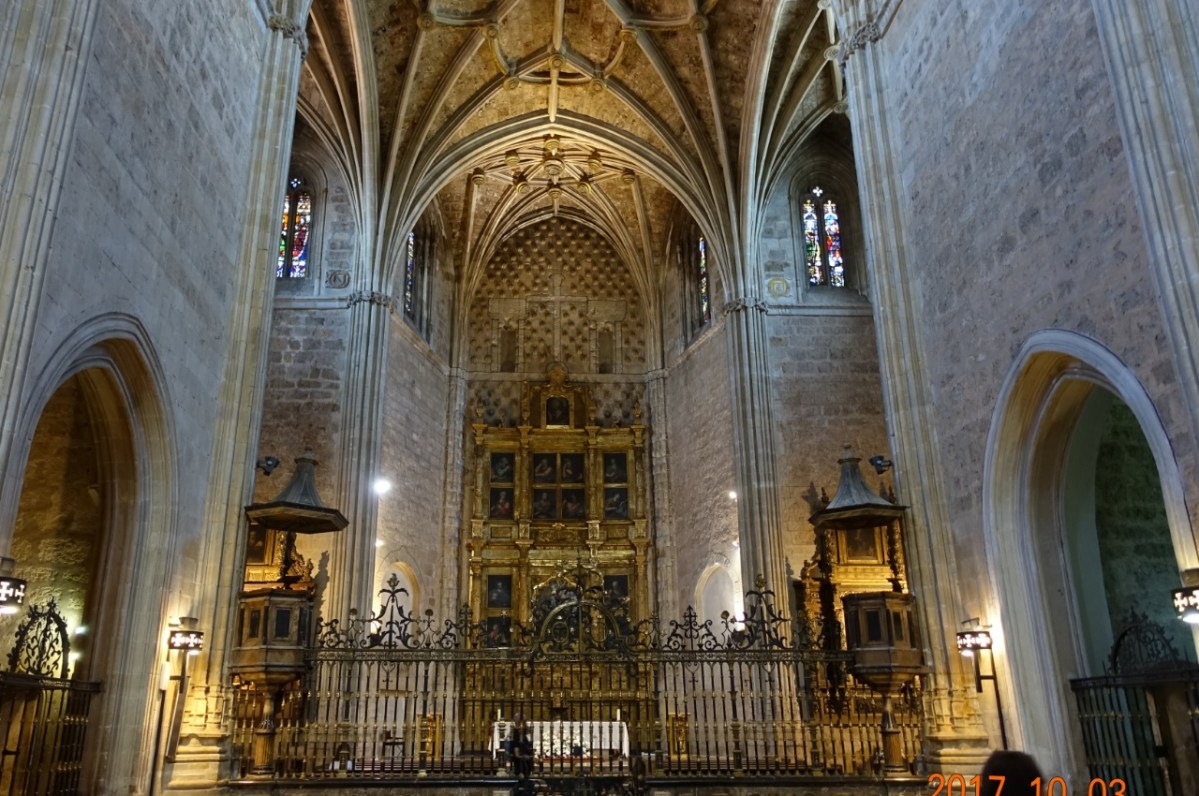
Inside, the church is large and elegant.
Going through to the museum, there were countless items of historic significance, and I photographed a few.

I am not sure who this is, as there was just too much information to remember everything, but I love the expression and the intensity of the figure.
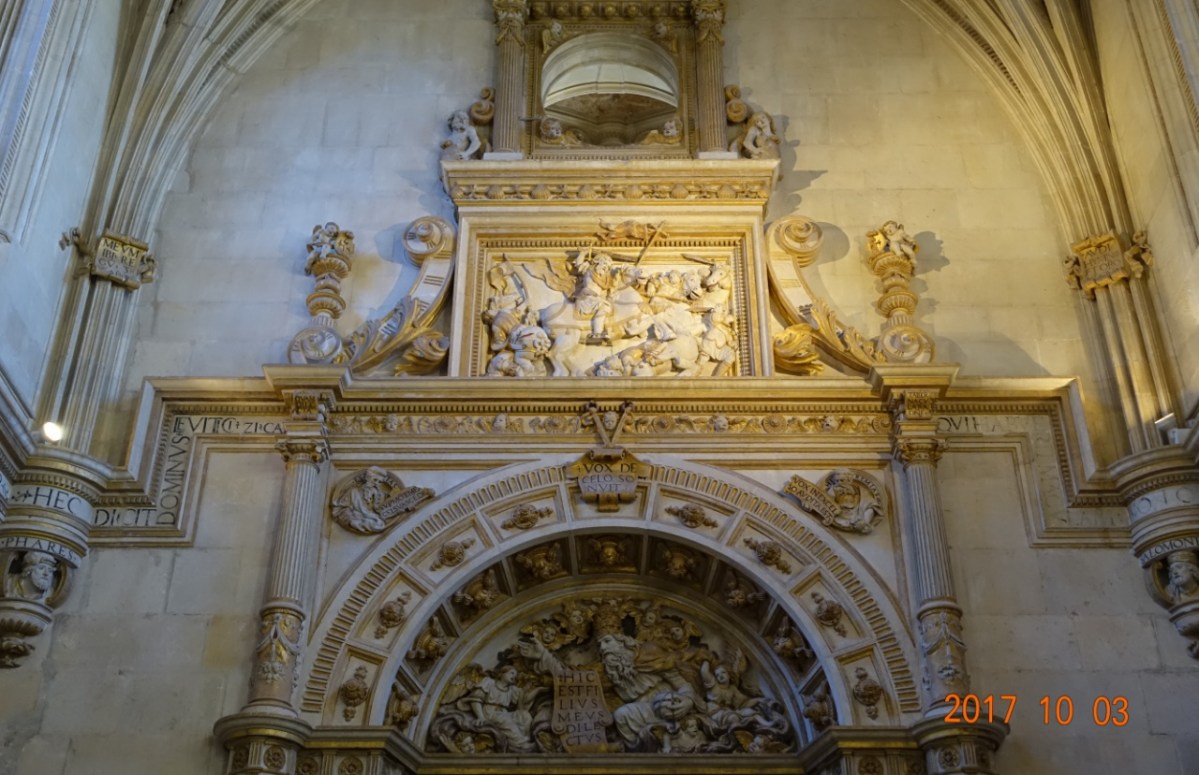
Detail of one of the walls in one of the rooms in the museum. Everything is detailed, meticulously crafted, and symbolic. This large building was once a large monastery, and is now a church (basilica), museum, part monestary, and a very upscale hotel.
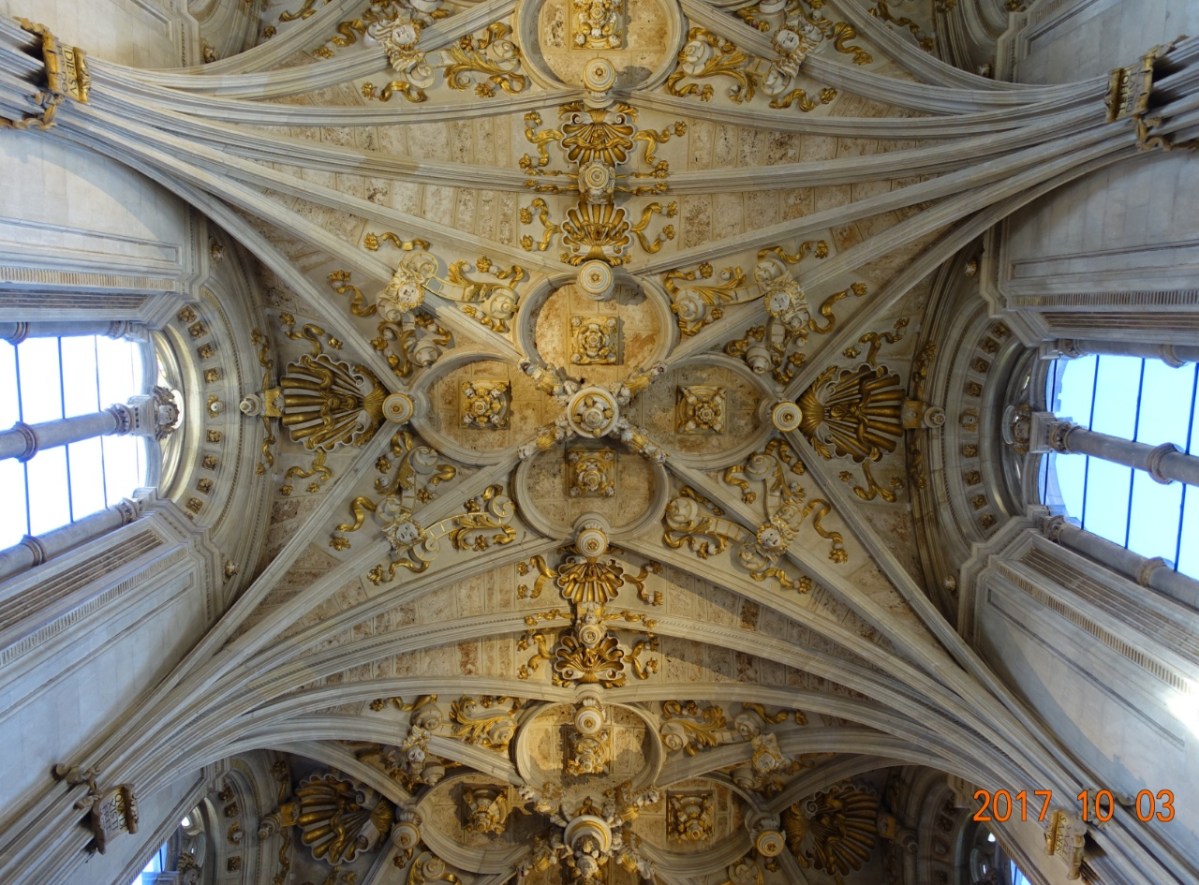
Even the ceiling is detailed and crafted meticulously. It would have been interesting to have seen this or many of the other historic cathedrals as they were under construction.

And inside the building is this beautiful cloisters at the Basilica de San Isidora.
In León there is a connection to the Spanish architect Antoni Gaudi. There are a few buildings designed by Gaudi, and a Gaudi Museum. Here I am sitting next to a statue of Gaudi near the Gaudi Museum:
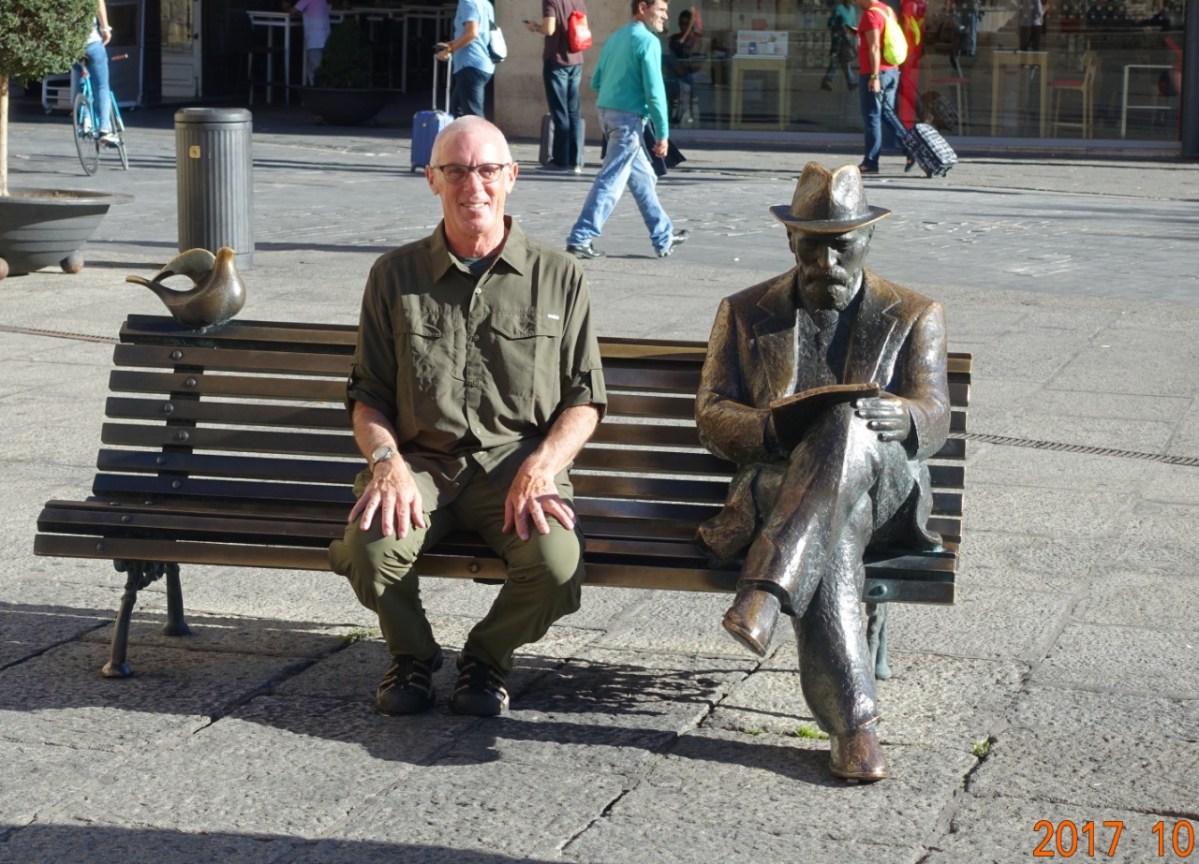
Gaudi looks more focussed on his notes than on being in the picture.
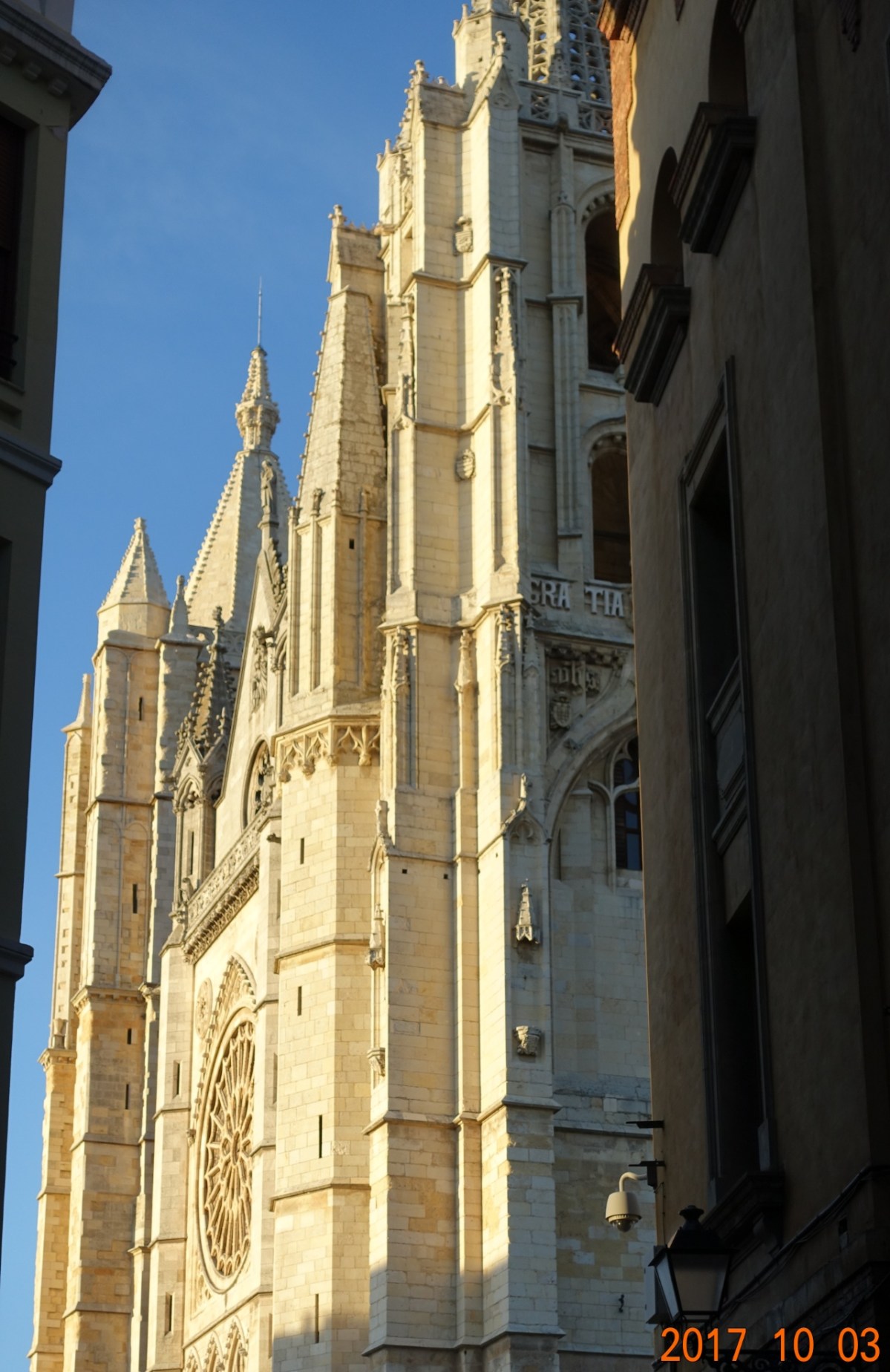
As I said earlier, the most significant landmark in León is the Cathedral – no wonder, it is an amazing building with a large number of large, brilliantly colored stained glass windows. As Tom, Julie, and I walked through part of the old city on a quest for dinner, this view of the cathedral appeared down the small street through which we were passing:
As we sat for an outside dinner, we had a view of the south side of the cathedral:
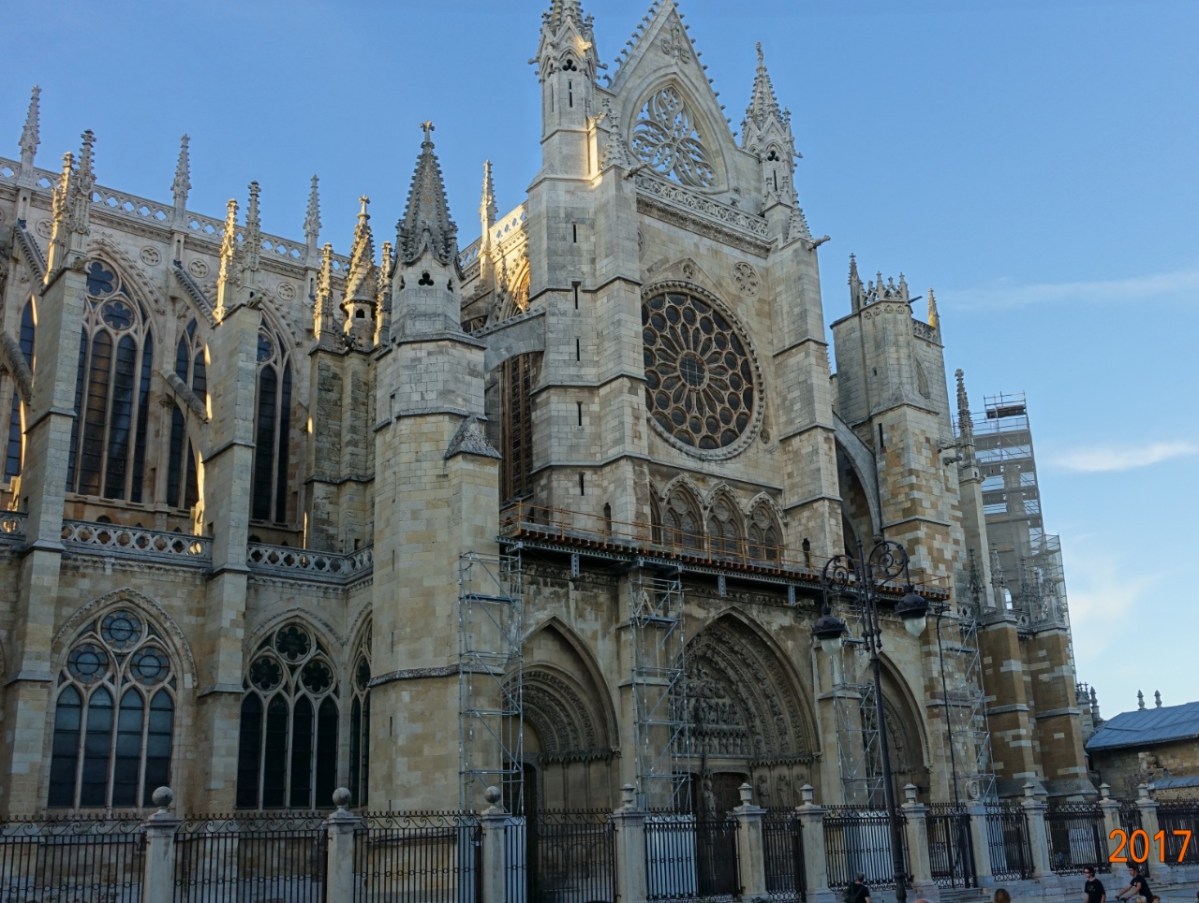
A stunning structure. And after dinner we said goodnight and made plans to resume walking on the Camino de Santiago tomorrow morning.
After leaving the old part of the city, we again found ourselves in front of the Basilica de San Isodora. Here are Tom’s and Julie’s backs in front of the Basilica:
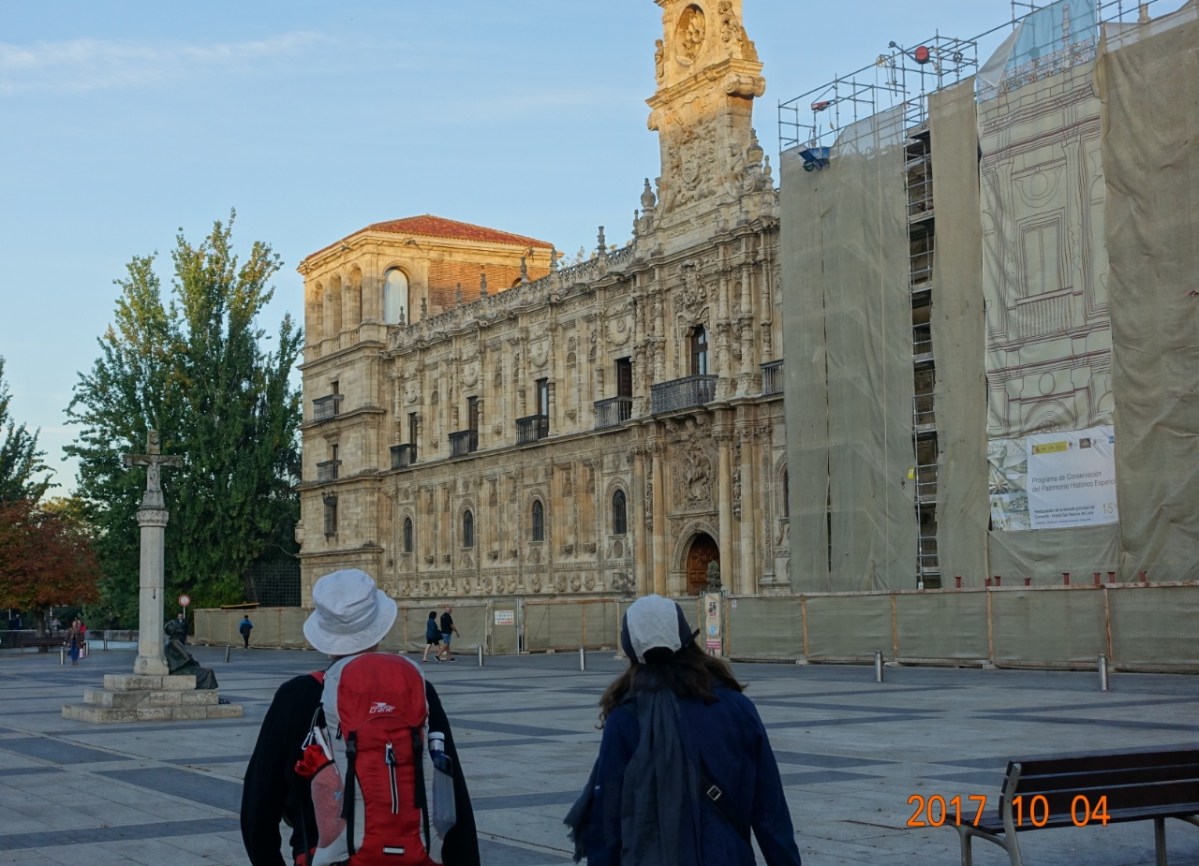
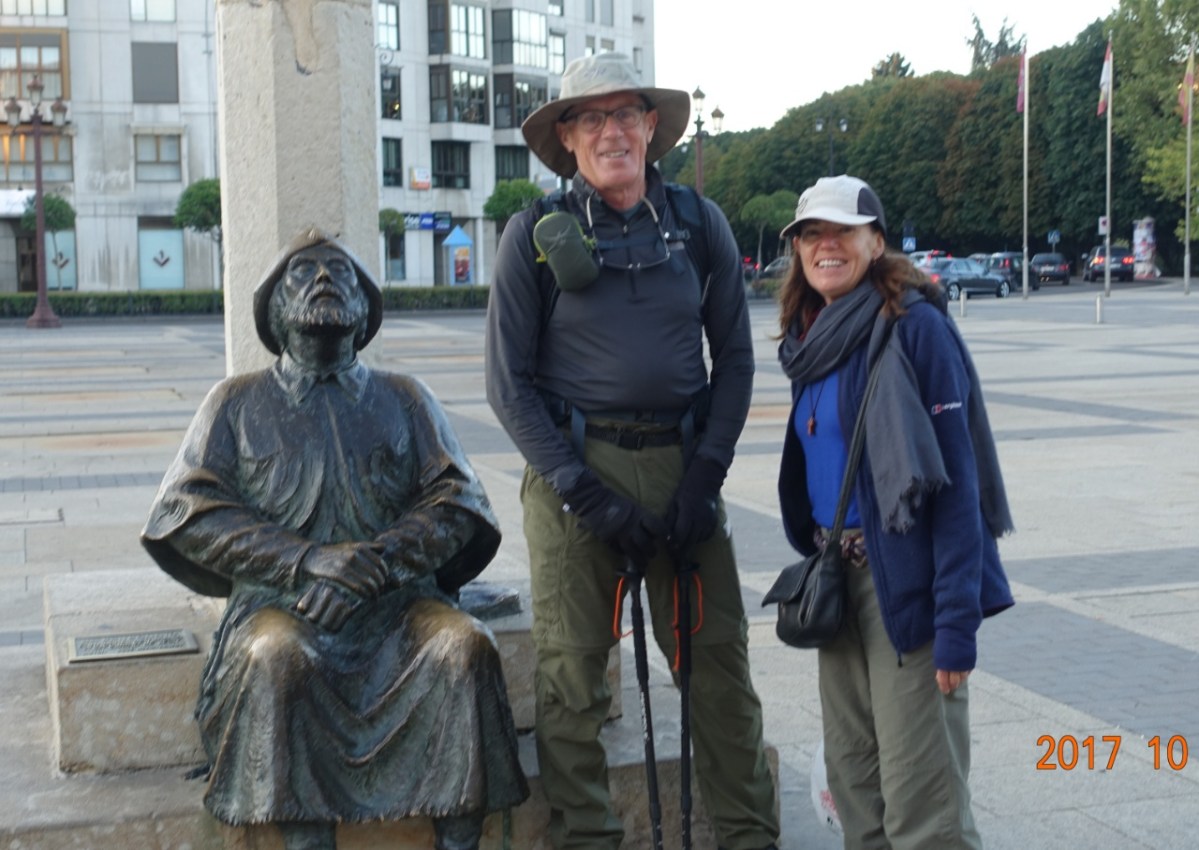
There was this interesting sculpture, looks too old to be another of Gaudi. Tom took our picture getting psyched to make the long walk out of the city.
The long walk through the city streets started and seemed to take much longer than I remember.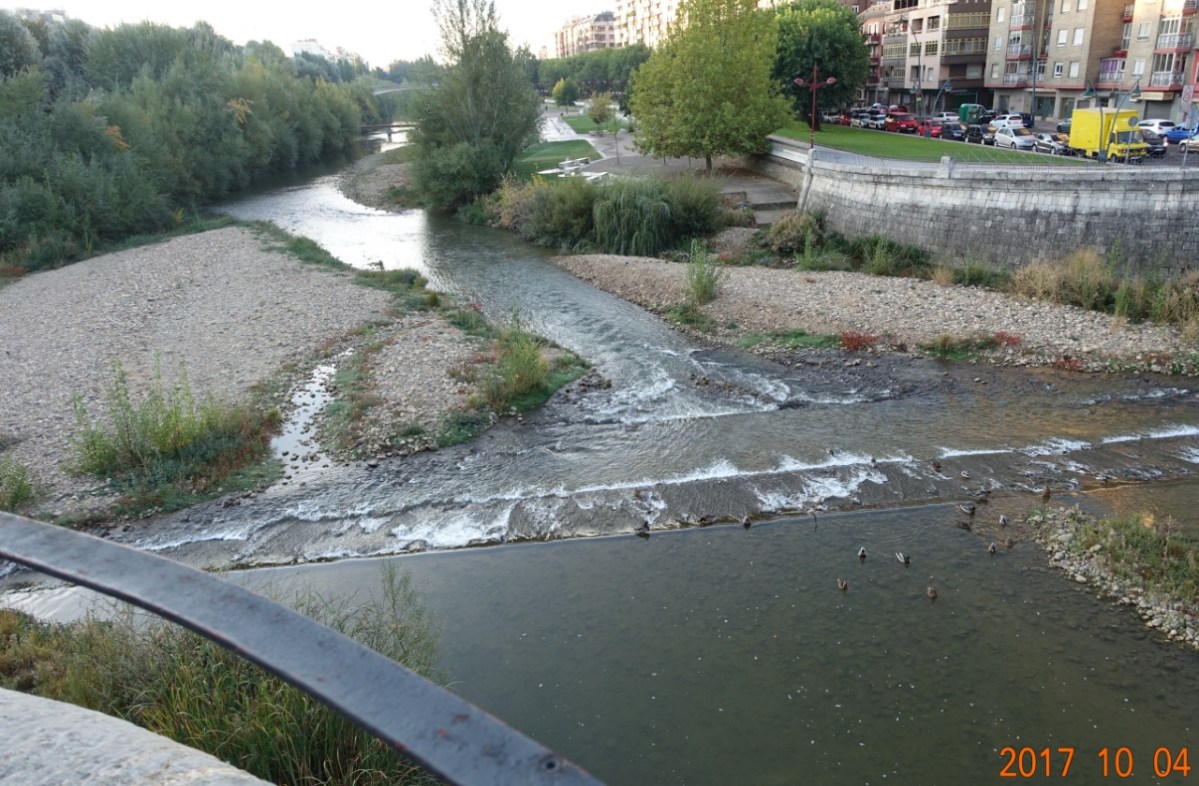
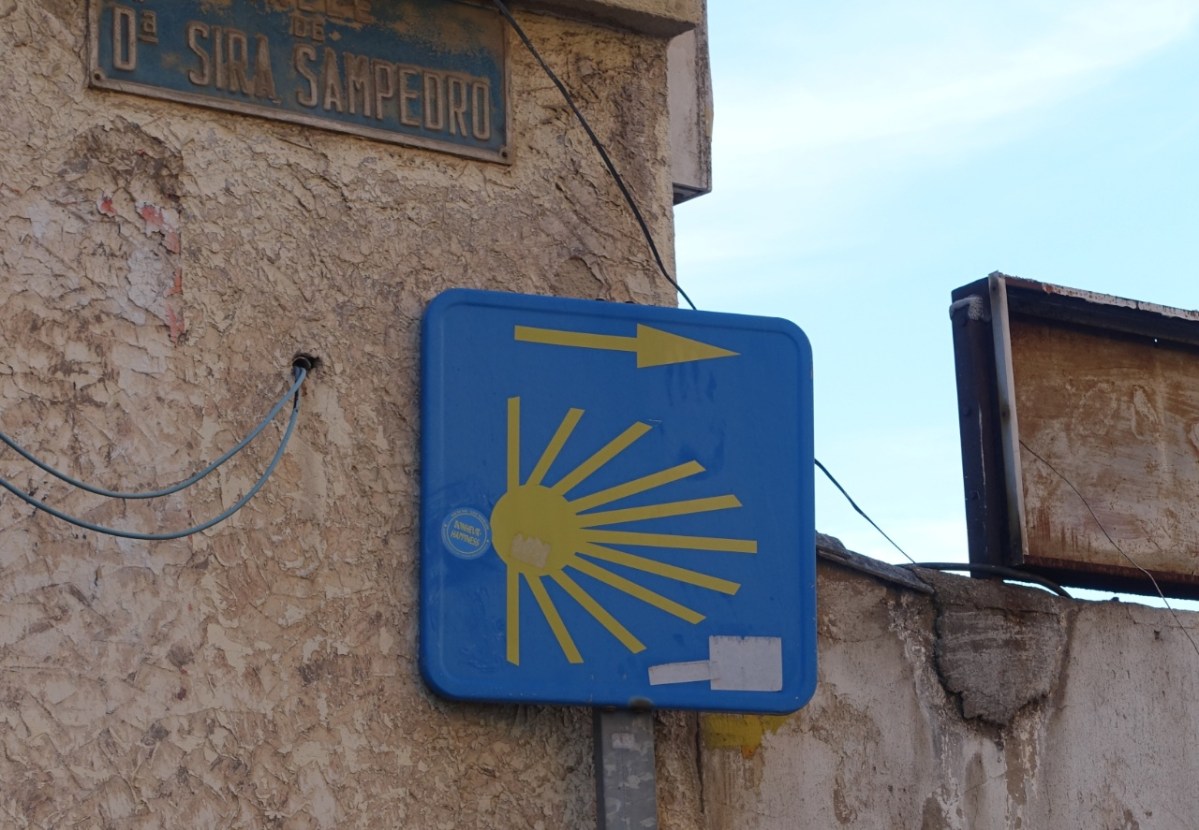
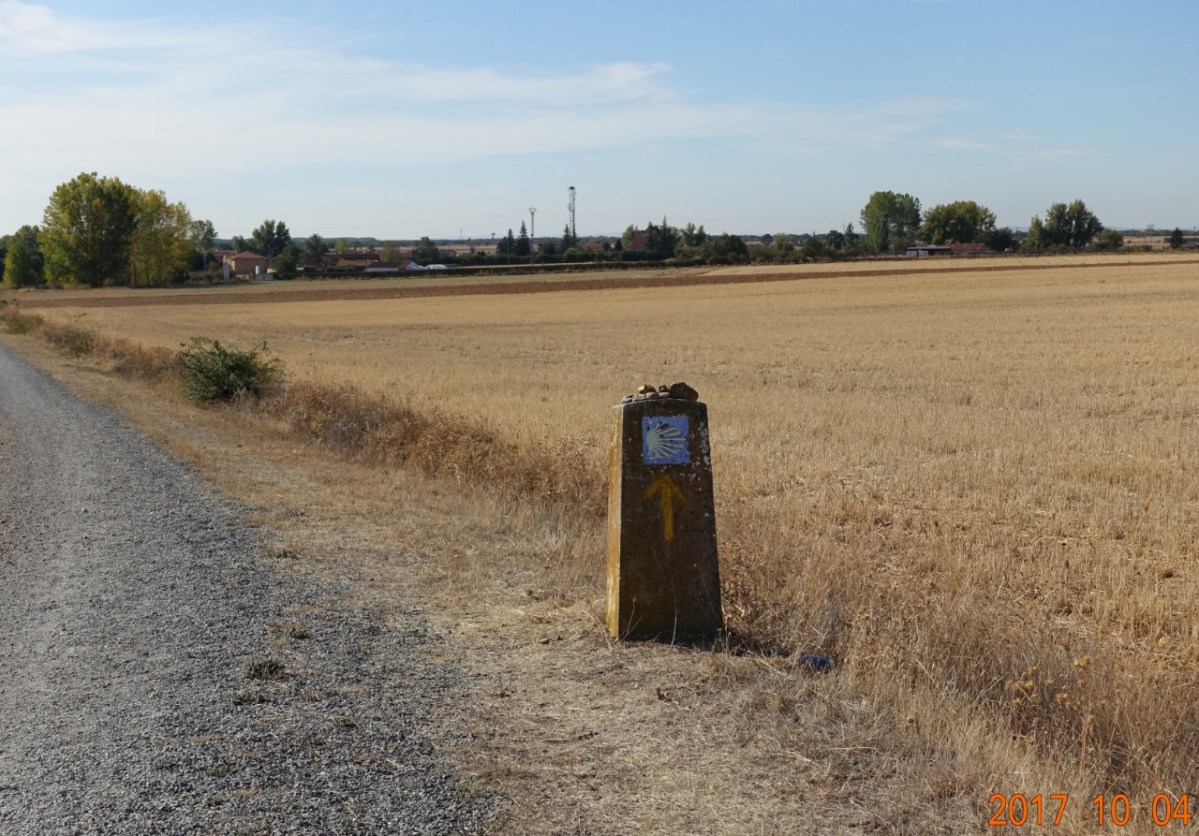
We crossed over the river and out of the main city, into the seemingly never ending suburbs. I noticed this way marker sign. with the shell graphic in the wrong direction (the point at which the lines converge is to represent Santiago, and the lines all of the many routes that can be taken to get to Santiago, so as a directional symbol, you go in the direction of the line convergence). When there are both the graphic and an arrow, it is safest to follow the arrow.
León is a symbolic end of the meseta, the long, rolling, repetitive plains of north-central Spain. We have been walking on the meseta for over a week. It is good time on the pilgrimage to think, meditate, contemplate, and then do more thinking, meditating, and contemplating. While on the meseta, it is fairly common to walk with others for long periods in silence, as you and the other person or people are contemplative.
The landscape changes gradually from the rolling farmland and wheat fields we have been seeing to more small trees in the undeveloped fields.
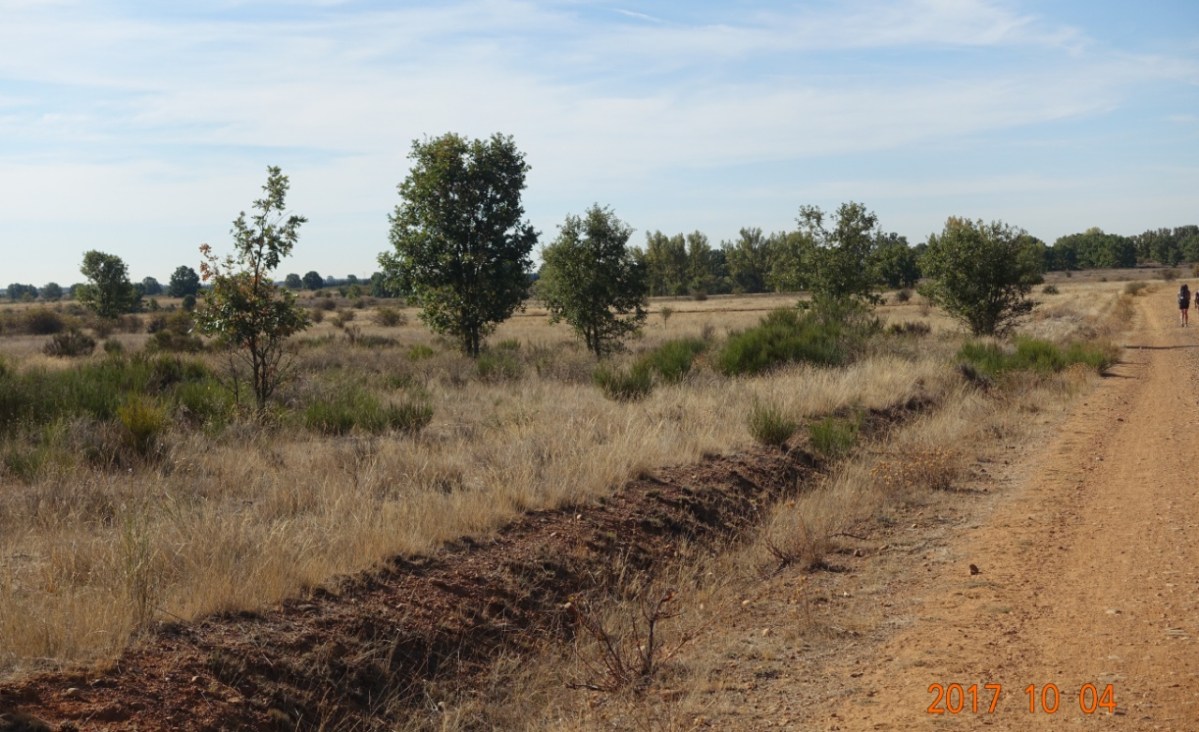
And there are some beautiful trees along the way, not forest, but some almost majestic trees in the fields.
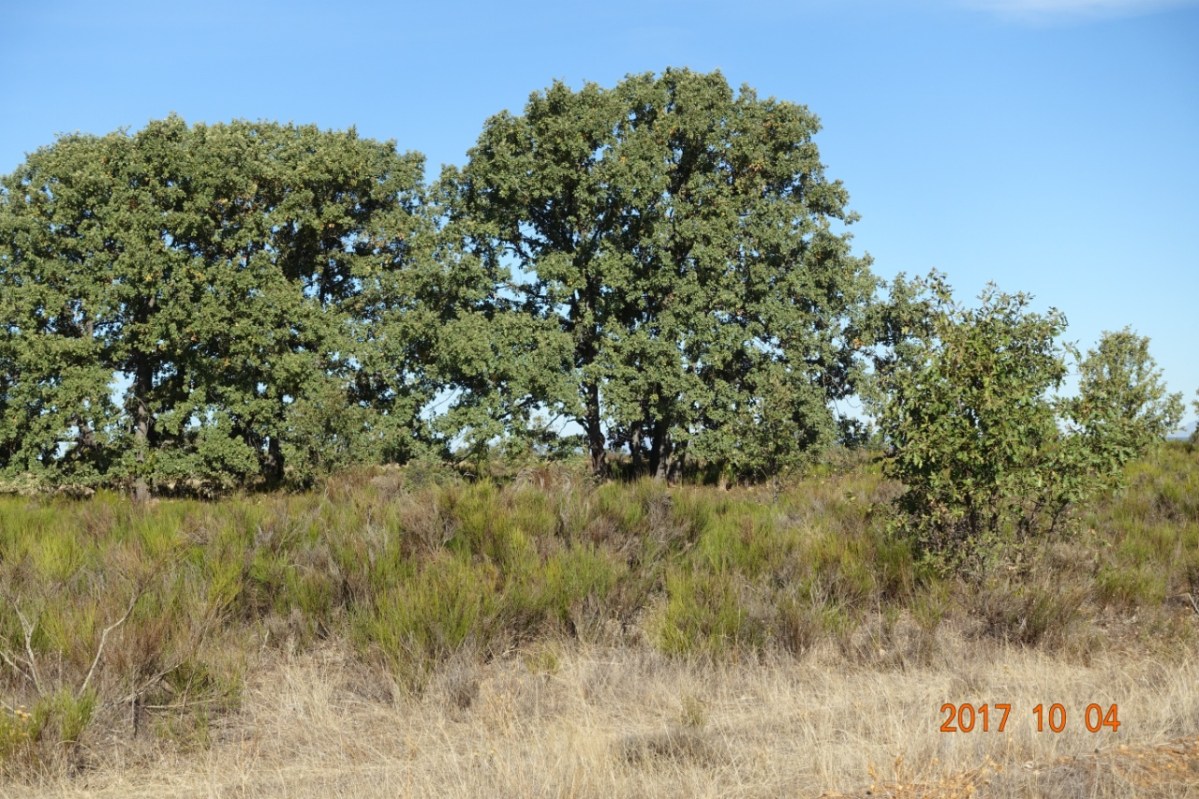
Then we drift back into rolling farmland, much like the meseta we have become used to. There are a few more trees and brush, so the change is evident.
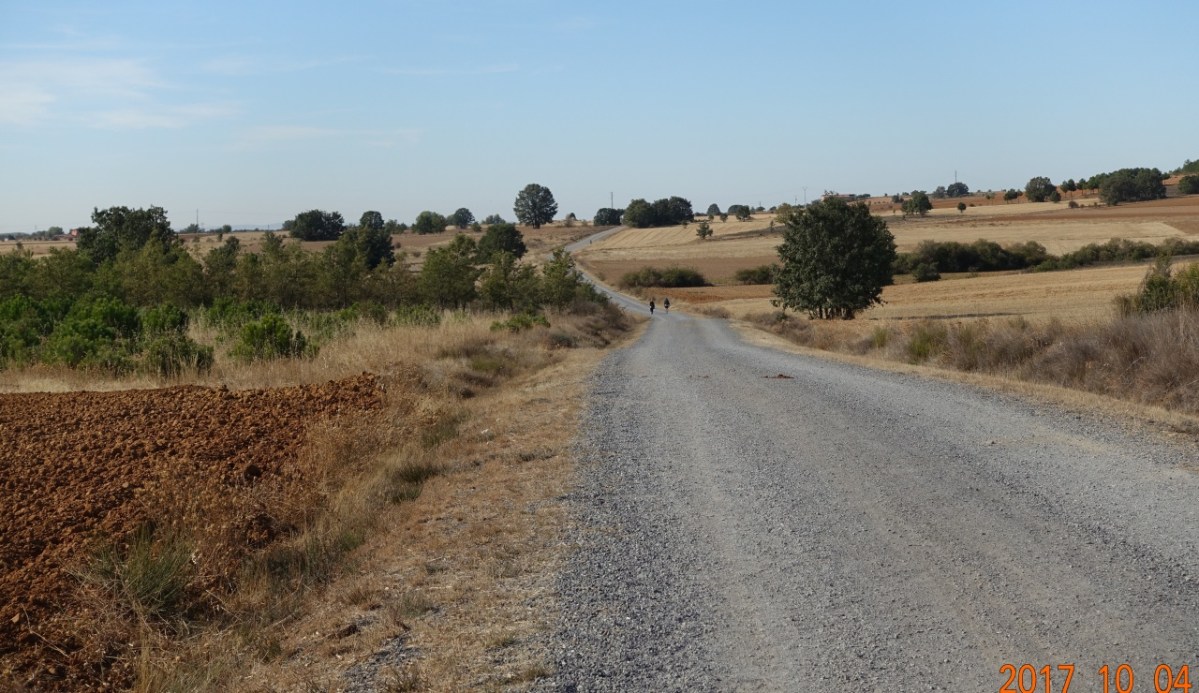
At times, it seems like the meseta has returned. We know we are on the right road by the monument way marker, but the view for a short time is that we have been seeing over the last week.
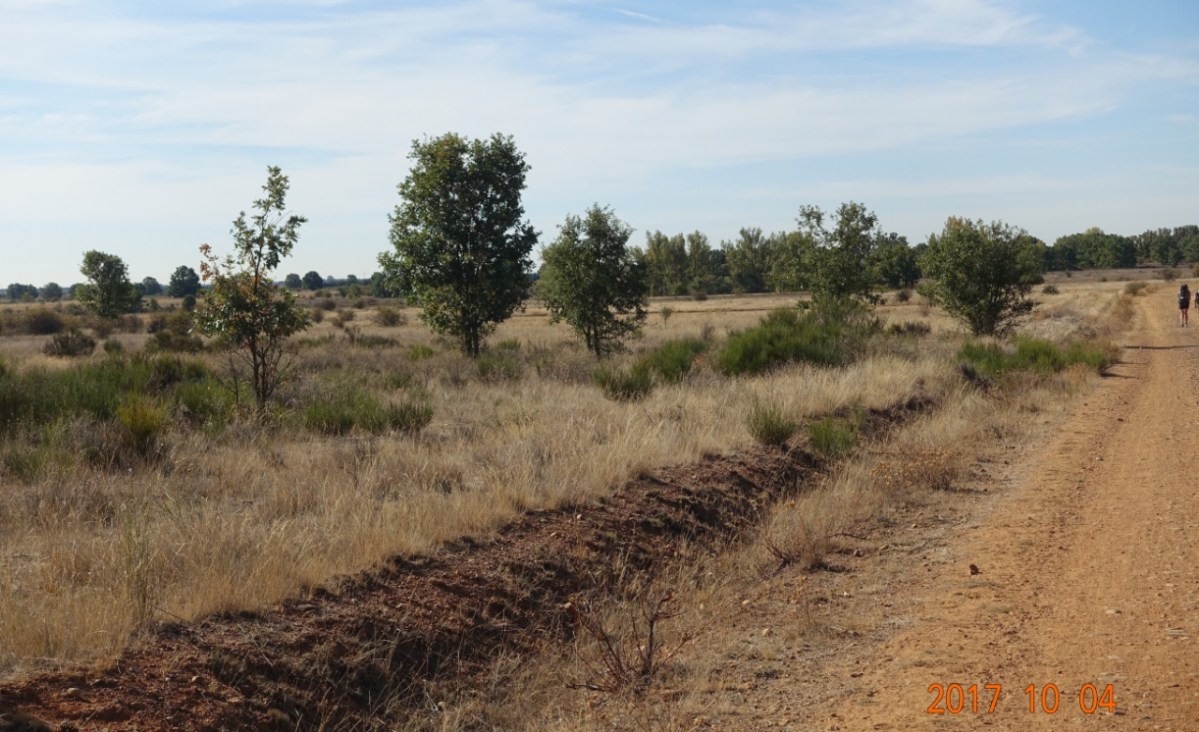
Then the landscape changes again, and the road just keeps going.
At the little town of Villavante, Tom and Julie are staying in an albergue with private rooms and private bathrooms. I leave them, continue through the small town, cross a bridge over the railroad, then as the path turns to go along the rail line, I see a sign for Molino Galoches, a little farmhouse B&B where I have a reservation for the night.
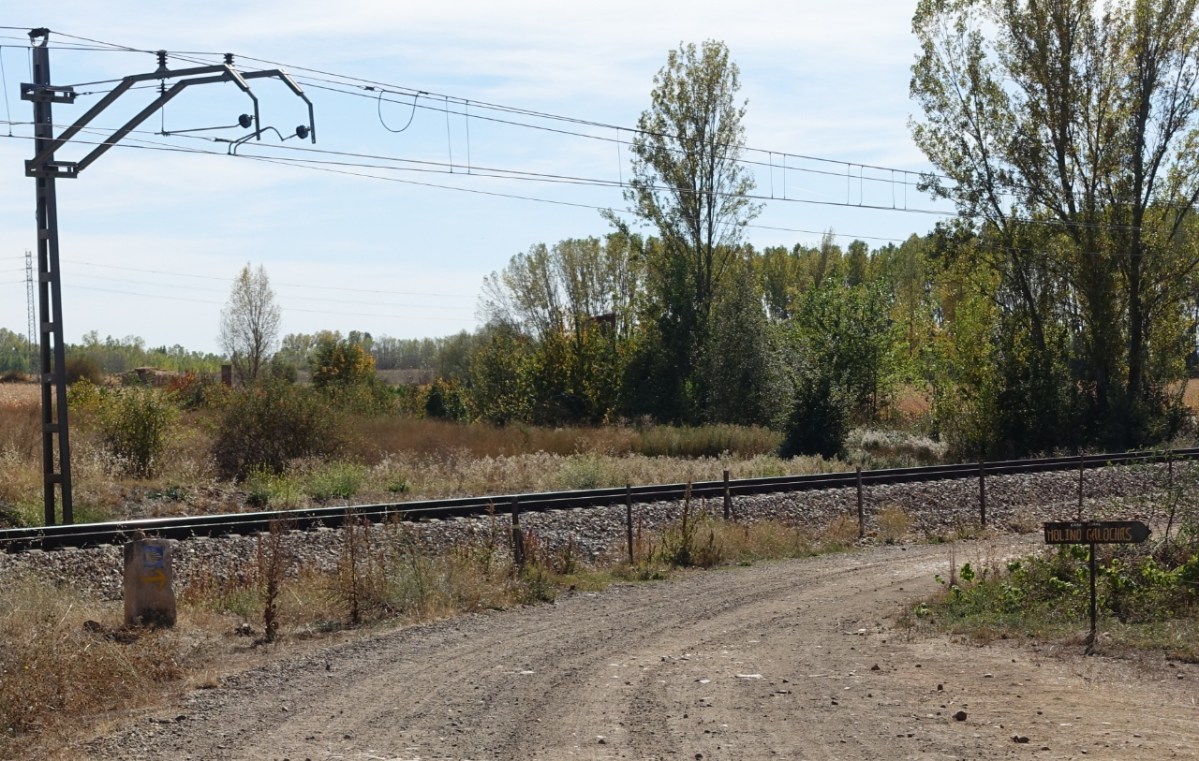
I follow the sign on the right, walk up the long driveway, and I am at Molino Galoches, a bit of an oasis.
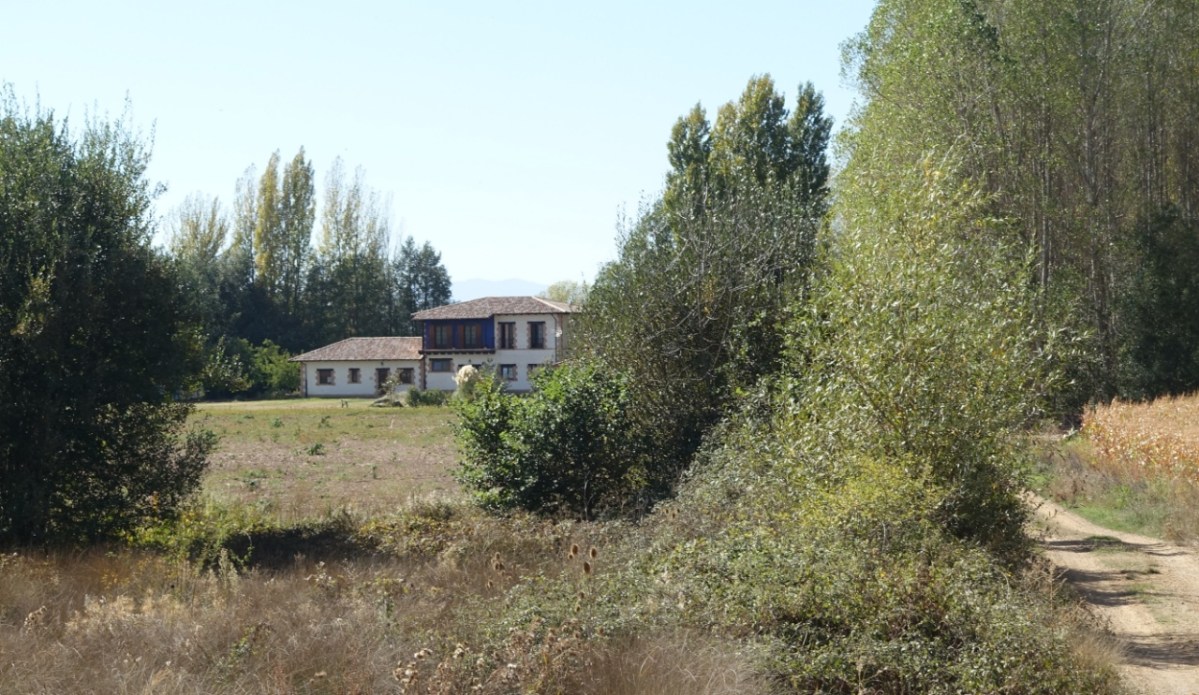
Molino Galoches is run by Mercedes and her husband Massimo, and they are warm hosts. They only have space for about 8-10 guests, so it is an intimate gathering with a group dinner. I was here last spring and met some people with whom I walked for a couple of weeks off and on. Today Mercedes has only five guests – and she considers this a night off as she has been completely full every day for a few weeks.
Next: On to Astorga on a shorter day of 18 kilometers.

 James the Intrepid Pilgrim