Walking Day 1:
Saint Jean Pied de Port, France to Roncesvalles, Spain
25 kilometers 36,044 Steps
Today was the first day walking the Camino de Santiago in autumn 2017. The route is over the Pyrenees mountains from Saint Jean Pied de Port in southwestern France (elevation 200 meters, 600 feet) up and over the Pyrenees (high point elevation 1450 meters, 4800 feet) and then down to Roncesvalles in Spain at 1000 meters elevation, 3300 feet. This is a very difficult walking day covering 20 kilometers of unrelenting uphills and over 5 kilometers of downhill, steep at times.
My fitbit recorded 36,044 steps by the time I got to my hotel in Roncesvalles. Roncesvalles is basically a hotel, two hostels, a church, and a bar/cafe.
Leaving Saint Jean Pied de Port, one goes through the old city.

Saint Jean is a very old city, and a good number of people were up and about as I left the city for my trek over the mountains. The first 8 km (5 miles) is very steep. Tom’s hotel was on the outside of town, about a walk of 1.5 km for me, almost all uphill. Although walking fairly slowly, we did pass a few people, and soon we were up in the hills, looking down at the valley from which we started. The views were stunningly beautiful all around except ahead where we could see the road going uphill unrelentlessly.

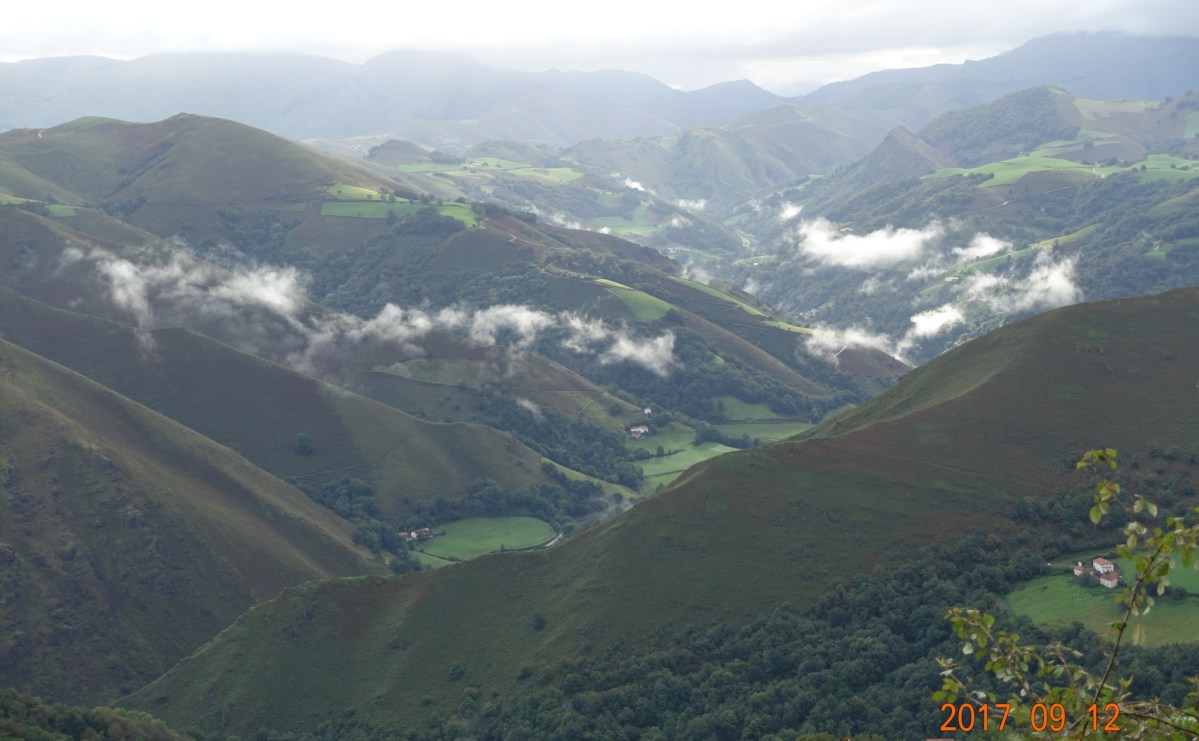
We continued up the hill, finally arriving at Orisson, a small hamlet 8 kilometers (5 miles) from Saint Jean with two albergues (hostels) and a cafe. This is last place to get food before crossing over the mountain and down to Roncesvalles. Tom and I had already packed food for the day’s climb. Orisson also marks the end of the steepest part of the climb, although the rest of the climb up is not easy – it was much harder than I remembered, and I remembered it as one of the most difficult days of physical exertion of my life. At Orisson, the view is spectacular:
We took a short rest. I had thoroughly broken in my hiking boots, and was surprised to feel a blister developing. I had packed band-aids and taped up the blister. Then we continued the climb, up hill, up hill, and at each turn, more up hill. The views were spectacular, and a light rain started.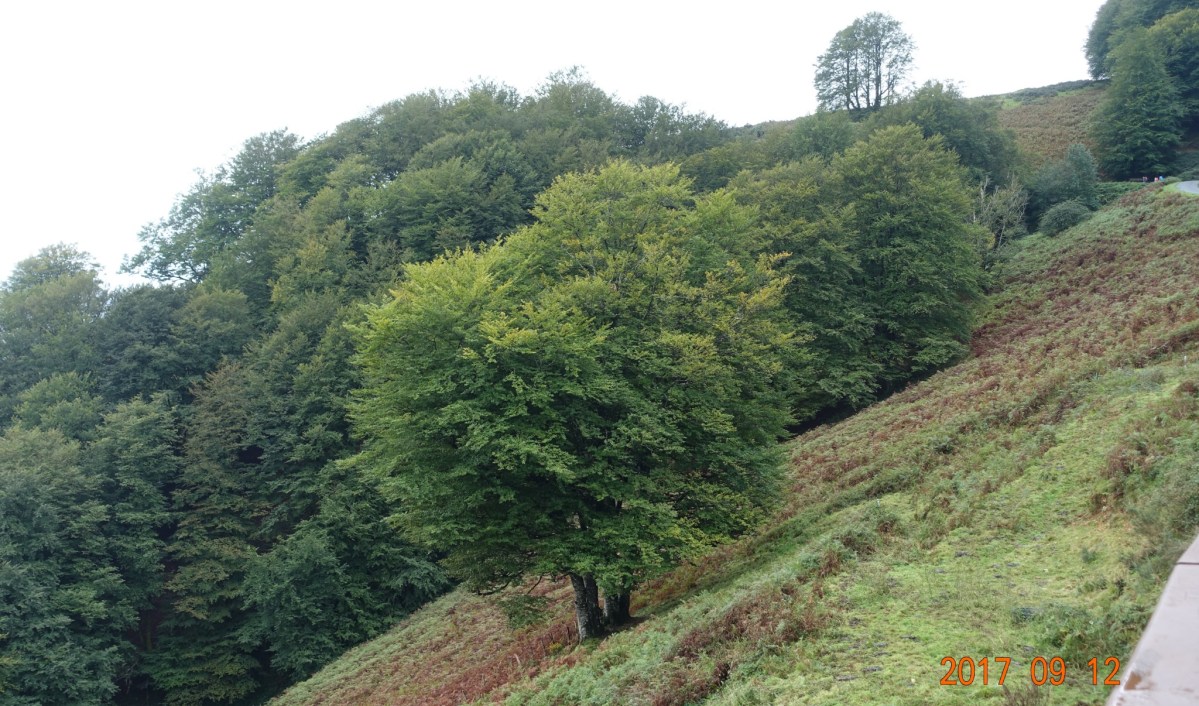
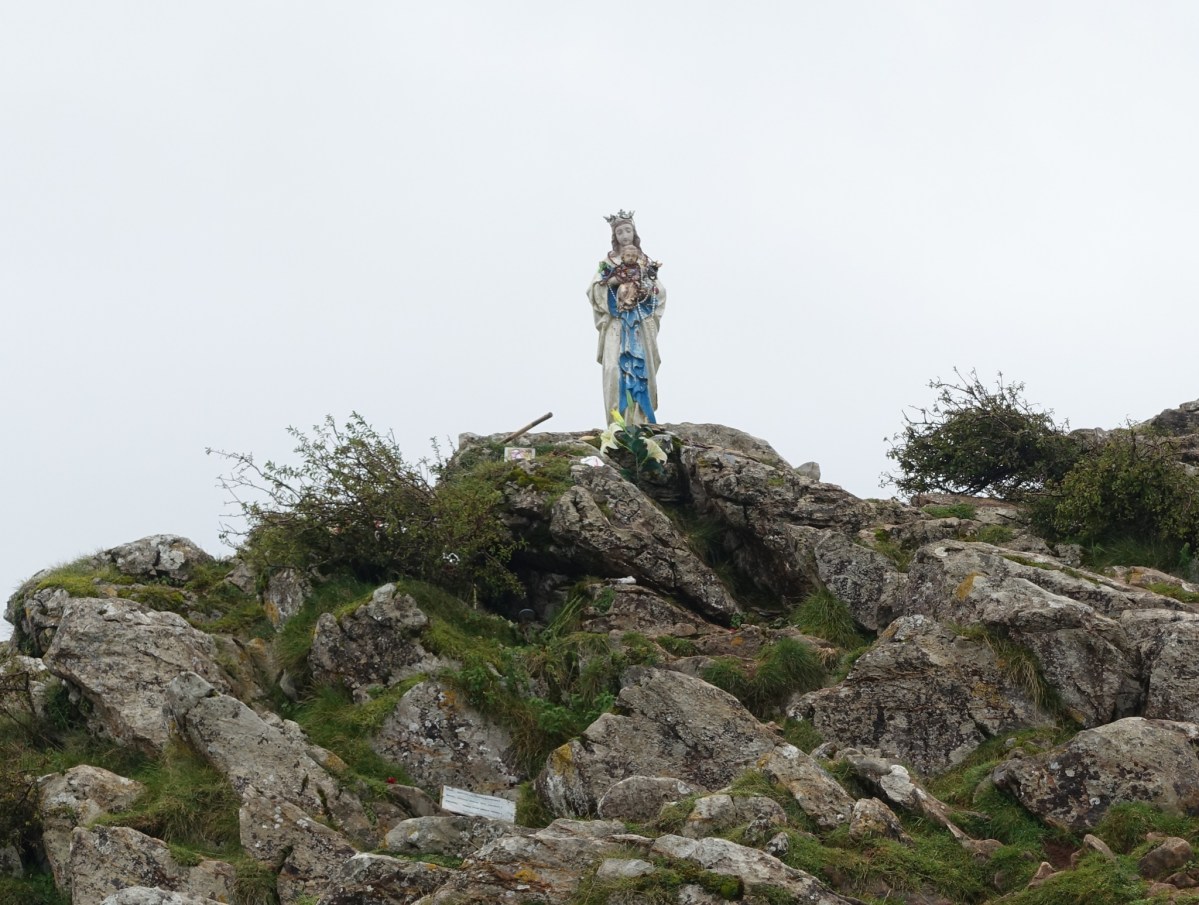
We got to what is often thought of as the highest point of the day in France (after crossing the border, there is more uphill in Spain). This may not be the actual high point, but it is where the Vierge d’Orisson, a statue of the Virgin Mary keeps silent vigil over the valley vistas. The statue was brought here from Lourdes by local shepherds. This is also the place where I met Philippe and Mary-Pierre from Paris last spring. We have remained in contact, and I am hoping to see them on my travel home as I stay a night in Paris.
Here is yours truly and Tom each by a marker near the statue.


And here is the statue, difficult to get close:
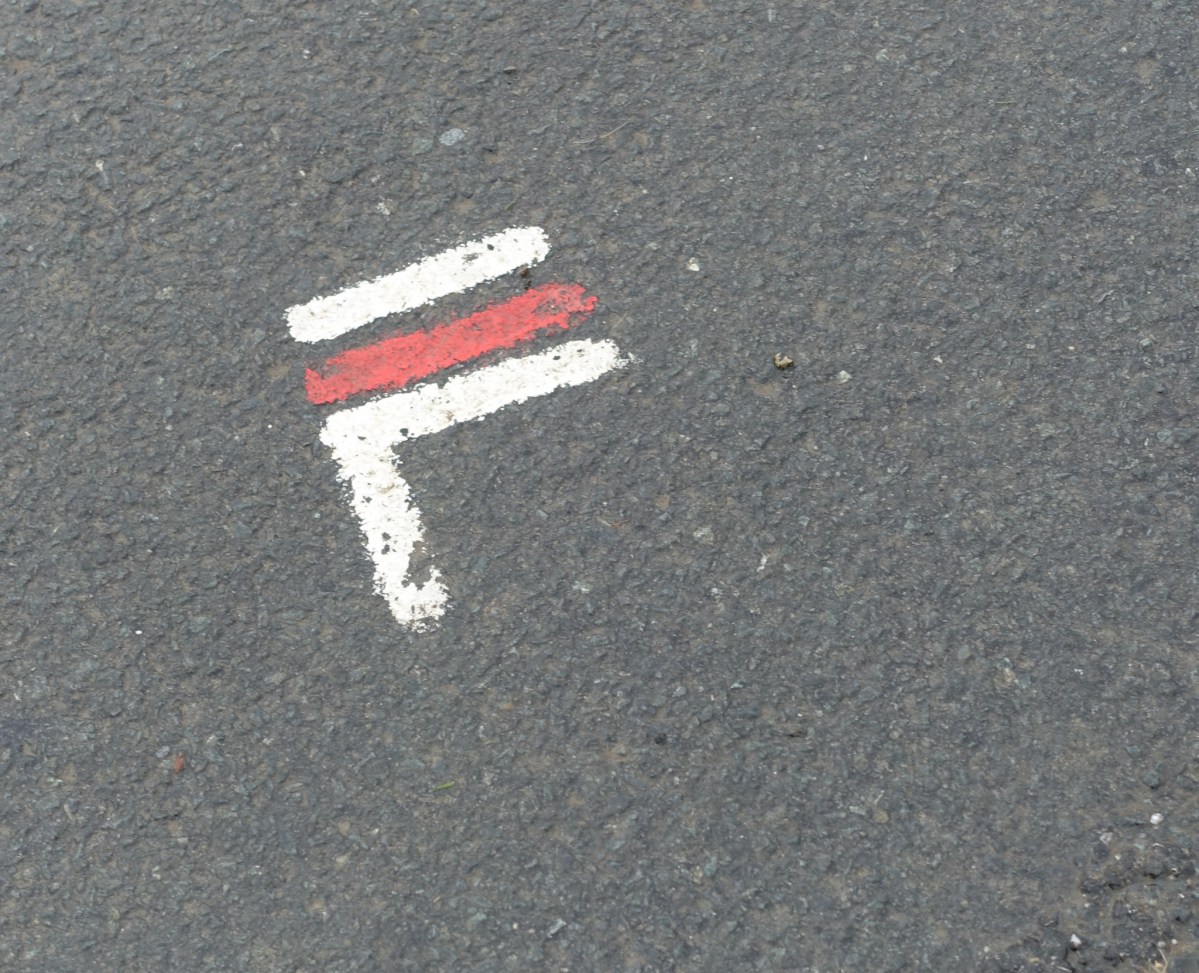
In France, the Camino de Santiago is called the Chemin de Saint Jacque, and marked with red and white bars instead of the familiar yellow shell graphic on blue background or yellow arrows in Spain. Here is a French marker indicating a right turn:
We continued up the hill, past a sort-of food truck called “the last stamp” where you can get a stamp in your credential, the last in France. Of course, I got the stamp along with a banana. We continued on (and it seemed more uphill) to the French/Spanish border. It is just a gate in the path, little fanfare. Just after crossing the border this monument announced that we are in the Navarra region of Spain.
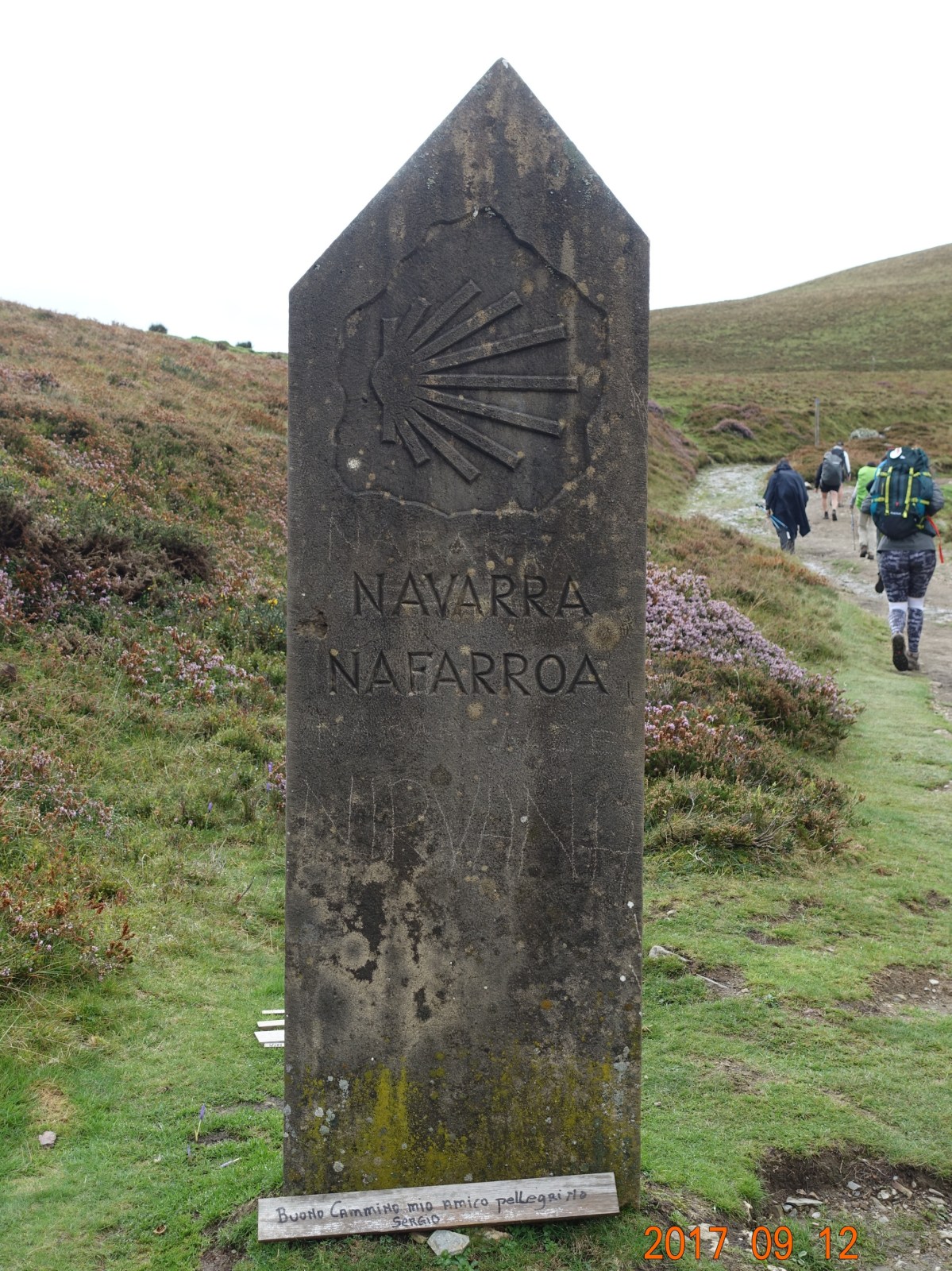
I presume Nararroa is the Basque translation of Navarra.
Once over the highest point and descending in Roncesvalles, the landscape changes, likely because of the wind and maybe the west side getting less rain.
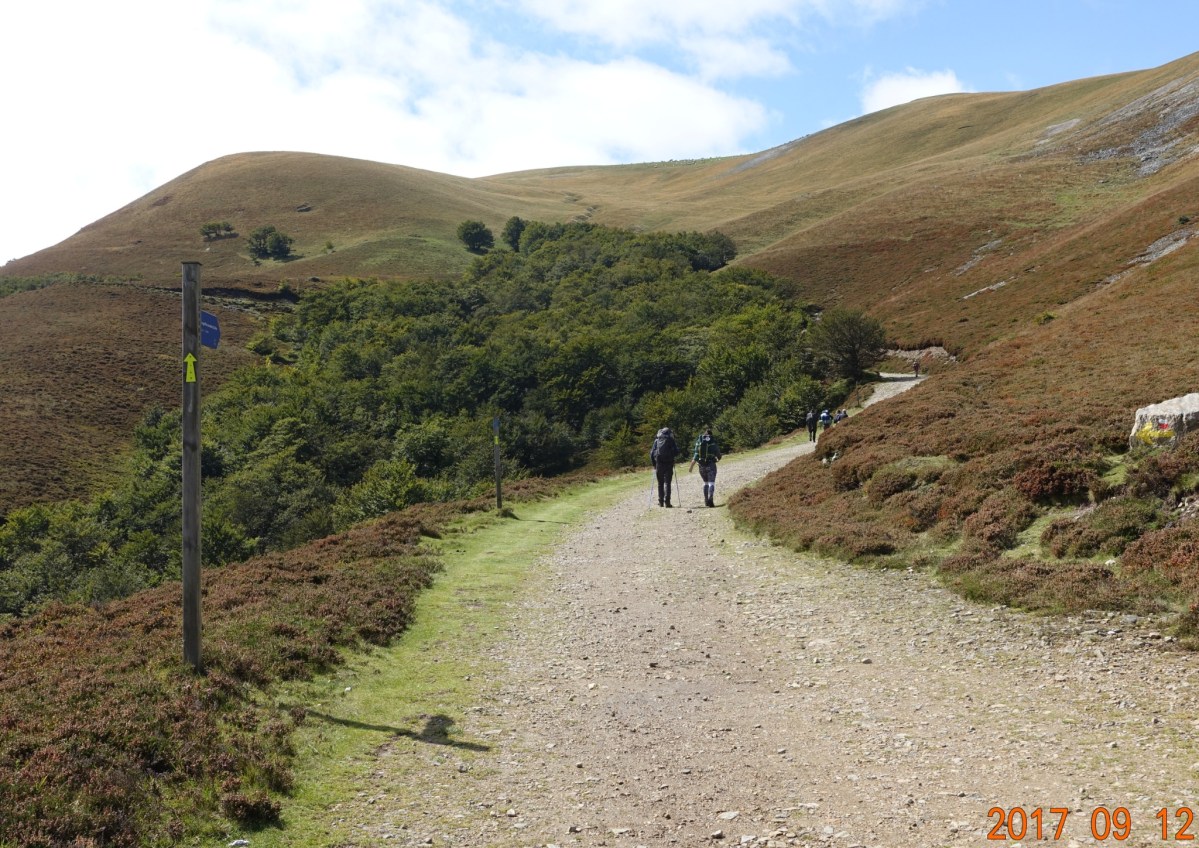
Finally, after just over 36,000 steps on my Fitbit, I made it to Roncesvalles and my hotel, right by the church and the two very large hostels.
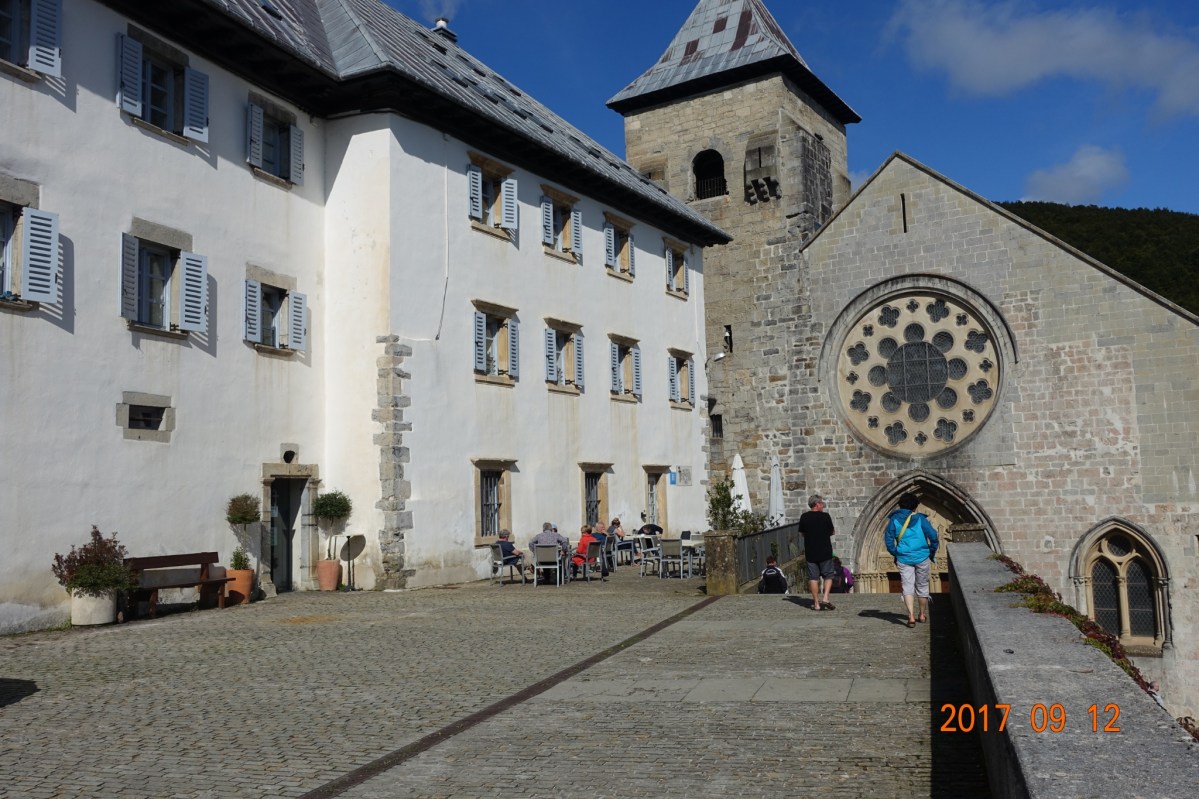
Tom and I were in separate accommodations, and had separate dinners, but met at the church for the pilgrim’s mass and pilgrim’s blessing at 8 PM. Today was long and very, very tiring. I did not remember it as being as difficult as I found it to be. This year, because of Philippe and Marie-Pierre teaching me how to use my hiking poles properly, my knees fared much better. They are sore, but nowhere near as sore as last year. My legs hips are tired and will likely be sore tomorrow. I am exhausted, and sleep is calling.
This was a very difficult day, both physically and emotionally. As I wrote a few days ago, one of my motivations was to discover my true motivation for returning to the Camino. There were more than a few times today that my mood and psyche darkened and I was wondering why I am here, why am I subjecting myself to this very difficult physical challenge. I reflected again on my thoughts and the questions a year ago on this very day in the Pyrenees – am I truly wanting to do this 555-mile walk, am I really up for this, should I stop now and just give up? There were several times when I was starting to contemplate how I could quit and go home. But I also thought of the quote by Sir Edmund Hillary, the first person to reach the peak of Mount Everest in 1954: I is not the mountain that we conquer but ourselves. Conquering the mind – that is the goal. I am not there yet, and I am hoping I get there. I am tired, I am not sure I can do this, and there is another very difficult, but beautiful day ahead.
Next: very gradual uphill and downhill Roncesvalles to Zubiri

 James the Intrepid Pilgrim